Description
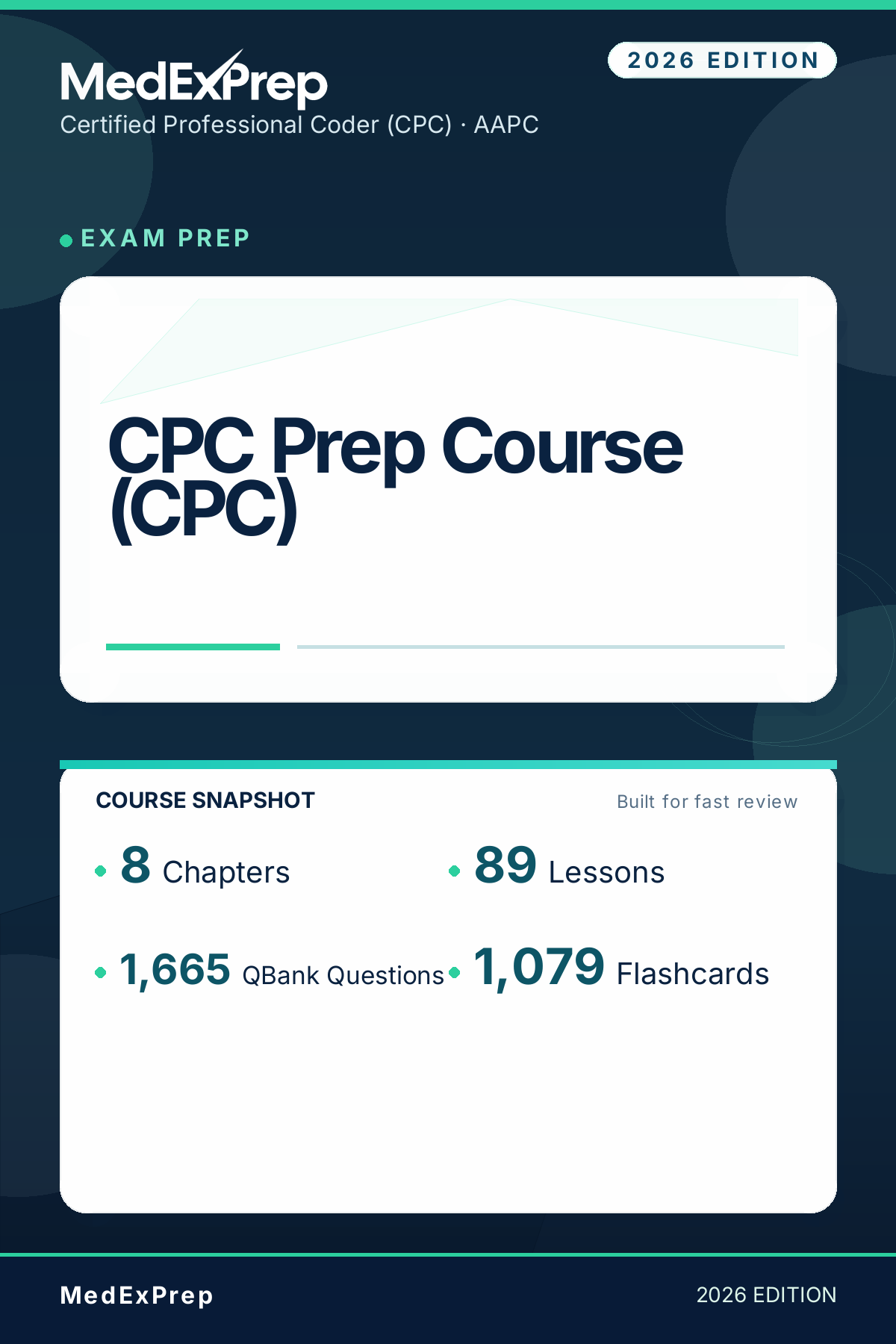
CPC Prep Course (CPC)
CPC candidates preparing for the AAPC Certified Professional Coder (CPC) exam, including entry-level medical coders, billing specialists, healthcare administrative professionals, and learners transitioning into physician-based coding roles. Key goals: By the end of this course, learners will be able to:; Explain the major CPC competency areas and how they connect to physician-based/outpatient coding tasks, using only publicly documented exam information and learner-safe mappings when official blueprint wording is broad..
Exam: Certified Professional Coder (CPC) · Organization: AAPC
Includes: Lessons + Flashcards + QBank
Audience: CPC candidates preparing for the AAPC Certified Professional Coder (CPC) exam, including entry-level medical coders, billing specialists, healthcare administrative professionals, and learners transitioning into physician-based coding roles.
Goals:
- By the end of this course, learners will be able to:
- Explain the major CPC competency areas and how they connect to physician-based/outpatient coding tasks, using only publicly documented exam information and learner-safe mappings when official blueprint wording is broad.
- Master high-yield concepts, definitions, conventions, and code-selection rules across medical terminology, anatomy, ICD-10-CM, CPT®, HCPCS Level II, modifiers, documentation interpretation, and compliance-aware coding.
- Apply a consistent coding workflow in realistic exam-style scenarios: identify the encounter/service → extract key documentation facts → determine the relevant code set and section → apply conventions, parenthetical notes, and guidelines → assign modifiers and sequencing → verify completeness and support.
- Navigate CPT®, ICD-10-CM, and HCPCS Level II codebooks efficiently, including index-to-tabular verification, note interpretation, laterality/specificity, add-on code recognition, separate procedure/bundling awareness, and outpatient/physician coding logic.
- Distinguish common distractors and coding pitfalls, including unsupported specificity, sequencing errors, modifier misuse, unbundling, wrong code family/section, and diagnoses or services not supported by documentation.
- Use medical terminology and anatomy as coding tools to identify body systems, procedural sites, approaches, and documentation clues that materially affect code choice.
- Build retrieval-ready memory with concise tables, coding checklists, decision algorithms, and spaced review summaries focused on high-yield CPC patterns rather than unsupported memorization.
- Demonstrate exam readiness through self-checks and mini-assessments mapped to CPC-relevant domains/subskills such as ICD-10-CM sequencing, CPT® code selection, HCPCS Level II usage, modifier application, documentation extraction, and compliance/guideline application.
- Coverage & Blueprint Mapping Requirements:
- Every chapter/section/subsection/topic must map to at least one CPC-relevant domain and one teachable subskill tag.
- Use consistent tags such as: Medical terminology -> Root/prefix/suffix interpretation; Anatomy -> Procedure site identification; ICD-10-CM -> Sequencing; CPT® -> Evaluation and Management code selection; CPT® -> Surgery section coding; HCPCS Level II -> Supply/service code assignment; Modifiers -> Documentation requirements; Documentation -> Key fact extraction; Compliance -> Bundling/edit awareness; Workflow -> Error checking/self-audit.
- Ensure complete coverage across the major areas of medical terminology, anatomy, ICD-10-CM, CPT®, HCPCS Level II, modifiers, documentation interpretation, compliance/coding guidelines, and physician/outpatient coding workflow.
- Do not invent unpublished AAPC blueprint percentages or hidden objectives. When official wording is broad or evolving, translate it into learner-safe subskills and map lessons to the closest documented competency area.
- When code sets, modifiers, annual updates, payer rules, or local guidance may vary, instruct learners to verify the current year's CPT®, ICD-10-CM, HCPCS Level II, and applicable payer guidance rather than presenting variable details as universal facts.
Access is granted immediately after purchase.