Description
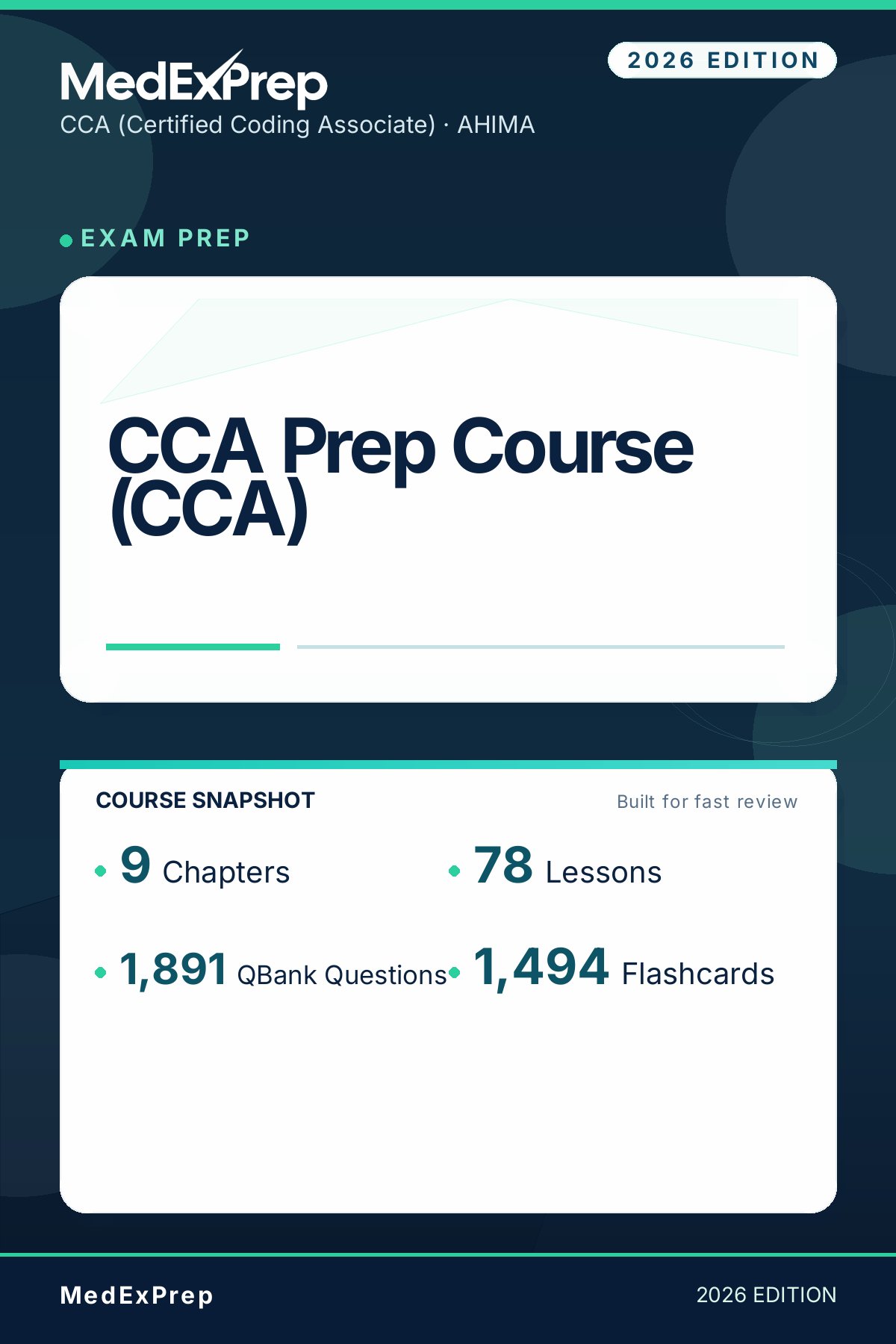
CCA Prep Course (CCA)
CCA candidates preparing for the AHIMA Certified Coding Associate exam, including entry-level medical coding students, recent graduates, and early-career coding professionals seeking exam readiness. Key goals: By the end of this course, learners will be able to:; Explain the current AHIMA CCA exam structure at a high level and use the current AHIMA candidate guide/content outline to prioritize study, without relying on unverified weighting claims..
Exam: CCA (Certified Coding Associate) · Organization: AHIMA
Includes: Lessons + Flashcards + QBank
Audience: CCA candidates preparing for the AHIMA Certified Coding Associate exam, including entry-level medical coding students, recent graduates, and early-career coding professionals seeking exam readiness.
Goals:
- By the end of this course, learners will be able to:
- Explain the current AHIMA CCA exam structure at a high level and use the current AHIMA candidate guide/content outline to prioritize study, without relying on unverified weighting claims.
- Master the high-yield concepts, definitions, conventions, and official coding logic commonly tested in entry-level coding practice, including diagnostic and procedural coding fundamentals, documentation interpretation, sequencing, validation, health record concepts, compliance, and basic reimbursement-related concepts within CCA scope.
- Apply coding concepts in realistic, exam-style scenarios using documentation excerpts to identify the coding task, extract reportable facts, apply conventions/guidelines, assign and sequence codes, and verify specificity, completeness, and compliance.
- Distinguish common distractors and edge cases, especially unsupported assumptions, incomplete documentation, wrong laterality/specificity, setting confusion, code-set confusion, and sequencing errors.
- Use a consistent problem-solving framework: identify the task → review the documentation → extract reportable facts → select the governing convention/guideline → assign and sequence → verify documentation support, specificity, and compliance.
- Build retrieval-ready memory using concise tables, checklists, sequencing frameworks, documentation-query trigger lists, and spaced review summaries.
- Demonstrate readiness through self-checks and mini-assessments mapped to the current AHIMA CCA domains/objectives or, when public blueprint wording is broad, to clearly labeled inferred subskills in the format 'DOMAIN: Objective → Subskill'.
- Coverage & Blueprint Mapping Requirements:
- Every chapter/section/subsection/topic must map to at least one current AHIMA CCA domain/objective or a clearly labeled inferred subskill.
- Use the current publicly available AHIMA candidate guide/content outline as the source of truth for exact domain labels when available.
- When blueprint language is broad or dynamic, translate it into teachable subskills and label them consistently in the format 'DOMAIN: Objective → Subskill'.
- Ensure complete coverage across all available exam domains/objectives; no domain/objective may be left unmapped.
- Stay within entry-level CCA scope: emphasize code-set navigation, guideline application, documentation-based code selection, sequencing, validation, health record basics, compliance/ethics, and basic reimbursement interpretation.
- Do not invent official blueprint details, hidden task lists, or exam weighting. If details are uncertain or may change, tell learners to confirm with the current AHIMA candidate guide/content outline.
- Do not assume facts not documented. When documentation is insufficient, teach learner-safe outcomes such as selecting the supported code, recognizing missing specificity, or identifying when clarification/query may be needed within compliant boundaries.
- Differentiate setting-specific logic and code-set usage when relevant, but avoid advanced auditor-, CDI-, or manager-level depth unless clearly identified as contextual background.
Access is granted immediately after purchase.