Description
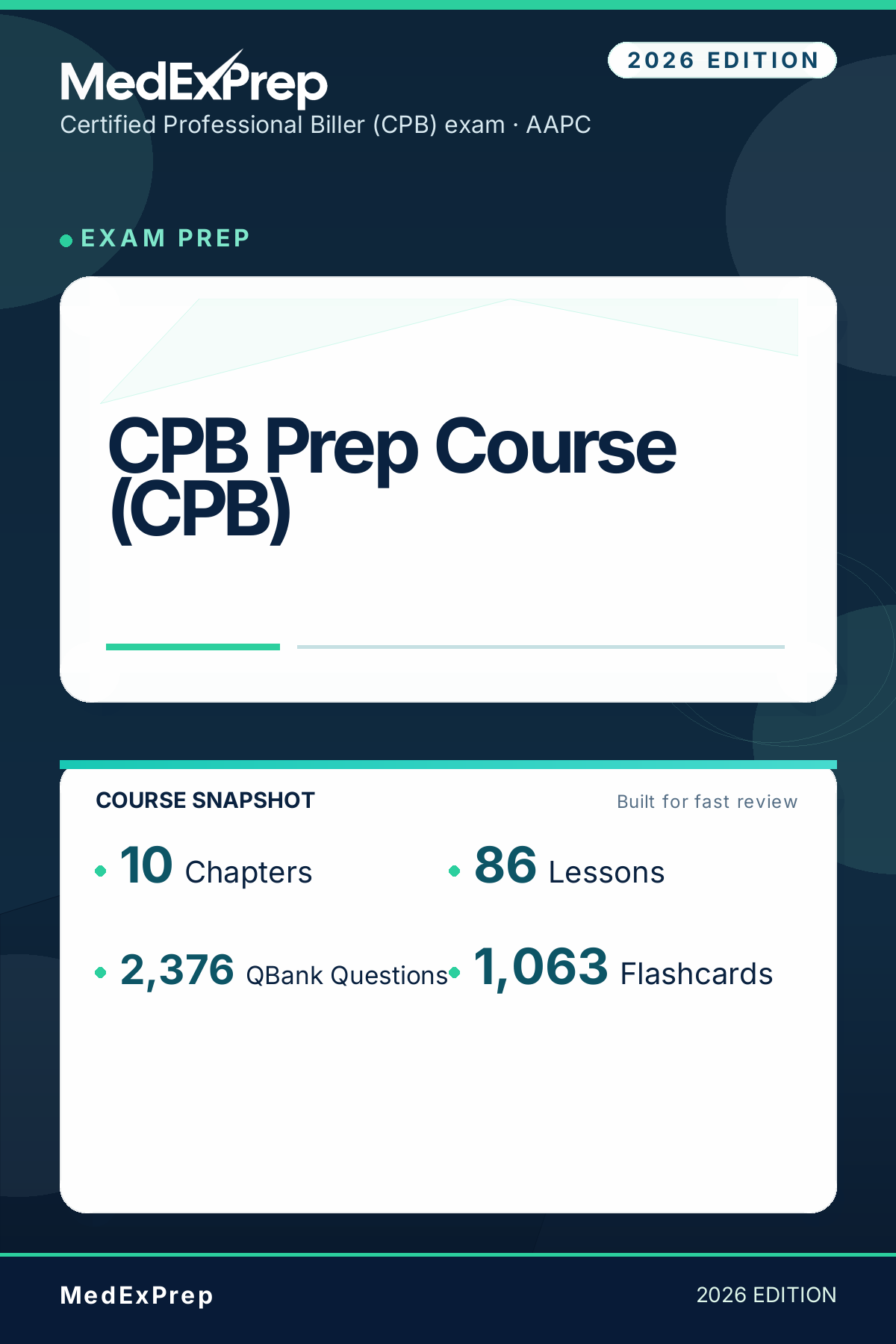
CPB Prep Course (CPB)
CPB candidates preparing for the AAPC Certified Professional Biller (CPB) exam, including new medical billing learners, front-end revenue cycle staff, billers seeking certification, and experienced healthcare administrative professionals who need exam-focused review. Key goals: By the end of this course, learners will be able to:; Explain the exam blueprint or competency domains used for CPB preparation and how major billing topics are represented, using explicit domain mapping when available..
Exam: Certified Professional Biller (CPB) exam · Organization: AAPC
Includes: Lessons + Flashcards + QBank
Audience: CPB candidates preparing for the AAPC Certified Professional Biller (CPB) exam, including new medical billing learners, front-end revenue cycle staff, billers seeking certification, and experienced healthcare administrative professionals who need exam-focused review.
Goals:
- By the end of this course, learners will be able to:
- Explain the exam blueprint or competency domains used for CPB preparation and how major billing topics are represented, using explicit domain mapping when available.
- Master the high-yield concepts, terminology, workflows, and rules used across the medical billing revenue cycle, including insurance and payer concepts, claim preparation, claim forms and data elements, reimbursement methodologies, payment posting, denials, appeals, patient responsibility, collections, and compliance-aware billing processes.
- Apply billing concepts in realistic, exam-style scenarios that require procedural judgment, multi-step reasoning, remittance interpretation, claim-status decisions, and selection of the next appropriate billing action.
- Solve common calculation and logic tasks accurately when applicable, including deductible, copay, coinsurance, coordination of benefits, and reimbursement-related calculations, showing steps clearly and avoiding shortcuts that hide reasoning.
- Distinguish common distractors, misconceptions, and boundary cases frequently tested in billing scenarios, especially where the correct action is to correct, resubmit, appeal, rebill, post, escalate, or verify payer instructions.
- Use a consistent problem-solving framework: identify the billing task → extract key claim, payer, patient, and remittance facts → select the governing billing rule or workflow → execute the next step → verify compliance and account status.
- Build retrieval-ready memory using concise tables, checklists, claim-lifecycle maps, remittance-to-action guides, and spaced review summaries.
- Demonstrate readiness by completing self-check questions and mini-assessments mapped to each domain or subskill relevant to the CPB exam.
- Coverage & Blueprint Mapping Requirements:
- Every chapter, section, subsection, and topic must map to at least one exam domain, objective, or clearly labeled billing subskill, even if the official blueprint wording is broad or not supplied.
- When blueprint language is broad, translate it into teachable subskills using consistent tags such as DOMAIN: Objective → Subskill.
- Ensure complete coverage across exam-relevant billing areas, including claim lifecycle workflows, payer and insurance concepts, CMS-1500/837P, UB-04/837I, remittance and payment posting, denial management, appeals, patient balances, reimbursement logic, accounts receivable follow-up, and compliance/privacy topics.
- Do not invent official blueprint details or unsupported payer-specific rules. If a detail is uncertain, variable, contract-specific, or organization-specific, provide learner-safe guidance such as: local policy, payer policy, or contract terms may vary; confirm current instructions.
- Keep content within the medical biller or revenue cycle professional role. Learners should interpret supplied documentation and coding information for billing purposes, but should not be taught to independently diagnose, select clinical treatment, alter provider documentation, or assign diagnosis/procedure codes when the task requires original coding judgment beyond billing scope.
- In ambiguous scenarios, train learners to choose the action that protects compliance, supports accurate reimbursement, preserves documentation integrity, and routes out-of-scope issues to the appropriate source.
Access is granted immediately after purchase.