Description
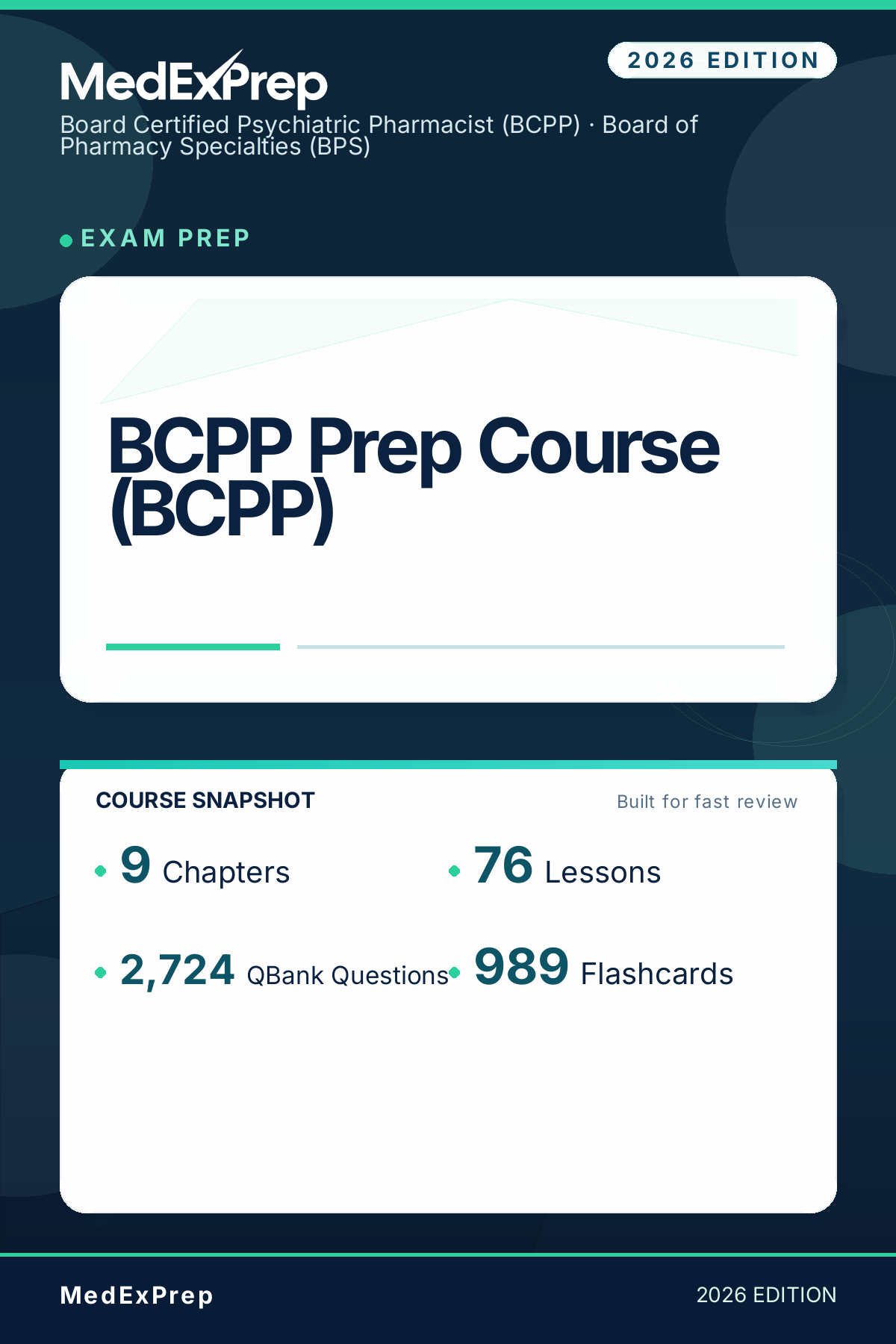
BCPP Prep Course (BCPP)
Pharmacists preparing for the Board of Pharmacy Specialties (BPS) Board Certified Psychiatric Pharmacist (BCPP) examination, including first-time candidates and recertification learners seeking focused, case-based psychiatric pharmacy review. Key goals: By the end of this course, learners will be able to:; Explain the current BCPP exam framework/competency areas and how major psychiatric pharmacy topics are organized for study; use official BPS blueprint language and weights only when explicitly confirmed..
Exam: Board Certified Psychiatric Pharmacist (BCPP) · Organization: Board of Pharmacy Specialties (BPS)
Includes: Lessons + Flashcards + QBank
Audience: Pharmacists preparing for the Board of Pharmacy Specialties (BPS) Board Certified Psychiatric Pharmacist (BCPP) examination, including first-time candidates and recertification learners seeking focused, case-based psychiatric pharmacy review.
Goals:
- By the end of this course, learners will be able to:
- Explain the current BCPP exam framework/competency areas and how major psychiatric pharmacy topics are organized for study; use official BPS blueprint language and weights only when explicitly confirmed.
- Master the high-yield concepts, definitions, medication facts, monitoring parameters, contraindications, interactions, and therapeutic principles most relevant to psychiatric pharmacy board-style questions.
- Apply psychiatric pharmacotherapy concepts in realistic pharmacist-facing exam scenarios, including medication selection, optimization, adverse-effect management, monitoring interpretation, transitions of care, and collaborative recommendations within pharmacist scope.
- Solve common calculation and interpretation tasks accurately when applicable, including dose/regimen calculations, conversions, titrations, therapeutic drug monitoring interpretation, and lab/vital/clinical-parameter use; show steps and avoid shortcuts that hide reasoning.
- Distinguish common distractors, misconceptions, overlapping syndromes, look-alike treatment options, and boundary cases frequently tested in psychopharmacology and psychiatric pharmacy practice.
- Use a consistent clinical reasoning framework: identify the task → extract key patient-specific facts → select the governing pharmacotherapy principle/guideline-informed rule → execute the recommendation or calculation → verify safety, efficacy, and monitoring.
- Build retrieval-ready memory using concise tables, checklists, treatment comparisons, monitoring grids, adverse-effect differentiation tools, and spaced review summaries.
- Demonstrate readiness through self-checks and mini-assessments mapped to at least one blueprint domain, competency, or translated subskill for every chapter/section/subsection/topic.
- Coverage & Blueprint Mapping Requirements:
- Every chapter/section/subsection/topic must map to at least one BCPP-relevant blueprint domain/objective or translated subskill tag.
- Because detailed official BPS blueprint wording/weights were not supplied here, do not invent domain names, wording, or percentages. When official language is unavailable or broad, translate content into teachable subskills using a consistent tag format such as DOMAIN: Objective → Subskill.
- Ensure complete coverage across major psychiatric pharmacy practice areas, including psychiatric disorders and therapeutics, psychopharmacology/PK-PD, adverse effects and monitoring, substance use and toxicology, special populations, care transitions, evidence/guideline-informed decision making, and calculations/clinical interpretation when applicable.
- No domain/objective should be left unmapped. If a detail is uncertain or institution-specific, provide learner-safe guidance such as “Local protocols vary; confirm with your institution” rather than guessing.
- Keep all recommendations within pharmacist candidate scope: assessment, medication optimization, monitoring, counseling, documentation/communication, and escalation/referral when needed.
Access is granted immediately after purchase.