Description
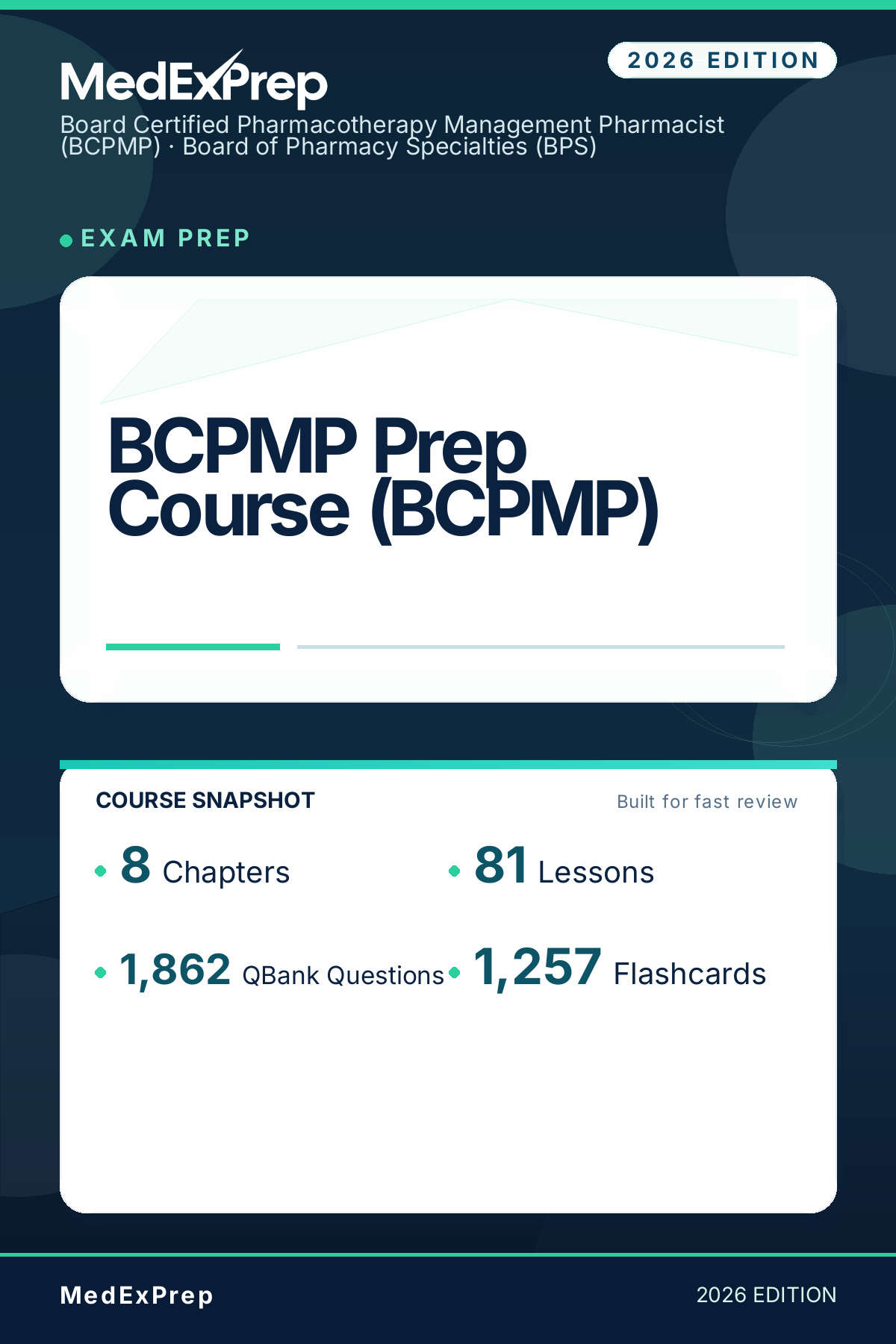
BCPMP Prep Course (BCPMP)
Licensed pharmacists preparing for the BCPMP board certification exam, including pharmacists seeking advanced competency in comprehensive pharmacotherapy management, medication optimization, patient-centered care planning, monitoring and follow-up, medication safety, transitions of care, and applied clinical decision-making across care settings. Key goals: By the end of this course, learners will be able to:; Explain the publicly supportable BCPMP exam framework and the course’s instructional competency mapping approach; if official blueprint detail or weighting is limited, identify the major pharmacist competency areas and how topics are mapped to them without assuming unpublished percentages..
Exam: Board Certified Pharmacotherapy Management Pharmacist (BCPMP) · Organization: Board of Pharmacy Specialties (BPS)
Includes: Lessons + Flashcards + QBank
Audience: Licensed pharmacists preparing for the BCPMP board certification exam, including pharmacists seeking advanced competency in comprehensive pharmacotherapy management, medication optimization, patient-centered care planning, monitoring and follow-up, medication safety, transitions of care, and applied clinical decision-making across care settings.
Goals:
- By the end of this course, learners will be able to:
- Explain the publicly supportable BCPMP exam framework and the course’s instructional competency mapping approach; if official blueprint detail or weighting is limited, identify the major pharmacist competency areas and how topics are mapped to them without assuming unpublished percentages.
- Master the high-yield concepts, definitions, therapeutic principles, and pharmacist decision rules relevant to comprehensive pharmacotherapy management.
- Apply patient-specific clinical reasoning in realistic exam-style cases: identify the pharmacist task, extract key facts, recognize drug-related problems, select or optimize evidence-based therapy, and verify safety, monitoring, and follow-up.
- Perform common pharmacotherapy calculations and logic tasks accurately when applicable, including renal function interpretation, dose individualization, weight-based dosing, concentration/rate logic, and monitoring threshold interpretation; show steps and avoid shortcuts that hide reasoning.
- Distinguish common distractors, misconceptions, and boundary cases, especially options that are generally reasonable but wrong for the specific patient because of comorbidities, organ function, interactions, contraindications, timing, adherence, or care-setting context.
- Use a consistent pharmacist problem-solving framework: identify the clinical task → extract decisive patient-specific data → classify the drug-therapy problem → select the governing rule/guideline principle → choose or adjust therapy → verify safety, counseling, monitoring, and continuity-of-care needs.
- Build retrieval-ready memory using concise comparison tables, checklists, algorithms, monitoring grids, adverse-effect summaries, and spaced review notes.
- Demonstrate readiness through self-checks and mini-assessments mapped to instructional competency tags such as: DOMAIN 1: Patient Assessment and Problem Identification; DOMAIN 2: Evidence-Based Therapeutic Planning and Implementation; DOMAIN 3: Monitoring, Follow-up, and Longitudinal Management; DOMAIN 4: Medication Safety and Practice-Based Clinical Judgment.
- Coverage & Blueprint Mapping Requirements:
- Every chapter, section, subsection, and topic must map to at least one competency tag. Use a consistent structure such as DOMAIN: Objective → Subskill.
- Treat the domain/objective labels as instructional mapping tags unless they are explicitly confirmed by public BPS materials.
- Ensure complete coverage across patient assessment, drug-related problem identification, therapy selection, dose individualization, monitoring/follow-up, medication safety, interactions, transitions of care, special populations, clinical calculations, guideline-based reasoning, and longitudinal management.
- Use disease states and care settings as clinical contexts for pharmacist tasks, not as the only organizing structure.
- Prioritize integrated case-based coverage across chronic care, acute decision points relevant to pharmacotherapy management, special populations, and transitions of care.
- When public blueprint language is broad, translate it into teachable pharmacist subskills and label them transparently.
- Do not invent unpublished BPS domain names, percentages, item counts, scoring methods, or passing-standard details.
- If a recommendation, protocol, formulary preference, collaborative practice authority, or workflow varies by institution, jurisdiction, or guideline version, state learner-safe uncertainty language such as: “Guideline recommendations may vary by update cycle, jurisdiction, or institution” or “Formulary preferences and protocol details may differ locally.”
Access is granted immediately after purchase.