Description
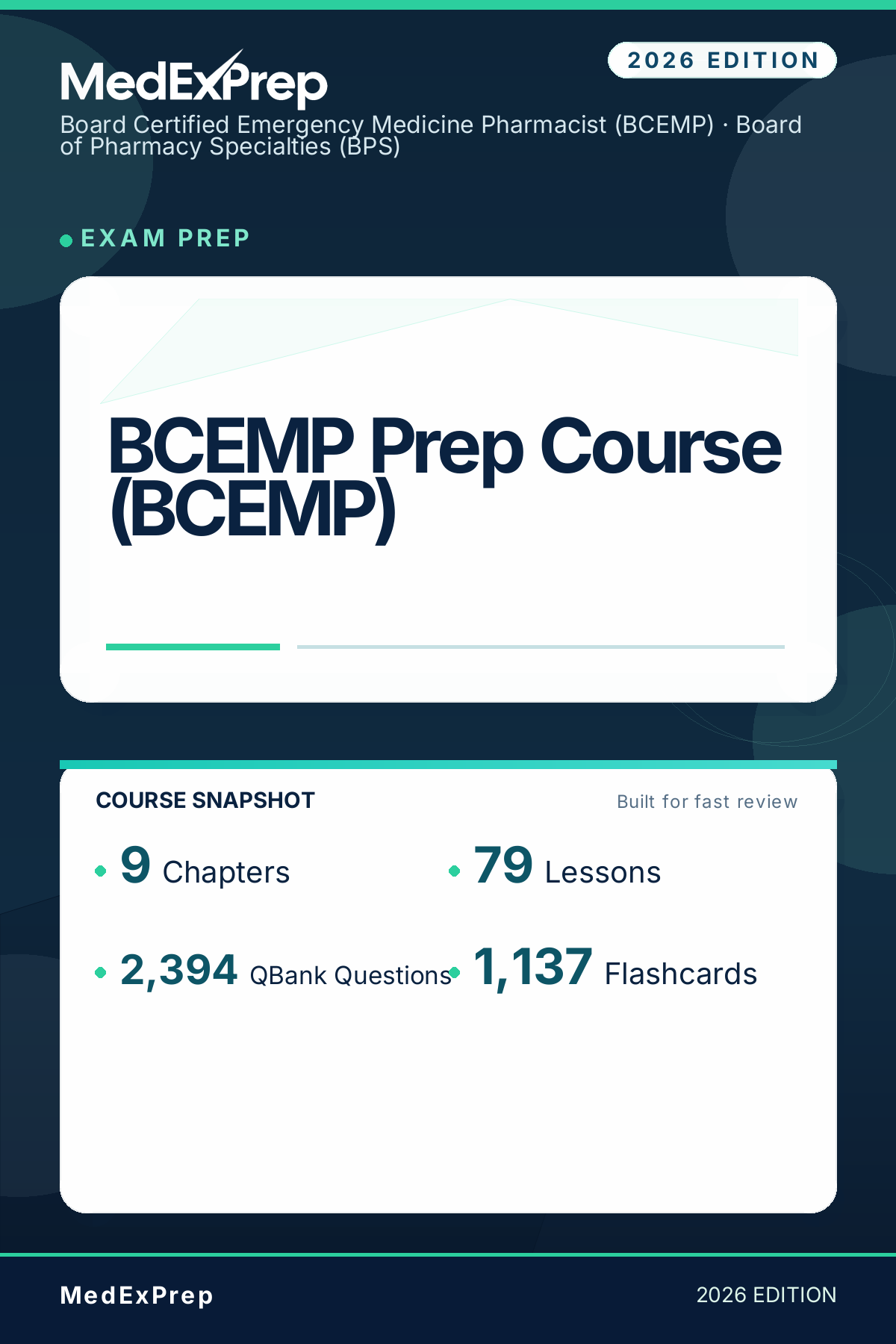
BCEMP Prep Course (BCEMP)
Pharmacists preparing for the BPS BCEMP certification exam, including PGY2 emergency medicine pharmacy residents, practicing emergency medicine pharmacists, critical care/emergency crossover pharmacists, and other pharmacist candidates seeking an exam-focused emergency medicine review. Key goals: By the end of this course, learners will be able to:; Explain the BPS BCEMP exam scope/framework and how course topics map to published BCEMP domains, objectives, and pharmacist emergency medicine subskills..
Exam: Board Certified Emergency Medicine Pharmacist (BCEMP) · Organization: Board of Pharmacy Specialties (BPS)
Includes: Lessons + Flashcards + QBank
Audience: Pharmacists preparing for the BPS BCEMP certification exam, including PGY2 emergency medicine pharmacy residents, practicing emergency medicine pharmacists, critical care/emergency crossover pharmacists, and other pharmacist candidates seeking an exam-focused emergency medicine review.
Goals:
- By the end of this course, learners will be able to:
- Explain the BPS BCEMP exam scope/framework and how course topics map to published BCEMP domains, objectives, and pharmacist emergency medicine subskills.
- Master high-yield emergency medicine pharmacotherapy concepts relevant to BCEMP, including resuscitation, toxicology/antidotes, neurologic emergencies, cardiovascular emergencies, infectious diseases in emergency care, trauma/bleeding, pain/agitation/sedation, medication safety/operations, transitions of care, and special population modifiers.
- Apply concepts in realistic BCEMP-style scenarios that require prioritization under time pressure, medication selection, dose/route/timing decisions, monitoring, contraindication recognition, and follow-up within the pharmacist scope of practice.
- Solve common emergency medicine pharmacist calculations accurately when applicable, including weight-based dosing, renal/hepatic adjustment, infusion/concentration logic, preparation interpretation, and antidote-related calculations, showing steps clearly.
- Distinguish common distractors, misconceptions, and boundary cases frequently tested in emergency medicine pharmacy, such as mistimed therapies, wrong route/preparation, failure to account for organ dysfunction or contraindications, and confusion between similar acute care pathways.
- Use a consistent problem-solving framework: identify the task -> extract key clinical facts -> determine immediate threats/priorities -> select the governing guideline, rule, or principle -> choose the best medication-related action -> verify safety, monitoring, and disposition implications.
- Build retrieval-ready memory using concise tables, antidote charts, resuscitation algorithms, checklists, and spaced review summaries.
- Demonstrate readiness through self-check questions and mini-assessments mapped to BCEMP blueprint areas or, when public blueprint wording is broad, to explicit pharmacist subskills labeled in the format DOMAIN: Objective -> Subskill.
- Coverage & Blueprint Mapping Requirements:
- Every chapter/section/subsection/topic must map to at least one BCEMP blueprint domain/objective or explicit pharmacist emergency medicine subskill.
- Use currently available BPS BCEMP candidate-facing materials and published exam scope/framework language as the authoritative basis.
- When blueprint language is broad, translate it into teachable subskills and label them consistently as DOMAIN: Objective -> Subskill.
- Ensure complete coverage: no published BCEMP domain/objective is left unmapped.
- Prioritize high-yield adult emergency medicine pharmacotherapy while incorporating pediatric, geriatric, pregnancy/lactation, renal dysfunction, hepatic dysfunction, obesity, and other special-population considerations when they materially change medication decisions.
- Keep content within pharmacist candidate responsibilities: medication-related assessment, therapeutic planning, dosing, preparation, monitoring, safety, stewardship, emergency response support, and transitions of care; avoid non-pharmacist procedural technique details except as context for medication support.
- If a recommendation varies by institution, formulary, protocol, or jurisdiction, write learner-safe guidance such as: "Local protocols vary; confirm with your institution." Do not invent hidden blueprint details or institution-specific rules.
Access is granted immediately after purchase.