1.1.1 - Screening Framework And Intervals
Screening Framework and Intervals
What you'll learn
- DOMAIN: Preventive care and health maintenance → SUBSKILL: screening/prevention — choose who should be screened, with what test, and at what interval.
- DOMAIN: Preventive care and health maintenance → SUBSKILL: next best step/workup — distinguish screening from diagnostic evaluation when symptoms are present.
- DOMAIN: Geriatrics, ethics, and care coordination → SUBSKILL: counseling/risk reduction — decide when screening should be individualized based on life expectancy, risk, or prior results.
- DOMAIN: Women’s health and reproductive care → SUBSKILL: screening/prevention — apply age and pregnancy-related preventive rules without mixing them with symptomatic workups.
- DOMAIN: Cardiometabolic disease → SUBSKILL: screening/prevention — use high-yield intervals for blood pressure, diabetes, lipids, and related primary care prevention targets.
- Preventive care and health maintenance → screening, counseling, interval selection
- Diagnosis / Next best step → separate asymptomatic screening from symptom-driven evaluation
- Screening/prevention → age-based adult screening in ambulatory family medicine
- Counseling/risk reduction → shared decision-making, risk modification, follow-up planning
Why it matters
- NBME questions often test the interval, not just the condition: the right test at the wrong time is still wrong.
- Family medicine shelves heavily reward recognizing average-risk asymptomatic screening versus symptom-driven diagnostic evaluation.
- Many distractors are attractive because they are real tests used for the same disease, but the stem asks for screening, not diagnosis.
- Screening questions also test restraint: knowing when not to screen is as high-yield as knowing when to start.
Key Terms & Must-Know Facts
1.1.1.1 Key terms
- Screening: testing asymptomatic people to detect disease earlier.
- Diagnostic testing: evaluation prompted by symptoms, signs, or abnormal prior testing.
- Average risk: no major risk-enhancing history that changes start age or interval.
- High risk: family history, prior abnormal result, comorbidity, exposure, or other factor that modifies screening.
- Interval: the time until the next recommended screening test.
- Sensitivity: ability to detect disease when present.
- Specificity: ability to exclude disease when absent.
- False positive: abnormal result in a person without disease.
- False negative: normal result despite disease.
- Shared decision-making: patient-centered selection when benefit depends on values or is small.
- USPSTF-style framing: population-based preventive recommendations by age and risk.
- Life expectancy consideration: benefit of screening depends on time to benefit and competing morbidity.
- Opportunistic screening: preventive care addressed during routine visits.
1.1.1.2 Must-know facts
- Symptoms convert a “screening” question into a diagnostic workup question.
- Age alone is often insufficient; exam questions add risk factors to move you away from average-risk intervals.
- Blood pressure should be assessed regularly in adults; confirmation may require repeat measurements or out-of-office monitoring.
- Diabetes screening is commonly age and weight/risk based rather than universal in all young adults.
- Lipid screening logic depends on age and cardiovascular risk, not a single universal yearly interval for everyone.
- A prior normal test usually lengthens follow-up; a prior abnormal test usually shortens or changes follow-up.
- Overtesting creates false positives and unnecessary downstream procedures.
- On the shelf, “most appropriate screening recommendation” usually means best next preventive test today, not a complete annual checklist.
Exam takeaway: Use symptoms and prior abnormalities to decide whether the stem is asking for screening or diagnostic evaluation.
flowchart TD
A[Patient encounter] --> B{Symptoms, red flags, or abnormal prior test?}
B -- Yes --> C[Diagnostic evaluation pathway]
B -- No --> D{Average risk or high risk?}
D -- Average risk --> E[Use age-based screening rule]
D -- High risk --> F[Modify start age or interval]
E --> G[Choose correct modality and follow-up interval]
F --> G Exam takeaway: First sort by age, then by risk modifiers, then by prior test result to avoid wrong interval choices.
flowchart LR
A[Age] --> B[Risk factors]
B --> C[Prior result]
C --> D[Recommended test]
D --> E[Correct interval]
E --> F[Counsel and arrange follow-up]
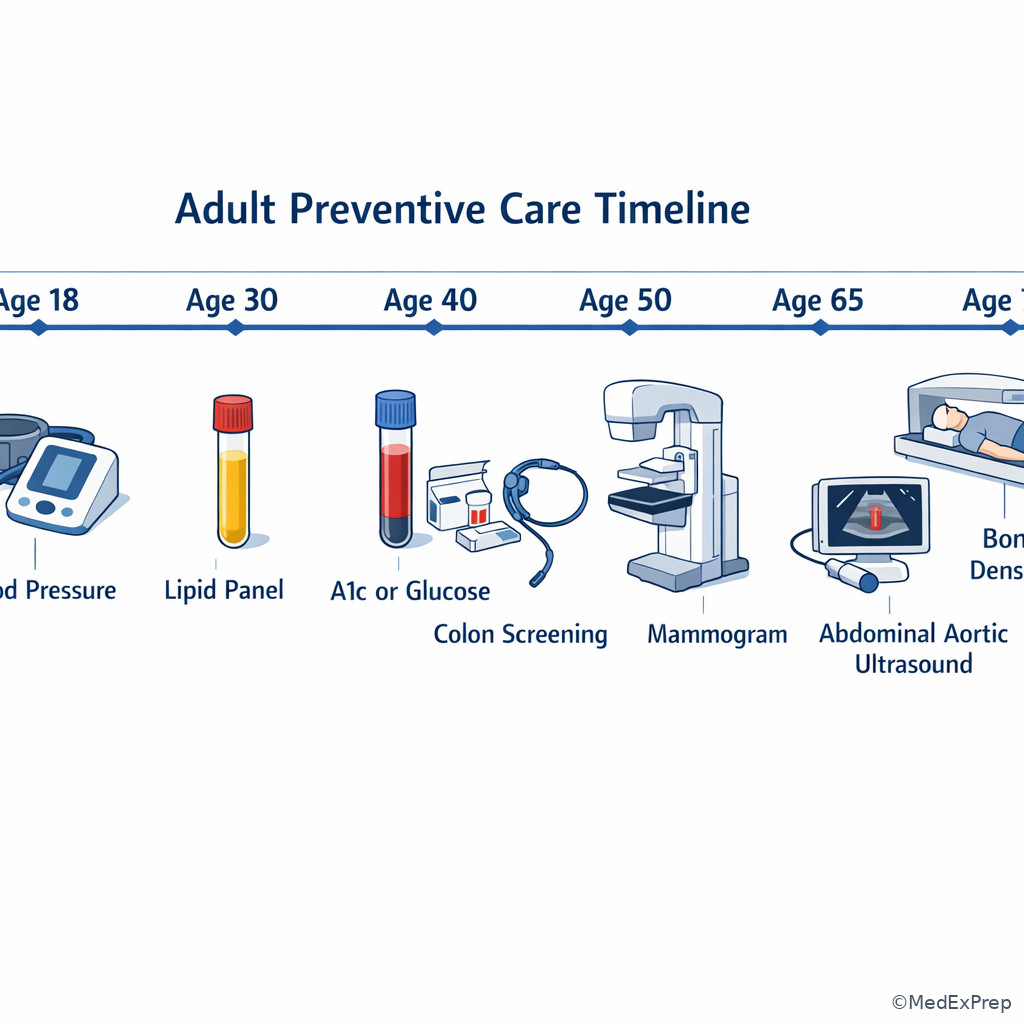
Exam takeaway: Visualize age-based checkpoints to anchor common shelf screening intervals in outpatient care.
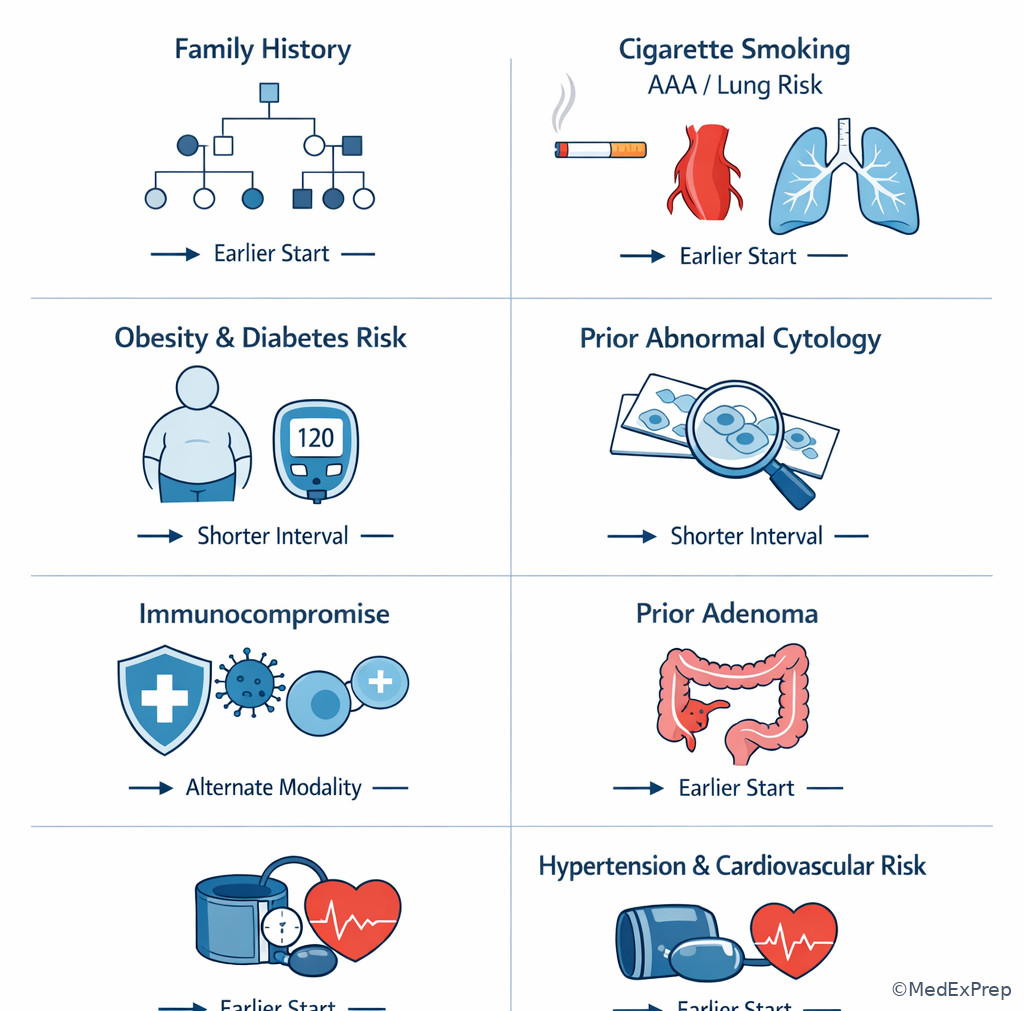
Exam takeaway: Family history, smoking, obesity, and prior abnormal tests are common clues that change timing or modality.
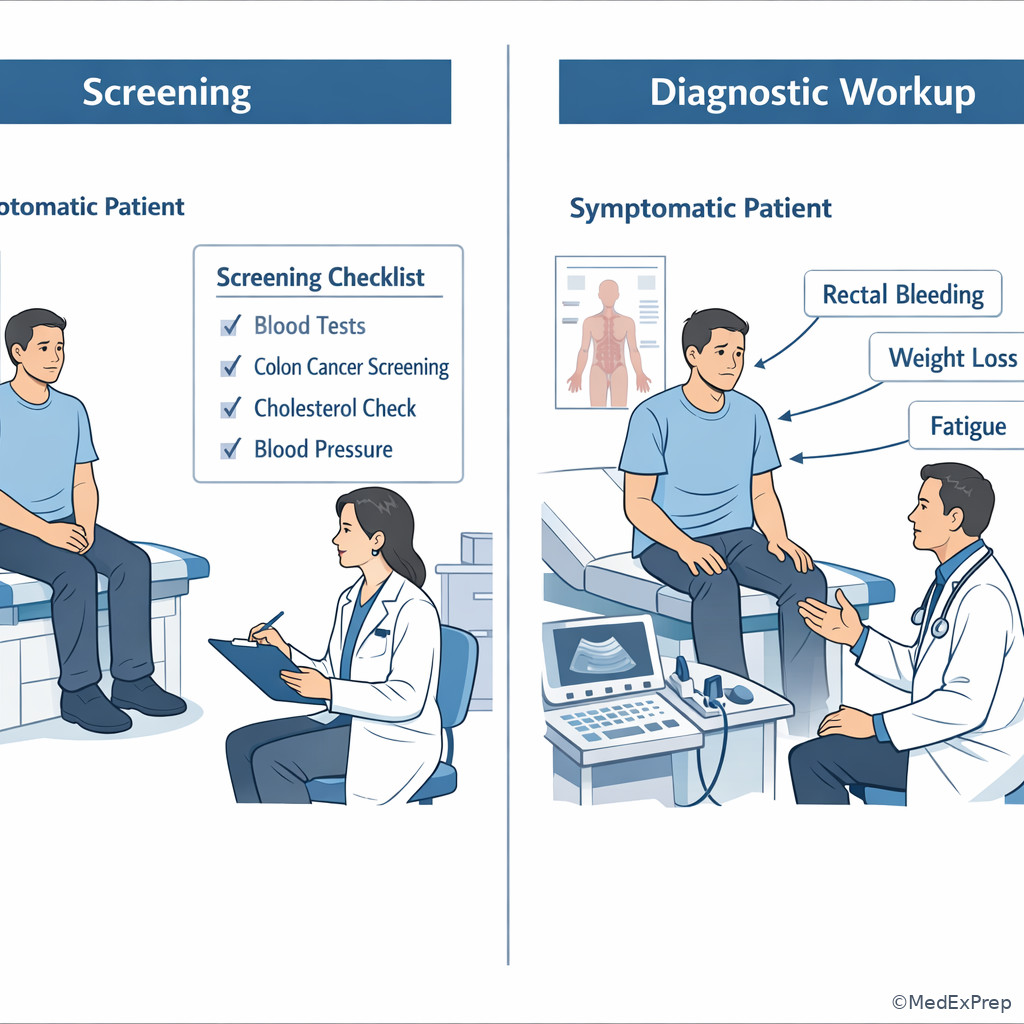
Exam takeaway: Once symptoms are present, choose evaluation for the complaint rather than routine screening.
Exam takeaway: Screening benefit falls when prior testing is recent, the patient is outside the target population, or life expectancy limits time to benefit.
flowchart TD
A[Considering a screening test] --> B{Within target age/risk group?}
B -- No --> C[Do not routinely screen]
B -- Yes --> D{Recent normal test on schedule?}
D -- Yes --> E[Wait until next interval]
D -- No --> F{Expected benefit meaningful for patient?}
F -- No --> G[Individualize or stop]
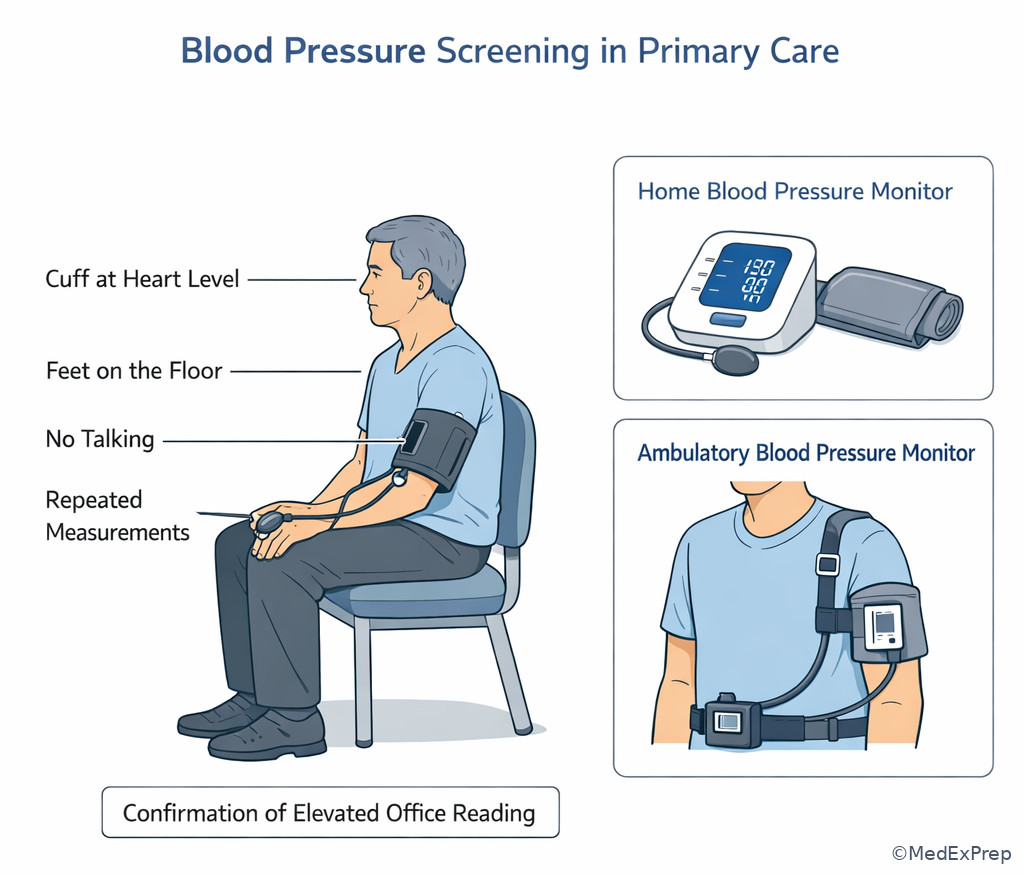
F -- Yes --> H[Screen now] Exam takeaway: Correct technique and confirmation strategy are often the hidden rule in outpatient screening stems.
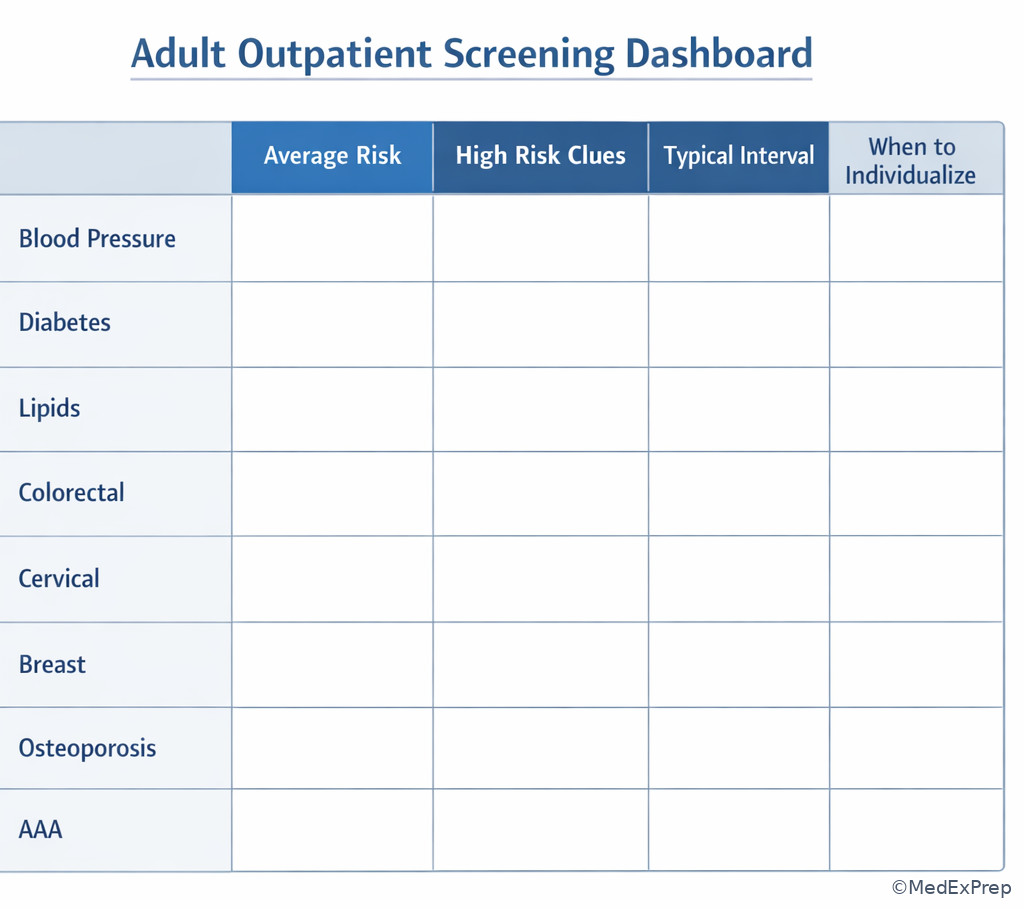
Exam takeaway: A compact age-and-risk dashboard helps separate routine annual care from interval-specific tests.
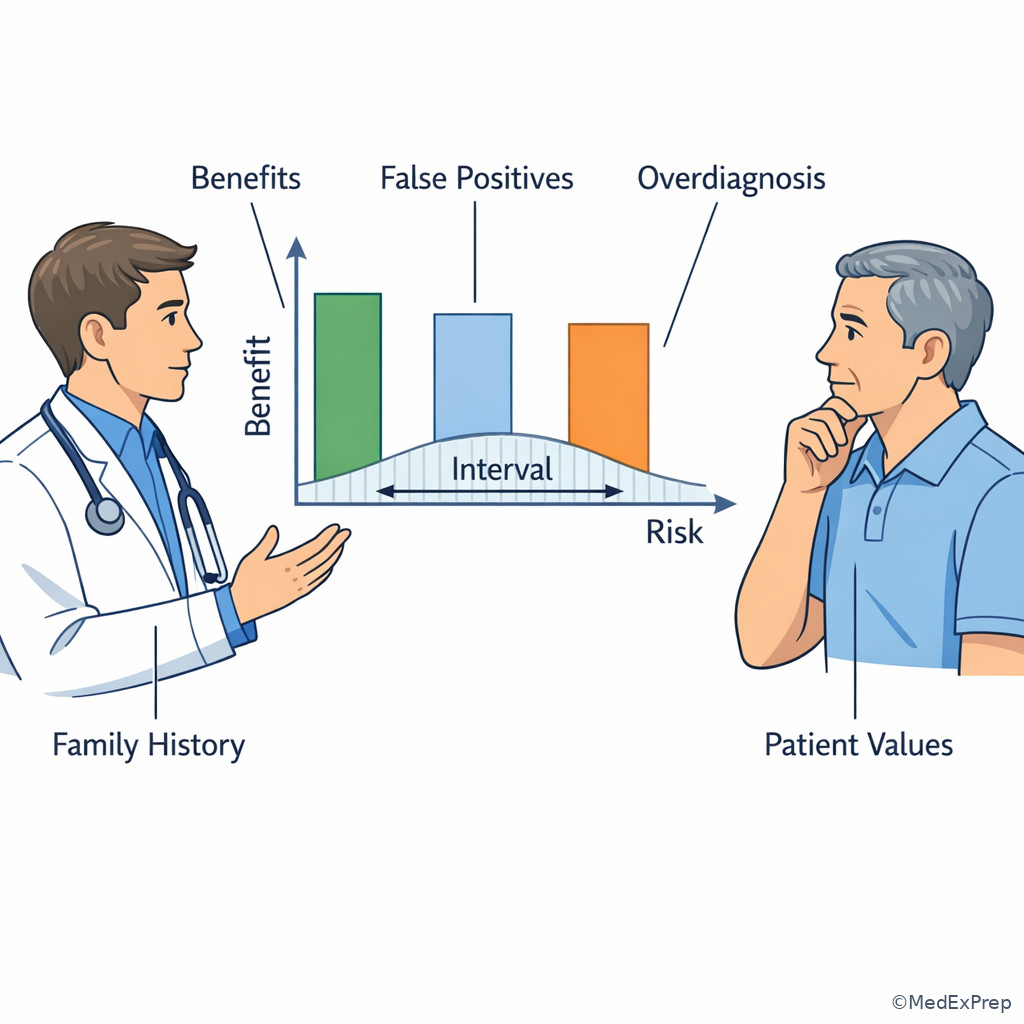
Exam takeaway: Some screening decisions are not automatic and require discussing benefit, harm, and patient values.
Core content
1.1.1.3 Foundational rule: screening is for asymptomatic patients
A Explanation
The first decision conflict is simple but heavily tested: Should you choose a screening test or a diagnostic workup? The single resolving rule is whether the patient is asymptomatic. Screening applies to people without signs or symptoms of the target disease. Once the stem includes alarm features, abnormal bleeding, weight loss, palpable mass, abnormal exam finding, or a prior abnormal test that requires follow-up, you are no longer in a pure screening pathway. See Fig 1 and Fig 3.
WHY THIS IS TESTED: exam writers build distractors using correct screening tests in the wrong setting. For example, stool-based colorectal screening is appropriate in an average-risk asymptomatic adult, but rectal bleeding with iron deficiency anemia requires diagnostic colon evaluation rather than routine screening. Similarly, a Pap interval question changes if the patient has postcoital bleeding or a prior high-grade lesion.
Choose screening when the visit is preventive and the patient is well. Reject screening when there are symptoms, a concerning physical finding, or a surveillance issue after known abnormality. Also reject “routine annual testing” distractors when the question asks for a specific evidence-based interval. In outpatient family medicine, you are often selecting the most appropriate next preventive step today, not ordering every conceivable test.
Key rule: Asymptomatic + average risk = think age-based screening. Symptoms, red flags, or prior abnormality = think diagnostic evaluation or surveillance.
Recall: This is the first topic in the course, so use it as the base rule for the upcoming lessons on Cancer Screening High Yield and Osteoporosis and AAA Screening. Those lessons assume you can already tell routine screening from workup of symptoms.
Clinician Action: Diagnose: decide if this is asymptomatic preventive care versus symptom evaluation. Order: screening only if the patient is in the target asymptomatic population. Treat: address modifiable risk factors during the same visit. Refer/Escalate: if the stem includes red-flag symptoms, prioritize urgent diagnostic workup or higher-level evaluation rather than routine screening.
B Worked example
A 52-year-old man presents for an annual visit. He has obesity, hypertension, and chronic low back pain treated with NSAIDs. He says he feels well overall but mentions two episodes of bright red blood per rectum over the past month, which he attributes to hemorrhoids. His father had a myocardial infarction at 61 years. He asks whether he should do a stool DNA test because a coworker just had one.
Identify task: The stem looks like a preventive visit, but the task is not routine screening anymore if symptoms are present.
Extract key facts: Age 52 would otherwise fit average-risk colorectal screening age; however, rectal bleeding is now a symptom. NSAID use and hemorrhoid self-diagnosis are distracting clues.
Apply rule: Symptomatic patients need diagnostic evaluation, not screening. The right move is not to choose among screening modalities but to recognize that stool DNA testing is inappropriate in this context.
Eliminate distractors: Stool DNA, FIT, and “repeat next year” are all tempting because he is due for colorectal screening by age. But they are screening tools for asymptomatic people. The bleeding is the single clue that flips the pathway.
Verify: A diagnostic colon evaluation best fits the scenario.
C Exam trap
Common wrong answer: order the routine screening test the patient is due for. WHY IT IS TEMPTING: the age in the stem strongly cues preventive care, and the symptom may be framed as mild or explained away by the patient. SINGLE CLUE THAT ELIMINATES IT: any active symptom concerning for the screened disease converts the question to diagnostic evaluation.
D Checkpoint
Question: A 49-year-old woman presents for a wellness visit. She has obesity, well-controlled hypothyroidism, and migraines. She reports 3 months of intermittent postcoital bleeding but otherwise feels well. Which is the most appropriate next step regarding cervical cancer prevention?
- Perform routine cervical screening at the usual interval only
- Delay evaluation until the bleeding persists for 6 months
- Evaluate the bleeding diagnostically rather than treating this as routine screening
- Stop cervical screening because the bleeding suggests a non-screening issue
- A: Tempting because she may still be due by age, but wrong because symptoms require evaluation beyond routine interval-based screening.
- B: Tempting because benign causes are common, but wrong because postcoital bleeding is a symptom that warrants workup now.
- C: Correct because the single discriminating clue is postcoital bleeding, which makes this a diagnostic problem rather than a screening-only question.
- D: Tempting because screening and diagnostic workup are different, but wrong because a symptomatic patient may still need evaluation and ongoing preventive care; you do not “stop” screening solely for that reason.
1.1.1.4 How to choose the interval: age, risk, and prior result
A Explanation
Once you know the patient is appropriate for screening, the next conflict is: screen now, wait, or change the schedule? The single resolving rule is to move through screening questions in a fixed sequence: age → risk modifiers → prior result. See Fig 2 and Fig 5.
Age usually determines eligibility. Risk factors then alter the start age, modality, or follow-up. Prior normal results often support a longer interval; prior abnormalities usually shorten follow-up or convert the patient to a surveillance pathway. This prevents the classic board mistake of picking a test that is valid in general but mistimed for this patient.
In family medicine, the most tested routine interval logic involves blood pressure, diabetes, lipids, colorectal screening, breast screening, and cervical screening. This lesson focuses on the framework rather than every cancer-specific detail, which will be expanded in upcoming topics. For now, remember that blood pressure is checked regularly and elevated readings are often confirmed; diabetes screening is guided by age and overweight/obesity plus risk; lipid screening is risk-based rather than “every year for all”; and major cancer screening decisions require careful use of age and prior testing history.
Never answer an interval question before asking whether the stem includes a prior normal test and when it was done. One line such as “normal colonoscopy 3 years ago” or “negative cotest 2 years ago” is often the entire question. See Fig 4 for the logic behind not screening too early.
Memory anchor: A-R-P = Age, Risk, Prior result. Before selecting any interval, run the stem through A-R-P in that exact order.
High-Yield Connection: This concept is tested alongside Cancer Screening High Yield. Know both the general A-R-P framework here and the specific breast, cervical, colorectal, lung, and prostate interval details there — they are frequently paired in stems.
Clinician Action: Diagnose: identify the relevant preventive condition and whether the patient is average or elevated risk. Order: the correct modality only if the timing is appropriate by age, risk, and prior result. Treat: pair screening with counseling on risk reduction. Refer/Escalate: move to surveillance or specialty follow-up if prior testing was abnormal or high-grade.
B Worked example
A 46-year-old woman comes for a preventive visit. She has class I obesity, polycystic ovary syndrome, and a history of gestational diabetes 8 years ago. Her blood pressure is 126/78 mm Hg. She exercises twice weekly. Her last fasting glucose screening was 4 years ago and normal. She asks whether she needs “yearly diabetes blood work” because her friend gets it every year.
Identify task: This is a screening interval question.
Extract key facts: She is an adult with overweight/obesity and multiple diabetes risk factors, including prior gestational diabetes and PCOS. Prior testing was normal but not recent.
Apply rule: A-R-P: age appropriate, elevated risk present, prior normal test was several years ago. This supports repeat diabetes screening now rather than waiting longer or assuming annual testing is universally required.
Eliminate distractors: “No screening until age 50” ignores risk factors. “Annual testing for all adults” overgeneralizes. “Only if symptomatic” confuses screening with diagnostic workup.
Verify: Screening now is the best recommendation because risk factors alter the threshold for routine preventive testing.
C Exam trap
Common wrong answer: order the right screening test at an overly frequent interval. WHY IT IS TEMPTING: more testing feels safer, and many learners default to annual labs. SINGLE CLUE THAT ELIMINATES IT: a recent normal result in an average-risk patient usually means it is too early.
D Checkpoint
Question: A 58-year-old man presents for preventive care. He has no symptoms. He has hypertension controlled with lisinopril and a 25-pack-year smoking history. His colonoscopy 4 years ago was normal. Which is the most appropriate colorectal recommendation today?
- Repeat colonoscopy now because he is older than 55
- Use a stool-based screening test now because it is less invasive
- Wait until the next recommended interval because his prior colonoscopy was normal
- Stop screening because the prior result was normal
- A: Tempting because age increases risk, but wrong because prior normal colonoscopy determines interval more than age alone here.
- B: Tempting because stool tests are accepted screening modalities, but wrong because a recent normal colonoscopy already established the interval.
- C: Correct because prior normal colonoscopy 4 years ago means it is too early to repeat routine screening.
- D: Tempting because a normal result is reassuring, but wrong because screening is not permanently discontinued after one normal test in an otherwise eligible patient.
- The three-step interval method is ___ → ___ → ___.
- True or False: A recent normal screening result often lengthens the interval.
- Name the single detail that most often turns a routine interval question into a surveillance question.
1.1.1.5 High-yield adult screening categories in primary care
A Explanation
This section answers the practical exam question: Which adult screening domains should you actively consider in a routine family medicine visit? The single rule is to think in categories rather than isolated diseases: cardiometabolic, cancer, substance use/behavioral health, infectious risk, and age-related screening. See Fig 5.
Cardiometabolic screening includes blood pressure, diabetes risk-based screening, lipid assessment, and obesity-related counseling. Cancer screening includes cervical, breast, colorectal, lung, prostate shared decision contexts, and later-life tests like osteoporosis and AAA in appropriate patients. Behavioral and substance use screening includes depression, alcohol use, tobacco use, and other risk counseling. Infectious prevention includes STI/HIV/hepatitis risk-based screening and immunization review, which is not the focus of this lesson but sits beside screening in real clinic visits.
The high-yield NBME move is not to shotgun every category. Instead, pick the one being asked. If the stem asks “most appropriate screening recommendation,” identify the patient’s age and risk clues, then select the most time-sensitive or guideline-concordant preventive step among plausible same-category options. In outpatient care, counseling often accompanies testing: screening for hypertension should lead to confirmation and lifestyle discussion; abnormal obesity-related risk should trigger diabetes consideration; smoking history changes both counseling and screening pathways.
Upcoming topics will cover cancer-specific details and osteoporosis/AAA separately. Here, the goal is the framework that keeps those facts organized and prevents category errors.
High-Yield Connection: Screening frameworks overlap with later lessons on dyslipidemia risk-based treatment, tobacco cessation, obesity counseling, and adult immunization schedules. The same risk factors often drive both screening and management questions.
Clinician Action: Diagnose: determine the screening category prompted by age and risk factors. Order: the single most relevant screening test rather than an indiscriminate panel. Treat: connect positive screening to first-line counseling or management. Refer/Escalate: use specialty referral when positive results or high-risk histories demand surveillance pathways.
B Worked example
A 61-year-old woman presents for a preventive visit. She has hypertension, obesity, and a 35-pack-year smoking history but quit 8 years ago. She had a normal mammogram last year and a negative stool test 10 months ago. She asks whether she needs “all the cancer tests again” because her sister was recently diagnosed with breast cancer at 72. She is asymptomatic and takes hydrochlorothiazide.
Identify task: This is not asking for every screening test; it is asking you to prioritize according to category and interval.
Extract key facts: Significant smoking history with quit date under 15 years is a key clue. Recent normal breast and colorectal screening are distractors. Sister’s diagnosis at 72 does not automatically create the same pattern as strong early family history.
Apply rule: Among common adult screening categories, lung cancer screening becomes the highest-yield unaddressed preventive item if the age and smoking criteria fit. Her recent breast and colorectal tests are not due again immediately.
Eliminate distractors: Repeat mammography and repeat stool testing are appealing because of cancer anxiety, but they ignore interval timing. “No further screening” ignores the smoking clue.
Verify: The most appropriate recommendation is the screening category triggered by her smoking history and age.
C Exam trap
Common wrong answer: repeat the most emotionally salient cancer test. WHY IT IS TEMPTING: stems often include a relative with cancer to pull you toward that organ system. SINGLE CLUE THAT ELIMINATES IT: the relative’s age, degree of relation, or the patient’s recent normal screening may make that test lower yield than another category triggered by smoking or age.
D Checkpoint
Question: An asymptomatic 67-year-old man presents for routine care. He has hyperlipidemia, osteoarthritis, and a 40-pack-year smoking history; he quit 10 years ago. He had a normal colonoscopy 2 years ago. Which preventive recommendation is most appropriate to address today?
- Repeat colonoscopy because smoking increases colorectal risk
- Offer lung cancer screening if he meets age and smoking criteria
- Order chest radiography annually instead of low-dose CT
- No cancer screening is indicated because he quit smoking
- A: Tempting because smoking increases malignancy risk broadly, but wrong because prior colonoscopy timing still governs colorectal interval.
- B: Correct because his age and smoking history fit a classic screening category often tested in family medicine.
- C: Tempting because chest x-ray seems simpler, but wrong because it is not the recommended lung screening modality.
- D: Tempting because quitting reduces risk, but wrong because former smokers may still qualify depending on timing and pack-years.
1.1.1.6 When to individualize or stop screening
A Explanation
The final major conflict is: Should the patient continue routine screening, or should screening be individualized, deferred, or stopped? The single resolving rule is whether the patient is still likely to benefit, based on target population criteria, prior normal testing, and realistic time to benefit. See Fig 4 and Fig 6.
This is where board questions test judgment rather than memorization. Older adults with major comorbidity, limited life expectancy, or recent adequate normal screening may not benefit from repeating long-interval tests. The shelf does not expect fellowship-level prognostication; it expects you to recognize that more screening is not always better. A frail older adult with advanced illness and repeated prior normal testing is different from a healthy older adult who remains functionally independent and likely to benefit.
Similarly, some screening decisions are individualized rather than automatic. Prostate screening is a classic shared decision topic. Some cancer tests may stop after a defined age or after adequate prior normal results, but these rules are often nuanced and will be covered in the dedicated cancer screening lesson. For this framework lesson, focus on the principles: do not ignore the patient’s overall health status, and do not screen outside the intended population merely because the test exists.
The best exam move is to ask: Will this patient plausibly live long enough and remain well enough to benefit from early detection? If no, screening may be inappropriate or individualized. If yes, do not stop screening prematurely solely because the patient is older.
Common pitfall: stopping screening based on age alone. On NBME-style questions, functional status, major comorbidity burden, and prior testing history matter more than chronological age by itself.
Memory anchor: BENEFIT = Baseline health, Expected lifespan, Normal prior tests, Eligibility window, Family/risk modifiers, Individual values, Time to benefit.
Clinician Action: Diagnose: determine whether the patient remains an appropriate screening candidate. Order: continue only those tests with meaningful expected benefit. Treat: focus preventive effort on interventions with immediate value such as blood pressure control, smoking cessation, falls prevention, and vaccinations. Refer/Escalate: use shared decision-making or specialist guidance when stopping rules or surveillance history are unclear.
B Worked example
An 82-year-old woman presents with her daughter for a wellness visit. She has moderate dementia, CHF with frequent admissions, chronic kidney disease, and dependence in most instrumental activities of daily living. She had a normal colonoscopy 8 years ago and a normal mammogram 1 year ago. She asks whether she should “keep doing every cancer test every year” because a neighbor said skipping tests is dangerous.
Identify task: This is an individualization question.
Extract key facts: Advanced age alone is not enough, but her severe comorbidity burden and limited functional reserve are central. Prior screening has been adequate. The recent normal mammogram is a distracting clue that may tempt continued annual testing.
Apply rule: Screening only helps if early detection is likely to improve meaningful outcomes within the patient’s expected time horizon. Her competing illnesses and prior normal testing reduce likely benefit.
Eliminate distractors: “Continue everything annually” ignores time to benefit. “Stop only because she is older than 80” uses age alone. The best answer individualizes and may reasonably stop certain routine screening tests.
Verify: Prioritize patient-centered discussion and focus on preventive measures with immediate benefit.
C Exam trap
Common wrong answer: continue screening because the patient wants reassurance. WHY IT IS TEMPTING: patient preference matters, and a recent prior normal screen may make repeat testing feel harmless. SINGLE CLUE THAT ELIMINATES IT: major comorbidity with limited expected benefit means routine screening may create burden without meaningful gain.
D Checkpoint
Question: A 79-year-old man lives independently, walks daily, and has well-controlled hypertension and hyperlipidemia. He has no history of cancer and remains active. Which principle best guides whether to continue age-based screening discussions?
- Stop all screening solely because he is older than 75
- Continue or individualize screening based on health status, prior tests, and expected benefit
- Avoid screening because preventive care is less relevant in older adults
- Repeat all available cancer screening tests annually
- A: Tempting because age cutoffs are memorable, but wrong because age alone should not automatically end every screening conversation.
- B: Correct because functional older adults may still benefit depending on the specific screening test and prior history.
- C: Tempting because chronic disease management is important, but wrong because prevention remains relevant in older adults.
- D: Tempting because screening may still matter, but wrong because indiscriminate annual testing ignores modality-specific intervals and harms.
- True or False: Older age by itself always means screening should stop.
- The key question before continuing screening in frail older adults is whether the patient is likely to ___ from early detection.
- Name 2 factors other than age that affect whether screening should continue.
1.1.1.7 Applying the framework to NBME-style stems
A Explanation
On test day, the main decision conflict is not medical complexity but stem interpretation: which single clue controls the answer? The resolving rule is to identify the governing clue before looking at options. In screening questions, that clue is usually one of five things: symptom present, target age reached, risk factor added, prior normal test too recent, or limited expected benefit. See Fig 1, Fig 4, and Fig 6.
A fast exam method works well: identify task → extract age/risk/result clues → classify as screening vs diagnostic → apply interval logic → eliminate overtesting/undertesting distractors → verify the answer matches the patient’s setting. This is especially useful because NBME distractors are usually clinically real. The wrong answer is often the right test for a different patient: the same modality but wrong interval, the same disease but diagnostic instead of screening, or the same cancer but wrong risk group.
Be skeptical of option choices that sound broad and aggressive, such as “annual full screening panel” or “repeat now to be safe.” Also beware of answer choices that are valid for a closely related upcoming topic, such as osteoporosis or AAA screening, when the current patient lacks the required age or smoking pattern. Forward-linking matters in this course: the upcoming osteoporosis/AAA lesson will build on this exact framework.
Recall: In this lesson, we built the rule sequence of symptom status, then A-R-P, then benefit assessment. In the next lessons on cancer screening and osteoporosis/AAA, you will swap in the specific disease-level intervals while keeping the same reasoning structure.
Clinician Action: Diagnose: identify the single clue governing the preventive decision. Order: choose the screening test or interval that matches the clue, not the disease name alone. Treat: use abnormal screening to start first-line outpatient counseling and management. Refer/Escalate: escalate when symptoms, instability, or markedly abnormal results move the case out of routine primary care screening.
B Worked example
A 55-year-old man with obesity, GERD, and a 32-pack-year smoking history quit 18 years ago. He had a normal colonoscopy 1 year ago and asks what cancer screening he needs. He mentions a chronic cough after meals that improved with proton pump inhibitor therapy. Physical exam is normal. Options include low-dose CT, chest radiograph, repeat colonoscopy, and no additional cancer screening recommendation today.
Identify task: Determine the most appropriate screening recommendation.
Extract key facts: Smoking history is close to lung-screening thresholds but the quit date is beyond the usual qualifying window. Chronic cough is explained and improved with GERD therapy, making it a distractor rather than a trigger for routine chest imaging. Colonoscopy was very recent and normal.
Apply rule: Use the smoking criteria precisely. If he does not meet screening criteria because quit date is too remote, low-dose CT is not appropriate as routine screening.
Eliminate distractors: Chest radiograph is a classic wrong modality. Repeat colonoscopy is too early. Low-dose CT is tempting because of pack-years, but the quit interval is the single discriminating detail.
Verify: The best answer is the option that respects the exact risk criteria rather than partial matching.
C Exam trap
Common wrong answer: choose a screening option because the patient almost meets criteria. WHY IT IS TEMPTING: exam writers frequently give 1 strong risk factor and 1 disqualifying detail. SINGLE CLUE THAT ELIMINATES IT: an exact threshold such as quit date, prior normal test timing, or absence of the required age range.
D Checkpoint
Question: A 63-year-old woman has well-controlled diabetes and hypertension. She had a normal mammogram 8 months ago and asks whether she should repeat it now because a friend was recently diagnosed with breast cancer. She has no breast symptoms and no strong early family history. What is the most appropriate response?
- Repeat the mammogram now for reassurance
- Switch to breast MRI because she is anxious
- Follow the usual recommended interval rather than repeating early
- Stop breast screening completely
- A: Tempting because reassurance is a common outpatient goal, but wrong because anxiety alone does not shorten a recent normal screening interval in average-risk care.
- B: Tempting because MRI sounds more sensitive, but wrong because higher-intensity testing is not indicated without the required risk profile.
- C: Correct because she is asymptomatic, average risk, and recently screened normally.
- D: Tempting if one overinterprets age or recent normal testing, but wrong because she remains within a population where screening may still be indicated at standard intervals.
Tables
| Screening domain | Who to think about | Core interval logic | Classic exam discriminator |
|---|---|---|---|
| Blood pressure | All adults in routine care | Check regularly; confirm elevated readings appropriately | Single elevated office reading does not equal confirmed diagnosis |
| Diabetes | Adults by age plus overweight/obesity or risk factors | Use risk-based periodic screening | PCOS, prior gestational diabetes, obesity, family history |
| Lipids | Adults based on age and cardiovascular risk | Not simply “yearly for everyone” | ASCVD risk context and treatment implications matter |
| Colorectal | Average-risk adults in screening age range | Modality-specific interval; prior normal test is crucial | Symptoms such as bleeding mean diagnostic workup |
| Cervical | Eligible patients with cervix by age/history | Test and interval depend on age and prior results | Abnormal bleeding or prior high-grade lesions changes pathway |
| Breast | Eligible adults by age/risk | Routine interval if average risk and recently normal | Anxiety alone does not justify early repeat imaging |
| Lung | Adults meeting age and smoking criteria | Use low-dose CT in the qualifying population | Chest x-ray is not the screening modality |
| Osteoporosis/AAA | Older adults in specific age/risk groups | Targeted, not universal | Smoking history often changes AAA eligibility |
| Choose this | Not this | Why the wrong option is tempting | Single clue that rejects it |
|---|---|---|---|
| Diagnostic colon evaluation for rectal bleeding | FIT or stool DNA screening | Patient is age-eligible for routine colorectal screening | Active bleeding makes it diagnostic, not screening |
| Repeat diabetes screening now in an at-risk adult | Wait for symptoms | Symptoms are memorable for diabetes diagnosis | Screening is meant to detect asymptomatic disease |
| Low-dose CT for eligible smoker | Chest radiograph | X-ray is familiar and cheaper | It is not the recommended screening modality |
| Routine interval follow-up after recent normal mammogram | Early repeat mammogram for reassurance | Patient anxiety pushes overtesting | Average-risk asymptomatic patient with recent normal result |
| Individualize screening in frail elder with limited benefit | Continue all routine tests automatically | “More prevention is always better” bias | Competing illness and limited time to benefit |
| Stem pattern | Interpretation | Likely best next step | Common distractor |
|---|---|---|---|
| Asymptomatic patient asks what preventive test is due | True screening question | Apply age-risk-prior result framework | Diagnostic testing for absent symptoms |
| Patient due by age but reports alarm symptom | No longer routine screening | Diagnostic evaluation | Routine interval-based screening modality |
| Recent normal test documented | Interval may not yet be reached | Wait until next recommended screen | Repeat now “to be safe” |
| Risk factor added: smoking, family history, obesity | May change eligibility or frequency | Screen now or use different modality if criteria fit | Use average-risk timing |
| Older adult with severe comorbidity and prior normal tests | Benefit may be limited | Individualize or stop selected screening | Automatic continuation of all annual tests |
| Option list includes “annual full panel” | Usually overscreening trap | Select focused evidence-based test | Broad non-guideline screening bundle |
| Prior result scenario | General rule | What the exam wants |
|---|---|---|
| Recent normal test | Do not shorten interval without a new indication | Choose “not yet due” when appropriate |
| Remote normal test | May now be due again | Screen if age and risk still fit |
| Prior abnormal but unresolved test | Follow-up/surveillance pathway | Do not treat as average-risk screening |
| No prior testing documented | Use current age and risk to decide initiation | Start appropriate screening |
| Multiple prior adequate normals in older adult | Potential stopping or individualization point | Assess benefit and target population fit |
Exam Traps & Differentiators
- Most common wrong answer: the correct screening test at the wrong interval. Learners know the disease-test pair but miss the last normal result.
- Looks similar but isn’t: screening colon test in an asymptomatic patient versus diagnostic colon evaluation for bleeding, anemia, or weight loss.
- Looks similar but isn’t: low-dose CT for lung screening versus chest x-ray for cough workup; same organ system, different purpose.
- Looks similar but isn’t: average-risk cancer screening versus surveillance after a prior abnormal test.
- If the stem says “feels well, annual exam” think screening framework.
- If the stem says “recent normal test 1–2 years ago” think overscreening trap unless high-risk history changes the plan.
- If the stem says “rectal bleeding, postcoital bleeding, palpable mass, unexplained weight loss” think diagnostic evaluation, not routine screening.
- If the stem says “former smoker” think exact pack-year and quit-date criteria before choosing lung screening.
- If the stem says “frail, advanced dementia, recurrent hospitalizations” think time to benefit and individualization, not automatic continuation.
- If the stem says “anxious because friend or neighbor was diagnosed” think reassurance trap; recent normal tests usually still govern.
| Confusable pair | Why they look similar | Discriminator |
|---|---|---|
| Screening vs diagnostic colon evaluation | Both involve colorectal testing | Symptoms or anemia make it diagnostic |
| Lung screening vs cough workup | Both involve chest imaging | Asymptomatic risk-based screening uses low-dose CT |
| Average-risk cervical screening vs surveillance after abnormal cytology | Both involve cervical tests | Prior abnormal result changes interval and pathway |
| Continue screening vs stop because of age | Older age appears in both | Benefit depends on health status and prior screening adequacy |
| Repeat now vs wait | Both seem preventive | Recent normal test usually means wait |
Review connection: The traps above test the same concept: identifying the governing screening rule before choosing a test. If any felt unfamiliar, revisit 1.1.1.1 Foundational rule: screening is for asymptomatic patients and 1.1.1.2 How to choose the interval: age, risk, and prior result before attempting the Self-check quiz.
Algorithm / Approach
Rapid Review
- Screening vs diagnosis → symptoms are the pivot point.
- A-R-P method → Age first, Risk second, Prior result third.
- Recent normal test → usually wait, not repeat early.
- Prior abnormal test → think surveillance, not average-risk schedule.
- Blood pressure screening → elevated office value usually needs confirmation.
- Diabetes screening → risk-based; obesity and prior gestational diabetes are high-yield triggers.
- Lipid screening → cardiovascular risk context matters more than reflex yearly labs.
- Lung screening → correct modality is low-dose CT, not chest x-ray.
- Colorectal symptom clue → bleeding or anemia means diagnostic evaluation.
- Cervical symptom clue → abnormal bleeding is not a routine interval-only question.
- Older adult screening → function and expected benefit matter more than age alone.
- Patient anxiety → does not automatically shorten interval after a recent normal test.
- Smoking history → exact pack-year and quit date can separate right from wrong.
- Family history → meaningful only if it truly changes risk profile, not merely because cancer exists in the family.
Self-check quiz
1. A 45-year-old woman presents for a preventive visit. She has obesity and PCOS but no symptoms. Which framework is most appropriate before choosing a screening interval?
- Symptom severity, treatment response, imaging result
- Age, risk factors, prior result
- Family history, patient preference, cost
- Medication list, allergies, vaccination status
2. A 53-year-old man presents for annual care. He has no GI symptoms and had a normal colonoscopy 3 years ago. Which is the most appropriate colorectal approach today?
- Repeat colonoscopy now
- Order stool DNA testing now
- Wait until the next recommended interval
- Stop future colorectal screening permanently
3. A 51-year-old woman presents for preventive care. She has hypertension, obesity, and chronic constipation. She reports 2 months of intermittent rectal bleeding that she thinks is from hemorrhoids. Hemoglobin is mildly low. Which is the most appropriate next step?
- Order FIT for routine colorectal screening
- Order stool DNA testing because it is noninvasive
- Proceed with diagnostic colon evaluation
- Repeat CBC in 6 months before deciding
4. A 62-year-old man with hyperlipidemia and osteoarthritis presents for routine care. He smoked 35 pack-years and quit 9 years ago. He had a normal colonoscopy 5 years ago and no pulmonary symptoms. Which is the most appropriate screening recommendation?
- Annual chest radiograph
- Low-dose CT for lung cancer screening if other criteria are met
- Diagnostic chest CT with contrast
- No lung-related screening because he quit smoking
5. A 47-year-old woman with obesity, prior gestational diabetes, and family history of type 2 diabetes had normal diabetes screening 4 years ago. She feels well and asks whether she should wait until symptoms develop. Which is the most appropriate recommendation?
- Defer screening until polyuria or weight loss occurs
- Repeat diabetes screening now because her risk profile supports periodic screening
- Screen only if the fasting glucose is already abnormal on chemistry testing
- Do not screen until age 65
6. A 78-year-old woman lives independently, gardens daily, and manages her medications. She has controlled hypertension and osteoporosis. She had appropriate prior preventive care and asks whether she should automatically stop all screening because she is now older. Which is the most appropriate response?
- Yes; age alone means screening should stop
- No; continue or individualize based on health status, prior results, and expected benefit
- Yes; preventive care is replaced entirely by chronic disease care after age 75
- No; repeat all cancer screening annually from now on
7. A 56-year-old man with GERD, obesity, and a 34-pack-year smoking history quit 16 years ago. He had a normal colonoscopy 2 years ago. He has occasional cough after meals that improved with proton pump inhibitor therapy. Which is the most appropriate screening recommendation today?
- Low-dose CT of the chest for lung cancer screening
- Chest radiograph because of his smoking history and cough
- Repeat colonoscopy because of his smoking history
- No routine lung cancer screening recommendation based on the quit-date detail
8. An 83-year-old man with severe COPD on home oxygen, heart failure with recent admissions, and progressive functional decline presents with his son for a wellness visit. He had a normal colonoscopy 7 years ago and a normal cancer screening history otherwise. Which is the most appropriate preventive approach?
- Continue all routine cancer screening because prior tests were normal
- Individualize or stop selected screening because competing illness limits likely benefit
- Repeat colonoscopy now because 7 years have passed
- Order multiple screening tests now to avoid missing occult disease
Answer key
1.1.1.8 1. Question 1
Correct answer: B. Age, risk factors, prior result.
- A: Tempting because symptom-based clinical reasoning is common in medicine, but incorrect because this patient is asymptomatic and the stem asks for a screening interval framework. Discriminating clue: preventive visit with no symptoms. Source: USPSTF prevention framework; Harrison’s outpatient preventive care principles.
- B: Correct because screening questions are best organized by age, then risk modifiers, then prior result. That sequence determines whether to screen now, later, or differently. Discriminating clue: asymptomatic preventive care scenario. Source: USPSTF recommendation structure; First Aid preventive care review.
- C: Tempting because family history and patient values matter in some decisions, but incorrect because this omits the core age-and-prior-result structure needed for interval selection. Discriminating clue: the question asks for the general framework, not only individualized counseling. Source: USPSTF and primary care screening approach.
- D: Tempting because preventive visits include medication and vaccine review, but incorrect because these do not define the screening interval algorithm. Discriminating clue: “before choosing a screening interval.” Source: Ambulatory preventive care texts and guidelines.
1.1.1.9 2. Question 2
Correct answer: C. Wait until the next recommended interval.
- A: Tempting because colonoscopy is a definitive colorectal screening modality, but incorrect because a normal colonoscopy 3 years ago is too recent for routine repeat screening in an average-risk asymptomatic patient. Discriminating clue: prior normal colonoscopy 3 years ago. Source: USPSTF colorectal screening guidance; ACG colorectal screening recommendations.
- B: Tempting because stool DNA is a valid screening option, but incorrect because one does not switch to a different screening modality early after a recent normal colonoscopy simply because it is available. Discriminating clue: already screened recently with a normal high-quality test. Source: USPSTF/ACG.
- C: Correct because the recent normal result is the main governing detail. The patient remains in a screening pathway but is not due yet. Discriminating clue: asymptomatic status plus recent normal colonoscopy. Source: USPSTF/ACG.
- D: Tempting because the last result was normal, but incorrect because routine screening is not permanently discontinued after one normal colonoscopy in an otherwise eligible average-risk adult. Discriminating clue: age 53, still in standard screening population. Source: USPSTF.
1.1.1.10 3. Question 3
Correct answer: C. Proceed with diagnostic colon evaluation.
- A: Tempting because FIT is a recognized colorectal screening test and she is in the screening age range, but incorrect because rectal bleeding and anemia move the case from screening to diagnostic evaluation. Discriminating clue: intermittent rectal bleeding plus low hemoglobin. Source: USPSTF screening principles; Harrison’s GI bleeding evaluation.
- B: Tempting because noninvasive stool DNA is also used in average-risk screening, but incorrect for the same reason: symptoms and anemia require diagnostic workup. Discriminating clue: symptomatic patient. Source: ACG colorectal guidance.
- C: Correct because the pathophysiologic concern is possible gastrointestinal blood loss from structural colonic disease or another lesion requiring direct evaluation. Screening tests are not the best next step in symptomatic patients. Discriminating clue: bleeding and mild anemia. Source: ACG/USPSTF screening-versus-diagnostic distinction.
- D: Tempting because constipation and hemorrhoids are common benign explanations, but incorrect because delaying evaluation risks missing clinically significant disease in a symptomatic screening-age adult. Discriminating clue: persistent symptoms with anemia. Source: Harrison’s; ACG.
1.1.1.11 4. Question 4
Correct answer: B. Low-dose CT for lung cancer screening if other criteria are met.
- A: Tempting because chest x-ray is familiar and seems simpler, but incorrect because it is not the recommended screening modality for lung cancer. Discriminating clue: asymptomatic former smoker in a screening context. Source: USPSTF lung cancer screening recommendation.
- B: Correct because his age and smoking history fit a classic lung screening profile, and low-dose CT is the evidence-based modality in qualifying patients. Discriminating clue: 35 pack-years and quit 9 years ago. Source: USPSTF; NEJM lung screening evidence base.
- C: Tempting because CT sounds more sensitive, but incorrect because diagnostic contrast CT is not the routine screening study for an asymptomatic patient. Discriminating clue: no pulmonary symptoms. Source: USPSTF.
- D: Tempting because he no longer smokes, but incorrect because former smokers may still qualify depending on pack-years and quit timing. Discriminating clue: quit date remains within the relevant window. Source: USPSTF.
1.1.1.12 5. Question 5
Correct answer: B. Repeat diabetes screening now because her risk profile supports periodic screening.
- A: Tempting because classic diabetes symptoms are memorable, but incorrect because screening is specifically intended before symptomatic disease appears. Discriminating clue: asymptomatic but high-risk patient. Source: USPSTF diabetes screening guidance; ADA Standards of Care.
- B: Correct because obesity, prior gestational diabetes, and family history make her higher risk, and a normal result 4 years ago does not eliminate the need for repeat periodic screening. Discriminating clue: multiple risk factors plus remote prior normal test. Source: USPSTF; ADA.
- C: Tempting because incidental glucose abnormalities often trigger follow-up, but incorrect because screening should be planned in at-risk patients even without a separate abnormal chemistry panel. Discriminating clue: the question asks for preventive recommendation today. Source: ADA/USPSTF.
- D: Tempting because age thresholds matter, but incorrect because risk factors can justify earlier or ongoing periodic screening before that age. Discriminating clue: prior gestational diabetes and obesity. Source: USPSTF; ADA.
1.1.1.13 6. Question 6
Correct answer: B. No; continue or individualize based on health status, prior results, and expected benefit.
- A: Tempting because age cutoffs are easy to memorize, but incorrect because age alone does not determine all screening decisions. Functional status and likely benefit matter. Discriminating clue: independent, active older adult. Source: USPSTF principles on individualized screening in older adults; geriatric preventive care texts.
- B: Correct because the patient is healthy and functional, so screening discussions should be individualized rather than automatically stopped. Discriminating clue: robust function and controlled chronic disease. Source: USPSTF; geriatric primary care guidance.
- C: Tempting because chronic disease management becomes prominent with age, but incorrect because prevention remains important when expected benefit is meaningful. Discriminating clue: long enough likely benefit horizon. Source: Harrison’s geriatric preventive care chapter.
- D: Tempting because screening may continue, but incorrect because no modality should be repeated annually without disease-specific interval logic. Discriminating clue: “all cancer screening annually” is an overscreening trap. Source: USPSTF screening recommendations.
1.1.1.14 7. Question 7
Correct answer: D. No routine lung cancer screening recommendation based on the quit-date detail.
- A: Tempting because his pack-year history is substantial and he is in the right general age range, but incorrect because the quit date is beyond the usual qualifying window. Discriminating clue: quit 16 years ago. Source: USPSTF lung cancer screening criteria.
- B: Tempting because he has a smoking history and cough, but incorrect because chest x-ray is not the screening modality, and his cough has an alternate explanation responsive to GERD treatment. Discriminating clue: improved postprandial cough with PPI therapy. Source: USPSTF; ambulatory cough evaluation guidance.
- C: Tempting because smoking increases cancer risk broadly, but incorrect because a normal colonoscopy 2 years ago means he is not due for repeat colorectal screening. Discriminating clue: recent normal colonoscopy. Source: USPSTF/ACG.
- D: Correct because this is a close-call screening stem where one exact criterion disqualifies an otherwise tempting answer. Discriminating clue: quit-date threshold. Source: USPSTF lung cancer screening recommendation.
1.1.1.15 8. Question 8
Correct answer: B. Individualize or stop selected screening because competing illness limits likely benefit.
- A: Tempting because normal prior tests can feel reassuring and seem to justify continuation, but incorrect because the main issue is whether future screening is likely to provide meaningful benefit in the face of severe comorbidity. Discriminating clue: severe COPD on oxygen, heart failure admissions, functional decline. Source: USPSTF individualized screening principles; geriatric primary care guidance.
- B: Correct because competing illness and limited physiologic reserve reduce the expected benefit of long-horizon cancer screening, making individualized decisions appropriate. Discriminating clue: major comorbidity burden with decline. Source: Harrison’s; geriatric preventive care recommendations.
- C: Tempting because 7 years sounds like a long interval, but incorrect because the question is not merely about chronology; it is about whether further screening is worth doing at all. Discriminating clue: limited expected benefit. Source: USPSTF/ACG and geriatric principles.
- D: Tempting because clinicians do not want to miss occult disease, but incorrect because adding multiple burdensome tests in a patient unlikely to benefit is not high-value care. Discriminating clue: severe illness and declining function. Source: Geriatric care and preventive screening guidance.
Keep going with the full Family Medicine Shelf Prep Course (FM Shelf)
You just studied the way members do, in the same lesson interface. Full access unlocks every lesson, the question bank and flashcards for a full year.
One payment · 1 year of access · No auto-renewal