1.1.1 - Osteopathic Tenets And Scope
Illustrations
Exam takeaway: Use this visual to recall the key testable points for Osteopathic Tenets And Scope.
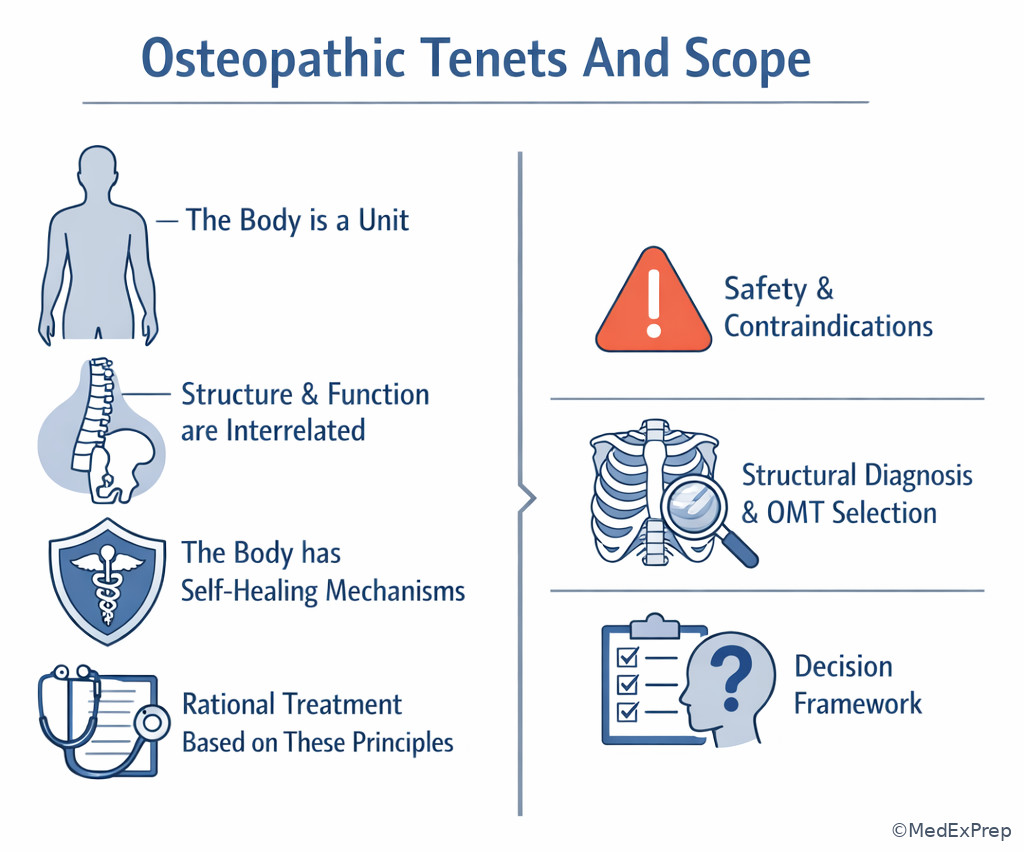
Why it matters
- NBOME-style stems often test judgment before technique: the best answer may be to diagnose, defer, or refer rather than manipulate.
- Osteopathic tenets are rarely tested as pure memorization; they are tested through application to patient findings, safety, and treatment choice.
- Early course topics set the logic for everything that follows: structural diagnosis, TART, biomechanics, and modality selection all assume you understand what OMT is for and when it is not appropriate.
- Misreading scope leads to classic misses: choosing HVLA in an unsafe patient, inventing missing findings, or answering like an attending instead of a supervised trainee.
Key Terms & Must-Know Facts
1.1.1.1 Key terms
- Osteopathic tenets — framework linking body unity, structure-function relationship, self-regulation, and rational treatment.
- Somatic dysfunction — impaired or altered function of body framework components; covered in depth next lesson.
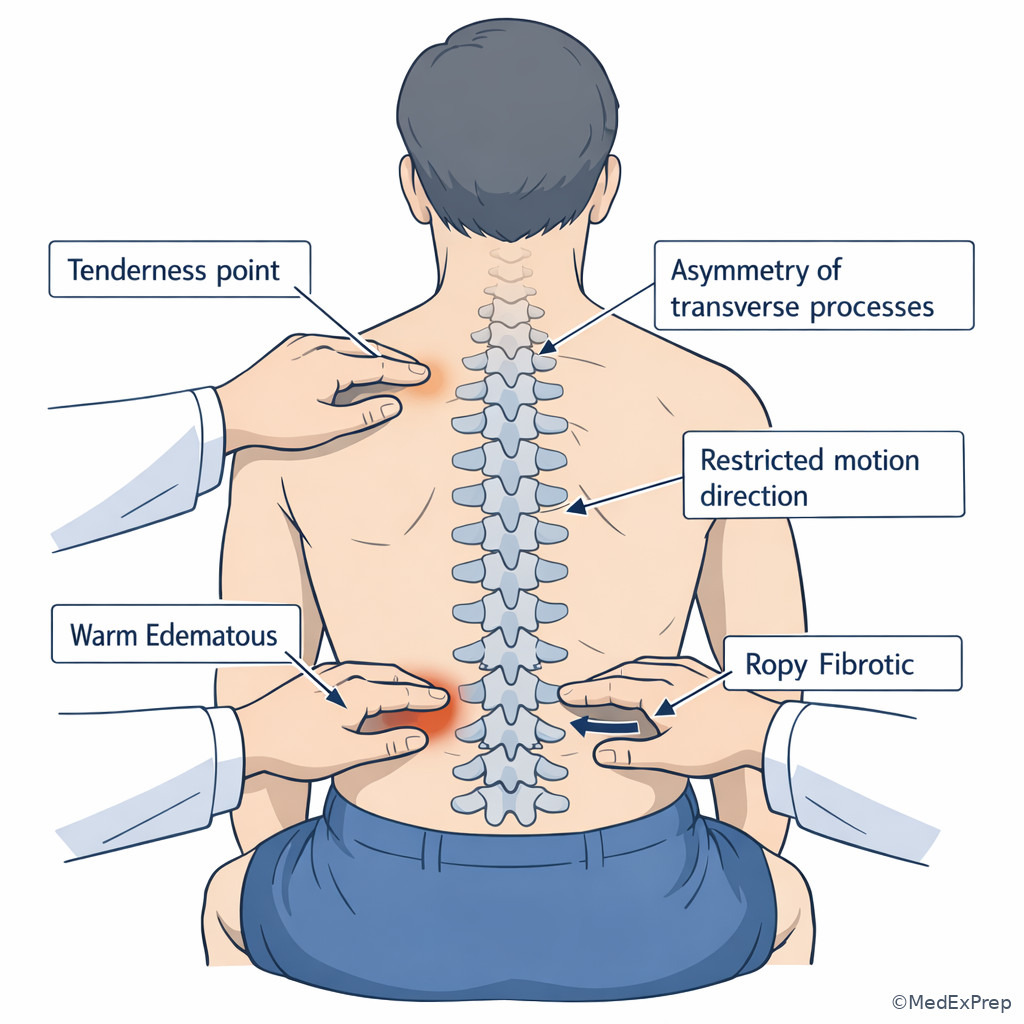
- TART — tenderness, asymmetry, restriction, tissue texture changes.
- Structural diagnosis — osteopathic naming of dysfunction based on exam findings.
- OMT — osteopathic manipulative treatment used to improve physiologic function and support homeostasis.
- Direct technique — engages restrictive barrier.
- Indirect technique — positions away from restrictive barrier toward ease.
- Absolute contraindication — manipulation should not be performed because risk outweighs benefit.
- Relative contraindication — manipulation may be modified or deferred based on risk, setting, and technique.
- TART localization — using palpatory findings to identify region and dysfunction.
- Red flag — fracture, instability, infection, malignancy, acute neurologic deficit, vascular compromise, or similar danger sign.
- Best next step — the exam’s preferred action given available information and safety constraints.
1.1.1.2 Must-know facts
- The exam tests application of tenets more often than verbatim recitation.
- If a stem includes a major red flag, the safest answer is often defer OMT and escalate evaluation.
- You should not invent missing motion findings, imaging, or labs.
- OMT is part of whole-patient care, not a replacement for urgent evaluation when instability is possible.
- Board-style OMM questions reward diagnose first, treat second, verify safety always.
- Scope matters: answer as a learner using osteopathic reasoning, not as an unsupervised attending making unrestricted management decisions.
- Technique selection depends on both diagnosis and contraindications.
- Direct vs indirect language becomes essential in later modality questions.
Exam takeaway: Start with the task and safety screen before choosing diagnosis or treatment.
flowchart TD
A[Read the stem] --> B{What is being asked?}
B -->|Diagnosis| C[Extract TART and motion findings]
B -->|Treatment| D[Confirm diagnosis first]
B -->|Next step| E[Screen for red flags and scope]
C --> F[Name dysfunction using standard terms]
D --> E
E -->|Unsafe or uncertain| G[Defer OMT / escalate evaluation]
E -->|Safe and clear| H[Choose appropriate OMT approach]
See Fig 1 for the core sequence that should anchor your thinking on every lesson that follows.
Core content
1.1.1.3 Foundational osteopathic tenets: what the exam is really asking
A Explanation
On exams, the conflict is rarely “Can you list the tenets?” The real conflict is: Should you treat the patient as a body part with an isolated lesion, or as an integrated system where structure, function, and self-regulation matter? The resolving rule is that osteopathic reasoning asks you to connect symptoms, structure, physiology, and patient context before choosing intervention.
The traditional tenets can be operationalized for questions:
- Body unity: symptoms in one region may relate to compensatory patterns or systemic disease.
- Self-regulation and self-healing: OMT aims to remove impediments, not to override basic medical judgment.
- Structure and function are interrelated: abnormal mechanics can alter function, and altered function can produce structural findings.
- Rational treatment is based on these principles: diagnosis, treatment, and safety should be integrated.
WHY THIS IS TESTED: The testable pattern is whether you can translate philosophy into a practical answer choice. If one option treats a painful segment in isolation while another accounts for the patient’s history, contraindications, and whole-body mechanics, the broader osteopathic option is usually preferred.
Exam takeaway: Translate each tenet into a practical decision about diagnosis, safety, or treatment choice.
See Fig 2 when a question looks philosophical but is actually asking for your next action.
B Worked example
A 42-year-old woman presents with thoracolumbar tightness after a long desk-work week. She also has rheumatoid arthritis and chronic prednisone use. She asks whether “a quick adjustment” can be done today because she had good relief years ago. She mentions mild fatigue from a recent viral illness, and the stem notes focal midline tenderness after a minor fall 2 days ago. The task asks for the most appropriate next step.
Reasoning chain: Identify task: next step, not naming a technique. Extract key facts: chronic steroid use raises fracture risk; rheumatoid arthritis increases concern for instability in some settings; recent fall plus focal midline tenderness is a red flag. Apply rule: osteopathic tenets support whole-patient reasoning, but rational treatment includes not manipulating when safety is uncertain. Eliminate distractors: the tempting wrong answer is immediate HVLA because prior relief and “tightness” suggest a biomechanical complaint. Verify: the single most important clue is recent trauma with focal tenderness in a high-risk patient. Best answer: defer manipulation and obtain further evaluation.
C Exam trap
D Checkpoint
Question: A 27-year-old man presents with upper back discomfort after increased weightlifting. He is otherwise healthy and asks for OMT. The stem provides no neurologic deficits, no trauma, and no systemic symptoms. Which principle best supports proceeding with focused structural evaluation before choosing treatment?
- Body unity and rational treatment — Tempting because both are broad principles; correct because the stem asks you to integrate the complaint with an osteopathic exam before selecting technique.
- Self-regulation alone — Tempting because OMT often supports healing; wrong because self-healing does not replace structural assessment.
- Structure-function relationship alone — Tempting because musculoskeletal symptoms suggest mechanics; wrong because the best answer must also include the treatment logic piece.
- Immediate treatment based on symptom location — Tempting because localized pain invites a local fix; wrong because diagnosis precedes treatment on osteopathic questions.
Answer: A
1.1.1.4 Scope, trainee role, and safety boundaries
A Explanation
This section is about the conflict between doing something osteopathic and doing something safe and within scope. The rule that resolves it is simple: if the stem suggests danger, uncertainty, or a task outside learner role, choose the option that defers manipulation, seeks clarification, or escalates care.
On NBOME-style questions, scope errors commonly occur in three ways:
- The learner answers like an unsupervised attending and selects definitive management unrelated to the OMM task.
- The learner ignores an absolute contraindication because the technique itself looks familiar.
- The learner invents missing findings to justify a preferred diagnosis or treatment.
Examples of out-of-role signals include operative planning, independent admission management, or specialty interventions that go beyond the educational OMM task. By contrast, actions like focused osteopathic assessment, naming somatic dysfunction, selecting an appropriate modality, or recommending further evaluation when red flags are present remain in scope.
WHY THIS IS TESTED: The testable pattern is whether you can recognize that patient welfare and contraindication screening take priority over “finishing the technique.” Safety is not separate from osteopathic reasoning; it is part of rational treatment.
Exam takeaway: When red flags or out-of-role tasks appear, the safest educational answer is to defer OMT and escalate appropriately.
Exam takeaway: A red flag or unstable scenario changes the best answer from manipulation to evaluation or escalation.
flowchart TD
A[Patient asks for OMT] --> B{Any red flag or major uncertainty?}
B -->|Yes| C[Stop and defer manipulation]
C --> D[Further evaluation / referral / urgent care]
B -->|No| E{Is the task within learner OMM scope?}
E -->|No| D
E -->|Yes| F[Make structural diagnosis]
F --> G[Choose safest appropriate modality]
See Fig 3 for the most important exam-saving branch in this lesson.
B Worked example
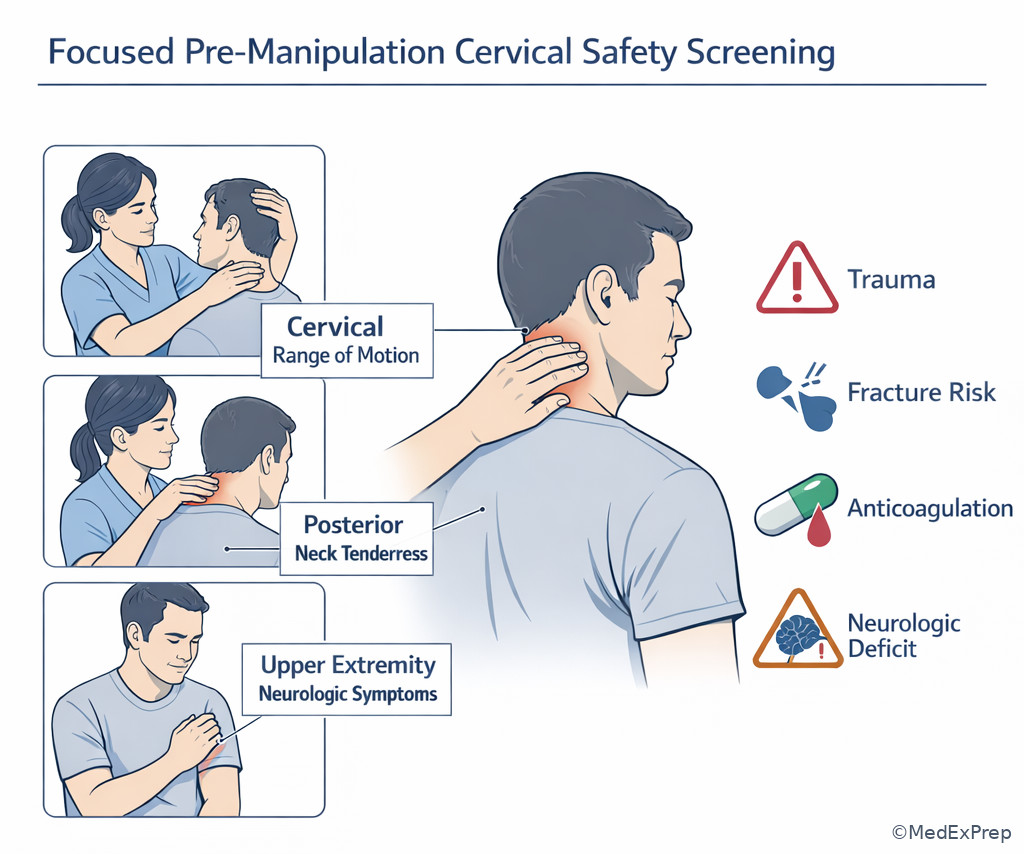
A 68-year-old man presents with neck stiffness and headache after backing his car into a pole yesterday. He has osteoporosis, atrial fibrillation on anticoagulation, and remote cervical spondylosis. He requests “a neck adjustment.” He also reports chronic seasonal sinus pressure, which is offered as a distracting clue. Exam notes limited cervical motion and new hand numbness. The stem asks for the best initial approach.
Reasoning chain: Identify task: best initial approach. Extract key facts: age, osteoporosis, anticoagulation, recent trauma, new neurologic symptom. Apply rule: do not choose manipulative treatment in a potentially unstable or neurologically evolving patient. Eliminate distractors: sinus pressure may tempt lymphatic or cranial reasoning; cervical stiffness may tempt soft tissue or muscle energy. Verify: new hand numbness after trauma is the discriminating clue. Best answer: defer cervical OMT and obtain urgent further evaluation.
C Exam trap
D Checkpoint
Question: A 35-year-old woman presents with low back pain after lifting boxes. She has no fever, no trauma, no weakness, and no bowel or bladder symptoms. Which finding would most strongly change the best answer from osteopathic structural evaluation to deferring OMT?
- Paraspinal tenderness after activity — Tempting because tenderness is common in back pain; wrong because this supports routine structural assessment.
- Pain improved by rest — Tempting because it sounds nonspecific; wrong because it does not create a contraindication.
- New saddle anesthesia — Tempting because it may be overlooked as neurologic detail; correct because it signals possible severe neurologic compromise requiring urgent evaluation.
- History of prior OMT benefit — Tempting because positive response may influence treatment; wrong because it does not by itself determine today’s safety.
Answer: C
- True or False: Prior benefit from OMT makes current manipulation appropriate even after new trauma. False.
- The best answer changes from treatment to escalation when the stem adds a red flag or instability concern.
- Name 3 stop-sign clues: fracture risk, acute neurologic deficit, infection/systemic concern.
1.1.1.5 How exam stems frame structural diagnosis, even before TART
A Explanation
At this stage, the conflict is: Do you need a complete named somatic dysfunction now, or are you being asked to recognize the kind of information required before diagnosis? The rule is that structural diagnosis depends on objective exam findings, not symptom location alone. Pain in a region is not the same thing as a diagnosed dysfunction.
This matters because many foundational questions present vague symptoms, then ask for the best osteopathic next step. Before you can choose a technique, you need exam findings that localize dysfunction. The upcoming lessons will formalize somatic dysfunction and TART, but even now you should know the hierarchy:
- Chief complaint suggests a region or system.
- Palpatory and motion findings localize dysfunction.
- Standard terminology names the dysfunction.
- Diagnosis guides treatment setup.
WHY THIS IS TESTED: The exam often tempts you to skip from pain complaint directly to treatment choice. The tested skill is recognizing when the stem has not yet given enough information to justify a specific diagnosis or technique.
Exam takeaway: Symptoms point you toward a region, but only exam findings allow a standard structural diagnosis.
Exam takeaway: Use region-specific landmarks and palpation targets to move from symptoms to testable dysfunction findings.
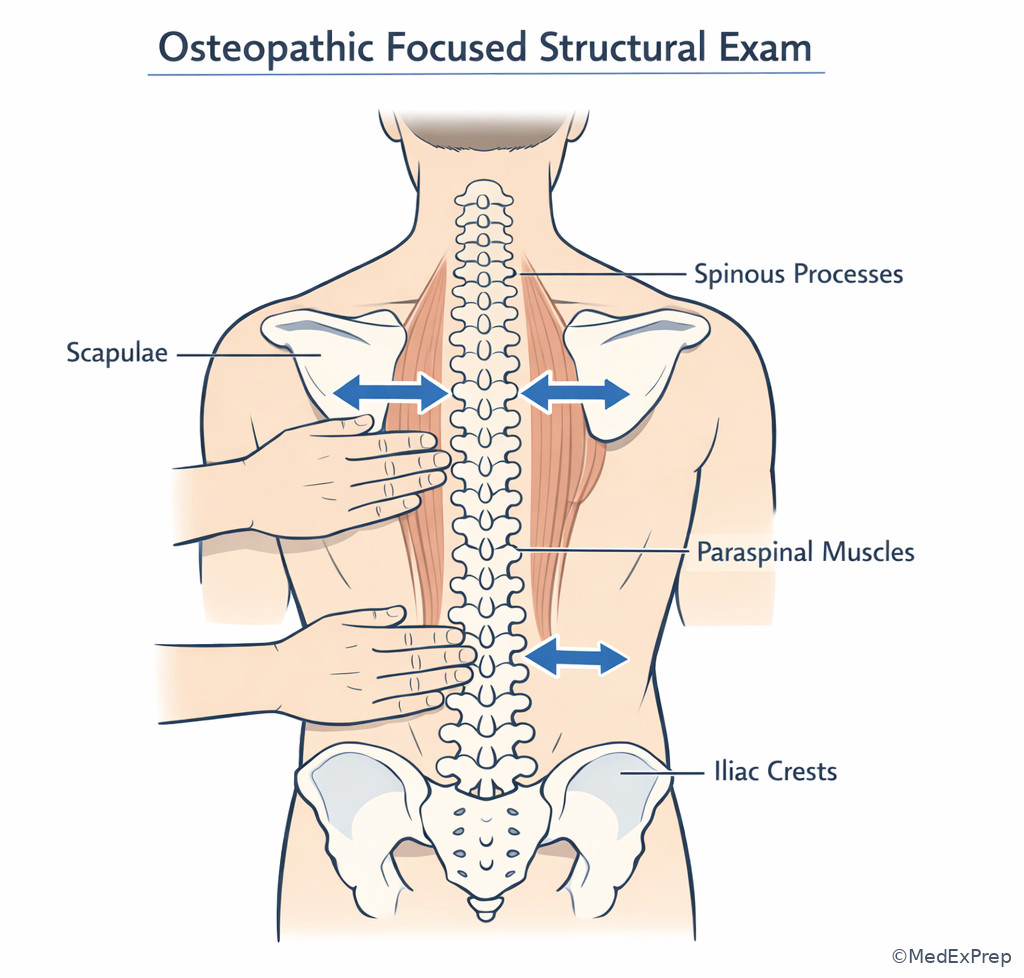
B Worked example
A 23-year-old graduate student presents with “rib pain” after a persistent cough from a recent URI. She has mild asthma and generalized anxiety. The stem notes soreness near the lateral chest wall and shallow breathing due to discomfort, but provides no rib angle asymmetry, respiratory-phase findings, or motion restriction. It asks for the most appropriate osteopathic next step.
Reasoning chain: Identify task: next step. Extract key facts: symptom region is rib cage, but diagnostic findings are incomplete. Apply rule: do not jump to naming an inhalation or exhalation dysfunction without motion data. Eliminate distractors: a tempting answer is “diagnose exhaled rib” because cough commonly produces rib issues; another tempting answer is “first rib dysfunction” because asthma sounds respiratory. Verify: the missing discriminator is actual structural exam findings. Best answer: perform a focused structural exam to localize dysfunction before selecting treatment.
C Exam trap
D Checkpoint
Question: A stem says a patient has neck pain after studying and asks for the best osteopathic next step. No motion testing or TART findings are provided. Which answer is best?
- Diagnose C3 ERRSR — Tempting because students expect a specific diagnosis; wrong because the stem lacks motion findings.
- Perform focused structural exam of the symptomatic region — Tempting because it feels less definitive; correct because diagnosis requires exam evidence.
- Use HVLA because the patient is young — Tempting because age suggests low risk; wrong because treatment selection still requires diagnosis and safety screen.
- Assume muscle strain and avoid osteopathic assessment — Tempting because studying posture is common; wrong because OMM questions usually want structured assessment unless red flags are present.
Answer: B
1.1.1.6 Choosing among osteopathic options: diagnose, treat, recheck, or defer
A Explanation
Now the conflict becomes more practical: When several osteopathic-sounding options appear, how do you choose among diagnosing, treating, reassessing, or deferring? The single resolving rule is to match the action to the information already available in the stem.
Use this sequence:
- If the stem lacks enough exam data, diagnose further.
- If the diagnosis is clear and safety is established, choose treatment.
- If treatment has already occurred, predict reassessment findings.
- If red flags or contraindications appear, defer and escalate.
This seems obvious, but it is one of the most common ways students miss introductory OMM items. Distractors are often all “osteopathic” in tone; only one fits the stage of the encounter. See Fig 1 again for the underlying sequence, and use Fig 3 whenever safety threatens to derail a technique question.
WHY THIS IS TESTED: Board stems often compress multiple possible actions into one snapshot. The exam is testing whether you know what comes first.
Exam takeaway: The right osteopathic answer depends on whether the stem gives enough findings and whether it remains safe to act.
See Fig 4 for the most useful “what comes next?” branch point.
B Worked example
A 31-year-old postpartum woman presents with sacroiliac discomfort when lifting her infant. She has mild iron-deficiency anemia and a history of migraines. The stem provides asymmetric pelvic landmarks and restricted motion findings, and asks for the best initial OMT approach. There is no trauma, fever, or neurologic deficit. A distractor mentions mild sinus congestion from poor sleep.
Reasoning chain: Identify task: treatment approach, not diagnosis gathering. Extract key facts: the stem already provides structural findings and no red flags. Apply rule: when diagnosis is supplied and safety is adequate, choose treatment rather than asking for more exam data. Eliminate distractors: “obtain imaging first” is tempting because postpartum patients can have pelvic pain; “perform more structural testing” is tempting because OMM students are trained to gather data. Verify: the discriminating clue is the stem already gave the relevant dysfunction findings. Best answer: choose the appropriate OMT approach.
C Exam trap
D Checkpoint
Question: Which stem is most likely asking you to defer rather than diagnose further?
- Back pain with no motion findings provided — Tempting because the stem is incomplete; wrong because this calls for more structural exam, not automatic deferral.
- Neck pain with recent trauma and new unilateral arm weakness — Tempting because weakness could be from pain guarding; correct because trauma plus neurologic deficit is a red flag.
- Rib pain after cough with missing respiratory-phase findings — Tempting because it feels clinically specific; wrong because it still mainly needs diagnostic clarification.
- Pelvic discomfort with complete landmark findings and no red flags — Tempting because pelvic questions can feel complex; wrong because this calls for diagnosis-based treatment choice.
Answer: B
- If the stem gives symptoms but no exam findings, the next step is usually focused structural exam.
- If the stem gives diagnosis-level findings and no red flags, the next step is usually treatment selection.
- True or False: Missing data and dangerous data are the same problem. False.
1.1.1.7 Forward map: how this foundation connects to somatic dysfunction and TART
A Explanation
The final integration question is: Why learn tenets and scope before mechanics? Because every later OMM decision assumes you know what counts as a legitimate dysfunction, what findings localize it, and when treatment should stop. The single rule here is that philosophy without palpatory application is too vague, while technique without safety and diagnostic logic is unsafe.
In the next lessons, somatic dysfunction gives you the formal target of osteopathic diagnosis, and TART gives you the observable pattern that supports naming it. This topic therefore functions as the “meta-rule” layer:
- Tenets tell you why osteopathic assessment matters.
- Somatic dysfunction tells you what you are diagnosing.
- TART tells you how you recognize it.
- Biomechanics and modality lessons tell you how to act on it safely.
WHY THIS IS TESTED: Foundational questions often seem easy but drive later accuracy. If you cannot tell whether the stem is asking for philosophy, diagnosis, safety screening, or treatment choice, later biomechanics questions become much harder than they need to be.
Exam takeaway: Tenets guide the purpose of care, while somatic dysfunction and TART provide the findings needed for board-style diagnosis and OMT choice.
See Fig 5 as the roadmap for the next several course topics.
B Worked example
A 19-year-old soccer player presents with neck and upper thoracic soreness after practice. She has mild scoliosis noted since adolescence and recent stress-related insomnia. The stem asks which additional exam information would be most important before selecting OMT. A tempting clue is that she “usually gets relief from massage.”
Reasoning chain: Identify task: what additional information is needed before OMT selection. Extract key facts: there is a complaint but not yet a structural diagnosis. Apply rule: treatment choice follows diagnosis, and diagnosis requires exam findings. Eliminate distractors: prior response to massage, duration of insomnia, and chronic scoliosis are contextual but not the key discriminator. Verify: the most important missing information is palpatory and motion findings that would establish somatic dysfunction and TART pattern.
C Exam trap
D Checkpoint
Question: Which statement best captures the relationship among this lesson and the next two upcoming lessons?
- This lesson replaces the need for TART because philosophy alone guides treatment — Tempting because tenets feel broad and important; wrong because later diagnosis still depends on exam findings.
- This lesson sets the framework, while somatic dysfunction and TART provide the concrete diagnostic evidence — Tempting because it sounds layered; correct because that is exactly how these topics connect.
- Somatic dysfunction is only relevant after a treatment is chosen — Tempting because learners may think dysfunction names are optional; wrong because diagnosis precedes treatment.
- TART is primarily a contraindication checklist — Tempting because safety is emphasized early; wrong because TART localizes dysfunction rather than serving as the main contraindication screen.
Answer: B
Exam Traps & Differentiators
- Most common wrong answer and why: choosing an osteopathic technique when the stem is really testing safety. This is tempting because the entire question appears to live in an OMM context, but the single eliminator is a red flag such as trauma, acute neurologic change, fever, or suspected instability.
- Second common wrong answer and why: naming a specific dysfunction from pain location alone. This is tempting because experienced students recognize stereotyped patterns, but the eliminator is the absence of palpatory or motion findings.
- Third common wrong answer and why: acting like an unsupervised attending. This is tempting because some options sound decisive and medically comprehensive, but the eliminator is that the educational task stays within trainee-level osteopathic reasoning.
| Looks similar | But actually means | Discriminating clue |
|---|---|---|
| Incomplete stem | Need more structural exam | No TART or motion data provided |
| Unsafe stem | Defer OMT and escalate | Red flag like trauma, deficit, infection, instability |
| Localized pain | Symptom region only | Still not a named dysfunction |
| Prior OMT benefit | Historical context only | Does not override current contraindication concern |
| Gentler modality option | Possible alternative only if manipulation is still appropriate | Some red flags exclude routine OMT entirely until evaluated |
| If the stem says... | Think... |
|---|---|
| “Most appropriate next step” with limited exam detail | Focused structural exam before naming diagnosis |
| “Best initial therapy” after a complete structural description | Choose modality or setup if safe |
| Recent trauma plus focal tenderness or neurologic change | Defer OMT; evaluate for serious pathology |
| Request for “adjustment” but concerning history | Safety outranks patient preference |
| Option asks you to invent findings not provided | Reject it; stay within the stem |
| Broad philosophy language in answer choices | Pick the option that changes management, not the one that sounds poetic |
Related future traps from neighboring topics: in Somatic Dysfunction Definition, the confusion will be symptom versus dysfunction; in TART Findings Pattern, the confusion will be recognizing which palpatory features actually localize the dysfunction. Those topics build directly on the distinction made here.
Exam takeaway: Separate missing data, sufficient data, and danger signals before choosing an osteopathic answer.
flowchart LR
A[OMM answer choices] --> B{Which problem is present?}
B -->|Missing findings| C[Do more structural exam]
B -->|Adequate findings| D[Choose diagnosis or treatment]
B -->|Danger signal| E[Defer OMT / escalate]
C --> F[Avoid overcalling dysfunction]
D --> G[Use standard terminology]
E --> H[Safety first]
See Fig 6 when all four choices sound plausible but represent different stages of reasoning.
Tables
| Reference point | High-yield rule | Why it matters on exam day |
|---|---|---|
| Body unity | Do not isolate one painful spot from the rest of the patient | Supports integrated answer choices over narrow local-only reasoning |
| Structure-function relationship | Mechanical findings can affect symptoms and physiology | Justifies structural exam and diagnosis |
| Self-regulation | OMT supports physiology by removing impediments | Prevents overclaiming OMT as a substitute for urgent medical evaluation |
| Rational treatment | Treat only after diagnosis and safety screening | Most testable tenet in practical stems |
| Scope | Answer as supervised trainee using osteopathic reasoning | Blocks out-of-role choices |
| Contraindication logic | Red flags override desire to manipulate | Prevents unsafe technique selection |
| Situation | Choose | Reject |
|---|---|---|
| Complaint without palpatory or motion findings | Focused structural exam | Specific diagnosis or setup |
| Diagnosis-level findings present; no red flags | Appropriate OMT modality selection | Unnecessary escalation or repeated generic exam |
| Recent trauma with focal tenderness | Defer OMT and evaluate further | Immediate manipulation |
| New neurologic deficit | Escalate | Routine office OMT |
| Question asks expected reassessment finding | Predict improved restriction/TART pattern | Re-diagnose from scratch |
| Option requires inventing unstated findings | Stay within stem evidence | Assumptive diagnosis |
| Category | Typical clue | Best next move | Common trap |
|---|---|---|---|
| Foundational principle question | Broad wording about osteopathic care or patient context | Select principle tied to action | Picking the most abstract phrase |
| Structural diagnosis precursor | Symptom only, incomplete exam | Obtain focused structural findings | Jumping to named dysfunction |
| Routine OMT selection | Clear dysfunction and safe context | Choose modality/setup | Over-ordering tests without indication |
| Safety/contraindication question | Trauma, fever, malignancy, acute neurologic deficit | Defer OMT and escalate | Switching to a “gentler” technique instead of stopping |
| Scope question | Option asks for attending-level independent management | Choose learner-safe osteopathic or escalation answer | Rewarding the most aggressive plan |
Algorithm / Approach
Exam takeaway: Visible trauma cues and neurologic findings should trigger defer-and-escalate reasoning before any technique choice.
Exam takeaway: Tenderness, asymmetry, restriction, and tissue texture change form the practical bridge from symptoms to structural diagnosis.
Rapid Review
- Osteopathic tenets → tested as decisions, not just memorized phrases
- Body unity → reject isolated local-only reasoning when systemic context matters
- Structure-function → mechanical findings justify focused osteopathic exam
- Self-regulation → supports OMT, does not replace urgent medical evaluation
- Rational treatment → diagnosis and safety come before technique
- Symptom location → points to region, not final dysfunction name
- Missing findings → choose more structural exam, not speculative diagnosis
- Red flag present → safest answer often defer OMT and escalate
- Prior OMT benefit → historical support only, not a current safety override
- Gentler technique option → still wrong if the patient is unsafe for manipulation
- Trainee role → choose supervised, learner-safe osteopathic reasoning
- Invented data → never acceptable to rescue a preferred answer
- Diagnosis supplied in stem → move to treatment or reassessment, not back to generic exam
- Upcoming lessons → somatic dysfunction defines the target; TART provides the evidence
Self-check quiz
1. A 24-year-old man presents with upper back soreness after rowing practice. He has no trauma, no neurologic deficits, and no systemic symptoms. The stem asks which osteopathic principle best supports performing a focused structural exam before choosing treatment. What is the most appropriate answer?
- Body unity and rational treatment
- Immediate direct technique based on pain location
- Self-regulation alone
- Prior response to stretching
2. A 29-year-old woman presents with neck discomfort after a week of computer work. She has migraine history and mild seasonal allergies. No motion testing or palpatory findings are provided. What is the most appropriate next step?
- Diagnose a specific cervical dysfunction
- Perform focused structural exam to obtain findings
- Select HVLA because she is young
- Assume uncomplicated strain and avoid osteopathic assessment
3. A 64-year-old woman presents with lumbar pain after slipping in her garden yesterday. She has osteoporosis, type 2 diabetes, and chronic steroid use for polymyalgia rheumatica. Exam notes focal midline tenderness. She requests OMT because it helped years ago. What is the most appropriate next step?
- Perform gentle indirect OMT because it is safer than HVLA
- Proceed with soft tissue treatment, then reassess
- Defer OMT and obtain further evaluation for possible fracture
- Diagnose somatic dysfunction from history alone and schedule treatment later
4. A 22-year-old runner presents with lateral rib pain after a recent cough illness. She has mild asthma and iron-deficiency anemia. The stem gives pain location but no rib angle asymmetry, respiratory-phase preference, or motion findings. Which action is most appropriate?
- Diagnose an exhalation dysfunction because cough is common
- Diagnose a first rib dysfunction because asthma is present
- Perform focused rib structural exam before naming dysfunction
- Defer all osteopathic evaluation because chest wall pain is nonspecific
5. A 33-year-old postpartum woman presents with sacroiliac discomfort while carrying her infant. She has complete pelvic landmark findings in the stem, no trauma, and no neurologic deficits. Which is the most appropriate board-style approach?
- Order imaging before any osteopathic reasoning because postpartum pain can be serious
- Perform a generic structural exam because a diagnosis has not yet been supplied
- Choose an appropriate OMT modality because the stem already provides the relevant findings
- Defer OMT because postpartum status alone is a contraindication
6. A 70-year-old man presents with neck pain after a minor motor vehicle collision this morning. He has osteoporosis, atrial fibrillation on apixaban, and chronic cervical spondylosis. He reports tingling in the right hand but says his pain feels “just like my old stiffness.” Which is the most appropriate initial approach?
- Use indirect cervical OMT because it avoids the restrictive barrier
- Use soft tissue first because chronic spondylosis explains the symptoms
- Defer cervical OMT and obtain urgent further evaluation
- Perform a focused structural exam, then decide on modality
7. A 26-year-old medical student presents with thoracic tightness during exam week. He has no trauma, fever, or neurologic deficits. He also reports occasional reflux and poor sleep. The stem asks for the most appropriate next step, but provides only symptom location and no TART findings. Which choice is best?
- Diagnose thoracic somatic dysfunction and choose muscle energy
- Perform focused structural exam to localize dysfunction
- Defer OMT because reflux suggests a visceral cause
- Perform HVLA because the patient is young and otherwise healthy
8. A 58-year-old woman presents with low back pain and requests the “same treatment as last year.” She has breast cancer in remission, recent unintentional weight loss, and worsening night pain over 3 weeks. She has no known acute trauma. The stem asks for the most appropriate next step from an osteopathic perspective. Which answer is best?
- Repeat the prior successful OMT because recurrence of musculoskeletal pain is common
- Use indirect treatment because malignancy history mainly contraindicates direct techniques
- Perform focused lumbar structural exam first because prior diagnosis is not provided
- Defer OMT and escalate evaluation for a concerning nonmechanical process
Answer key
1.1.1.8 1. Question 1
Correct answer: A. Body unity and rational treatment. The mechanism-to-treatment logic is that osteopathic principles support integrating the patient’s complaint into a whole-person assessment and choosing treatment only after appropriate diagnosis. This is the best principle pair for a stem asking why structural evaluation comes before technique. Source: American Osteopathic Association and Savarese emphasize that osteopathic principles guide diagnosis and treatment planning rather than bypassing them.
- A. Tempting because it sounds broad, but it is correct for this scenario: body unity frames whole-patient assessment, and rational treatment explains why the structural exam comes before intervention. Single clue: the stem asks what supports performing an exam before choosing treatment.
- B. Tempting because localized pain invites a local technique answer, but incorrect because symptom location alone does not justify immediate direct treatment. Single clue: no diagnosis has yet been established.
- C. Tempting because self-regulation is a familiar tenet, but incorrect because it does not specifically explain the sequence of exam before treatment. Single clue: the question is about workflow, not healing capacity.
- D. Tempting because prior response to conservative care can influence context, but incorrect because it is not an osteopathic tenet and does not justify today’s decision. Single clue: the stem asks for a principle, not a historical detail.
1.1.1.9 2. Question 2
Correct answer: B. Perform focused structural exam to obtain findings. The mechanism-to-treatment logic is that structural diagnosis requires palpatory or motion evidence; without it, treatment selection is premature. Source: Savarese and standard OMM teaching frameworks emphasize diagnosis from findings rather than from symptom labels alone.
- A. Tempting because cervical questions often end with a named diagnosis, but incorrect because no motion testing or TART data are provided. Single clue: the stem explicitly lacks exam findings.
- B. Tempting because it is less flashy than a diagnosis, and correct because it is the proper next step when data are incomplete. Single clue: absent palpatory/motion findings.
- C. Tempting because a young patient seems lower risk, but incorrect because safety alone does not replace diagnostic sufficiency. Single clue: no diagnosis has been earned yet.
- D. Tempting because posture-related pain is common, but incorrect because the question remains an osteopathic assessment task, not a reason to skip evaluation. Single clue: no red flags are present.
1.1.1.10 3. Question 3
Correct answer: C. Defer OMT and obtain further evaluation for possible fracture. The mechanism-to-treatment logic is that recent trauma, osteoporosis, steroid use, and focal midline tenderness create a fracture concern that makes manipulation inappropriate until serious pathology is excluded. Source: standard OMM safety teaching and AOA principles prioritize contraindication screening before treatment.
- A. Tempting because indirect OMT is often safer than HVLA, but incorrect because this patient may be unsafe for manipulation in general until fracture is excluded. Single clue: focal midline tenderness after a fall in a high-risk patient.
- B. Tempting because soft tissue feels gentle and practical, but incorrect for the same reason: possible fracture changes the best next step. Single clue: recent trauma plus osteoporosis and steroids.
- C. Tempting because it may feel less “osteopathic,” but correct because rational osteopathic care includes stopping when red flags are present. Single clue: fracture risk profile.
- D. Tempting because history may suggest a musculoskeletal process, but incorrect because history alone cannot safely establish a benign dysfunction here. Single clue: dangerous current context overrides prior patterns.
1.1.1.11 4. Question 4
Correct answer: C. Perform focused rib structural exam before naming dysfunction. The mechanism-to-treatment logic is that rib dysfunction diagnosis requires motion and respiratory-phase findings, not just symptom location and a common precipitating history. Source: Savarese; standard rib diagnosis teaching emphasizes respiratory-phase motion testing.
- A. Tempting because cough commonly produces exhalation dysfunctions in review questions, but incorrect because no motion findings are provided. Single clue: missing respiratory-phase data.
- B. Tempting because asthma makes first-rib mechanics a familiar distractor, but incorrect because first-rib diagnosis also requires exam findings. Single clue: no specific upper rib landmark or motion detail.
- C. Tempting because it delays naming the lesion, and correct because the stem is under-specified for a final diagnosis. Single clue: absence of structural data.
- D. Tempting because chest wall pain can have a broad differential, but incorrect because the stem does not provide red flags requiring immediate deferral. Single clue: lack of danger signs.
1.1.1.12 5. Question 5
Correct answer: C. Choose an appropriate OMT modality because the stem already provides the relevant findings. The mechanism-to-treatment logic is that once the structural diagnosis is adequately supported and no red flags are present, the encounter stage shifts from diagnosis gathering to modality selection. Source: standard OMM problem-solving sequence in Savarese and osteopathic curricula.
- A. Tempting because postpartum pelvic pain can be serious in some contexts, but incorrect because this stem does not provide red flags requiring imaging first. Single clue: no trauma, no neurologic deficit, and complete structural findings.
- B. Tempting because “more exam” feels careful, but incorrect because the needed data are already supplied. Single clue: complete pelvic landmark findings in the stem.
- C. Tempting because it requires trusting the provided data, and correct because the encounter is now at the treatment-selection stage. Single clue: diagnosis-level information is present.
- D. Tempting because postpartum status changes biomechanics, but incorrect because postpartum status alone is not a blanket contraindication. Single clue: absence of specific danger signals.
1.1.1.13 6. Question 6
Correct answer: C. Defer cervical OMT and obtain urgent further evaluation. The mechanism-to-treatment logic is that trauma, osteoporosis, anticoagulation, and new neurologic symptoms raise concern for dangerous cervical pathology; manipulation should not proceed before evaluation. Source: standard OMM contraindication principles and learner-safe clinical reasoning.
- A. Tempting because indirect cervical methods are gentler, but incorrect because the issue is not directness—it is unsafe context. Single clue: right-hand tingling after a motor vehicle collision.
- B. Tempting because chronic spondylosis could explain stiffness, but incorrect because the stem adds acute trauma and a neurologic change, which are more important. Single clue: “this morning” plus new tingling.
- C. Tempting because it may seem less satisfying than an OMT action, and correct because red flags override routine technique selection. Single clue: trauma with neurologic symptom in a high-risk patient.
- D. Tempting because focused structural exam often precedes treatment, but incorrect because the patient first requires evaluation for serious pathology rather than routine manipulative assessment. Single clue: acute neurologic symptom after trauma.
1.1.1.14 7. Question 7
Correct answer: B. Perform focused structural exam to localize dysfunction. The mechanism-to-treatment logic is that this is a benign-appearing musculoskeletal stem without red flags, but it still lacks the findings needed for a named diagnosis or modality. Source: Savarese and standard structural diagnosis teaching.
- A. Tempting because thoracic tightness in a stressed student sounds familiar, but incorrect because no TART findings are given. Single clue: symptom location only.
- B. Tempting because it is methodical rather than definitive, and correct because it matches the stage of the encounter. Single clue: no structural findings have been provided.
- C. Tempting because reflux introduces a visceral possibility, but incorrect because occasional reflux without red flags does not displace an OMM structural evaluation. Single clue: no systemic danger signs.
- D. Tempting because youth and health make HVLA seem reasonable, but incorrect because treatment selection still requires diagnosis. Single clue: absence of diagnostic findings.
1.1.1.15 8. Question 8
Correct answer: D. Defer OMT and escalate evaluation for a concerning nonmechanical process. The mechanism-to-treatment logic is that malignancy history, weight loss, and worsening night pain suggest a potentially serious nonmechanical cause; osteopathic care is not ignored, but manipulation is deferred while concerning pathology is evaluated. Source: OMM safety principles and standard red-flag back pain teaching integrated into osteopathic decision-making.
- A. Tempting because prior success makes recurrence sound routine, but incorrect because current alarm features change the problem. Single clue: recent weight loss and night pain.
- B. Tempting because indirect treatment is often safer, but incorrect because concerning malignancy-related features call for evaluation rather than routine manipulation. Single clue: cancer history plus constitutional concern.
- C. Tempting because no structural exam findings are provided, but incorrect because the main issue is not incomplete mechanical data—it is red-flag history. Single clue: nonmechanical warning pattern.
- D. Tempting because it may feel less OMT-specific, and correct because rational osteopathic treatment begins by recognizing when OMT should wait. Single clue: malignancy history with concerning symptom progression.
Keep going with the full OMM / OMT Review Prep Course (OMM)
You just studied the way members do, in the same lesson interface. Full access unlocks every lesson, the question bank and flashcards for a full year.
One payment · 1 year of access · No auto-renewal