1.1.1 - AEMT Scope Boundaries
Why it matters
- Many NREMT stems reward the candidate who picks the best AEMT-level action, not the most advanced action imaginable.
- Scope questions are often disguised as airway, shock, cardiology, or refusal questions; the hidden task is deciding whether to intervene, assist, request ALS, or transport.
- A wrong answer is often tempting because it is clinically sophisticated but belongs to a paramedic, nurse, or physician rather than an AEMT.
- Safe scope decisions protect the patient, the crew, and your certification by pairing appropriate care with timely escalation and documentation.
Key Terms & Must-Know Facts
1.1.1.1 Key terms
- Scope of practice - legal/credential-level range of actions permitted for an AEMT
- Local protocol - jurisdiction-specific rule set that authorizes or restricts treatments
- Medical direction - physician oversight, offline or online
- Standing order - preapproved treatment allowed without real-time contact
- Online medical direction - direct consultation for patient-specific decisions
- ALS intercept - higher-level response requested when patient needs exceed current unit capability
- Supportive care - oxygenation, ventilation, circulation support, positioning, reassessment, transport
- Scope violation - performing or selecting an intervention not authorized for your level
- Protocol deviation - failing to follow approved treatment pathway
- Reassessment - repeated evaluation after interventions or change in status
- Informed refusal - competent patient declines care after risks are explained
- Clinical priority - immediate life threat or transport decision that drives action
- Delegated function - task allowed only if specifically authorized under system rules
1.1.1.2 Must-know facts
- The best answer is often provide the highest level of supportive care available, request ALS, and transport.
- Do not delay transport for nonessential advanced procedures.
- Recognition of a problem does not automatically authorize definitive management beyond scope.
- If protocols vary by jurisdiction, the exam-safe answer is to confirm local protocol or contact medical direction.
- AEMT questions commonly test two errors: EMT-level under-treatment and paramedic-level overreach.
- When an intervention is outside scope, the right move is escalation, not improvisation.
- Documentation should include findings, interventions performed, patient response, consultations, and reasons for any limits or refusals.
- Scene safety and patient life threats outrank paperwork, minor complaints, and noncritical history details.
Exam takeaway: Use this ladder to decide whether to act now, assist, escalate, or avoid a scope violation.
flowchart TD
A[Patient problem identified] --> B{Immediate life threat?}
B -->|Yes| C[Perform approved AEMT supportive intervention]
B -->|No| D[Continue assessment and protocol-based care]
C --> E{Within local AEMT protocol?}
D --> E
E -->|Yes| F[Proceed and reassess]
E -->|No or unsure| G[Contact medical direction / request ALS]
G --> H[Transport and communicate limitations]
F --> H Exam takeaway: Visualize the overlap and limits between EMT, AEMT, and paramedic actions so you do not choose the wrong provider-level intervention.
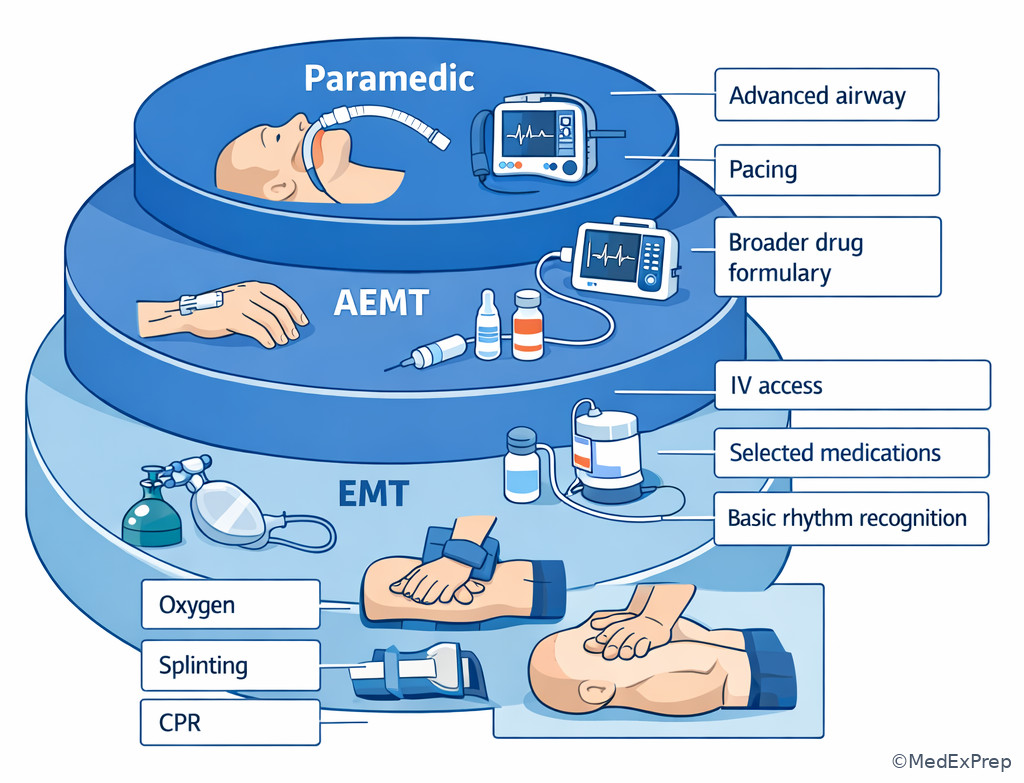
Core content
1.1.1.3 Foundational role: what the AEMT is expected to do
A Explanation
The decision conflict here is simple but heavily tested: Should you act independently, assist within protocol, or escalate? The single rule that resolves most stems is this: the AEMT provides approved prehospital interventions under protocol and medical oversight, then reassesses and transports appropriately. You are not expected to deliver physician-level definitive management. You are expected to recognize urgency, support airway/breathing/circulation, obtain focused findings, perform authorized treatments, and communicate what the patient needs next.
WHY THIS IS TESTED: exam questions often place a patient in front of you with a problem that clearly needs treatment, then offer one answer that is too basic, one that is correct but too advanced for the AEMT, one that ignores transport urgency, and one that matches AEMT scope. The right answer is the scope-appropriate action with reassessment.
See Fig 1 for the core decision ladder. AEMT practice sits between EMT supportive care and paramedic advanced interventions. That means you must be comfortable with limited advanced care, but equally comfortable saying, “This patient needs more than I can provide alone.” In NREMT logic, that is not weakness; it is good judgment.
Key rule: Recognition does not equal authorization. You may recognize severe dysrhythmia, impending respiratory failure, or shock and still need to request ALS or medical direction if the definitive intervention exceeds AEMT scope.
B Worked example
A 67-year-old man with COPD, coronary artery disease, and type 2 diabetes has severe dyspnea at home. He is sitting tripod, speaking in one-word phrases, with wheezing and poor air movement. His spouse says he “usually gets really bad and needed a breathing tube once,” and his home glucose meter reads 238 mg/dL. The tempting clue is the prior intubation history, which may push you toward a paramedic-level mindset. The task is to choose the most appropriate AEMT action now.
Reasoning chain: identify task → severe respiratory distress with possible failure; extract key facts → poor speech, tripod position, wheeze, serious work of breathing; apply rule → give approved airway/oxygen/ventilation support and authorized medications per protocol, consider ALS intercept, do not jump to out-of-scope definitive airway procedures; eliminate distractors → glucose is distracting but not the driver, and prior intubation does not authorize advanced airway beyond scope; verify → reassess mental status, work of breathing, pulse ox if available, and transport priority.
C Exam trap
Common wrong answer: selecting the most advanced definitive intervention because the patient looks critically ill.
Why it is tempting: severe illness creates an urgency bias; candidates assume “sicker patient = more advanced procedure.”
Single clue that eliminates it: the question asks for the best AEMT-level next step, not the ideal hospital or paramedic-only intervention.
D Checkpoint
Question: An AEMT evaluates a patient with severe respiratory distress and cyanosis. Which action best matches AEMT role expectations?
- Delay transport to attempt any advanced airway procedure that might definitively secure the airway.
- Provide approved airway and ventilation support, administer protocol-authorized treatment, request ALS if needed, and reassess en route.
- Wait for ALS before beginning any intervention beyond basic oxygen.
- Focus on obtaining a complete history before treating because the exact diagnosis changes everything.
Answer: B
- A: Tempting because definitive airway sounds lifesaving; wrong because delaying transport and choosing procedures outside scope violates prehospital priorities.
- B: Tempting because it seems less aggressive; right because it matches AEMT-level action: intervene within scope, escalate, reassess, transport.
- C: Tempting because ALS may be needed; wrong because withholding indicated AEMT care is under-treatment.
- D: Tempting because history matters; wrong because treatment of life threats comes before a full secondary assessment.
Practitioner Action: ASSESS severity, life threats, and transport priority. INTERVENE with approved AEMT supportive care and authorized treatments. REFER to ALS or medical direction when definitive care exceeds scope. DOCUMENT your findings, interventions, response, and the reason additional resources were requested.
1.1.1.4 Protocols, medical direction, and local variation
A Explanation
The decision conflict is often: Do I do what seems clinically reasonable, or do I follow protocol and contact medical direction when needed? The exam rule is clear: protocol and medical oversight govern AEMT practice. An intervention may be appropriate in some EMS systems and unavailable in others. When the stem includes uncertainty, unusual circumstances, or a therapy not clearly covered by standing orders, the safest exam answer is to confirm local protocol or contact medical direction while continuing supportive care.
WHY THIS IS TESTED: AEMTs practice under delegated authority. The exam wants candidates who know that “I know what this patient probably needs” is not the same as “I am authorized to do it here, now, this way.” A good AEMT is protocol-driven, not improvisation-driven.
Common triggers for online medical direction include atypical refusals, unusual medication situations, borderline indications, protocol exceptions, and situations in which the patient needs an intervention outside your standing orders. The best answer usually includes a paired action: continue essential supportive care and call for direction or ALS.
Recall: This is the first topic in the course, so there is no earlier lesson to build from. In the upcoming topic Scene Size-Up Priorities, you will apply the same idea operationally: hazards and resources can limit what you can safely do even before clinical care begins.
Memory anchor: PACE = Protocol first, Act within authorization, Call when unclear, Escalate when beyond scope.
B Worked example
A 24-year-old pregnant patient at 30 weeks with asthma and anxiety is short of breath after moving apartments. She is tachypneic, wheezing, and frightened. Her mother asks you to give a medication from the patient’s backpack that is not part of your standard unit supply. She has mild pedal edema from pregnancy, which is a distracting detail, and says, “Last time the ER gave me something stronger through an IV.” The task is not to recreate ED management. The task is to select the correct prehospital AEMT response.
Reasoning chain: identify task → manage acute respiratory distress within protocol; extract key facts → pregnant, wheezing, anxious, possible asthma exacerbation, nonstandard medication request; apply rule → use approved unit medications and protocol-based care, avoid administering drugs outside formulary or unclear authorization, contact medical direction if needed; eliminate distractors → pregnancy does not automatically change basic safety priorities, and carrying a medication does not make it authorized; verify → reassess breathing, fetal concerns as relevant to transport, response to care, and urgency.
C Exam trap
Common wrong answer: giving a medication or using a route because it seems familiar from prior patient care experiences.
Why it is tempting: candidates confuse what happens in the emergency department with what is authorized in the ambulance.
Single clue that eliminates it: the medication is not clearly within standing orders or formulary for that indication.
D Checkpoint
Question: Which statement best reflects exam-safe use of protocol and medical direction?
- If a treatment makes pathophysiologic sense, it is acceptable even if not listed in protocol.
- If a patient is critically ill, certification level limits no longer matter.
- If local authorization is unclear, continue supportive care and obtain medical direction or ALS assistance.
- If a family member requests a familiar medication, patient preference determines EMS authorization.
Answer: C
- A: Tempting because clinical reasoning matters; wrong because delegated EMS practice requires authorization, not just logic.
- B: Tempting because urgency feels like an exception; wrong because sick patients increase the need for escalation, not independent overreach.
- C: Tempting because it may feel slower; right because it combines care continuation with lawful escalation.
- D: Tempting because patient-centered care matters; wrong because patient requests do not create scope authority.
Practitioner Action: ASSESS whether the clinical problem fits a standing-order pathway. INTERVENE using only approved treatments. REFER to online medical direction or ALS for exceptions, exclusions, or higher-acuity needs. DOCUMENT whom you contacted, when, what guidance was received, and patient response.
- The safest answer when authorization is unclear is continue supportive care and contact medical direction.
- True or False: Severe illness automatically expands AEMT scope. False.
- Name the 3 key escalation targets: ALS, medical direction, definitive facility transport.
Exam takeaway: Separate protocol-based treatment from improvisation by asking whether the action is authorized, indicated, and time-appropriate.
flowchart LR
A[Need identified] --> B{Authorized by local protocol?}
B -->|Yes| C{Indicated now?}
B -->|No| D[Call medical direction / request ALS]
C -->|Yes| E[Perform intervention and reassess]
C -->|No| F[Do not perform; continue monitoring]
D --> G[Transport with supportive care]
E --> G
F --> G
1.1.1.5 Under-treatment versus overreach: choosing the best next step
A Explanation
This section contains one of the highest-yield NREMT patterns: the wrong answers cluster at two extremes. One extreme is doing too little because you are afraid to exceed scope. The other is doing too much because you know what the patient “really needs.” The single rule that resolves this conflict is: perform the highest-level intervention you are authorized to perform right now, then escalate when the patient needs more.
WHY THIS IS TESTED: new AEMTs commonly make one of two reasoning errors. Error 1: “I should wait for ALS before using my own AEMT tools.” Error 2: “Since ALS is delayed, I should perform the next advanced step anyway.” Both are unsafe. Your job is not to freeze or freelance. Your job is to deliver what your level permits and move the patient toward additional care when indicated.
Examples: a patient with severe hypoperfusion may need IV access and fluid per protocol from the AEMT, not passive transport only. A patient with a likely need for pacing or advanced airway may still need bag-mask ventilation, oxygen, positioning, rapid transport, and ALS intercept now. In the exam, the best answer often sounds balanced: immediate scope-appropriate care plus escalation.
High-Yield Connection: This concept is tested alongside Airway, Breathing, and Circulation Priorities and Transport Decision Triggers. Know both the intervention hierarchy and the moment when transport or ALS request cannot wait.
See Fig 2 for the choose-versus-reject map. It is particularly useful when two answers both sound reasonable but one is either timid under-treatment or unauthorized overreach.
B Worked example
A 58-year-old woman with heart failure, chronic kidney disease, and hypertension collapses at a dialysis center waiting area. She is pale, weak, and confused with a radial pulse that is weak and rapid. A staff member says, “She missed dialysis yesterday,” which is a tempting clue toward a complex metabolic framing. Her blood pressure is 78/46 mm Hg, and she complains of chest pressure. The task is to choose the best next step for an AEMT crew awaiting a longer ALS response.
Reasoning chain: identify task → unstable shock-like presentation requiring immediate AEMT action; extract key facts → hypotension, altered mentation, weak pulse, possible cardiogenic or other shock, delayed ALS; apply rule → use authorized circulation support measures now, rapid transport, early ALS request, continuous reassessment; eliminate distractors → waiting passively is under-treatment, while initiating paramedic-only cardiac interventions is overreach; verify → repeat blood pressure, mental status, pulse quality, response to treatment, and communicate trend to receiving facility.
C Exam trap
Common wrong answer: “Wait for ALS because the patient is too sick for AEMT treatment to matter.”
Why it is tempting: critical illness makes candidates assume only higher-level providers can help.
Single clue that eliminates it: the patient is unstable now, and the stem asks for the best next step; time-sensitive AEMT interventions still matter.
D Checkpoint
Question: Which answer best avoids both under-treatment and scope violation?
- Provide authorized AEMT care immediately, request ALS early, and expedite transport.
- Withhold all advanced care until a paramedic confirms the diagnosis.
- Perform the intervention most likely to definitively solve the problem, even if outside protocol.
- Spend extra time gathering a complete medication history before beginning treatment.
Answer: A
- A: Tempting because it seems moderate; right because moderate is exactly the point when it combines authorized action with escalation.
- B: Tempting because it avoids overreach; wrong because it creates avoidable delay and under-treatment.
- C: Tempting because definitive care sounds ideal; wrong because scope and protocol remain controlling factors.
- D: Tempting because medication history can matter; wrong because unstable patients require immediate priority actions first.
Practitioner Action: ASSESS whether the patient is deteriorating faster than your available tools. INTERVENE at the top of your scope immediately. REFER by requesting ALS and identifying when definitive care is beyond AEMT capacity. DOCUMENT the patient trend, why ALS was requested, and all time-critical actions taken.
Exam takeaway: Picture the sequence of supportive care, ALS request, and transport so you avoid both passivity and unauthorized care.
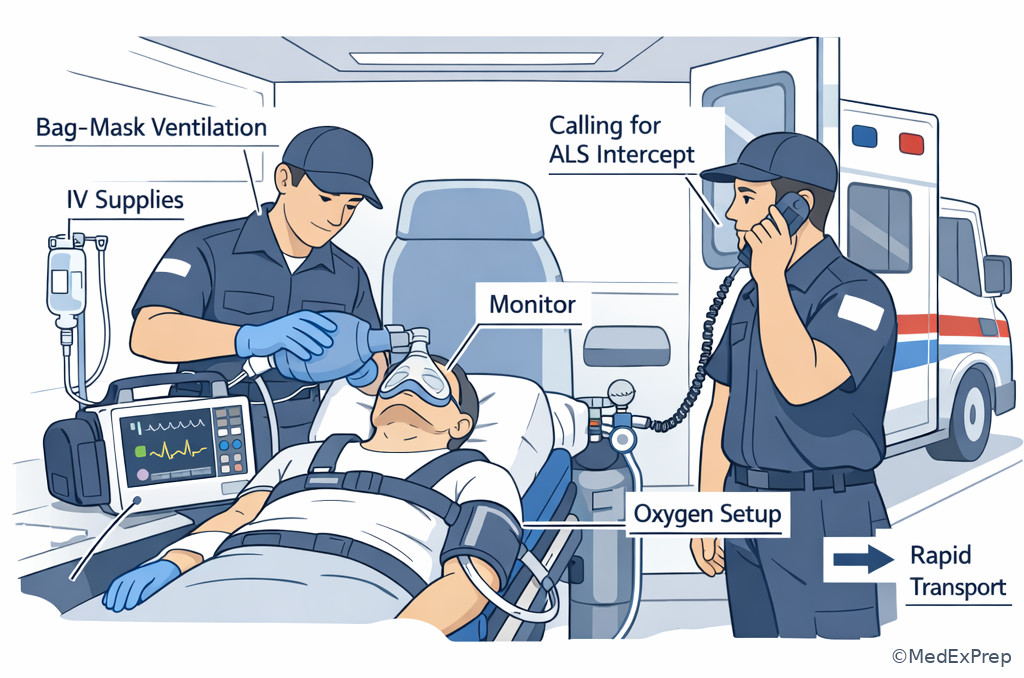
1.1.1.6 Recognizing beyond-scope needs and escalating safely
A Explanation
The decision conflict now becomes: When do you stop trying to expand your own care and instead clearly escalate? The single rule is: when the likely needed intervention exceeds your authorization, your job is to stabilize within scope, request the right resource, and keep moving. Beyond-scope recognition is itself a testable competency. You must recognize when a patient likely needs a higher-level airway, more advanced cardiac intervention, unusual medication authority, physician decision-making, or hospital-only care.
WHY THIS IS TESTED: the exam expects safe humility. A candidate who recognizes limits and escalates appropriately is stronger than a candidate who knows the disease mechanism but ignores operational reality.
Triggers for escalation include persistent instability despite AEMT interventions, need for a procedure not authorized locally, inability to secure airway with approved adjuncts, deteriorating mental status with ventilatory failure, refractory shock, or complex medication decisions outside standing orders. Escalation can mean ALS intercept, online medical direction, air medical consideration per system design, or immediate transport to an appropriate facility. It never means abandoning supportive care.
Common pitfall: confusing “I cannot perform definitive treatment” with “there is nothing useful I can do.” Even when definitive care is beyond scope, airway positioning, oxygenation, ventilation support, circulation support, transport, and reassessment remain essential.
High-Yield Connection: This concept overlaps with Scene Size-Up Priorities and Consent Refusal And Capacity. Resource requests and medical direction are not just clinical; they are operational and legal tools when the patient’s needs or decisions exceed your immediate authority.
B Worked example
A 72-year-old man with prior stroke, atrial fibrillation, and congestive heart failure is found confused and bradypneic after complaining of weakness during dinner. His pupils are small, respirations are shallow, and family says he “takes a lot of pain medicine,” but they also mention he skipped lunch and sometimes “gets low sugar,” which is the tempting alternate clue. His oxygen saturation is falling despite supplemental oxygen. The task is to decide what the AEMT should do if ventilatory failure is progressing and additional advanced interventions may be needed.
Reasoning chain: identify task → immediate life threat is ventilation, not full diagnostic certainty; extract key facts → altered mental status, shallow breathing, possible tox or other cause, desaturation; apply rule → support ventilation within scope immediately, use authorized medication if indicated and allowed by protocol, request ALS because patient may require care beyond AEMT support; eliminate distractors → do not wait for a full differential, and do not pursue hospital-level decisions in the field; verify → repeat mental status, respiratory effort, oxygenation, and transport urgency.
C Exam trap
Common wrong answer: chasing the exact diagnosis before escalating.
Why it is tempting: several causes seem plausible, and candidates think certainty is required before acting.
Single clue that eliminates it: worsening ventilatory failure is itself enough to mandate immediate supportive care and escalation.
D Checkpoint
Question: A patient appears to require care beyond current AEMT capability. What is the most appropriate next step?
- Continue within-scope stabilization, request ALS or medical direction, and expedite transport.
- Stop interventions to avoid liability until a higher provider arrives.
- Attempt any needed advanced procedure because delay would be harmful.
- Remain on scene until the exact diagnosis is confirmed through repeated history.
Answer: A
- A: Tempting because it seems procedural; right because safe escalation includes ongoing care, not passive waiting.
- B: Tempting because it feels legally cautious; wrong because withholding indicated scope-level support is unsafe.
- C: Tempting because harm from delay is real; wrong because scope does not expand based on urgency alone.
- D: Tempting because diagnosis guides care; wrong because unstable patients need action before exhaustive history.
Practitioner Action: ASSESS for failure of response, worsening instability, or need for nonauthorized care. INTERVENE with all supportive measures available to you. REFER by activating ALS, medical direction, or destination escalation early. DOCUMENT why the patient exceeded AEMT capability and what supportive steps were maintained during transfer of care.
- The most common scope error on exam questions is choosing a clinically appealing but unauthorized intervention.
- True or False: If definitive care is beyond scope, supportive care no longer matters. False.
- Name the 3 escalation verbs: request, consult, transport.
Exam takeaway: Use deterioration, failed response, or authorization gaps as triggers for ALS request and medical direction.
flowchart TD
A[Patient evaluated] --> B{Improving with AEMT care?}
B -->|Yes| C[Continue protocol and reassess]
B -->|No| D{Need higher-level procedure or decision?}
D -->|Yes| E[Request ALS / contact medical direction]
D -->|No| F[Continue transport and monitoring]
E --> G[Maintain supportive care during handoff]
C --> G
F --> G
1.1.1.7 Communication, documentation, and legal safety inside scope
A Explanation
The final foundational conflict is: Is communication and documentation just paperwork, or is it part of safe scope practice? The single rule is: clear communication and documentation protect patient safety and prove that your scope decisions were appropriate. The NREMT exam may test this indirectly through refusal, handoff, unusual medication issues, or deterioration during transport.
WHY THIS IS TESTED: a correct intervention can still become an incorrect answer if it lacks communication, reassessment, or documentation. Scope-safe practice includes telling the next provider what you saw, what you did, what changed, what was outside your capability, and what consultation occurred.
Minimum communication elements include patient condition, life threats, treatments performed, response to treatment, changes in status, need for higher care, and any protocol consultation. Documentation should reflect times, findings, interventions, patient response, refusal elements when relevant, and the reason transport priority or resource requests changed. This matters because scope issues are often retrospective: after the call, reviewers ask what was recognized, why a decision was made, and whether escalation occurred promptly.
Recall: In the upcoming topic Consent Refusal And Capacity, documentation becomes even more critical. A refusal is not safe unless capacity, risks, alternatives, and patient understanding are communicated and recorded clearly.
See Fig 4 for the escalation triggers you should communicate during handoff. Strong handoffs make your scope choices legible to the receiving team.
B Worked example
An AEMT crew transports a 49-year-old woman with chest discomfort, diaphoresis, and weakness. She has lupus, hypertension, and recent viral illness. During transport she becomes more pale and hypotensive after an initially normal pressure. Her husband keeps repeating that “her anxiety does this,” which is a tempting minimizing clue. The crew provided approved care and requested ALS intercept, but the intercept is delayed. The task is now to decide what must be communicated during hospital handoff.
Reasoning chain: identify task → high-acuity handoff and scope justification; extract key facts → chest symptoms, deterioration, hypotension, ALS requested but delayed, response trend matters; apply rule → communicate acuity, what interventions were done, what response occurred, what remains outside current capability, and timeline; eliminate distractors → detailed unrelated past history is lower priority than unstable trend, and vague “patient got worse” is insufficient; verify → ensure handoff includes specific times and repeated vitals.
C Exam trap
Common wrong answer: giving a broad narrative without the decision points that justify care and escalation.
Why it is tempting: candidates think storytelling equals communication.
Single clue that eliminates it: the receiving team needs the exact trend, interventions, response, and why higher-level support was requested.
D Checkpoint
Question: Which handoff element most directly supports scope-safe patient care?
- Lengthy detail about remote past medical history before current instability is mentioned.
- A concise report of current acuity, interventions performed, patient response, and need for additional care.
- A statement that the patient “looked bad” without objective trends.
- Only the chief complaint, because the hospital will repeat the full assessment anyway.
Answer: B
- A: Tempting because history seems thorough; wrong because unstable handoff should prioritize present condition and trend.
- B: Tempting because it is concise; right because it gives the receiving team the operationally critical information.
- C: Tempting because general impression matters; wrong because it lacks the objective data that support decisions.
- D: Tempting because the hospital will reassess; wrong because prehospital findings and treatment response can change immediate care.
Practitioner Action: ASSESS what changed and which findings matter most now. INTERVENE by continuing approved care during transition. REFER with a focused report that states what higher care is needed. DOCUMENT times, objective reassessment, consultations, refusals if applicable, and transport priority rationale.
Exam takeaway: A structured handoff should show current acuity, interventions, response, and escalation needs rather than a loose story.
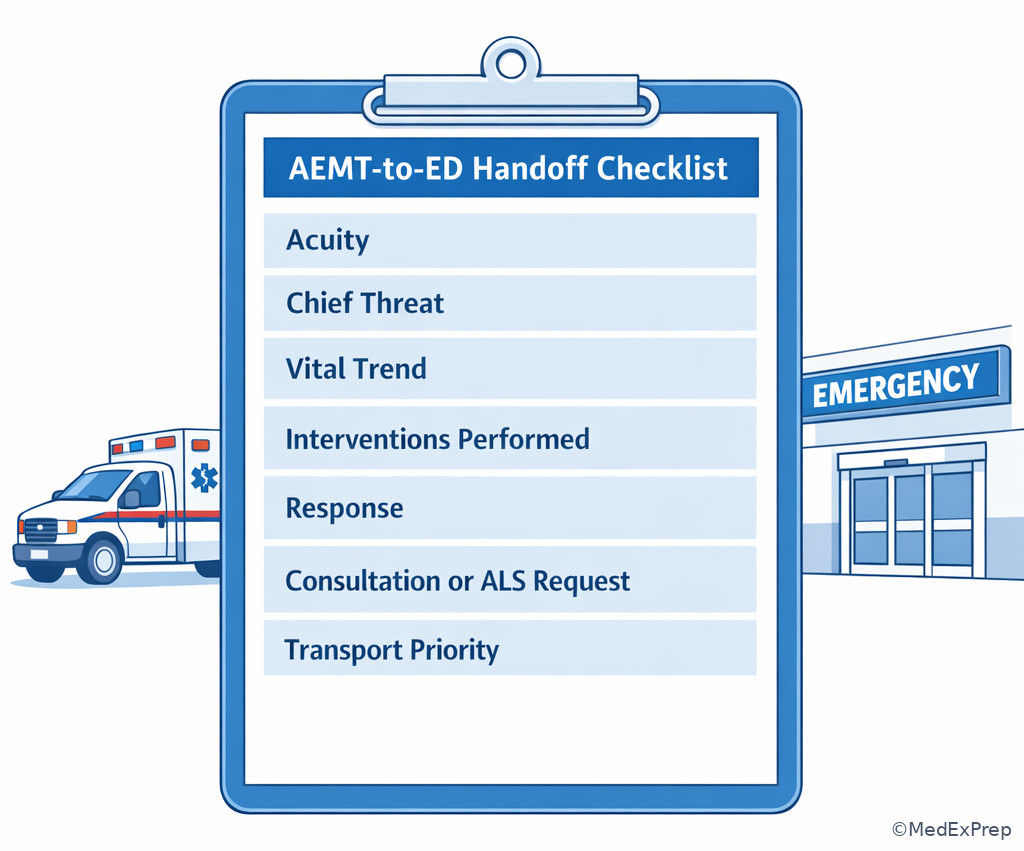
Memory anchor: CARE handoff = Condition now, Actions taken, Response/trend, Escalation needed.
Exam Traps & Differentiators
Common traps & distractors: The exam often hides scope testing inside airway, shock, refusal, or medication questions. Watch for answers that are either too passive for an AEMT or too advanced for the role.
- Most common wrong answer and why: choosing a paramedic-level or physician-level intervention because it is clinically impressive. It is tempting because it sounds definitive; it is wrong because the stem asks what you should do as the AEMT.
- Looks similar but isn't: “Request ALS” is correct when paired with ongoing care; “wait for ALS before doing anything meaningful” is usually wrong.
- If the stem says “best AEMT-level next step,” think highest authorized action now, not ultimate definitive treatment.
- If the stem says “local protocols vary,” think confirm with medical direction rather than guessing.
- If the stem says “patient remains unstable despite your interventions,” think escalate early and communicate trend.
- If the stem says “family asks for a medication” or “the patient usually gets X at the hospital,” think formulary and protocol still control.
- If the stem says “refusal” with altered mentation, intoxication, or unclear understanding, think capacity is the gatekeeper; this connects directly to the upcoming consent/refusal lesson.
| Stem clue | Tempting wrong answer | Why it tempts | Single differentiator |
|---|---|---|---|
| Severe distress | Most advanced definitive procedure | Sick patient bias | Question asks for best AEMT-level action |
| ALS delayed | Wait passively | Fear of overreach | Authorized AEMT interventions still matter now |
| Medication not in usual kit | Give it because patient uses it | Feels patient-centered | Patient possession does not equal EMS authorization |
| Unclear protocol fit | Improvise based on pathophysiology | Smart-sounding reasoning | Delegated practice requires protocol or direction |
| Deterioration in transport | Document later, focus only on driving | Operational stress | Communication and trend reporting shape ongoing care |
| Looks similar | Actually means | Best exam move |
|---|---|---|
| Recognize need for advanced airway | Patient may exceed current scope | Support airway/ventilation, request ALS, transport |
| Recognize complex dysrhythmia | Cardiology escalation needed | Perform authorized monitoring/support, contact ALS or direction |
| Family requests specific drug | Potential protocol conflict | Use formulary/standing orders, call if unclear |
| Patient seems stable at first | Trend may matter more than snapshot | Reassess and communicate change in status |
See Fig 3 for the visual model of balanced escalation, and see Fig 5 for how to report it cleanly. The upcoming topics on scene size-up and consent create common confusable pairs: unsafe scenes can limit what you can do, and patients who refuse care may require capacity assessment before your scope of action changes.
Tables
| Key fact area | High-yield rule | Exam use |
|---|---|---|
| Scope of practice | Operate within credential and protocol | Eliminates unauthorized options |
| Medical direction | Use when standing orders are unclear or insufficient | Best answer in jurisdiction-dependent stems |
| ALS request | Call early when patient may exceed your tools | Prevents delay trap |
| Supportive care | Never stop while awaiting higher resources | Rejects passive waiting answers |
| Transport | Do not delay for nonessential out-of-scope interventions | Separates field priorities from hospital thinking |
| Documentation | Record findings, care, response, consultation, and rationale | Supports legal and clinical continuity |
| Decision type | Choose this | Reject this |
|---|---|---|
| Authorized immediate care available | Perform it now and reassess | Waiting for ALS first |
| Needed intervention not clearly authorized | Supportive care + medical direction | Improvising outside protocol |
| Patient worsening despite your care | Escalate resources and transport urgency | Continuing the same plan without escalation |
| Family requests unfamiliar treatment | Use formulary/protocol and verify if needed | Assuming patient history authorizes EMS use |
| Need for hospital-only care recognized | Support, package, move, communicate | Trying to reproduce hospital management on scene |
| Situation | Likely classification | Operational implication |
|---|---|---|
| Clearly listed standing-order intervention | Within protocol | Perform and reassess |
| Medication or route not clearly authorized | Protocol-dependent / uncertain | Call medical direction |
| Patient needs advanced definitive airway or cardiac procedure beyond authorization | Beyond AEMT scope | Request ALS, continue support, transport |
| Unstable patient with treatable AEMT-level problem | Within role despite high acuity | Do not wait passively |
| Competent patient considering refusal | Legal/ethical decision point | Assess capacity and document; see upcoming consent topic |
Exam takeaway: Associate unclear authorization with immediate supportive care plus real-time consultation rather than independent improvisation.
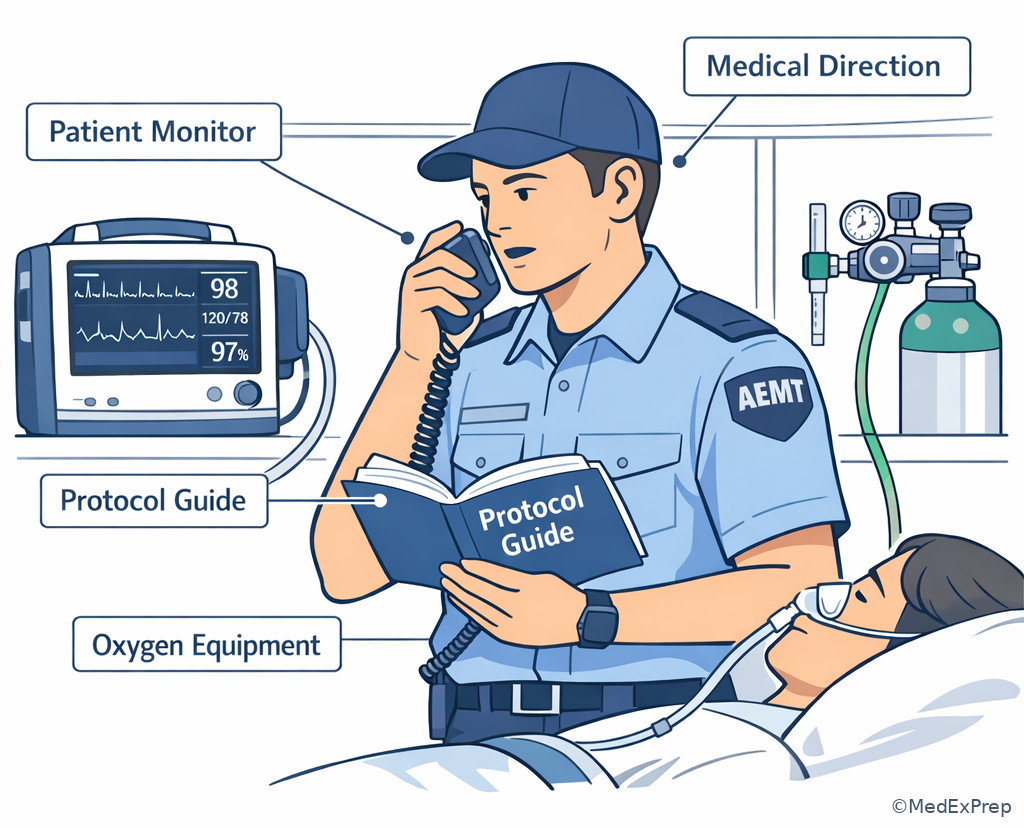
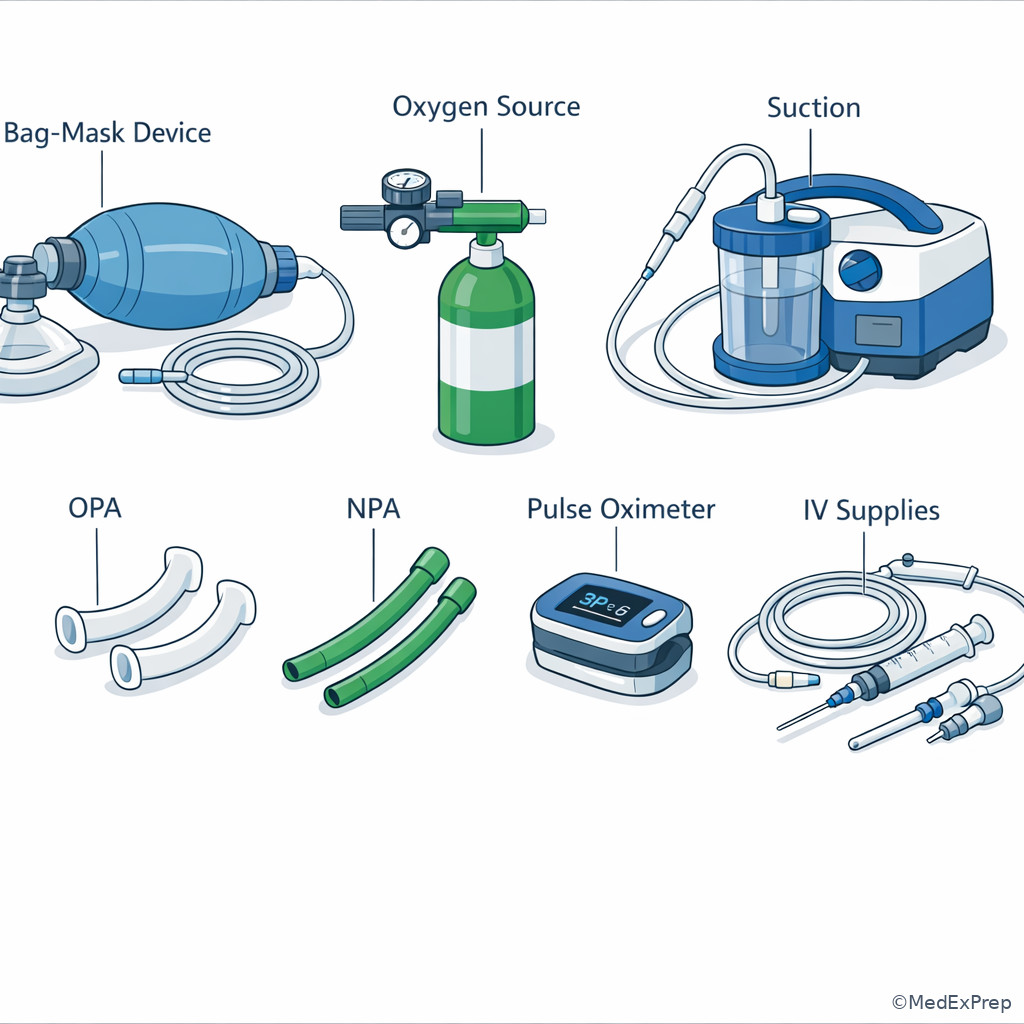
Exam takeaway: Visualize the AEMT using approved airway and ventilation tools while preparing for higher-level assistance when needed.
Algorithm / Approach
Exam takeaway: Start with life threats, use the highest authorized intervention, and escalate early whenever patient need outruns your scope.
See Fig 6. This algorithm is the safest general-purpose approach for early exam stems: find the threat, match it to authorized care, escalate early if the patient exceeds your resources, and never forget reassessment and communication.
Rapid Review
- Scope recognition → knowing what the patient needs is different from being authorized to provide it
- Best AEMT action → highest approved intervention now, not ideal definitive care later
- Protocol uncertainty → supportive care plus medical direction
- ALS delay → do not wait passively if authorized care can begin now
- Critical patient → severity does not expand certification limits
- Hospital treatment memory → prior ED care does not authorize field replication
- Family request → patient preference cannot override formulary or protocol
- Deterioration → failed response triggers escalation, not repetition without change
- Transport priority → nonessential advanced tasks should not delay movement
- Handoff quality → trend and response outrank long background history
- Legal safety → documentation of consultation and rationale matters as much as intervention choice
- Upcoming refusal topic → capacity, not mere disagreement, drives whether refusal stands
Self-check quiz
1.1.1.8 Question 1
An AEMT evaluates a patient with severe respiratory distress. Which option is the most appropriate next step if the needed definitive intervention may be beyond AEMT scope?
- Provide approved supportive care, request ALS, and transport.
- Wait to begin care until a paramedic arrives.
- Perform the advanced definitive procedure anyway because the patient is critical.
- Delay treatment until the exact diagnosis is known.
1.1.1.9 Question 2
A local protocol does not clearly address a requested medication route. Which action best fits AEMT scope boundaries?
- Use the route if the medication is commonly given that way in hospitals.
- Refuse all care and transport until clarification is available.
- Continue supportive care and contact medical direction.
- Ask the family what was done last time and follow that.
1.1.1.10 Question 3
A 64-year-old man with CHF and COPD has increasing dyspnea, crackles, and accessory muscle use. He had a prior ICU stay, which makes a definitive airway answer tempting. Oxygen saturation is dropping, and ALS is 12 minutes away. What is the most appropriate AEMT-level next step?
- Provide authorized airway/ventilation support, request ALS, and begin transport.
- Wait for ALS because he may need advanced airway management.
- Attempt a paramedic-level airway intervention to prevent deterioration.
- Focus on a detailed medication reconciliation before treatment.
1.1.1.11 Question 4
A 31-year-old pregnant patient with asthma and anxiety is wheezing and tachypneic after exertion. Her partner hands you a medication not stocked on your unit and says it always works. She is alert, frightened, and speaking in short phrases. Which action is most appropriate?
- Administer the partner-provided medication because the patient has used it before.
- Use protocol-authorized treatment, continue supportive care, and consult medical direction if needed.
- Withhold all treatment because pregnancy makes field care too risky.
- Transport without treating because emergency department care is definitive.
1.1.1.12 Question 5
A 70-year-old woman with diabetes and chronic kidney disease is weak, confused, and hypotensive at a dialysis center. Staff mention she missed dialysis yesterday, which distracts toward a complex metabolic explanation. ALS is delayed. What is the best AEMT response?
- Provide no intervention until a paramedic identifies the exact shock type.
- Perform authorized circulation support now, request ALS, and reassess during rapid transport.
- Choose an out-of-scope advanced cardiac intervention because her blood pressure is low.
- Spend several extra minutes obtaining complete dialysis records before moving.
1.1.1.13 Question 6
A 73-year-old man with atrial fibrillation, prior stroke, and chronic pain is found somnolent with shallow respirations and pinpoint pupils. Family says he also skipped lunch and sometimes “gets low sugar.” Oxygen saturation falls despite supplemental oxygen. Which action is most appropriate for the AEMT?
- Delay airway support until the exact cause of altered mental status is known.
- Provide immediate ventilatory support within scope, use any authorized treatment per protocol, request ALS, and transport.
- Attempt a nonauthorized advanced airway because the patient may arrest.
- Assume hypoglycemia is most likely and focus only on glucose correction before breathing.
1.1.1.14 Question 7
A 52-year-old woman with chest discomfort, lupus, and hypertension becomes pale and hypotensive during transport after initially stable vitals. Your crew has already given approved care and requested ALS intercept, but intercept is delayed. Which handoff statement best reflects scope-safe communication?
- “She has many chronic conditions, and the full story is complicated.”
- “Chest discomfort with worsening hypotension in transport; approved care given; patient deteriorating despite treatment; ALS requested; repeat BP now 82/48.”
- “She seemed anxious, so we mostly observed her.”
- “We thought about several diagnoses but are not sure which one it is.”
1.1.1.15 Question 8
An AEMT crew reaches a patient in severe distress who may require a procedure not authorized in their system. The patient is conscious but rapidly tiring, and the nearest ALS unit is 15 minutes away. Which choice best avoids both legal and clinical error?
- Try the unauthorized procedure because the need appears obvious.
- Do nothing beyond minimal oxygen so there can be no scope violation.
- Perform the highest authorized supportive intervention, request ALS and medical direction as appropriate, and expedite transport.
- Remain on scene until a supervisor confirms every step of care.
Answer key
1.1.1.16 Question 1: A
A: Tempting because it may sound less definitive than an advanced procedure; correct because it matches the core rule of AEMT practice: stabilize within scope, escalate, and transport. The single stem clue is that definitive intervention may be beyond AEMT scope. Source: National EMS Scope of Practice Model; NREMT candidate role expectations.
B: Tempting because it avoids overreach; incorrect because waiting to begin indicated care is under-treatment. The clue is severe respiratory distress requiring immediate support now. Source: National EMS Scope of Practice Model; AHA emergency cardiovascular care emphasis on immediate supportive care.
C: Tempting because critical illness creates urgency and makes definitive care feel necessary; incorrect because severity does not expand authorization. The clue is the phrase “beyond AEMT scope.” Source: National EMS Scope of Practice Model.
D: Tempting because diagnosis matters; incorrect because life threats are treated before full diagnostic certainty. The clue is severe respiratory distress. Source: AAOS emergency care principles; AHA life support framework.
1.1.1.17 Question 2: C
A: Tempting because it reflects common hospital practice; incorrect because hospital norms do not authorize EMS route selection outside protocol. The discriminating clue is that the route is not clearly addressed locally. Source: National EMS Scope of Practice Model; local-protocol principle in EMS systems.
B: Tempting because it seems cautious; incorrect because refusing all care is not appropriate when supportive care can continue safely. The clue is uncertainty about one route, not all care. Source: EMS protocol structure and patient care continuity standards.
C: Tempting because it feels procedural rather than clinical; correct because unclear authorization calls for supportive care plus medical direction. The clue is lack of clear protocol coverage. Source: National EMS Scope of Practice Model; EMS medical oversight principles.
D: Tempting because patient/family experience seems helpful; incorrect because family recollection does not establish EMS authorization or safety. The clue is protocol ambiguity. Source: EMS medication safety standards.
1.1.1.18 Question 3: A
A: Tempting because it sounds less dramatic than a definitive airway answer; correct because the AEMT should provide authorized respiratory support immediately, call ALS early, and avoid transport delay. The clue is dropping oxygen saturation with ALS still 12 minutes away. Source: National EMS Scope of Practice Model; AHA prehospital emphasis on airway and ventilation support.
B: Tempting because advanced airway may indeed be needed; incorrect because waiting wastes time when AEMT-level airway and ventilation support can start now. The clue is current deterioration, not future possibility. Source: AHA emergency care guidance.
C: Tempting because prior ICU stay and worsening distress make advanced airway seem justified; incorrect because possible need does not authorize paramedic-level action. The clue is the question asks for the AEMT-level next step. Source: National EMS Scope of Practice Model.
D: Tempting because medication review can distinguish CHF from COPD management nuances; incorrect because immediate breathing support comes first. The clue is increasing dyspnea with dropping oxygen saturation. Source: AAOS emergency care text.
1.1.1.19 Question 4: B
A: Tempting because the partner reports prior benefit, making the drug seem personalized and effective; incorrect because patient-supplied or partner-supplied medication does not bypass formulary and protocol rules. The clue is that the medication is not stocked on your unit. Source: National EMS Scope of Practice Model; EMS medication safety principles.
B: Tempting because it sounds conservative; correct because it applies authorized care, maintains supportive measures, and uses consultation for uncertainty. The clue is active wheezing with an unverified medication request. Source: EMS medical oversight standards.
C: Tempting because pregnancy raises stakes; incorrect because pregnancy does not cancel standard prehospital respiratory treatment priorities. The clue is treatable respiratory distress within EMS care. Source: standard prehospital obstetric and respiratory care principles.
D: Tempting because definitive care is at the hospital; incorrect because field treatment of respiratory distress should not be withheld when authorized and indicated. The clue is short-phrase speech and tachypnea now. Source: AHA and prehospital emergency care texts.
1.1.1.20 Question 5: B
A: Tempting because shock type can affect nuanced therapy; incorrect because unstable hypotension and confusion require immediate AEMT-level circulation support and transport decisions now. The clue is hypotension with delayed ALS. Source: National EMS Scope of Practice Model; shock priorities in prehospital care.
B: Tempting because it may feel incomplete without a full diagnosis; correct because it captures the right operational sequence: authorized treatment, ALS request, rapid transport, reassessment. The clue is unstable patient plus delayed ALS. Source: National EMS Scope of Practice Model.
C: Tempting because low blood pressure makes advanced cardiac procedures seem appropriate; incorrect because such interventions may be outside AEMT authority. The clue is that the question asks for best AEMT response, not ideal higher-level care. Source: scope-of-practice standards.
D: Tempting because missed dialysis suggests relevant pathophysiology; incorrect because records do not outrank urgent perfusion support. The clue is current confusion and hypotension. Source: emergency care prioritization texts.
1.1.1.21 Question 6: B
A: Tempting because multiple causes of altered mental status are possible; incorrect because shallow respirations and falling oxygen saturation make ventilatory failure the immediate priority. The clue is desaturation despite supplemental oxygen. Source: AHA airway and ventilation priorities; emergency care texts.
B: Tempting because it addresses several possibilities at once; correct because it prioritizes breathing support, uses protocol-based therapy if allowed, and escalates appropriately. The clue is the combination of shallow respirations, pinpoint pupils, and worsening oxygenation. Source: National EMS Scope of Practice Model; AHA prehospital resuscitation priorities.
C: Tempting because impending arrest can trigger heroic thinking; incorrect because unauthorized advanced airway intervention remains outside scope. The clue is that the scenario asks what the AEMT should do. Source: National EMS Scope of Practice Model.
D: Tempting because skipped lunch suggests hypoglycemia; incorrect because breathing takes priority over exploring alternate causes when respirations are inadequate. The clue is shallow respirations with dropping saturation. Source: emergency assessment sequence standards.
1.1.1.22 Question 7: B
A: Tempting because it acknowledges complexity; incorrect because it does not communicate acuity, intervention, or trend. The clue is active deterioration during transport. Source: EMS handoff best practices; prehospital documentation standards.
B: Tempting because it is concise and data-rich; correct because it includes the present threat, what was done, patient response, and the escalation step already taken. The clue is worsening hypotension after treatment. Source: EMS communication and transfer-of-care standards.
C: Tempting because anxiety may have been mentioned by family; incorrect because it minimizes an unstable trend and omits objective data. The clue is hypotension and pallor during transport. Source: emergency care reassessment principles.
D: Tempting because differential thinking sounds thoughtful; incorrect because handoff should prioritize current status and action over speculative diagnosis. The clue is the need for immediate receiving-team understanding of deterioration. Source: EMS handoff standards.
1.1.1.23 Question 8: C
A: Tempting because the patient is rapidly tiring and the need seems obvious; incorrect because obvious need does not authorize an unauthorized procedure. The clue is that the procedure is not authorized in their system. Source: National EMS Scope of Practice Model.
B: Tempting because it avoids legal overreach; incorrect because minimal oxygen alone may be under-treatment when a higher authorized supportive intervention is available. The clue is severe distress with rapid tiring. Source: prehospital airway and supportive care standards.
C: Tempting because it sounds operationally balanced rather than dramatic; correct because it delivers lawful care, early escalation, and timely transport. The clue is need for an unauthorized procedure with ALS 15 minutes away. Source: National EMS Scope of Practice Model; EMS medical oversight principles.
D: Tempting because supervision can feel protective; incorrect because remaining on scene delays care when the best action is already clear. The clue is rapidly tiring patient in severe distress. Source: emergency transport priority standards.
Keep going with the full NREMT-AEMT Prep Course (AEMT)
You just studied the way members do, in the same lesson interface. Full access unlocks every lesson, the question bank and flashcards for a full year.
One payment · 1 year of access · No auto-renewal