1.1.1 - Entry-Level Chiropractic Scope
Why it matters
- NBCE Part IV commonly rewards the safest appropriate action, not the most aggressive action.
- Many distractors are tempting because they sound medically complete but are performed by the wrong provider or exceed chiropractic scope.
- Entry-level competence means recognizing when findings support routine conservative care versus when red flags stop the encounter from becoming a manipulation problem.
- Scope errors are often professionalism errors too: clear explanation, consent, draping, and referral language are part of competent clinical judgment.
Exam takeaway: Start by deciding whether the case is safe and within role before choosing any examination or treatment step.
flowchart TD
A[Patient presents] --> B{Immediate red flag or instability?}
B -->|Yes| C[Defer manipulation]
C --> D[Urgent referral or emergency activation]
B -->|No| E{Question is within entry-level chiropractic role?}
E -->|No| F[Reject out-of-scope action]
E -->|Yes| G[Focused history and exam]
G --> H[Choose safest next step]
H --> I[Treat modify defer or refer] Exam takeaway: The exam expects safe patient positioning, explanation, consent, and role-appropriate clinical conduct.
Key Terms & Must-Know Facts
1.1.1.1 Key terms
- Scope of practice — the set of actions the candidate can appropriately perform or recommend within chiropractic training and exam role.
- Focused history — complaint-directed questioning to clarify mechanism, irritability, red flags, and functional impact.
- Neuromusculoskeletal exam — observation, ROM, orthopedic, neurologic, and palpatory procedures within training.
- Contraindication — finding that makes a procedure unsafe and should stop or prevent it.
- Precaution — finding that may require modification, reduced force, additional assessment, or referral.
- Red flag — historical or exam clue suggesting serious pathology.
- Best next step — the safest appropriate action given current data, not the most definitive possible action.
- Defer care — postpone treatment because safety is not established.
- Urgent referral — same-day or prompt medical evaluation for concerning findings.
- Emergency activation — immediate response when symptoms suggest emergent danger.
- Clinical correlation — matching symptoms and examination findings with imaging or history.
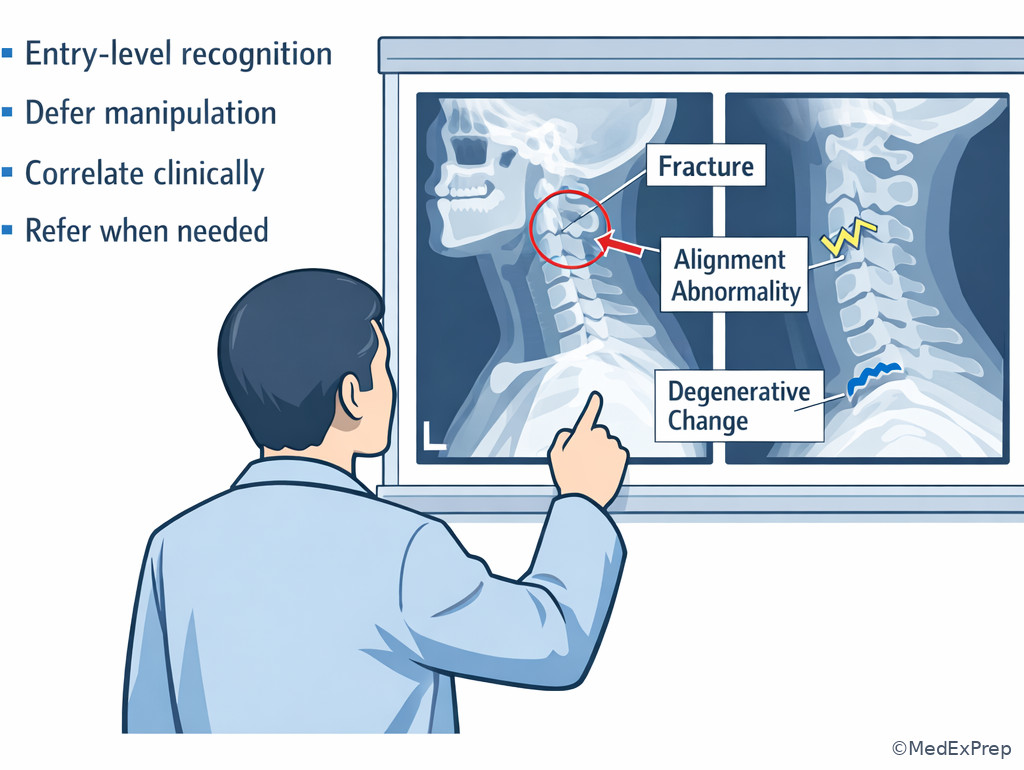
- Entry-level imaging interpretation — recognizing common plain-film findings without claiming radiologist-level certainty.
- Professional boundary — communicating clearly without overstating authority or stepping into another profession’s role.
1.1.1.2 Must-know facts
- On NBCE-style scenarios, red flags override biomechanical findings.
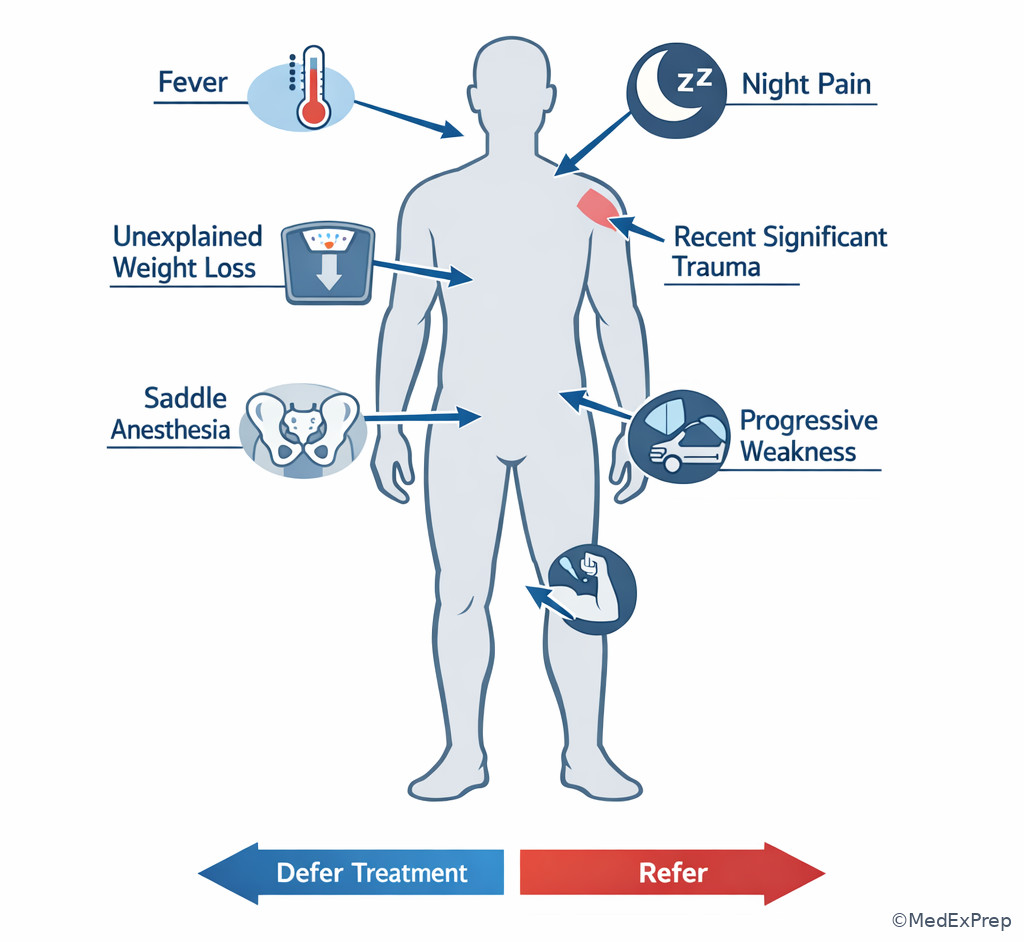
- If the presentation suggests fracture, infection, malignancy, vascular compromise, cauda equina syndrome, or progressive neurologic deficit, withhold manipulation.
- Entry-level chiropractic candidates can assess, communicate, modify care, defer care, and refer; they do not prescribe medications or manage hospital-level emergencies.
- When data are incomplete, the correct move is often further assessment, imaging review, consultation, or referral.
- A distractor may be medically reasonable in a different profession but still wrong for the examinee’s role.
- Professional conduct includes consent, explanation, dignity, positioning, and safety sequencing.
- Do not claim to clear serious pathology without appropriate workup.
- Plain-film interpretation at this level means recognizing common patterns and acting safely on them.
| Scope category | Usually within role | Usually outside role | Exam consequence |
|---|---|---|---|
| History | Focused MSK and red flag history | Comprehensive medical admission history for inpatient management | Choose targeted questioning, not physician-level workup ownership |
| Examination | Observation, ROM, orthopedic, neurologic screens | Invasive procedures or specialist testing beyond training | Demonstrate safe practical competence |
| Imaging | Entry-level plain-film recognition and correlation | Specialist radiology interpretation claims | Act on obvious risk; avoid overclaiming |
| Treatment | Select, modify, or defer conservative chiropractic care | Prescribe drugs or perform surgery | Reject wrong-provider distractors |
| Escalation | Refer, co-manage, activate emergency response | Definitively manage medical emergency alone | Safety-first judgment is tested |
Core content
1.1.1.3 Foundational role: what the entry-level chiropractic candidate is being asked to do
A Explanation
The first decision conflict is simple but heavily tested: Is the question asking you to act like an entry-level chiropractic examinee, or is it baiting you into physician-level management? The resolving rule is this: choose the answer that shows competent focused assessment, safe conservative decision-making, and appropriate referral language. Reject options that require prescribing, surgery, invasive emergency management, or unsupported diagnostic overreach.
WHY THIS IS TESTED: many exam items are not really about diagnosis alone; they test whether you know your role boundaries under pressure. A candidate can recognize a dangerous condition and still fail the item by choosing an action outside scope instead of urgent referral or emergency activation.
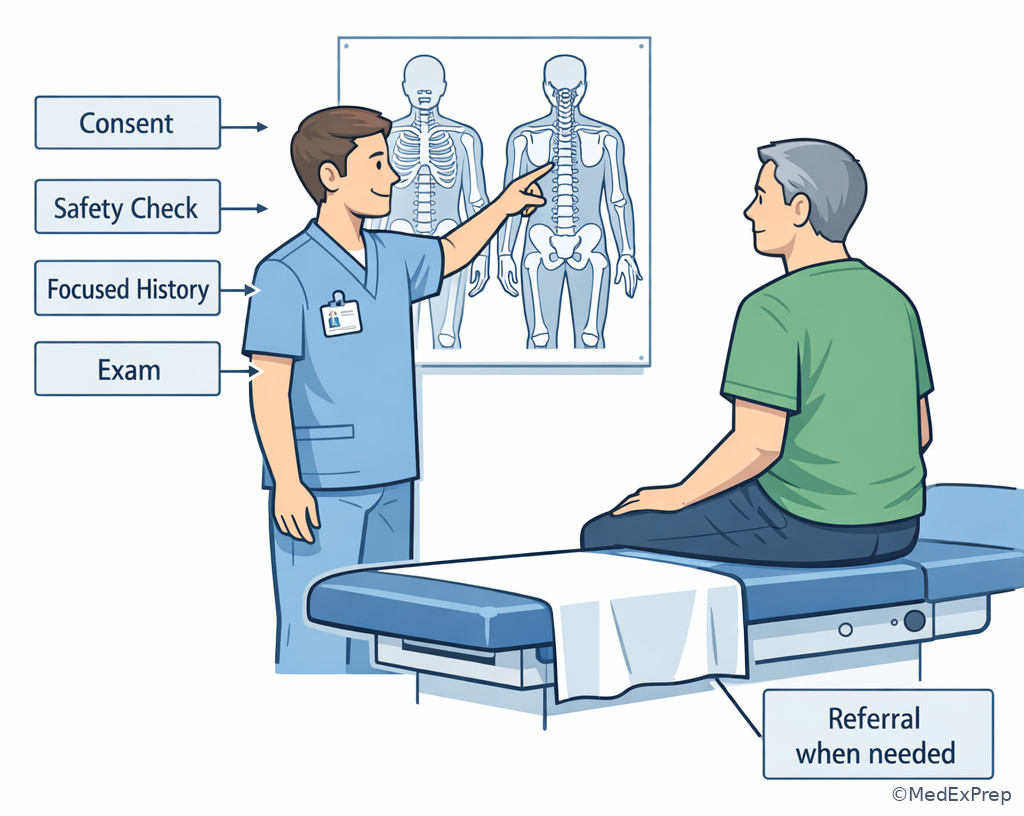
Within role, you can obtain complaint-focused history, perform neuromusculoskeletal examination, identify likely mechanical patterns, recognize red flags, correlate common imaging findings, decide whether SMT is indicated or unsafe, and communicate next steps. Outside role, you do not prescribe analgesics, clear surgical candidacy, interpret advanced imaging as a subspecialist, or independently manage severe medical emergencies. See Fig 1.
B Worked example
A 46-year-old warehouse worker presents with acute low back pain after lifting. He has hypertension, obesity, and controlled type 2 diabetes. He asks whether you can “just write something stronger than ibuprofen because the urgent care wait is too long.” He also reports one episode of lightheadedness this morning after skipping breakfast. Neurologic screening is normal, pain is mechanical with flexion, and there is no saddle anesthesia or bowel/bladder change.
Reasoning chain: identify the task — this is a scope question disguised as a back pain complaint. Extract key facts — mechanical presentation, no major red flags, distracting lightheadedness likely unrelated, direct request for medication. Apply rule — prescribing is outside the examinee’s role. Eliminate distractors — writing a prescription is wrong-provider logic; sending to the emergency department for isolated mechanical pain without red flags is excessive; proceeding directly to forceful manipulation without a fuller exam is premature. Verify — the best next step is focused assessment and scope-appropriate conservative management or advice, with referral for medication questions if needed.
C Exam trap
D Checkpoint
Question: A 38-year-old office worker with neck stiffness, mild tension-type headache, and no neurologic deficit asks for “the strongest muscle relaxer you can give me” before an afternoon flight. What is the most appropriate response?
- Provide a short course of muscle relaxants because the symptoms are musculoskeletal.
Tempting because the pain seems routine; wrong because prescribing medication is outside role. - Explain the likely mechanical nature, continue focused assessment, and discuss scope-appropriate conservative options while advising her to contact an appropriate medical provider for medication questions.
Tempting because it may feel less immediately satisfying; right because it stays within role and addresses the request safely. - Activate emergency medical services because headache is present.
Tempting because headaches can be serious; wrong because this stem lacks emergent red flags. - Skip the history because the patient already identifies muscle spasm as the cause.
Tempting because it saves time; wrong because focused history is still required before care decisions.
Answer: B
1.1.1.4 Foundational boundaries: assess, interpret, communicate, but do not overclaim
A Explanation
Another common decision conflict is recognizing a finding versus claiming too much from that finding. The single resolving rule: at entry level, you may identify and act on common concerning patterns, but you should not overstate diagnostic certainty or specialist authority. For example, saying “this plain film suggests a compression fracture and manipulation should be deferred pending appropriate referral” fits the role. Saying “I have definitively ruled out malignancy” does not.
This matters in imaging, neurologic findings, and case language. Good NBCE-style answers use careful verbs: suggests, is concerning for, requires further evaluation, warrants referral, appears consistent with, unsafe to manipulate until clarified. Unsafe answers use overreach: clear, definitively diagnose beyond data, manage independently beyond scope. See Fig 2.
Exam takeaway: Board-style answers favor cautious, evidence-linked language when findings are concerning or incomplete.
flowchart LR
A[Finding noticed] --> B[Can I recognize this pattern?]
B --> C[Yes: describe concern]
C --> D[Link to safety implication]
D --> E[Choose assess modify defer or refer]
B --> F[No certainty]
F --> G[Avoid definitive claims]
G --> E
B Worked example
A 67-year-old woman presents with mid-thoracic pain after coughing during a recent respiratory illness. She has osteoporosis, rheumatoid arthritis, and chronic steroid use. She also mentions long-standing trapezius tightness from knitting, which is a tempting mechanical clue. Lateral thoracic radiograph appears to show anterior wedging at one vertebral body. The question asks for the best interpretation and next step.
Reasoning chain: identify the task — interpretation linked to management. Extract key facts — older age, osteoporosis, steroid use, acute pain after minimal stress, radiographic wedge deformity. Apply rule — you may recognize a pattern concerning for compression fracture and withhold manipulation; you should not overclaim complete diagnosis and independent medical management. Eliminate distractors — “perform thoracic SMT to restore motion” ignores instability risk; “read the image as benign postural variation” ignores the clinical context; “start pharmacologic osteoporosis therapy” exceeds role. Verify — state concern for compression fracture and arrange appropriate referral or further medical evaluation.
C Exam trap
D Checkpoint
Question: Which statement best reflects appropriate entry-level scope language when a plain film raises concern for an acute structural lesion?
- “This definitely rules out all serious pathology, so full treatment can proceed.”
Tempting because certainty feels decisive; wrong because it overclaims clearance. - “This appears consistent with a possible acute structural lesion; manipulation should be deferred pending appropriate referral or further evaluation.”
Tempting because it may seem less decisive; right because it links recognition to safe action without overreach. - “I will prescribe treatment for the underlying bone disease immediately.”
Tempting because it addresses cause; wrong because prescribing is outside role. - “Because the patient wants treatment today, the imaging concern can be ignored if palpation finds restriction.”
Tempting because it prioritizes patient preference; wrong because safety outranks preference.
Answer: B
- The safest verb when serious pathology is not fully ruled out is concerning for.
- True or False: A plain-film clue plus major risk factors can justify deferring manipulation before definitive diagnosis is confirmed. True.
- Name the 3 safer choices when data are incomplete: further assessment, imaging review, referral.
1.1.1.5 Applied scope: choosing among treat, modify, defer, and refer
A Explanation
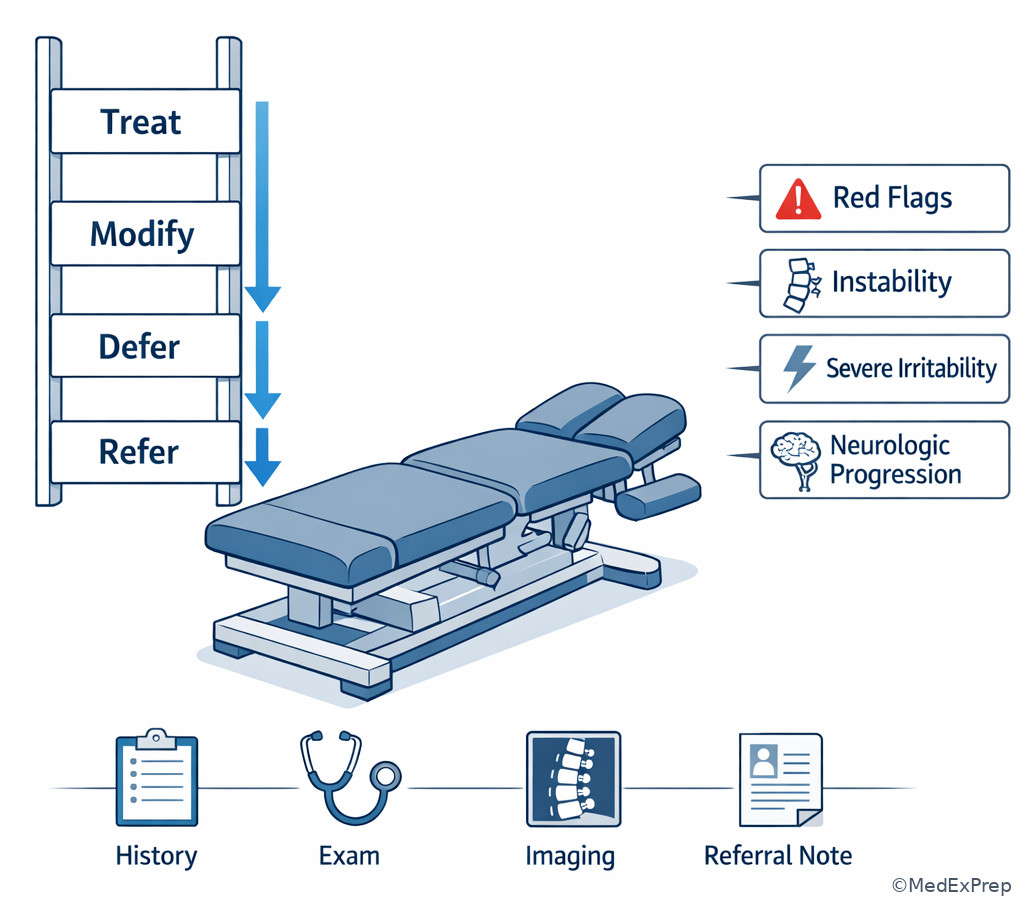
This is the central practical skill for the course: when should the candidate treat, and when should the candidate modify, defer, or refer? The single rule that resolves most items is: choose the least risky action that still matches the current level of certainty. If the pattern is routine mechanical and no red flags are present, conservative care may be reasonable. If the patient has a precaution such as advanced age, anticoagulant use, or severe irritability, you may need modification or lower-force approaches. If instability, fracture suspicion, progressive neurologic deficit, infection, malignancy concern, or vascular warning signs appear, you defer manipulation and refer.
Foundational learners often miss the middle category: modify. Not every nonideal patient needs emergency referral; some need gentler positioning, additional testing, or avoiding a high-velocity technique. But once a true contraindication or urgent red flag enters the stem, modification is no longer enough. See Fig 3.
Exam takeaway: One danger signal is enough to shift a manipulation stem into a modification or referral problem.
flowchart TD
A[Patient with MSK complaint] --> B{Red flag or contraindication?}
B -->|Yes| C[Defer manipulation]
C --> D[Urgent referral or emergency activation]
B -->|No| E{Precaution or high irritability?}
E -->|Yes| F[Modify exam or technique]
F --> G[Low-force safer next step]
E -->|No| H[Routine conservative care may proceed]
H --> I[Reassess response] Exam takeaway: The safest option may be modification or deferment rather than the strongest available technique.
B Worked example
A 72-year-old man presents with severe neck pain after backing into a low garage door yesterday. He has atrial fibrillation on anticoagulation, osteopenia, and prior cervical spondylosis. He also reports occasional chronic hand numbness from known carpal tunnel syndrome, which is the tempting but wrong clue that may draw attention away from trauma. Today he has marked guarding and pain with minimal active rotation, but no obvious focal weakness.
Reasoning chain: identify the task — choose the safest next step, not the most likely chronic diagnosis. Extract key facts — age, trauma, anticoagulation, osteopenia, severe pain with restricted motion. Apply rule — trauma plus bleeding risk and bone fragility means high concern; manipulation should be deferred pending appropriate imaging or referral. Eliminate distractors — chronic carpal tunnel does not explain the acute neck risk; low-force manipulation is still not the first step because instability has not been excluded; home exercise alone underreacts to trauma. Verify — defer cervical manipulation and arrange appropriate evaluation.
C Exam trap
D Checkpoint
Question: Which scenario most strongly supports modification rather than immediate full-force treatment or urgent referral?
- A patient with fever, unexplained weight loss, and night pain.
Tempting because pain is musculoskeletal; wrong because systemic red flags favor referral. - A patient with acute foot drop after lifting.
Tempting because the onset followed a mechanical event; wrong because progressive motor deficit requires escalation. - A patient with routine mechanical low back pain, no neurologic deficit, but high irritability and apprehension in side posture.
Tempting because treatment is still possible; right because the issue is safety/tolerance, so technique modification is reasonable. - A patient with recent significant trauma and suspected fracture on plain film.
Tempting because pain might respond to care; wrong because manipulation must be deferred.
Answer: C
1.1.1.6 Applied communication: consent, boundaries, and patient-facing scope language
A Explanation
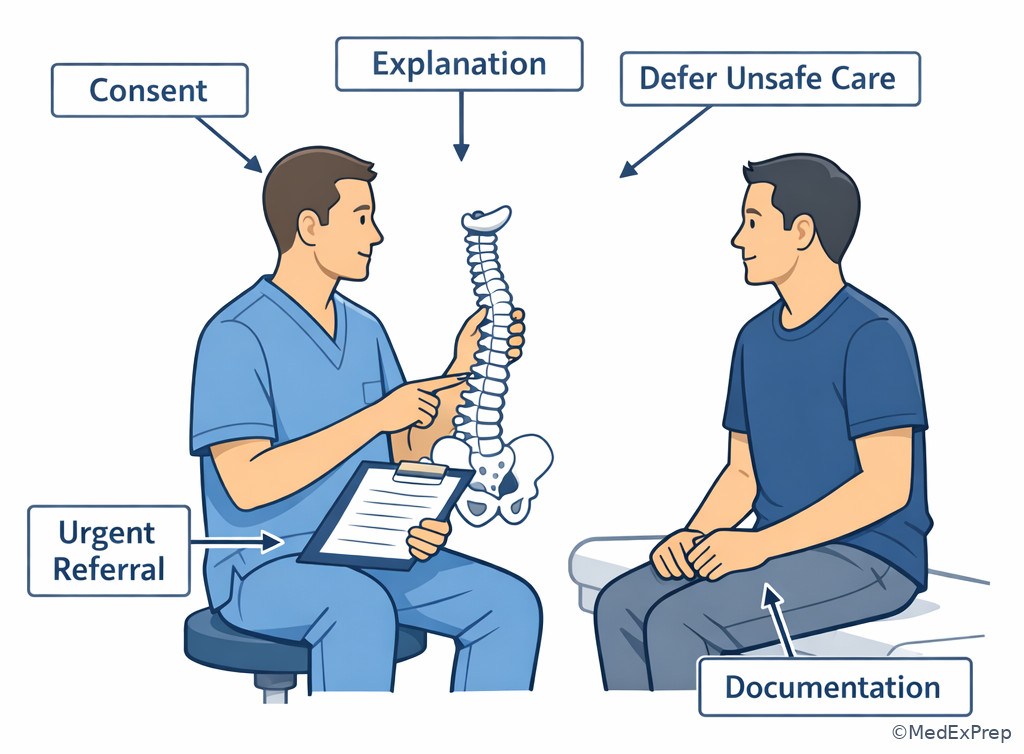
Scope is not only a legal boundary; it is a communication task. In practical stations, the decision conflict is often how to speak to the patient when you are not proceeding exactly as they expect. The rule that resolves it: explain the reason in safety language, not defensive language. Good patient communication sounds like this: “Based on your history and findings, I want to avoid a procedure that could be unsafe today. The most appropriate next step is further evaluation.” This preserves dignity, demonstrates competence, and avoids arguing.
Patient-facing scope language should be clear, calm, and role-appropriate. Obtain consent before touching or positioning. State what you are about to do and why. If withholding care, explain the concern without alarming the patient unnecessarily. If referring, specify urgency and destination in practical terms. Do not imply that the patient is being “rejected”; explain that the decision protects them. See Fig 4.
Exam takeaway: Scope-appropriate answers explain risk, obtain consent, and redirect care without overstating authority.
B Worked example
A 29-year-old postpartum patient presents with severe headache and neck pain three days after delivery. She has a history of migraines and anemia, and she says, “I just want my neck adjusted because that always fixes my headaches.” The tempting clue is the prior migraine history. However, she also reports worsening headache when lying down, mild visual blurring, and elevated blood pressure measured earlier at an urgent care kiosk.
Reasoning chain: identify the task — communicate the next step. Extract key facts — postpartum status, severe headache, visual changes, possible hypertension. Apply rule — this is not a routine headache management situation; manipulation should be deferred and urgent medical evaluation recommended. Eliminate distractors — discussing prior migraine success is not enough; offering reassurance alone minimizes risk; giving a definitive diagnosis is overreach. Verify — explain that the symptoms require prompt medical assessment and that treatment today would not be the safest choice.
C Exam trap
D Checkpoint
Question: Which patient-facing statement best fits the entry-level chiropractic role when a red flag emerges during intake?
- “I know exactly what this is, and I will manage it here today.”
Tempting because certainty sounds reassuring; wrong because it overstates authority and may ignore risk. - “Because some of your symptoms could indicate a condition that should be medically evaluated promptly, I do not want to perform this procedure today; the safest next step is urgent referral.”
Tempting because it may feel conservative; right because it is clear, professional, and safety-based. - “I cannot help you, so there is no reason to continue discussing your symptoms.”
Tempting because referral is needed; wrong because it is unprofessional and abandons communication. - “Let’s try a quick treatment first, and if it fails, then we can refer.”
Tempting because it seems efficient; wrong because red flags should redirect the plan before treatment.
Answer: B
- Fill in the blank: When a red flag appears, the first duty is patient safety, not completing the planned procedure.
- True or False: Prior benefit from manipulation can outweigh a new serious warning sign. False.
- Name 3 elements of strong scope-aware communication: explain risk, state next step, document.
1.1.1.7 Integration: scope-aware reasoning when the stem mixes mechanical clues with danger signals
A Explanation
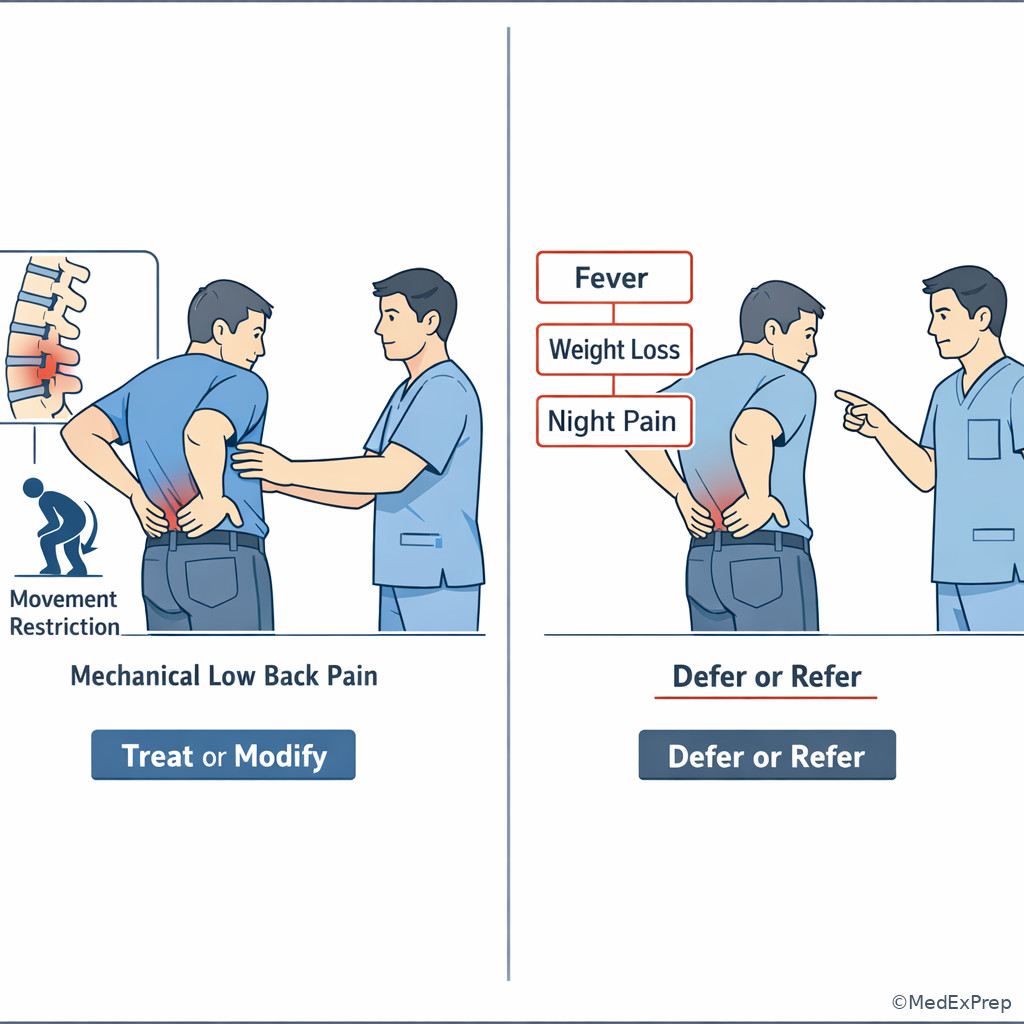
The final integration skill is handling stems that deliberately mix routine mechanical findings with one decisive clue that changes management. This is classic board construction. The question may include joint restriction, pain with motion, or a prior good response to chiropractic care, but the correct answer turns on a single override finding such as fever, unexplained weight loss, trauma, anticoagulation, severe osteoporosis, progressive weakness, saddle anesthesia, or vascular symptoms.
The decision conflict is between pattern recognition and safety override. The resolving rule is simple: when a red flag and a mechanical clue coexist, the red flag governs the next step. The stem is not asking whether the patient also has a biomechanical dysfunction; it is asking whether you can resist the temptation to act on that finding before excluding danger. See Fig 5.
Exam takeaway: When mechanical findings and red flags appear together, the safety clue determines the next action.
B Worked example
A 55-year-old man presents with low back pain and right buttock stiffness after gardening. He has a history of prostate cancer in remission, hypertension, and insomnia. He reports morning stiffness that loosens with movement, which tempts a benign mechanical interpretation. However, he also notes worsening night pain over three weeks and an unintentional 12-pound weight loss. Lumbar flexion is limited, and palpation finds paraspinal hypertonicity.
Reasoning chain: identify the task — choose management, not just classify pain. Extract key facts — cancer history, weight loss, night pain, progressive course; biomechanical findings are present but not decisive. Apply rule — red flags outweigh mechanical restriction. Eliminate distractors — SMT based on segmental findings ignores malignancy concern; home exercise alone delays evaluation; declaring “sciatica” is unsupported and misses the danger pattern. Verify — manipulation should be deferred and prompt medical referral arranged.
C Exam trap
D Checkpoint
Question: A patient has localized lumbar pain, muscle spasm, and limited motion, but also new urinary retention and saddle anesthesia. What is the best interpretation of your role?
- Proceed with gentle lumbar mobilization because the findings are consistent with muscle guarding.
Tempting because guarding is present; wrong because cauda equina warning signs override mechanical findings. - Perform repeated orthopedic testing to confirm the exact segment before changing the plan.
Tempting because specificity sounds thorough; wrong because urgent escalation should not be delayed. - Defer treatment and arrange immediate emergency evaluation because the presentation exceeds safe chiropractic management.
Tempting because it may feel abrupt; right because the neurologic red flags are decisive. - Recommend over-the-counter medication and recheck tomorrow.
Tempting because it seems practical; wrong because it both delays care and steps into medication advice.
Answer: C
Exam takeaway: Recognize common concerning patterns and act safely without claiming specialist-level certainty.
Exam takeaway: Systemic or neurologic warning symptoms should redirect the encounter away from routine manual care.
Exam Traps & Differentiators
| Looks similar | But isn’t | Discriminator | Best scope-aware move |
|---|---|---|---|
| Routine neck pain after desk work | Neck pain after trauma in an anticoagulated older adult | Recent trauma plus bleeding/fracture risk | Defer manipulation; evaluate or refer |
| Usual migraine history | Postpartum headache with visual change and elevated BP | New-risk context overrides old benign label | Urgent medical referral |
| Mechanical low back pain with spasm | Back pain plus urinary retention and saddle anesthesia | Cauda equina warning signs | Immediate emergency evaluation |
| Benign age-related pain | Night pain, weight loss, cancer history | Systemic red flags | Defer and refer |
| Imaging review | Specialist radiology-level final read claim | Overclaiming certainty beyond role | Describe concern and correlate clinically |
If the stem says...
- “write a prescription” → think wrong provider / outside scope.
- “recent trauma,” “osteoporosis,” or “anticoagulated” → think exclude instability before any manual procedure.
- “night pain,” “weight loss,” “fever,” or “cancer history” → think systemic pathology until proven otherwise.
- “saddle anesthesia,” “urinary retention,” or “progressive weakness” → think urgent or emergent referral, not treatment modification.
- “patient requests what worked before” → think prior benefit does not override current red flags.
- “image suggests” → think describe concern and next step, not definitive specialist claim.
Tables
| Reference summary | Within entry-level chiropractic role | Use caution / modify | Defer / refer |
|---|---|---|---|
| History | Focused complaint, mechanism, red flags, prior response | Complex multisystem history needing prioritization | History suggests emergency or unstable condition |
| Exam | Observation, ROM, ortho, neuro, palpation | High irritability or guarded positioning | Exam provocation unsafe or major neurologic warning signs present |
| Imaging | Recognize common plain-film patterns | Uncertain finding requiring correlation | Suspected fracture, instability, aggressive lesion, or serious pathology |
| Treatment | Conservative care if routine mechanical and safe | Lower-force or altered positioning for precautions | Any care requiring unsafe force or when contraindications exist |
| Communication | Consent, explanation, education, referral discussion | Emotionally distressed patient needing slower pacing | Do not reassure away red flags or overpromise outcomes |
| Comparison | Within-scope answer style | Tempting wrong answer style |
|---|---|---|
| Medication request | Discuss conservative options and refer medication questions appropriately | Prescribe or direct specific drug therapy |
| Suspicious imaging | State concern, correlate clinically, defer unsafe care | Give definitive subspecialty-level read and clear treatment |
| Acute neurologic decline | Urgent referral or emergency activation | Repeat manual exam or trial treatment first |
| Routine mechanical pain | Focused exam and reasonable conservative management | Immediate referral without indication or aggressive force without full screen |
| Patient expectation conflict | Explain why plan changes based on safety | Proceed to satisfy the patient despite warning signs |
| Differential/classification pattern | Typical clue set | Classification | Scope implication |
|---|---|---|---|
| Mechanical uncomplicated complaint | Movement-related pain, no systemic signs, stable neuro exam | Routine conservative candidate | Assessment and possible care within role |
| Precaution case | High irritability, frailty, apprehension, anticoagulation without acute trauma | Modification candidate | Choose gentler approach or more assessment |
| Contraindication concern | Suspected fracture, instability, severe osteoporosis, acute structural risk | Defer procedure | No manipulation until clarified |
| Urgent referral case | Progressive weakness, systemic red flags, possible infection or malignancy | Out of routine management | Prompt medical evaluation |
| Emergency case | Cauda equina signs, major vascular concern, severe acute neurologic event | Emergency escalation | Immediate emergency response |
Algorithm / Approach
Exam takeaway: Use a role check and red-flag check before committing to examination depth or treatment choice.
flowchart TD
A[Start with task in stem] --> B{Is action within chiropractic entry-level role?}
B -->|No| C[Reject option]
B -->|Yes| D{Any red flag contraindication or unstable clue?}
D -->|Yes| E[Defer unsafe care]
E --> F[Urgent referral or emergency activation as indicated]
D -->|No| G{Precaution or incomplete data?}
G -->|Yes| H[Modify exam or technique / gather more information]
G -->|No| I[Proceed with focused assessment or conservative care]
I --> J[Reassess and document]
H --> J
F --> J Rapid Review
- Scope distractor → medically reasonable does not mean candidate-appropriate.
- Medication request → refer drug management questions; do not prescribe.
- Imaging concern → describe pattern and implication; avoid specialist-level certainty.
- Mechanical findings + red flag → red flag governs next step.
- Precaution → modify force, position, or depth of assessment.
- Contraindication → no manipulation until clarified.
- Progressive neurologic deficit → escalation beats repeated manual testing.
- Cancer history + night pain → think referral, not segmental treatment.
- Postpartum severe headache + visual change → urgent medical evaluation, not routine neck care.
- Older adult + trauma + osteoporosis → suspect structural risk first.
- Patient preference → never overrides safety findings.
- Professional explanation → state safety reason and next step clearly.
- Incomplete data → more assessment or referral is often the best answer.
- Entry-level competence → assess well, act safely, escalate appropriately.
Self-check quiz
1. A 41-year-old patient with uncomplicated mechanical thoracic tightness asks you to prescribe an anti-inflammatory before treatment. He has seasonal allergies and controlled GERD. What action most appropriately matches entry-level chiropractic scope?
- Prescribe a short course of anti-inflammatory medication
- Recommend a specific prescription dose and duration through the chart
- Continue focused assessment, discuss conservative options, and direct medication questions to an appropriate prescribing provider
- Cancel the encounter because any medication question is outside discussion
2. A plain film obtained elsewhere appears concerning for an acute compression deformity in a 70-year-old patient with osteoporosis and recent cough-related thoracic pain. What is the best entry-level response?
- State that the finding is concerning, defer manipulation, and arrange appropriate referral or further evaluation
- Declare the exact fracture age and stability with certainty
- Proceed with low-force thoracic treatment because the patient is uncomfortable
- Begin drug therapy for bone protection
3. A 33-year-old recreational runner has low back pain after lifting a child. He has mild asthma and remote ankle sprains. Pain is worse with flexion, neurologic exam is normal, and there is no fever, trauma, weight loss, or bowel/bladder change. He is highly anxious in side posture and asks whether there is a gentler option. What is the most appropriate next step?
- Forceful side-posture manipulation because neurologic findings are normal
- Modify the approach to a lower-force option or further tolerated assessment
- Send for emergency evaluation because back pain can become serious
- Prescribe a muscle relaxant and delay treatment
4. A 58-year-old man presents with lumbar pain after yard work. He has hypertension, prior prostate cancer, and recent unintended weight loss. Examination shows paraspinal hypertonicity and limited flexion. He says prior chiropractic visits “always fixed this.” What is the most appropriate next step?
- Proceed with lumbar manipulation because the pain began mechanically
- Defer manipulation and arrange prompt medical referral because systemic red flags are present
- Offer home stretching only and recheck in 6 weeks
- Write a recommendation for opioid pain management
5. A 28-year-old postpartum patient presents with severe headache, neck pain, and blurred vision. She has a history of migraines and iron-deficiency anemia. She reports a high blood pressure reading earlier today and requests the same cervical treatment that helped her before pregnancy. What is the most appropriate action?
- Proceed with cervical treatment because prior response supports a benign headache pattern
- Defer treatment and recommend urgent medical evaluation
- Prescribe migraine medication and follow up tomorrow
- Reassure her that postpartum headaches are usually mechanical
6. A 74-year-old woman presents with new neck pain after a minor fall. She has atrial fibrillation on anticoagulation, osteopenia, and chronic hand paresthesias previously attributed to carpal tunnel syndrome. Active rotation is severely limited by pain, but strength testing is grossly intact. Which option is the safest next step?
- Use a low-force cervical technique because neurologic strength is intact
- Defer cervical manipulation and arrange appropriate evaluation for possible structural injury
- Perform repeated cervical compression testing to localize the lesion first
- Reassure her that the hand paresthesias are chronic and unrelated, so treatment can proceed
7. A 49-year-old patient presents with low back pain, bilateral leg heaviness, and urinary retention that began over 24 hours. He has diabetes, obesity, and a history of prior mechanical back flares treated conservatively. Examination also finds lumbar spasm and restricted motion. What action requires immediate selection?
- Emergency referral because the neurologic warning signs exceed safe outpatient chiropractic management
- Trial lumbar mobilization because the patient has a history of similar back pain
- Repeat orthopedic testing to determine whether the pattern is discogenic before deciding
- Advise bed rest and nonprescription analgesics overnight
8. A 62-year-old man presents with thoracic pain and stiffness. He has chronic kidney disease, steroid-treated COPD, and reports fever and night sweats over the past week after a recent skin infection. Palpation reveals restriction at the mid-thoracic region, and he asks whether an adjustment will “break the cycle.” Which choice best reflects entry-level chiropractic scope?
- Proceed with thoracic manipulation because segmental restriction identifies the pain generator
- Use a seated technique instead of prone positioning and treat conservatively
- Defer manipulation and arrange urgent medical evaluation for possible infection-related pathology
- Order long-term antimicrobial therapy and monitor response
Answer key
1. Correct answer: C
- A. Tempting because the complaint appears routine and anti-inflammatory therapy is common in musculoskeletal care. Incorrect because prescribing is outside entry-level chiropractic scope; the stem clue is the direct request for a prescription, which tests role boundaries rather than thoracic diagnosis. Source support: chiropractic clinical practice and professional scope standards emphasize conservative management and referral for needs outside scope.
- B. Tempting because recommending a specific dose sounds medically helpful. Incorrect because it still functions as prescriber-level medication management; the discriminating clue is that the candidate is not the prescribing provider.
- C. Tempting because it may seem less decisive than prescribing. Correct because it keeps care within role: assess, discuss nonpharmacologic options, and direct medication questions appropriately. The key clue is uncomplicated mechanical presentation without red flags, so conservative scope-appropriate care remains reasonable.
- D. Tempting because it avoids scope issues entirely. Incorrect because medication questions can be addressed professionally through explanation and referral; abandoning the encounter is unnecessary and poor communication.
2. Correct answer: A
- A. Tempting because it sounds cautious rather than definitive. Correct because entry-level scope allows recognition of a concerning pattern, withholding unsafe care, and arranging referral. The clue is osteoporosis plus recent onset pain and a suspicious deformity on imaging.
- B. Tempting because certainty can feel expert. Incorrect because definitive claims about age and stability exceed what the exam expects from entry-level plain-film interpretation; the discriminating clue is the question’s emphasis on best response, not specialist read.
- C. Tempting because low-force care can be appropriate in precaution cases. Incorrect because suspected acute structural lesion is not merely a precaution; it is a reason to defer until clarified.
- D. Tempting because it addresses bone health. Incorrect because initiating drug therapy is outside role; the stem is testing safe imaging-linked management, not medical treatment planning.
3. Correct answer: B
- A. Tempting because the neurologic exam is normal and the presentation is mechanical. Incorrect because high irritability and poor tolerance favor modification rather than forceful treatment; the clue is his anxiety in side posture without red flags.
- B. Tempting because it may seem less direct than a standard setup. Correct because the case is mechanical yet precautionary for tolerance, making modification the best scope-aware action. The discriminating clue is absence of red flags paired with high irritability.
- C. Tempting because safety matters. Incorrect because there are no urgent warning signs requiring emergency referral; this overreacts to a routine mechanical case.
- D. Tempting because muscle spasm is present. Incorrect because prescribing is outside role and unnecessary for the decision point presented.
4. Correct answer: B
- A. Tempting because the pain followed yard work and hypertonicity is present. Incorrect because cancer history and recent weight loss are systemic red flags that override the mechanical onset. The discriminating clue is unintended weight loss in a patient with prior cancer.
- B. Tempting because it delays hands-on care the patient expects. Correct because the red flags shift the case from routine mechanical management to prompt medical referral; the stem deliberately includes biomechanical findings as noise.
- C. Tempting because it avoids manipulation. Incorrect because passive delay is unsafe when malignancy concern exists; the clue is the systemic pattern requiring prompt evaluation, not watchful waiting.
- D. Tempting because pain is significant. Incorrect because opioid recommendations exceed chiropractic prescribing role and miss the primary issue.
5. Correct answer: B
- A. Tempting because prior successful treatment suggests a familiar benign pattern. Incorrect because postpartum severe headache with blurred vision and elevated blood pressure creates a different risk context. The discriminating clue is the new postpartum warning cluster.
- B. Tempting because it may feel conservative. Correct because the presentation requires urgent medical evaluation and lies beyond routine chiropractic management at this moment.
- C. Tempting because migraines are in the history. Incorrect because prescribing medication is outside role and the headache cannot be presumed to be a routine migraine here.
- D. Tempting because many headaches are benign. Incorrect because reassurance alone ignores major warning features.
6. Correct answer: B
- A. Tempting because low-force options are often used when risk is present. Incorrect because trauma, anticoagulation, osteopenia, and marked pain-limited rotation raise concern for structural injury; the discriminating clue is combined fragility and trauma risk, not the absence of gross weakness.
- B. Tempting because it postpones treatment. Correct because possible structural injury must be excluded before cervical manipulation. The clue that decides it is recent fall plus anticoagulation and osteopenia.
- C. Tempting because more localization seems thorough. Incorrect because provocative testing should not precede safety clarification when structural injury is possible.
- D. Tempting because the chronic paresthesias may indeed be unrelated. Incorrect because even if unrelated, they do not cancel the acute trauma risks that govern management.
7. Correct answer: A
- A. Tempting because it immediately changes the clinical pathway. Correct because urinary retention and bilateral leg symptoms raise concern for cauda equina syndrome, which exceeds safe outpatient chiropractic management and requires emergency evaluation. The discriminating clue is urinary retention.
- B. Tempting because prior mechanical flares create familiarity. Incorrect because previous benign episodes do not override current emergent neurologic signs.
- C. Tempting because diagnostic precision can feel necessary. Incorrect because emergency signs should not be delayed by more office testing; the clue is the time-sensitive neurologic presentation.
- D. Tempting because it is a common self-care approach for benign back pain. Incorrect because delayed care risks neurologic harm and medication advice does not address the emergency concern.
8. Correct answer: C
- A. Tempting because segmental restriction is a familiar MSK finding. Incorrect because fever, night sweats, recent infection, steroid use, and systemic illness concern override local restriction; the discriminating clue is the infection-risk cluster.
- B. Tempting because changing position is a common modification strategy. Incorrect because this is not merely a positioning issue; possible infection-related pathology requires referral rather than modified treatment.
- C. Tempting because it interrupts the expected manual care plan. Correct because systemic infectious red flags place the case outside routine conservative management until medically evaluated.
- D. Tempting because recent infection suggests antimicrobials. Incorrect because prescribing long-term antimicrobial therapy is outside role and bypasses appropriate medical evaluation.
Keep going with the full NBCE Part IV Prep Course (NBCE IV)
You just studied the way members do, in the same lesson interface. Full access unlocks every lesson, the question bank and flashcards for a full year.
One payment · 1 year of access · No auto-renewal