1.1.1 - Next-Step Question Framework
1.1.1 Next-Step Question Framework
What you'll learn
- SURG DOMAIN: Surgical Foundations → Next-step task identification: Determine whether the stem is asking for diagnosis, best initial test, most appropriate next step, definitive management, or urgent escalation.
- SURG DOMAIN: Surgical Foundations → Stability-first triage: Apply a consistent sequence of assess stability first, then pursue diagnosis only if the patient can safely wait.
- SURG DOMAIN: Surgical Foundations → Rule selection: Choose the governing surgery rule that resolves the conflict between tempting answer choices.
- SURG DOMAIN: Surgical Foundations → Sequencing and distractor control: Avoid classic errors such as imaging before resuscitation or definitive therapy before temporizing stabilization.
- SURG DOMAIN: Surgical Foundations → Shelf-style vignette reasoning: Use a repeatable reasoning chain to eliminate close-call distractors in common surgical stems.
- SURG DOMAIN: Surgical Foundations → Question task decoding
- SURG DOMAIN: Surgical Foundations → Urgency recognition
- SURG DOMAIN: Surgical Foundations → Initial stabilization vs diagnostic workup
- SURG DOMAIN: Surgical Foundations → Management sequencing in clerkship-level surgery
Why it matters
- Many COMAT Surgery misses are not content deficits; they are sequencing errors such as choosing the right idea at the wrong time.
- Surgery stems repeatedly test whether you can separate unstable now from stable enough for workup.
- The same disease can generate different correct answers depending on the task: diagnosis, initial test, immediate stabilization, or definitive management.
- A reliable framework improves accuracy across all later topics, from trauma to acute abdomen to postoperative complications.
Key Terms & Must-Know Facts
1.1.1.1 Key terms
- Next best step: The single safest and most appropriate action at this moment in the case.
- Best initial test: First diagnostic study that is practical, informative, and appropriate given stability.
- Definitive test: Study with the highest diagnostic certainty, even if not the first step.
- Best initial therapy: First treatment started before all downstream decisions are complete.
- Definitive management: The intervention that actually resolves the underlying problem.
- Stabilization: Immediate action to protect airway, breathing, circulation, or control ongoing life threat.
- Temporizing measure: Short-term bridge when definitive treatment cannot occur immediately.
- Urgency cue: Finding that makes delay unsafe, such as hypotension, peritonitis, or altered mental status.
- Diagnostic sequencing: Order in which tests and treatments should occur.
- Distractor: Plausible answer made wrong by timing, stability, or one missing clue.
- Governing rule: The single principle that decides between close answer choices.
- Clinical noise: Extra data in the stem that is true but not decision-defining.
1.1.1.2 Must-know facts
- In surgery questions, ABCs outrank diagnosis refinement.
- An unstable patient usually needs resuscitation before CT.
- The correct answer often depends more on timing than on disease recognition.
- If the stem asks for best initial test, do not jump to the most definitive study unless it is also the safest first step.
- If the stem asks for most appropriate next step, treatment may beat testing.
- Peritonitis, shock, airway compromise, active hemorrhage, and sepsis are classic reasons to prioritize immediate action.
- A tempting wrong answer is often the correct answer for a stable version of the same patient.
- Board stems commonly include one distracting comorbidity or laboratory abnormality that should not redirect the whole approach.
| Question wording | What you are choosing | Common wrong move | Discriminator |
|---|---|---|---|
| Most likely diagnosis | Pattern match disease identity | Treating before confirming the pattern | Use localization + key finding |
| Best initial test | First study that is safe and useful | Picking the gold-standard test first | Ask whether the patient can wait |
| Most appropriate next step | Action needed now | Ignoring unstable physiology | Stability can override diagnosis workup |
| Best initial therapy | Immediate treatment | Choosing definitive management too early | Does the patient need temporizing care first? |
| Definitive management | Final corrective treatment | Stopping at temporary stabilization | What actually fixes the lesion? |
Core content
1.1.1.3 Foundational step 1: identify the task the stem is asking you to solve
A Explanation
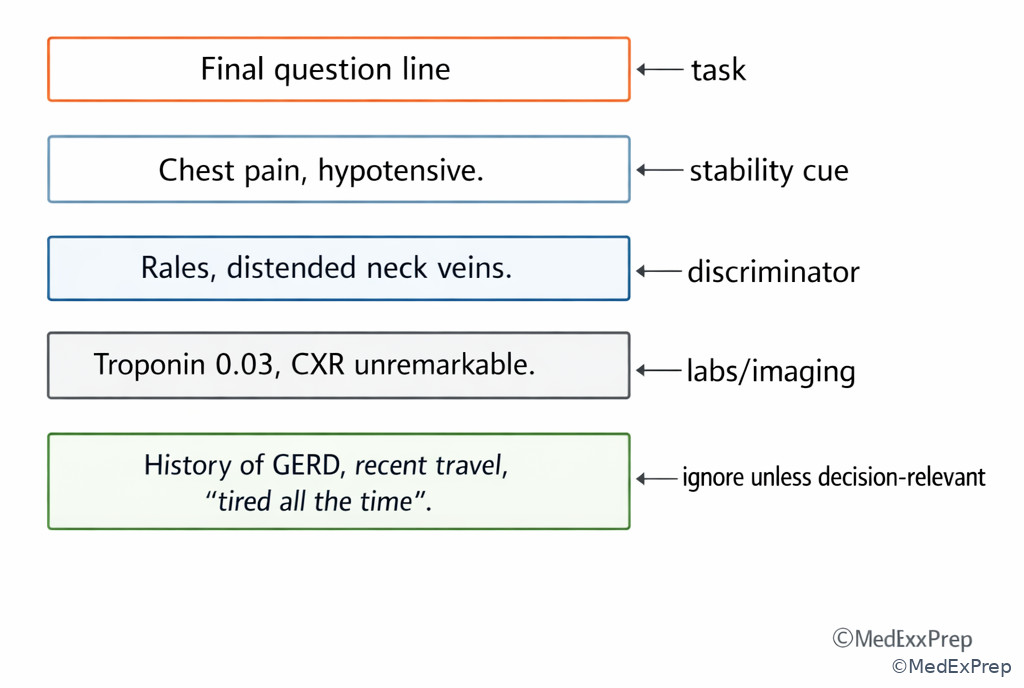
The first conflict in surgery questions is not disease recognition; it is task recognition. Students often know the disease but miss the item because they answer a different question than the one asked. You must choose between several possible tasks: diagnose the condition, order the best initial test, start immediate stabilization, choose definitive management, or escalate urgently. The single rule that resolves this conflict is: read the final line as an action label before interpreting the stem. If the last line says “most appropriate next step,” your answer may be treatment, bedside assessment, or consultation rather than the best imaging study.
WHY THIS IS TESTED: Board writers exploit the difference between “best initial test,” “most likely diagnosis,” and “most appropriate next step” using the same clinical scenario. A stem describing classic acute cholecystitis may support ultrasound as the best initial test in one question, antibiotics and surgical evaluation as the next step in another, and laparoscopic cholecystectomy as definitive management in a third.
Choose-vs-reject framing helps here. Choose an answer that matches the verb in the final line. Reject options that are medically reasonable but answer the wrong task. This is especially important in clerkship-level surgery, where the test rewards safe sequencing over heroic certainty. See Fig 1.
Exam takeaway: Match your answer to the task being asked before solving the case.
flowchart TD
A[Read final question line] --> B{What is being asked?}
B --> C[Diagnosis]
B --> D[Best initial test]
B --> E[Most appropriate next step]
B --> F[Definitive management]
C --> G[Pattern match disease]
D --> H[Pick safe first study]
E --> I[Act on urgency now]
F --> J[Choose final corrective treatment] Exam takeaway: The stem becomes easier once you sort it into a diagnosis, test, treatment, or escalation task.
Exam takeaway: Separate task line, urgency clues, key facts, and noise before choosing an answer.
B Worked example
A 46-year-old woman with obesity, type 2 diabetes, and migraine presents with 18 hours of right upper quadrant pain, fever, nausea, and pain after fatty meals. She has a leukocyte count of 15,000/mm3, mild AST elevation, and a known history of asymptomatic gallstones from a prior scan. Murphy sign is positive. The stem asks for the best initial test. A tempting wrong clue is the known gallstones, which may push you straight to surgery.
Reasoning chain: Identify task → this is not asking for diagnosis or definitive management; it asks for a first study. Extract key facts → stable patient, suspected acute cholecystitis, no shock or jaundice. Apply rule → in a stable patient with suspected gallbladder disease, right upper quadrant ultrasound is the best initial test. Eliminate distractors → CT may show complications but is not first line; HIDA may be more sensitive but is generally used when ultrasound is nondiagnostic; immediate surgery answers a treatment question, not a testing question. Verify → ultrasound matches the task and the setting.
C Exam trap
Common wrong answer: The most definitive study or the final treatment.
Why it is tempting: If you recognize the disease early, your brain jumps ahead to the eventual endpoint.
Single clue that eliminates it: The final line asks for best initial test or most appropriate next step, not definitive management.
D Checkpoint
Question: A 63-year-old man with hypertension and chronic tobacco use presents with sudden severe epigastric pain radiating to the back. He is alert, blood pressure is 132/78 mm Hg, and abdominal exam shows a pulsatile mass. The stem asks for the most likely diagnosis. Which answer best matches the task?
- Immediate vascular surgery consultation
- Abdominal aortic aneurysm
- CT angiography of the abdomen
- Large-bore IV access and crossmatch
Correct answer: B. Abdominal aortic aneurysm.
- A: Tempting because this is a dangerous vascular emergency, but it answers management rather than diagnosis.
- B: Right because the final line asks for disease identity; pulsatile abdominal mass plus back pain supports AAA.
- C: Tempting because CTA is a common study in stable vascular cases, but this is not a testing question.
- D: Tempting because resuscitation is high yield in real practice, but the stem specifically asks for diagnosis.
Clinician Action: DIAGNOSE the question type before diagnosing the patient. ORDER a test only if the task asks for one and the patient is stable enough. TREAT immediately when the task or stability demands action. REFER/ESCALATE when the clinical scenario suggests a time-sensitive surgical problem even if the item is written as a diagnostic stem.
1.1.1.4 Foundational step 2: assess stability before choosing test versus treatment
A Explanation
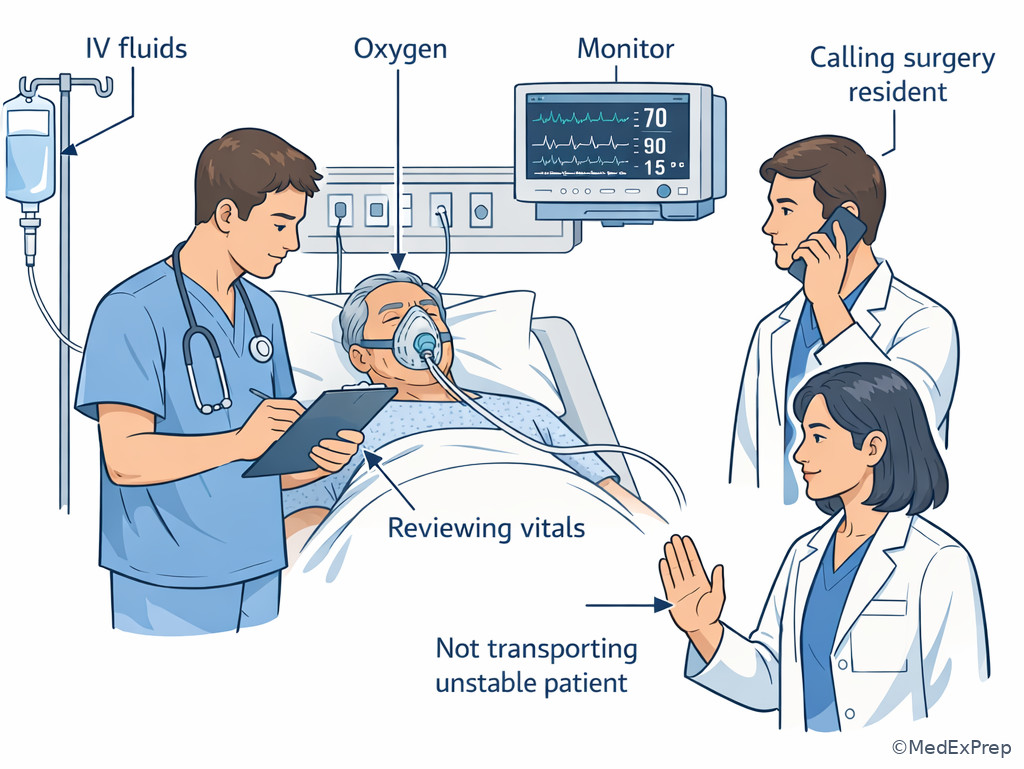
The second major conflict is choosing between more information and immediate stabilization. On surgery exams, the single rule that resolves this conflict is: unstable physiology beats diagnostic completeness. If the patient has airway compromise, severe respiratory distress, shock, active hemorrhage, peritonitis with toxicity, or altered mental status from a likely surgical catastrophe, the correct answer is often immediate resuscitation or urgent intervention rather than imaging.
WHY THIS IS TESTED: Shelf questions repeatedly punish the student who recognizes the disease but forgets that the patient is too unstable to wait for confirmation. A chest tube in tension pneumothorax, fluids and blood in hemorrhagic shock, and broad sepsis care with urgent source control in septic perforation all reflect this principle. The test is not asking whether you know the disease; it is asking whether you understand what must happen first.
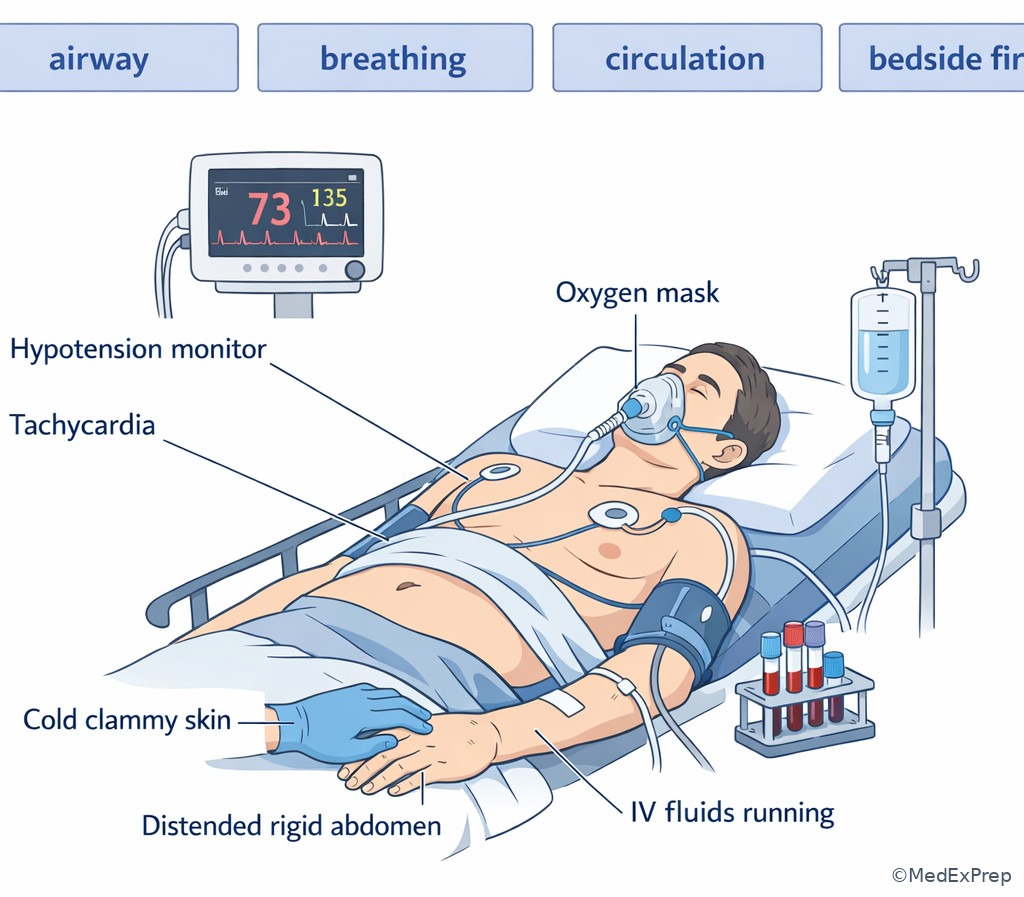
For this topic, keep stability screening simple: airway, breathing, circulation, obvious ongoing life threat, and whether transport to imaging is safe. If not, reject even excellent diagnostic tests. See Fig 2. This lesson sets up the next topic, Stability And Urgency Cues, where these signals are expanded into disease-specific patterns.
Exam takeaway: If the patient is unstable, stabilization outranks further workup.
flowchart TD
A[Recognize possible surgical problem] --> B{Unstable?}
B -->|Yes| C[Airway, oxygen, IV access, monitor]
C --> D[Resuscitate and urgent consult]
D --> E[Bedside or immediate intervention]
B -->|No| F[Focused history and exam]
F --> G[Choose best initial test]
G --> H[Move toward definitive management] Exam takeaway: Ask whether imaging changes care safely right now or only delays needed action.
Exam takeaway: Visual cues of shock, respiratory distress, and peritonitis should trigger action before transport to imaging.
B Worked example
A 71-year-old man with atrial fibrillation, chronic kidney disease, and peripheral arterial disease presents with abrupt severe abdominal pain, vomiting, and confusion. He has a lactate of 5.2 mmol/L, blood pressure 82/46 mm Hg, diffuse abdominal tenderness, and one episode of dark stool. A prior colonoscopy 2 years ago was normal, which is distracting and not useful. The stem asks for the most appropriate next step.
Reasoning chain: Identify task → immediate action, not final diagnosis. Assess urgency → hypotension, confusion, high lactate, and severe pain indicate possible ischemia or sepsis; this patient is unstable. Apply rule → begin resuscitation now with IV fluids, monitoring, broad urgent evaluation, and immediate surgical escalation rather than sending straight to delayed imaging as the first move. Eliminate distractors → colonoscopy is irrelevant and unsafe; outpatient follow-up is absurdly delayed; CT angiography may ultimately help if he stabilizes, but not before basic resuscitation and urgent involvement. Verify → the safest answer is the one that addresses instability first.
C Exam trap
Common wrong answer: CT scan first.
Why it is tempting: Students correctly suspect a specific diagnosis and want confirmation.
Single clue that eliminates it: Hypotension means the patient may not safely tolerate diagnostic delay or transport.
D Checkpoint
Question: A 29-year-old man is brought after a stab wound to the chest. He is anxious, tachycardic, hypotensive, and has unilateral absent breath sounds with tracheal deviation. Which is the most appropriate next step?
- Portable chest radiograph
- Needle decompression followed by tube thoracostomy
- CT scan of the chest with contrast
- FAST examination before intervention
Correct answer: B. Needle decompression followed by tube thoracostomy.
- A: Tempting because x-ray confirms thoracic injuries, but tension physiology is treated clinically without waiting.
- B: Right because obstructive shock from tension pneumothorax is a treat-first diagnosis.
- C: Tempting because CT provides detail, but an unstable trauma patient should not go to CT first.
- D: Tempting because FAST is a trauma tool, but the stem already gives the diagnosis that requires immediate decompression.
- The most common reason CT is wrong as the first answer in surgery stems is instability.
- True or False: A definitive test should always be chosen before treatment in a hypotensive patient. False.
- Name 3 bedside danger cues: hypotension, respiratory distress, peritonitis.
Memory anchor: LAST = Last line first, ABCs next, Stability decides, Task-specific answer. Use it before reading answer choices.
High-Yield Connection: This concept is tested alongside trauma primary survey and postoperative complication recognition. Know both the instability cue and the first intervention; exams often pair mechanism recognition with a sequencing decision.
Clinician Action: DIAGNOSE instability from vitals and bedside findings, not from delayed imaging. ORDER bedside tests only if they do not delay life-saving care. TREAT with airway support, oxygen, IV access, fluids, blood, decompression, or antibiotics when indicated. REFER/ESCALATE early to trauma or surgery when shock, perforation, hemorrhage, or ischemia is suspected.
1.1.1.5 Application step 3: extract discriminating facts and ignore clinical noise
A Explanation
Once you know the task and have screened stability, the next conflict is between signal and noise. Surgery stems are loaded with age, comorbidities, prior operations, mildly abnormal labs, or side complaints that may be true but not decisive. The single rule here is: keep only the findings that separate one close answer from another. The goal is not to memorize every detail in the stem; it is to identify the one clue that makes one option correct and the others wrong.
WHY THIS IS TESTED: Board-style items are designed so that several options look plausible at first glance. The correct answer is separated by a specific detail such as pain out of proportion, bilious vomiting, groin bulge that cannot be reduced, postoperative day timing, or persistent tachycardia with oliguria. Experienced test-takers ask, “What single clue would make this choice wrong?” and use that clue to eliminate distractors.
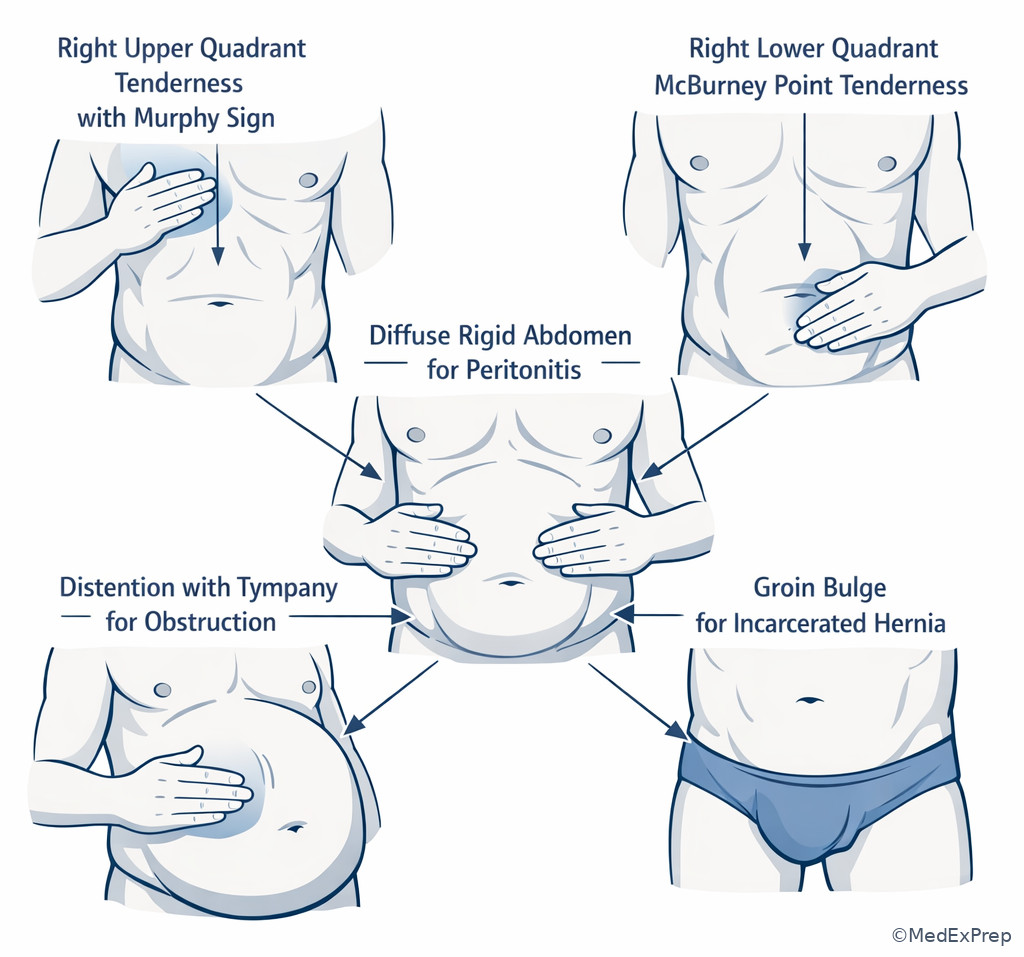
Noise often includes chronic diseases that matter less than the acute presentation, old imaging findings, isolated mild lab changes, or medication history that does not change the immediate decision. Relevant details usually cluster around timing, location, hemodynamics, peritoneal findings, obstruction signs, infection signs, and postoperative day. See Fig 4.
Exam takeaway: Keep the one discriminating clue that changes management and demote the rest to background.
flowchart LR
A[Read stem details] --> B[Sort by urgency]
B --> C[Instability clues]
B --> D[Localizing findings]
B --> E[Timing clues]
B --> F[Noise]
C --> G[Keep]
D --> G
E --> G
F --> H[Ignore unless it changes action]
Exam takeaway: The right answer usually turns on one finding rather than the full data dump.
Exam takeaway: Labeled exam localization helps separate diffuse surgical catastrophe from focal stable pathology.
Recall: There is no prior topic before this one, but this framework becomes the base for the upcoming lessons Stability And Urgency Cues and Diagnosis Versus Stabilization Errors. Here, we build the sorting method those lessons will use in disease-specific situations.
B Worked example
A 58-year-old woman with rheumatoid arthritis, GERD, and a prior cesarean delivery presents with abdominal distention, vomiting, crampy pain, and no flatus for 24 hours. She takes NSAIDs and has mild anemia. Her abdomen is distended but soft; bowel sounds are high-pitched; she is afebrile and normotensive. The stem asks for the most likely diagnosis. The tempting wrong clue is chronic NSAID use, which may nudge you toward perforated ulcer disease.
Reasoning chain: Identify task → diagnosis. Assess stability → stable. Extract key facts → prior abdominal surgery, obstipation, distention, vomiting, high-pitched bowel sounds. Apply rule → this is the classic signal set for small bowel obstruction from adhesions. Eliminate distractors → perforation would more likely bring sudden severe pain and peritonitis; ileus usually has absent or hypoactive rather than high-pitched sounds and less colicky pain; gastroenteritis does not explain obstipation. Verify → the old cesarean delivery is not noise; it is the discriminating clue.
C Exam trap
Common wrong answer: A diagnosis suggested by an eye-catching comorbidity.
Why it is tempting: The stem includes a classic risk factor like NSAID use, anticoagulation, or alcohol history that feels important.
Single clue that eliminates it: The acute pattern of symptoms and exam findings points more strongly elsewhere than the chronic risk factor does.
D Checkpoint
Question: A 67-year-old man with COPD and atrial fibrillation presents with severe abdominal pain that began suddenly 4 hours ago. Exam shows only mild tenderness, but he appears distressed; lactate is elevated. Which detail is the strongest discriminator in favor of mesenteric ischemia rather than simple gastroenteritis?
- Mild leukocytosis
- Pain out of proportion to exam findings
- Nausea and vomiting
- Atrial fibrillation alone
Correct answer: B. Pain out of proportion to exam findings.
- A: Tempting because infection and ischemia both can raise the white count, but leukocytosis is nonspecific.
- B: Right because severe pain with relatively benign early exam is a classic discriminator for mesenteric ischemia.
- C: Tempting because it appears in many GI conditions, but it lacks decision-making specificity.
- D: Tempting because atrial fibrillation is a key risk factor, but risk factor alone is weaker than the presentation pattern.
Clinician Action: DIAGNOSE by pulling out the one or two details that separate near-neighbor diagnoses. ORDER tests that answer the actual discriminator, not every possible problem in the stem. TREAT based on the acute pattern rather than chronic background noise. REFER/ESCALATE if the discriminator suggests ischemia, strangulation, perforation, or another time-sensitive surgical process.
1.1.1.6 Application step 4: choose the governing rule and reject close distractors
A Explanation
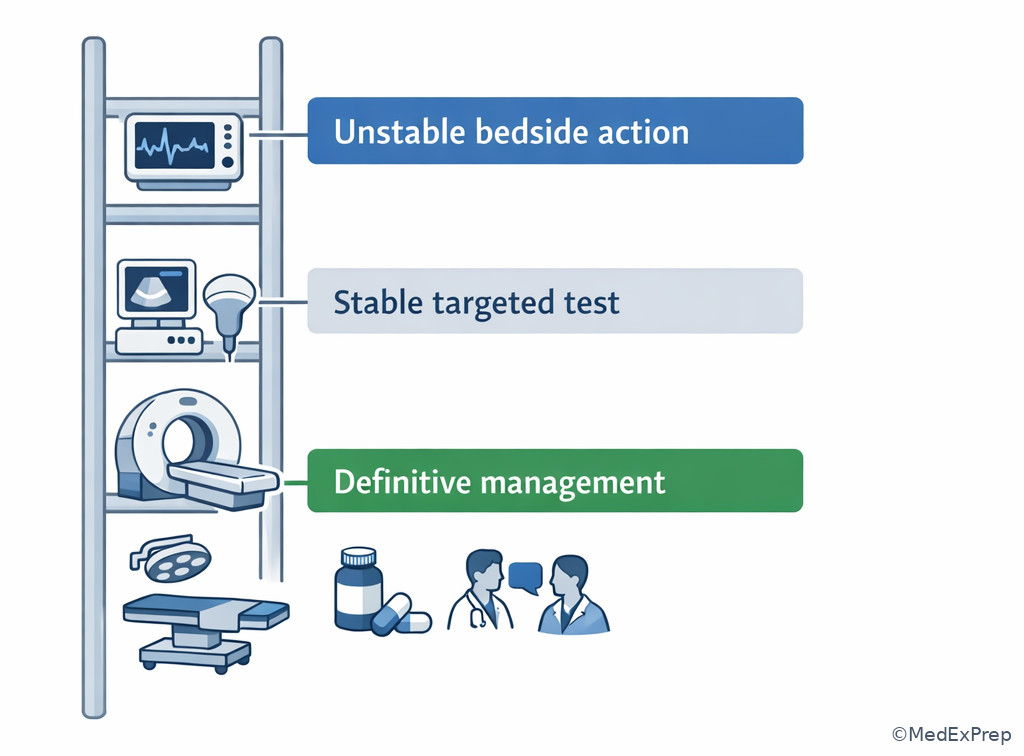
After you isolate the important facts, you must identify the governing rule: the single principle that converts facts into action. The conflict here is between several plausible answers that each would be correct in a slightly different patient. The rule may be “unstable before imaging,” “ultrasound first for suspected biliary disease,” “peritonitis means operative evaluation,” or “postoperative timing points to a specific complication.” The winning move is to ask: What one rule makes three options wrong at once?
WHY THIS IS TESTED: Surgery shelf questions often use four answers from the same category: four tests, four management steps, or four diagnoses. Without a governing rule, choices feel equally attractive. With a rule, one option snaps into place. This is especially important when the stem contains a tempting but incomplete answer, such as outpatient antibiotics for a patient who actually has an incarcerated hernia or a CT scan for a patient with diffuse peritonitis.
Use choose-vs-reject language deliberately. Choose an answer if the patient has the one finding that triggers that rule. Reject it if that trigger is missing or if another trigger takes priority. See Fig 5.
Exam takeaway: One rule should explain why the correct answer wins and why the strongest distractor loses.
flowchart TD
A[Key facts extracted] --> B{Which rule governs?}
B --> C[Unstable before imaging]
B --> D[Stable patient gets targeted test]
B --> E[Peritonitis or ischemia needs urgent surgery]
B --> F[Temporize before definitive care]
C --> G[Choose bedside treatment]
D --> H[Choose best initial study]
E --> I[Choose urgent escalation]
F --> J[Choose bridge measure] Exam takeaway: Eliminate options by asking in which alternate patient each one would have been correct.
Exam takeaway: A visual rule ladder helps distinguish bedside action, targeted test, and definitive treatment.
B Worked example
A 62-year-old man with diabetes, hypertension, and prior inguinal hernia repair presents with worsening groin pain, vomiting, and a nonreducible tender groin mass. He also mentions chronic constipation, which is distracting because it suggests a bowel-only problem. He is tachycardic but normotensive. The stem asks for the most appropriate next step.
Reasoning chain: Identify task → immediate action. Assess urgency → nonreducible tender mass with vomiting suggests incarceration or strangulation. Extract key facts → irreducible groin bulge plus obstructive symptoms. Apply governing rule → a suspected incarcerated or strangulated hernia requires urgent surgical evaluation; repeated delays for outpatient workup are unsafe. Eliminate distractors → laxatives answer constipation but ignore a surgical emergency; CT may help in unclear stable cases but should not delay urgent evaluation when exam is classic; colonoscopy is unrelated. Verify → the rule “obstruction plus tender irreducible hernia means urgent surgical management pathway” beats the noise.
C Exam trap
Common wrong answer: The option that is correct for a milder or stable version of the same condition.
Why it is tempting: It sounds medically sensible and often appears in textbooks as part of the workup.
Single clue that eliminates it: The stem includes a trigger such as irreducibility, peritonitis, shock, or ischemic concern that upgrades the pathway.
D Checkpoint
Question: A 54-year-old woman with obesity and hyperlipidemia presents with fever, right upper quadrant pain, and leukocytosis. Ultrasound already shows gallstones, gallbladder wall thickening, and pericholecystic fluid. Which governing rule best supports the next step?
- All gallstone disease requires ERCP first
- Stable focal biliary infection is managed with antibiotics and early cholecystectomy planning
- CT abdomen is mandatory before any treatment decision
- Asymptomatic cholelithiasis is best managed surgically the same day
Correct answer: B. Stable focal biliary infection is managed with antibiotics and early cholecystectomy planning.
- A: Tempting because ERCP is used in biliary disease, but it is reserved for suspected common bile duct obstruction or cholangitis.
- B: Right because the findings support acute cholecystitis in a stable patient.
- C: Tempting because CT offers more anatomy, but ultrasound already answered the relevant question.
- D: Tempting because stones are present, but asymptomatic and symptomatic pathways differ.
- Fill in the blank: A tempting distractor is often the right answer for a more stable patient.
- True or False: If an option is medically reasonable, it can still be wrong because the sequence is wrong. True.
- Name 3 trigger findings that upgrade urgency: shock, peritonitis, irreducibility.
Memory anchor: RULE = Read the ask, Unstable first, Lock onto the discriminator, Eliminate by sequence. If two options seem correct, the wrong one usually fails sequence.
High-Yield Connection: This concept is tested alongside postoperative timing questions and acute abdomen differentials. Know both the disease pattern and the escalation trigger; boards often pair a familiar diagnosis with an unfamiliar urgency change.
Clinician Action: DIAGNOSE the trigger that activates a management rule. ORDER additional testing only if it changes care without dangerous delay. TREAT using the first-line pathway that matches the trigger. REFER/ESCALATE urgently when the rule signals incarceration, ischemia, perforation, uncontrolled sepsis, or hemorrhage.
1.1.1.7 Integration step 5: verify sequencing, contraindications, and student-role safe actions
A Explanation
The final conflict is between a technically correct intervention and a safe, clerkship-level next step. COMAT Surgery expects you to think like a supervised student physician: recognize emergencies, begin appropriate initial measures, and escalate. The governing rule is: pick the next action that is safe, standard, and within the expected sequence of care. If an answer assumes independent operative decision-making, detailed procedural execution, or advanced ICU management beyond student scope, it is usually wrong unless phrased as urgent consultation or supervised escalation.
WHY THIS IS TESTED: Surgery questions often place a student at the bedside where the most appropriate answer is not “perform the operation” but “recognize the emergency, begin resuscitation, and notify the surgical team.” This is not a legal trivia point; it is a safety and sequencing principle. The right answer often combines immediate supportive care with timely escalation.
Verification means doing one last scan: Is the patient stable enough for this step? Is there a contraindication? Is this temporizing when the stem wants definitive management, or vice versa? Is the action appropriate for a clerkship-level supervised role? See Fig 6.
Exam takeaway: Before locking in an answer, confirm sequence, safety, and whether escalation is needed.
flowchart TD
A[Likely answer selected] --> B{Safe right now?}
B -->|No| C[Choose stabilization or escalation]
B -->|Yes| D{Matches the task?}
D -->|No| E[Return to final line]
D -->|Yes| F{Right sequence?}
F -->|No| G[Choose initial or temporizing step]
F -->|Yes| H[Confirm and answer] Exam takeaway: A 10-second safety check prevents many sequence and scope errors.
Exam takeaway: Student-level excellence means recognizing danger, starting standard measures, and escalating quickly.
B Worked example
A 74-year-old woman on postoperative day 1 after bowel surgery develops tachycardia, low urine output, mild confusion, and abdominal pain. She has heart failure, chronic anemia, and anxiety. Her oxygen saturation is 96% on room air. A tempting wrong clue is the anxiety history, which could make you underreact. The stem asks for the most appropriate next step.
Reasoning chain: Identify task → immediate action. Assess urgency → tachycardia, oliguria, confusion, and pain after surgery suggest possible hypovolemia, bleeding, or early sepsis; this is not routine anxiety. Apply rule → verify safety and sequence: bedside reassessment, resuscitative measures as indicated, focused labs, and prompt notification of the surgical team are appropriate before low-yield reassurances or delayed testing. Eliminate distractors → “observe and recheck later” ignores physiologic deterioration; attributing symptoms to anxiety ignores postoperative danger signs; requesting a highly specific advanced test before reassessment and escalation mis-sequences care. Verify → the best answer should combine recognition, stabilization, and escalation.
C Exam trap
Common wrong answer: The option that assumes independent definitive management or overly delayed observation.
Why it is tempting: Students either overreach into attending-level actions or underreact because they recognize only part of the danger.
Single clue that eliminates it: The stem includes a time-sensitive change in physiology that requires supervised escalation now.
D Checkpoint
Question: A third-year medical student evaluates a 65-year-old postoperative patient with new tachycardia, hypotension, and a distended tender abdomen. Which response best fits the expected next step on COMAT Surgery?
- Independently consent the patient for emergent reoperation
- Order outpatient follow-up in 24 hours
- Begin initial stabilization, obtain urgent senior/surgical help, and prepare for further evaluation
- Wait for the morning team because postoperative pain can be variable
Correct answer: C. Begin initial stabilization, obtain urgent senior/surgical help, and prepare for further evaluation.
- A: Tempting because the patient may need surgery, but this oversteps the expected student role.
- B: Tempting only if one underestimates the urgency, but new hypotension makes outpatient management unsafe.
- C: Right because clerkship-level excellence is early recognition, support, and escalation.
- D: Tempting because postoperative discomfort is common, but physiologic deterioration is not watchful-waiting territory.
Clinician Action: DIAGNOSE evolving danger from new postoperative or emergency physiologic change. ORDER focused bedside reassessment and urgent studies that do not delay care. TREAT with standard initial stabilization measures appropriate to the scenario. REFER/ESCALATE immediately to the supervising resident or surgeon when the patient may be bleeding, septic, ischemic, obstructed, or otherwise unstable.
Exam Traps & Differentiators
Common traps & distractors: Many wrong answers are not absurd; they are simply the right move for a different patient state, a different task, or a different time point.
1.1.1.8 Most common wrong answer and why
The most common wrong answer in surgery framework questions is advanced imaging before stabilization. It is tempting because the student recognizes a dangerous diagnosis and wants certainty. The single clue that eliminates that answer is usually instability: hypotension, respiratory compromise, diffuse peritonitis, active hemorrhage, or rapidly worsening postoperative physiology.
1.1.1.9 Looks similar but isn't
| Looks similar | Why students confuse it | What separates them | Exam move |
|---|---|---|---|
| Best initial test vs definitive test | Both may diagnose the same condition | Initial test is practical and safe now; definitive test may come later | Answer the asked task, not the fanciest study |
| Most appropriate next step vs definitive management | Students jump to the endpoint | Immediate sequence may require fluids, antibiotics, decompression, or consult first | Choose what happens now |
| Stable workup vs unstable resuscitation | Same disease can appear in both settings | Vital signs and bedside danger findings | Unstable first, details later |
| Risk factor vs discriminator | Chronic history feels important | The acute pattern determines the answer | Do not let noise outrank presentation |
| Student role vs attending role | Emergency language creates urgency to “do everything” | Safe next step is recognition, stabilization, and escalation | Stay within clerkship-level action framing |
1.1.1.10 If the stem says ___, think ___
- If the stem says most appropriate next step, think What must happen now, before the patient leaves the bedside?
- If the stem says best initial test, think safe, practical first study in this stability state.
- If the stem says pain out of proportion, think ischemia until proved otherwise.
- If the stem says hypotension or altered mental status, think resuscitation before diagnostic completeness.
- If the stem says peritonitis, rigid abdomen, or irreducible tender hernia, think urgent surgical pathway, not leisurely outpatient workup.
- If the stem says postoperative day plus new tachycardia, think complication timing and bedside reassessment, not routine discomfort.
| Upcoming confusable pair | Framework distinction now | Where it will matter later |
|---|---|---|
| Stability cues vs diagnosis refinement | Vitals can overrule the desire for imaging | Trauma, perforation, mesenteric ischemia, GI bleed |
| Diagnosis vs stabilization errors | A correct diagnosis can still lead to a wrong next step | Tension pneumothorax, septic abdomen, hemorrhage |
| Initial test vs definitive test | Same disease, different exam ask | Biliary disease, obstruction, vascular imaging |
| Temporizing vs definitive management | Bridge care is not the endpoint | Obstruction, abscess, biliary decompression, airway emergencies |
Algorithm / Approach
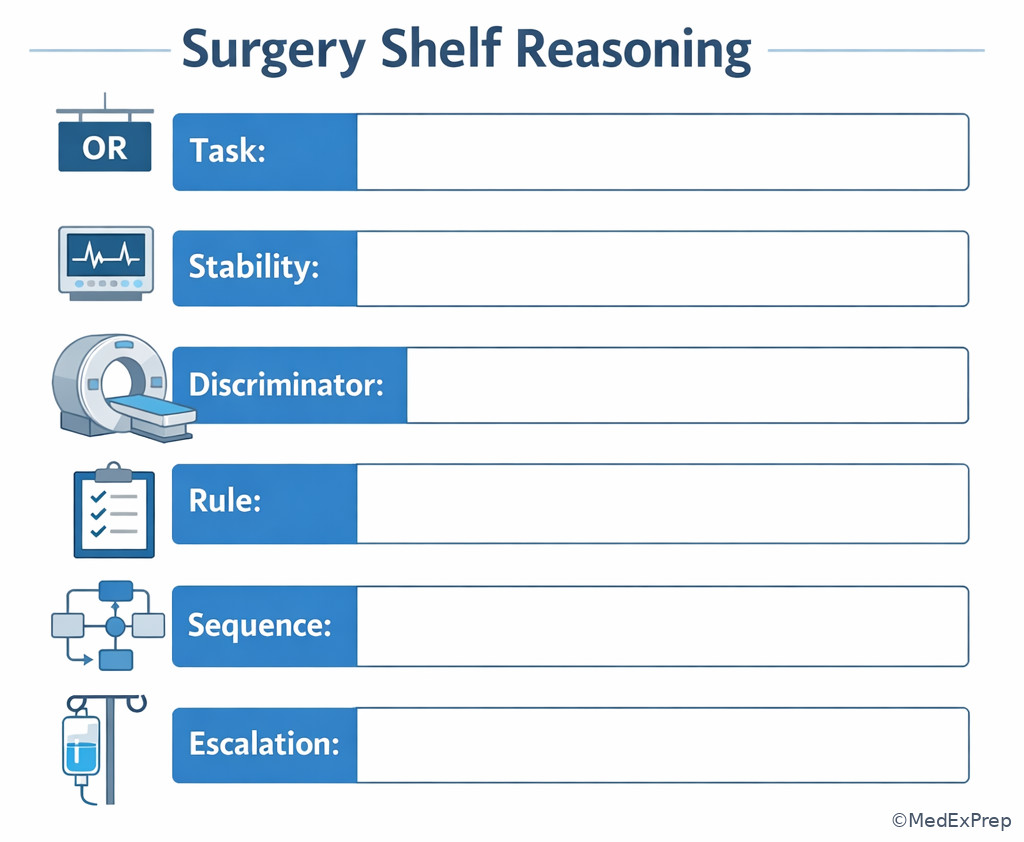
Exam takeaway: Use this sequence to solve most COMAT Surgery management stems safely and quickly.
Exam takeaway: A visual checklist helps prevent missing the ask, the instability cue, or the sequence error.
Rapid Review
- Question task → final line decides whether you diagnose, test, treat, or escalate
- Most appropriate next step → often bedside action, not perfect diagnostic certainty
- Best initial test → first safe informative study, not always the gold standard
- Unstable patient → resuscitation outranks CT
- Peritonitis → think urgent surgical pathway over outpatient workup
- Pain out of proportion → ischemia discriminator, not routine gastroenteritis
- Irreducible tender hernia + vomiting → incarceration/strangulation pathway, not constipation treatment
- Known risk factor → weaker than the acute presentation pattern
- Close distractor → usually correct for a slightly different timing or stability state
- Postoperative tachycardia → complication until proven otherwise, not automatic anxiety or pain
- Temporizing measure → bridge, not endpoint
- Definitive management → what actually fixes the lesion after initial stabilization
- Student-role answer → recognize, stabilize, escalate; do not leap to unsupervised operative action
- Best answer test → one rule should explain why the strongest distractor loses
Self-check quiz
1.1.1.11 Question 1
A 42-year-old woman with obesity and hypertension presents with right upper quadrant pain after meals and mild fever. She is hemodynamically stable. The stem asks for the best initial test. Which option best fits the task?
- Right upper quadrant ultrasound
- Laparoscopic cholecystectomy
- HIDA scan
- Broad-spectrum antibiotics only
1.1.1.12 Question 2
A 60-year-old man with tobacco use and hyperlipidemia presents with sudden tearing abdominal and back pain. He is stable, and the stem asks for the most likely diagnosis. Which answer category best matches the task?
- CT angiography of the abdomen
- Abdominal aortic aneurysm
- Immediate vascular surgery consultation
- Two large-bore IV lines
1.1.1.13 Question 3
A 27-year-old man is brought after a motor vehicle collision. He has chest pain, severe dyspnea, blood pressure 78/40 mm Hg, distended neck veins, and absent breath sounds on the left. A shoulder abrasion is noted but is distracting. Which is the most appropriate next step?
- Portable chest radiograph
- Needle decompression
- CT chest with contrast
- Observation with repeat vitals in 15 minutes
1.1.1.14 Question 4
A 55-year-old woman with prior hysterectomy, diabetes, and GERD presents with abdominal distention, vomiting, and no flatus for 24 hours. She is afebrile and normotensive. The stem asks for the most likely diagnosis. Which option is best?
- Small bowel obstruction from adhesions
- Perforated peptic ulcer
- Acute pancreatitis
- Gastroenteritis
1.1.1.15 Question 5
A 68-year-old man with atrial fibrillation, coronary disease, and chronic kidney disease presents with abrupt severe abdominal pain, lactate elevation, and relatively mild early abdominal tenderness. He is tachycardic but not hypotensive. Which detail most strongly supports mesenteric ischemia as the framework’s key discriminator?
- Mild leukocytosis
- Pain out of proportion to exam findings
- Nausea and vomiting
- History of chronic kidney disease
1.1.1.16 Question 6
A 73-year-old woman on postoperative day 1 after colectomy develops tachycardia, low urine output, and increasing abdominal pain. She has chronic anxiety, heart failure, and anemia. Temperature is 37.8°C, blood pressure 92/58 mm Hg. Which is the most appropriate next step?
- Reassure her that early postoperative pain is expected
- Order an outpatient CT scan for later this week
- Begin prompt bedside reassessment and stabilization while urgently notifying the surgical team
- Attribute the symptoms to anxiety and give discharge instructions
1.1.1.17 Question 7
A 61-year-old man with diabetes and chronic constipation presents with a painful groin bulge, vomiting, and inability to reduce the mass. He is tachycardic, afebrile, and has a remote history of hemorrhoids that is distracting. Which is the most appropriate next step?
- Urgent surgical evaluation for incarcerated or strangulated hernia
- Colonoscopy to evaluate constipation
- Outpatient laxative therapy and clinic follow-up
- Routine abdominal radiography before any consultation
1.1.1.18 Question 8
A third-year medical student evaluates a 66-year-old man with sudden severe abdominal pain, hypotension, and a rigid abdomen. He has COPD and remote peptic ulcer disease. Which answer best reflects the expected COMAT Surgery framework?
- Perform the operation independently because the diagnosis is obvious
- Send the patient to CT immediately before any resuscitation
- Recognize a surgical emergency, start initial stabilization, and urgently escalate to supervising surgical personnel
- Wait for laboratory confirmation before contacting the team
Answer key
1.1.1.19 Answer 1: A. Right upper quadrant ultrasound
Correct-answer logic: The patient is stable, the likely problem is biliary, and the stem asks for the best initial test. Ultrasound is the appropriate first-line study for suspected gallbladder disease because it is safe, readily available, and directly evaluates gallstones, wall thickening, and pericholecystic fluid. This is a task-recognition question more than a disease-recognition question. Authoritative teaching from standard surgery and medicine references supports ultrasound as the initial test for suspected acute cholecystitis in stable patients.
- A: Tempting because it is both common and highly useful; it is correct because the stem asks for the initial test in a stable biliary presentation. Single clue: “best initial test.” Sources: Townsend et al.; UpToDate.
- B: Tempting because cholecystectomy is definitive treatment for symptomatic gallbladder disease; it is incorrect because surgery answers management, not the initial testing task. Single clue: the question asks for a test, not treatment. Sources: Townsend et al.; UpToDate.
- C: Tempting because HIDA can be more sensitive when ultrasound is equivocal; it is incorrect because it is usually not the first study when ultrasound is available and the patient is stable. Single clue: “initial” test. Sources: UpToDate; First Aid.
- D: Tempting because antibiotics may be part of treatment; it is incorrect because treatment alone does not satisfy the testing prompt. Single clue: the stem asks for diagnostic next step. Sources: Townsend et al.; UpToDate.
1.1.1.20 Answer 2: B. Abdominal aortic aneurysm
Correct-answer logic: This stem tests whether you answer the task asked. The final line asks for the most likely diagnosis, so the answer must be a disease entity rather than a test or treatment. Sudden tearing abdominal/back pain in an older vascular-risk patient strongly supports AAA in this framework question.
- A: Tempting because CTA is a common study in stable aneurysm evaluation; it is incorrect because it answers “what test?” rather than “what diagnosis?” Single clue: “most likely diagnosis.” Sources: UpToDate; AHA/ACC vascular guidance.
- B: Tempting and correct because it directly names the disease pattern suggested by the stem. Single clue: back pain plus vascular risk profile with diagnosis wording. Sources: UpToDate; First Aid.
- C: Tempting because surgery consultation may be appropriate in practice; it is incorrect because consultation is a management step, not a diagnosis. Single clue: task mismatch. Sources: UpToDate; Harrison’s.
- D: Tempting because IV access is often needed in unstable vascular patients; it is incorrect because this option is treatment/resuscitation, not diagnosis. Single clue: diagnosis question wording. Sources: Harrison’s; UpToDate.
1.1.1.21 Answer 3: B. Needle decompression
Correct-answer logic: This is tension pneumothorax causing obstructive shock: hypotension, severe dyspnea, distended neck veins, and unilateral absent breath sounds. The pathophysiology is rapidly rising intrathoracic pressure reducing venous return and collapsing the affected lung. Immediate decompression is required before imaging. This is the classic “unstable before diagnosis refinement” rule. Authoritative trauma teaching supports clinical treatment without waiting for confirmatory x-ray.
- A: Tempting because chest radiography is a standard trauma study; it is incorrect because unstable tension physiology is treated immediately. Single clue: hypotension plus absent breath sounds. Sources: ATLS principles summarized in Townsend; UpToDate.
- B: Tempting and correct because it reverses life-threatening obstructive physiology. Single clue: tracheal deviation with shock. Sources: Townsend et al.; UpToDate.
- C: Tempting because CT gives excellent thoracic detail; it is incorrect because CT delays life-saving bedside intervention. Single clue: unstable patient. Sources: UpToDate; Harrison’s.
- D: Tempting because FAST is part of trauma evaluation; it is incorrect because it does not address the immediately lethal thoracic diagnosis already present. Single clue: classic clinical tension findings. Sources: Townsend et al.; UpToDate.
1.1.1.22 Answer 4: A. Small bowel obstruction from adhesions
Correct-answer logic: Prior abdominal surgery, distention, vomiting, and obstipation form the classic mechanism-pattern pair for adhesive small bowel obstruction. The hysterectomy is not background filler; it is the key discriminator because postoperative adhesions are the most common cause of SBO. The stable presentation and task wording favor diagnosis rather than immediate intervention wording.
- A: Tempting and correct because prior surgery plus obstructive symptoms strongly support adhesive SBO. Single clue: previous abdominal operation with obstipation. Sources: Townsend et al.; UpToDate.
- B: Tempting because GERD and upper abdominal pain conditions often appear on exams; it is incorrect because perforation would usually show sudden severe pain with peritoneal signs rather than isolated obstructive pattern. Single clue: no rigid abdomen or acute peritonitis. Sources: Harrison’s; UpToDate.
- C: Tempting because vomiting and abdominal pain can occur in pancreatitis; it is incorrect because distention, no flatus, and prior surgery point elsewhere. Single clue: obstipation. Sources: UpToDate; First Aid.
- D: Tempting because vomiting is common; it is incorrect because gastroenteritis does not explain no flatus and surgical-history-linked obstruction. Single clue: absence of flatus with distention. Sources: UpToDate; Townsend et al.
1.1.1.23 Answer 5: B. Pain out of proportion to exam findings
Correct-answer logic: Mesenteric ischemia classically causes severe visceral pain before full peritoneal findings develop. The mechanism is acute bowel hypoperfusion or embolic occlusion causing ischemic pain that initially exceeds the exam. Atrial fibrillation increases embolic risk, but the most discriminating presentation clue is pain out of proportion to the abdominal exam.
- A: Tempting because leukocytosis often accompanies ischemia; it is incorrect because it is nonspecific and shared by many abdominal emergencies. Single clue: leukocytosis does not localize. Sources: UpToDate; Harrison’s.
- B: Tempting and correct because it is the board-style hallmark finding that separates ischemia from more benign GI illness. Single clue: severe pain with mild early tenderness. Sources: UpToDate; Townsend et al.
- C: Tempting because nausea and vomiting are common in ischemia; it is incorrect because they are too nonspecific to discriminate. Single clue: present in multiple GI conditions. Sources: Harrison’s; UpToDate.
- D: Tempting because comorbid kidney disease raises concern about vascular disease; it is incorrect because risk factor is weaker than the classic symptom pattern. Single clue: the question asks for the best discriminator, not a background risk marker. Sources: UpToDate; First Aid.
1.1.1.24 Answer 6: C. Begin prompt bedside reassessment and stabilization while urgently notifying the surgical team
Correct-answer logic: On postoperative day 1, tachycardia, hypotension, pain, and oliguria suggest evolving postoperative complication such as bleeding, third spacing, sepsis, or other acute deterioration. The mechanism-based approach is to recognize instability, reassess at bedside, begin supportive management, and urgently escalate. This is the clerkship-safe, sequence-correct answer.
- A: Tempting because postoperative pain is common; it is incorrect because oliguria and hypotension indicate physiologic decline, not routine pain alone. Single clue: low blood pressure with low urine output. Sources: Townsend et al.; UpToDate.
- B: Tempting because CT may be part of later evaluation; it is incorrect because outpatient or delayed imaging ignores immediate instability. Single clue: current hemodynamic concern. Sources: UpToDate; Harrison’s.
- C: Tempting and correct because it fits the student-role framework of recognize, stabilize, and escalate. Single clue: new postoperative deterioration. Sources: UpToDate; Townsend et al.
- D: Tempting because the patient has anxiety history; it is incorrect because anxiety does not explain hypotension and oliguria. Single clue: objective physiologic abnormalities. Sources: Harrison’s; UpToDate.
1.1.1.25 Answer 7: A. Urgent surgical evaluation for incarcerated or strangulated hernia
Correct-answer logic: A painful irreducible groin mass with vomiting suggests incarceration, and possible strangulation if bowel perfusion is threatened. The mechanism is trapped bowel causing obstruction and possibly ischemia. The correct next step is urgent surgical pathway activation rather than constipation workup. This is a classic example in which a stable outpatient answer becomes wrong because one trigger finding upgrades urgency.
- A: Tempting and correct because the exam already identifies the dangerous mechanical problem. Single clue: nonreducible tender groin mass with vomiting. Sources: Townsend et al.; UpToDate.
- B: Tempting because constipation appears in the history; it is incorrect because the acute obstructive hernia findings dominate the decision. Single clue: palpable irreducible mass. Sources: UpToDate; Harrison’s.
- C: Tempting because constipation treatment sounds conservative and benign; it is incorrect because it dangerously delays care for possible strangulation. Single clue: inability to reduce the mass. Sources: Townsend et al.; UpToDate.
- D: Tempting because radiography can assist obstruction workup; it is incorrect because classic exam findings already require urgent evaluation and imaging should not delay it. Single clue: bedside diagnosis with urgency trigger. Sources: UpToDate; Townsend et al.
1.1.1.26 Answer 8: C. Recognize a surgical emergency, start initial stabilization, and urgently escalate to supervising surgical personnel
Correct-answer logic: Hypotension plus rigid abdomen indicates a likely catastrophic intra-abdominal process such as perforation, ischemia, or hemorrhage. The correct student-level response is not independent surgery or delayed confirmation. It is recognition of emergency physiology, initiation of standard stabilization, and urgent surgical escalation. This integrates task recognition, instability triage, and role-appropriate action.
- A: Tempting because the patient likely needs operative intervention; it is incorrect because the student does not independently perform surgery. Single clue: COMAT-style supervised student role. Sources: course scope framing; Townsend et al.
- B: Tempting because CT clarifies abdominal catastrophes; it is incorrect because hypotension and rigidity make stabilization and urgent team involvement the priority. Single clue: unstable abdomen. Sources: UpToDate; Harrison’s.
- C: Tempting and correct because it is safe, sequence-correct, and role-appropriate. Single clue: shock plus peritonitis. Sources: Townsend et al.; UpToDate.
- D: Tempting because labs are useful; it is incorrect because waiting for laboratory confirmation delays time-sensitive care. Single clue: immediate instability. Sources: Harrison’s; UpToDate.
Keep going with the full COMAT Surgery Prep Course (COMAT Surg)
You just studied the way members do, in the same lesson interface. Full access unlocks every lesson, the question bank and flashcards for a full year.
One payment · 1 year of access · No auto-renewal