1.1.1 - Health Supervision Visits
Health Supervision Visits
What you'll learn
- DOMAIN: Pediatric Preventive Care → Subskill: Well-child visit structure — organize a health supervision visit by age, risk, and visit purpose.
- DOMAIN: Pediatric Preventive Care → Subskill: Growth and development surveillance — identify what must be reviewed at each routine visit and what findings require escalation.
- DOMAIN: Pediatric Preventive Care → Subskill: Preventive counseling — choose the most appropriate anticipatory guidance topic based on age and setting.
- DOMAIN: Pediatric Preventive Care → Subskill: Screening and next steps — distinguish routine surveillance from formal screening and know when abnormal findings change management.
- DOMAIN: Professionalism and Safety → Subskill: Pediatric confidentiality and safeguarding — recognize when private adolescent time, mandatory reporting, or urgent referral is the safest next step.
- Domain: Pediatric Preventive Care → Objective: Perform age-appropriate well-child reasoning
- Domain: Pediatric Preventive Care → Objective: Select routine screening, counseling, and follow-up
- Domain: Development and Behavior → Objective: Integrate developmental surveillance into routine care
- Domain: Adolescent Medicine / Safeguarding → Objective: Apply confidentiality and risk recognition in preventive visits
- Weight: Official topic-specific percentages not published; emphasis inferred from common pediatric clerkship and shelf-style themes.
Why it matters
- COMAT Pediatrics repeatedly tests prevention through vignettes that look routine but hide a next-best-step decision: reassure, screen, counsel, refer, or escalate.
- Many wrong answers are tempting because they mix up surveillance, screening, and diagnostic workup.
- Age drives the answer: the same finding may be normal in infancy, concerning in school age, and urgent in adolescence.
- Health supervision visits are the anchor point for growth, development, immunization review, injury prevention, behavior assessment, and safeguarding.
Key Terms & Must-Know Facts
1.1.1.1 Key terms
- Health supervision visit: routine preventive pediatric visit focused on growth, development, screening, counseling, and risk review.
- Surveillance: continuous clinical observation over time using history, physical exam, and caregiver concerns.
- Screening: standardized test or tool applied to detect a condition before symptoms are obvious.
- Anticipatory guidance: age-specific counseling on expected development and safety risks.
- Growth parameters: weight, length/height, head circumference when age-appropriate, BMI when age-appropriate.
- Percentile: comparison with age- and sex-based reference populations.
- Growth velocity: rate of growth over time; often more useful than a single number.
- Developmental surveillance: ongoing review of milestones, regression, caregiver concerns, and functioning.
- Psychosocial assessment: review of family stressors, school, behavior, mental health, and home safety.
- Confidential adolescent care: private discussion with the teen when appropriate, with limits for safety concerns.
- Red flag: finding that requires urgent clarification, workup, referral, or emergency escalation.
- Preventive visit noise: incidental information in the stem that is less important than the age-based preventive task.
1.1.1.2 Must-know facts
- Routine well-child questions often ask for the single most appropriate preventive action for that age.
- Crossing percentiles matters more than one isolated value when deciding whether growth is abnormal.
- Caregiver concern about development is itself high-yield and should not be dismissed by a normal brief exam.
- Developmental regression is never normal and requires evaluation.
- Private time with adolescents is standard preventive care, but confidentiality has safety limits.
- Suspected abuse, suicidality, severe malnutrition, significant dehydration, or unstable vital signs are not routine follow-up issues; they require escalation.
- Preventive visits include review of immunizations, but detailed catch-up logic is a separate topic. This lesson focuses on visit structure and decision framing.
- Normal exam findings do not override concerning history when the stem is testing preventive screening or safeguarding.
Core content
1.1.1.3 Foundational structure: what happens in a health supervision visit?
A Explanation
The decision conflict in a well-child question is often: Is this a routine preventive visit that stays preventive, or has a finding shifted the encounter into diagnostic or urgent care? The single rule that resolves the conflict is this: start with the age-based preventive framework, then ask whether any red flag overrides routine care. A health supervision visit is not just “normal exam + vaccines.” It is a structured assessment of growth, development, nutrition, behavior, safety, family context, and risk factors. For COMAT-style stems, choose the answer that matches the visit’s primary preventive task for the child’s age, unless a red flag demands a different next step.
WHY THIS IS TESTED: exam writers hide simple preventive reasoning inside long vignettes with distracting details such as mild eczema, recent daycare illness, or a parent’s unrelated concern. The correct answer usually comes from identifying the visit type and the age-based priority, not from chasing every incidental clue.
Core tasks include interval history, growth review, developmental surveillance, physical examination, immunization review, screening selection, anticipatory guidance, and follow-up planning. In infants, feeding, elimination, sleep position, and developmental milestones dominate. In school-age children, behavior, school performance, exercise, sleep, and injury prevention rise in importance. In adolescents, private time, mental health, substance use, sexual health, and confidentiality boundaries become central. See Fig 1.
Exam takeaway: Start with age-based preventive tasks, then upgrade to evaluation or escalation only if a red flag changes the visit.
flowchart TD
A[Identify age and visit type] --> B[Review interval history and caregiver concerns]
B --> C[Check growth and development]
C --> D[Perform focused preventive physical exam]
D --> E[Choose age appropriate screening and counseling]
E --> F{Any red flag?}
F -- No --> G[Routine follow up]
F -- Yes --> H[Diagnostic workup or urgent escalation] B Worked example
A 4-month-old boy is brought for a routine visit. He was born at term, has mild reflux, and his father asks whether occasional spit-ups mean he needs imaging. The infant smiles, coos, tracks, and has normal tone. Weight has followed the 35th percentile since birth. He sleeps in a crib, but the mother says she sometimes lets him nap prone on her chest after feeds. Temperature and exam are normal.
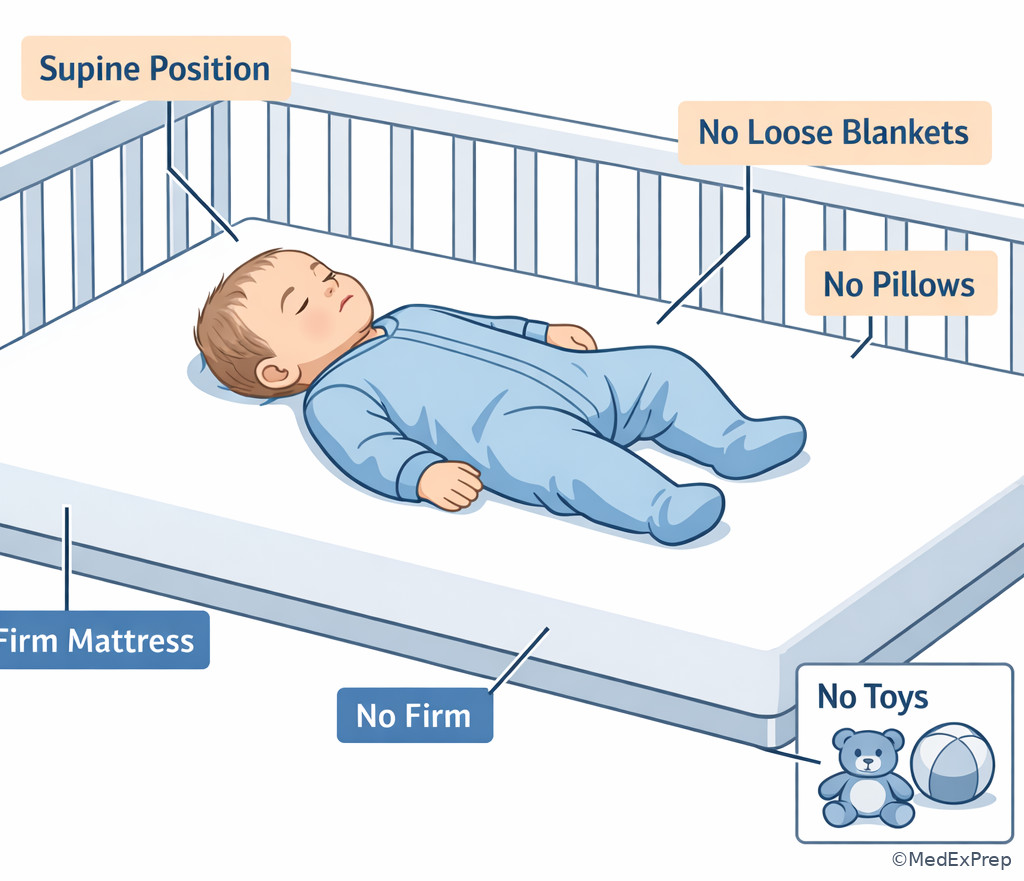
Identify task: This is a routine preventive infant visit, not a vomiting workup. Extract key facts: growth is steady, development is appropriate, reflux is mild, no bilious emesis, no poor weight gain, no dehydration. Apply rule: choose the highest-yield anticipatory guidance and safety issue for this age. Eliminate distractors: abdominal ultrasound is tempting because the word “vomiting” appears, but the infant has normal growth and uncomplicated spit-up. Acid suppression is tempting because reflux is common, but there are no alarm features. Verify: the best next step is safe sleep counseling, including supine sleep and avoiding prone sleep on a caregiver.
C Exam trap
D Checkpoint
Question: A 7-year-old girl presents for a routine visit before school starts. She has mild intermittent eczema and a history of one otitis media episode last winter. Her growth curves are stable, she is doing well in school, and the physical exam is normal. Which is the most appropriate next step?
- Order serum immunoglobulin testing because of prior infection history
- Focus the visit on school performance, sleep, exercise, and injury-prevention counseling
- Begin an elimination diet to reduce eczema flares
- Refer for developmental evaluation despite no school or behavior concerns
- A: Tempting because recurrent infections can signal immunodeficiency, but one routine ear infection without growth failure or severe infections is not enough.
- B: Correct because school-age health supervision prioritizes function, behavior, healthy habits, and safety when no red flags are present.
- C: Tempting because eczema is present, but routine elimination diets are not first-line without a specific food trigger history.
- D: Tempting because developmental screening matters, but referral is not indicated when surveillance and school functioning are reassuring.
1.1.1.4 Growth and developmental surveillance: what finding changes the visit?
A Explanation
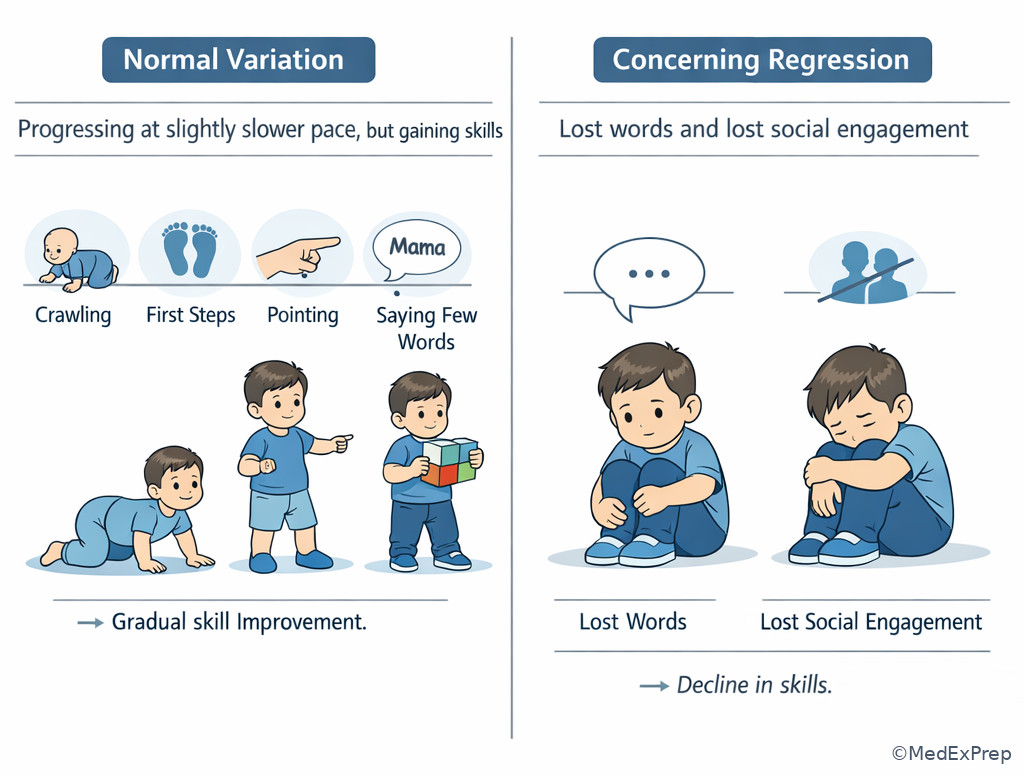
The decision conflict here is: observe and continue routine surveillance versus initiate further evaluation for abnormal growth or development. The single resolving rule is: trend over time and regression matter more than isolated noisy details. In pediatrics, a single percentile is less informative than the trajectory. Steady tracking may be normal even when lower than peers. By contrast, crossing percentiles, poor weight gain, or discordance between weight, height, and head circumference may signal undernutrition, chronic disease, endocrine issues, or neurologic problems. Developmental surveillance is similarly longitudinal. A caregiver concern, missed milestone cluster, or any loss of previously achieved skills should not be written off as “variation.” See Fig 2.
At clerkship level, the test is usually not asking you to build the full subspecialty workup. It is asking whether to reassure, repeat surveillance, formally screen, or escalate. A toddler who says fewer words than expected but has otherwise normal social reciprocity may need formal language evaluation, not broad neurologic imaging. A child with developmental regression or abnormal neurologic exam needs more urgent evaluation. Growth questions often hide urgency in feeding history, chronic diarrhea, cardiac symptoms, or psychosocial neglect.
WHY THIS IS TESTED: students overcall normal variation or undercall true red flags. The exam rewards recognizing the one finding that moves the visit from routine monitoring to action: trajectory change, regression, or functional impairment.
Exam takeaway: Trend change, regression, and caregiver concern are the clues that convert routine surveillance into formal evaluation.
flowchart TD
A[Review growth curve and milestone history] --> B{Stable trend and age appropriate skills?}
B -- Yes --> C[Continue surveillance and guidance]
B -- No --> D{Crossing percentiles or missed skills?}
D -- Yes --> E[Formal screening or targeted evaluation]
D -- No --> F[Repeat close follow up]
E --> G{Regression or abnormal neuro exam?}
G -- Yes --> H[Urgent referral and escalation]
G -- No --> I[Outpatient developmental or growth workup] Exam takeaway: Compare longitudinal weight, length, and head circumference trends rather than anchoring on one isolated percentile.
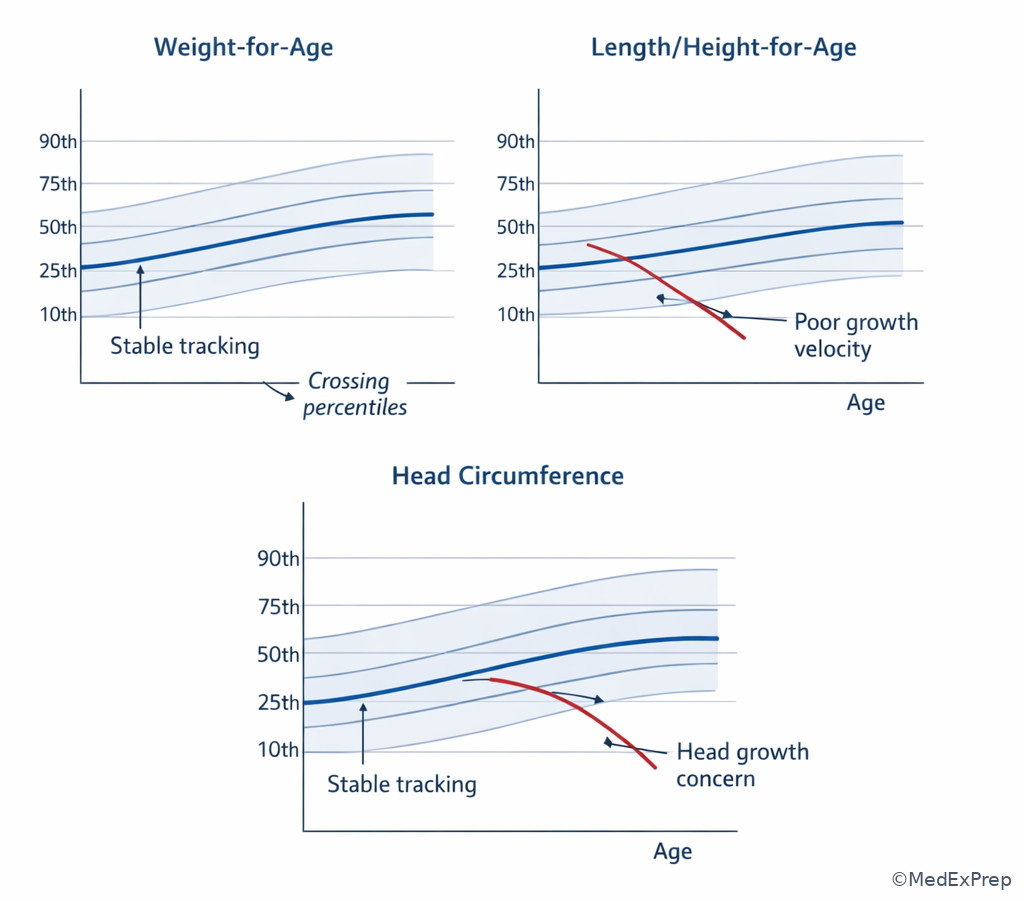
B Worked example
A 20-month-old girl is seen for a routine visit. She was born at 37 weeks, has mild atopic dermatitis, and attends daycare. Her mother reports that she previously said “mama” and “ball” but now mostly points and grunts. She does not combine words. She has had two viral upper respiratory infections this winter. Weight dropped from the 40th to the 18th percentile over 6 months, while length remains near the 35th percentile. Exam shows normal tone and no focal deficits.
Identify task: decide whether this is routine surveillance or needs formal evaluation. Extract key facts: loss of previously used words suggests regression; there is also a decline in weight trajectory. Viral infections and eczema are noise. Apply rule: regression is never normal and outweighs the reassuring neurologic exam. Eliminate distractors: “reassure and recheck at next annual visit” is wrong because regression is an action trigger. “Treat eczema more aggressively” addresses noise, not the core problem. Verify: the most appropriate next step is prompt developmental evaluation and formal screening, with close follow-up on nutrition/growth.
C Exam trap
D Checkpoint
Question: A 2-year-old boy is seen for a routine visit. His weight has remained near the 12th percentile since infancy, height is at the 18th percentile, and head circumference is normal. He runs, follows commands, and uses two-word phrases. His mother worries that he is “small compared with cousins.” Which is the most appropriate next step?
- Order broad endocrine testing because weight is below average
- Reassure and continue routine surveillance because growth tracks consistently and development is appropriate
- Refer urgently to neurology because of low weight percentile
- Obtain neuroimaging because head circumference should be larger than weight percentile
- A: Tempting because growth concerns invite lab testing, but stable tracking without red flags argues against immediate broad endocrine workup.
- B: Correct because consistent growth trajectory plus normal milestones supports normal variation rather than failure to thrive.
- C: Tempting if one mistakes “small” for pathology, but there is no neurologic regression or focal deficit.
- D: Tempting because head circumference sounds important, but normal head growth with normal development does not justify imaging.
- The most worrisome developmental history item is loss of a previously attained skill.
- True or False: A low percentile alone is enough to diagnose abnormal growth. False.
- Name the 3 trend clues that should trigger action: crossing percentiles, poor growth velocity, regression.
1.1.1.5 Age-based priorities: infant, school-age child, and adolescent visits
A Explanation
The decision conflict here is: which preventive issue is highest yield for this age right now? The single resolving rule is: choose the answer that matches the child’s developmental stage and immediate risk environment. For infants, feeding adequacy, safe sleep, caregiver bonding, elimination, and early development dominate. For toddlers and preschoolers, language, behavior, toilet habits, injury prevention, and routines become central. For school-age children, school performance, sleep, activity, bullying, and screen use matter. For adolescents, autonomy, confidentiality, mental health, substance use, sexual health, and safety behaviors are high yield. See Fig 3.
Board questions frequently offer several “good things” to discuss, but one is best because of the age. For example, helmet use may be appropriate at many ages, but in an adolescent visit with private time and risk behavior clues, confidential psychosocial assessment may be the highest-priority next step. Conversely, in a 2-month-old, counseling on sleep position outranks school performance or substance use questions.
WHY THIS IS TESTED: it measures whether you can prioritize rather than list every preventive topic you know. High scores come from matching age to the most testable risk.
Exam takeaway: The best next step in a well visit is usually the preventive issue with the highest immediate relevance for that developmental stage.
flowchart LR
A[Infant] --> A1[Feeding and growth]
A --> A2[Safe sleep]
A --> A3[Early milestones]
B[School age] --> B1[School and behavior]
B --> B2[Exercise and sleep]
B --> B3[Injury prevention]
C[Adolescent] --> C1[Confidential time]
C --> C2[Mental health and substances]
C --> C3[Sexual health and safety]
Exam takeaway: Link each age band to its highest-yield counseling themes so you can prioritize the single best answer in a crowded option set.
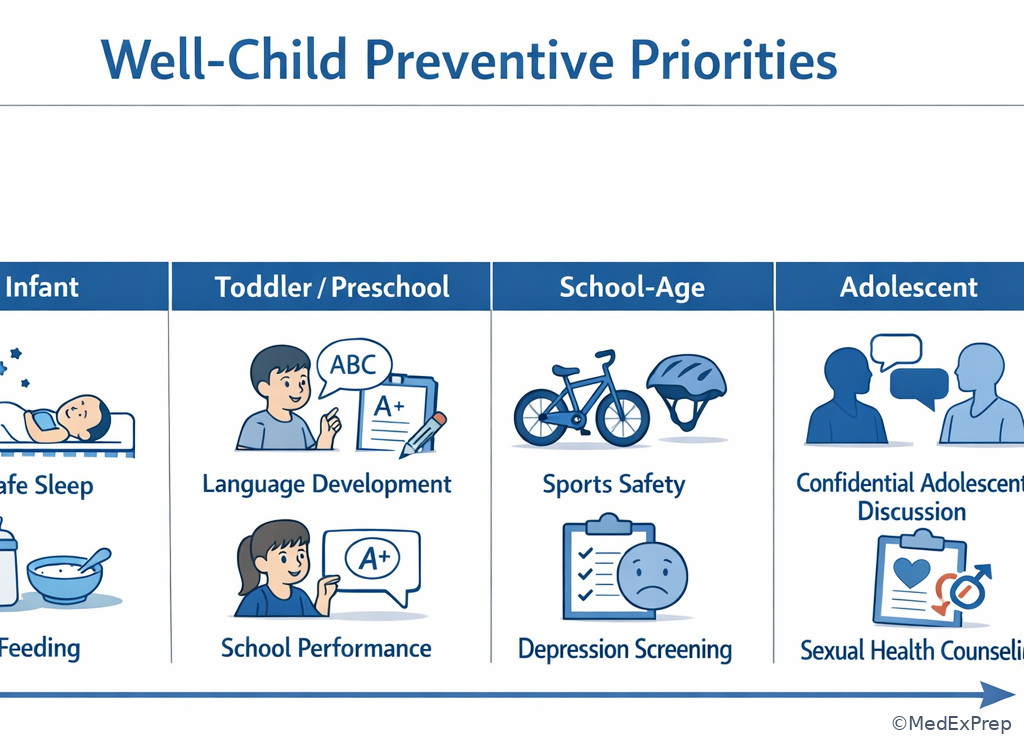
B Worked example
A 15-year-old girl presents for her annual visit before sports season. She has mild exercise-induced wheeze, wears glasses, and recently changed schools. Her mother answers most questions and says her daughter is “just moody.” The teen has normal vitals and exam. When asked directly, she avoids eye contact. The options include counseling on calcium intake, discussing helmet use, reviewing contraception, and requesting private time with the adolescent.
Identify task: choose the best immediate preventive step in an adolescent visit. Extract key facts: adolescent age, parent dominating the conversation, behavior suggesting unspoken concerns, normal exam. Apply rule: confidential time is a standard, high-yield part of adolescent preventive care and often precedes more specific counseling. Eliminate distractors: calcium intake and sports safety matter but are not the best first step when confidential psychosocial assessment has not yet occurred. Contraception counseling may become relevant, but private discussion comes first. Verify: request time alone with the adolescent, while explaining confidentiality and its safety limits.
C Exam trap
D Checkpoint
Question: A healthy 2-month-old infant comes for a routine visit. The parents ask about developmental toys and tummy time. The infant feeds well, tracks faces, and has stable growth. Which is the most appropriate counseling priority?
- Discuss confidential interview time without the parents present
- Review supine sleep positioning and safe sleep environment
- Screen for academic difficulties and bullying
- Counsel on sports concussion prevention
- A: Tempting because autonomy matters later, but confidential interview time is not the priority for a young infant.
- B: Correct because safe sleep remains one of the highest-yield infant counseling targets.
- C: Tempting as a routine child topic, but it belongs to school-age care, not early infancy.
- D: Tempting because injury prevention is always good counseling, but this is not the most age-specific priority.
1.1.1.6 Adolescent confidentiality, psychosocial risk, and safeguarding in preventive visits
A Explanation
The decision conflict is: maintain routine confidential preventive care versus break confidentiality or urgently escalate for safety. The single rule is: private time is standard; imminent safety risks are exceptions. Adolescent health supervision visits are high-yield because they combine routine prevention with hidden risk detection. The clinician should establish confidential space, explain limits clearly, and then assess mood, self-harm, substances, sexual health, violence exposure, and home/school safety. However, if the adolescent reports suicidality with plan, abuse, coercion, immediate danger, or severe medical instability, the encounter shifts from routine preventive care to urgent safety response and supervisor involvement.
On exams, the challenge is not memorizing every confidentiality law. The challenge is recognizing when private questioning is the next best step and when safety overrides it. A teen requesting birth control may still deserve confidentiality, but a teen with syncope, severe weight loss, bradycardia, and amenorrhea may need urgent evaluation for medical instability. A parent demanding to stay in the room may create the key clue that private time is the most appropriate next step. See Fig 4.
WHY THIS IS TESTED: these questions assess safe pediatric care, professionalism, and the ability to detect concealed high-risk conditions during a seemingly routine visit.
Exam takeaway: Offer confidential time routinely, but escalate immediately when self-harm, abuse, coercion, or medical instability is present.
flowchart TD
A[Adolescent preventive visit] --> B[Request private time and explain confidentiality]
B --> C{Disclosure of safety risk?}
C -- No --> D[Continue psychosocial screening and counseling]
C -- Yes --> E{Imminent harm or reportable abuse?}
E -- Yes --> F[Notify supervisor and escalate for safety]
E -- No --> G[Provide support, follow up, and appropriate referral] Exam takeaway: Visualize private interviewing with clear confidentiality boundaries so you can recognize the correct first step in adolescent preventive vignettes.
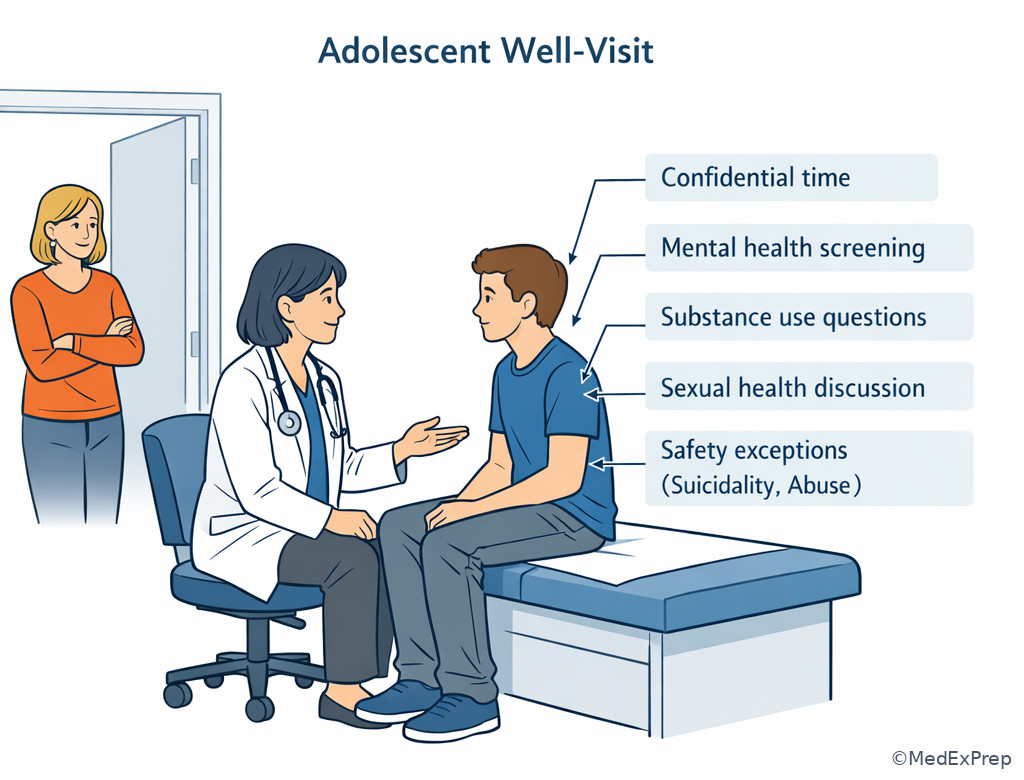
B Worked example
A 16-year-old boy presents for a sports physical. He has type 1 diabetes controlled on insulin and seasonal allergies. His mother says he is “fine” but insists on staying for all questions. He has lost 6 kg over 3 months, says he is trying to “make weight,” and his pulse is 48/min. He denies symptoms when his mother is present. The tempting clue is sports participation; the distracting detail is diabetes.
Identify task: determine the most appropriate next step during a preventive adolescent encounter. Extract key facts: adolescent, parent blocking privacy, weight loss, bradycardia, concerning behavior around weight. Apply rule: private time is routine, but bradycardia and significant weight loss suggest possible eating disorder with medical instability; this is not just routine counseling. Eliminate distractors: simple sports clearance is wrong. Generic nutrition advice is inadequate. Verify: obtain private history promptly and escalate to the supervising clinician for urgent evaluation of possible eating disorder/medical instability.
C Exam trap
D Checkpoint
Question: A 14-year-old girl presents for an annual visit with her father. She has mild acne and excellent grades. She becomes quiet when asked about mood and relationships. Physical exam is normal. Which is the most appropriate next step?
- Continue the visit only with the parent present to avoid discomfort
- Explain routine confidentiality, request time alone with the adolescent, and continue psychosocial screening
- Assure the father there is no reason to discuss private topics because the exam is normal
- Order toxicology screening before asking additional questions
- A: Tempting because parent involvement is valuable, but it misses standard adolescent preventive practice.
- B: Correct because confidential time is a routine and often necessary part of adolescent health supervision.
- C: Tempting because normal exam may feel reassuring, but psychosocial risk is often hidden and not detected on physical exam.
- D: Tempting because substance use screening matters, but testing before a confidential history is not the best next step.
- True or False: A normal physical exam rules out important adolescent psychosocial risk. False.
- The most common first step before sensitive adolescent counseling is private time with confidentiality explained.
- Name 3 safety issues that override routine confidentiality: suicidality, abuse, medical instability.
1.1.1.7 Integrating the visit: choosing reassurance, screening, counseling, or escalation
A Explanation
The final integration question is: what is the single best next step after you have recognized the age, setting, and red flags? The rule is to match the clinical task to one of four actions: reassure when findings are normal variation with stable trends; screen when routine age- or risk-based preventive testing is due; counsel when the main need is anticipatory guidance or behavior change; escalate when symptoms, exam findings, growth patterns, or safety concerns exceed routine supervision. See Fig 5.
This is where many shelf questions become deliberately tricky. Several answer choices may be partially correct, but only one fits the hierarchy of action. For example, a child with normal growth and a parent worried about picky eating usually needs reassurance plus routine guidance, not referral. A teen with depressive symptoms may need private screening first, not immediate generic counseling. An infant with poor weight gain and lethargy is no longer a routine feeding-counseling case; that patient needs urgent evaluation. The best answer is the one that matches severity + age + purpose of visit.
WHY THIS IS TESTED: this mirrors real clinical clerkship reasoning. You are being asked to select the safest and most appropriate first action within a supervised learner role.
Exam takeaway: The best next step comes from matching severity and visit purpose to the correct action category.
flowchart TD
A[Health supervision finding] --> B{Normal variation with stable trend?}
B -- Yes --> C[Reassure and routine follow up]
B -- No --> D{Routine age or risk based preventive test due?}
D -- Yes --> E[Screen]
D -- No --> F{Main need is behavior or safety counseling?}
F -- Yes --> G[Counsel]
F -- No --> H[Escalate for evaluation or urgent care] Exam takeaway: Picture the four action buckets so you can quickly classify a vignette into reassure, screen, counsel, or escalate.
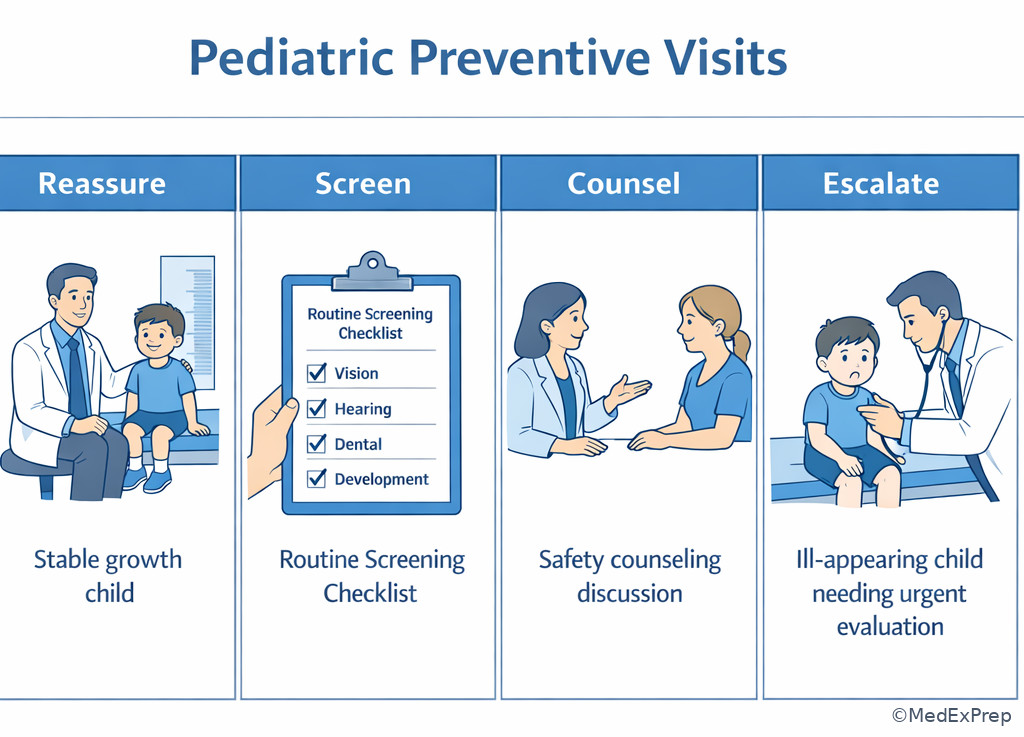
B Worked example
A 9-year-old boy presents for a routine visit. He has obesity, seasonal allergies, and frequent video game use. His mother is concerned he is “lazy,” but he plays soccer twice weekly and sleeps 6 hours on school nights. He has normal blood pressure, no polyuria, and no weight loss. School performance has declined slightly. The options include ordering endocrine labs, counseling on sleep and screen routines, referring to cardiology, and reassuring that weight usually self-corrects.
Identify task: choose the best next step in a school-age preventive visit with behavioral and lifestyle risk factors. Extract key facts: short sleep, high screen exposure, stable hemodynamics, no endocrine red flags, school decline. Apply rule: this fits the counsel bucket rather than urgent workup or pure reassurance. Eliminate distractors: endocrine labs are tempting because obesity invites medicalization, but there are no specific diabetes or endocrine warning signs in this stem. Reassurance alone ignores modifiable risk. Verify: structured counseling on sleep, routines, activity, and screen use is the most appropriate next step.
C Exam trap
D Checkpoint
Question: An 11-month-old infant presents for a routine visit. The parents report poor feeding for 2 days, fewer wet diapers, lethargy, and one episode of emesis. Weight today is below prior trajectory, and mucous membranes are dry. Which is the most appropriate next step?
- Provide routine feeding handouts and recheck in 3 months
- Offer anticipatory guidance on tantrums and limit setting
- Escalate for prompt evaluation of dehydration and acute illness
- Reassure that appetite varies around the first birthday
- A: Tempting because feeding counseling belongs in infant care, but the child has acute dehydration clues and trajectory decline.
- B: Tempting as age-adjacent behavior counseling, but it ignores the unstable medical issue in front of you.
- C: Correct because lethargy, fewer wet diapers, dry mucosa, and poor intake convert the visit into an urgent evaluation problem.
- D: Tempting because feeding variation can be normal, but the dehydration signs are the single clue that rules reassurance out.
Exam Traps & Differentiators
- Most common wrong answer and why: ordering a diagnostic test for an incidental, non-urgent complaint during a routine visit. This is tempting because disease-focused reasoning feels more concrete than preventive reasoning.
- Looks similar but isn’t: stable low percentile versus true growth faltering; developmental variation versus regression; routine adolescent confidentiality versus immediate safety escalation.
- If the stem says “annual visit” + normal trends, think preventive prioritization, not broad workup.
- If the stem says “lost words” or “used to do X,” think regression and formal evaluation.
- If the stem says parent answers all questions for a teen, think private confidential time.
- If the stem says fewer wet diapers, lethargy, or unstable vitals, think escalation, not routine counseling.
- If the stem says one prior common infection with normal growth, think normal variation, not immunodeficiency.
| Look-alike pair | Why they seem similar | Single differentiating clue | Best action |
|---|---|---|---|
| Stable small child vs failure to thrive | Both may have low percentiles | Stable tracking versus downward crossing/poor velocity | Reassure and monitor vs targeted evaluation |
| Language delay vs regression | Both involve speech concerns | Loss of prior words means regression | Prompt evaluation |
| Routine adolescent counseling vs safety escalation | Both arise during private interviews | Suicidality, abuse, or instability overrides confidentiality | Immediate escalation |
| Infant reflux counseling vs vomiting workup | Both mention spit-up or emesis | Bilious emesis, poor growth, dehydration, or forceful vomiting | Escalate/work up |
| General preventive advice vs age-targeted counseling | Many options sound reasonable | Age/developmental stage determines highest-yield topic | Choose the age-matched answer |
| Stem clue | Tempting wrong answer | Why it is tempting | What should you think instead |
|---|---|---|---|
| Mild eczema + normal growth at routine visit | Elimination diet or broad allergy testing | Skin disease invites food attribution | Routine preventive priorities first unless a trigger history exists |
| Teen appears withdrawn with parent present | Reassure based on normal exam | No physical abnormality is seen | Private confidential interview |
| One low percentile noted once | Broad endocrine testing | Numbers feel objective | Check longitudinal trajectory |
| School decline + short sleep | MRI or endocrine workup | Academic concern feels serious | Address lifestyle and preventive factors first if no red flags |
| Weight loss + bradycardia in adolescent athlete | Routine sports clearance | Athletic context normalizes weight focus | Evaluate for eating disorder and escalate |
Related traps will recur in the upcoming lessons on Screening And Anticipatory Guidance and Immunization Catch-Up Reasoning: a visit may appear generally preventive, but one clue shifts the answer to a specific screening task or vaccine plan. That is why this lesson emphasizes encounter structure first.
Tables
| Visit domain | What you routinely assess | What finding changes management | Typical next step |
|---|---|---|---|
| Growth | Weight, length/height, BMI as age-appropriate, head circumference in younger children | Crossing percentiles, poor velocity, discordant trends | Targeted evaluation or close follow-up |
| Development | Milestones, function, caregiver concerns | Regression, missed milestone clusters, abnormal neuro exam | Formal screening or referral |
| Behavior / psychosocial | School, sleep, family stress, mood, peer issues | Functional impairment, depression clues, violence exposure | Confidential assessment and supervised next steps |
| Nutrition | Intake quality, feeding behavior, elimination | Poor intake with dehydration, weight faltering | Escalation or targeted workup |
| Safety | Sleep, car seats, helmets, firearms, supervision | Unsafe environment or suspected abuse | Urgent safeguarding action |
| Preventive services | Screening and immunization review | Age/risk-based service due or missed | Provide screening or update plan |
| Age group | Highest-yield visit priorities | Common testable distractor | Discriminator |
|---|---|---|---|
| Infant | Feeding, sleep safety, early milestones, caregiver support | School or sports counseling | Age alone makes those low priority |
| Toddler / preschool | Language, routines, injury prevention, behavior | Adolescent confidentiality | Developmental stage mismatch |
| School-age | School performance, sleep, exercise, injury prevention | Infant feeding focus | Setting and age no longer fit |
| Adolescent | Private time, mood, substances, sexual health, safety | Parent-only interview | Confidential assessment is standard |
| Classification | Definition in practice | What the exam wants you to do |
|---|---|---|
| Surveillance | Ongoing clinical observation through history, growth review, and development discussion | Continue routine care if reassuring |
| Screening | Structured age- or risk-based tool/test applied before symptoms are obvious | Select the due preventive service |
| Diagnostic evaluation | Targeted workup triggered by abnormal finding, symptom, or red flag | Do not confuse with routine preventive testing |
| Counseling | Behavioral or safety guidance matched to age and setting | Pick the highest-yield anticipatory guidance topic |
| Escalation | Urgent evaluation, admission, or protective action for instability or safety risk | Recognize when the visit is no longer routine |
Exam takeaway: Distinguish normal variability from regression and functional loss, which should immediately change the visit plan.
Exam takeaway: When an infant well visit stem is otherwise reassuring, safe sleep counseling remains one of the highest-yield board answers.
Algorithm / Approach
Exam takeaway: Use this algorithm to decide whether the answer should be reassurance, screening, counseling, or urgent escalation.
flowchart TD
A[Well-child stem] --> B{Red flag present?}
B -- Yes --> C[Urgent evaluation or supervised escalation]
B -- No --> D{Primary issue age-based counseling?}
D -- Yes --> E[Choose anticipatory guidance]
D -- No --> F{Routine preventive service due?}
F -- Yes --> G[Choose screening/immunization review]
F -- No --> H[Reassure and arrange follow up] Rapid Review
- Health supervision visit → age anchors the first decision
- Stable low percentile → usually less concerning than downward percentile crossing
- Developmental regression → never normal variation
- Incidental mild symptom at routine visit → do not over-upgrade to full workup without red flags
- Infant preventive priority → feeding and safe sleep beat generic counseling
- School-age preventive priority → school function, sleep, activity, injury prevention
- Adolescent preventive priority → private time before sensitive counseling
- Normal physical exam in teen → does not exclude major psychosocial risk
- Dehydration clues at a well visit → convert prevention to urgent evaluation
- Caregiver developmental concern → actionable even if brief exam is normal
- One ordinary infection → not enough for immunodeficiency workup
- Reasonable but wrong answer → often correct for a different age group
- Routine counseling vs escalation → severity and safety determine the split
- Parent dominates adolescent interview → ask for confidential time
Self-check quiz
1.1.1.8 Question 1
A 6-year-old boy presents for a routine visit. He had one episode of streptococcal pharyngitis last year and has mild seasonal allergies. Height and weight have tracked near the 25th percentile for years, and he is doing well in school. Which is the most appropriate next step?
- Order immunodeficiency testing
- Continue routine health supervision with school, sleep, and safety counseling
- Obtain brain MRI for stable lower percentiles
- Refer urgently for failure to thrive evaluation
1.1.1.9 Question 2
A healthy 3-month-old girl is seen for a routine visit. She feeds well, smiles responsively, and has stable growth. Which counseling topic is most appropriate to prioritize?
- Private confidential interview time
- Safe sleep positioning and sleep environment
- Bullying prevention at school
- Driving safety
1.1.1.10 Question 3
A 13-year-old boy presents for an annual visit with his mother. He has mild acne and allergic rhinitis. He becomes reserved when asked about mood, friends, and substance use; the mother answers for him. Vital signs and exam are normal. What is the most appropriate next step?
- Proceed with the full visit only with the mother present
- Explain confidentiality and request private time with the adolescent
- Order a urine drug screen before further discussion
- Defer psychosocial questions because the exam is normal
1.1.1.11 Question 4
A 22-month-old girl presents for a routine visit. She had bronchiolitis 4 months ago and mild eczema. Her father says she used to say three words consistently but now mostly points. Weight dropped from the 45th to the 20th percentile, while length remains stable. Neurologic exam is nonfocal. Which is the most appropriate next step?
- Reassure that language development varies widely
- Prompt formal developmental evaluation and close growth follow-up
- Order urgent head CT because speech is delayed
- Treat eczema more aggressively and recheck in a year
1.1.1.12 Question 5
A 9-year-old boy presents for a health supervision visit. He has obesity, snores occasionally, plays video games late into the night, and sleeps 6 hours on school nights. He has normal blood pressure, normal urination pattern, and no daytime dyspnea. Grades have slipped since the last term. Which is the most appropriate next step?
- Order endocrine testing immediately for obesity
- Counsel on sleep hygiene, screen time, activity, and school routines
- Reassure and schedule follow-up in 1 year without intervention
- Refer to cardiology because of occasional snoring
1.1.1.13 Question 6
An 11-month-old boy presents for a routine visit. He has had 2 days of poor feeding, fewer wet diapers, dry lips, and decreased activity. He also has a small patch of eczema and a sibling with a cold. Weight today is below prior trajectory. Which is the most appropriate next step?
- Provide age-appropriate anticipatory guidance and recheck in 3 months
- Escalate for prompt evaluation of dehydration and acute illness
- Discuss transition to table foods and whole milk
- Reassure that feeding often declines near age 1 year
1.1.1.14 Question 7
A 16-year-old cross-country runner presents for a sports physical. She has asthma treated with intermittent albuterol and a recent stress fracture. Her mother says she is “eating clean.” The patient has lost 7 kg over 4 months, has amenorrhea, and a pulse of 46/min. Which is the most appropriate next step?
- Clear her for sports and counsel on hydration
- Obtain private history and urgently escalate for possible eating disorder with medical instability
- Recommend calcium supplements and routine follow-up
- Attribute amenorrhea to athletic conditioning and observe
1.1.1.15 Question 8
A 5-year-old boy presents for a kindergarten health supervision visit. He was born small for gestational age but has tracked along the 8th percentile for height and 10th percentile for weight since infancy. He has normal energy, no chronic diarrhea, no cardiac symptoms, and age-appropriate speech, behavior, and motor skills. Which is the most appropriate next step?
- Initiate broad laboratory evaluation for chronic disease
- Refer urgently for endocrine consultation because height is below average
- Reassure and continue routine surveillance because growth is stable and development is normal
- Order neuroimaging because prior fetal growth restriction predicts developmental pathology
Answer key
1.1.1.16 Question 1: B. Continue routine health supervision with school, sleep, and safety counseling
Why B is correct: This is a routine school-age preventive visit with stable growth, normal function, and no red flags. The mechanism-to-management logic is straightforward: normal longitudinal growth and ordinary infection history support routine preventive care, not diagnostic escalation. Authoritative pediatric preventive frameworks emphasize age-based counseling and surveillance in such visits. Sources: Hagan et al., Bright Futures; Kliegman et al., Nelson Textbook of Pediatrics.
- A: Tempting because prior infection history can suggest immune problems. It is incorrect because one common infection without severe/recurrent unusual infections, poor growth, or chronic diarrhea does not support immunodeficiency. Single clue: only one routine infection.
- B: Tempting because it may seem “too simple.” It is correct because school-age counseling is the proper action when the visit remains preventive. Single clue: stable percentiles and normal school function.
- C: Tempting because lower percentiles can trigger concern. It is incorrect because MRI does not evaluate normal stable growth variation. Single clue: longstanding tracking near the same percentile.
- D: Tempting because failure to thrive is a common shelf concept. It is incorrect because failure to thrive depends on trajectory problems or functional compromise, not simply being at the 25th percentile. Single clue: no downward crossing.
1.1.1.17 Question 2: B. Safe sleep positioning and sleep environment
Why B is correct: In early infancy, safe sleep remains one of the highest-yield preventive counseling topics. Mechanistically, sleep position and environment reduce risk of sleep-related infant death, so the best next step is counseling, not unrelated developmental-stage content. Sources: Moon et al., American Academy of Pediatrics safe sleep recommendations; Hagan et al., Bright Futures.
- A: Tempting because confidentiality is an important preventive principle. It is incorrect because private adolescent interviewing is not an infant priority. Single clue: age 3 months.
- B: Tempting because it is common and may seem basic. It is correct because infant safe sleep counseling is exactly the kind of board-tested preventive answer expected in a reassuring well visit. Single clue: healthy infant routine visit.
- C: Tempting as a worthy preventive issue, but it is school-age specific. Single clue: developmental stage mismatch.
- D: Tempting because safety counseling is broadly useful, but driving safety belongs to adolescents. Single clue: infant age.
1.1.1.18 Question 3: B. Explain confidentiality and request private time with the adolescent
Why B is correct: Adolescent preventive care relies on confidential interviewing to detect hidden mental health, substance use, and sexual health risks. A normal exam does not exclude psychosocial pathology. The correct action is to create private space while explaining confidentiality limits. Sources: Hagan et al., Bright Futures; AAP adolescent confidentiality policy statements.
- A: Tempting because parent participation can improve history accuracy. It is incorrect because parent-only presence limits disclosure of sensitive issues. Single clue: the adolescent becomes reserved when sensitive topics arise.
- B: Tempting because it may feel socially awkward. It is correct because private time is standard preventive adolescent care. Single clue: annual visit in a 13-year-old with parent dominating answers.
- C: Tempting because substance use is a possible concern. It is incorrect because testing before a confidential history is not the most appropriate next step. Single clue: no acute intoxication or emergency.
- D: Tempting because the physical exam is normal. It is incorrect because psychosocial screening is history-based and often invisible on exam. Single clue: sensitive topics have not been adequately explored.
1.1.1.19 Question 4: B. Prompt formal developmental evaluation and close growth follow-up
Why B is correct: The mechanism here is developmental regression: the child used to say words and no longer does. Regression, especially when paired with declining weight trajectory, converts routine surveillance into formal evaluation. A nonfocal neurologic exam does not cancel this concern. Sources: Kliegman et al., Nelson Textbook of Pediatrics; Hagan et al., Bright Futures.
- A: Tempting because language milestones vary. It is incorrect because regression is not ordinary variation. Single clue: loss of previously used words.
- B: Tempting because it requires more action than a reassuring exam might suggest. It is correct because regression is the discriminator. Single clue: “used to say three words consistently.”
- C: Tempting because speech loss sounds neurologic. It is incorrect because urgent CT is not the best next step without focal deficits, trauma, or acute neurologic signs. Single clue: chronic developmental concern with nonfocal exam.
- D: Tempting because eczema is present and easy to address. It is incorrect because eczema is incidental noise in this stem. Single clue: the real problem is regression plus weight decline.
1.1.1.20 Question 5: B. Counsel on sleep hygiene, screen time, activity, and school routines
Why B is correct: This school-age vignette fits the counseling bucket. The mechanism linking short sleep and excessive screen exposure to daytime function and school decline makes structured preventive counseling the most appropriate initial action. There are no specific clues demanding endocrine or cardiology workup. Sources: Hagan et al., Bright Futures; Kliegman et al., Nelson Textbook of Pediatrics.
- A: Tempting because obesity can signal endocrine disease. It is incorrect because the stem lacks polyuria, polydipsia, poor linear growth, or other endocrine red flags. Single clue: normal blood pressure and no diabetic symptoms.
- B: Tempting because counseling may feel less decisive than testing. It is correct because lifestyle and sleep are the most directly modifiable contributors described. Single clue: sleeps only 6 hours with heavy nighttime screen use.
- C: Tempting because no immediate instability is present. It is incorrect because the visit includes clear modifiable risk factors affecting school performance. Single clue: grades have slipped.
- D: Tempting because snoring can signal sleep-disordered breathing. It is incorrect because occasional snoring alone without cardiorespiratory symptoms does not make cardiology the next step. Single clue: no dyspnea or cardiovascular red flags.
1.1.1.21 Question 6: B. Escalate for prompt evaluation of dehydration and acute illness
Why B is correct: Poor intake, fewer wet diapers, dry lips, decreased activity, and recent weight decline indicate possible dehydration and acute illness. Mechanistically, the visit is no longer purely preventive because the child may be clinically unstable. The correct next step is urgent evaluation under supervision. Sources: Kliegman et al., Nelson Textbook of Pediatrics; First Aid for the USMLE Step 2 CK pediatrics preventive/emergency integration.
- A: Tempting because anticipatory guidance belongs in infant visits. It is incorrect because this child has dehydration red flags. Single clue: fewer wet diapers and decreased activity.
- B: Tempting because escalation may feel like overreaction in a well-visit stem. It is correct because hydration status and lethargy override routine counseling. Single clue: dry lips plus poor intake.
- C: Tempting because nutrition transition is age-appropriate near 1 year. It is incorrect because it ignores the acute problem. Single clue: acute decline over 2 days.
- D: Tempting because feeding fluctuation near toddler transition can be normal. It is incorrect because dehydration signs rule out simple reassurance. Single clue: weight below prior trajectory with fewer wet diapers.
1.1.1.22 Question 7: B. Obtain private history and urgently escalate for possible eating disorder with medical instability
Why B is correct: Weight loss, amenorrhea, bradycardia, and stress fracture in an adolescent athlete suggest an eating disorder or relative energy deficiency with medical instability. The mechanism-to-treatment logic is that bradycardia and physiologic compromise make this more than routine counseling; private assessment plus urgent escalation is required. Sources: Hagan et al., Bright Futures; Kliegman et al., Nelson Textbook of Pediatrics; AAP guidance on eating disorders in adolescents.
- A: Tempting because sports physicals often end with clearance and hydration advice. It is incorrect because the physiologic warning signs are too significant for routine clearance. Single clue: pulse 46/min.
- B: Tempting because it adds complexity to a preventive visit. It is correct because both confidentiality and urgent escalation are needed here. Single clue: weight loss plus amenorrhea plus bradycardia.
- C: Tempting because bone health matters with a stress fracture. It is incorrect because supplements alone do not address likely medical instability or eating pathology. Single clue: systemic signs, not isolated low calcium intake.
- D: Tempting because athletic training can alter menstruation. It is incorrect because the accompanying weight loss, stress fracture, and bradycardia make benign observation unsafe. Single clue: multiple physiologic red flags.
1.1.1.23 Question 8: C. Reassure and continue routine surveillance because growth is stable and development is normal
Why C is correct: This child has consistently tracked on low but stable percentiles with normal energy, no systemic symptoms, and age-appropriate development. The mechanism is constitutional or stable small size rather than acquired growth failure. The right action is reassurance with ongoing surveillance. Sources: Kliegman et al., Nelson Textbook of Pediatrics; Hagan et al., Bright Futures.
- A: Tempting because prior small-for-gestational-age history may raise concern for chronic disease. It is incorrect because there is no current trajectory failure or symptom pattern suggesting disease. Single clue: stable tracking since infancy.
- B: Tempting because height below peers may feel endocrine. It is incorrect because endocrine causes often impair height velocity rather than produce long-term stable low percentiles with normal development. Single clue: no crossing of percentiles.
- C: Tempting because it avoids unnecessary testing. It is correct because stable growth plus normal function supports routine monitoring. Single clue: age-appropriate speech, behavior, and motor skills.
- D: Tempting because fetal growth restriction can make students fear neurologic sequelae. It is incorrect because neuroimaging is not indicated in a developmentally normal child without focal findings. Single clue: normal developmental surveillance.
Keep going with the full COMAT Pediatrics Prep Course (COMAT Peds)
You just studied the way members do, in the same lesson interface. Full access unlocks every lesson, the question bank and flashcards for a full year.
One payment · 1 year of access · No auto-renewal