1.1.1 - Candidate Role Boundaries
Why it matters
- Many CMTMS-style questions test scope discipline, not raw memorization: the correct answer is often the safest action within role limits.
- Boundary errors create downstream risk: inaccurate summaries, privacy breaches, unsupported eligibility assumptions, and improper escalation delays.
- In mass tort and claims support work, missing evidence is not proof; exam items frequently punish filling gaps with inference.
- Role boundaries anchor nearly every later topic in this course, including intake, chronology building, criteria application, and compliance review.
Key Terms & Must-Know Facts
1.1.1.1 Key terms
- Objective evidence: Information directly supported by records, dates, signatures, reports, or documented statements.
- Inference: A conclusion not directly established by the file.
- Escalation: Referral to authorized clinical, legal, claims, or program leadership when the issue exceeds stated reviewer authority.
- Scope of role: The actions the reviewer may perform under program rules and job function.
- Criteria application: Matching file facts against stated program requirements without rewriting the criteria.
- Chronology: Ordered timeline of events derived from source documents.
- Deficiency: Missing, conflicting, illegible, or insufficient documentation affecting review.
- Supportable finding: A statement that can be tied to a specific source in the file.
- Final eligibility decision: Reserved outcome determination when authority belongs to attorneys, program leads, or claims leadership.
- Medical causation: Whether an exposure or event caused a condition; usually outside reviewer authority unless governed by explicit criteria.
- Legal sufficiency: Whether documentation meets legal standards; not independently decided by support staff unless protocol explicitly assigns a limited screening step.
- Protected information: Sensitive personal, medical, identifying, or confidential case material.
1.1.1.2 Must-know facts
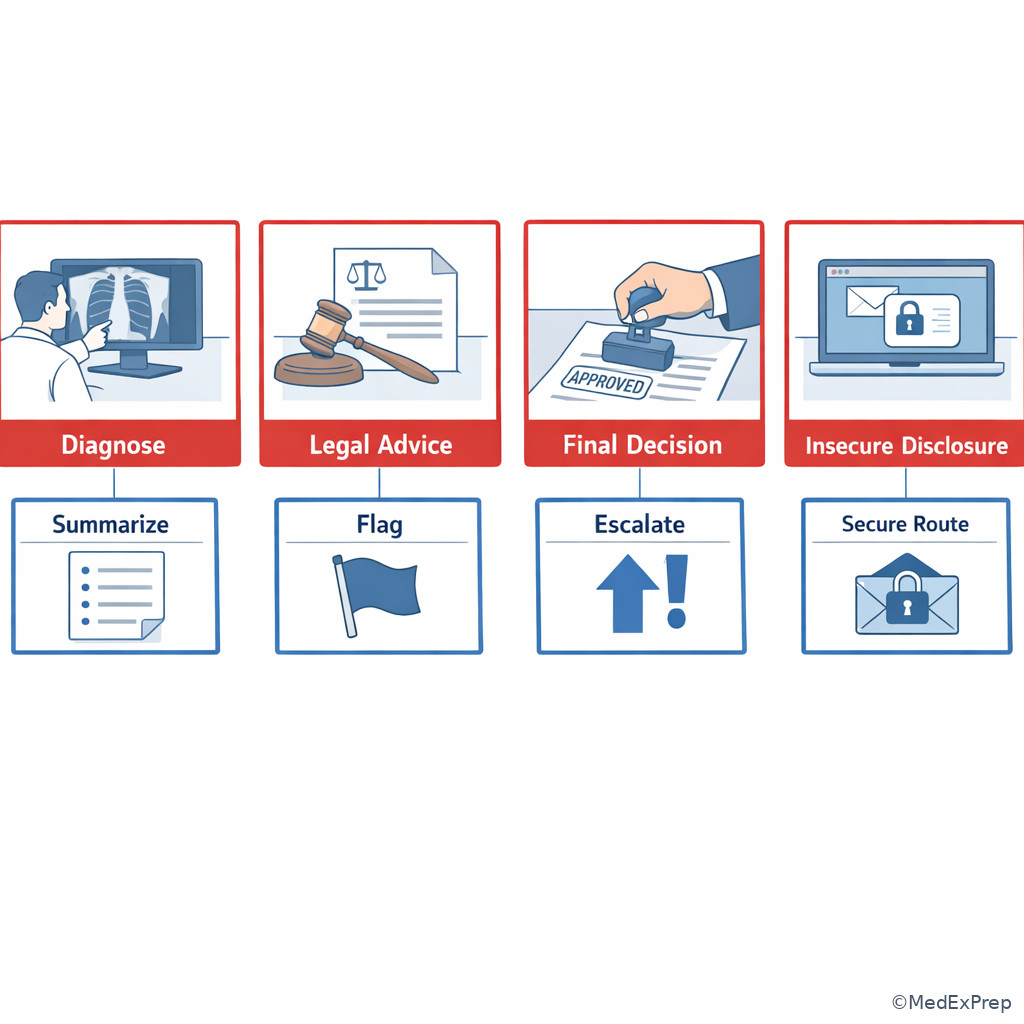
- The reviewer may organize, summarize, classify, and flag; the reviewer may not invent, diagnose, or issue unauthorized final decisions.
- If a question asks for action beyond stated authority, the safest answer is usually clarify or escalate.
- Absence of records is a documentation gap, not proof that an event did or did not occur.
- Unsupported assumptions about exposure, diagnosis, product use, or causation are exam traps.
- When facts conflict, document the conflict objectively and follow escalation workflow.
- Neutral wording beats advocacy: describe what the record shows, not what you think it means legally.
- Authority belongs to the workflow, not to personal confidence.
- Privacy and record integrity obligations apply even in administrative roles.
Exam takeaway: Choose actions that stay inside review-support scope and escalate anything requiring diagnosis, legal interpretation, or final authority.
flowchart TD
A[File review task] --> B{Is the fact documented?}
B -->|Yes| C[Summarize objectively]
B -->|No| D[Flag gap or conflict]
C --> E{Does action stay within stated role?}
E -->|Yes| F[Apply criteria or classify per protocol]
E -->|No| G[Escalate to authorized reviewer]
D --> G
G --> H[Document reason for escalation]
Use this as the master pattern for the lesson. See Fig 1.
Core content
1.1.1.3 Foundational boundary: what the role is allowed to do
A Explanation
The central decision conflict in this topic is simple: Should you act, clarify, or escalate? The single rule that resolves it is whether the task can be completed using documented facts plus stated protocol without stepping into clinical judgment, legal judgment, or final authority. A CMTMS-role reviewer supports downstream decisions by building chronologies, abstracting records, identifying missing items, and applying defined criteria. That is different from determining liability, diagnosing a condition, deciding causation, or issuing a final settlement ruling.
WHY THIS IS TESTED: Exam items often make the wrong answer look efficient. A file appears obvious, a claimant statement sounds believable, or a pattern strongly suggests a conclusion. The tested pattern is whether you can resist overreaching and remain within scope.
Choose the action when the rule is explicit and the evidence is in the file. Reject the action when it depends on an assumption, a medical opinion, or legal interpretation not assigned to you. For example, you may state, “Pharmacy records show fills from January through April,” but you may not state, “This proves the medication caused the claimed injury,” unless a program rule expressly defines that conclusion and gives you authority to apply it.
Key rule: Support roles convert records into organized facts; they do not convert uncertainty into conclusions.
B Worked example
A 58-year-old claimant with diabetes and chronic kidney disease is screened for a product-liability program. The file includes hospital discharge papers, a claimant questionnaire, and a pharmacy printout. The questionnaire states daily product use for 10 years. The pharmacy printout shows a related medication class but not the named product. A scanned lab page is partly illegible, and a family member’s email claims “the doctors said the product definitely caused the injury.” The stem asks for the most appropriate next step.
Reasoning chain: Identify task → this is not “make the causation call”; it is decide what a reviewer should do next. Extract key facts → product use is asserted but not fully documented; causation statement is second-hand; a lab page is incomplete. Apply rule → you may summarize documented records and flag missing proof, but you may not adopt undocumented causation or infer product identity. Eliminate distractors → “approve because the pattern is obvious” fails scope; “deny because proof is weak” may exceed authority if denial is reserved; “state causation is established” is outside role. Verify → the best next step is to document the objective evidence, flag the missing or conflicting product documentation and illegible record, and escalate or request clarification per workflow.
C Exam trap
Common wrong answer: “Conclude likely causation because the claimant, family email, and hospital context all point in the same direction.”
Why it is tempting: Multiple pieces of file content seem consistent, so the reviewer feels justified connecting them.
Single clue that eliminates it: None of those items gives the reviewer authorized medical-causation authority; one is a claimant statement, one is second-hand hearsay, and neither replaces documented expert determination or explicit program criteria.
D Checkpoint
Question: A reviewer is asked to prepare an intake summary for a file that includes treatment records, a claimant statement, and a billing ledger. The claimant statement alleges continuous exposure, but the treatment records do not mention the product. What is the most appropriate summary approach?
- State that exposure is established because the claimant reported it consistently.
- State that exposure did not occur because the treatment records are silent.
- Document the claimant-reported exposure separately from record-confirmed facts and flag the need for supporting documentation.
- Remove the claimant statement because it is less reliable than medical records.
Answer: C
- A: Tempting because repeated statements feel credible; wrong because consistency is not the same as independent documentary proof.
- B: Tempting because medical records may be viewed as primary; wrong because silence in one source does not prove non-exposure.
- C: Correct because it preserves objective source distinctions and identifies the evidentiary gap without overreaching.
- D: Tempting because it avoids noise; wrong because claimant-reported history may still be relevant if clearly labeled by source.
1.1.1.4 Foundational boundary: what the role must not do
A Explanation
The second foundational conflict is when a task sounds reasonable but still exceeds authority. The tested rule is that you must reject actions that require clinical diagnosis, independent causation judgment, legal advice, final eligibility ruling, or invention of missing facts. Many stems use phrases like “the file strongly suggests,” “the pattern is classic,” or “everyone on the team knows.” Those phrases are red flags. In this role, strong suspicion does not convert into authorized determination.
WHY THIS IS TESTED: The exam wants you to spot boundary breaches even when they are operationally convenient. Time pressure, attorney urgency, staffing shortage, or an incomplete platform migration may make a shortcut look appealing. The correct action remains the same: do not exceed protocol.
Reject statements that presume exposure from proximity, assume a diagnosis from a medication list, infer severity from billing amount, or issue a final disposition when program rules reserve that authority elsewhere. Also reject privacy shortcuts, such as sending records through unapproved channels simply because the request seems urgent.
Boundary warning: “Probably,” “must have,” and “obvious from context” are common exam signals that the proposed action rests on inference rather than record support.
Recall: In the upcoming topic Allowed And Disallowed Actions, we will convert these boundary concepts into a practical choose-vs-avoid list. Here, the goal is broader: recognize the authority line before you learn the action catalog.
Exam takeaway: When a task requires inference, diagnosis, legal advice, or final authority, reject personal judgment and escalate under protocol.
flowchart LR
A[Requested action] --> B{Needs only documented facts?}
B -->|Yes| C{Within protocol authority?}
C -->|Yes| D[Proceed and document]
C -->|No| E[Escalate]
B -->|No| F{Requires diagnosis or legal judgment?}
F -->|Yes| E
F -->|No| G[Request clarification or missing records]
See Fig 2 for the fastest exam decision filter.
B Worked example
A file reviewer receives a call from a litigation coordinator about a 67-year-old claimant with hypertension and COPD. The coordinator says the attorney needs “a quick medical opinion” before a hearing and asks the reviewer to state whether a hospitalization “was clearly caused by the product.” The chart includes an emergency note, medication fills, and a handwritten office note with unclear dates. A recent address mismatch in the intake system is also visible but unrelated to causation. The best answer is not the most medically persuasive one.
Reasoning chain: Identify task → requested action is a causation opinion. Extract key facts → file is incomplete and even if it were complete, independent causation is outside role. Apply rule → support staff may organize facts and identify missing items, but not render causation or legal strategy advice. Eliminate distractors → “give a provisional opinion with a disclaimer” still exceeds role; “decide eligibility based on likely causation” exceeds role; “ignore the request” fails workflow. Verify → provide an objective record summary, note unclear dates and missing support, and escalate to authorized attorney or clinical reviewer.
C Exam trap
Common wrong answer: “Provide a tentative opinion and label it preliminary.”
Why it is tempting: Test-takers think the disclaimer fixes the authority problem.
Single clue that eliminates it: A disclaimer does not create authority; the underlying act is still out of role.
D Checkpoint
Question: Which action is outside the typical CMTMS support role unless expressly authorized by program policy?
- Creating a chronology from medical and pharmacy records.
- Flagging inconsistent dates for supervisor review.
- Determining final eligibility when the policy reserves that decision to program leadership.
- Separating claimant-reported facts from provider-documented facts in the summary.
Answer: C
- A: Tempting because chronology work can feel interpretive; wrong to choose because it is a core support function when based on records.
- B: Tempting because it involves judgment; wrong to choose because identifying conflicts for review is within scope.
- C: Correct because reserved final decisions cannot be assumed by support staff, even if the outcome seems obvious.
- D: Tempting because source labeling requires care; wrong to choose because objective source separation is expected reviewer work.
- The safest response to an out-of-role request is to document the limitation and escalate.
- True or False: A strongly suggestive file pattern allows the reviewer to infer missing exposure facts. False.
- Name the 3 common out-of-role domains: clinical diagnosis/causation, legal advice/interpretation, final reserved decisions.
1.1.1.5 Applied boundary: separating documented fact from inference
A Explanation
Once you understand scope, the next application question is how to write and reason inside that scope. The deciding rule is source discipline: every meaningful statement in your summary should be traceable to a source type or clearly labeled as reported history, observed conflict, or missing documentation. The board-style conflict is usually between a neat, persuasive narrative and a defensible, neutral one. The exam rewards the second.
WHY THIS IS TESTED: Poor file summaries create downstream legal and operational risk. A summary that quietly blends claimant statements, medical findings, and reviewer assumptions may look efficient but becomes indefensible under audit or challenge.
Choose wording such as “Claimant questionnaire reports daily use from 2012 to 2019” and “pharmacy records in file do not yet confirm the named product.” Reject wording such as “claimant used the product continuously for years” unless the file contains corroborating documentation and the statement is precisely sourced. Also distinguish no documentation located from documentation disproves. Those are not interchangeable.
Memory anchor: SOURCE = Say what is documented, Objectively label the source, Unmask gaps, Reject assumptions, Clarify conflicts, Escalate when needed.
High-Yield Connection: This concept is tested alongside Objective Evidence Versus Inference later in Chapter 1. Know both the language of neutral abstraction and the workflow response to unsupported conclusions; they are frequently paired in stems.
Exam takeaway: Label each statement by source and keep unsupported conclusions out of the summary.
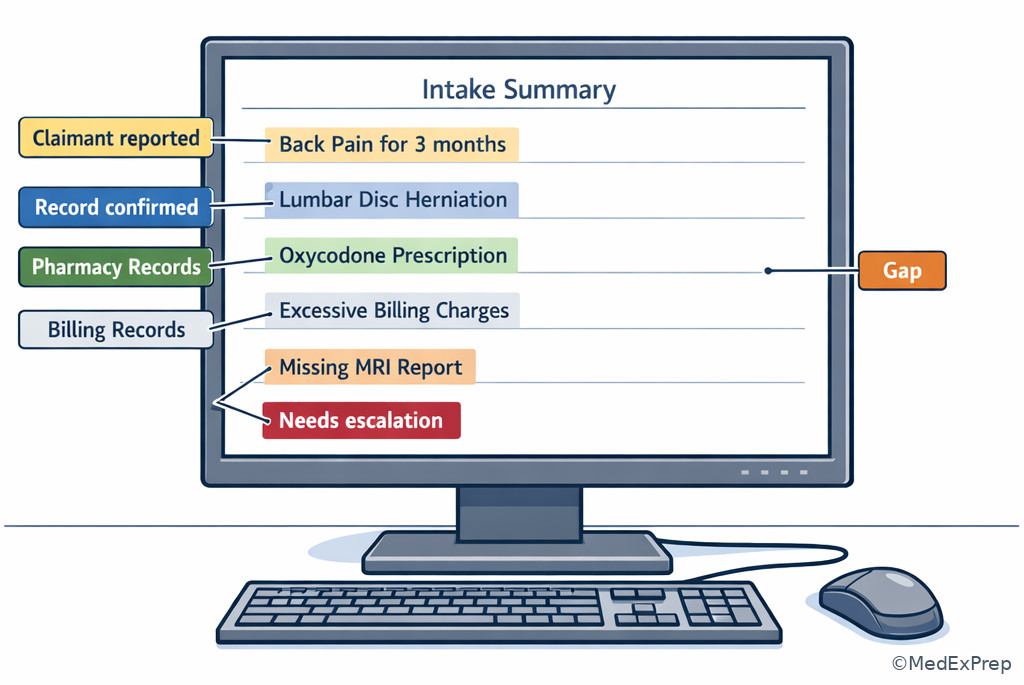
See Fig 3 for the visual model of source-labeled abstraction.
B Worked example
A 46-year-old claimant with asthma and obesity submits an intake packet. The packet includes a questionnaire naming a product, a radiology report unrelated to the claim, an emergency department note referencing “possible medication reaction,” and billing records showing office visits over several years. A distracting detail is a highlighted social media screenshot attached by the claimant. The stem asks which summary sentence is best supported.
Reasoning chain: Identify task → this is a documentation-quality question. Extract key facts → claimant names the product; ED note says possible reaction, not definite causation; social media content is not equivalent to verified record support. Apply rule → write source-labeled, limited statements. Eliminate distractors → “reaction caused by product” overstates; “product use confirmed” may be unsupported if billing lacks product identification; “no relevant medical evidence” ignores the ED note. Verify → the best summary is a neutral source-labeled statement noting reported product use, the ED note’s limited wording, and the need for additional supporting records if required by program criteria.
C Exam trap
Common wrong answer: “Elevate a possibility to a finding because the wording appears in a provider note.”
Why it is tempting: Test-takers trust provider notes so strongly that they ignore qualifiers like “possible,” “question of,” or “rule out.”
Single clue that eliminates it: Qualifier language limits the statement; your summary must preserve that uncertainty rather than collapse it into certainty.
D Checkpoint
Question: Which summary sentence is the most defensible?
- “The records prove chronic product use and resulting injury.”
- “Claimant reports chronic product use; currently available records include an ED note referencing a possible medication reaction, but independent confirmation of the named product remains incomplete.”
- “Because the billing history spans years, long-term product use is established.”
- “The absence of explicit denial in the chart supports product exposure.”
Answer: B
- A: Tempting because it sounds decisive; wrong because it merges multiple unsupported conclusions.
- B: Correct because it preserves source, uncertainty, and the evidentiary gap.
- C: Tempting because duration of care can suggest ongoing treatment; wrong because billing duration does not identify the specific product.
- D: Tempting because silence may feel supportive; wrong because lack of contradiction is not proof.
1.1.1.6 Applied boundary: when incomplete or conflicting files require escalation
A Explanation
This section asks a different question: When is routine handling no longer safe? The single rule is that once a gap or conflict prevents reliable criteria application, or once the next step requires authority you do not have, the file moves from routine review to clarification or escalation. The wrong answers usually overreact by making a final judgment too early or underreact by pretending the conflict does not matter.
WHY THIS IS TESTED: Claims and litigation support work is full of imperfect files. The exam tests whether you can recognize the threshold where ordinary abstraction ends and escalation begins.
Common escalation signals include conflicting dates of exposure, mismatch between claimant statement and pharmacy data, illegible key records, inconsistent identity elements, documentation suggesting a serious privacy problem, or a criteria question that depends on legal or medical interpretation beyond the protocol. Your job is to frame the issue clearly: what conflicts, why it matters to the workflow, and who should review next.
High-Yield Connection: This concept overlaps directly with the upcoming topic Escalation Triggers And Authority. Learn the general threshold here, then build the detailed trigger list in the next lesson.
Exam takeaway: Escalate when a gap or conflict blocks reliable protocol-based handling or requires authority outside the reviewer role.
flowchart TD
A[Review file] --> B{Complete and consistent?}
B -->|Yes| C{Within protocol authority?}
C -->|Yes| D[Continue routine handling]
C -->|No| E[Escalate to authorized reviewer]
B -->|No| F{Can missing item be requested routinely?}
F -->|Yes| G[Request clarification / records]
F -->|No or unresolved| E
See Fig 4 when a stem asks whether to proceed, clarify, or escalate.
B Worked example
A 71-year-old claimant with coronary disease and rheumatoid arthritis has an intake file containing pharmacy records for one last name spelling, a hospital note under a slightly different spelling, and a claimant questionnaire listing a product start date two years earlier than the earliest available pharmacy fill. There is also a distracting unrelated dermatology bill. The stem asks for the best next step.
Reasoning chain: Identify task → operational judgment under uncertainty. Extract key facts → identity variance may or may not be clerical; exposure date conflict directly affects chronology; unrelated bill is noise. Apply rule → because the conflict affects file reliability and criteria use, routine summary alone is insufficient. Eliminate distractors → “choose the earliest date because claimants often remember first use” is inference; “choose the pharmacy date because records outrank claimant statements” may still be premature if records are incomplete; “ignore spelling mismatch as minor” risks identity error. Verify → document both date sources, flag the identity discrepancy, and route for clarification/escalation per protocol.
C Exam trap
Common wrong answer: “Use the more official-looking source and move on.”
Why it is tempting: Official documents often are more reliable, so test-takers overgeneralize that one source always resolves all conflicts.
Single clue that eliminates it: The issue is not only reliability but whether the unresolved conflict materially affects chronology, identity, or criteria application.
D Checkpoint
Question: A file contains conflicting product start dates that would change whether the case meets a timing criterion. What is the most appropriate next step?
- Select the earliest date because it is most favorable to the claimant.
- Select the date from the most recent note because it is closest to current review.
- Document the conflicting dates, note their impact on the criterion, and follow clarification/escalation workflow.
- Average the dates and use the midpoint in the chronology.
Answer: C
- A: Tempting because it avoids delay; wrong because reviewer neutrality forbids choosing based on favorability.
- B: Tempting because recent notes may seem more complete; wrong because recency does not resolve a material conflict.
- C: Correct because it preserves the record issue and routes the matter appropriately.
- D: Tempting because it feels analytical; wrong because averaging conflicting dates invents a fact not in the file.
- The most common safe response to a material file conflict is document plus clarify/escalate.
- True or False: You may average two inconsistent dates if both seem plausible. False.
- Name 3 escalation signals: material conflict, missing key evidence, authority outside role.
1.1.1.7 Integration: confidentiality, neutrality, and defensible communication
A Explanation
The final integration conflict is between helpful communication and defensible communication. The resolving rule is that role-appropriate communication must be objective, limited to need-to-know channels, and free of unsupported advocacy. In practice, exam stems may present pressure from an attorney assistant, claimant, supervisor, or vendor asking for speed, certainty, or convenience. Your job is not to be maximally accommodating; it is to be accurate, neutral, and compliant.
WHY THIS IS TESTED: Boundary questions often hide privacy and neutrality issues inside workflow pressure. The examiner wants to know whether you can preserve record integrity while still moving the file appropriately.
Choose communication that states the facts, source limits, missing items, and next procedural step. Reject casual statements such as “we know what happened,” “this should qualify,” or “I told them the product definitely caused it.” Also reject disclosure through unapproved channels or to people without a defined need to access the information. A technically correct summary sent improperly is still a boundary failure.
Memory anchor: Think NIP for every case note: Neutral wording, In-role action, Private handling.
Exam takeaway: A strong escalation note states the issue, source limitation, workflow impact, and next authorized reviewer without advocacy.
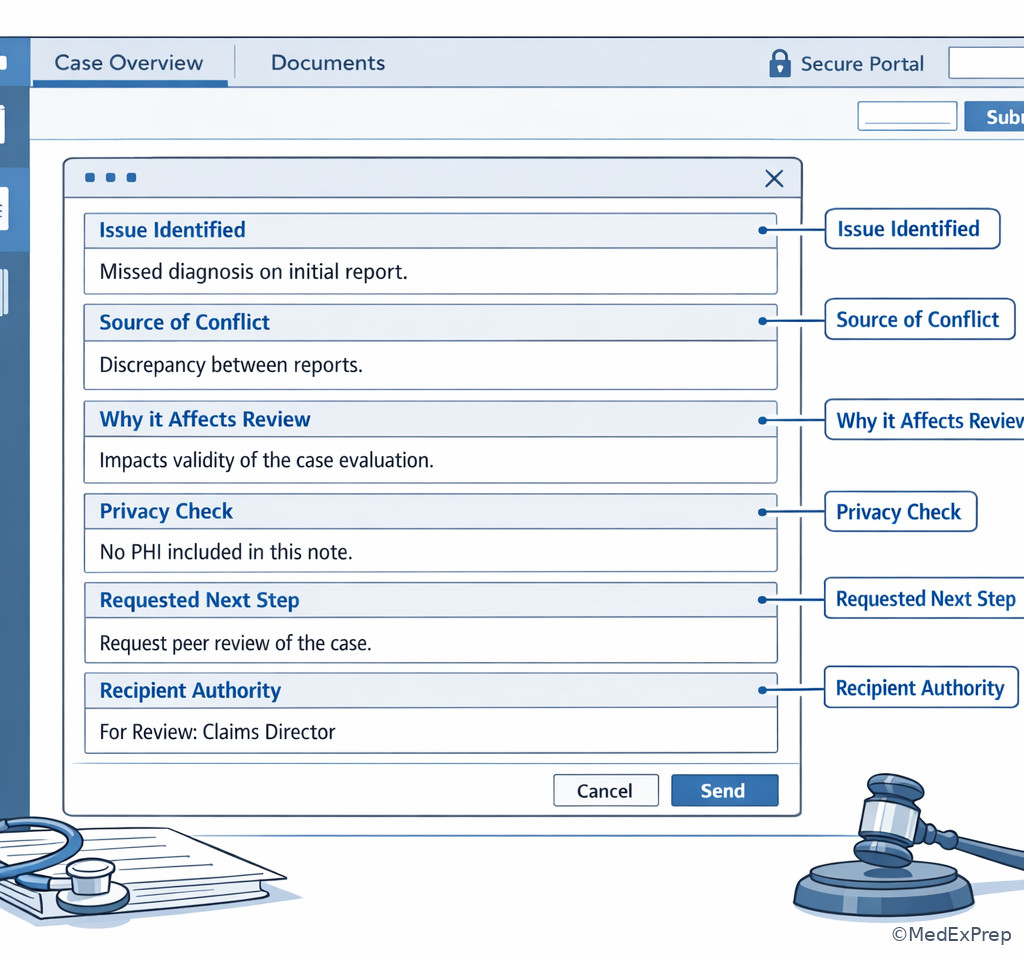
See Fig 5 for the anatomy of a defensible escalation note.
B Worked example
A reviewer handling a file for a 63-year-old claimant with heart failure and prior cancer treatment receives a text message from a coworker asking for “the quick story” because the attorney is in court. The file includes partially redacted records, a draft chronology, and an unresolved discrepancy about product use dates. A tempting clue is that the coworker has worked on similar cases before. The stem asks what requires immediate clarification.
Reasoning chain: Identify task → this is a confidentiality-plus-boundaries item. Extract key facts → unapproved text channel, unresolved discrepancy, partially redacted records, uncertain need-to-know. Apply rule → do not transmit case details through an unapproved channel; do not communicate unresolved conclusions as settled. Eliminate distractors → “send a brief summary without identifiers” may still violate policy if the channel is not approved; “share because the attorney is waiting” does not override policy; “answer from memory to save time” is even riskier. Verify → the correct response is to withhold substantive case communication through the unapproved channel, use an approved pathway, and note that unresolved issues remain pending clarification/escalation.
C Exam trap
Common wrong answer: “Share a limited summary because urgency and partial de-identification make it acceptable.”
Why it is tempting: Test-takers focus on efficiency and think removing some identifiers solves the compliance problem.
Single clue that eliminates it: The stem signals an unapproved communication channel; channel compliance matters even when the content is abbreviated.
D Checkpoint
Question: Which case note is the best example of role-appropriate communication?
- “This case should qualify because the records strongly imply long-term product exposure.”
- “The claimant almost certainly has a product-related injury based on the treatment pattern.”
- “Available records include claimant-reported long-term product use; file review also identified unresolved date discrepancies that may affect criteria review and have been routed for clarification.”
- “I recommend immediate settlement because the narrative is compelling.”
Answer: C
- A: Tempting because it sounds practical; wrong because it predicts a reserved decision and relies on implication.
- B: Tempting because treatment pattern may seem persuasive; wrong because it states causation beyond role.
- C: Correct because it is neutral, source-labeled, and procedural.
- D: Tempting because it appears decisive; wrong because settlement recommendation exceeds support-role authority.
Exam Traps & Differentiators
Common traps & distractors: The most common wrong answer is the one that sounds efficient, helpful, or decisive but quietly exceeds authority.
| Looks right | Why it is tempting | Why it is wrong | Single clue that eliminates it |
|---|---|---|---|
| “Use your judgment and decide likely causation.” | The file pattern feels medically coherent. | Causation judgment is usually outside reviewer authority. | The stem asks for a reviewer action, not a clinician or attorney conclusion. |
| “Silence in the record disproves the claim.” | Primary records seem more reliable than self-report. | Missing documentation is a gap, not automatic disproof. | No explicit contradiction is documented. |
| “Add a disclaimer and give the opinion anyway.” | Disclaimers feel protective. | They do not create authority that the role lacks. | The core action remains diagnosis, legal advice, or final ruling. |
| “Choose the more official source and ignore the conflict.” | Official documents often carry more weight. | Material conflicts affecting criteria or identity still require clarification. | The unresolved difference changes workflow outcome. |
| “Send a quick summary through any channel because it is urgent.” | Urgency pressures operational shortcuts. | Privacy and approved-channel rules still apply. | The communication pathway itself is noncompliant. |
| Similar pair | Looks similar but is not | Exam discriminator |
|---|---|---|
| Summarizing vs concluding | Both involve writing about the case. | Summaries restate documented facts; conclusions may require authority beyond role. |
| Flagging a gap vs denying a fact | Both respond to absent documentation. | Flagging says evidence is missing; denying says the event did not occur. |
| Applying criteria vs rewriting criteria | Both use program rules. | Application follows stated elements; rewriting adds assumptions or exceptions not given. |
| Routine clarification vs escalation | Both move the file forward. | Clarification handles solvable gaps; escalation addresses authority, material conflict, or high-risk issues. |
| Neutral case note vs advocacy | Both may sound supportive. | Neutral notes describe sources and issues; advocacy predicts outcome or argues the case. |
- If the stem says “strongly suggests,” think “Do I actually have documented proof and authority?”
- If the stem says “the attorney needs a quick answer,” think “Urgency does not expand scope.”
- If the stem says “the records are silent,” think “Gap, not disproof.”
- If the stem says “everyone knows what happened,” think “What is supportable in the file?”
- If the stem says “give a preliminary opinion,” think “A disclaimer does not create authority.”
- If the stem says “just send a text/email,” think “Approved channel and need-to-know check first.”
Tables
| Task type | Usually within role | Usually outside role | Best action if uncertain |
|---|---|---|---|
| Record organization | Yes | No, unless records are altered or mishandled | Follow secure handling protocol |
| Chronology building | Yes, from documented events | No if dates must be invented or medically interpreted beyond protocol | Label uncertainty and clarify |
| Criteria matching | Yes, when criteria are stated | No if criteria require independent legal or medical judgment | Escalate criteria ambiguity |
| Exposure determination | Limited source identification only | Final proof finding without documentation | Flag evidentiary support level |
| Medical diagnosis/causation | No, except source-labeling what providers documented | Yes, as an independent conclusion | Escalate to authorized reviewer |
| Final eligibility disposition | Only if expressly delegated by protocol | Usually yes, if reserved elsewhere | Follow chain of authority |
| Case communication | Yes, objective and approved-channel only | No through unapproved or unnecessary disclosure | Use secure approved pathway |
| Source type | What you may say | What you may not say |
|---|---|---|
| Claimant questionnaire | “Claimant reports...” | “This proves...” |
| Provider note with qualifiers | “Provider note references possible/suspected...” | “Diagnosis or causation is confirmed” if the note is qualified |
| Pharmacy record | “Records show fills for...” | “The patient took the drug exactly as prescribed” if adherence is not documented |
| Billing ledger | “Billing reflects dates/services billed...” | “This establishes the exact clinical event” unless corroborated |
| Missing record | “No documentation located in current file” | “The event did not occur” |
| Conflicting sources | “Sources conflict as follows...” | “I selected the likely true version” without protocol basis |
| Scenario pattern | Likely classification | Reason | Recommended next step |
|---|---|---|---|
| Complete records, clear protocol, no authority issue | Routine handling | Facts support standard workflow | Process and document objectively |
| Minor missing administrative item, no material impact yet | Routine clarification | Gap is fixable without higher authority | Request missing item per intake process |
| Material conflict affecting chronology or criteria | Escalation trigger | Reviewer cannot safely resolve by assumption | Document conflict and escalate |
| Request for medical causation opinion | Out-of-role request | Requires clinical judgment beyond support scope | Decline and route to authorized reviewer |
| Request for final case qualification where reserved to lead | Authority breach risk | Reserved decision cannot be assumed | Prepare support summary only |
| Urgent request through unapproved channel | Compliance risk | Privacy and handling rules apply | Use approved secure communication |
Exam takeaway: Distinguish source type, source limit, and missing proof before assigning any case significance.
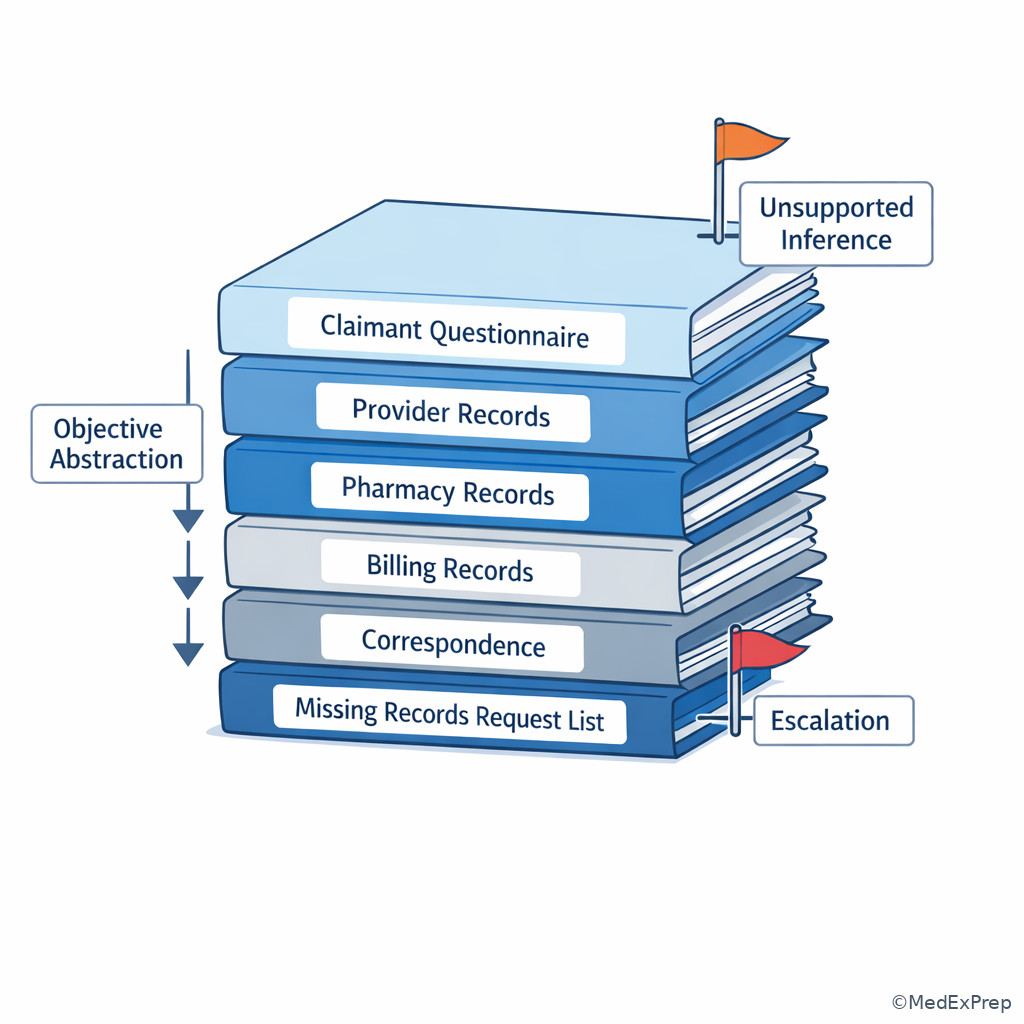
Exam takeaway: Fast pattern recognition of common overreach scenarios helps eliminate tempting but unauthorized choices.
Algorithm / Approach
Exam takeaway: Ask documented fact, role authority, and workflow impact in sequence to choose proceed, clarify, or escalate.
See Fig 6 as the default exam-day algorithm.
Rapid Review
- Scope boundary → Authorized support work uses documented facts plus stated protocol only.
- Claimant statement → Relevant history, not automatic proof.
- Record silence → Gap in support, not disproof.
- Qualified provider wording → Preserve uncertainty; do not upgrade “possible” to confirmed.
- Final eligibility → Reserved authority defeats the tempting “obvious answer.”
- Causation request → Most likely escalate, not opine.
- Conflicting dates → Document both; never average or choose by preference.
- Urgent communication → Urgency never overrides approved-channel rules.
- Neutral note → States source, conflict, impact, and next step.
- Strong pattern in file → Pattern recognition does not replace documentary support.
- Disclaimer trap → Preliminary language does not cure unauthorized action.
- Best next step → Proceed only when fact, authority, and workflow alignment are all present.
Self-check quiz
1. A reviewer is preparing a case summary from a claimant questionnaire, provider note, and pharmacy printout. Which action is the most appropriate within role?
- Determine that the product caused the claimant’s condition because the records are persuasive.
- Document the claimant-reported use separately from provider-documented findings and note any missing confirmation.
- Issue the final eligibility ruling because enough information is present.
- Delete all claimant-reported statements because only provider records matter.
2. A file contains treatment records and billing records but no direct documentation of the claimed exposure. What does the absence of exposure documentation most appropriately mean?
- Exposure definitely did not occur.
- Exposure is established if the claimant has a related diagnosis.
- The file has an evidentiary gap that should be documented as such.
- The reviewer may infer exposure from the treatment pattern.
3. A 62-year-old claimant with hypertension and osteoarthritis has a questionnaire reporting product use from 2014 to 2020. Pharmacy records in the file show fills beginning in 2017. A spouse email says use began “even earlier,” and an unrelated ophthalmology bill is attached. The program timing rule depends on first documented use. What is the best next step?
- Use 2014 because claimant recollection is likely accurate over long-term use.
- Use 2017, document that earlier use is reported but not confirmed in the current file, and follow clarification workflow if needed.
- Use the spouse email because family witnesses often know medication history well.
- Average the reported years and record 2015–2016 as first use.
4. A 55-year-old claimant with chronic lung disease and diabetes has records showing a hospitalization, a claimant statement naming a product, and an ED note that says “possible medication reaction.” The stem asks for the best interpretation based on the documentation context. Which answer is best?
- The product injury is confirmed because a provider mentioned medication reaction.
- The claimant cannot have a product-related issue because the ED note is uncertain.
- The file includes claimant-reported product use and a provider note raising a possible reaction; causation is not established by the current record set.
- The reviewer should decide likely causation and state it as a preliminary opinion.
5. A litigation coordinator asks a reviewer to send a “quick case summary” by personal text message because the attorney is in court. The file for a 70-year-old claimant with CKD and heart disease includes unresolved date discrepancies and partial identifiers. What requires immediate clarification?
- Whether the reviewer can summarize from memory to save time.
- Whether the personal text channel is approved and whether disclosure is appropriate through that channel.
- Whether the claimant’s age makes the case more urgent.
- Whether the reviewer can omit the discrepancy and send only the likely facts.
6. A 64-year-old claimant with COPD and prior stroke has a questionnaire naming Product A, a pharmacy ledger showing Product B in the same therapeutic category, and a hospitalization record under a slightly different last-name spelling. Program screening allows routine handling of minor clerical issues but requires escalation when identity or product evidence materially affects criteria. What is the most appropriate next step?
- Treat Product B as equivalent to Product A and continue routine screening because the category matches.
- Document the product mismatch and identity discrepancy as material issues affecting criteria review and escalate per protocol.
- Ignore the spelling variation as a normal clerical issue and use the claimant’s product statement as controlling.
- Deny the case immediately because the file is inconsistent.
7. A reviewer is asked by a supervisor to “just make the call” on a file for a 59-year-old claimant with obesity and rheumatoid arthritis because the medical consultant is unavailable. The file strongly suggests exposure, but one key source document is illegible and program rules reserve final eligibility to program leadership. Which is the best response?
- Issue a provisional eligibility decision with a note that it can be revised later.
- Complete an objective summary, identify the illegible key document, and route the file according to reserved-authority workflow.
- Approve the case because the overall pattern is persuasive despite the illegible document.
- Reject the file because any illegibility prevents all further work.
8. A 68-year-old claimant with CHF and chronic pain has an intake file containing claimant-reported product use, provider records with a “rule out medication reaction” note, billing entries spanning several years, and an urgent request from counsel staff for “bottom-line settlement likelihood.” Program materials instruct support staff to summarize objective findings, flag missing proof, and escalate legal sufficiency questions. What is the most appropriate response?
- Explain that settlement likelihood is high because the chronology and billing pattern support a strong case.
- State that the file currently contains claimant-reported use and a provider note with nonconfirmatory language, identify any missing proof, and escalate the legal sufficiency request.
- Say the claimant is ineligible because the provider note does not confirm a reaction.
- Provide an estimated settlement likelihood but mark it “for internal use only.”
Answer key
1. Answer: B
- A: Tempting because persuasive records can make causation feel obvious; incorrect because independent causation determination is outside the support role. Single clue: the task is summary preparation, not medical judgment.
- B: Correct because it preserves source distinctions, stays within role, and identifies evidentiary limits without overreach. Single clue: source-labeled abstraction is exactly what the role permits.
- C: Tempting because “enough information” sounds efficient; incorrect because final eligibility may be reserved elsewhere. Single clue: the reviewer is not described as the final authority.
- D: Tempting because provider records often carry more weight; incorrect because claimant-reported history may still belong in the file when clearly labeled. Single clue: the issue is labeling, not deletion.
2. Answer: C
- A: Tempting because lack of proof may feel like disproof; incorrect because absence of documentation is only a gap unless the file affirmatively contradicts the claim. Single clue: no contradictory evidence is stated.
- B: Tempting because diagnoses can appear related to exposure allegations; incorrect because diagnosis does not establish documented exposure. Single clue: the stem specifically says no direct exposure documentation.
- C: Correct because it treats missing support as an evidentiary deficiency rather than a finding. Single clue: this preserves neutrality and workflow integrity.
- D: Tempting because treatment pattern can seem suggestive; incorrect because inference cannot replace documentation. Single clue: inferred exposure is not authorized proof.
3. Answer: B
- A: Tempting because claimant recollection may capture earlier use; incorrect because the timing rule depends on first documented use in the current file. Single clue: the stem explicitly ties the rule to documented use.
- B: Correct because it uses the earliest documented file evidence, preserves earlier unconfirmed reports, and allows clarification workflow. Single clue: this option respects both documentation and process.
- C: Tempting because family observations may sound corroborative; incorrect because a spouse email still does not satisfy the stated documentation rule. Single clue: it remains unconfirmed report, not first documented use.
- D: Tempting because it feels balanced; incorrect because averaging dates invents a fact not present in the record. Single clue: no source documents the midpoint date.
4. Answer: C
- A: Tempting because provider documentation carries weight; incorrect because the note says “possible,” which preserves uncertainty. Single clue: qualifier language blocks confirmation.
- B: Tempting because the note is uncertain; incorrect because uncertainty does not rule out the issue either. Single clue: the current record set is inconclusive, not disproving.
- C: Correct because it states exactly what is documented and avoids causation overreach. Single clue: source-labeled, qualified wording matches defensible abstraction.
- D: Tempting because preliminary opinions can seem operationally helpful; incorrect because disclaimers do not create authority. Single clue: the action remains an unauthorized causation opinion.
5. Answer: B
- A: Tempting because memory seems faster under pressure; incorrect because unapproved summary from memory risks both accuracy and privacy failures. Single clue: the request is by personal text message.
- B: Correct because channel approval and disclosure appropriateness are the immediate compliance questions. Single clue: urgent text communication is the dominant risk signal in the stem.
- C: Tempting because age might affect urgency in some clinical settings; incorrect because age is irrelevant to the boundary issue presented. Single clue: the stem’s real problem is communication channel and unresolved discrepancy.
- D: Tempting because simplifying the message seems efficient; incorrect because omitting a material discrepancy creates an inaccurate and potentially misleading communication. Single clue: unresolved discrepancies must be preserved, not hidden.
6. Answer: B
- A: Tempting because products in the same category may seem functionally close; incorrect because product-specific evidence matters when criteria depend on the named product. Single clue: the stem says product evidence materially affects criteria.
- B: Correct because both the product mismatch and identity discrepancy are material under the stated rule and trigger escalation. Single clue: the stem explicitly distinguishes minor clerical issues from material identity/product issues.
- C: Tempting because spelling variations can be clerical; incorrect because here the identity discrepancy is paired with product mismatch and affects criteria reliability. Single clue: the combination makes it material, not routine.
- D: Tempting because inconsistency can suggest denial; incorrect because the role is to escalate material issues, not issue final denial absent authority. Single clue: the protocol provides escalation, not immediate denial, for this pattern.
7. Answer: B
- A: Tempting because provisional decisions seem flexible; incorrect because a provisional label does not bypass reserved authority. Single clue: final eligibility is reserved to program leadership.
- B: Correct because it stays within support role, identifies the key record problem, and routes the file through the proper authority path. Single clue: objective summary plus reserved-authority routing is the safest workflow response.
- C: Tempting because the file “strongly suggests” the outcome; incorrect because persuasive patterns do not permit unauthorized approval. Single clue: one key document is illegible and authority is reserved elsewhere.
- D: Tempting because illegibility is a serious concern; incorrect because one illegible source does not automatically require total rejection if the workflow provides escalation and further review. Single clue: the correct action is route, not abandon.
8. Answer: B
- A: Tempting because chronology and billing can make the case look strong; incorrect because settlement likelihood is a legal or program decision beyond the support summary role. Single clue: the request asks for “bottom-line settlement likelihood.”
- B: Correct because it provides the authorized objective summary, preserves uncertainty in the provider note, flags missing proof, and escalates legal sufficiency. Single clue: this option mirrors the program instruction in the stem.
- C: Tempting because the provider note is nonconfirmatory; incorrect because nonconfirmatory language does not equal ineligibility. Single clue: “rule out” preserves uncertainty rather than deciding against the claim.
- D: Tempting because “internal use only” sounds safer; incorrect because the content still exceeds role by estimating settlement likelihood. Single clue: a confidentiality label does not cure an authority problem.
Keep going with the full CMTMS Prep Course (CMTMS)
You just studied the way members do, in the same lesson interface. Full access unlocks every lesson, the question bank and flashcards for a full year.
One payment · 1 year of access · No auto-renewal