1.1.1 - Patient Identity And Order Verification
Why it matters Wrong-patient and wrong-procedure errors in nuclear medicine can…
- 1 Why it matters Wrong-patient and wrong-procedure errors in nuclear medicine can… 0:52
- 2 Key Terms & Must-Know Facts Key terms Two-identifier check — confirmation using… 2:00
- 3 If the study name, indication, route, timing, or patient-specific factors are u… 0:51
- 4 Core content Recall: This is the first topic in the course sequence, so it buil… 1:38
- 5 Body 1:32
- 6 The transporter says, “This is Mr. 1:53
- 7 What is the most appropriate next step? 1:18
- 8 The resolving rule is that the order must support the intended examination with… 1:28
- 9 Body 1:34
- 10 Verify — pause and clarify the intended study/protocol with the ordering source… 1:37
- 11 Memory anchor: Think I-S-C-A-N for order review: Identity, Study named, Clinica… 1:43
- 12 Body 1:33
- 13 The patient also has asthma and repaired congenital heart disease. 1:32
- 14 Answer: C A: Tempting because the symptom history seems specific, but wrong bec… 1:37
- 15 Explanation The final foundational decision conflict is: When an identity or or… 1:37
- 16 Body 1:43
- 17 Extract key facts — correct patient, ambiguous study wording, stress component… 1:35
- 18 B: Correct because clarification plus documentation is the technologist-level r… 1:45
- 19 The resolving rule is this: if the discrepancy could connect the wrong patient… 1:39
- 20 Body 2:22
- 21 Reasoning chain: Identify task — determine the safest technologist action befor… 2:01
- 22 Ask the patient whether the displayed study information looks familiar before c… 1:46
- 23 Exam Traps & Differentiators Common traps & distractors: The exam often rewards… 2:21
- 24 If the stem says ___, think ___ If the stem says similar last names, think form… 1:36
- 25 Tables Reference check What to confirm Why it matters Identity Two approved ide… 1:17
- 26 Example Exam logic Verify identity Yes Ask full name and date of birth; compare… 1:46
- 27 Algorithm / Approach Concept flow: Practical approach to patient identity and o… 1:09
- 28 Rapid Review Two identifiers → room number never substitutes Vague study name →… 1:32
- 29 Self-check quiz 1. 2:17
- 30 The nurse says, “It is definitely the right side; we all know this patient.” Wh… 2:02
- 31 Administer the dose now to avoid decay loss, then fix the chart before imaging. 2:00
- 32 Answer key 1. 1:37
- 33 The clue is that one exam is named with a fitting indication. 1:27
- 34 Source basis: SNMMI thyroid procedure standards; ARRT-style scope limits on tec… 1:23
- 35 B: Correct because the exact ordered nuclear cardiac study and variant must be… 1:43
- 36 Source basis: SNMMI quality and safety principles; Joint Commission patient ide… 1:30
- 37 The clue is the note suggesting possible bile leak evaluation, which can affect… 1:27
Why it matters
- Wrong-patient and wrong-procedure errors in nuclear medicine can expose a patient to unnecessary radiation and compromise diagnosis, even before imaging begins.
- Many board questions test the technologist's safest next step: not image interpretation, but whether you should stop and clarify the order.
- Order verification protects image quality because the correct radiopharmaceutical, route, timing, and prep all depend on the intended study.
- Identity verification is also a legal and documentation issue: once a dose is prepared or administered to the wrong patient, the event may require formal reporting under institutional and regulatory processes.
Key Terms & Must-Know Facts
1.1.1.1 Key terms
- Two-identifier check — confirmation using two approved identifiers, commonly full name and date of birth or medical record number.
- Order verification — review of the requested study for completeness, accuracy, indication, and consistency with the patient.
- Authorized user — physician authorized under regulations for radiopharmaceutical use; escalation target for certain order issues per policy.
- Clinical indication — reason for the study that supports proper protocol selection.
- Protocol — institution-approved workflow specifying preparation, dose, timing, acquisition, and post-processing.
- Contraindication — factor that means a study should not proceed or requires physician review.
- Precaution — factor requiring additional steps, not automatic cancellation.
- Misadministration/wrong-patient event — administration to the wrong individual or inconsistent with the intended order; reporting rules vary by case and jurisdiction.
- Read-back — verification of verbal or corrected order details by repeating them back to the ordering source per policy.
- NPO — nothing by mouth; relevant only when the study requires it, not as a generic assumption.
- Dose assay — measurement of activity before administration; must match the correct patient and study.
- ALARA — keeping radiation exposure as low as reasonably achievable.
1.1.1.2 Must-know facts
- Never rely on room number, verbal recognition, or appearance alone to identify a patient.
- The minimum safe habit is: verify patient identity first, then verify the order, then verify the planned dose/protocol.
- If the patient identifiers do not match the order exactly enough per policy, do not proceed.
- If the study name, indication, route, timing, or patient-specific factors are unclear, the best technologist action is to pause and clarify.
- Technologists may clarify incomplete information through proper channels; they do not independently rewrite medical intent.
- A complete order should allow you to determine the correct examination and workflow without guessing.
- Pregnancy, breastfeeding, recent prior nuclear medicine studies, and inability to follow prep instructions often become relevant immediately after order verification.
- Local protocols vary; confirm with your institution when a workflow detail is policy dependent.
Core content
1.1.1.3 Foundational check: verifying the right patient before anything else
A Explanation
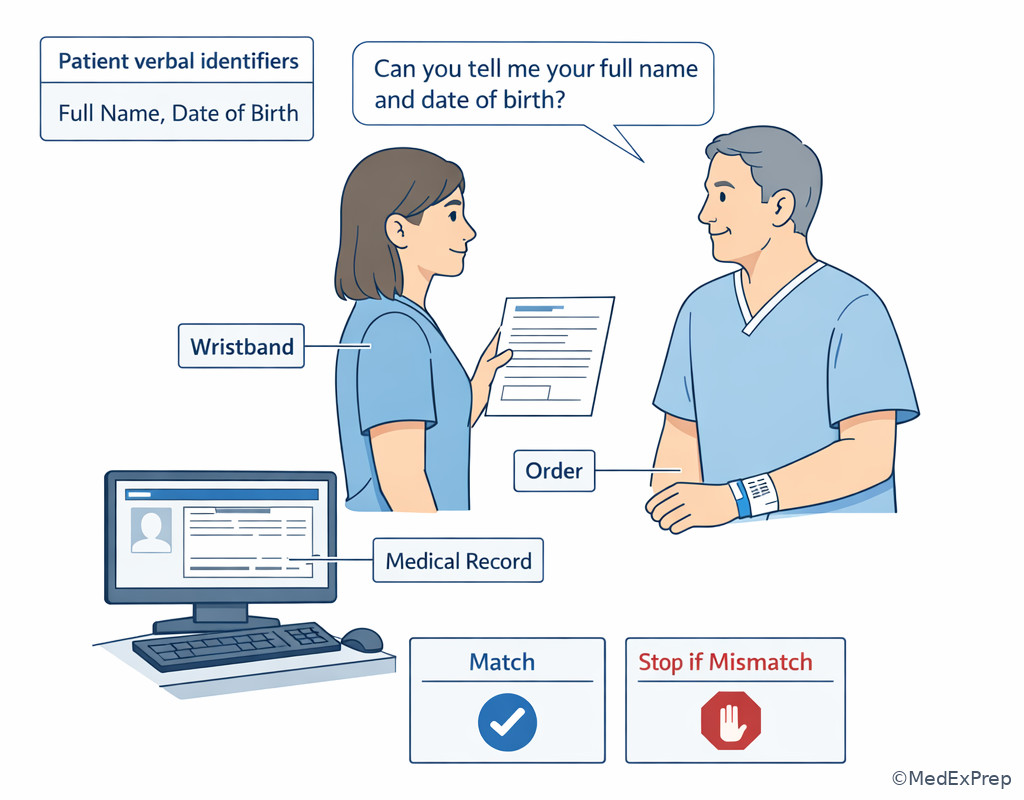
The first decision conflict is simple but heavily tested: Do you proceed because the patient is physically present and expects a scan, or do you stop because identity has not been independently confirmed? The rule that resolves it is the two-identifier rule. Before discussing preparation, dose, IV access, or imaging, the technologist must confirm identity using approved identifiers that match the order and the institutional record. The most common accepted pair is full name plus date of birth, though some facilities use medical record number as one identifier. A room number, verbal familiarity, spouse confirmation, or wristband alone is not enough if policy requires two identifiers.
WHY THIS IS TESTED: board stems often include workflow pressure — a busy schedule, an inpatient in a shared room, or a patient who says, “I’ve had this test before.” The testable pattern is that convenience never overrides formal identification. Nuclear medicine adds a radiation exposure component, so a wrong-patient error is both a patient-care failure and a radiation safety event.
Choose proceed only when the patient, wristband/record, and order align. Reject proceeding when a mismatch exists in spelling, date of birth, medical record number, or intended study. If the patient cannot self-identify due to condition, use approved alternative processes such as wristband and chart verification with institutional policy, and escalate if uncertainty remains. See Fig 1 for the core decision pathway.
Exam takeaway: A patient who is present and cooperative still cannot proceed until two approved identifiers match the order and record.
flowchart TD
A[Patient arrives or is brought to department] --> B[Ask for two approved identifiers]
B --> C{Match order and record?}
C -->|Yes| D[Continue to order verification]
C -->|No| E[Stop workflow]
E --> F[Check wristband chart registration source]
F --> G{Resolved?}
G -->|Yes| D
G -->|No| H[Escalate to supervisor or ordering source per policy] Exam takeaway: Use two approved identifiers and a matching wristband/order before discussing prep or administering dose.
B Worked example
A 68-year-old inpatient arrives for a bone scan. He has diabetes, chronic kidney disease, and hearing loss. The transporter says, “This is Mr. Lopez from room 412 for his scan.” The wristband reads Luis Lopez, date of birth 05/12/1956. The printed order at the camera console is for Louis Lopes, date of birth 05/21/1956, whole-body bone imaging. The patient nods when asked if he is “Mr. Lopez.” His glucose is mildly elevated, which is distracting but irrelevant to identity verification.
Reasoning chain: Identify task — determine the most appropriate next step before dose administration. Extract key facts — similar name, different spelling, different birth date, transporter confirmation only, and patient hearing loss increases chance of superficial yes/no agreement. Apply rule — two approved identifiers must match the order/record; they do not. Eliminate distractors — proceeding because the room and last name are close is unsafe; asking the transporter again does not solve the mismatch; changing the order yourself is outside scope. Verify — stop, clarify through the chart/registration/order source, and document the discrepancy according to policy.
C Exam trap
D Checkpoint
Question: A technologist is preparing to inject a radiopharmaceutical for a hepatobiliary study. The patient states her full name correctly but does not know her date of birth. Her wristband matches the electronic chart, but the printed order at the hot lab has a different medical record number because an old label was attached. What is the most appropriate next step?
- Proceed because the patient stated her name and the wristband matches the chart.
- Proceed after confirming the study verbally with the patient's family member.
- Stop and resolve the record-label discrepancy before administering the dose.
- Cross out the incorrect label and rewrite the medical record number yourself, then continue.
Answer: C
- A: Tempting because two sources appear to agree, but wrong because the printed order used in the workflow has a conflicting identifier that must be resolved.
- B: Tempting when the patient cannot fully self-identify, but wrong because family confirmation does not replace correction of a document discrepancy.
- C: Correct because an inconsistent identifier on the active order label means the wrong-patient chain is not secure.
- D: Tempting as a quick fix, but wrong because technologists should not unilaterally alter source documentation without proper correction procedures.
1.1.1.4 Order verification: deciding whether the request is complete enough to act on
A Explanation
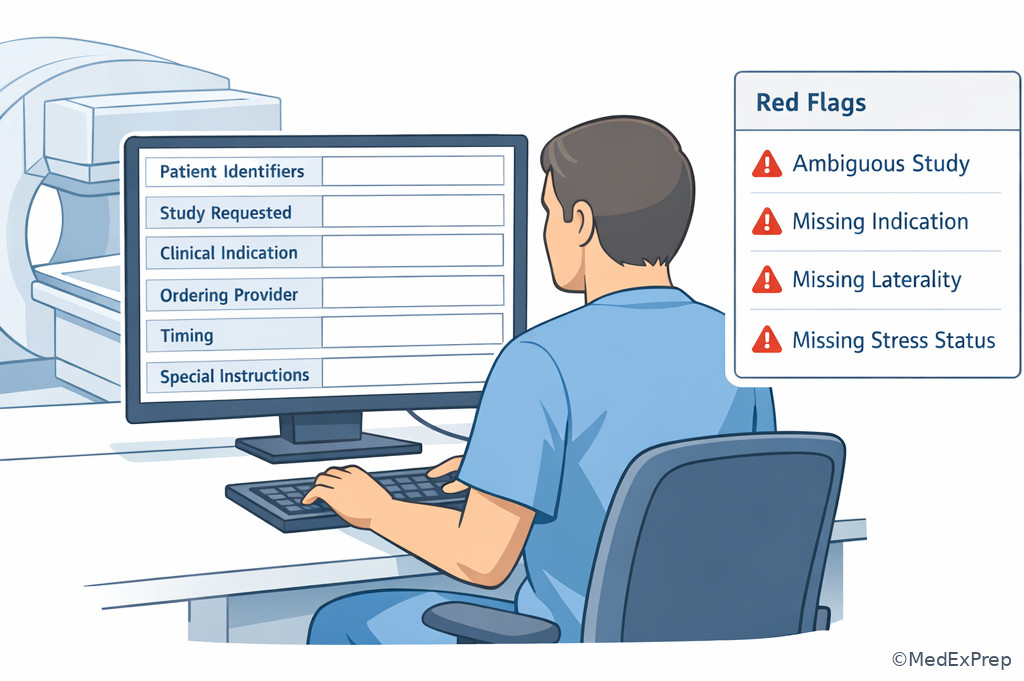
The second decision conflict is: Do you accept an order because a study name is present, or do you reject it because the information is not sufficient to perform the correct protocol safely? The resolving rule is that the order must support the intended examination without technologist guesswork. For ARRT-style questions, a usable order generally includes the patient identity, requested study, relevant indication or reason, ordering provider information per workflow, and enough context to choose the correct radiopharmaceutical/protocol path. Some studies also require clarification of route, laterality, timing, stress status, or special preparation.
WHY THIS IS TESTED: exam writers like incomplete or vague orders because they test scope boundaries. The technologist may clarify, but not independently redefine medical intent. “Nuclear scan please,” “thyroid test,” or “rule out problem” are not automatically actionable if the intended examination could be more than one study or if patient prep/protocol would differ.
Choose proceed when the order identifies one clear study and aligns with the clinical question. Reject proceeding when the order is ambiguous, internally inconsistent, or missing a critical detail that affects dose, patient prep, or acquisition. See Fig 2 for a high-yield order completeness framework. This topic also points forward to the next lesson: after the order is confirmed, you will gather focused history and contraindications that may further modify workflow.
Exam takeaway: If the order does not identify one clear study and protocol path, pause and clarify rather than guess.
flowchart LR
A[Order received] --> B[Correct patient?]
B --> C[Clear study named?]
C --> D[Indication supports study?]
D --> E[Prep timing route laterality clarified if needed?]
E --> F{All yes?}
F -->|Yes| G[Proceed to focused history and prep]
F -->|No| H[Clarify through approved channel and document] Exam takeaway: A complete order must support one clear exam path without technologist guesswork.
B Worked example
A 54-year-old outpatient with obesity, atrial fibrillation, and recent cholecystectomy presents with an order that reads, “liver/gallbladder scan — pain after meals.” He reports he was told to fast, but he ate toast four hours ago. The scheduler note mentions “possible bile leak?” A mildly elevated creatinine is listed in the chart, which is not the key issue. The tempting-but-wrong clue is that “liver/gallbladder scan” sounds close enough to a standard hepatobiliary exam.
Reasoning chain: Identify task — determine whether the order is complete enough to proceed. Extract key facts — vague study wording, conflicting possible indication, post-cholecystectomy status, and prep uncertainty. Apply rule — when study intent or protocol implications are unclear, the technologist clarifies rather than chooses a medical objective independently. Eliminate distractors — selecting a routine hepatobiliary protocol without clarification may be wrong because post-op bile leak evaluation can have different timing/documentation considerations; canceling outright is premature; instructing the patient based on assumption exceeds the available confirmed order details. Verify — pause and clarify the intended study/protocol with the ordering source per policy.
C Exam trap
D Checkpoint
Question: An outpatient arrives for a “thyroid scan” order. The electronic request contains patient identifiers and provider name but does not specify uptake only, imaging, or both. The patient has had a recent iodinated CT contrast study. What is the best technologist action?
- Proceed with standard thyroid imaging because the order includes the target organ.
- Clarify the intended thyroid procedure before scheduling or dose preparation.
- Convert the order to a thyroid uptake and scan because that provides the most information.
- Cancel the appointment permanently because contrast was recently given.
Answer: B
- A: Tempting because “thyroid scan” sounds specific, but wrong because uptake, imaging, and combined studies differ in workflow and prep.
- B: Correct because the order does not identify a single unambiguous protocol path.
- C: Tempting because it seems comprehensive, but wrong because technologists do not independently expand medical intent.
- D: Tempting because recent iodinated contrast can matter, but wrong because that issue belongs after clarifying which thyroid study is actually ordered.
- The minimum identity habit before any dose or scan is ___ approved identifiers.
- True or False: A vague order can be made actionable by choosing the most common protocol.
- Name 3 core order elements: patient identity, ___, and ___.
1.1.1.5 Matching patient, order, and procedure: the study-protocol consistency check
A Explanation
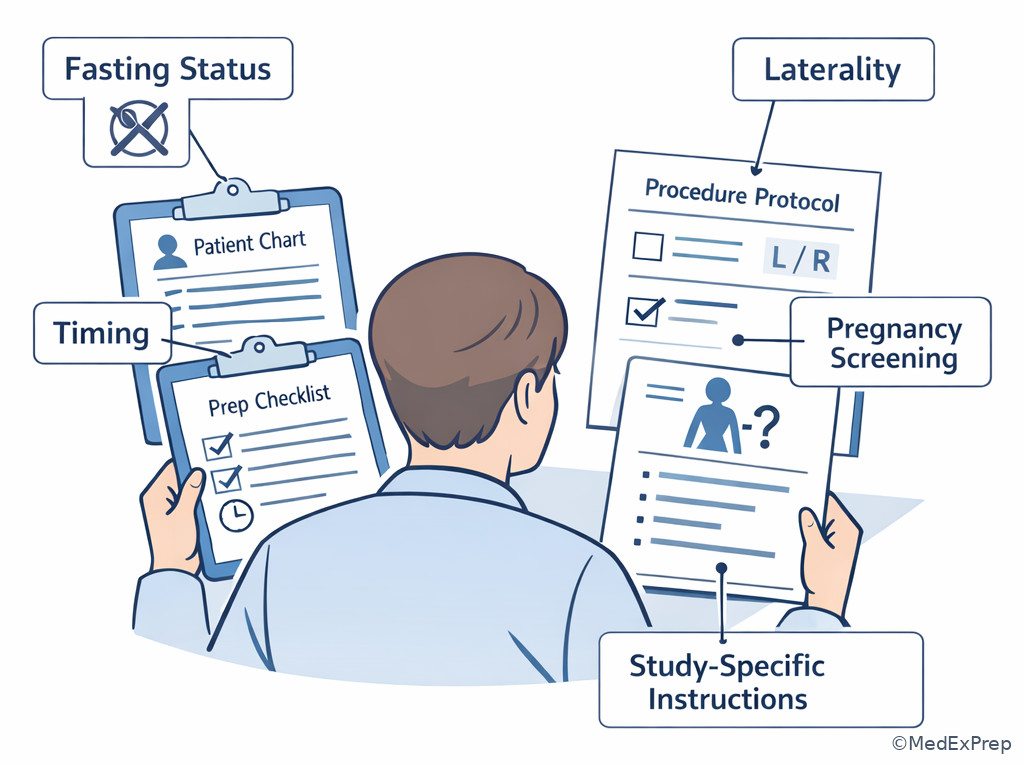
Once identity and order completeness are confirmed, the next decision conflict is: Does this specific patient's situation fit the ordered workflow as written, or is there an internal inconsistency that requires clarification before dose preparation? The single resolving rule is consistency. The patient, indication, prep status, timing, route, and procedure category must point to the same intended examination. This is the bridge between paperwork and actual technologist workflow.
WHY THIS IS TESTED: ARRT-style stems often hide the key clue in a mismatch: an outpatient booked for a study that requires fasting who clearly did not fast; an order for a laterality-dependent procedure without a side specified; a stress-related order missing the stress component; or a pediatric patient arriving with an adult workflow assumption. The candidate must distinguish incomplete order from contraindication and from routine prep issue. In this lesson, the high-yield move is to detect inconsistency and clarify or reschedule appropriately per policy, not to force the protocol forward.
Choose use the existing workflow when the indication, prep, and exam path line up. Reject using it when the order or patient context suggests the wrong protocol, wrong timing, or missing side/status detail. See Fig 3 for a comparison of proceed vs clarify vs reschedule logic.
Exam takeaway: A matched order still may not proceed if prep, timing, laterality, or patient-specific workflow details do not align.
flowchart TD
A[Identity and order confirmed] --> B{Study and patient context consistent?}
B -->|Yes| C[Proceed to focused history and preparation]
B -->|No, missing detail| D[Clarify order or protocol]
B -->|No, prep/timing failure| E[Hold or reschedule per policy]
D --> F[Document clarification]
E --> F Exam takeaway: Verify that indication, prep, timing, and study instructions align before dose preparation.
B Worked example
A 7-year-old child arrives for renal imaging with a parent. The order has the correct patient identifiers and a clear study name, but the scheduling note indicates sedation “if needed,” while the child drank juice on the way in. The patient also has asthma and repaired congenital heart disease. A recent normal chest radiograph is present in the chart, which is a distractor. The tempting-but-wrong clue is that the order itself is technically present and readable.
Reasoning chain: Identify task — decide whether workflow can proceed exactly as planned. Extract key facts — pediatric case, possible sedation note, recent oral intake, and unclear final sedation plan. Apply rule — if patient-specific workflow details affect prep and timing, the technologist must not assume they are irrelevant. Eliminate distractors — proceeding because the study name is complete ignores internal workflow inconsistency; canceling without review may be premature; independently deciding no sedation is needed may exceed role depending on local process. Verify — clarify the planned workflow and prep implications through the appropriate team before continuing.
C Exam trap
D Checkpoint
Question: A patient presents for a study that requires side-specific imaging, but the order lists the correct patient and a clear procedure name without laterality. The patient reports symptoms only on the left. What is the best technologist action?
- Proceed on the left because the patient's symptoms identify the side.
- Proceed bilaterally to avoid missing pathology.
- Clarify the missing laterality through the approved ordering channel before imaging.
- Ask the patient's family to sign a note confirming the left side and continue.
Answer: C
- A: Tempting because the symptom history seems specific, but wrong because the technologist should not supply omitted order detail based only on patient report when laterality affects the order.
- B: Tempting as a comprehensive compromise, but wrong because expanding the scope of the ordered study changes medical intent.
- C: Correct because missing laterality is an order inconsistency that must be clarified before proceeding.
- D: Tempting when trying to move workflow forward, but wrong because family confirmation is not an authorized substitute for order correction.
1.1.1.6 Escalation, documentation, and scope: what the technologist should do when something does not fit
A Explanation
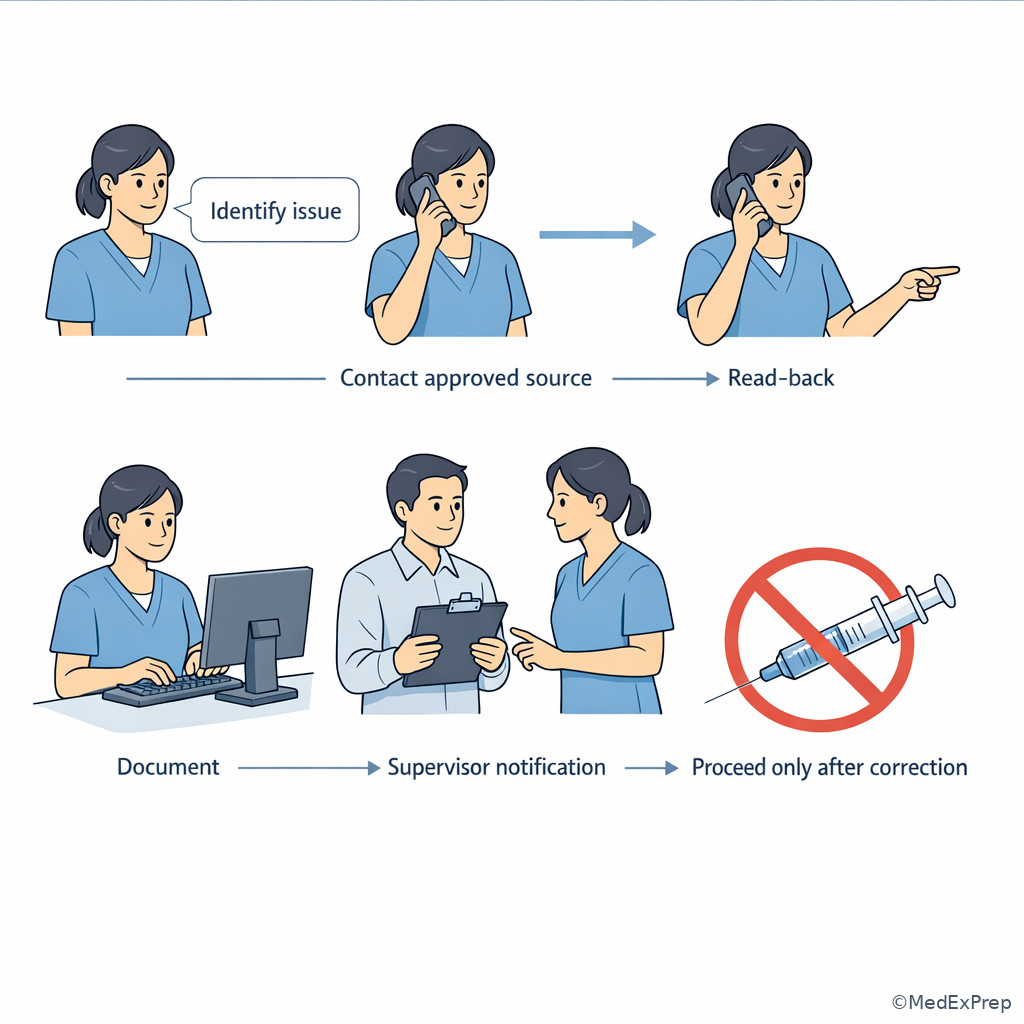
The final foundational decision conflict is: When an identity or order problem is found, should the technologist solve it independently to keep the schedule moving, or escalate through proper channels? The rule is scope-based: the technologist can identify, pause, clarify, and document; the technologist does not independently alter medical intent, rewrite the examination indication, or override safety requirements. This distinction is critical for ARRT NM questions because distractors often include actions that sound helpful but cross role boundaries.
WHY THIS IS TESTED: exam stems commonly present a near-solution that is actually outside scope — changing the order to what “makes sense,” performing an extra view/study to cover uncertainty, or deciding a provider “must have meant” a related procedure. The correct answer is often a communication-and-documentation action: contact the ordering source, authorized user, supervisor, nurse, or registration process according to policy. Documentation matters because it closes the loop, preserves dose accountability, and protects the patient and department if a discrepancy later becomes a reportable event.
Choose clarify and document when the issue can be resolved through approved workflow. Reject independent modification of the order or protocol. See Fig 4 for a role-safe escalation tree, and compare the documentation essentials in the tables below.
Exam takeaway: The technologist may clarify and document but must not independently change medical intent or override safety requirements.
flowchart TD
A[Problem found] --> B{What type?}
B -->|Identity mismatch| C[Stop and verify through record or registration process]
B -->|Ambiguous study| D[Contact ordering source or supervisor]
B -->|Protocol-defining missing detail| E[Clarify laterality timing or status]
B -->|Potential safety issue| F[Escalate per institutional policy]
C --> G[Document resolution]
D --> G
E --> G
F --> G Exam takeaway: When details do not fit, the safe technologist action is pause, escalate, and document rather than guess.
Exam takeaway: Identity and order verification must remain linked to dose labeling and administration to prevent wrong-patient radiation events.
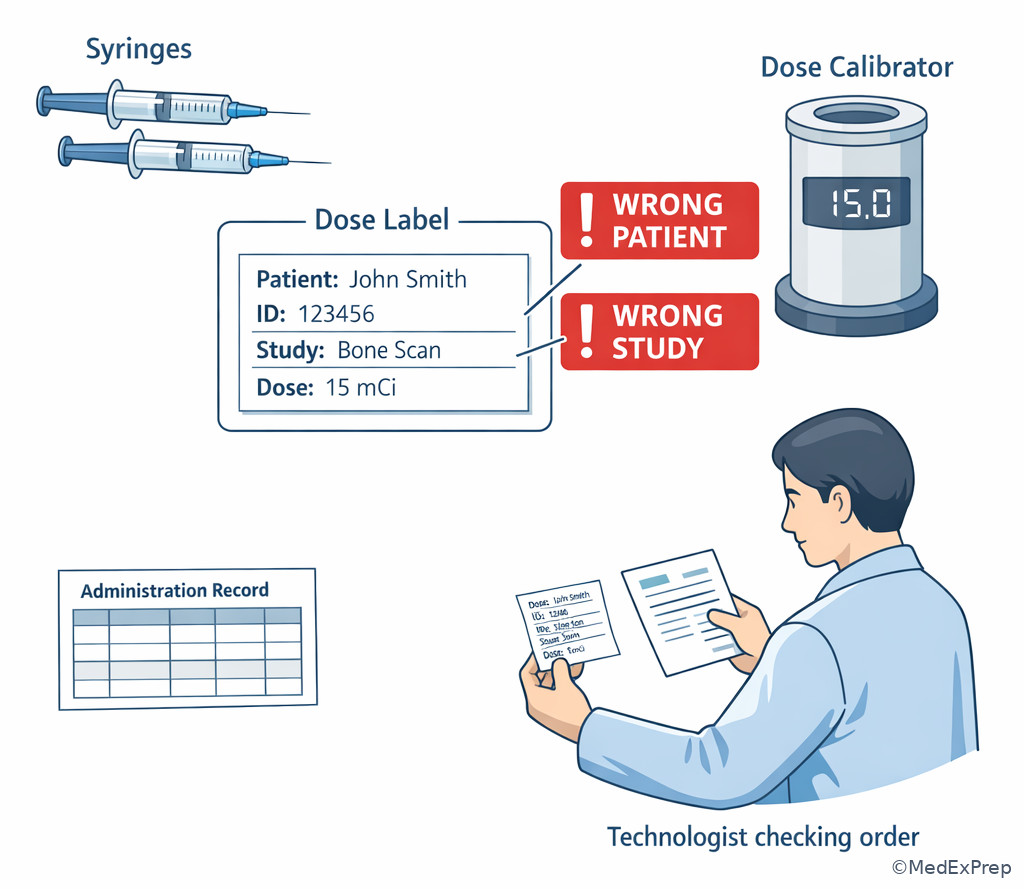
B Worked example
A 73-year-old man with coronary artery disease, COPD, and mild dementia arrives for an outpatient myocardial perfusion appointment. The order identifies the correct patient but says only “nuclear cardiac test.” The scheduler note mentions stress testing, but no stress type is confirmed. The patient's daughter says, “He always does the treadmill one,” while the chart notes recent severe exertional dyspnea. A low potassium value from last week appears in the chart and distracts from the actual decision point.
Reasoning chain: Identify task — determine the best technologist action before preparation begins. Extract key facts — correct patient, ambiguous study wording, stress component not fully specified, family statement not authoritative, and possible clinical factors that could affect stress method. Apply rule — the technologist cannot independently decide the intended stress approach based on habit or family recollection. Eliminate distractors — selecting treadmill because the daughter said so is unsafe; rewriting the order to “stress/rest MPI” exceeds scope; proceeding with rest-only imaging changes intent. Verify — contact the approved source/supervisor to clarify the complete order and document the resolution.
C Exam trap
D Checkpoint
Question: A technologist identifies that an order for a nuclear medicine procedure has the correct patient but an unclear protocol variant that changes preparation and timing. Which action is most appropriate?
- Choose the department's most frequently performed variant and document that it was standard practice.
- Delay administration, clarify through the approved channel, and document who provided the corrected instruction.
- Ask the patient which version of the study was performed in the past and repeat that protocol.
- Proceed with the basic imaging portion and let the interpreting physician add the rest later if needed.
Answer: B
- A: Tempting because standardization feels safe, but wrong because routine practice cannot replace a valid order.
- B: Correct because clarification plus documentation is the technologist-level response within scope.
- C: Tempting because patient history may help, but wrong because prior recollection does not establish the intended current order.
- D: Tempting as a partial workaround, but wrong because starting an incomplete or possibly incorrect workflow still exposes the patient to unnecessary steps or dose.
- True or False: A technologist may expand an order to include bilateral imaging if that seems safer.
- The safest action when protocol-defining details are missing is pause, ___, and document.
- Name one source that may help resolve an identity discrepancy and one source that may help resolve an ambiguous order.
1.1.1.7 Integration: preventing wrong-patient and wrong-study events in real NM workflow
A Explanation
The integrated exam-level decision conflict is: At what point does a small clerical issue become a radiation safety and quality event risk? The resolving rule is this: if the discrepancy could connect the wrong patient to the wrong dose, wrong timing, or wrong protocol, treat it as a stop point. In nuclear medicine, verification is not a front-desk formality; it is connected to radiopharmaceutical selection, assay, labeling, administration, image interpretation context, and downstream documentation. That is why identity and order verification remain relevant at multiple handoff points: scheduling, arrival, hot lab preparation, administration, and acquisition.
WHY THIS IS TESTED: integrated stems add noise such as patient anxiety, schedule delay, inpatient transport pressure, or a prepared dose that is already assayed. The candidate must resist “sunk cost” reasoning. A ready dose does not justify proceeding with uncertainty. Correct action may include holding the dose, confirming decay timing, relabeling only through proper process, or notifying supervisory personnel if an event nearly occurred.
Choose safety over convenience whenever uncertainty persists. Reject the idea that because “the dose is ready” or “the patient has done this before,” verification steps can be abbreviated. See Fig 5 for a wrong-study prevention map and Fig 6 for the handoff chain that must stay intact.
Exam takeaway: Verification must be repeated at high-risk handoffs, especially before dose administration and image acquisition.
flowchart LR
A[Order intake] --> B[Patient arrival check]
B --> C[Protocol and prep consistency]
C --> D[Dose labeling and assay]
D --> E[Pre-injection timeout]
E --> F[Acquisition metadata review]
F --> G[Document completion]
Exam takeaway: The patient, order, protocol, and labeled dose must remain linked through every handoff to prevent wrong-patient administration.
flowchart TD
A[Verified patient] --> B[Verified order]
B --> C[Selected protocol]
C --> D[Prepared and assayed dose]
D --> E[Patient bedside or injection chair recheck]
E --> F[Administer correct dose to correct patient]
F --> G[Acquire under correct study record]
Exam takeaway: A final pause before administration catches identity, order, and dose-label mismatches before radiation exposure occurs.
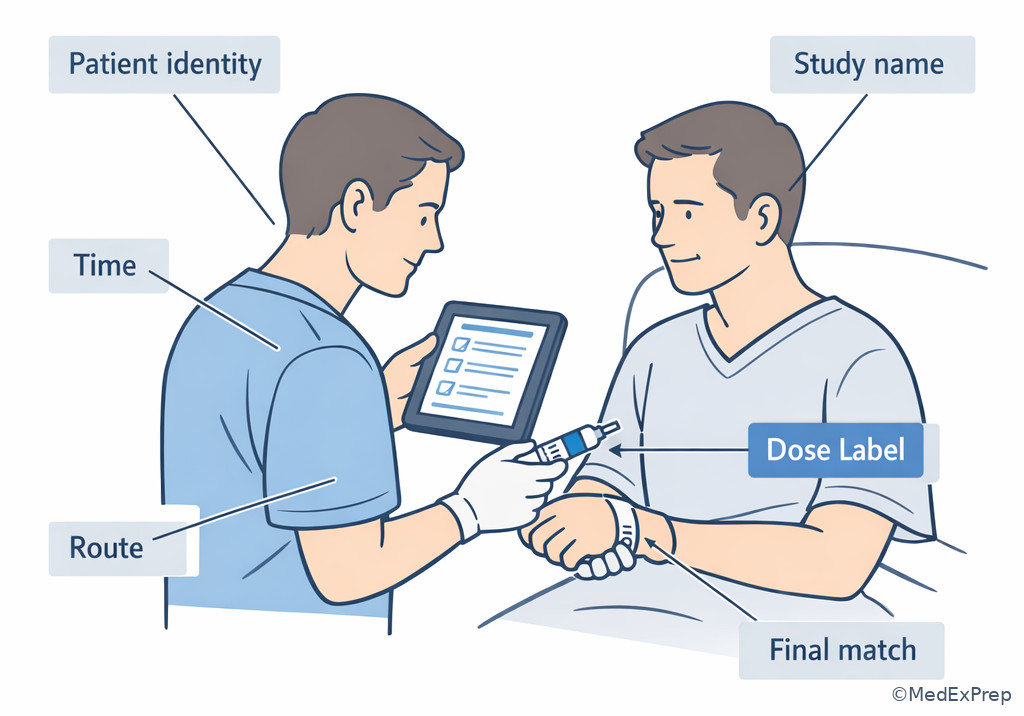
Exam takeaway: Correct patient data on the camera workstation is part of order verification because wrong metadata can mislabel the entire study.
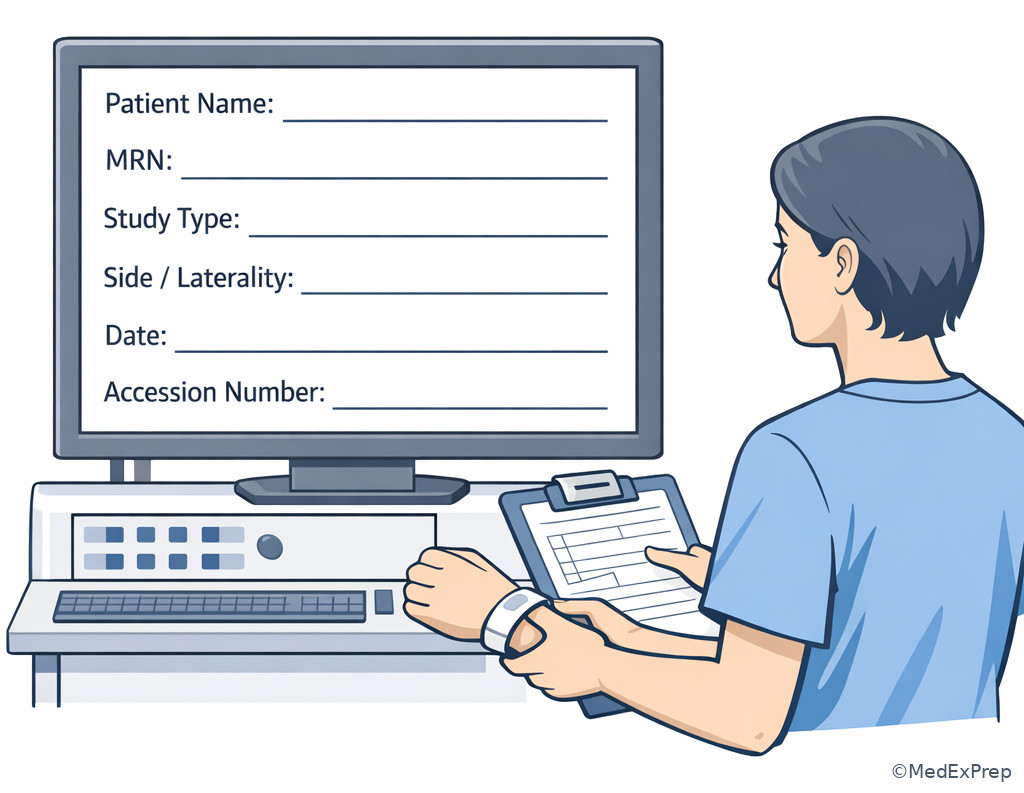
B Worked example
A 61-year-old outpatient with metastatic prostate cancer, hypertension, and chronic back pain arrives for a bone scan. Two doses were prepared that morning for patients with similar last names. The patient is anxious and says, “I’m the one for the injection at 10.” The dose syringe on the tray has the correct study type but only an initialed last-name sticker pending final bedside confirmation. Another patient's chart is open at the workstation because the previous exam ran late. A slightly elevated PSA in the chart is distracting but clinically expected.
Reasoning chain: Identify task — determine the safest technologist action before injection. Extract key facts — two similar names, incomplete bedside linkage of the dose label, wrong chart open on workstation, and patient self-identification by appointment time rather than full identifiers. Apply rule — at any chain-of-custody break involving patient, order, chart, or dose label, stop and rebuild the verification chain. Eliminate distractors — proceeding because the study type matches is not enough; relying on appointment time or last initial is unsafe; assuming the tray arrangement is correct ignores wrong-patient risk. Verify — confirm the patient's full identifiers, ensure the correct chart is active, match the fully labeled dose to the correct verified order, and only then proceed.
C Exam trap
D Checkpoint
Question: A labeled dose is ready, but at the injection chair the technologist notices the camera workstation still displays another patient's record from the previous study. The current patient gives the correct name and date of birth. What is the best technologist action?
- Proceed because bedside verbal identification is the final required check.
- Administer the dose, then correct the workstation record before acquisition.
- Pause, correct the active record, re-verify the patient-order-dose linkage, and then proceed.
- Ask the patient whether the displayed study information looks familiar before continuing.
Answer: C
- A: Tempting because the patient identified themselves correctly, but wrong because the electronic study chain is still attached to another patient.
- B: Tempting as a workflow-saving step, but wrong because the wrong record at administration is already a high-risk mismatch point.
- C: Correct because the full patient-order-dose-record chain must be re-established before dose administration.
- D: Tempting because it adds one more human check, but wrong because patient recognition of displayed data is not the official correction process.
Exam Traps & Differentiators
Most common wrong answer and why: “Proceed based on the most likely intended study or the most likely patient.” This is tempting because real clinical environments are fast and patterns seem obvious. It is wrong because technologists work within a formal verification chain; likely is not good enough when radiation administration is involved.
| Situation | Proceed | Clarify | Do not proceed |
|---|---|---|---|
| Two identifiers match all records | Yes | No | No |
| Order names one clear study and indication | Yes | No | No |
| Order is vague but probably means a common study | No | Yes | No |
| Birth date mismatch between wristband and order | No | Yes | Until resolved |
| Missing laterality or protocol-defining detail | No | Yes | Until resolved |
| Prepared dose linked to uncertain patient/order chain | No | Yes | Until full re-verification |
| Looks similar but isn't | What it really is | Discriminator |
|---|---|---|
| Incomplete order | Needs clarification of study intent | You cannot choose one safe protocol path from the existing order. |
| Prep problem | Potential reschedule or modified workflow issue | The order is clear, but the patient's current status does not fit protocol. |
| Contraindication concern | Focused history/safety screening issue | The order may be correct, but patient factors may make the study unsafe or require review. |
| Documentation typo already corrected in system | Verification step to confirm final source of truth | You still must identify which corrected record is active before proceeding. |
| Family confirmation | Supportive information only | It does not replace approved patient/order verification steps. |
If the stem says ___, think ___
- If the stem says similar last names, think formal identifier mismatch risk.
- If the stem says the dose is already prepared, think sunk cost is irrelevant; safety check still rules.
- If the stem says the order is vague but the symptom suggests a common study, think clarify medical intent.
- If the stem says patient says “I've had this before”, think prior familiarity does not validate today's order.
- If the stem says family or transporter confirms identity, think supportive but not sufficient.
- If the stem says laterality/stress status/variant missing, think protocol-defining detail requires correction.
Tables
| Reference check | What to confirm | Why it matters |
|---|---|---|
| Identity | Two approved identifiers match the order and active record | Prevents wrong-patient administration and mislabeled studies |
| Study requested | One clear exam name or exam path | Determines radiopharmaceutical, prep, timing, and acquisition |
| Indication | Reason for study supports protocol choice | Prevents performing the wrong examination variant |
| Special detail | Laterality, stress status, route, timing, or special instructions if applicable | Missing details can change the procedure substantially |
| Documentation path | Who clarified the issue and how it was corrected | Closes the loop and supports safety/accountability |
| Action type | Within technologist scope? | Example | Exam logic |
|---|---|---|---|
| Verify identity | Yes | Ask full name and date of birth; compare to wristband/order | Required before all procedures |
| Clarify ambiguous order | Yes | Call ordering office/supervisor for exact exam variant | Safe clarification |
| Rewrite medical intent | No | Changing “thyroid scan” to “uptake and scan” on your own | Outside scope |
| Expand study | No | Perform bilateral imaging because unilateral laterality was missing | Outside scope unless corrected order exists |
| Document discrepancy | Yes | Record mismatch, contact person, and resolution | Required safety habit |
| Differential problem type | What it looks like | Best technologist action |
|---|---|---|
| Identity discrepancy | Name/DOB/MRN mismatch across sources | Stop and resolve the mismatch before any dose or scan |
| Ambiguous order | Study name too vague to choose one protocol | Clarify with approved source and document |
| Missing protocol-defining detail | No laterality, no stress type, unclear route/timing | Hold and obtain corrected detail |
| Prep inconsistency | Order is clear, but patient did not meet prep instructions | Follow protocol for hold/reschedule/clarify |
| Scope issue | Only way forward would require changing medical intent | Escalate; do not independently alter the exam |
Algorithm / Approach
Rapid Review
- Two identifiers → room number never substitutes
- Vague study name → clarify before scheduling dose prep
- Missing laterality → do not infer from symptoms alone
- Family confirmation → supportive, not definitive verification
- Prepared dose already assayed → not a reason to bypass mismatch resolution
- Wrong chart open on workstation → re-establish full patient-order-dose chain
- Common protocol variant sounds likely → still outside scope to choose without clarification
- Order clear but prep failed → workflow issue, not identity issue
- Identity mismatch → stop before any radiopharmaceutical administration
- Technologist role → verify, clarify, escalate, document
- Provider intent unclear → do not rewrite the order
- Metadata on acquisition console → part of verification, not just clerical detail
- Near-miss caught before injection → document per policy; safety event prevention still matters
- Upcoming screening topics → identity/order first, contraindications second
Self-check quiz
1. A patient arrives for a routine outpatient nuclear medicine study. He states his full name correctly, but the date of birth on the order does not match the wristband. What is the most appropriate next step?
- Proceed because the patient verbally identified himself.
- Stop and resolve the mismatch before continuing.
- Ask the patient's spouse to confirm the correct birth date and proceed.
- Correct the date on the printed order yourself and continue.
2. Which order most requires clarification before a technologist can safely proceed with protocol planning?
- Bone scan for metastatic survey in a verified patient
- Hepatobiliary scan with correct patient identifiers and postprandial RUQ pain indication
- Thyroid scan with correct patient identifiers but no specification of uptake, imaging, or both
- Renal scan with correct patient identifiers and referring provider listed
3. A 59-year-old woman with diabetes and prior thyroid disease arrives for a “thyroid study.” She had iodinated contrast 1 week ago and says she was told “it might just be pictures.” The order has correct identifiers but only says “thyroid scan.” What is the best technologist action?
- Proceed with thyroid imaging because that is the most literal reading of the order.
- Clarify the exact intended thyroid procedure before proceeding with preparation or scheduling.
- Convert the order to uptake and imaging because recent contrast affects both.
- Cancel the study immediately because recent contrast always prevents thyroid imaging.
4. A 46-year-old inpatient with obesity and chronic pain is sent for a side-specific nuclear medicine procedure. The order contains the correct patient and procedure name but no laterality. The nurse says, “It is definitely the right side; we all know this patient.” What is the most appropriate next step?
- Proceed on the side named by the nurse because the nurse knows the patient.
- Perform bilateral imaging so the missing side becomes irrelevant.
- Clarify the missing laterality through the approved ordering channel before imaging.
- Ask the patient to point to the painful side and use that as the final order detail.
5. A 72-year-old outpatient with coronary artery disease and COPD arrives for a “nuclear cardiac test.” The schedule mentions stress imaging, but the order does not identify the variant. His daughter says he usually walks on the treadmill. What is the best technologist action?
- Prepare for treadmill stress because family history of prior exams is usually reliable.
- Clarify the exact ordered study and protocol variant before proceeding.
- Perform rest images only and let the physician decide later if stress is needed.
- Rewrite the order as stress/rest imaging because that is most common.
6. A 64-year-old man with metastatic cancer, hypertension, and anxiety presents for a bone scan. Two patients with similar last names are scheduled close together. A dose syringe is on the tray with the correct study type but only a partial last-name label, and another patient's chart remains open at the workstation. The current patient gives the correct full name and date of birth. What action is most appropriate?
- Proceed because the verbal identifiers are correct and the study type matches.
- Pause, correct the active record, confirm the fully labeled dose against the verified order, and then proceed.
- Ask the patient if the open chart on the workstation appears to be his and continue if he agrees.
- Administer the dose now to avoid decay loss, then fix the chart before imaging.
7. A 7-year-old child with asthma and repaired congenital heart disease arrives for renal imaging. The order is clear and identifiers match, but the chart contains a note that sedation may be needed and the parent reports the child drank juice during the drive in. The department is busy and a dose has not yet been prepared. What is the best technologist action?
- Proceed because the order itself is valid and the dose is not yet prepared.
- Independently decide no sedation will be used so the oral intake is irrelevant.
- Clarify the planned workflow because a patient-specific factor may affect preparation and timing.
- Cancel the study immediately because any recent oral intake makes renal imaging impossible.
8. A 67-year-old woman with hearing impairment, chronic kidney disease, and prior cholecystectomy arrives for a hepatobiliary-type study. She nods when staff say her name, but the printed order spells the surname differently and the scheduling note mentions possible bile leak evaluation. She ate 4 hours ago. Which issue most requires immediate clarification before the technologist can proceed?
- The meal 4 hours ago, because prep issues always outrank paperwork issues
- The possible bile leak note, because the study intent may affect protocol selection
- The hearing impairment, because inability to hear eliminates self-identification
- The kidney disease, because renal function usually changes hepatobiliary radiopharmaceutical choice
Answer key
1. Correct answer: B
- A: Tempting because verbal confirmation feels direct, but incorrect for this scenario because one approved identifier conflicts with the order. The single stem clue is the birth-date mismatch. Authoritative practice standards emphasize patient identification with approved matching identifiers before procedures and medication/radiopharmaceutical administration.
- B: Correct because unresolved identifier discrepancies require the technologist to stop and resolve the mismatch before dose administration or imaging. The discriminating clue is the nonmatching date of birth.
- C: Tempting because a family member may seem helpful, but incorrect because family confirmation does not replace the required formal verification chain. The discriminating clue is that the official documents still conflict.
- D: Tempting as a practical shortcut, but incorrect because the technologist should not unilaterally alter source documentation. The discriminating clue is that the correction has not been validated through approved workflow.
Source basis: Joint Commission National Patient Safety Goals; SNMMI practice emphasis on patient safety and accurate radiopharmaceutical administration.
2. Correct answer: C
- A: Tempting because oncology-related orders often raise questions, but incorrect because this order identifies a clear study and indication. The key clue is that it already supports one obvious protocol path.
- B: Tempting because hepatobiliary exams can vary, but incorrect because the study and indication are still reasonably specific enough to begin workflow review. The clue is that one exam is named with a fitting indication.
- C: Correct because “thyroid scan” can refer to different workflows, and the order does not tell the technologist whether uptake, imaging, or both are intended. The discriminating clue is missing protocol-defining specificity.
- D: Tempting because renal studies have variants too, but incorrect because the option states a clear study with proper identifiers and provider linkage. The clue is that ambiguity is not stated.
Source basis: SNMMI procedure standards and general imaging order verification principles requiring sufficient specificity to safely perform the intended procedure.
3. Correct answer: B
- A: Tempting because “scan” literally suggests imaging, but incorrect because the exact intended thyroid procedure is still not fully specified. The single clue is the vague order wording.
- B: Correct because the technologist must clarify the exact thyroid study before preparation decisions are made. The discriminating clue is that uptake, imaging, and combined protocols differ and cannot be assumed.
- C: Tempting because it sounds comprehensive and recent contrast matters in thyroid testing, but incorrect because expanding the order changes medical intent and exceeds scope. The clue is that the provider did not specify a combined study.
- D: Tempting because recent iodinated contrast may interfere with some thyroid workflows, but incorrect because the first task is still to determine which thyroid procedure was actually ordered. The clue is ambiguity precedes prep interpretation.
Source basis: SNMMI thyroid procedure standards; ARRT-style scope limits on technologist protocol clarification versus independent exam selection.
4. Correct answer: C
- A: Tempting because nursing input is clinically valuable, but incorrect because missing laterality is an order defect that cannot be solved by informal report alone. The clue is absent laterality on the order.
- B: Tempting because bilateral imaging appears cautious, but incorrect because it expands the ordered examination. The clue is that performing more than ordered changes intent.
- C: Correct because laterality is protocol-defining for side-specific procedures and must be clarified through approved channels. The clue is that the order lacks the side entirely.
- D: Tempting because the patient knows where symptoms are, but incorrect because symptom location is not an authorized order correction. The clue is that laterality must come from approved order clarification.
Source basis: Joint Commission patient/procedure verification principles; standard imaging safety practice on laterality confirmation.
5. Correct answer: B
- A: Tempting because prior patient routine may seem informative, but incorrect because family recollection does not establish today's intended protocol. The clue is that the order remains vague.
- B: Correct because the exact ordered nuclear cardiac study and variant must be clarified before prep or stress planning. The clue is “nuclear cardiac test” without the specific pathway.
- C: Tempting as a partial workaround, but incorrect because rest-only imaging changes the original intent if stress imaging was intended. The clue is the schedule suggests a broader study.
- D: Tempting because stress/rest may be common, but incorrect because technologists do not rewrite vague orders into a specific exam independently. The clue is scope boundary.
Source basis: ASNC/SNMMI nuclear cardiology procedure standards and general order verification practice requiring exact protocol clarification.
6. Correct answer: B
- A: Tempting because verbal identifiers are correct, but incorrect because the chart and dose-label chain are still broken. The clue is another patient's chart remains open and the syringe label is incomplete.
- B: Correct because the technologist must restore the full patient-order-dose-record chain before administration. The discriminating clue is the simultaneous mismatch risk across tray labeling and workstation record.
- C: Tempting because it adds another human confirmation step, but incorrect because patient recognition does not replace formal system correction. The clue is that the active electronic record is objectively wrong.
- D: Tempting because decay and schedule pressure are real in nuclear medicine, but incorrect because dose readiness never outweighs wrong-patient risk. The clue is the incomplete chain of custody.
Source basis: SNMMI quality and safety principles; Joint Commission patient identification standards; radiopharmaceutical accountability practice.
7. Correct answer: C
- A: Tempting because the order and identity are valid, but incorrect because a patient-specific workflow note may affect timing and prep. The clue is the possible sedation plan plus recent juice intake.
- B: Tempting as a practical interpretation, but incorrect because independently deciding the sedation pathway may exceed technologist role and bypass required workflow. The clue is that sedation need is unresolved.
- C: Correct because even with a valid order, the technologist must clarify workflow details that change preparation or timing. The discriminating clue is the chart note that could alter safe protocol execution.
- D: Tempting because oral intake can matter in some workflows, but incorrect because the appropriate response is clarification of the intended process, not automatic cancellation from the facts given. The clue is uncertainty, not confirmed impossibility.
Source basis: General procedural safety standards, pediatric workflow principles, and institutional policy dependence acknowledged in NM practice.
8. Correct answer: B
- A: Tempting because prep failures often cause delays, but incorrect because from the stem the study intent itself may still be unclear. The clue is the note suggesting possible bile leak evaluation, which can affect protocol logic.
- B: Correct because the scheduling note raises uncertainty about the intended protocol objective, and that must be clarified before prep interpretation is finalized. The discriminating clue is “possible bile leak evaluation?” attached to a broadly described study.
- C: Tempting because hearing impairment can complicate communication, but incorrect because it does not automatically eliminate self-identification; alternative clear verification methods can still be used. The clue is that communication difficulty is not the primary inconsistency here.
- D: Tempting because comorbidities often matter, but incorrect because the stem's key verification conflict is order/protocol intent, not renal adjustment. The clue is the mismatch between broad study wording and possible post-op bile leak focus.
Source basis: SNMMI hepatobiliary procedure guidance, order verification standards, and technologist scope boundaries regarding protocol selection.
Keep going with the full ARRT Nuclear Medicine Prep Course (ARRT NM)
You just studied the way members do, in the same lesson interface. Full access unlocks every lesson, the question bank and flashcards for a full year.
One payment · 1 year of access · No auto-renewal