1.1.1 - Palliative Care Scope
Why it matters
- Board questions often hinge on whether the physician recognizes that palliative care can and should coexist with curative, life-prolonging, or disease-modifying treatment.
- Many distractors exploit confusion between symptom-focused care, hospice enrollment, comfort-only plans, and requests to stop all treatment.
- Getting scope right changes the next step: consult palliative care early, assess total suffering, clarify values, and still treat urgent reversible pathology when consistent with goals.
- This topic anchors later lessons on hospice, total pain, communication, prognostication, and interdisciplinary planning.
Key Terms & Must-Know Facts
1.1.1.1 Key terms
- Palliative care: Specialized medical care focused on relief of symptoms, stress, and suffering at any stage of serious illness.
- Serious illness: A condition with high symptom burden, uncertain prognosis, or major effect on function, quality of life, or caregiver load.
- Goal-concordant care: Treatment aligned with informed patient values, priorities, and acceptable tradeoffs.
- Total pain: Suffering shaped by physical, psychological, social, and spiritual contributors.
- Primary palliative care: Core symptom and communication skills expected of frontline clinicians.
- Specialty palliative care: Consultative or longitudinal expertise for complex symptoms, conflict, or difficult decision making.
- Advance care planning: Ongoing discussion about values, surrogates, and future decisions.
- Interdisciplinary team: Coordinated care across medicine, nursing, social work, chaplaincy, pharmacy, rehab, and others.
- Proportionality: Matching intervention intensity to symptom severity, prognosis, and goals.
- Double effect principle: A foreseen adverse consequence may be ethically acceptable when the intended act is symptom relief and the intervention is proportionate.
- Concurrent care: Palliative care delivered alongside active treatment.
- Caregiver burden: Physical, emotional, and practical strain on family or other caregivers.
1.1.1.2 Must-know facts
- Palliative care is not limited to the last days of life.
- Palliative care is appropriate with chemotherapy, dialysis, LVAD evaluation, transplant workup, and ICU care if aligned with goals.
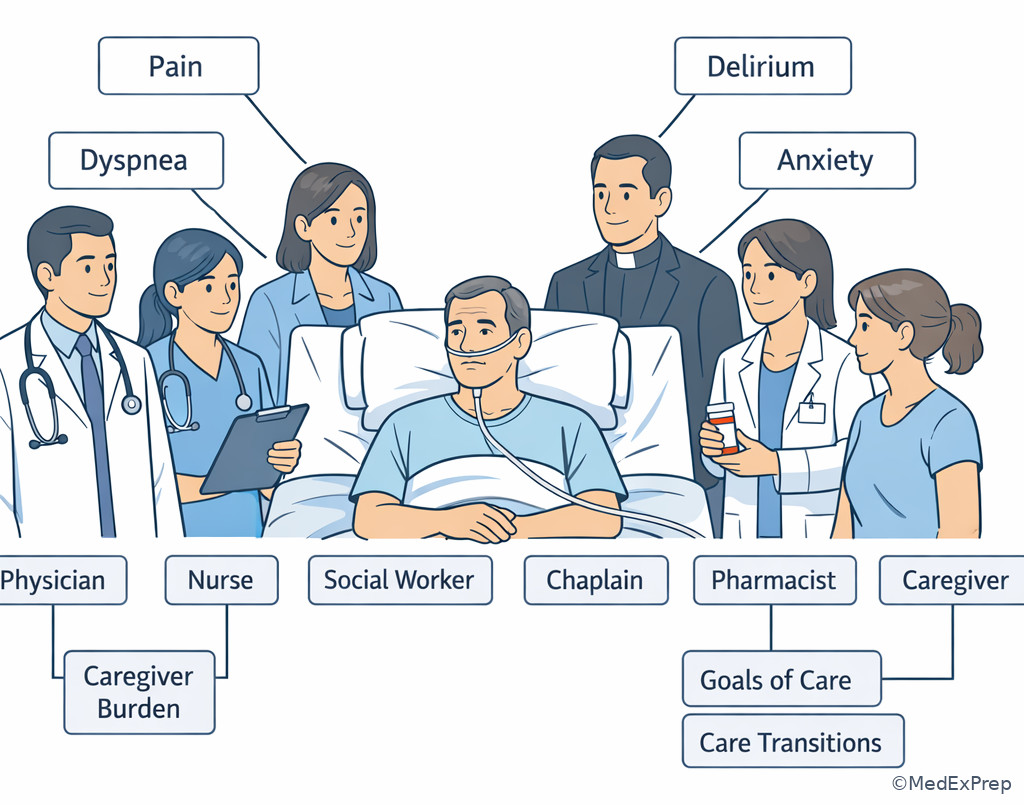
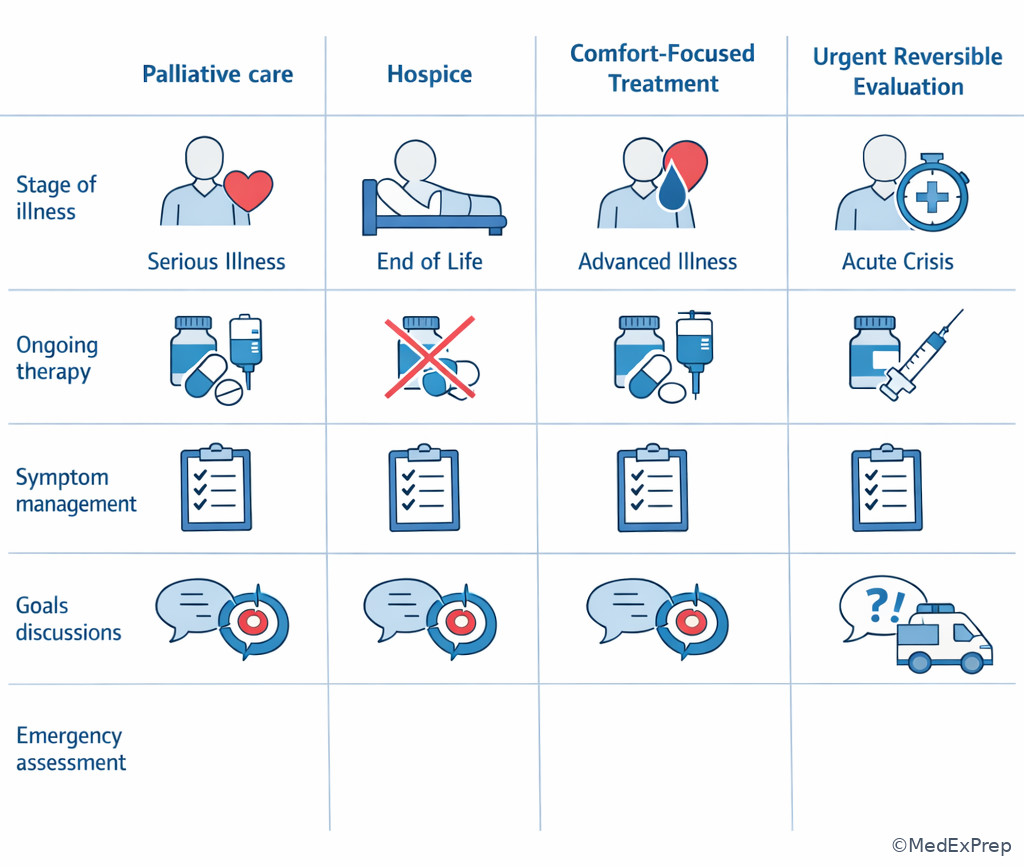
- Hospice is a subset of serious-illness care; palliative care is the broader umbrella. See Fig 1.
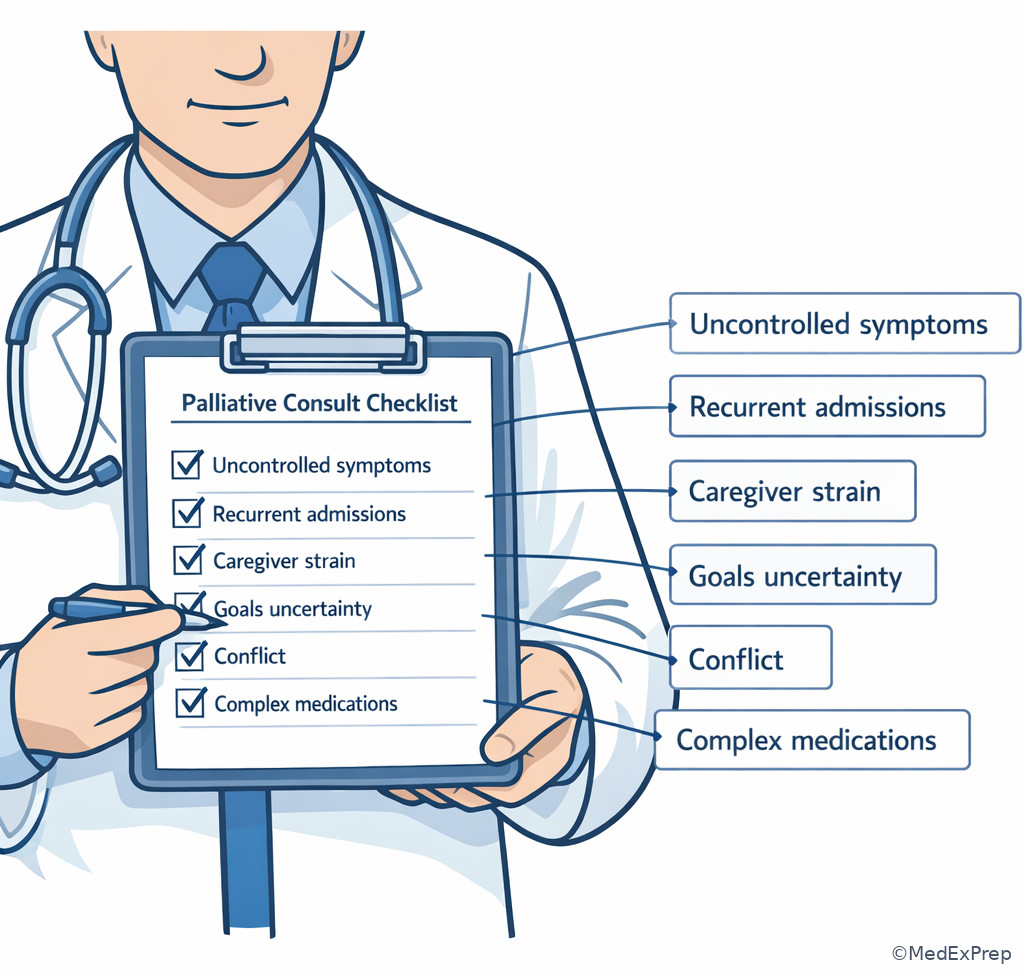
- High symptom burden, recurrent hospitalization, caregiver distress, or decisional conflict are common consult triggers.
- The correct board answer often includes both symptom treatment and communication, not one or the other.
- Palliative clinicians do not ignore reversible emergencies; they treat or escalate based on goals and proportionality.
- Pain is only one domain; dyspnea, delirium, nausea, depression, existential distress, and family stress are equally testable.
- The physician’s role includes diagnosis, recommendations, medication selection, monitoring, and coordination with the team.
Exam takeaway: Distinguish broad palliative care from hospice so you do not reject appropriate early consultation.
flowchart TD
A[Serious illness] --> B[Palliative care appropriate]
B --> C[Concurrent disease-directed treatment]
B --> D[Symptom management]
B --> E[Goals and decision support]
B --> F[Caregiver support]
B --> G[Hospice may become appropriate later]
C --> H[Not comfort-only by default]
Exam takeaway: Physician board questions test coordination and recommendation-making across multiple domains of suffering.
Core content
1.1.1.3 Foundational scope: when palliative care is the right frame
A Explanation
The decision conflict is usually early supportive care versus waiting until nothing disease-directed remains. The rule that resolves it is simple: if a patient has serious illness with burdensome symptoms, complex decisions, or caregiver strain, palliative care is appropriate now, not only at the end of life. On exams, the wrong answer often assumes palliative care equals withdrawal of treatment. Reject that. Choose palliative involvement when symptom relief, communication, advance care planning, or support needs are present, even if the patient is pursuing chemotherapy, transplant evaluation, surgery, or ICU-level treatment.
WHY THIS IS TESTED: The exam wants you to recognize the broad scope of palliative medicine and avoid the false binary of “either aggressive treatment or palliation.” The single finding that resolves the conflict is not prognosis alone; it is the presence of serious-illness burden and need for expert symptom/decision support.
Use choose-vs-reject logic: choose palliative care when there is uncontrolled symptom distress, decisional uncertainty, repeated admissions, poor functional trajectory, or mismatch between treatments and goals. Reject the idea that palliative care requires DNR status, hospice enrollment, metastatic cancer, or comfort-only goals. See Fig 1.
B Worked example
A 63-year-old man with metastatic non–small cell lung cancer, COPD, and insulin-treated diabetes is admitted for dyspnea and pleuritic chest discomfort. He remains on second-line immunotherapy and says, “I still want treatment if it can help.” He has severe anxiety, poor sleep, and his wife reports exhaustion from caregiving. Troponin is mildly elevated from chronic demand ischemia, and the intern worries that a palliative consult would send the message that “we are giving up.”
Reasoning chain: Identify task: determine the most appropriate next step in overall care framing. Extract key facts: metastatic cancer, active disease-directed therapy continues, high symptom burden, caregiver strain, emotional distress. Apply rule: palliative care is appropriate alongside ongoing treatment. Eliminate distractors: “wait until treatment options are exhausted” is wrong because prognosis alone is not the trigger; “hospice referral now” may be premature if goals still include further therapy and eligibility specifics are not established; “treat symptoms without consult” misses complex multidomain needs. Verify: a palliative consultation can manage dyspnea/anxiety, support caregiver burden, and help clarify goals without requiring treatment cessation.
C Exam trap
D Checkpoint
Question: A 58-year-old woman with metastatic breast cancer, heart failure with reduced ejection fraction, and recent hospitalization for nausea and pain asks whether she can see palliative care “even though I want more chemotherapy.” Which is the most appropriate response?
- A. Palliative care is appropriate only after chemotherapy is stopped.
- B. Palliative care is appropriate now because it can be provided alongside cancer treatment.
- C. Palliative care is unnecessary unless she has a documented DNR order.
- D. Palliative care should be deferred until hospice eligibility is confirmed.
Answer: B
- A: Tempting because many stems pair palliation with late disease, but wrong because concurrent palliative care is standard.
- B: Tempting because it addresses current symptom burden, and right because palliative care is based on need, not treatment cessation.
- C: Tempting because DNR discussions often occur with palliative teams, but wrong because code status is not an entry requirement.
- D: Tempting because hospice and palliative care overlap, but wrong because hospice is only one subset of serious-illness care.
1.1.1.4 What palliative care actually covers: symptoms, suffering, communication, and support
A Explanation
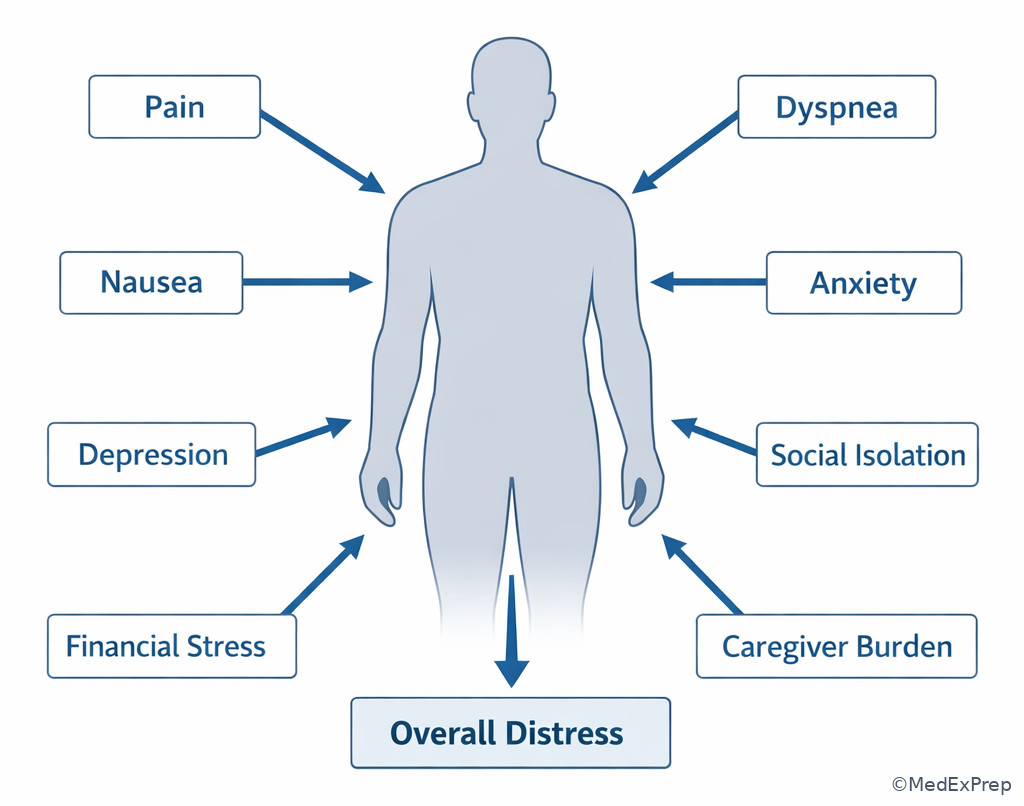
The decision conflict here is narrow symptom-only thinking versus whole-person assessment. The rule is that palliative care addresses physical symptoms and psychological, social, spiritual, caregiver, and decision-making burdens. If the stem gives pain plus anxiety, conflict, insomnia, caregiver fatigue, or existential distress, do not choose a purely pharmacologic answer unless the question is tightly limited to one symptom. The single finding that resolves the choice is the presence of multidomain suffering.
WHY THIS IS TESTED: Board questions reward recognition that serious suffering persists when nonphysical drivers are missed. A patient with “uncontrolled pain” may actually have fear, family conflict, financial stress, depression, or spiritual distress amplifying the symptom experience. This lesson sets up the upcoming Total Pain Framework; for now, know the scope before learning the deeper assessment model.
Choose comprehensive assessment when the presentation is messy. Reject the distractor that reduces palliative care to opioid prescribing. Conversely, reject the distractor that makes palliative care only counseling and ignores active medical management of symptoms. The best answer often combines medication adjustment, communication, caregiver assessment, and team involvement. See Fig 2.
Exam takeaway: When multiple domains drive distress, the best answer broadens assessment beyond a single symptom label.
flowchart LR
A[Patient distress] --> B[Physical symptoms]
A --> C[Psychological distress]
A --> D[Social strain]
A --> E[Spiritual or existential concerns]
A --> F[Caregiver burden]
B --> G[Medication and medical plan]
C --> H[Counseling and psychiatric support]
D --> I[Practical resources]
E --> J[Meaning-centered support]
F --> K[Family support plan]
Exam takeaway: Board stems often hide psychological, social, and spiritual drivers inside a “symptom” complaint.
B Worked example
A 71-year-old woman with pancreatic cancer, CKD stage 3, and generalized anxiety disorder reports “10/10 abdominal pain” despite stable opioid dosing. She has no peritoneal signs, no new obstruction symptoms, and her creatinine is unchanged. Her son recently lost his job and moved in; she says she is afraid she is “ruining everyone’s life.” A mildly elevated alkaline phosphatase distracts the team toward urgent imaging.
Reasoning chain: Identify task: determine the next palliative assessment step. Extract key facts: severe distress, no clear new emergent abdominal red flags, major guilt and family strain, anxiety history. Apply rule: whole-person assessment is needed because suffering may be amplified by psychological and social factors. Eliminate distractors: reflexive opioid escalation alone misses multidomain distress; immediate invasive workup is unsupported by the stem; telling the son to decide the plan bypasses the patient. Verify: address pain physiology, explore meaning and fear, assess caregiver stress, and involve team supports.
C Exam trap
D Checkpoint
Question: A 49-year-old man with amyotrophic lateral sclerosis, insomnia, dyspnea, and caregiver conflict is referred for palliative evaluation. Which physician task best reflects the scope of palliative care?
- A. Limit the visit to opioid decisions because psychosocial issues fall outside medical care.
- B. Address dyspnea, clarify goals, assess caregiver burden, and coordinate interdisciplinary support.
- C. Defer symptom management until neurology determines prognosis with certainty.
- D. Focus on advance directive completion and avoid active symptom treatment in the same visit.
Answer: B
- A: Tempting because medication management is concrete, but wrong because scope includes psychosocial and decision support.
- B: Tempting because several needs are present, and right because palliative care integrates symptom treatment with communication and team coordination.
- C: Tempting because prognosis matters, but wrong because uncertainty does not delay symptom-focused care.
- D: Tempting because planning documents are important, but wrong because active symptom relief should not be postponed.
- Palliative care can be provided alongside disease-directed treatment.
- True or False: A DNR order is required before palliative care is appropriate. False.
- Name the 3 nonphysical domains commonly folded into serious suffering: psychological, social, spiritual.
1.1.1.5 Primary versus specialty palliative care: what every physician should do and when to consult
A Explanation
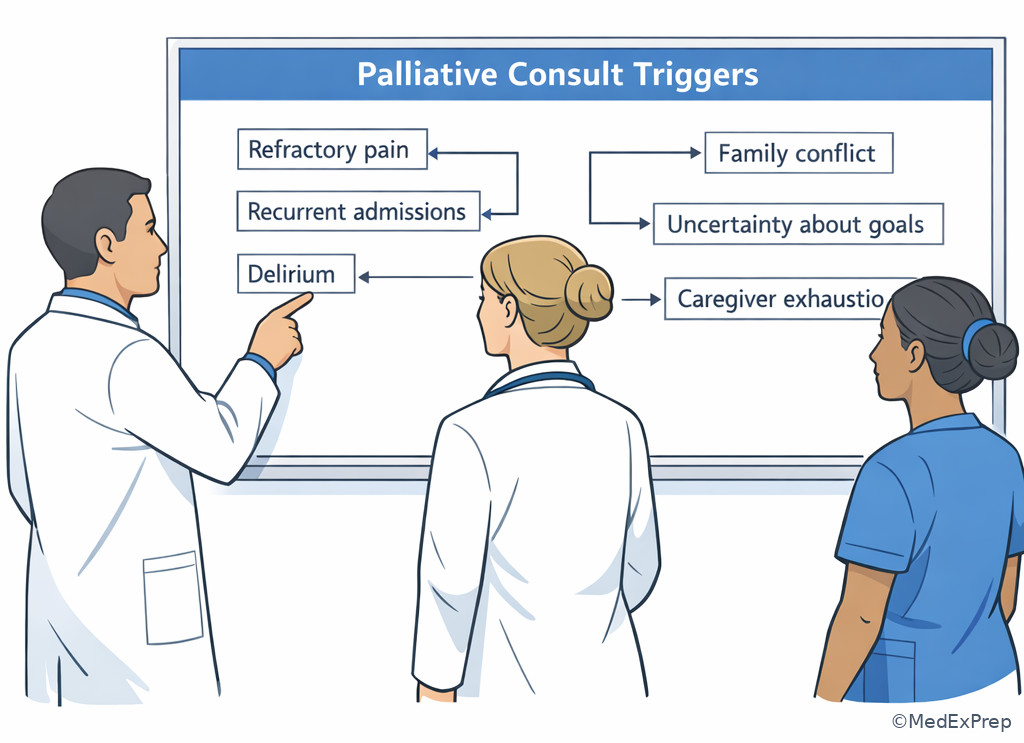
The decision conflict is manage independently versus request specialty support. The resolving rule is based on complexity, not on whether the primary team has already “failed.” Primary palliative care includes basic symptom control, straightforward goals-of-care discussion, code status clarification, and initial support for patients and families. Specialty palliative care is indicated when symptoms are refractory, opioid rotation is complex, delirium or existential distress is difficult, conflict is escalating, or there is uncertainty about best goal-concordant recommendations.
WHY THIS IS TESTED: The exam expects physicians to know both what they should initiate themselves and when the better answer is an early consult. The best next step is often not “consult palliative care” for every minor symptom, but it is also not “handle everything alone” when the case has multidimensional complexity. The single clue that pushes toward specialty care is complexity that changes safety, communication difficulty, or coordination needs.
Choose primary management first for mild predictable symptoms and simple decision questions. Choose specialty support for refractory symptoms, family conflict, repeated admissions, unclear tradeoffs, or mismatch between medical options and patient values. Reject the distractor that treats palliative consultation as a sign of abandonment or a last resort. See Fig 4.
Exam takeaway: Complexity, refractory symptoms, or conflict should push you toward specialty palliative consultation.
flowchart TD
A[Serious illness concern] --> B{Complexity level}
B -->|Low| C[Primary team manages basic symptoms and goals discussion]
B -->|High| D[Specialty palliative consult]
D --> E[Refractory symptoms]
D --> F[Family conflict]
D --> G[Complex opioid or delirium case]
D --> H[Uncertain goal-concordant recommendation] Exam takeaway: Visualizing complexity triggers helps distinguish routine primary palliative care from specialty consultation.
B Worked example
A 76-year-old man with end-stage COPD, chronic hypercapnia, coronary disease, and mild vascular dementia is hospitalized for recurrent dyspnea crises. He wants “whatever helps me breathe but not a prolonged ICU death.” His daughter and son disagree about intubation. He is taking escalating opioids from multiple prescribers, and he became agitated after benzodiazepines in the ED. A low-grade leukocytosis distracts the team toward a purely infectious framing.
Reasoning chain: Identify task: determine whether primary management is enough. Extract key facts: refractory dyspnea, medication complexity, conflict about life-sustaining treatment, cognitive vulnerability, values ambiguity. Apply rule: this is specialty-level palliative complexity. Eliminate distractors: “continue routine COPD treatment only” misses ongoing suffering and conflict; “wait for another hospitalization” delays needed support; “hospice only” is premature without first clarifying goals and scope. Verify: specialty palliative consultation for symptom strategy, family meeting, and recommendation-making is the best next step.
C Exam trap
D Checkpoint
Question: A 67-year-old woman with metastatic ovarian cancer, severe constipation, opioid neurotoxicity concerns, and disagreement among family members about further hospitalization is admitted from home. Which finding most strongly supports specialty palliative care consultation rather than primary palliative management alone?
- A. Presence of any cancer diagnosis
- B. Need for a single bowel regimen adjustment
- C. Refractory symptom burden plus conflict about goals and setting of care
- D. A request for printed educational materials about advance directives
Answer: C
- A: Tempting because cancer commonly triggers consults, but wrong because diagnosis alone does not define specialty need.
- B: Tempting because constipation is common in palliative care, but wrong because a single straightforward adjustment is usually primary-level care.
- C: Tempting because multiple serious issues coexist, and right because complexity and conflict are classic specialty triggers.
- D: Tempting because planning questions may involve palliative teams, but wrong because education alone does not imply specialty complexity.
1.1.1.6 Palliative care across settings and disease trajectories
A Explanation
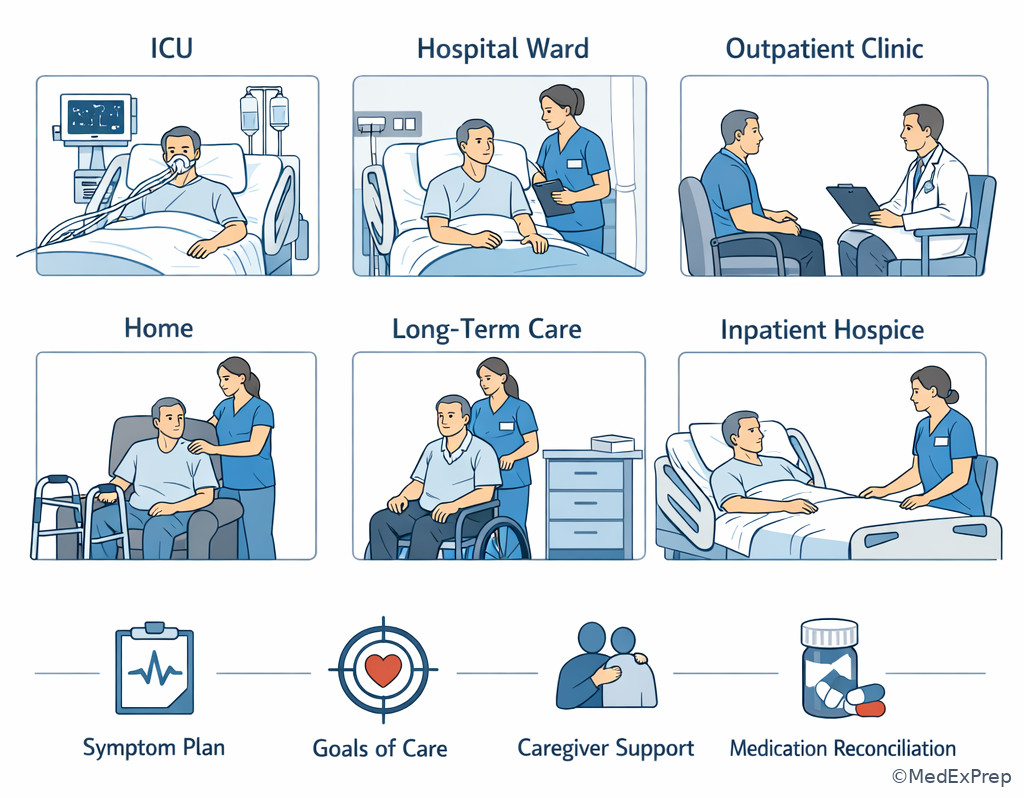
The decision conflict is restrict palliative care to oncology or hospice settings versus apply it across illnesses and care environments. The resolving rule is that palliative care follows patient need across settings: hospital, ICU, outpatient clinic, home, long-term care, inpatient hospice, and specialty clinics. It also applies across diagnoses: cancer, heart failure, COPD, dementia, stroke, renal disease, liver disease, neurodegeneration, and pediatric serious illness.
WHY THIS IS TESTED: Exam stems frequently include noncancer disease or acute-care settings to see whether you wrongly limit palliative care to terminal oncology. The single clue that resolves the question is the burden and complexity of illness, not the location or diagnosis. A patient in the ICU can need palliative communication support; a patient in clinic can need symptom management; a nursing home resident with dementia can need goals clarification.
Choose palliative care when symptom, communication, or support needs arise in any setting. Reject the answer that says “this is an ICU issue, not palliative,” or “this patient does not have cancer.” Also reject the idea that palliative care is relevant only when prognosis is measured in days. See Fig 5.
Exam takeaway: Do not let diagnosis or location distract you from palliative needs that are present now.
flowchart LR
A[Needs-based trigger] --> B[Hospital]
A --> C[ICU]
A --> D[Outpatient clinic]
A --> E[Home]
A --> F[Long-term care]
A --> G[Inpatient hospice]
A --> H[Cancer]
A --> I[Heart failure]
A --> J[COPD]
A --> K[Dementia]
A --> L[Neurologic disease]
Exam takeaway: Palliative plans should travel with the patient across hospital, clinic, home, and long-term care settings.
B Worked example
An 82-year-old woman with advanced heart failure, CKD stage 4, and osteoarthritis lives in a nursing facility and is admitted for volume overload. She has had three hospitalizations in four months. She says she is tired of “bouncing back and forth” but still wants treatment that could keep her comfortable at the facility. Her nephew says palliative care is “for cancer patients,” and a chest x-ray showing mild pleural effusions distracts the team toward a purely cardiology frame.
Reasoning chain: Identify task: determine if palliative care applies in this noncancer, long-term-care-to-hospital transition case. Extract key facts: advanced chronic disease, repeated admissions, burden from transitions, values focused on comfort and reduced disruption, ongoing treatment interest. Apply rule: palliative care is diagnosis- and setting-independent. Eliminate distractors: “not appropriate because noncancer” is wrong; “hospice now” may or may not be right but is not the foundational scope question; “continue usual disease management only” misses repeated-burden triggers. Verify: palliative involvement for symptom, goal, and transition planning is appropriate.
C Exam trap
D Checkpoint
Question: Which patient is the best example of an appropriate palliative care referral based on scope rather than diagnosis?
- A. A 45-year-old with stage I colon cancer after uncomplicated surgery and no symptoms
- B. A 72-year-old with severe heart failure, recurrent admissions, dyspnea, and uncertainty about future hospital-based care
- C. A 29-year-old with isolated ankle sprain and normal function
- D. A 60-year-old with stable hypertension requesting a routine medication refill
Answer: B
- A: Tempting because cancer raises palliative associations, but wrong because the stem lacks serious-illness burden or complex needs.
- B: Tempting because noncancer illness may be underrecognized, and right because recurrent symptom and decision burden fit palliative scope.
- C: Tempting because pain is present, but wrong because there is no serious-illness context.
- D: Tempting because medication review is a physician task, but wrong because this is routine primary care rather than serious-illness support.
- The most common false limiter of palliative care is confusion with hospice only.
- True or False: ICU patients can receive palliative care while still getting life-prolonging treatment. True.
- Name 3 noncancer illnesses commonly tested with palliative needs: heart failure, COPD, dementia.
1.1.1.7 Integration: goal-concordant care, proportionality, and urgent reversible conditions
A Explanation
The final decision conflict is comfort focus versus abandonment of medical judgment. The rule is that palliative care relieves suffering while still identifying and addressing urgent reversible causes when consistent with patient goals. The exam often forces you to choose between over-treatment and under-treatment. The single clue that resolves the question is whether the intervention would plausibly relieve suffering or preserve a valued outcome without imposing disproportionate burden.
WHY THIS IS TESTED: Candidates may err in two directions: either pushing burdensome interventions with no goal-concordant benefit, or prematurely refusing evaluation/treatment because the patient has serious illness. Palliative medicine requires proportionate decisions. If a reversible cause is causing distress and treatment is aligned with goals, address it. If a treatment adds burden without meaningful benefit for that patient’s goals, reject it. This same reasoning underlies later topics in ethics, hospice, and active dying management.
Choose symptom relief with clear intent and monitoring. Reject answers whose primary intent is to hasten death. Also reject answers that ignore emergent symptoms such as spinal cord compression, severe hypercalcemia, airway compromise, sepsis, or catastrophic bleeding when evaluation would change a goal-concordant plan. See Fig 6.
Exam takeaway: Treat reversible suffering when aligned with goals, but reject interventions whose burden exceeds expected patient-valued benefit.
flowchart TD
A[New serious symptom] --> B{Potentially reversible cause?}
B -->|Yes| C{Would treatment relieve suffering or preserve valued outcome?}
C -->|Yes| D[Treat or escalate]
C -->|No| E[Focus on comfort measures]
B -->|No| E
D --> F[Reassess burden and goal alignment]
E --> F Exam takeaway: Serious illness does not remove the need to identify reversible emergencies when treatment could still be goal-concordant.
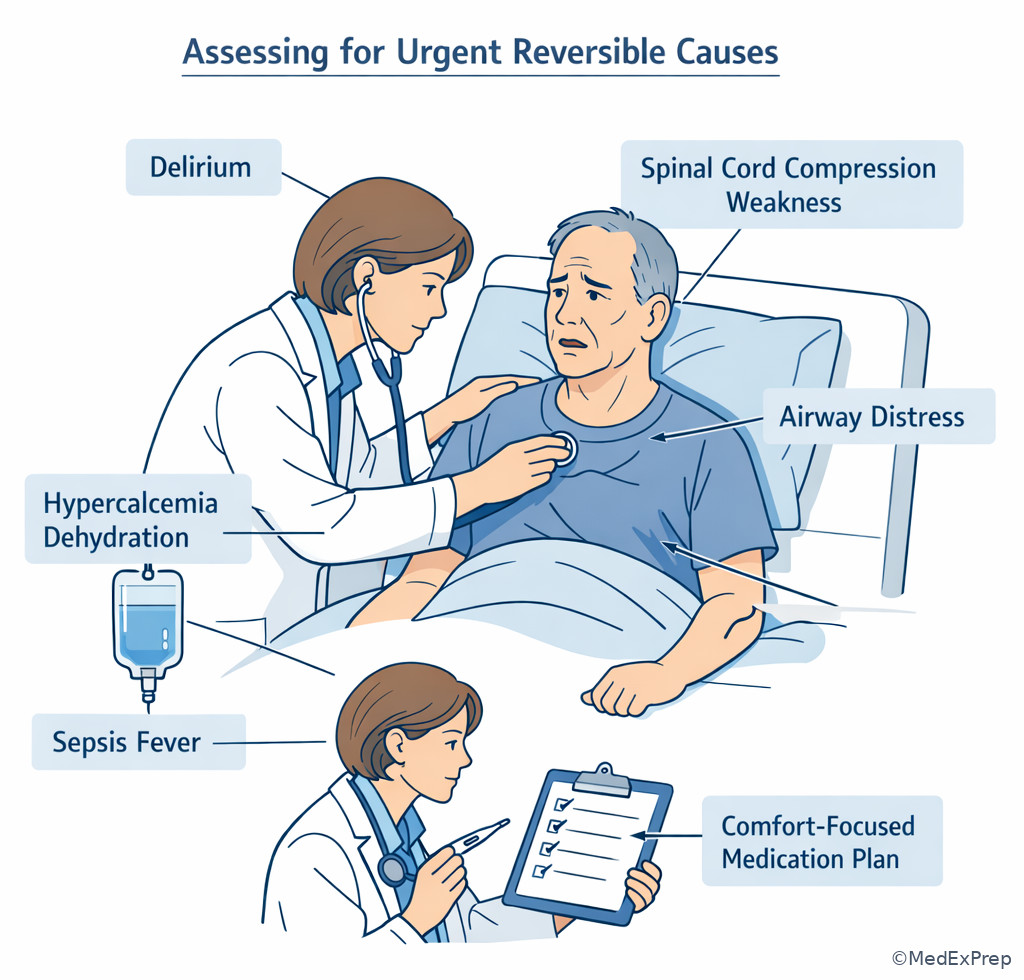
B Worked example
A 68-year-old man with metastatic prostate cancer, chronic kidney disease, and chronic back pain on opioids is admitted from home hospice-level support but not yet formally enrolled. He now has rapidly progressive bilateral leg weakness and urinary retention. His wife says, “He only wants comfort,” and a bedside note mentions he has been more sleepy after recent opioid increases. Mild anemia is a distracting chronic finding.
Reasoning chain: Identify task: most appropriate next step. Extract key facts: acute neurologic decline and urinary retention suggest spinal cord compression, a potentially reversible emergency that could worsen suffering and function. Apply rule: even in serious illness, urgent reversible causes should be assessed if doing so could preserve a patient-valued outcome and align with goals. Eliminate distractors: simply increasing opioids misses a time-sensitive emergency; saying “comfort only means no evaluation” is wrong because many patients value preserved function and relief from compression-related suffering; routine outpatient follow-up is unsafe. Verify: urgent evaluation and treatment discussion are appropriate while clarifying current goals.
C Exam trap
D Checkpoint
Question: A 74-year-old woman with metastatic colon cancer, chronic nausea, and home oxygen for COPD presents with new confusion and profound thirst. She wants to remain lucid enough to talk with family if possible. Which is the most appropriate palliative approach?
- A. Assume active dying and avoid evaluation because serious illness is present
- B. Treat distress and assess for reversible causes such as medication toxicity or hypercalcemia if results would change care
- C. Increase sedatives first because lucidity is less important than symptom control in all advanced cancer
- D. Delay symptom treatment until a complete diagnostic workup is finished
Answer: B
- A: Tempting because advanced cancer can progress rapidly, but wrong because new reversible causes can still matter for comfort and lucidity.
- B: Tempting because it balances relief and evaluation, and right because it aligns treatment with the patient’s stated priority.
- C: Tempting because sedatives may reduce distress, but wrong because the patient explicitly values lucidity and a reversible cause may be treatable.
- D: Tempting because diagnosis matters, but wrong because palliative care treats suffering in parallel rather than withholding relief.
Exam Traps & Differentiators
- Most common wrong answer and why: “Palliative care is appropriate only when curative treatment stops.” Tempting because hospice and palliative care are often conflated; eliminated by any clue that active treatment continues alongside unmet symptom or decision needs.
- Looks similar but isn't: Hospice is a specific model within limited-prognosis care; palliative care is broader and needs-based. Related confusion will deepen in the upcoming Hospice Care Concepts lesson.
- Another trap: “If the patient wants comfort, skip evaluation.” Eliminated by a clue for a reversible emergency that could relieve suffering or preserve a valued outcome.
- Another trap: “Pain complaint means opioid escalation.” Eliminated by clues for anxiety, family conflict, existential distress, or delirium risk.
- Another trap: “Consult palliative care for every issue.” Eliminated when the stem shows a straightforward problem within primary palliative skills.
| Stem says... | Think... |
|---|---|
| “Still wants chemotherapy, but symptoms are uncontrolled” | Concurrent palliative care is appropriate now |
| “Family exhausted, repeated admissions, hard decisions ahead” | Palliative scope includes caregiver and decision support |
| “New weakness, urinary retention, or abrupt delirium” | Look for urgent reversible causes before assuming expected decline |
| “No cancer diagnosis” | Palliative care still applies in heart failure, COPD, dementia, neurologic disease, and more |
| “Basic constipation or initial code-status question” | Primary palliative care may be enough |
| “Refractory symptoms plus conflict” | Specialty palliative consultation is favored |
| Confusable pair | Shared feature | Single differentiator | Board-safe choice |
|---|---|---|---|
| Palliative care vs hospice | Comfort-focused support | Palliative can occur at any stage and with ongoing treatment | Choose palliative if need is present now and hospice specifics are not the key issue |
| Comfort-focused care vs no evaluation | Attention to suffering | Comfort plans still allow evaluation of reversible distress when it would help | Choose targeted assessment aligned with goals |
| Opioid titration vs whole-person assessment | Symptom relief | Nonphysical contributors amplify distress | Choose multidomain assessment when the stem contains psychosocial clues |
| Primary palliative vs specialty consultation | Both provide symptom and communication support | Complexity, refractoriness, or conflict drives specialty input | Consult early when complexity is high |
Exam takeaway: Many wrong answers arise from collapsing different serious-illness care concepts into one undifferentiated “comfort care” label.
Tables
| Key fact / reference point | High-yield takeaway |
|---|---|
| Palliative care timing | Any stage of serious illness when burden or complexity exists |
| Disease-directed therapy | May continue concurrently with palliative care |
| Core domains | Physical, psychological, social, spiritual, caregiver, decision support |
| Primary palliative care | Basic symptom control and straightforward communication by frontline clinicians |
| Specialty consult trigger | Refractory symptoms, conflict, complexity, or unsafe uncertainty |
| Care settings | Hospital, ICU, clinic, home, long-term care, hospice |
| Urgent reversible conditions | Still matter if treatment could relieve suffering and aligns with goals |
| Ethical focus | Intention is symptom relief, not hastening death |
| Comparison | Palliative care | Hospice | Usual disease-focused care alone |
|---|---|---|---|
| Primary aim | Relief of suffering and support for goals | Comfort-focused care near end of life | Disease control and prolongation |
| Timing | Any stage of serious illness | Limited prognosis framework | Any stage |
| Can coexist with active treatment? | Yes | Practice patterns vary; conceptually hospice is a narrower comfort-focused model | Yes |
| Communication role | Central | Central | Variable |
| Caregiver support | Included | Included | Often less structured |
| Board pearl | Choose when need is present now | Think subset, not synonym | Insufficient if suffering or conflict remains unaddressed |
| Clinical situation | Likely category | Why |
|---|---|---|
| Metastatic cancer on chemotherapy with pain and caregiver exhaustion | Concurrent palliative care | Need-based support during ongoing treatment |
| Advanced heart failure with recurrent admissions and dyspnea | Palliative care appropriate | Noncancer serious illness with high burden |
| Mild constipation after a new opioid, otherwise stable | Primary palliative skill | Straightforward symptom issue |
| Refractory delirium, opioid toxicity concern, family conflict | Specialty palliative consultation | Complex multidomain problem |
| New spinal cord compression symptoms in advanced cancer | Urgent targeted evaluation within palliative framework | Potentially reversible suffering and function loss |
| No serious illness, routine refill visit | Not a palliative scope question | No serious-illness burden or complexity |
Algorithm / Approach
Exam takeaway: A consistent needs-based checklist prevents hospice-only and diagnosis-limited errors.
Rapid Review
- Palliative care → needs-based, not prognosis-only
- Hospice → narrower subset, not synonym for all palliation
- Concurrent treatment → active chemotherapy does not exclude palliative care
- Primary palliative care → frontline physician handles straightforward symptoms and basic goals discussions
- Specialty consultation → refractory symptoms, conflict, or complexity
- Total suffering clues → guilt, fear, family strain, insomnia, meaning distress
- Noncancer disease → heart failure, COPD, dementia, ALS all qualify when burden is high
- ICU setting → palliative input can coexist with life-prolonging treatment
- Comfort-focused plan → still evaluate reversible distress if it could help and fits goals
- Urgent weakness plus retention → think spinal cord compression, not just “progression”
- New confusion plus thirst → consider reversible contributors before assuming active dying
- Wrong answer pattern → reducing palliative medicine to opioids alone
- Caregiver exhaustion → legitimate palliative trigger, not background noise
- Best board answer → symptom relief plus communication plus coordination
Self-check quiz
1. A 62-year-old woman with metastatic lung cancer, diabetes, and chronic anxiety is receiving immunotherapy and asks whether palliative care means she must stop treatment. Which is the most appropriate answer?
- A. Yes; palliative care is used only after disease-directed therapy ends
- B. No; palliative care can be added alongside active treatment to help with symptoms and decision making
- C. No; palliative care is only for pain, not for communication or family support
- D. Yes; palliative care requires hospice enrollment first
2. A 70-year-old man with severe heart failure, CKD, and recent dyspnea admissions asks whether palliative care is “only for cancer.” Which diagnosis best supports palliative involvement based on scope?
- A. Advanced heart failure with recurrent hospitalizations
- B. Stable seasonal allergies
- C. Uncomplicated tension headache
- D. Controlled hyperlipidemia
3. A 68-year-old woman with ovarian cancer, depression, and chronic constipation has persistent pain, family conflict, and repeated admissions while still receiving treatment. A mildly elevated bilirubin is unchanged from baseline. What is the most appropriate next step?
- A. Defer palliative consultation until treatment stops
- B. Request specialty palliative care consultation for complex symptom and goals support
- C. Increase opioids only and avoid broader assessment
- D. Refer directly to hospice because any palliative need requires hospice enrollment
4. A 74-year-old man with COPD, coronary disease, and mild cognitive impairment is hospitalized with dyspnea. He wants relief of breathlessness and hopes to avoid prolonged ventilation if possible. His daughter and son disagree about next steps. Which physician action best fits palliative scope?
- A. Limit care to bronchodilators and defer values discussion until discharge
- B. Treat dyspnea, clarify values and tradeoffs, and coordinate a family meeting
- C. Avoid palliative involvement because he does not have cancer
- D. Focus only on code status and postpone symptom management
5. A 59-year-old woman with metastatic breast cancer, insomnia, and severe anxiety reports 10/10 pain, saying she is terrified of leaving her spouse overwhelmed. Examination shows no new focal deficits, peritoneal signs, or fever. Which is the most appropriate initial palliative approach?
- A. Escalate opioids immediately without further assessment because pain score alone determines treatment
- B. Assess physical pain plus psychological and caregiver contributors before changing the full plan
- C. Avoid symptom treatment until psychiatry evaluates her
- D. Explain that family distress is outside the physician’s scope
6. A 72-year-old man with metastatic prostate cancer, chronic opioid use, and CKD has new bilateral leg weakness and urinary retention. His wife says he wanted comfort-focused care and fewer hospital trips. Which is the most appropriate next step?
- A. Increase opioids and avoid further evaluation because comfort is the stated goal
- B. Urgently assess for spinal cord compression while treating distress and clarifying current goals
- C. Defer any action until his outpatient oncologist can be reached next week
- D. Start continuous sedation because new weakness indicates active dying
7. A 66-year-old woman with advanced heart failure, frailty, diabetes, and three admissions in 2 months is on maximal tolerated therapy. She has dyspnea, caregiver strain, and uncertainty about future hospitalizations, but says she still wants treatments that might help her feel better and stay home. Which plan is most appropriate?
- A. Continue cardiology management alone because palliative care would conflict with ongoing treatment
- B. Introduce palliative care for symptom management and goals support while continuing disease-directed therapy
- C. Recommend immediate comfort-only orders because recurrent admissions prove treatment is futile
- D. Wait for a precise 6-month prognosis before discussing palliative involvement
8. A 79-year-old nursing home resident with advanced dementia, aspiration risk, chronic pain, and recurrent infections is transferred for agitation and decreased intake. Her daughter says, “I do not want her to suffer, but I also do not want us to miss something reversible.” Which physician approach best reflects palliative care scope?
- A. Choose either comfort or medical evaluation, because both cannot occur together
- B. Provide symptom relief and perform targeted evaluation only for reversible causes likely to change a goal-concordant plan
- C. Avoid discussing goals because advanced dementia removes the need for shared decision making with surrogates
- D. Transfer all decision making to the facility social worker because the family is distressed
Answer key
1. Correct answer: B
- A: Tempting because many clinicians first encounter palliative care late in illness. Incorrect for this scenario because palliative care is concurrent and needs-based, not dependent on stopping immunotherapy. Single stem clue: she is asking about palliative care while still on active treatment. Source: National Consensus Project Clinical Practice Guidelines; UpToDate topic reviews on adult palliative care.
- B: Tempting because it addresses her exact concern. Correct because palliative care can be added alongside disease-directed therapy to treat symptoms and support decision making. Single stem clue: active immunotherapy does not exclude palliative involvement. Source: National Consensus Project; Harrison's Principles of Internal Medicine.
- C: Tempting because pain management is a visible part of palliative care. Incorrect because communication and family support are core parts of scope. Single stem clue: the question asks about overall palliative meaning, not pain-only care. Source: National Consensus Project.
- D: Tempting because hospice and palliative care are often conflated. Incorrect because hospice is a narrower model and is not required for palliative services. Single stem clue: no hospice-specific issue is being tested. Source: CMS hospice overview concepts; National Consensus Project.
2. Correct answer: A
- A: Tempting because heart failure is often underrecognized in palliative medicine. Correct because advanced heart failure with recurrent admissions creates high symptom and decision burden that fits palliative scope. Single stem clue: severe heart failure plus repeated dyspnea admissions. Source: Harrison's; AHA statements on palliative care in cardiovascular disease.
- B: Tempting because symptoms exist, but incorrect because seasonal allergies do not represent serious-illness burden. Single stem clue: no major functional or prognostic complexity. Source: General palliative scope guidelines.
- C: Tempting because pain may seem palliative, but incorrect because uncomplicated tension headache is not a serious-illness context. Single stem clue: isolated minor symptom without serious disease. Source: National Consensus Project.
- D: Tempting because chronic disease is present, but incorrect because controlled hyperlipidemia lacks symptom and goals burden. Single stem clue: stable preventive care problem. Source: Harrison's.
3. Correct answer: B
- A: Tempting because ongoing treatment can distract from concurrent palliative needs. Incorrect because complex symptoms and conflict support early consultation now. Single stem clue: repeated admissions plus family conflict during active treatment. Source: National Consensus Project; UpToDate.
- B: Tempting because multiple burdens are named. Correct because refractory symptoms and decision complexity favor specialty palliative consultation. Single stem clue: persistent pain, family conflict, repeated admissions. Source: National Consensus Project Clinical Practice Guidelines.
- C: Tempting because pain is central and opioid escalation is common. Incorrect because a medication-only response misses multidomain assessment and conflict. Single stem clue: family conflict and repeated admissions broaden the problem. Source: Harrison's; palliative care guidelines.
- D: Tempting because hospice is associated with symptom support. Incorrect because palliative needs do not automatically mean hospice is the right immediate step. Single stem clue: she is still receiving treatment and the question is about complex support, not hospice eligibility. Source: CMS conceptual hospice materials; National Consensus Project.
4. Correct answer: B
- A: Tempting because bronchodilator treatment fits COPD physiology. Incorrect because the stem also asks about tradeoffs and family disagreement, which require communication support now. Single stem clue: he wants to avoid prolonged ventilation if possible. Source: AHA/ATS serious-illness communication principles; National Consensus Project.
- B: Tempting because it addresses both dyspnea and decisions. Correct because palliative scope integrates symptom management with values clarification and family meeting coordination. Single stem clue: dyspnea plus conflict plus stated care preference. Source: National Consensus Project; UpToDate serious illness communication resources.
- C: Tempting because COPD may be seen as a pulmonary issue only. Incorrect because palliative care is diagnosis-independent. Single stem clue: severe dyspnea burden and decisional complexity. Source: National Consensus Project.
- D: Tempting because code status is important. Incorrect because symptom relief should not be postponed while discussing future treatments. Single stem clue: present dyspnea requires active treatment now. Source: Harrison's; palliative dyspnea guidance.
5. Correct answer: B
- A: Tempting because a 10/10 score seems to demand immediate escalation. Incorrect because the stem embeds severe anxiety and caregiver fear without new red flags, so multidomain assessment should guide the plan. Single stem clue: terror about overwhelming her spouse. Source: National Consensus Project; palliative symptom assessment guidance.
- B: Tempting because it does not ignore pain. Correct because palliative care should assess physical pain together with psychological and caregiver contributors before deciding the full intervention strategy. Single stem clue: no new focal exam or infectious signs, but major emotional distress. Source: National Consensus Project; UpToDate total pain concepts.
- C: Tempting because anxiety is prominent. Incorrect because symptom treatment should proceed in parallel and not wait for another service. Single stem clue: active pain remains present now. Source: Harrison's; palliative care practice standards.
- D: Tempting because caregiver issues often involve other team members. Incorrect because physicians still assess and incorporate caregiver burden into the medical plan. Single stem clue: family strain is clearly part of the clinical picture. Source: National Consensus Project.
6. Correct answer: B
- A: Tempting because he prefers comfort and already uses opioids. Incorrect because new bilateral weakness with urinary retention suggests spinal cord compression, a potentially reversible emergency that may affect suffering and function. Single stem clue: acute neurologic deficit with retention. Source: Harrison's oncologic emergencies; UpToDate malignant spinal cord compression.
- B: Tempting because it balances urgency and palliation. Correct because palliative care includes urgent targeted evaluation when it could relieve suffering or preserve a valued outcome and remains aligned with goals. Single stem clue: potentially reversible emergency signs. Source: Harrison's; National Consensus Project.
- C: Tempting because outpatient clinicians know the longitudinal context. Incorrect because delay risks permanent neurologic loss and prolonged suffering. Single stem clue: this is time-sensitive, not a routine follow-up issue. Source: Harrison's.
- D: Tempting because sedation is used in refractory suffering near end of life. Incorrect because new weakness here more likely indicates a reversible emergency, not an indication for immediate continuous sedation. Single stem clue: focal neurologic pattern rather than refractory terminal agitation. Source: palliative sedation guidelines; Harrison's oncologic emergencies.
7. Correct answer: B
- A: Tempting because cardiology remains central to heart failure treatment. Incorrect because palliative care complements rather than conflicts with disease-directed therapy. Single stem clue: she still wants treatments that might help and has high burden now. Source: AHA palliative care statements; National Consensus Project.
- B: Tempting because it fits her goals of symptom relief and staying home. Correct because concurrent palliative care addresses dyspnea, caregiver strain, and future planning while cardiology care continues. Single stem clue: she wants both symptom relief and ongoing helpful treatment. Source: AHA; National Consensus Project.
- C: Tempting because repeated admissions may suggest limited prognosis. Incorrect because futility is overstated and her preferences still include selected active therapies. Single stem clue: she has not chosen comfort-only care. Source: ethics and serious-illness communication guidance.
- D: Tempting because prognosis affects planning. Incorrect because uncertainty does not delay palliative involvement. Single stem clue: burden and uncertainty are already present. Source: National Consensus Project; UpToDate on referral timing.
8. Correct answer: B
- A: Tempting because exams often present comfort and evaluation as opposites. Incorrect because palliative care commonly combines symptom relief with targeted evaluation when results could change a goal-concordant plan. Single stem clue: the daughter wants both comfort and not missing something reversible. Source: National Consensus Project; Harrison's geriatric serious illness care.
- B: Tempting because it sounds nuanced. Correct because targeted evaluation should be limited to reversible issues likely to alter care and improve comfort or a valued outcome while symptoms are treated in parallel. Single stem clue: decreased intake and agitation may have reversible causes, but goals remain comfort-centered. Source: National Consensus Project; UpToDate delirium and dementia palliation topics.
- C: Tempting because the patient lacks decision-making capacity. Incorrect because surrogate-based shared decision making remains essential. Single stem clue: the daughter is actively articulating goals and tradeoffs. Source: ethics guidance; National Consensus Project.
- D: Tempting because family distress invites team help. Incorrect because physician-level clinical judgment and recommendations cannot be delegated away. Single stem clue: the question asks for physician approach to evaluation and treatment. Source: ABIM HPM scope expectations; National Consensus Project.
Keep going with the full ABIM Hospice & Palliative Prep Course (Hospice)
You just studied the way members do, in the same lesson interface. Full access unlocks every lesson, the question bank and flashcards for a full year.
One payment · 1 year of access · No auto-renewal