Description
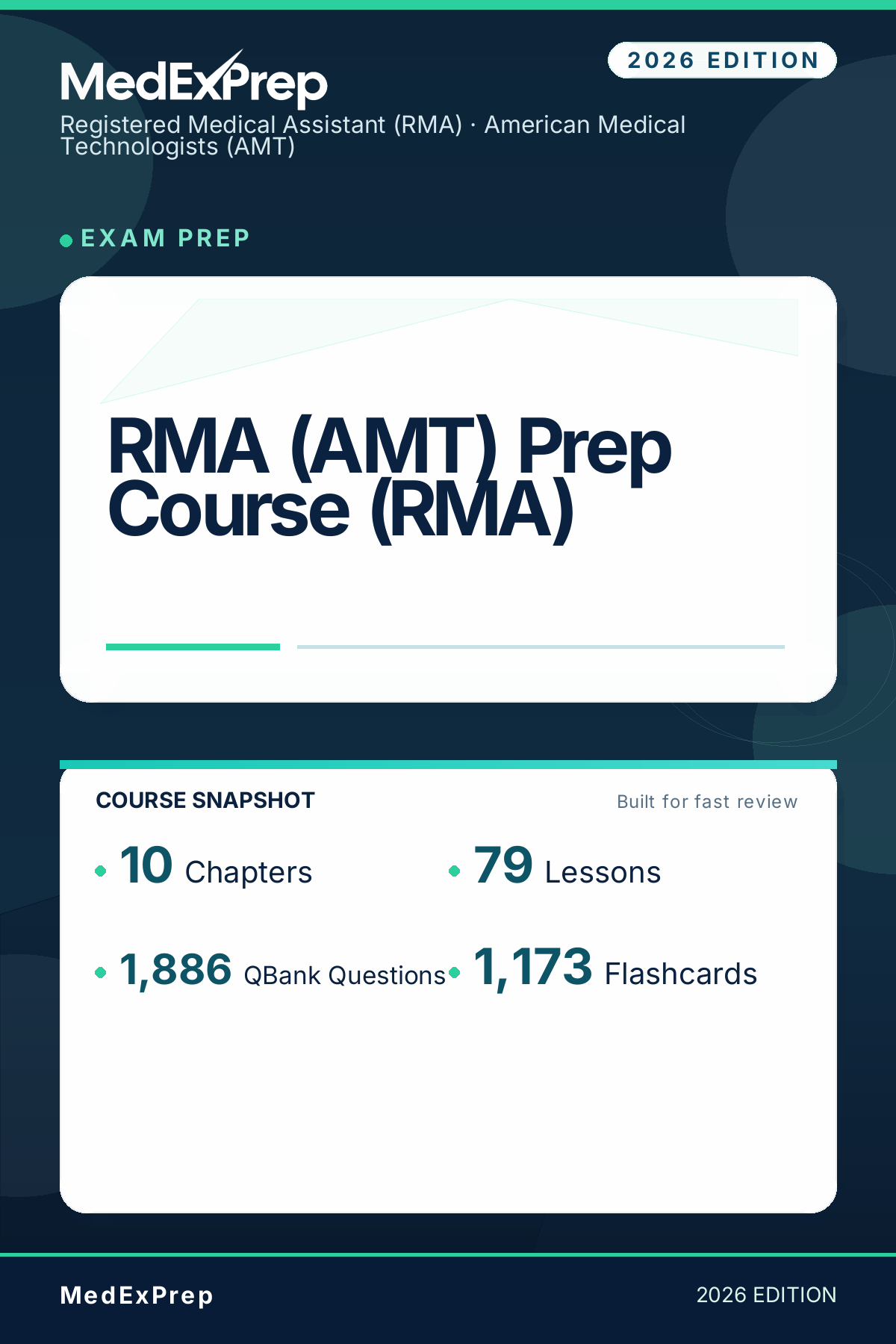
RMA (AMT) Prep Course (RMA)
Learners preparing for the AMT Registered Medical Assistant (RMA) certification exam, including medical assisting students, recent graduates, and working medical assistants seeking certification or recertification-focused review. Key goals: By the end of this course, learners will be able to:; Explain the AMT RMA exam focus areas/competency domains and how each lesson maps to likely tested responsibilities for entry-level medical assistants in outpatient and ambulatory settings..
Exam: Registered Medical Assistant (RMA) · Organization: American Medical Technologists (AMT)
Includes: Lessons + Flashcards + QBank
Audience: Learners preparing for the AMT Registered Medical Assistant (RMA) certification exam, including medical assisting students, recent graduates, and working medical assistants seeking certification or recertification-focused review.
Goals:
- By the end of this course, learners will be able to:
- Explain the AMT RMA exam focus areas/competency domains and how each lesson maps to likely tested responsibilities for entry-level medical assistants in outpatient and ambulatory settings.
- Master the high-yield concepts, definitions, procedures, safety rules, and documentation standards relevant to administrative and clinical medical assisting tasks.
- Apply concepts in realistic, exam-style scenarios involving patient intake, documentation, vital signs, infection control, specimen collection, diagnostic testing assistance, medication safety, scheduling, billing/coding fundamentals, and legal/ethical conduct.
- Solve common calculation and logic tasks accurately when applicable, including medication-related math within MA scope, scheduling/administrative reasoning, lab-related reasoning, and sequence-based procedural questions; show steps and avoid shortcuts that hide reasoning.
- Distinguish common distractors, misconceptions, unsafe actions, and out-of-scope choices by using a consistent framework: identify the task → extract key facts → confirm MA scope and safety → select the governing rule/procedure → execute → verify/document/escalate when indicated.
- Build retrieval-ready memory using concise tables, checklists, workflow summaries, and spaced review that reinforce the most testable facts and distinctions.
- Demonstrate readiness through self-check questions and mini-assessments mapped to each topic area, with special attention to safe delegation, escalation, confidentiality, documentation accuracy, and outpatient office workflow.
- Coverage & Blueprint Mapping Requirements:
- Every chapter/section/subsection/topic must map to at least one exam domain, competency area, or clearly labeled subskill, even if the official blueprint language is broad or not fully provided.
- Use consistent tags to translate broad exam areas into teachable subskills, such as: Administrative Assisting → Scheduling/Records/Insurance/Billing Basics; Clinical Assisting → Vital Signs/Asepsis/Patient Prep; Laboratory & Diagnostic Procedures → Specimen Handling/Waived Testing/ECG Support; Pharmacology & Medication Safety → Orders/Routes/Allergy Checks/Documentation; Law, Ethics & Professionalism → Consent/Confidentiality/Scope/Communication.
- Ensure complete coverage across the course: no major exam area should be left unmapped. If a detail is uncertain or varies by employer, state law, payer, or office protocol, provide learner-safe guidance such as “follow employer policy and applicable law” or “local protocols vary; confirm with your institution,” rather than guessing.
- Keep all teaching and questions within the role of an entry-level medical assistant working under provider supervision. Emphasize when the correct action is to clarify, report, document, or escalate rather than independently diagnose, prescribe, interpret for medical decision-making, or perform tasks outside MA scope.
Access is granted immediately after purchase.