Description
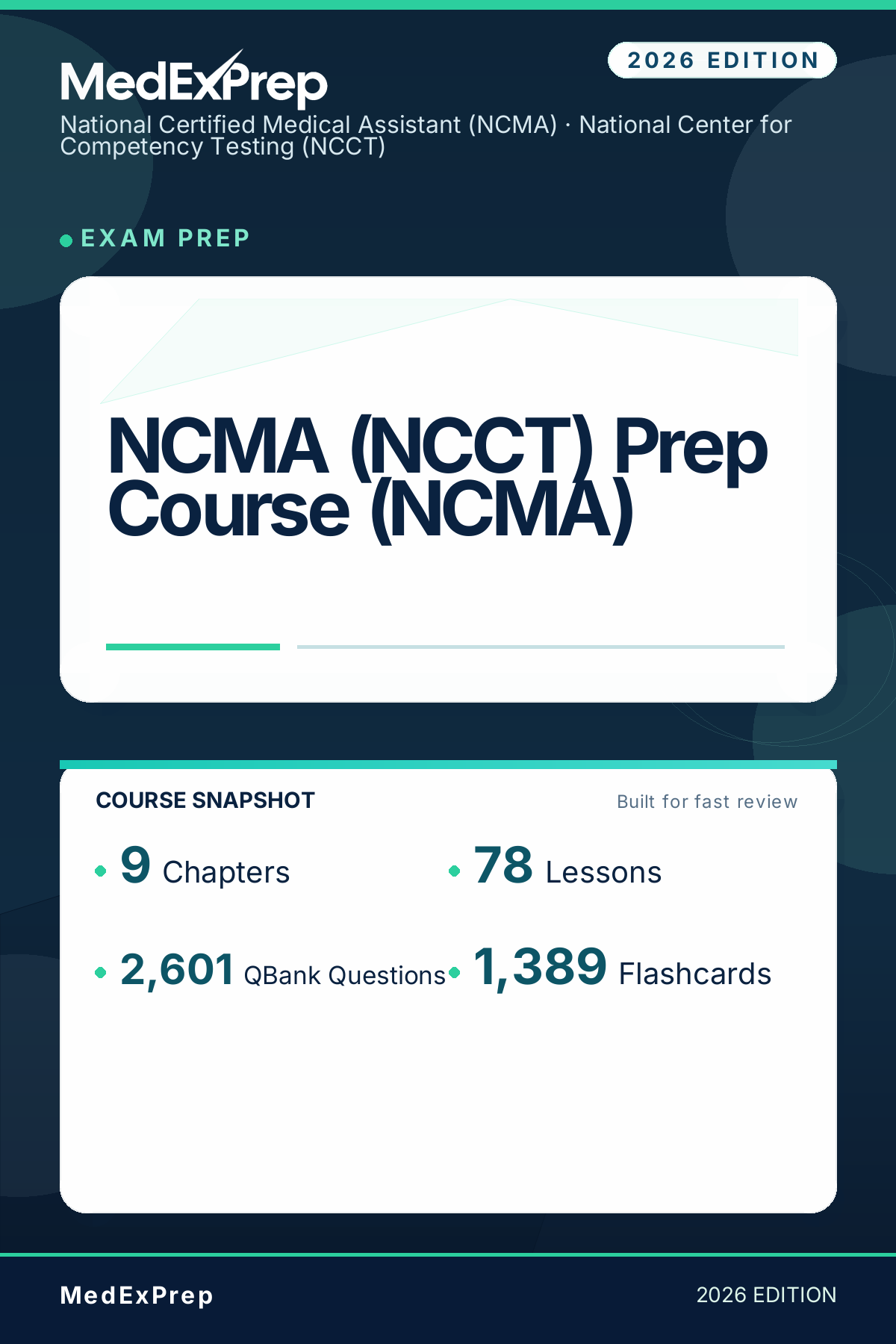
NCMA (NCCT) Prep Course (NCMA)
Candidates preparing for the NCCT National Certified Medical Assistant (NCMA) exam, including medical assisting students, recent graduates, and allied health workers seeking certification. Assume an entry-level medical assistant perspective in outpatient or ambulatory care settings, working under provider direction and within employer policy, applicable state law, and certification-level expectations. Key goals: By the end of this course, learners will be able to:; Explain the exam-relevant competency domains for NCMA preparation and how each lesson maps to those domains; if official weighting is unavailable, use transparent competency mapping rather than invented percentages..
Exam: National Certified Medical Assistant (NCMA) · Organization: National Center for Competency Testing (NCCT)
Includes: Lessons + Flashcards + QBank
Audience: Candidates preparing for the NCCT National Certified Medical Assistant (NCMA) exam, including medical assisting students, recent graduates, and allied health workers seeking certification. Assume an entry-level medical assistant perspective in outpatient or ambulatory care settings, working under provider direction and within employer policy, applicable state law, and certification-level expectations.
Goals:
- By the end of this course, learners will be able to:
- Explain the exam-relevant competency domains for NCMA preparation and how each lesson maps to those domains; if official weighting is unavailable, use transparent competency mapping rather than invented percentages.
- Master high-yield concepts, definitions, terminology, and rules across foundational knowledge, clinical medical assisting, administrative medical assisting, law/ethics/professionalism, and safety/quality.
- Apply concepts in realistic outpatient and ambulatory care scenarios involving patient intake, vital signs, infection prevention, specimen handling, pharmacology basics, diagnostic testing support, procedure support, emergency response, scheduling, documentation, insurance/billing basics, communication, and privacy.
- Solve common entry-level medical assisting calculation and workflow tasks accurately when applicable, including measurement conversions, basic dosage-related arithmetic within MA scope, scheduling intervals, inventory/billing-style reasoning, and time-based sequencing; show steps, units, and verification.
- Distinguish common distractors, misconceptions, and boundary cases frequently tested in medical assisting, especially scope-of-practice violations, unsafe shortcuts, documentation errors, labeling/timing mistakes, confidentiality breaches, and infection-control failures.
- Use a consistent problem-solving framework: identify the task → extract key facts → select the governing rule, protocol, or best practice → execute → verify.
- Build retrieval-ready memory using concise tables, checklists, workflow summaries, terminology clusters, and spaced review recaps.
- Demonstrate readiness through self-check questions and mini-assessments mapped to each competency area.
- Coverage & Blueprint Mapping Requirements:
- Every chapter, section, subsection, and topic must map to at least one competency label using this format: DOMAIN: Objective -> Subskill.
- Use a transparent NCMA-relevant competency map built from entry-level medical assisting functions when official blueprint wording is limited or broad.
- Ensure complete coverage across at minimum these domains: Foundational Knowledge; Clinical Medical Assisting; Administrative Medical Assisting; Law, Ethics, and Professionalism; Safety and Quality.
- Translate broad domain language into teachable subskills, such as anatomy/physiology foundations, pathophysiology/microbiology basics, patient intake/preparation, vital signs/basic measurements, infection prevention/asepsis, specimen collection/handling, pharmacology basics, diagnostic testing support, procedures/treatment support, emergency preparedness/response, scheduling/office workflow, documentation/health records, insurance/billing basics, communication/customer service, medical law/ethics, scope of practice/delegation, workplace safety, and quality/error prevention.
- No identified domain or objective may remain unmapped.
- Stay strictly within entry-level MA scope. Clearly distinguish tasks that may be performed by the MA, tasks requiring provider authorization or supervision, and tasks that vary by employer policy or state law.
- If legal, procedural, or scope details are uncertain or jurisdiction-specific, use learner-safe guidance such as: “Follow employer policy and applicable state law” or “Local protocols vary; confirm with your institution.” Do not invent unpublished NCCT blueprint details or provider-level responsibilities.
Access is granted immediately after purchase.