Description
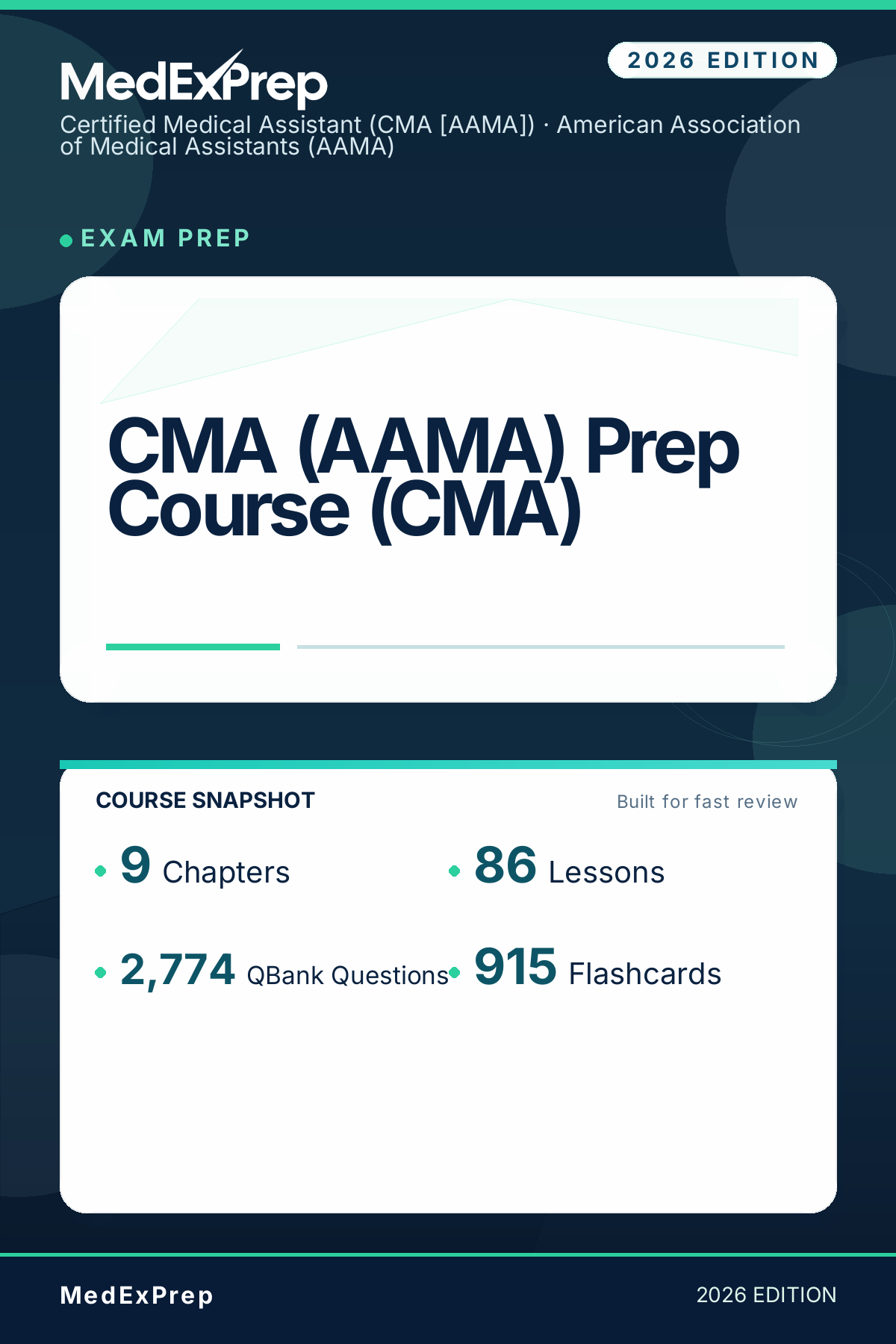
CMA (AAMA) Prep Course (CMA)
Learners preparing for the CMA (AAMA) certification exam, including medical assisting students, recent graduates of eligible medical assisting programs, and candidates seeking initial certification or focused retake preparation. Key goals: By the end of this course, learners will be able to:; Explain the CMA (AAMA) exam competency areas and how lesson topics map to those areas, using explicit domain/subskill tags throughout the course..
Exam: Certified Medical Assistant (CMA [AAMA]) · Organization: American Association of Medical Assistants (AAMA)
Includes: Lessons + Flashcards + QBank
Audience: Learners preparing for the CMA (AAMA) certification exam, including medical assisting students, recent graduates of eligible medical assisting programs, and candidates seeking initial certification or focused retake preparation.
Goals:
- By the end of this course, learners will be able to:
- Explain the CMA (AAMA) exam competency areas and how lesson topics map to those areas, using explicit domain/subskill tags throughout the course.
- Master the high-yield concepts, definitions, office standards, and safety rules relevant to administrative, clinical, and general medical assisting responsibilities in ambulatory and outpatient settings.
- Apply concepts in realistic, exam-style scenarios involving patient intake, communication, scheduling, documentation, room preparation, vital signs, specimen handling, medication safety, infection control, minor procedure support, and routine office workflows.
- Use a consistent problem-solving framework: identify the task → extract key facts → determine whether the action is within the medical assistant role → select the governing rule/protocol → execute → verify/document/escalate when appropriate.
- Distinguish tasks that are appropriate for an entry-level medical assistant from tasks that require clinician judgment, licensed practice, or immediate escalation.
- Solve common calculation and logic tasks accurately when applicable, including medication-related arithmetic, scheduling/sequence decisions, record-handling steps, and procedural ordering; show steps and avoid shortcuts that hide reasoning.
- Recognize urgent findings, abnormal results, adverse reactions, privacy/compliance risks, and safety concerns that require stopping, notifying the supervising clinician, and following office protocol.
- Build retrieval-ready memory using concise tables, checklists, scope-of-role boundaries, workflow algorithms, and spaced review summaries.
- Demonstrate readiness by completing self-check questions and mini-assessments mapped to each competency area, with complete coverage across administrative, clinical, and general professional duties.
- Coverage & Blueprint Mapping Requirements:
- Every chapter/section/subsection/topic must map to at least one exam competency area or teachable subskill using a consistent tag format such as DOMAIN: Objective → Subskill.
- Because public blueprint language may be broad or summarized, translate broad competency statements into learner-ready subskills without inventing official weighting or hidden subdomains.
- Ensure complete coverage across the CMA (AAMA) exam scope suggested by the course inputs and exam context, including administrative procedures, clinical procedures, communication, documentation, professionalism, safety, legal/ethical principles, and role-appropriate escalation.
- Keep all teaching aligned to the role of an entry-level medical assistant working under supervision in ambulatory or outpatient settings.
- If details vary by state law, employer policy, payer rules, or institutional protocol, provide learner-safe guidance such as: follow current office policy, stay within delegated medical assistant scope, and confirm with the supervising clinician or authorized office lead.
- Do not invent clinical authority beyond the medical assistant role. When a scenario involves diagnosis, prescribing, independent interpretation, informed consent responsibility, or independent treatment decisions, teach the correct next step as escalation, documentation, and protocol adherence.
Access is granted immediately after purchase.