Description
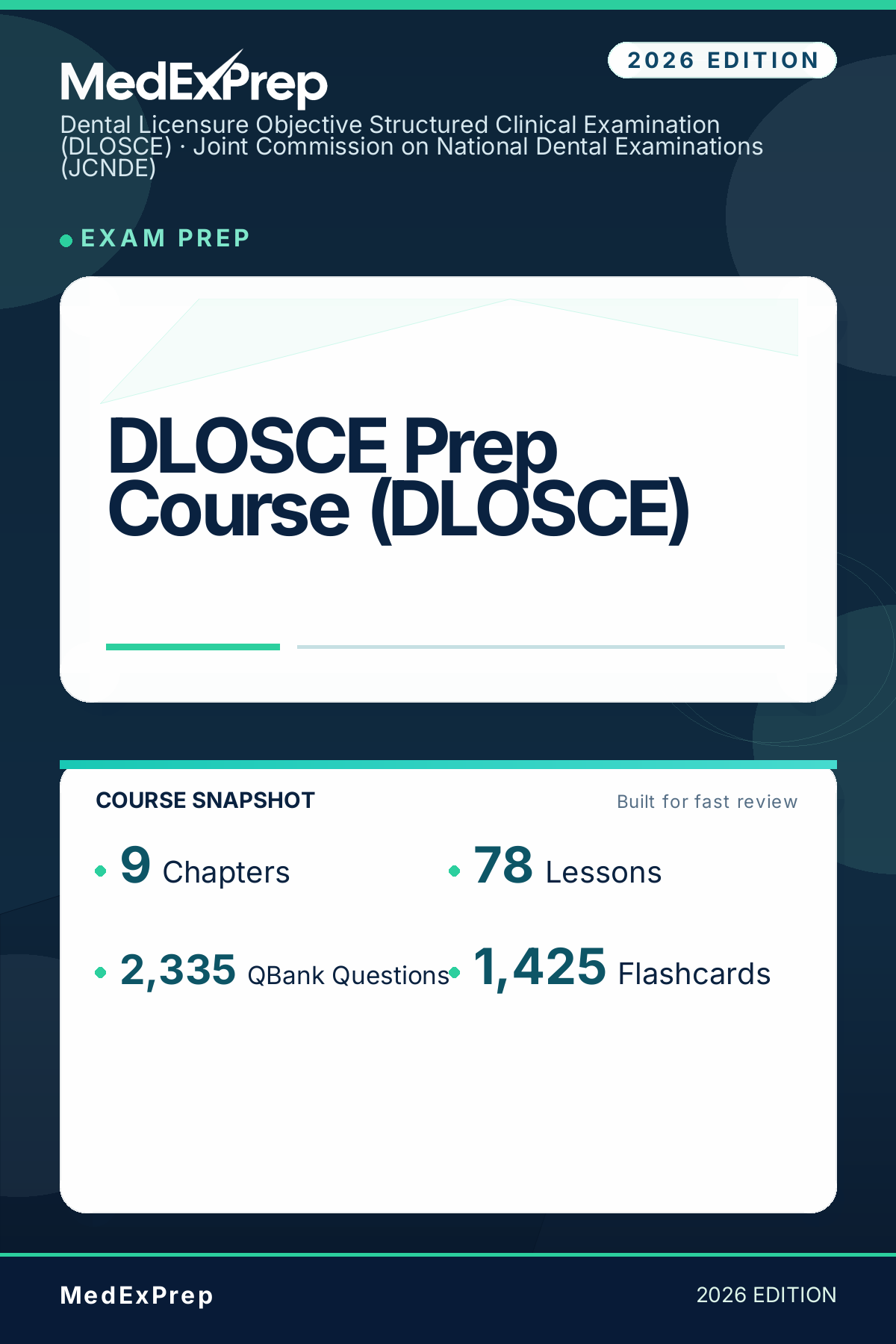
DLOSCE Prep Course (DLOSCE)
Dental licensure candidates preparing for the JCNDE DLOSCE, including U.S. dental students, internationally trained dentists in licensure pathways, and recent graduates seeking exam-focused clinical decision-making practice as entry-level general dentists. Key goals: By the end of this course, learners will be able to:; Explain the defensible competency domains used for DLOSCE preparation and how OSCE-style cases may integrate multiple domains, without assuming unpublished station weights or unofficial blueprint details..
Exam: Dental Licensure Objective Structured Clinical Examination (DLOSCE) · Organization: Joint Commission on National Dental Examinations (JCNDE)
Includes: Lessons + Flashcards + QBank
Audience: Dental licensure candidates preparing for the JCNDE DLOSCE, including U.S. dental students, internationally trained dentists in licensure pathways, and recent graduates seeking exam-focused clinical decision-making practice as entry-level general dentists.
Goals:
- By the end of this course, learners will be able to:
- Explain the defensible competency domains used for DLOSCE preparation and how OSCE-style cases may integrate multiple domains, without assuming unpublished station weights or unofficial blueprint details.
- Master the high-yield concepts, definitions, decision rules, and safety principles relevant to entry-level dental licensure scenarios across patient assessment, diagnosis, treatment planning, data interpretation, medical risk, urgent care, communication, ethics, professionalism, prevention, and follow-up.
- Apply concepts in realistic DLOSCE-style scenarios that require interpretation of histories, clinical findings, radiographs, charts, records, and patient communication cues.
- Use a consistent clinical reasoning framework: identify the task → extract key findings → prioritize safety/urgency → select the governing principle → choose the best next step → verify against contraindications and patient-specific factors.
- Form the most likely diagnosis and focused differential when appropriate, using discriminating findings to eliminate plausible distractors.
- Select appropriate treatment plans and sequencing for common entry-level dental cases, including best next step, stabilization before definitive care, referral thresholds, and follow-up planning.
- Recognize urgent and emergent findings, infection risks, pain presentations, trauma concerns, and safety issues that require escalation, modification of care, or immediate management.
- Modify dental decisions appropriately based on medical history, medications, allergies, vital signs, and other patient-specific risk factors within entry-level scope.
- Demonstrate patient-centered communication, informed consent, ethical reasoning, professionalism, and documentation judgment in exam-style interactions.
- Build retrieval-ready memory using concise tables, differential frameworks, checklists, sequencing algorithms, and spaced review summaries.
- Demonstrate readiness through self-check questions, mini-assessments, and station-style practice mapped to explicit competency tags.
- Coverage & Blueprint Mapping Requirements:
- Every chapter, section, subsection, topic, and assessment item must map to at least one DLOSCE competency tag.
- Use a consistent tag format such as: DLOSCE Domain: Objective → Subskill.
- When official blueprint language is limited or broad, organize content into learner-safe inferred domains including: Patient Assessment and Data Gathering; Diagnosis and Clinical Reasoning; Treatment Planning and Sequencing; Interpretation of Records, Images, and Clinical Data; Medical Risk, Pharmacology, and Patient Management; Urgent Care, Infection, Pain, and Safety; Communication, Ethics, and Professionalism; Prevention, Maintenance, and Follow-Up.
- Translate broad competencies into teachable subskills such as history triage, urgency recognition, differential narrowing, radiographic interpretation, contraindication checking, best-next-step selection, informed consent, and recall planning.
- Ensure complete coverage across all inferred DLOSCE domains; no domain/objective should be left unmapped.
- Do not invent official DLOSCE station counts, weights, or unpublished blueprint specifics. If a detail is uncertain, provide learner-safe guidance such as: local protocols vary; confirm with your institution or jurisdiction.
Access is granted immediately after purchase.