Description
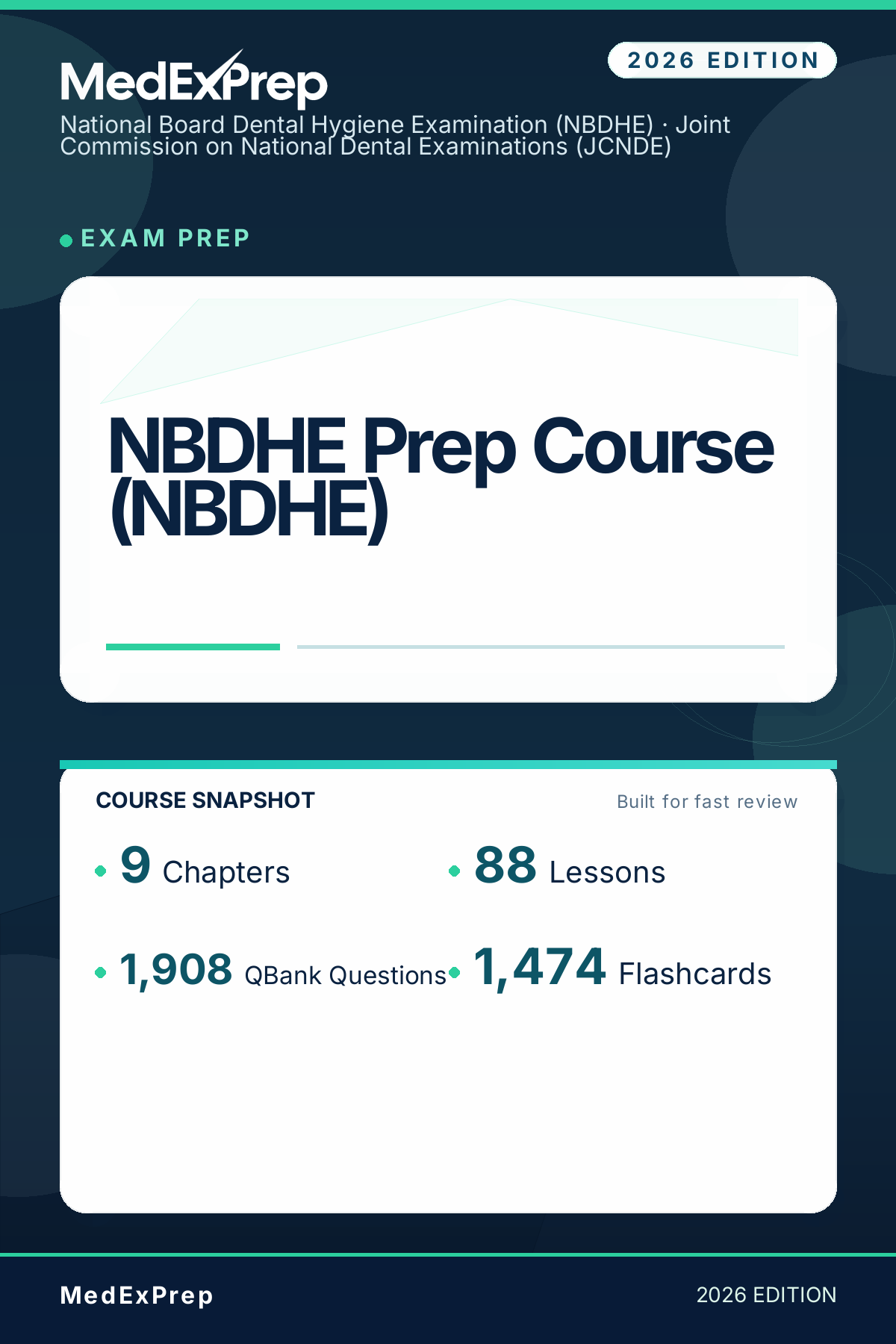
NBDHE Prep Course (NBDHE)
Dental hygiene students, recent graduates, and licensure candidates preparing for the National Board Dental Hygiene Examination (NBDHE) initial licensure written examination. Key goals: By the end of this course, learners will be able to:; Explain the major NBDHE content domains and organize study using a blueprint-mapped framework, including clearly labeled inferred subskills when official blueprint wording is broad..
Exam: National Board Dental Hygiene Examination (NBDHE) · Organization: Joint Commission on National Dental Examinations (JCNDE)
Includes: Lessons + Flashcards + QBank
Audience: Dental hygiene students, recent graduates, and licensure candidates preparing for the National Board Dental Hygiene Examination (NBDHE) initial licensure written examination.
Goals:
- By the end of this course, learners will be able to:
- Explain the major NBDHE content domains and organize study using a blueprint-mapped framework, including clearly labeled inferred subskills when official blueprint wording is broad.
- Master high-yield foundational science concepts relevant to dental hygiene practice, including anatomy, oral histology, microbiology, pathology, nutrition, pharmacology, behavioral science, and evidence interpretation.
- Interpret patient histories, vital signs, assessment findings, periodontal data, charting, indices, radiographs, and lesion descriptions to support safe dental hygiene judgment.
- Apply dental hygiene diagnosis, care-planning, implementation, reevaluation, and maintenance principles in realistic exam-style scenarios within entry-level dental hygienist scope.
- Select the safest and most appropriate next step for prevention, nonsurgical periodontal care, patient education, infection control, radiology, documentation, referral, and emergency recognition/initial response.
- Distinguish common distractors, misconceptions, and boundary cases frequently tested on the NBDHE, especially unsafe actions, overtreatment/undertreatment, and choices outside dental hygiene scope.
- Solve applicable calculation and interpretation tasks step by step, including dosage/math when relevant, index/chart interpretation, vital-sign reasoning, and risk-based decision making.
- Use a consistent clinical reasoning framework: identify the task -> extract key clues -> apply the governing principle/standard -> choose the best answer within scope -> verify for safety.
- Build retrieval-ready memory using concise tables, checklists, comparison charts, and spaced-review summaries.
- Demonstrate readiness through self-checks and mini-assessments mapped to all major NBDHE domains and subskills.
- Coverage & Blueprint Mapping Requirements:
- Every chapter, section, subsection, and topic must map to at least one NBDHE domain, competency statement, objective, or clearly labeled inferred subskill.
- Use a consistent tag format for mappings: DOMAIN: Objective -> Subskill.
- Ensure complete coverage across foundational sciences, assessment and patient evaluation, dental hygiene diagnosis/care planning/implementation, and professional responsibility, ethics, patient management, and community/public health.
- When blueprint language is broad, translate it into teachable subskills and explicitly label them rather than guessing hidden details.
- If a detail is uncertain, jurisdiction-dependent, or program-dependent, provide learner-safe guidance such as: "Local protocols, laws, or authorization requirements may vary; confirm with your jurisdiction, program, or clinical setting."
- Keep all content within the entry-level dental hygienist candidate role: emphasize assessment, prevention, nonsurgical periodontal care, patient education, documentation, safety, collaboration, and referral; do not present dentist-only definitive diagnosis or treatment decisions as if they were within universal hygienist scope.
Access is granted immediately after purchase.