Description
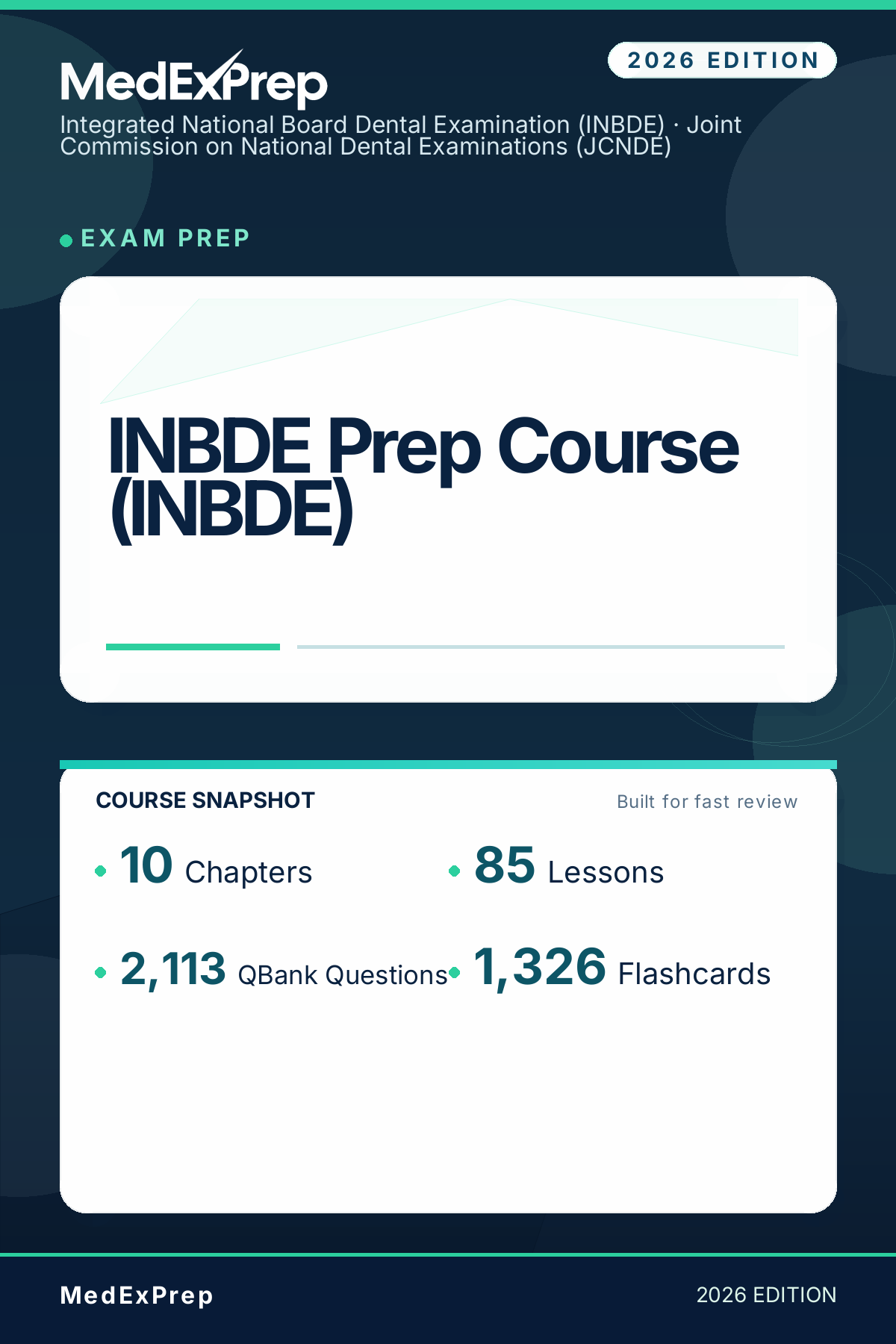
INBDE Prep Course (INBDE)
Dental students and graduates preparing for the INBDE, including first-time test takers and repeat candidates seeking an integrated, exam-focused review of foundational biomedical, clinical, ethical, and patient-management concepts relevant to entry-level dentistry. Key goals: By the end of this course, learners will be able to:; Explain the INBDE’s integrated, case-based exam style and the major tested content areas relevant to entry-level dentistry, without claiming unsupported official weighting..
Exam: Integrated National Board Dental Examination (INBDE) · Organization: Joint Commission on National Dental Examinations (JCNDE)
Includes: Lessons + Flashcards + QBank
Audience: Dental students and graduates preparing for the INBDE, including first-time test takers and repeat candidates seeking an integrated, exam-focused review of foundational biomedical, clinical, ethical, and patient-management concepts relevant to entry-level dentistry.
Goals:
- By the end of this course, learners will be able to:
- Explain the INBDE’s integrated, case-based exam style and the major tested content areas relevant to entry-level dentistry, without claiming unsupported official weighting.
- Master high-yield, exam-relevant concepts across patient assessment, diagnosis, treatment planning, oral medicine/pathology, pharmacology, pain control, restorative care, periodontics, endodontics, oral surgery, pediatric and special patient care, orthodontic principles, radiology, infection control, medical emergencies, ethics/professionalism, biomedical sciences, and quantitative reasoning.
- Apply biomedical and clinical knowledge in realistic dental board-style scenarios to identify the most appropriate next step, safest management, best diagnosis, best initial therapy, or best treatment sequence.
- Use a consistent clinical reasoning framework: identify the task → extract key facts → prioritize safety/urgency/contraindications → select the governing principle or standard of care → execute → verify against the scenario.
- Solve exam-relevant calculations accurately when applicable, including dosage, maximum local anesthetic limits, and basic risk/evidence interpretation, showing steps and checking units and safety limits.
- Distinguish common distractors, misconceptions, unsafe shortcuts, and boundary cases frequently tested in integrated dental scenarios.
- Build retrieval-ready memory using concise tables, checklists, algorithms, diagnostic comparisons, and spaced review summaries.
- Demonstrate readiness through self-check questions, mini-assessments, and integrated case blocks mapped to course tags using the structure: CONTENT AREA -> Competency/Theme -> Subskill.
- Coverage & Blueprint Mapping Requirements:
- Map every chapter, section, subsection, and topic to at least one tag using the structure: CONTENT AREA -> Competency/Theme -> Subskill.
- Because publicly provided framework details may be broad, translate broad domains into teachable subskills and label them consistently.
- Ensure complete coverage across the course, including patient assessment and diagnosis; treatment planning and case management; oral medicine/oral pathology; pharmacology and therapeutics; pain control and anxiety management; operative/restorative dentistry; prosthodontics; periodontics; endodontics; oral and maxillofacial surgery; pediatric dentistry and special patient considerations; orthodontic principles and craniofacial growth; radiology and imaging interpretation; infection control and occupational safety; medical emergencies and medically complex care; ethics, jurisprudence, professionalism, and patient management; biomedical sciences integrated with clinical care; and quantitative reasoning and evidence interpretation.
- Do not invent official JCNDE blueprint details or exam weighting. If a domain boundary or procedural detail is uncertain, use learner-safe wording such as “follow current standard precautions,” “use current standard-of-care guidance,” or “local protocols may vary; confirm with your institution.”
- Teach from the perspective of the entry-level dentist candidate responsible for evaluating, diagnosing, treatment planning, and managing patients safely and professionally.
Access is granted immediately after purchase.