Description
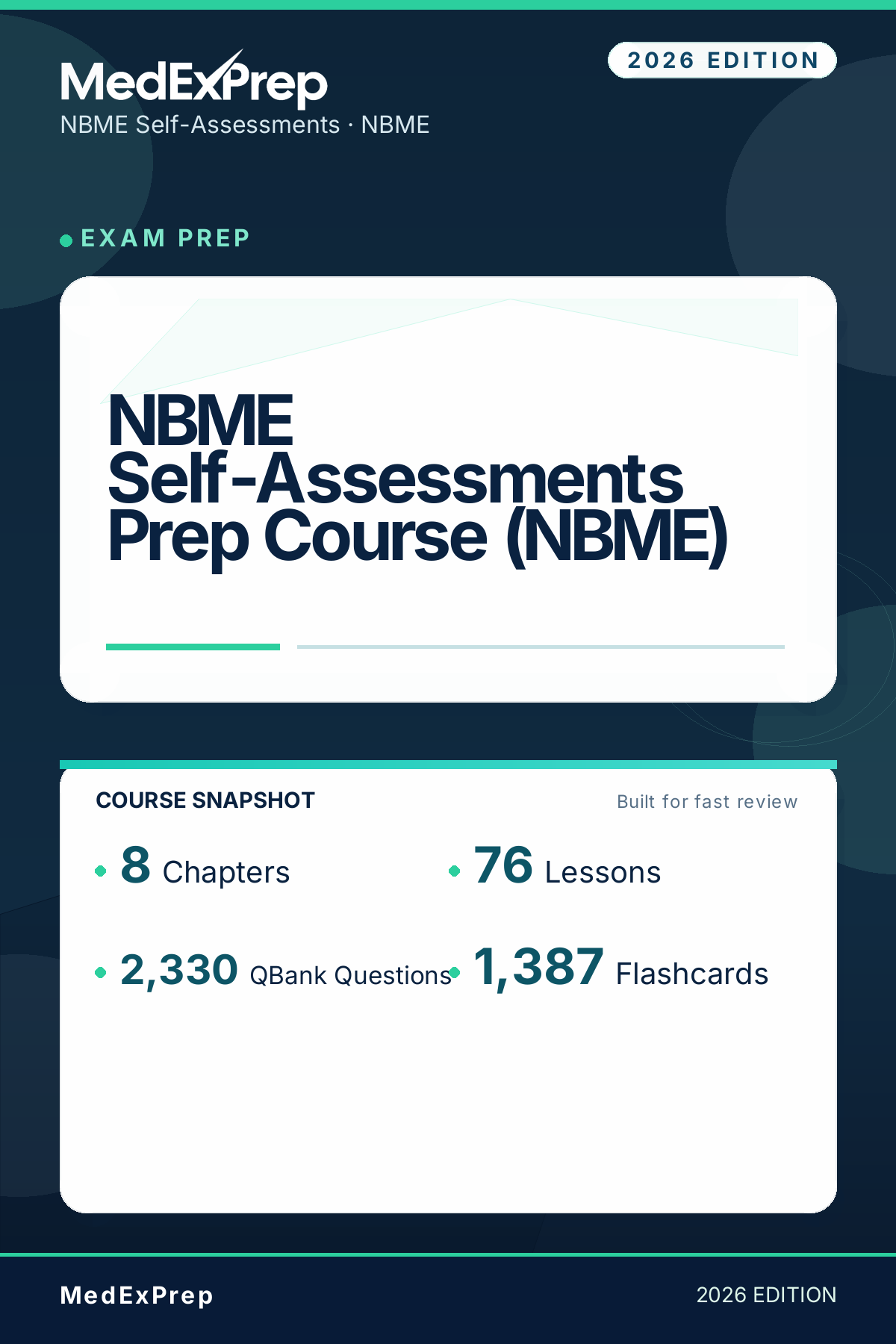
NBME Self-Assessments Prep Course (NBME)
Medical students and other examinees using NBME Self-Assessments to prepare for NBME-style standardized exams, especially learners seeking diagnostic feedback on clinical reasoning, foundational/basic science integration, organ-system performance, and single-best-answer test-taking skills. Candidate role: examinee completing NBME-style self-assessment forms to identify weak domains, interpret performance trends, and strengthen vignette-based reasoning across multisystem foundational and clinical content. Key goals: By the end of this course, learners will be able to:; Explain the purpose, structure, limits, and practical use of NBME Self-Assessments, including learner-safe interpretation of score reports and performance profiles without relying on unsupported claims about exact scoring formulas..
Exam: NBME Self-Assessments · Organization: NBME
Includes: Lessons + Flashcards + QBank
Audience: Medical students and other examinees using NBME Self-Assessments to prepare for NBME-style standardized exams, especially learners seeking diagnostic feedback on clinical reasoning, foundational/basic science integration, organ-system performance, and single-best-answer test-taking skills. Candidate role: examinee completing NBME-style self-assessment forms to identify weak domains, interpret performance trends, and strengthen vignette-based reasoning across multisystem foundational and clinical content.
Goals:
- By the end of this course, learners will be able to:
- Explain the purpose, structure, limits, and practical use of NBME Self-Assessments, including learner-safe interpretation of score reports and performance profiles without relying on unsupported claims about exact scoring formulas.
- Use an inferred-domain coverage model to organize study across commonly tested NBME-style areas: foundational sciences, organ systems, clinical reasoning tasks, laboratory/data interpretation, and quantitative reasoning.
- Master the high-yield concepts, definitions, mechanisms, and decision rules commonly assessed in NBME-style questions across pathology, physiology, pharmacology, microbiology, immunology, biochemistry/genetics, behavioral science, epidemiology/biostatistics, and major organ systems.
- Apply concepts in realistic NBME-style single-best-answer scenarios, including diagnosis from vignette, pathophysiologic mechanism identification, lesion/localization reasoning, best next step when appropriate, and interpretation of labs, graphs, tables, and images.
- Solve common calculation and logic tasks accurately when applicable, especially epidemiology/biostatistics, pharmacology, and physiology-style quantitative reasoning, showing steps clearly and avoiding shortcuts that hide reasoning.
- Distinguish common distractors, misconceptions, near-miss answer choices, and boundary cases that are frequently tested in NBME-style items.
- Use a consistent problem-solving framework: identify the task → extract key facts → localize the tested system/domain → select the governing rule or mechanism → eliminate distractors → verify the best answer.
- Build retrieval-ready memory using concise tables, illness scripts, mechanism maps, checklists, comparison grids, and spaced-review summaries.
- Use self-assessment results to create a targeted remediation plan by weak system, discipline, and clinical task, with broad review when form-specific emphasis is uncertain.
- Demonstrate readiness through self-check questions and mini-assessments mapped to explicit tags for every content unit.
- Coverage & Blueprint Mapping Requirements:
- Because official form-level blueprint detail may be limited or variable, map every chapter/section/subsection/topic to at least one explicit tag using a consistent schema such as "SYSTEM: Discipline -> Subskill" and, when relevant, "TASK: Clinical reasoning -> Subskill."
- Ensure no major inferred domain is left unmapped. At minimum, represent: ORIENTATION: Exam use; MULTISYSTEM: Clinical reasoning; MULTISYSTEM: Test taking; MULTISYSTEM: Laboratory and data interpretation; CARDIOVASCULAR; RESPIRATORY; RENAL; GASTROINTESTINAL; ENDOCRINE; REPRODUCTIVE; NEUROLOGY; MUSCULOSKELETAL; HEMATOLOGY/ONCOLOGY; IMMUNOLOGY; MICROBIOLOGY; PHARMACOLOGY; PATHOLOGY; BIOCHEMISTRY/GENETICS; BEHAVIORAL SCIENCE; EPIDEMIOLOGY/BIOSTATISTICS.
- When blueprint language is broad or absent, translate it into teachable subskills and label them consistently, for example: "RENAL: Physiology -> Acid-base interpretation" or "TASK: Clinical reasoning -> Most likely diagnosis."
- Cross-tag integrated topics when multiple disciplines or systems are required.
- Flag form-dependent emphasis in learner-facing language when appropriate, e.g., "Emphasis may vary by self-assessment form; use your score report and intended exam context to prioritize review."
- Do not invent official NBME weighting, hidden blueprint details, or exact score conversion methods. If a detail is uncertain, provide learner-safe guidance instead of guessing.
Access is granted immediately after purchase.