Description
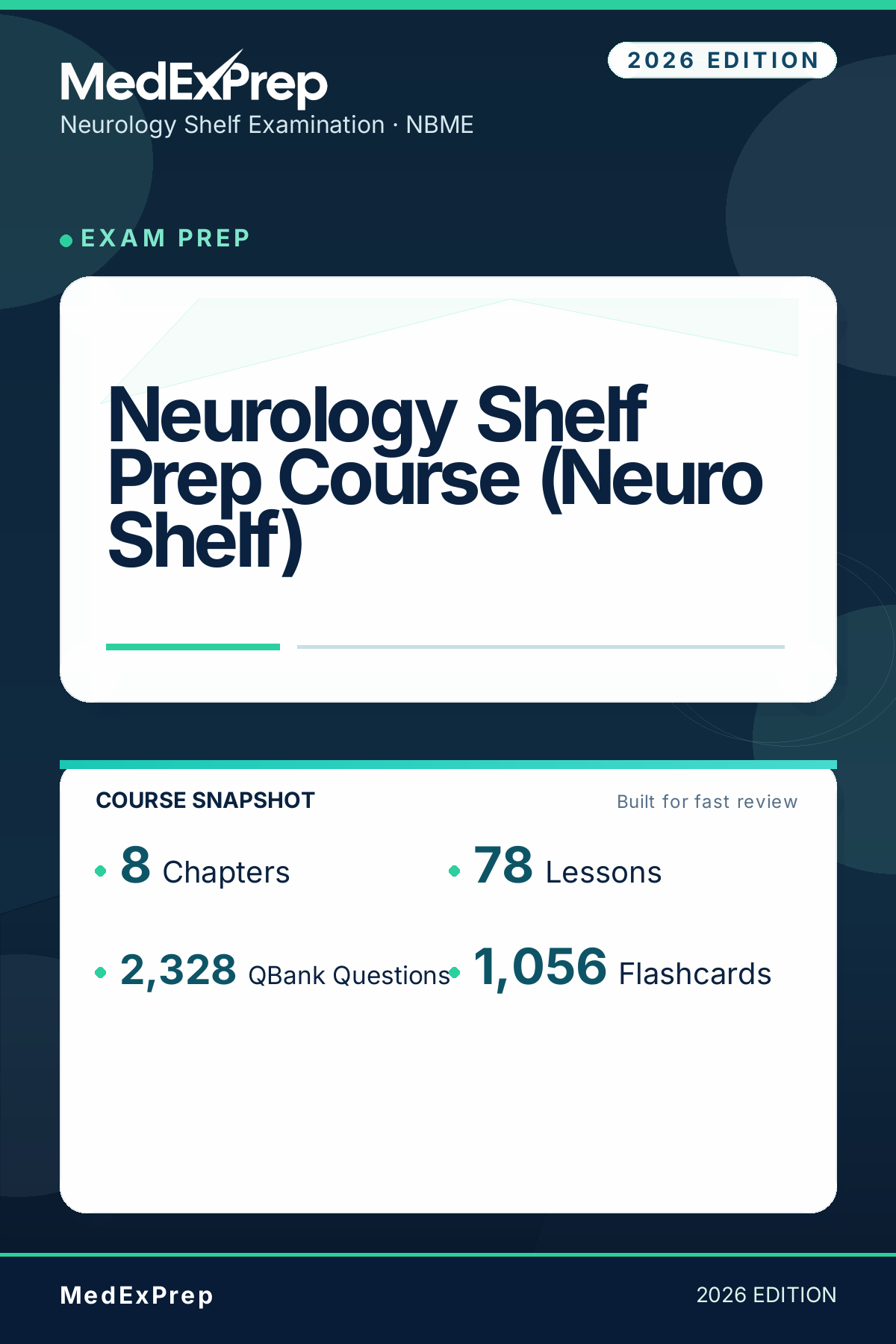
Neurology Shelf Prep Course (Neuro Shelf)
Medical students preparing for the NBME Neurology Shelf during clinical clerkships and sub-internships; senior medical students using adult-focused, vignette-based neurology review to strengthen lesion localization, diagnosis, test selection, acute management, and next-best-step reasoning. Key goals: By the end of this course, learners will be able to:; Explain the broad scope of the NBME Neurology Shelf and organize study by major adult neurology content areas and clinical task types without relying on unsupported claims about exact subtopic weighting..
Exam: Neurology Shelf Examination · Organization: NBME
Includes: Lessons + Flashcards + QBank
Audience: Medical students preparing for the NBME Neurology Shelf during clinical clerkships and sub-internships; senior medical students using adult-focused, vignette-based neurology review to strengthen lesion localization, diagnosis, test selection, acute management, and next-best-step reasoning.
Goals:
- By the end of this course, learners will be able to:
- Explain the broad scope of the NBME Neurology Shelf and organize study by major adult neurology content areas and clinical task types without relying on unsupported claims about exact subtopic weighting.
- Master the high-yield concepts, definitions, syndrome scripts, localization rules, and first-line management principles across core shelf-relevant neurology domains, including neurologic examination/localization, cerebrovascular disease, seizures, headache, movement disorders, demyelinating disease, peripheral nerve/neuromuscular/muscle disorders, spinal cord disease, cognitive disorders, CNS infections, neuro-oncology, trauma, and toxic-metabolic encephalopathy.
- Apply concepts in realistic NBME-style single-best-answer clinical vignettes that require lesion localization, most likely diagnosis, best initial test, confirmatory test, acute stabilization, first-line treatment, complication recognition, and most appropriate next step.
- Interpret common neurologic data sources at shelf depth, including neurologic examination findings, CT/MRI description patterns, CSF profiles, EEG patterns, and basic EMG/NCS correlations.
- Use a consistent problem-solving framework: identify the clinical task → extract key neurologic clues → localize the lesion or process → select the governing diagnosis or management rule → execute the next-best step → verify against time course, risk factors, and examination findings.
- Distinguish high-yield look-alikes, common distractors, and boundary cases frequently tested on neurology shelf exams, including stroke mimics, seizure mimics, headache red flags, parkinsonism mimics, delirium vs dementia, neuropathy vs myopathy vs neuromuscular junction disease, and compressive vs inflammatory spinal processes.
- Build retrieval-ready memory using concise tables, localization frameworks, checklists, algorithms, and spaced-review summaries designed for rapid clerkship-level review.
- Demonstrate readiness through self-check questions and mini-assessments mapped to all major course domains and clinical task types, with explicit gap flags for broad or potentially underrepresented areas such as sleep disorders, autonomic disorders, and limited shelf-relevant pediatric/congenital presentations.
- Coverage & Blueprint Mapping Requirements:
- Every chapter, section, subsection, and topic must map to at least one domain/objective, even when the official blueprint is broad or unspecified.
- Use a consistent tag format for all mappings: DOMAIN: Objective -> Subskill.
- Ensure complete coverage across these shelf-relevant domains: exam strategy/task recognition; neurologic localization and examination; cerebrovascular disease; epilepsy and seizures; headache and facial pain; movement disorders; demyelinating/inflammatory CNS disorders; peripheral nerve, neuromuscular junction, and muscle disease; spinal cord disorders; neurodegenerative/cognitive disorders; CNS infections; neuro-oncology; trauma/neurocritical presentations; toxic-metabolic, sleep, and autonomic disorders; and data interpretation/test selection.
- Because exact NBME weighting details are not specified here, maintain balanced coverage through topic mapping and gap flags rather than claiming precise percentages.
- Translate broad blueprint language into teachable subskills such as lesion localization, vascular territory recognition, CSF interpretation, EEG pattern recognition, emergency stabilization, and next-best-step reasoning.
- No domain/objective may be left unmapped. If a management detail varies by institution, use learner-safe language such as: Local protocols vary; confirm with your institution.
Access is granted immediately after purchase.