Description
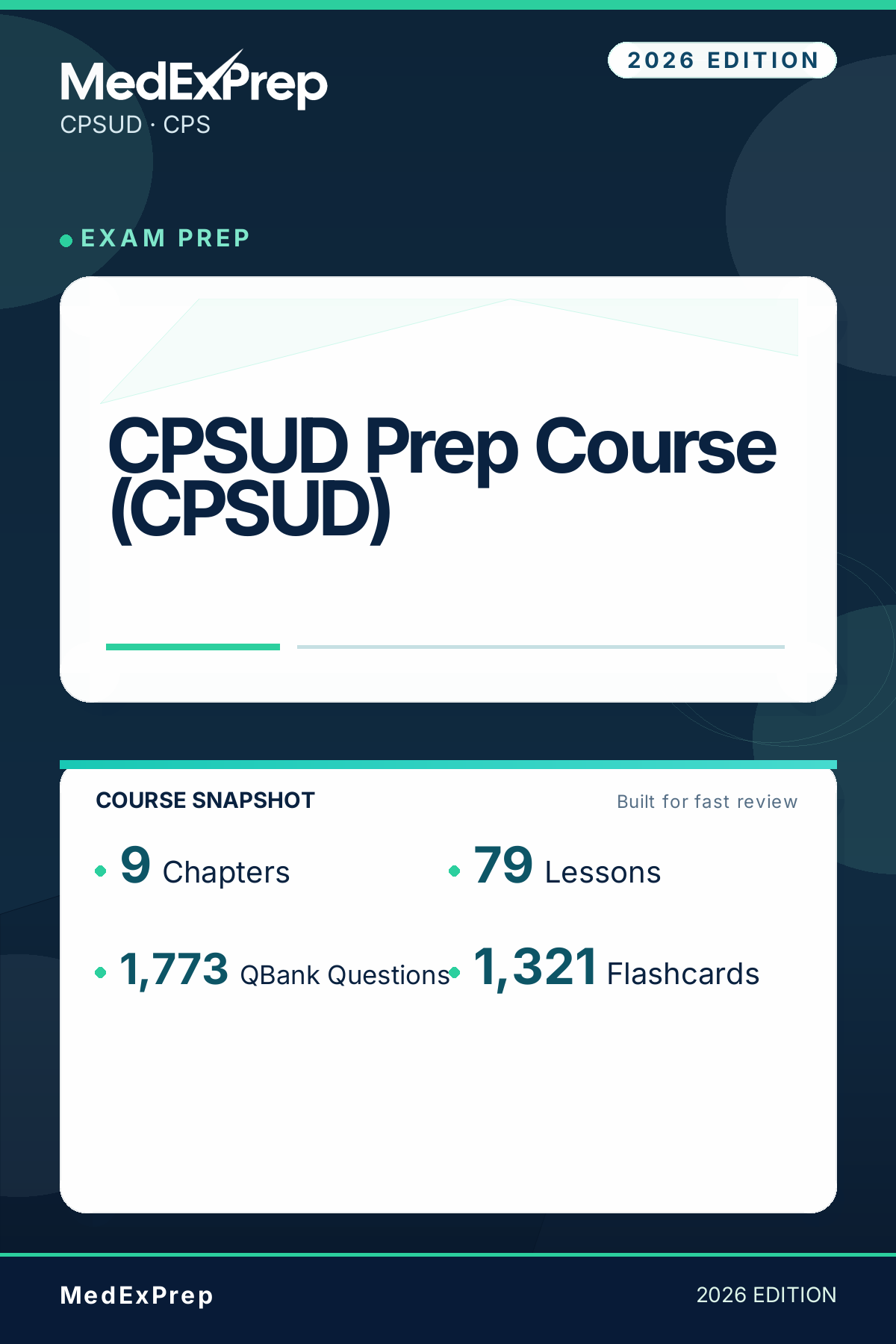
CPSUD Prep Course (CPSUD)
Candidates preparing for the CPSUD examination/credential, including trainees entering substance use disorder-related practice and professionals seeking certification or recertification in substance use disorder-related practice. Key goals: By the end of this course, learners will be able to:; Explain the CPSUD exam scope using the provided materials and a clearly labeled derived competency map when official blueprint detail is unavailable..
Exam: CPSUD · Organization: CPS
Includes: Lessons + Flashcards + QBank
Audience: Candidates preparing for the CPSUD examination/credential, including trainees entering substance use disorder-related practice and professionals seeking certification or recertification in substance use disorder-related practice.
Goals:
- By the end of this course, learners will be able to:
- Explain the CPSUD exam scope using the provided materials and a clearly labeled derived competency map when official blueprint detail is unavailable.
- Master high-yield concepts, terminology, ethical principles, communication strategies, screening concepts, referral logic, safety recognition, documentation basics, and professionalism commonly tested in substance use disorder-related credentialing scenarios.
- Apply concepts in realistic exam-style situations involving client engagement, readiness, boundaries, confidentiality, role-appropriate helping interactions, recovery/support planning, referral, crisis recognition, and care coordination.
- Use a consistent problem-solving framework: identify the task -> extract key facts -> select the governing principle or rule -> execute the best next step -> verify against safety, scope, documentation, and client-centeredness.
- Distinguish common distractors, including overstepping scope, weak boundaries, stigmatizing communication, premature reassurance, unnecessary disclosure, poor documentation, underreaction to safety concerns, and excessive escalation when not indicated.
- Demonstrate role-bounded judgment by recognizing when to support, document, consult, refer, or escalate rather than diagnose, prescribe, or make jurisdiction-specific legal determinations beyond candidate scope.
- Build retrieval-ready memory using concise tables, checklists, decision algorithms, and spaced review summaries organized by domain/objective/subskill tags.
- Demonstrate readiness through self-check questions and mini-assessments mapped to every domain/objective in a CPSUD Derived Competency Map, with gap flags if official blueprint details are later supplied and differ.
- Coverage & Blueprint Mapping Requirements:
- Every chapter, section, subsection, topic, and assessment item must map to at least one competency tag in the format DOMAIN -> Objective -> Subskill.
- Use a derived framework when official blueprint language is absent or broad. Label it clearly as course-derived rather than official.
- Ensure complete coverage across these derived domains at minimum: exam strategy and professional scope; foundations of substance use disorder practice; prevention, screening, and early recognition; engagement, communication, and helping interactions; intervention principles, recovery/support planning, and referral; safety, crisis recognition, and escalation; ethics, confidentiality, and professional responsibilities; documentation and information management; care coordination, collaboration, and systems awareness.
- Do not invent official percentages, domain weights, laws, or proprietary standards. If the source framework is vague, translate it into teachable subskills and flag uncertainty through learner-safe wording such as: local requirements vary; confirm with the applicable authority or organization.
- Emphasize scenario-based judgment, especially ethics, confidentiality, communication, referral, documentation, safety recognition, professionalism, and best-next-step reasoning.
- Keep all teaching and questions within role-appropriate CPSUD candidate scope; avoid requiring independent diagnosis, prescribing, or unsupported clinical protocols unless explicitly framed as referral/escalation responsibilities.
Access is granted immediately after purchase.