Description
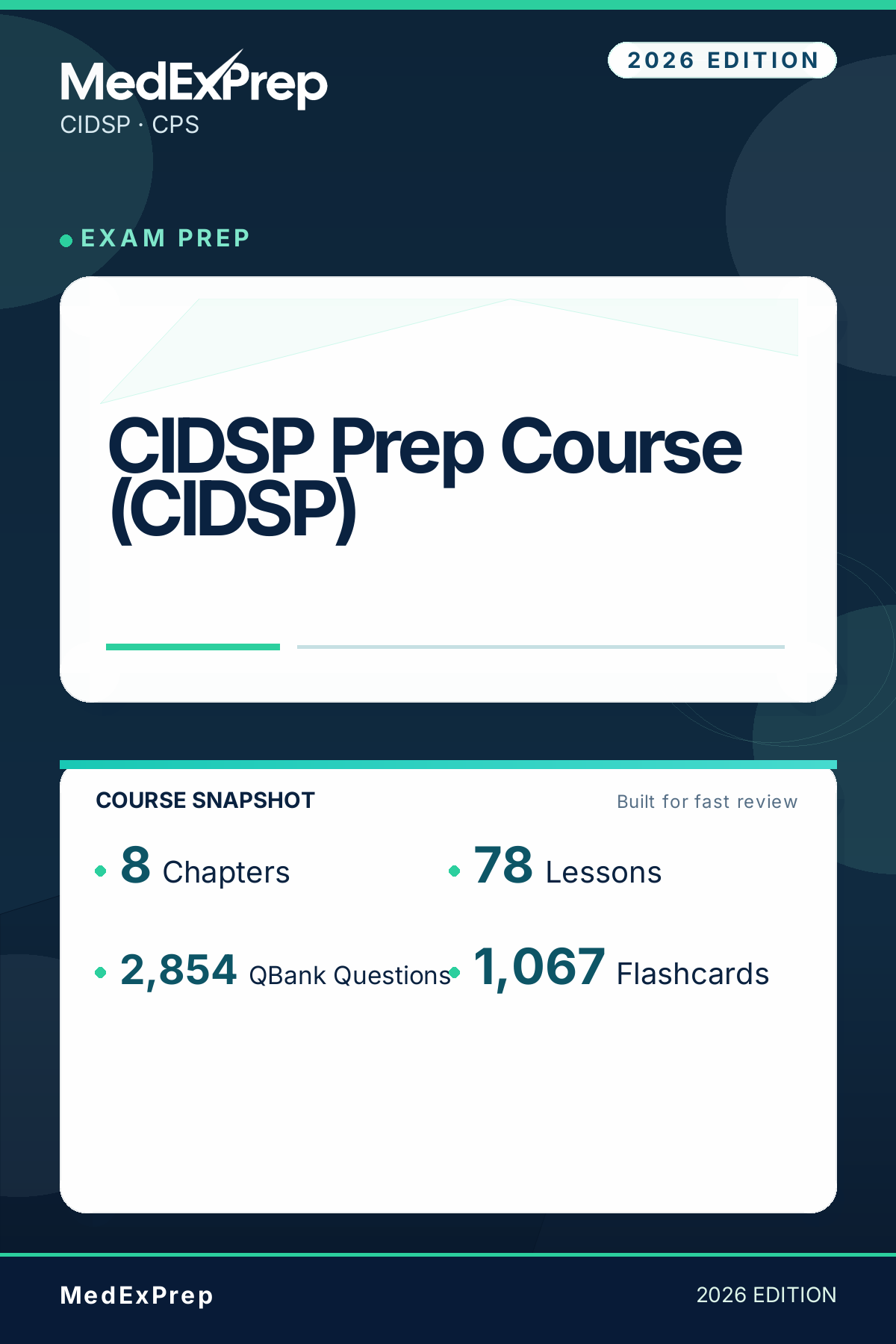
CIDSP Prep Course (CIDSP)
CIDSP candidates preparing for initial certification or exam readiness in the CIDSP domain, including learners who need a structured, blueprint-mapped review with applied scenario practice. Key goals: By the end of this course, learners will be able to:; Explain the CIDSP exam framework, likely competency areas, and how to organize study priorities even when official blueprint detail is limited..
Exam: CIDSP · Organization: CPS
Includes: Lessons + Flashcards + QBank
Audience: CIDSP candidates preparing for initial certification or exam readiness in the CIDSP domain, including learners who need a structured, blueprint-mapped review with applied scenario practice.
Goals:
- By the end of this course, learners will be able to:
- Explain the CIDSP exam framework, likely competency areas, and how to organize study priorities even when official blueprint detail is limited.
- Master high-yield concepts, terminology, definitions, governing principles, and decision rules across confirmed, inferred, supportive, and integrative CIDSP content areas.
- Apply concepts in realistic CIDSP-style scenarios requiring procedural judgment, prioritization, interpretation, classification, and multi-step reasoning.
- Solve calculation, logic, sequencing, or classification tasks accurately when applicable, showing steps and avoiding shortcuts that hide reasoning.
- Distinguish common distractors, misconceptions, boundary cases, and near-miss answer choices that are frequently tested in professional certification exams.
- Use a consistent problem-solving framework: identify the task → extract key facts → select the governing rule or principle → execute → verify.
- Build retrieval-ready memory using concise tables, checklists, comparison charts, algorithms, and spaced review summaries.
- Demonstrate readiness by completing self-checks, mini-assessments, and mixed review sets mapped to each CIDSP domain, objective, or inferred competency area.
- Coverage and blueprint mapping requirements:
- Every chapter, section, subsection, and topic must map to at least one CIDSP blueprint domain, official objective, or clearly labeled inferred competency area.
- If the official blueprint is vague, limited, or unavailable, create a learner-facing inferred exam map first using consistent tags in the format DOMAIN: Objective → Subskill.
- Use these learner-facing inferred competency buckets until official CPS/CIDSP blueprint language is confirmed: Exam Framework and Test Strategy; Core Concepts and Terminology; Principles, Rules, and Decision Criteria; Operational or Procedural Workflows; Scenario Judgment and Prioritization; Calculations, Logic, or Classification; Common Errors, Distractors, and Boundary Cases; Integrated Practice and Readiness Review.
- Mark content areas explicitly as confirmed, inferred, supportive, or integrative when appropriate.
- Ensure complete coverage: no identified domain or objective is left unmapped.
- Do not invent official weights, policies, or standards. If a detail is uncertain, use learner-safe guidance such as: specific policies, terminology, or operational standards may vary; confirm against current CPS/CIDSP exam information and your local practice setting.
Access is granted immediately after purchase.