Description
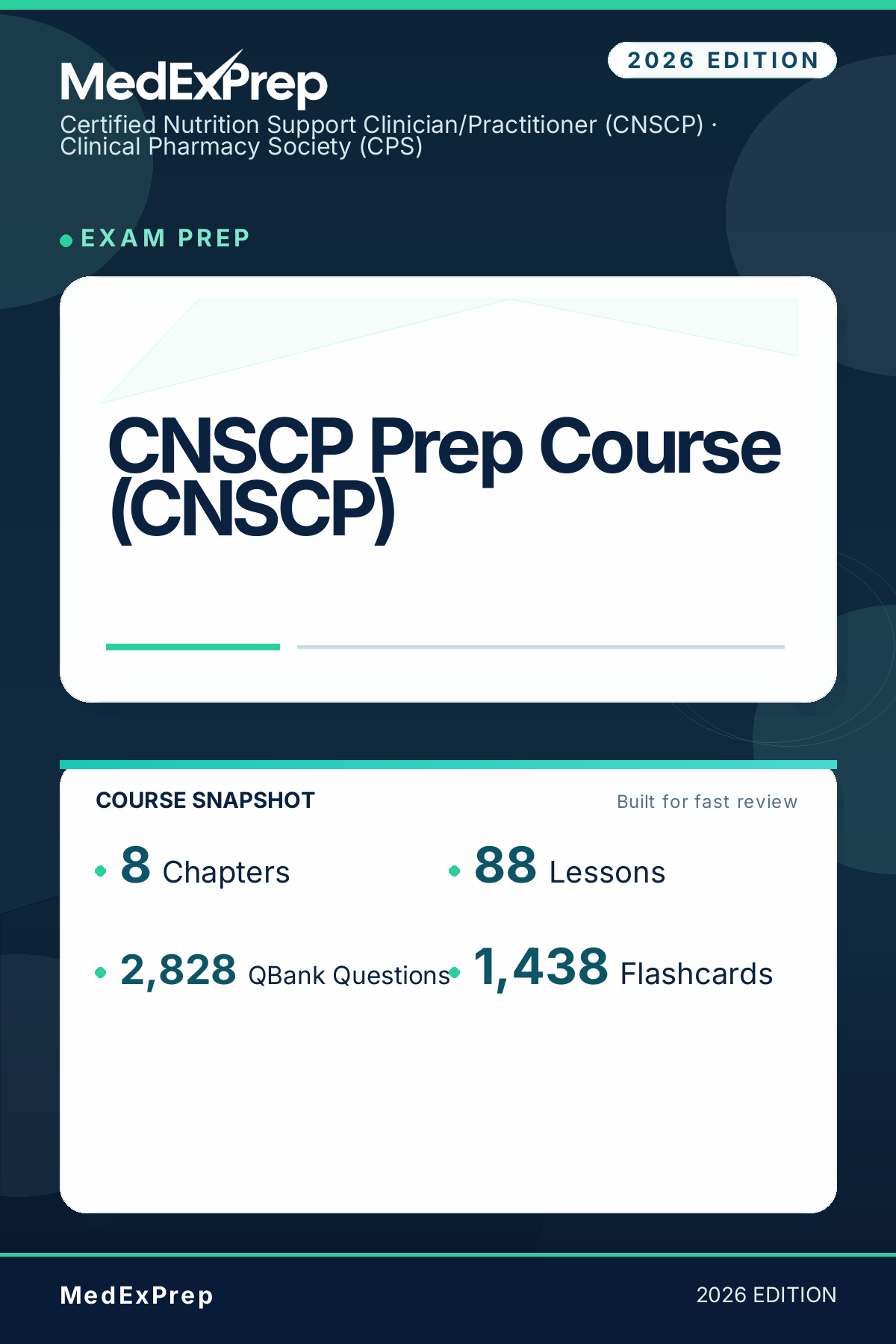
CNSCP Prep Course (CNSCP)
Pharmacists and other clinicians preparing for the CNSCP exam, including dietitians, nurses, physicians, and other candidates seeking competency in adult, pediatric, and practice-based nutrition support concepts. Key goals: By the end of this course, learners will be able to:; Explain the CNSCP exam scope using broad, defensible nutrition support domains and identify how each lesson maps to DOMAIN: Objective → Subskill tags; do not assume official weighting when not provided..
Exam: Certified Nutrition Support Clinician/Practitioner (CNSCP) · Organization: Clinical Pharmacy Society (CPS)
Includes: Lessons + Flashcards + QBank
Audience: Pharmacists and other clinicians preparing for the CNSCP exam, including dietitians, nurses, physicians, and other candidates seeking competency in adult, pediatric, and practice-based nutrition support concepts.
Goals:
- By the end of this course, learners will be able to:
- Explain the CNSCP exam scope using broad, defensible nutrition support domains and identify how each lesson maps to DOMAIN: Objective → Subskill tags; do not assume official weighting when not provided.
- Master high-yield concepts, definitions, indications, contraindications, and decision rules for nutrition assessment, enteral nutrition, parenteral nutrition, monitoring, complications, calculations, transitions of care, and practice-based application.
- Apply nutrition support principles in realistic exam-style scenarios involving adult and pediatric patients, including route selection, access choice, regimen design, monitoring, adjustment, and complication management.
- Solve common nutrition support calculations accurately when applicable, including energy, protein, fluid, infusion rate, component, concentration/osmolarity, and regimen-delivery reasoning; show steps and verify units.
- Distinguish common distractors, misconceptions, contraindications, and boundary cases frequently tested in board-style questions, especially around enteral vs parenteral indications, tolerance, refeeding risk, metabolic derangements, and access/device issues.
- Use a consistent problem-solving framework: identify the task → extract key facts → select the governing rule or nutrition support principle → execute → verify.
- Build retrieval-ready memory using concise tables, checklists, decision algorithms, formula-selection frameworks, monitoring summaries, and spaced review.
- Demonstrate readiness through self-check questions and mini-assessments mapped to every broad exam domain, with explicit gap flags where official blueprint detail is limited.
- Coverage & Blueprint Mapping Requirements:
- Every chapter/section/subsection/topic must map to at least one blueprint domain/objective, using consistent labels in the form DOMAIN: Objective → Subskill.
- Use broad, defensible CNSCP-relevant domains such as Foundations of Nutrition Assessment and Indications; Enteral Nutrition Therapy; Parenteral Nutrition Therapy; Calculations and Interpretation; Complications, Safety, and Monitoring; Transitions of Care and Population-Specific Considerations; and Professional and Practice-Based Application.
- When blueprint language is broad or incomplete, translate it into teachable subskills and label them consistently; ensure no domain/objective is left unmapped.
- Do not invent official CNSCP blueprint weights, cut scores, or unsupported policies. If a detail is uncertain or institution-specific, write learner-safe guidance such as: “Local protocols vary; confirm with your institution.”
- Keep coverage focused on candidate-role appropriate, exam-relevant nutrition support decision-making rather than local workflow trivia or product memorization.
Access is granted immediately after purchase.