Description
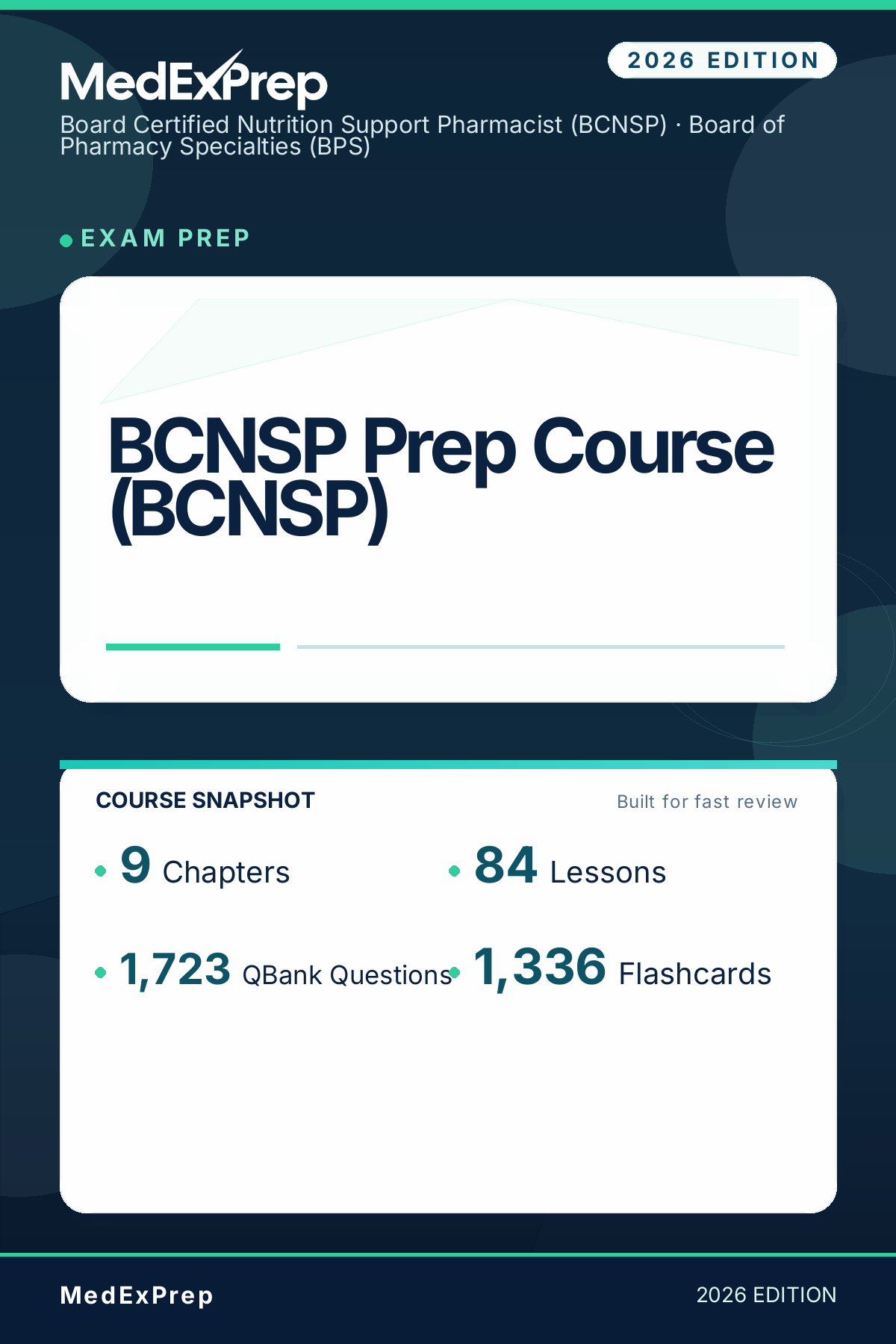
BCNSP Prep Course (BCNSP)
Pharmacists preparing for the Board of Pharmacy Specialties (BPS) Board Certified Nutrition Support Pharmacist (BCNSP) certification exam, including candidates seeking initial board certification in nutrition support pharmacy. This course is designed to help learners build a structured, domain-based study plan and strengthen the advanced knowledge, calculations, clinical reasoning, and practice-management skills relevant to nutrition support pharmacy.
Exam: Board Certified Nutrition Support Pharmacist (BCNSP) · Organization: Board of Pharmacy Specialties (BPS)
Includes: Lessons + Flashcards + QBank
Audience: Pharmacists preparing for the Board of Pharmacy Specialties (BPS) Board Certified Nutrition Support Pharmacist (BCNSP) certification exam, including candidates seeking initial board certification in nutrition support pharmacy.
Goals:
- By the end of this course, learners will be able to:
- Explain the BCNSP exam competency areas and use a domain-based study plan without relying on unofficial weighting claims.
- Master high-yield foundational nutrition support concepts, terminology, and patient-centered principles related to enteral nutrition, parenteral nutrition, micronutrients, macronutrients, fluids, and electrolytes.
- Apply nutrition assessment principles to evaluate indications for nutrition support, estimate patient-specific requirements, define therapeutic goals, and determine the most appropriate route of nutrition support.
- Select appropriate enteral and parenteral nutrition formulations, delivery systems, administration methods, and access strategies based on patient-specific clinical factors.
- Identify and manage clinically significant interactions among drugs, nutrients, dietary supplements, disease states, and nutrition support therapies.
- Design monitoring plans and modify nutrition support regimens based on clinical response, laboratory data, adverse effects, complications, transitions of care, and progress toward therapeutic goals.
- Recognize, prevent, and manage common and high-risk complications of nutrition support, including metabolic, infectious, mechanical, gastrointestinal, and access-related problems.
- Apply sterile compounding, preparation, compatibility, stability, labeling, storage, beyond-use dating, product selection, equipment selection, and workflow principles relevant to safe nutrition support practice.
- Perform essential nutrition support calculations accurately, including energy, protein, fluid, electrolyte, osmolarity, infusion rate, concentration, additive, and compounding-related calculations; show steps, units, and reasonableness checks.
- Use regulations-, standards-, safety-, and quality-aware reasoning for documentation, policy adherence, operational decisions, and compliance with current practice expectations while recognizing when institutional, state, federal, accreditation, payer, or site-specific requirements may vary.
- Apply practice management and operations principles related to quality improvement, patient safety, formulary/product review, cost-effective care, reimbursement awareness, and interdisciplinary nutrition support services.
- Interpret clinical literature, guidelines, and evidence relevant to nutrition support, and apply evidence-based reasoning to board-style scenarios.
- Communicate effectively with patients, caregivers, and interprofessional teams regarding nutrition care plans, monitoring, education, and transitions of care.
- Distinguish common distractors, misconceptions, and boundary cases frequently tested in certification-style questions, especially where route selection, formulation choice, calculations, complications, monitoring, or operational decisions can be confused.
- Use a consistent problem-solving framework: identify the task → extract key clinical and operational facts → select the governing principle, calculation, or evidence-based action → execute → verify.
- Build retrieval-ready memory using concise tables, comparison charts, checklists, calculation workflows, and spaced-review summaries.
- Demonstrate readiness through self-checks and mini-assessments mapped to every BCNSP domain or derived subskill.
- Coverage & Blueprint Mapping Requirements:
- Every chapter, section, subsection, and topic must map to at least one BCNSP blueprint domain/objective or a derived subskill tag.
- Use a consistent tag format such as DOMAIN: Objective → Subskill.
- Ensure complete coverage across patient-centered clinical nutrition support practice, practice management and operations, and evidence-based medicine, scholarship, education, and advocacy.
- Do not claim unofficial exam weighting or unpublished blueprint details.
- When blueprint wording is broad, translate it into teachable subskills and explicitly map content to those subskills.
- No blueprint domain/objective may be left unmapped.
- If a detail is uncertain or varies by institution, payer, compounding environment, product availability, guideline updates, accreditation standards, or local/state/federal requirements, write learner-safe guidance such as: Follow current BPS-relevant standards, institutional policy, and applicable legal/regulatory requirements.
Access is granted immediately after purchase.