1.1.1 - Psychiatric History Components
Psychiatric History Components
What you'll learn
- DOMAIN: Psychiatric evaluation → History-taking structure — gather the core components of a psychiatric history in the order most likely to clarify diagnosis and safety.
- DOMAIN: Safety and disposition → Risk-oriented interviewing — identify when the history must pivot immediately to suicidality, homicidality, psychosis, intoxication, withdrawal, or inability to care for self.
- DOMAIN: Medical vs psychiatric rule-out → Context and timeline — use chronology, substances, medications, and medical history to distinguish primary psychiatric illness from secondary causes.
- DOMAIN: Clinical decision-making → Focused next step — choose what additional history is still required before selecting diagnosis, workup, or disposition.
- DOMAIN: Mental status linkage → Interview-to-exam bridge — understand how history findings set up the next topic, the mental status examination.
- Psychiatric evaluation → interview foundations → chief concern, HPI, past psychiatric history, substance history, social history, family history
- Safety and disposition → emergency recognition → suicide/violence screening, grave disability, access to lethal means
- Medical overlap → medical/substance rule-out → medication review, neurologic/endocrine/infectious clues, intoxication/withdrawal timeline
- Clerkship reasoning → next best step → what to ask next before diagnosing or dispositioning
Why it matters
- Many shelf questions are really asking, What should you ask next? rather than What is the final diagnosis?
- A strong psychiatric history prevents the classic exam mistake of diagnosing a primary disorder before ruling out delirium, substances, medication adverse effects, or acute safety threats.
- Disposition depends on history as much as symptoms: intent, plan, means, supports, adherence, and prior attempts change the answer choice.
- The psychiatric history is the frame for the mental status examination and collateral gathering; if the history is incomplete, the safest answer is often to obtain more targeted information before acting.
Key Terms & Must-Know Facts
1.1.1.1 Key terms
- Chief concern: the patient’s presenting problem in their own words when possible
- HPI: chronological account of current symptoms, onset, course, triggers, severity, associated features, and functional impact
- Past psychiatric history: prior diagnoses, hospitalizations, suicide attempts, self-harm, treatment, and medication response
- Substance history: alcohol, opioids, stimulants, cannabis, sedatives, hallucinogens, nicotine, caffeine, and timing of last use
- Medical rule-out: searching for nonpsychiatric causes of psychiatric symptoms
- Collateral history: information from family, EMS, staff, records, pharmacy, or outpatient clinicians
- Historian reliability: judgment of how trustworthy and complete the patient’s account is
- Psychiatric review of systems: targeted screening for mood, anxiety, psychosis, trauma, OCD, cognition, substances, and safety
- Functional impairment: effect on work, school, self-care, relationships, or basic activities
- Lethal means: access to firearms, medications, ropes, knives, vehicles, or other means of self-harm
- Mania screen: questions about decreased need for sleep, elevated/irritable mood, impulsivity, grandiosity, talkativeness, and goal-directed behavior
- Psychosis screen: hallucinations, delusions, disorganization, paranoia, and negative symptoms
- Capacity clue: ability to understand, appreciate, reason, and communicate a choice in the current decision context
1.1.1.2 Must-know facts
- In psychiatric vignettes, safety questions outrank diagnostic detail when there is possible suicidality, violence, severe intoxication, withdrawal, delirium, or inability to care for self.
- Timeline is a major discriminator: abrupt onset suggests substance, medication, delirium, or neurologic/medical causes more than primary psychiatric illness.
- Every psychiatric history should include past suicide attempts; it is one of the strongest risk predictors.
- A medication list is part of the psychiatric history because steroids, dopaminergic drugs, anticholinergics, antidepressants, and sedatives can create psychiatric presentations.
- Functional decline often distinguishes normal distress from a diagnosable disorder.
- When psychosis, mania, intoxication, or confusion limits reliability, the next best step often includes collateral.
- Do not assume insomnia means anxiety or depression; ask whether it is decreased need for sleep, which points toward mania.
- Substance history is not complete without amount, frequency, route, and last use.
- Family history matters because bipolar disorder, schizophrenia, substance use disorders, and suicide cluster in families.
Core content
1.1.1.3 Foundational interview sequence: what to ask first and why
A Explanation
The first decision conflict in a psychiatric interview is open-ended exploration vs immediate safety triage. The rule that resolves it is simple: if the presentation suggests imminent risk, unstable behavior, severe agitation, delirium, intoxication, withdrawal, or psychosis with poor reality testing, you pivot to focused safety questions before a full narrative. Otherwise, start broad, then narrow.
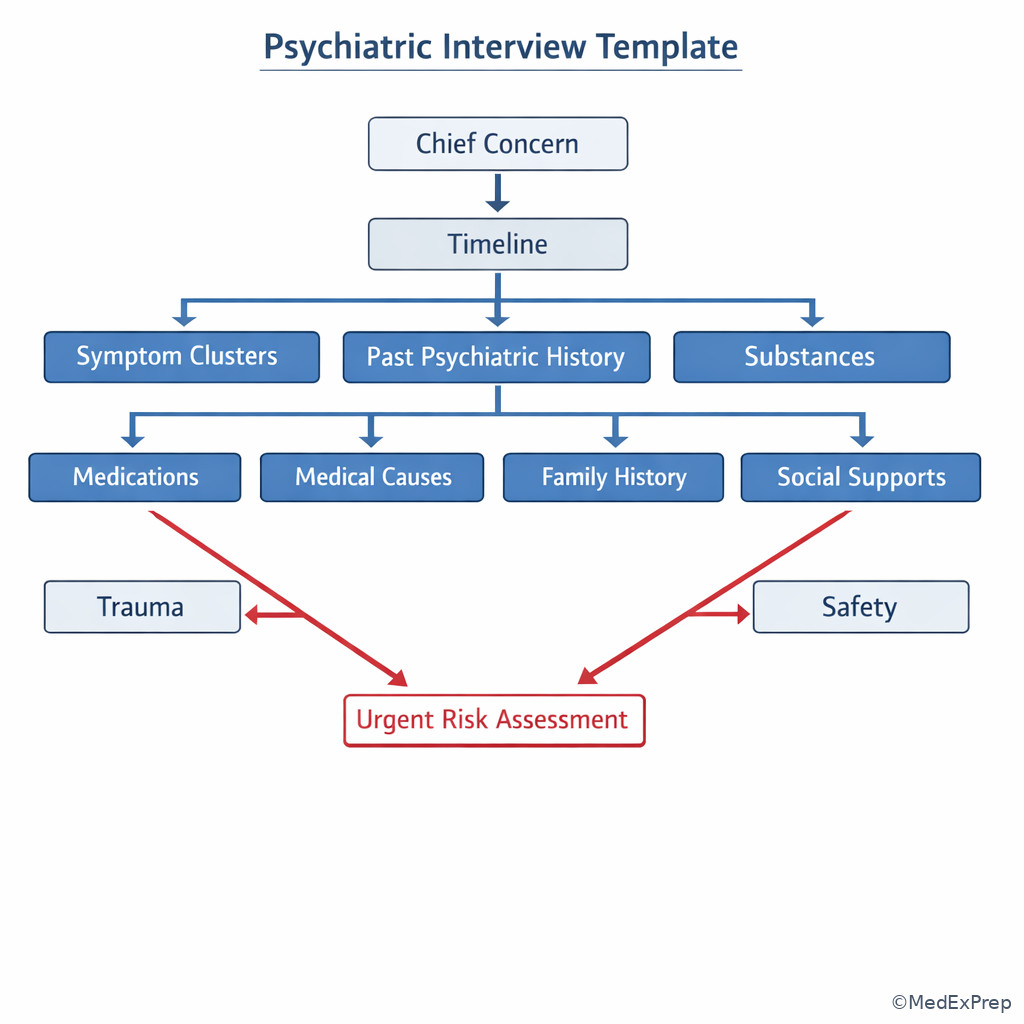
A high-yield structure is: chief concern → HPI with timeline → psychiatric review of systems → past psychiatric history → substance/medication history → medical history → family history → social/developmental/trauma history → safety. In practice, safety is never “saved for the end” if the story raises concern earlier. The psychiatric history is not a checklist to recite; it is a prioritization tool to answer three exam questions: What syndrome is present? Could it be medical/substance-induced? Is this patient safe right now?
WHY THIS IS TESTED: Exam writers hide the correct answer in sequencing. Students miss points by jumping to diagnosis after hearing “sad,” “anxious,” or “hearing voices,” instead of clarifying onset, course, impairment, safety, and secondary causes.
Use choose-vs-reject framing. Choose an open narrative when the patient is calm and coherent. Reject a prolonged psychosocial deep dive when there is current suicidal intent, command hallucinations, confusion, autonomic instability, or inability to provide a reliable history. The history component you ask next should be the one that most changes safety, differential, or disposition.
Exam takeaway: Ask the next question that most changes safety, secondary-cause suspicion, or disposition.
flowchart TD
A[Presenting complaint] --> B{Immediate safety concern?}
B -->|Yes| C[Suicidal or violent intent, psychosis, delirium, intoxication, severe agitation]
C --> D[Focused safety questions and urgent stabilization]
B -->|No| E[Chronology of symptoms]
E --> F[Past psychiatric history]
F --> G[Substance and medication review]
G --> H[Medical causes and neurologic clues]
H --> I[Family and social context]
I --> J[Functional impairment and disposition planning]
See Fig 1 for the test-day logic that determines which history component comes next.
B Worked example
A 22-year-old woman is brought to the ED by her roommate for “panic attacks.” She has type 1 diabetes and migraine headaches. She reports feeling “overwhelmed” and crying for 2 weeks after failing an exam. She also says she has slept only 2 hours nightly for 5 days but “doesn’t really feel tired.” Her roommate adds that she spent nearly all her savings on online business supplies. Finger-stick glucose is 168 mg/dL. A tempting wrong move is to focus on stress and ask only about anxiety triggers.
Reasoning chain: Identify task: what history question is most important next? Extract key facts: decreased need for sleep, impulsive spending, likely mood elevation/mania clue; diabetes is noise here because she is not hypoglycemic or delirious. Apply rule: insomnia in psychiatry requires distinction between inability to sleep and decreased need for sleep. Eliminate distractors: asking only about trauma, caffeine, or school stress misses a syndrome-changing clue. Verify: the best next questions target manic symptoms, including grandiosity, increased goal-directed activity, risky behavior, and prior episodes.
C Exam trap
D Checkpoint
Question: A 29-year-old man presents with “depression” after losing his job. He is pacing, sleeping 1 hour nightly, speaking rapidly, and insists he is about to launch a multimillion-dollar app. What is the most appropriate next step in the interview?
- Ask about childhood developmental milestones
- Ask about suicidal and homicidal ideation, access to means, and recent risky behavior
- Ask about dietary patterns and body image concerns
- Ask whether his sadness worsens in winter
Answer: B
- A: Tempting because developmental history can matter in psychiatry, but it does not change the immediate safety or likely manic syndrome.
- B: Tempting because it narrows the interview quickly; it is right because pressured behavior, grandiosity, and severe sleep reduction raise safety and mania concerns that change disposition.
- C: Tempting because appetite/weight are mood-disorder questions, but they are lower priority than acute risk in an activated patient.
- D: Tempting because seasonality can be tested with mood disorders, but the stem points toward mania, not seasonal affective pattern.
1.1.1.4 History of present illness: timeline, symptom clusters, and functional impact
A Explanation
The next decision conflict is label the symptom vs define the pattern. Shelf questions rarely reward accepting a symptom word at face value. “Depressed,” “anxious,” “not sleeping,” or “hearing things” are starting points, not conclusions. The single rule that resolves the conflict is: build the HPI around chronology, associated features, and functional impairment.
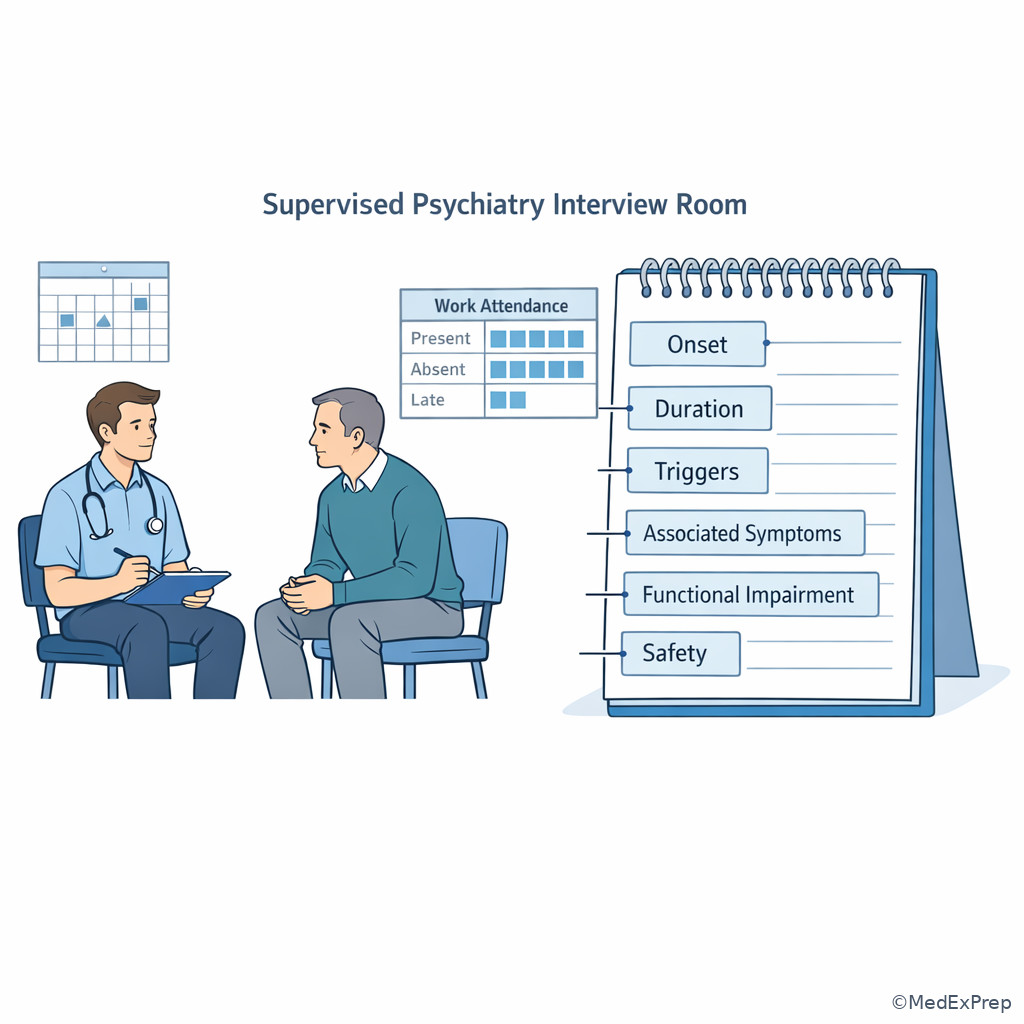
For mood symptoms, ask onset, duration, precipitants, neurovegetative symptoms, anhedonia, guilt, concentration, psychomotor change, and suicidality. For anxiety, ask triggers, unexpected vs cued episodes, avoidance, autonomic symptoms, duration, and impairment. For psychosis, ask what the patient is experiencing, whether symptoms are mood-congruent, whether they occur with intact consciousness, and whether there is disorganization or paranoia. For sleep complaints, ask whether the issue is difficulty sleeping, fragmented sleep, early awakening, or decreased need for sleep. For cognition or behavior change, ask whether onset was acute, fluctuating, and associated with illness or medications.
Functional impairment is the move many students forget. Board stems often distinguish normal distress from disorder by showing inability to work, attend school, care for children, maintain hygiene, or manage finances. If symptoms sound dramatic but functioning remains intact, reconsider the diagnosis or severity.
WHY THIS IS TESTED: The HPI is where timeline-based differentials live: panic attack vs generalized anxiety, grief vs major depression, brief psychotic disorder vs schizophrenia spectrum, delirium vs primary psychosis, intoxication vs withdrawal.
Exam takeaway: Timeline plus associated features separates look-alike psychiatric syndromes.
flowchart LR
A[Symptom word from stem] --> B[When did it start?]
B --> C{Acute or chronic?}
C -->|Acute/fluctuating| D[Think delirium, intoxication, withdrawal, medication, neurologic cause]
C -->|Episodic| E[Think panic, bipolar episodes, intermittent substance use, brief psychosis]
C -->|Persistent| F[Think depressive, anxiety, trauma-related, psychotic, personality patterns]
E --> G[Ask triggers and inter-episode function]
F --> H[Ask duration and impairment]
D --> I[Medical review and collateral]
See Fig 2 when a stem gives one psychiatric word but the diagnosis depends on timing.
Exam takeaway: Organize symptoms by onset, duration, triggers, and functional decline rather than by diagnosis labels.
B Worked example
A 68-year-old man with hypertension, COPD, and chronic insomnia is brought by his daughter for “seeing bugs on the wall” since yesterday. He also started a new bladder medication last week and has had a cough with fever. He has no psychiatric history. The daughter says he was “a little depressed” after retirement. A tempting wrong clue is the retirement sadness, which could push you toward late-life depression with psychosis.
Reasoning chain: Identify task: what HPI detail matters most? Extract key facts: abrupt onset over one day, visual hallucinations, medical illness, new medication, older age. Apply rule: acute fluctuating symptoms with visual perceptual disturbance suggest delirium or medication effect, not primary psychosis or major depression. Eliminate distractors: grief and insomnia do not explain abrupt hallucinations with infection and anticholinergic exposure. Verify: the HPI should focus on baseline cognition, fluctuation, attention, fever timeline, medication change, and substance use.
C Exam trap
D Checkpoint
Question: A 34-year-old woman reports “insomnia” and irritability for 4 days. She has no fatigue, has started three new business projects, and has been talking more quickly than usual. Which HPI clarification best separates mania from anxiety-related insomnia?
- Whether she snores loudly
- Whether she has decreased need for sleep despite high energy
- Whether she drinks coffee after noon
- Whether she has nightmares
Answer: B
- A: Tempting because sleep disorders can mimic psychiatric complaints, but snoring does not explain the activation pattern in the stem.
- B: Tempting because it directly addresses sleep; it is right because decreased need for sleep is a manic discriminator, unlike ordinary insomnia with fatigue.
- C: Tempting because caffeine can worsen insomnia and anxiety, but it does not explain the goal-directed overactivity.
- D: Tempting because nightmares relate to trauma disorders, but the stem lacks trauma-linked re-experiencing and instead suggests mania.
- The most useful first discriminator for many psychiatric symptoms is timeline.
- True or False: A patient saying “I’m depressed” is enough to diagnose major depressive disorder. False.
- Name the 3 HPI anchors: onset/course, associated features, functional impairment.
1.1.1.5 Past psychiatric, substance, medication, and medical history: ruling in and ruling out
A Explanation
The key decision conflict here is primary psychiatric disorder vs symptoms due to substances, medications, or medical illness. The single finding/rule that resolves it is often chronology: symptoms beginning after a new medication, after intoxication/withdrawal, or with acute medical illness should make you reject a premature primary psychiatric diagnosis.
Past psychiatric history should include prior diagnoses, hospitalizations, suicide attempts, nonsuicidal self-injury, violence, prior episodes, outpatient treatment, medication trials, adherence, adverse effects, and what actually worked. This is not trivia; it predicts both diagnosis and next best step. Prior manic episode changes the meaning of current depression. Prior antipsychotic response matters in psychosis stems. Prior suicide attempt materially changes risk.
Substance history must be specific: what, how much, how often, route, last use, prior withdrawal, blackouts, seizures, and treatment history. “Occasional use” is not enough. The exam favorite is the patient with psychiatric symptoms plus an omitted timeline of last alcohol, benzodiazepine, cocaine, cannabis, or opioid use.
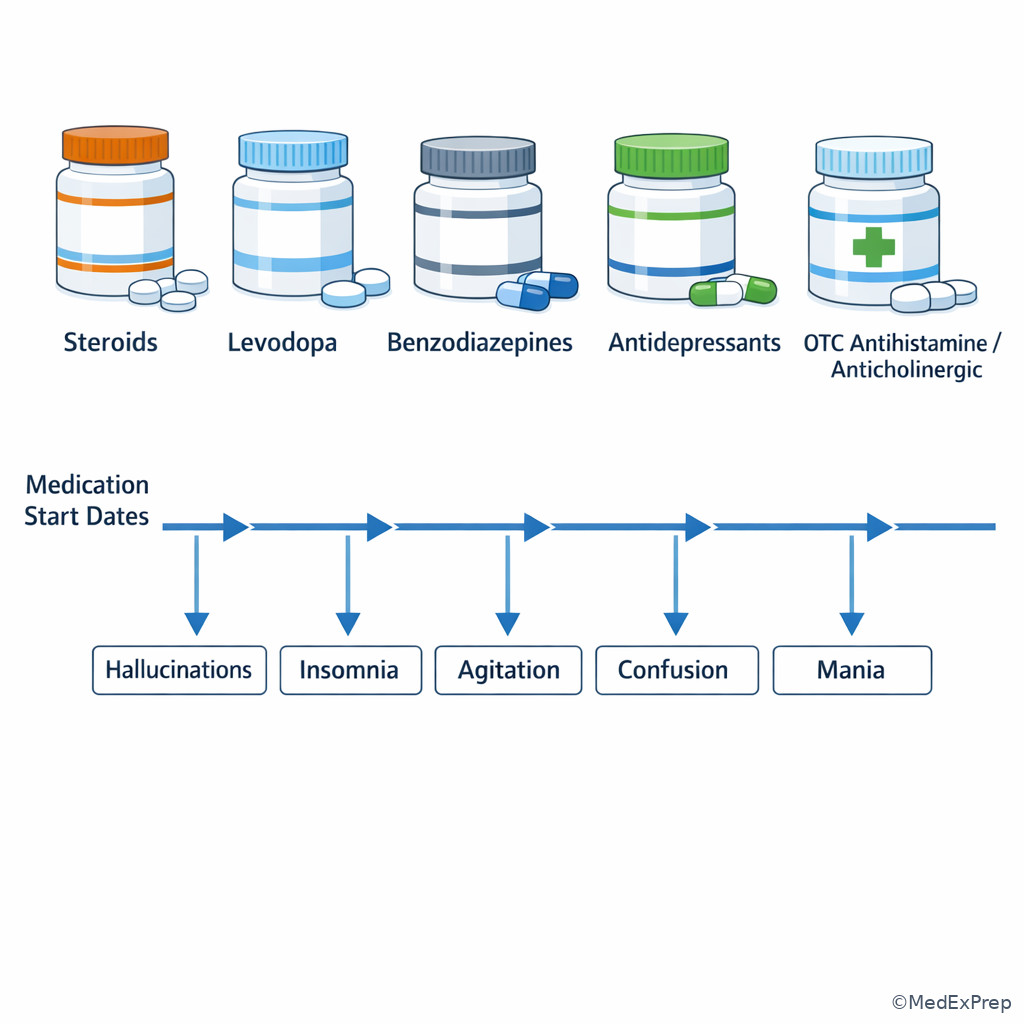
Medication review is equally high-yield. Steroids can provoke mood and psychotic symptoms; levodopa can cause hallucinations; benzodiazepines and anticholinergics can cloud cognition; antidepressants can unmask mania; prescribed stimulants can worsen insomnia and anxiety. Medical history should screen for seizures, endocrine disease, neurologic conditions, infection, chronic pain, pregnancy/postpartum state, and other high-yield mimics.
WHY THIS IS TESTED: Shelf questions reward recognizing when a “psychiatric” presentation is actually a secondary syndrome or when prior psychiatric history changes the most likely diagnosis.
Exam takeaway: New-onset psychiatric symptoms after medication change, substance use, or acute illness should trigger a secondary-cause search.
flowchart TD
A[Psychiatric symptom] --> B{Prior similar episodes?}
B -->|Yes| C[Compare to known psychiatric pattern and past treatment response]
B -->|No| D[Search aggressively for substances, medications, and medical causes]
D --> E{Recent exposure or illness?}
E -->|Yes| F[Secondary cause likely; workup and collateral]
E -->|No| G[Continue primary psychiatric differential]
C --> H{Current story atypical?}
H -->|Yes| F
H -->|No| G
See Fig 3 whenever a stem introduces a new medication, unclear last substance use, or sudden mental status change.
Exam takeaway: Pair new symptoms with recent medication or substance exposure before assuming a primary psychiatric diagnosis.
B Worked example
A 44-year-old man with Crohn disease, hypertension, and remote depression presents with irritability, euphoria, and minimal sleep for 1 week. He recently completed a high-dose prednisone taper for a flare. He denies alcohol use but drinks several energy drinks daily. He once took sertraline in college. The tempting wrong clue is his distant depression history, which might steer you toward bipolar disorder if you stop early.
Reasoning chain: Identify task: what history component most changes the differential? Extract key facts: recent steroid exposure, new manic symptoms, no prior manic history, brief time course. Apply rule: new mood elevation after glucocorticoids suggests a medication-induced syndrome. Eliminate distractors: energy drinks can worsen sleep, but they do not fully explain expansive mood and activation after steroid treatment. Verify: ask dose/timing of steroids, prior reactions, psychotic features, and current safety risk.
C Exam trap
D Checkpoint
Question: A 71-year-old woman with Parkinson disease and recurrent UTIs develops vivid visual hallucinations over 2 days. Which history element is most important to obtain next?
- Family history of bipolar disorder
- Whether she recently started or increased a dopaminergic medication
- Whether she had social anxiety as a teenager
- Whether she prefers to live alone
Answer: B
- A: Tempting because family psychiatric history matters, but it is lower yield than a direct medication trigger for acute hallucinations.
- B: Tempting because Parkinson treatment often affects mental status; it is right because acute visual hallucinations in this context commonly follow dopaminergic or medication changes.
- C: Tempting because remote anxiety can appear in psychiatry histories, but it does not explain sudden hallucinations in an elderly patient.
- D: Tempting because social supports affect disposition, but it does not identify the likely cause of the current syndrome.
1.1.1.6 Family, social, trauma, and developmental history: context that changes interpretation
A Explanation
The decision conflict here is background detail vs clinically relevant context. Students sometimes over-collect facts that do not move the case. The resolving rule: choose family, social, trauma, and developmental elements that change diagnosis, risk, adherence, or disposition.
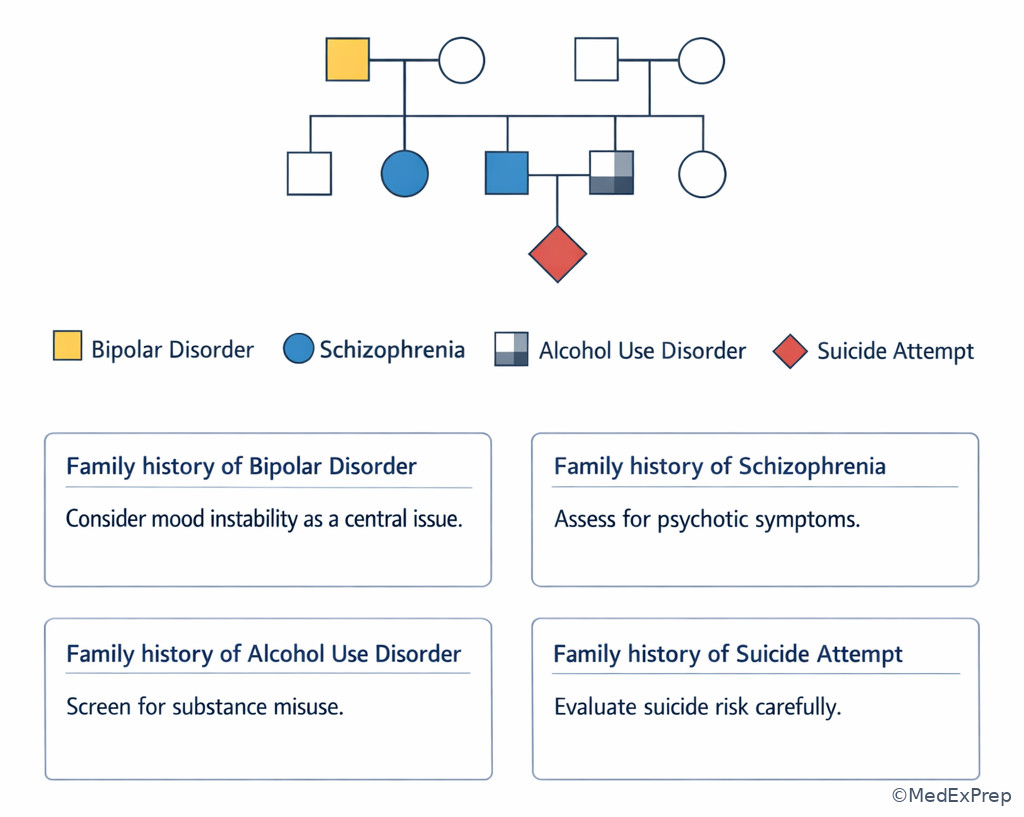
Family history matters most for mood disorders, psychotic disorders, substance use disorders, and suicide. A family history of bipolar disorder can make a “depression” stem more suspicious for bipolar spectrum illness; a family history of suicide raises concern in a suicidal patient. Social history matters because housing, work, legal issues, relationship stress, access to firearms, caregiving burdens, and recent losses often clarify risk and functioning. In psychiatry, “social” is not background fluff; it helps determine whether the patient can be safely managed outpatient.
Trauma history should be obtained respectfully and purposefully. Ask when it is relevant to re-experiencing, avoidance, hyperarousal, dissociation, self-harm, or interpersonal instability—but do not force a detailed trauma narrative in an unstable acute interview. Developmental history is more useful when considering neurodevelopmental disorders, personality patterns, long-standing social/occupational dysfunction, or distinguishing lifelong traits from new adult-onset illness.
WHY THIS IS TESTED: These history domains commonly appear as discriminators in close stems. The right answer may hinge on firearm access, homelessness, family bipolar history, recent bereavement, or trauma-linked avoidance rather than on the symptom complaint alone.
Exam takeaway: Housing, supports, and access to lethal means directly influence disposition decisions.
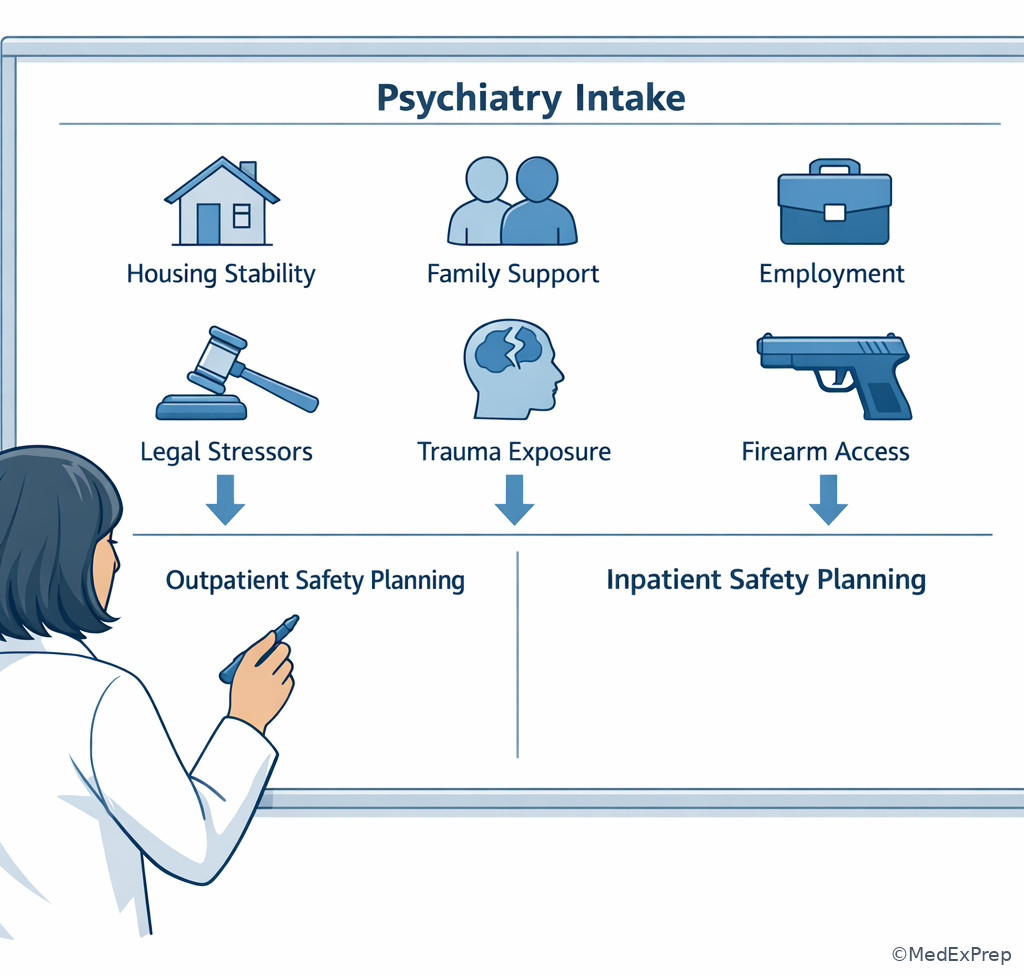
See Fig 4 for why social history often changes the correct disposition answer even when the diagnosis is unchanged.
Exam takeaway: Family history is most useful when it changes pretest probability for bipolar disorder, psychosis, substance use, or suicide.
B Worked example
A 36-year-old man presents with low mood and insomnia after divorce. He has hypertension and alcohol use disorder in remission. He says he has “thoughts that everyone would be better off without me” but denies a current plan. He lives alone, recently bought a handgun for “home protection,” and missed work all week. His mother died by suicide. A tempting wrong clue is the denial of a current plan, which may falsely reassure.
Reasoning chain: Identify task: what additional history element most changes disposition? Extract key facts: passive death thoughts, social isolation, firearm access, family suicide history, functional collapse. Apply rule: means access and supports strongly alter risk assessment even when explicit plan is denied. Eliminate distractors: detailed childhood history or dietary patterns do not affect immediate safety. Verify: ask about intent, rehearsals, reasons for living, ability to remove firearms, and prior attempts.
C Exam trap
D Checkpoint
Question: A 19-year-old college student reports depressed mood for 2 weeks. Which social history element most directly changes acute disposition planning?
- Whether his father has hypertension
- Whether he has access to firearms at home or on campus
- Whether he changed his major this semester
- Whether he plays intramural soccer
Answer: B
- A: Tempting because family medical history is routinely obtained, but it does not directly affect psychiatric safety disposition.
- B: Tempting because it feels very specific; it is right because lethal means access can immediately shift risk management and level of care.
- C: Tempting because academic stress can worsen mood, but it does not directly determine acute safety.
- D: Tempting because exercise can signal function and coping, but it is less urgent than means assessment.
- True or False: Denying a suicide plan always means outpatient management is safe. False.
- The family-history pattern most likely to shift a “depression” stem toward bipolar concern is bipolar disorder in a first-degree relative.
- Name 3 social factors that change disposition: housing, supports, access to lethal means.
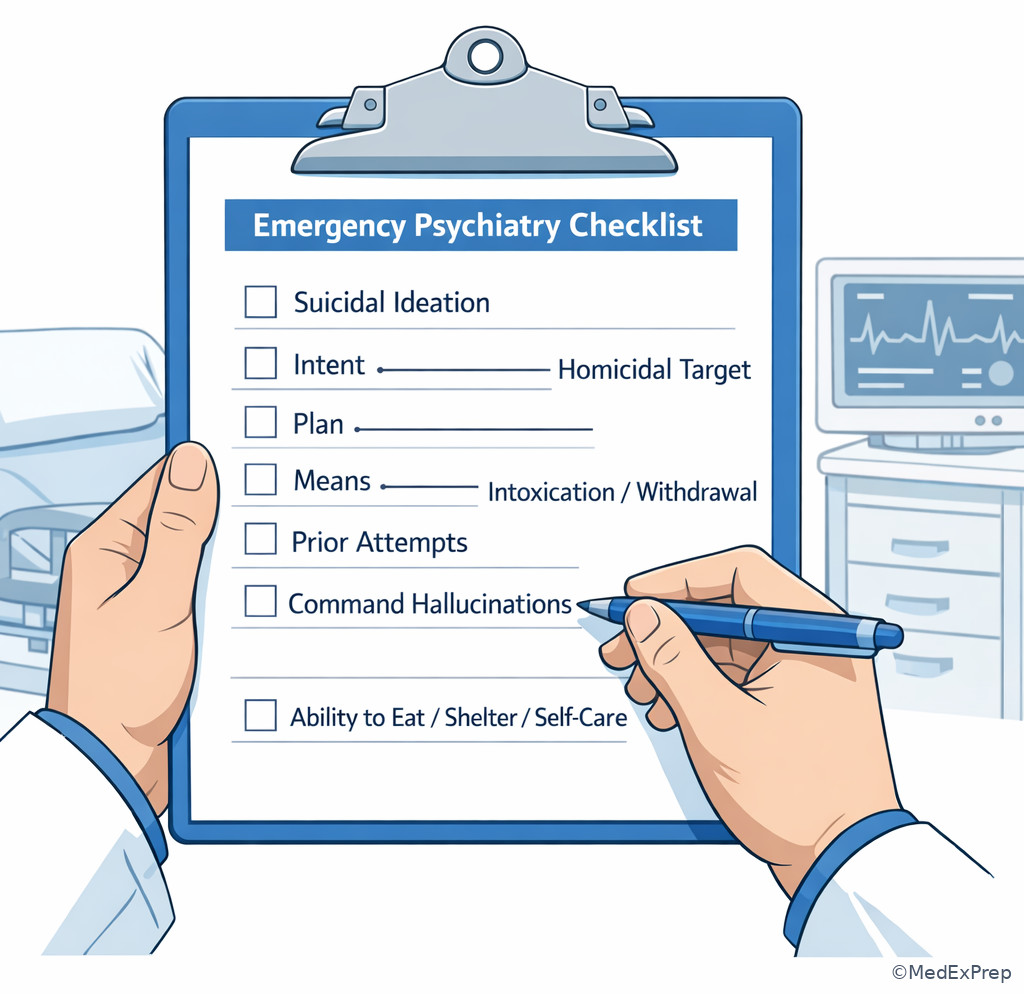
1.1.1.7 Safety history and next-step prioritization: suicide, violence, psychosis, and inability to care for self
A Explanation
The final foundational conflict is continue diagnostic interviewing vs stop and assess immediate safety. The rule is decisive: if any current history raises concern for self-harm, harm to others, severe psychosis, delirium, catatonia, severe intoxication/withdrawal, or inability to meet basic needs, safety assessment becomes the interview priority.
For suicide risk, ask thoughts of death, active ideation, intent, plan, means, timing, preparatory behaviors, past attempts, nonsuicidal self-injury, substance use, hopelessness, supports, and reasons for living. For violence, ask about threats, intent, specific targets, access to weapons, command hallucinations, persecutory delusions, and recent aggression. For psychosis, assess whether hallucinations are commanding, whether delusions impair judgment, and whether the patient can reality-test. For inability to care for self, look for not eating, not drinking, inability to obtain shelter, profound disorganization, or severe functional collapse.
Important exam nuance: asking directly about suicide does not “put the idea in the patient’s head.” On shelves, avoidance is never the right answer. Also, risk is not judged by one item alone. The combination of current intent, means, prior attempts, severe substance use, psychosis, agitation, and social isolation matters far more than any single checkbox.
WHY THIS IS TESTED: Many psychiatry questions are really about triage. The best answer is often hospitalization, urgent evaluation, suicide precautions, or immediate escalation—not naming the diagnosis.
Exam takeaway: Current intent, means, command symptoms, or inability to care for self should trigger urgent escalation before routine diagnostic interviewing.
flowchart TD
A[Psychiatric interview] --> B{Warning sign present?}
B -->|No| C[Continue routine history]
B -->|Yes| D[Ask directly about suicide, violence, psychosis, and self-care]
D --> E{Intent/means/command symptoms/grave disability?}
E -->|Yes| F[Urgent protection, supervised evaluation, likely inpatient level of care]
E -->|No| G[Assess supports, remove means, complete focused risk evaluation]
G --> H[Decide outpatient vs higher level care]
See Fig 5 for the shelf pattern in which safety interrupts the rest of the interview.
Exam takeaway: Direct questions about intent, plan, means, command hallucinations, and self-care determine the immediate next step.
B Worked example
A 47-year-old woman with major depression, chronic pain, and alcohol use presents to clinic after saying she is “done fighting.” She denies a current plan but says she has been giving away jewelry, has not eaten for 2 days, and keeps a loaded gun in her bedside table. She also complains of constipation from opioids, which is a tempting but irrelevant distractor. She lives alone and missed her last two appointments.
Reasoning chain: Identify task: most appropriate next step in the interview and disposition. Extract key facts: hopelessness, preparatory behavior, firearm access, impaired self-care, isolation, substance use. Apply rule: even without a verbally stated plan, preparatory acts plus means access make this high risk. Eliminate distractors: adjusting antidepressants or discussing sleep hygiene ignores imminent safety. Verify: the interview should directly assess intent, secure lethal means, and escalate for urgent psychiatric evaluation, likely inpatient.
C Exam trap
D Checkpoint
Question: A 26-year-old man with new paranoia says neighbors are transmitting messages through his television. He has not slept in 3 days and reports a voice telling him to “protect yourself before they kill you.” What is the most appropriate next step?
- Obtain a detailed childhood trauma history
- Ask directly whether the voice is commanding him to harm himself or others and whether he has access to weapons
- Ask whether he has seasonal mood variation
- Discuss outpatient therapy options
Answer: B
- A: Tempting because trauma can contribute to paranoia, but it does not address immediate risk from possible command hallucinations.
- B: Tempting because it is narrow; it is right because command content and weapon access immediately determine safety and level of care.
- C: Tempting because sleep loss can occur with mood disorders, but seasonal pattern is irrelevant during acute psychotic risk assessment.
- D: Tempting because therapy is part of psychiatric care, but acute command hallucinations require immediate safety clarification first.
Exam Traps & Differentiators
- Most common wrong answer: choosing a diagnosis before clarifying chronology. Why: symptom labels in stems are seductive. Fix: ask onset, duration, and associated features first.
- Looks similar but isn’t: insomnia from depression/anxiety vs decreased need for sleep in mania. The discriminator is preserved energy and lack of fatigue.
- Looks similar but isn’t: primary psychosis vs delirium. The discriminator is acute fluctuation, impaired attention, and medical context.
- Looks similar but isn’t: passive suicidal language vs lower risk. The discriminator is intent, means, preparatory behavior, and supports—not wording alone.
- Looks similar but isn’t: prior psychiatric history vs current psychiatric cause. The discriminator is whether a new medication, substance, or medical event temporally triggered the symptoms.
If the stem says “just started prednisone,” think medication-induced mood or psychotic symptoms before bipolar disorder.
If the stem says “seeing animals/bugs,” acute onset, and older age, think delirium or medication effect before schizophrenia.
If the stem says “hasn’t slept but isn’t tired,” think mania rather than simple insomnia or anxiety.
If the stem says “denies plan” but has a gun, gave away belongings, or is hearing commands, think high acute risk anyway.
If the stem says “no psychiatric history” with sudden onset symptoms, think medical/substance/medication rule-out.
If the stem says the patient is disorganized, intoxicated, manic, psychotic, or confused, think collateral and reliability issues—an upcoming confusable pair with the next lesson sequence.
| Look-alike pair | Tempting overlap | Single best discriminator from history | Most likely exam action |
|---|---|---|---|
| Depression vs bipolar depression | Low mood, insomnia, poor concentration | Past mania/hypomania or decreased need for sleep | Ask manic screening questions before labeling unipolar depression |
| Primary psychosis vs delirium | Hallucinations, fear, altered behavior | Acute fluctuation with impaired attention and medical trigger | Medical workup and urgent assessment |
| Anxiety insomnia vs mania | Restlessness and poor sleep | No fatigue despite very little sleep | Assess manic features and risk |
| Passive SI vs high acute risk | Patient denies a detailed plan | Means access or preparatory behavior | Escalate safety evaluation |
| Primary mood disorder vs steroid effect | Euphoria, irritability, insomnia | Recent glucocorticoid exposure | Review medication timeline and supervise management |
Tables
| Psychiatric history component | What to ask | Why examiners care |
|---|---|---|
| Chief concern | Patient’s main problem in their own words | Frames the interview and may reveal distress, insight, or mismatch with collateral |
| HPI | Onset, duration, triggers, associated symptoms, severity, impairment | Most diagnostic distinctions come from timeline and syndrome clustering |
| Past psychiatric history | Diagnoses, hospitalizations, attempts, treatment response | Past episodes predict diagnosis and risk |
| Substance history | Type, amount, route, frequency, last use, withdrawal history | Substances commonly mimic or cause psychiatric symptoms |
| Medication history | Prescription, OTC, recent changes, adherence, adverse effects | Medication-induced syndromes are frequent shelf traps |
| Medical history | Neurologic, endocrine, infectious, pain, pregnancy/postpartum, sleep issues | Rules out secondary causes and changes workup |
| Family history | Mood, psychosis, substance use, suicide | Changes pretest probability |
| Social history | Housing, work, supports, legal issues, relationships, firearms | Determines function and disposition safety |
| Trauma history | Exposure, current re-experiencing, avoidance, hyperarousal | Clarifies trauma-related syndromes without overpathologizing stress |
| Safety history | SI/HI, intent, plan, means, commands, self-care ability | Can immediately override the rest of the interview |
| Complaint in stem | History question that best refines it | Choose this if... | Reject this if... |
|---|---|---|---|
| “I can’t sleep” | Do you feel tired, or do you not need sleep? | Need to separate anxiety/depression from mania | You already know the sleep pattern is secondary to pain or apnea |
| “I’m depressed” | How long, with what associated symptoms, and how impaired are you? | Need syndrome and severity definition | There is immediate self-harm risk that must be asked first |
| “I hear voices” | What do the voices say, and when did this start? | Need to assess command content and acute onset | There is obvious delirium requiring urgent medical stabilization |
| “I’m anxious” | Are episodes unexpected, triggered, or constant? | Need to split panic from GAD or situational anxiety | The patient is medically unstable or intoxicated |
| “I want to disappear” | Are you thinking of killing yourself, and do you have a plan or means? | Any self-harm concern appears | Never reject; direct questioning is indicated |
| Differential clue | Primary psychiatric pattern | Secondary/medical-substance pattern | High-yield discriminator |
|---|---|---|---|
| Onset | Often subacute or chronic, though exceptions exist | Often abrupt after exposure or illness | Sudden change in an older patient is secondary until proved otherwise |
| Course | More internally consistent syndrome pattern | Fluctuating, waxing-waning, or exposure-linked | Fluctuation suggests delirium or toxic-metabolic process |
| Consciousness/attention | Usually preserved in primary mood/anxiety disorders | Impaired in delirium and many intoxication states | Attention testing matters when confusion is present |
| Medication timeline | No clear exposure link | Symptoms follow initiation or dose change | Steroids, dopaminergic drugs, anticholinergics are classic clues |
| Substance timeline | Not tightly linked to intoxication/withdrawal | Occurs during use or soon after cessation | Last use and withdrawal history are mandatory questions |
| Age of first presentation | Depends on disorder, often younger | Older new-onset symptoms need medical review | Late-life first psychosis or mania deserves rule-out workup |
Algorithm / Approach
Exam takeaway: The best next question is the one that most changes safety, differential diagnosis, or disposition.
flowchart TD
A[Start interview] --> B{Immediate danger or instability?}
B -->|Yes| C[Ask suicide, violence, psychosis, intoxication, self-care questions]
C --> D[Urgent escalation and focused history]
B -->|No| E[Clarify HPI timeline and symptom cluster]
E --> F{Abrupt onset or new exposure?}
F -->|Yes| G[Review substances, medications, and medical causes]
F -->|No| H[Review past psychiatric history and prior episodes]
G --> I[Assess reliability and obtain collateral if needed]
H --> I
I --> J[Add family, social, trauma, and functional context]
J --> K[Choose diagnosis, workup, and disposition]
See Fig 6 as the complete “what do I ask next?” framework for early psychiatry shelf questions.
Exam takeaway: Start broad, then branch to safety or secondary-cause questions as soon as the history demands it.
Rapid Review
- Chief concern → patient’s words start the interview, but they do not determine the diagnosis
- HPI → timeline beats symptom label
- Insomnia → no fatigue suggests mania, not routine anxiety/depression insomnia
- Acute hallucinations in older adult → think medical/medication/substance until ruled out
- Past suicide attempt → stronger risk marker than many current verbal reassurances
- Substance history → incomplete without last use and withdrawal history
- Medication history → recent steroid or dopaminergic exposure can explain new psychiatric symptoms
- Family bipolar history → shifts a “depression” stem toward bipolar screening
- Social history → means access and supports change disposition more than many symptom details
- Trauma history → ask purposefully when it changes the syndrome or management question
- Functional impairment → separates distress from disorder severity
- Safety questions → direct questioning is indicated; avoidance is never the best answer
- New-onset psychiatric symptoms → chronological exposure review first, especially if abrupt
- Poor reliability → psychosis, mania, intoxication, delirium, and cognitive impairment should make you seek collateral
Self-check quiz
1. A 24-year-old woman presents for low mood after a breakup. She has asthma and migraine, denies substance use, and says she is “not sleeping.” Which history question best distinguishes mania from anxiety-related insomnia?
- Whether she has a family history of hypertension
- Whether she feels rested and energetic despite very little sleep
- Whether she prefers caffeine-free soda
- Whether she had childhood enuresis
2. A 73-year-old man with benign prostatic hyperplasia and diabetes develops visual hallucinations and confusion over 1 day after starting a new medication. Which history domain is most important to clarify next?
- Recent medication changes
- Long-term career satisfaction
- Religious affiliation
- Favorite hobbies in retirement
3. A 31-year-old man with no psychiatric admissions reports “panic attacks” for 1 week after using cocaine heavily at a music festival. He has hypertension and ADHD and says he last used “a couple days ago.” He is restless but oriented and asks for “an anxiety diagnosis.” What is the most appropriate next step in the history?
- Clarify amount, frequency, route, and exact timing of stimulant use
- Move directly to generalized anxiety disorder diagnosis because he reports panic
- Ask only about childhood separation anxiety
- Skip to psychotherapy preference because substances are already admitted
4. A 66-year-old woman with COPD, osteoarthritis, and chronic insomnia is brought by her son for new paranoia and seeing “children in the hallway” since this morning. She has a mild fever and started diphenhydramine nightly 3 days ago. What is the most appropriate next step?
- Diagnose late-onset schizophrenia based on hallucinations
- Clarify baseline cognition, fluctuation, recent illness, and medication exposure
- Ask whether she has perfectionistic personality traits
- Focus only on family psychiatric history
5. A 20-year-old college student with depression, cannabis use, and recent academic failure says, “Sometimes I think everyone would be better off if I were gone.” He denies a specific plan. He lives alone off campus and recently bought a handgun after a burglary. What is the most appropriate next step in the interview?
- Provide reassurance because he denied a plan
- Ask directly about intent, access to the handgun, preparatory behavior, and supports
- Shift to detailed childhood developmental history
- Ask whether his symptoms worsen every winter
6. A 42-year-old woman with ulcerative colitis, obesity, and remote postpartum depression presents with pressured speech, irritability, decreased need for sleep, and impulsive online spending for 6 days. She completed high-dose prednisone 1 week ago for a flare. Her sister has major depression. Which is the most likely explanation for her current symptoms?
- Primary bipolar disorder
- Glucocorticoid-induced mood symptoms
- Generalized anxiety disorder
- Borderline personality disorder
7. A 70-year-old retired teacher with hypertension and mild hearing loss is brought in for “new psychosis.” Over 12 hours she became disoriented, pulled at IV lines, and reported seeing insects on the ceiling after admission for pneumonia. She has no psychiatric history. Which additional history element most strongly supports a medical rather than primary psychiatric cause?
- Family history of schizophrenia
- Fluctuating attention and rapid onset after acute illness
- Lifelong shyness
- Recent bereavement
8. A 28-year-old man with no formal psychiatric diagnosis is brought by police after yelling that neighbors are poisoning him. He has slept minimally for 4 nights, drinks heavily on weekends, and used “something at a party” 2 days ago. He is intermittently cooperative and says a voice told him to “strike first.” Which is the most appropriate immediate interviewing priority?
- Detailed trauma chronology to evaluate PTSD
- Direct assessment of command hallucinations, homicidal intent, weapon access, and recent substance use timeline
- Discussion of long-term antipsychotic maintenance options
- Detailed family pedigree for bipolar and schizophrenia
Answer key
1. Correct answer: B
- A: Tempting because family history belongs in every psychiatric interview, but it does not distinguish the sleep complaint here. The discriminating clue is the nature of the sleep reduction, not vascular family history. Source: First Aid for the USMLE Step 2 CK; DSM-5-TR.
- B: Correct. Mania is suggested by decreased need for sleep, meaning the patient sleeps little yet still feels energetic and not fatigued. That single feature separates mania from anxiety- or depression-related insomnia, in which patients usually feel tired. The discriminating clue is “rested despite very little sleep.” Source: DSM-5-TR; Harrison’s Principles of Internal Medicine.
- C: Tempting because caffeine can worsen insomnia and anxiety, but it is a secondary contributor, not the key discriminator the stem is testing. The clue is the syndromic sleep pattern, not beverage preference. Source: First Aid for the USMLE Step 2 CK.
- D: Tempting because developmental history sometimes appears in psychiatry vignettes, but it is far less relevant than clarifying a potential manic symptom. The clue is the current sleep-energy relationship. Source: DSM-5-TR.
2. Correct answer: A
- A: Correct. Acute confusion and visual hallucinations after a new drug strongly suggest medication effect or delirium. The discriminating clue is one-day onset after medication initiation. Source: Harrison’s Principles of Internal Medicine; DSM-5-TR.
- B: Tempting because psychosocial stress can affect mental health, but it does not explain abrupt hallucinations in an older patient. The clue is the exposure-linked onset. Source: Harrison’s Principles of Internal Medicine.
- C: Tempting because religion may be relevant to coping or delusional content, but it does not identify the likely cause of an acute syndrome. The clue remains the new medication. Source: DSM-5-TR.
- D: Tempting because hobbies reflect baseline function, but they are low priority in a likely secondary mental status change. The clue is abrupt onset with medication change. Source: First Aid for the USMLE Step 2 CK.
3. Correct answer: A
- A: Correct. Panic-like symptoms after cocaine use require detailed substance chronology because stimulant intoxication or withdrawal can mimic anxiety. The discriminating clue is the recent heavy cocaine use and vague “couple days ago” last-use history. Source: DSM-5-TR; Harrison’s Principles of Internal Medicine.
- B: Tempting because the patient uses the term “panic attacks,” but the exam tests rejection of self-labeled diagnoses when a substance explanation is plausible. The clue is the stimulant exposure. Source: DSM-5-TR.
- C: Tempting because anxiety disorders have developmental patterns, but childhood history is lower yield than immediate substance clarification. The clue is the temporal relationship to cocaine. Source: First Aid for the USMLE Step 2 CK.
- D: Tempting because treatment preferences matter eventually, but choosing treatment before clarifying whether this is substance-related is premature. The clue is incomplete exposure history. Source: Harrison’s Principles of Internal Medicine.
4. Correct answer: B
- A: Tempting because hallucinations and paranoia can suggest psychosis, but late-onset schizophrenia is far less likely than delirium or medication effect in this stem. The discriminating clue is acute onset with fever and anticholinergic exposure. Source: Harrison’s Principles of Internal Medicine; DSM-5-TR.
- B: Correct. Baseline cognition, fluctuation, illness timeline, and medication exposure are the highest-yield next questions when an older patient develops abrupt hallucinations. The single discriminating clue is this morning plus diphenhydramine use and fever. Source: Harrison’s Principles of Internal Medicine.
- C: Tempting because personality can influence presentation, but personality disorders do not cause sudden hallucinations with medical illness. The clue is acute fluctuation. Source: DSM-5-TR.
- D: Tempting because family history helps with psychiatric differentials, but it is lower yield than immediate delirium screening. The clue is the acute medical context. Source: First Aid for the USMLE Step 2 CK.
5. Correct answer: B
- A: Tempting because denial of a specific plan can feel reassuring, but it is insufficient when means access and worsening function are present. The discriminating clue is the recently purchased handgun plus social isolation. Source: DSM-5-TR; APA suicide assessment principles.
- B: Correct. Direct questioning about intent, firearm access, preparatory behavior, and supports is the appropriate safety pivot. The discriminating clue is passive suicidal language combined with lethal means access. Source: First Aid for the USMLE Step 2 CK; DSM-5-TR.
- C: Tempting because a full psychiatric history is generally important, but developmental detail is lower priority than acute safety assessment. The clue is immediate self-harm concern. Source: APA Practice Guideline; Harrison’s.
- D: Tempting because depression questions often include seasonality, but it does not address current risk. The clue is firearm access, not seasonal pattern. Source: DSM-5-TR.
6. Correct answer: B
- A: Tempting because the patient has classic manic symptoms and a mood history, but the single clue against primary bipolar disorder is the close temporal relationship to recent high-dose prednisone. Source: Harrison’s Principles of Internal Medicine; DSM-5-TR.
- B: Correct. Glucocorticoids can induce euphoria, irritability, insomnia, and psychotic symptoms. The discriminating clue is symptom emergence shortly after steroid exposure, especially without prior mania. Source: Harrison’s; First Aid for the USMLE Step 2 CK.
- C: Tempting because anxiety can cause insomnia and irritability, but it does not explain decreased need for sleep and impulsive spending. The clue is the manic syndrome pattern. Source: DSM-5-TR.
- D: Tempting because impulsivity can occur in borderline personality disorder, but a 6-day acute activated syndrome after steroids fits medication-induced symptoms better. The clue is abrupt exposure-linked onset rather than chronic interpersonal instability. Source: DSM-5-TR.
7. Correct answer: B
- A: Tempting because family history can increase psychiatric risk, but it does not outweigh the acute hospitalized onset in an older adult. The discriminating clue is rapid fluctuation during pneumonia treatment. Source: Harrison’s Principles of Internal Medicine.
- B: Correct. Fluctuating attention with rapid onset after acute illness strongly supports delirium rather than primary psychosis. The discriminating clue is 12-hour change during pneumonia admission. Source: DSM-5-TR; Harrison’s.
- C: Tempting because premorbid personality can affect presentation, but lifelong shyness does not explain abrupt visual hallucinations and line-pulling. The clue is attentional disturbance and fluctuation. Source: First Aid for the USMLE Step 2 CK.
- D: Tempting because bereavement can cause distress or even transient perceptual experiences, but it does not account for acute disorientation in the setting of infection. The clue is systemic illness with waxing-waning attention. Source: DSM-5-TR.
8. Correct answer: B
- A: Tempting because trauma can present with paranoia or hypervigilance, but it is not the immediate priority when command-like voices and potential violence are in play. The discriminating clue is “strike first.” Source: DSM-5-TR; emergency psychiatry principles.
- B: Correct. In an agitated, paranoid patient with possible substance involvement and possible command hallucinations, the immediate interviewing priority is direct assessment of homicidal risk, command content, weapons, and substance timeline. The discriminating clue is the voice telling him to act violently. Source: Harrison’s Principles of Internal Medicine; DSM-5-TR.
- C: Tempting because long-term treatment matters eventually, but it is unsafe to move to maintenance planning before clarifying immediate threat and intoxication. The clue is acute dangerousness, not chronic management. Source: First Aid for the USMLE Step 2 CK.
- D: Tempting because family pedigree helps the broader differential, but acute violence/safety assessment cannot wait. The clue is active paranoid command content plus uncertain substance use. Source: DSM-5-TR.
Keep going with the full Psychiatry Shelf Prep Course (Psych Shelf)
You just studied the way members do, in the same lesson interface. Full access unlocks every lesson, the question bank and flashcards for a full year.
One payment · 1 year of access · No auto-renewal