1.1.1 - Public Content Areas
1.1.1 Public Content Areas
This lesson shows how to organize the publicly available RNC-OB exam content areas into a usable study map without inventing unpublished blueprint details. The exam tests inpatient obstetric nursing judgment: what to assess, what is normal versus concerning, what to do next within RN scope, and when to escalate.
What you'll learn
- Map broad public RNC-OB content areas into practical study buckets and bedside decision tasks.
- Distinguish content-area language from actual testable nursing actions such as assessment, intervention, monitoring, documentation, teaching, and escalation.
- Recognize how antepartum, intrapartum, postpartum, fetal surveillance, pharmacology, immediate newborn, and safety topics connect on exam questions.
- Choose the safest next nursing action when a stem mixes maternal, fetal, and workflow cues.
- Build a study plan that follows public content areas while staying inside RN inpatient obstetric scope.
Blueprint mapping
- Exam Framework → Public content areas → convert broad domains into teachable subskills.
- Antepartum assessment and maternal-fetal well-being → assessment cues, warning signs, escalation triggers.
- Intrapartum care and labor progress → labor assessment, contraction patterns, support, urgent changes.
- Fetal assessment and electronic monitoring → baseline, variability, decelerations, bedside response.
- Postpartum recovery and complications → stabilization, bleeding, infection, education.
- Immediate newborn considerations → transition assessment, thermoregulation, early concerns, safety.
- Pharmacology, communication, and safety → monitoring, adverse effects, handoff, delegation, chain of command.
Estimated time
45–60 minutes
Prereqs
None in-course yet. Forward links: RN Scope Boundaries and Institutional Policy Variability.
Key outputs
- You should be able to sort any question stem into the correct public content area.
- You should be able to identify the nursing task hiding under broad blueprint wording.
- You should be able to reject out-of-scope answer choices even when they sound clinically reasonable.
Why it matters
- Broad blueprint language becomes manageable only when translated into bedside nursing tasks: assess, interpret, intervene, reassess, document, escalate.
- Many wrong answers sound sophisticated because they reflect provider-level decision-making rather than the RN's safest next action.
- The RNC-OB exam blends domains in one stem; a labor question may also test fetal surveillance, medication safety, documentation, or postpartum stabilization.
- A clear content map reduces random studying and improves pattern recognition under time pressure.
Exam takeaway: Use the public content areas to sort stems into the nursing task being tested before choosing an action.
flowchart TD
A[RNC-OB Public Content Areas] --> B[Antepartum]
A --> C[Intrapartum]
A --> D[Fetal Surveillance]
A --> E[Obstetric Emergencies]
A --> F[Postpartum]
A --> G[Immediate Newborn]
A --> H[Pharmacology]
A --> I[Safety and Communication]
B --> B1[Assessment and warning signs]
C --> C1[Labor progress and bedside care]
D --> D1[Tracing interpretation and response]
E --> E1[Recognition and escalation]
F --> F1[Recovery and complications]
G --> G1[Transition and safety]
H --> H1[Monitor effects and adverse effects]
I --> I1[SBAR, documentation, delegation]
Exam takeaway: Visual grouping helps you remember that the exam samples across the whole inpatient OB episode, not isolated facts.
Key Terms & Must-Know Facts
1.1.1.1 Key terms
- Public content area: broad exam topic category available to candidates.
- Subskill: a teachable bedside task derived from a broad content area.
- Best next nursing action: the highest-priority RN step based on current findings.
- Escalation: notifying provider, charge nurse, or activating emergency response per policy.
- Maternal stabilization: priority support of airway, breathing, circulation, perfusion, bleeding, and neurologic status.
- Fetal surveillance: assessment of fetal well-being through movement, heart rate, and contraction relationship.
- Labor progress evaluation: interpretation of cervical change, descent, uterine activity, and maternal-fetal response.
- Postpartum stabilization: early recovery assessment focused on bleeding, fundus, bladder, pain, vital signs, and complications.
- Immediate newborn transition: initial adaptation after birth including respirations, temperature, tone, color, and glucose risk.
- Scope boundary: the line between RN action and provider-only decision-making.
- Policy-aware language: wording such as “follow institutional protocol,” “verify order,” or “escalate promptly.”
- Distractor: a plausible option that fails because of priority, timing, scope, or a single missing cue.
1.1.1.2 Must-know facts
- The exam uses broad public categories; do not rely on invented percentages or unofficial task lists.
- Most stems test nursing judgment, not independent medical diagnosis.
- Maternal safety comes first when maternal and fetal concerns compete.
- Many questions combine two or more content areas in one scenario.
- Actions that sound definitive or provider-level are often traps for RNC-OB nurses.
- Monitoring and reassessment are as testable as the intervention itself.
- Documentation, communication, and escalation are core content, not “extra” skills.
- Local protocols vary; exam-safe language focuses on policy, orders, reassessment, and escalation.
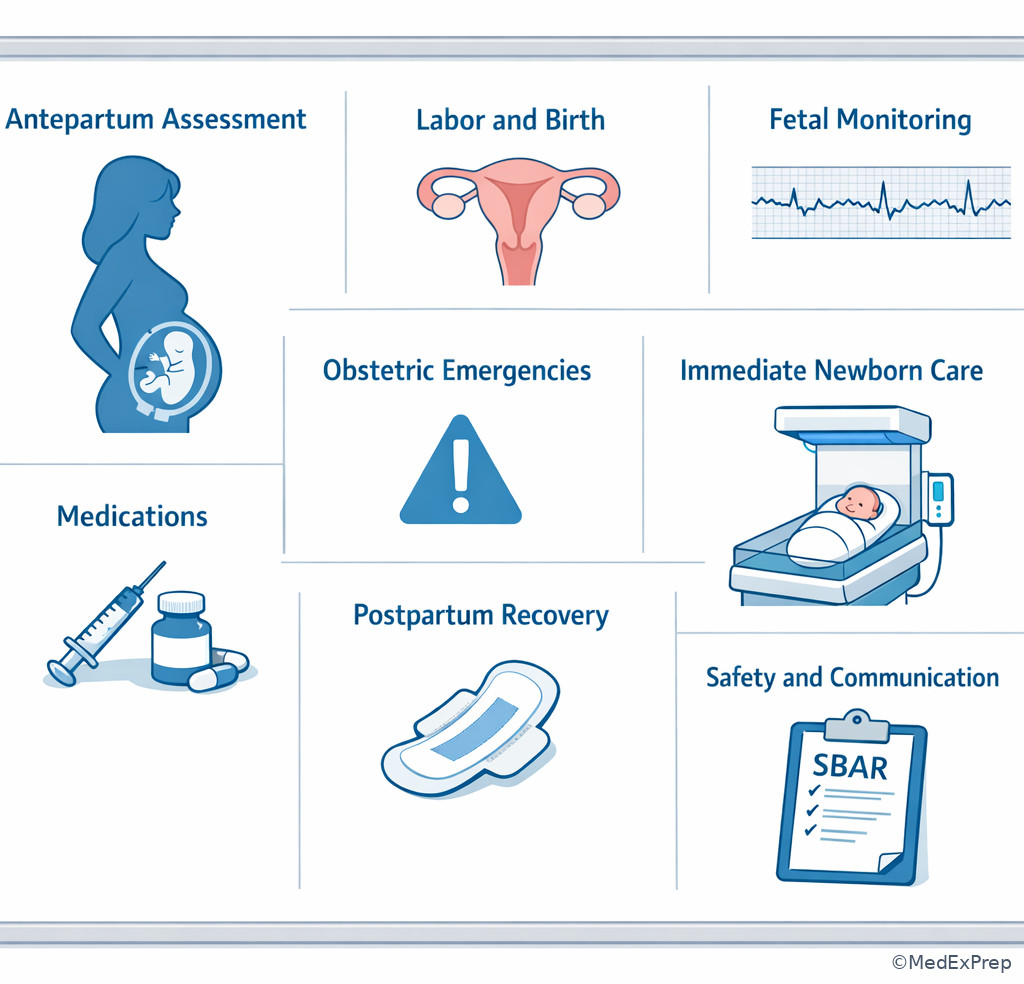
| Public content area | What the exam is really asking you to do | Typical RN action verbs |
|---|---|---|
| Antepartum assessment | Identify normal vs concerning maternal-fetal findings | Assess, compare, notify, teach |
| Labor and birth | Evaluate progress and bedside safety needs | Monitor, position, support, document |
| Fetal surveillance | Interpret tracing pattern and choose immediate nursing response | Interpret, intervene, reassess, escalate |
| Obstetric emergencies | Recognize deterioration and activate urgent response | Call, assist, support, prepare |
| Postpartum recovery | Detect instability early after birth | Check, massage, quantify, report |
| Immediate newborn | Support transition and identify urgent concerns | Warm, assess, stimulate, escalate |
| Pharmacology | Monitor ordered therapy and adverse effects | Verify, administer, monitor, hold, notify |
| Safety and communication | Hand off clearly and protect patient safety | Document, report, delegate, confirm |
Core content
1.1.1.3 Foundational map: from broad content area to bedside nursing task
A Explanation
The first decision conflict is not clinical treatment; it is classification. When a stem feels broad, choose between memorizing topic labels and identifying the actual nursing task. The correct move is to ask: What am I being asked to do as the RN right now? A public content area is only the outer bucket. The score-producing step is converting that bucket into an action such as assessing a contraction pattern, recognizing excessive bleeding, monitoring magnesium effects, or escalating a concerning tracing. WHY THIS IS TESTED: exam items often hide a simple priority action inside broad obstetric wording.
Choose the content area only after identifying the action. For example, “patient at 38 weeks with headache, edema, elevated blood pressure, and decreased fetal movement” may sound like antepartum assessment, hypertensive disorder recognition, fetal well-being, and escalation all at once. The stem is not asking for a diagnosis label first. It is asking which nursing action takes priority based on current findings. This is why public content areas are useful as study organizers but insufficient as answer strategies.
See Fig 1 for the broad map. Use it to place the question, then narrow to the nursing verb: assess, interpret, intervene, reassess, document, or escalate.
B Worked example
A 29-year-old G2P1 at 39 weeks is admitted in active labor with gestational diabetes controlled by insulin and obesity. She reports increasing pressure and nausea. Her support person says, “I think the baby is coming now.” The monitor shows recurrent variable decelerations, and the patient also mentions she has not eaten since morning. The tempting wrong clue is the nausea and fasting status, which may push the learner toward food or antiemetic thinking. Identify task → this is not nutrition management first; it is fetal surveillance plus intrapartum bedside response. Extract key facts → laboring patient, recurrent variables, active labor, urgent interpretation needed. Apply rule → prioritize interventions related to fetal status and labor safety. Eliminate distractors → snacks, routine education, and nonurgent chart cleanup are lower priority. Verify → choose a nursing action that addresses the tracing and ongoing assessment.
C Exam trap
Why it is tempting: Candidates often think advanced-sounding terminology proves deeper knowledge.
Single clue that eliminates it: The stem asks for the best next nursing action, not a provider decision.
D Checkpoint
Question: A board-style stem describes a postpartum patient with heavy lochia, a boggy fundus, tachycardia, and increasing anxiety. Which framing best identifies the exam task before selecting an answer?
- Determine the exact etiology of the hemorrhage before acting.
- Classify the stem as postpartum stabilization and choose the highest-priority RN intervention.
- Focus on discharge teaching because anxiety may worsen perception of blood loss.
- Wait for a complete provider assessment before interpreting the bleeding pattern.
- A: Tempting because cause matters clinically; wrong because bedside priority precedes definitive etiology.
- B: Tempting because it sounds broad, and right because public content area plus priority RN action is the correct framework.
- C: Tempting because teaching is a nursing role; wrong because circulation and active assessment come first.
- D: Tempting because collaboration is important; wrong because the RN must assess and intervene immediately within scope.
1.1.1.4 The main public content areas and what each one really tests
A Explanation
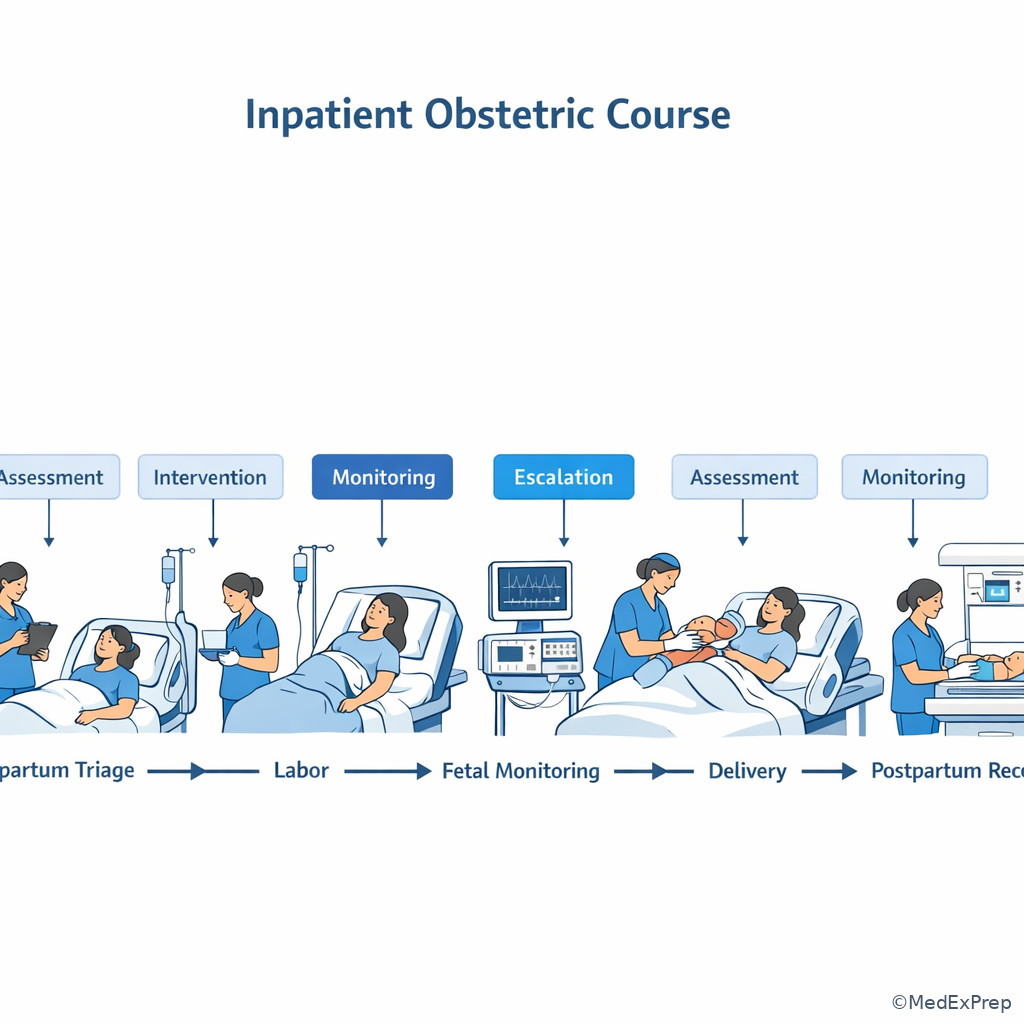
The second foundational choice is between content memorization and content discrimination. The RNC-OB public areas are not isolated chapters in real life. They overlap around the inpatient timeline: antepartum triage, labor care, fetal monitoring, urgent complications, recovery, and immediate newborn transition. The resolving rule is this: each content area has a signature nursing question type. Antepartum asks, “Is this expected or concerning?” Intrapartum asks, “Is labor progress and bedside support adequate and safe?” Fetal surveillance asks, “What does the pattern mean and what should I do now?” Postpartum asks, “Is the patient recovering normally or becoming unstable?” Immediate newborn asks, “Is the newborn transitioning normally?” Pharmacology asks, “What must I monitor?” Safety and communication ask, “Who needs to know, what needs to be documented, and what must the RN keep?” WHY THIS IS TESTED: candidates who recognize the question type eliminate distractors faster than candidates who only memorize categories.
See Fig 2 for a comparison view. This kind of compression matters because a single stem may activate several content buckets, but one action remains the priority. For example, a patient on magnesium sulfate with decreased respirations is pharmacology, obstetric emergency, and communication—but the nursing question type is monitoring-related deterioration with immediate escalation.
Exam takeaway: Match the stem to the nursing question type to narrow the best answer quickly.
flowchart LR
A[Antepartum] --> A1[Expected vs warning sign]
B[Intrapartum] --> B1[Progress vs problem]
C[Fetal Surveillance] --> C1[Pattern vs response]
D[Emergencies] --> D1[Recognize vs escalate]
E[Postpartum] --> E1[Recovery vs instability]
F[Immediate Newborn] --> F1[Transition vs distress]
G[Pharmacology] --> G1[Therapeutic effect vs adverse effect]
H[Safety and Communication] --> H1[Document vs escalate vs delegate]
Exam takeaway: Think of the exam as following the inpatient mother-baby episode across connected nursing decisions.
B Worked example
A 35-year-old primigravida at 32 weeks is admitted for observation after reporting decreased fetal movement. She has chronic hypertension and a history of anxiety. Her blood pressure is mildly elevated compared with baseline, and she says, “My smartwatch says my pulse is always high.” The tempting wrong clue is the smartwatch and anxiety, which can pull attention toward reassurance or nonclinical data. Identify task → this is antepartum assessment with fetal well-being emphasis. Extract key facts → decreased fetal movement is the signal; chronic hypertension adds risk; anxiety is noise unless it changes immediate safety. Apply rule → choose the answer that addresses maternal-fetal assessment and escalation as needed, not generic reassurance. Eliminate distractors → routine coping teaching or future appointment scheduling are lower priority. Verify → the best nursing action aligns with antepartum assessment and fetal status evaluation.
C Exam trap
Why it is tempting: These details feel urgent and human-centered.
Single clue that eliminates it: The highest-risk physiologic cue in the stem points to the tested content area and should drive priority.
D Checkpoint
Question: A question asks which patient receiving magnesium sulfate requires the most immediate nursing action. Which public content area pairing best captures the stem?
- Immediate newborn care and discharge education
- Pharmacology monitoring and obstetric emergency recognition
- Routine labor support and comfort measures
- Postpartum teaching and delegation planning
- A: Tempting only if the learner focuses on obstetrics generally; wrong because the drug-monitoring cue dominates.
- B: Tempting because both labels fit, and right because the stem centers on adverse-effect monitoring and urgent response.
- C: Tempting because magnesium may appear during labor; wrong because comfort is not the tested task.
- D: Tempting because communication matters; wrong because emergency monitoring takes priority.
- The content area most associated with “pattern plus response” is fetal surveillance.
- True or False: A broad blueprint category tells you the answer without identifying the nursing task. False.
- Name the three common action layers in a stem: recognition, intervention, escalation.
1.1.1.5 Application: how broad content areas appear in mixed board-style stems
A Explanation
Once you know the categories, the next decision conflict is whether to follow the loudest detail or the most actionable detail. Mixed stems intentionally combine comorbidities, emotional cues, and secondary findings. The resolving rule is to locate the cue that changes nursing priority now. In RNC-OB questions, that cue is usually one of four things: worsening maternal circulation or neurologic status, nonreassuring fetal data, excessive bleeding, or therapy-related adverse effect. Broad content areas help you identify the background, but the winning move is to ask which detail demands action in the current moment. WHY THIS IS TESTED: realistic inpatient OB nursing requires triage under noise.
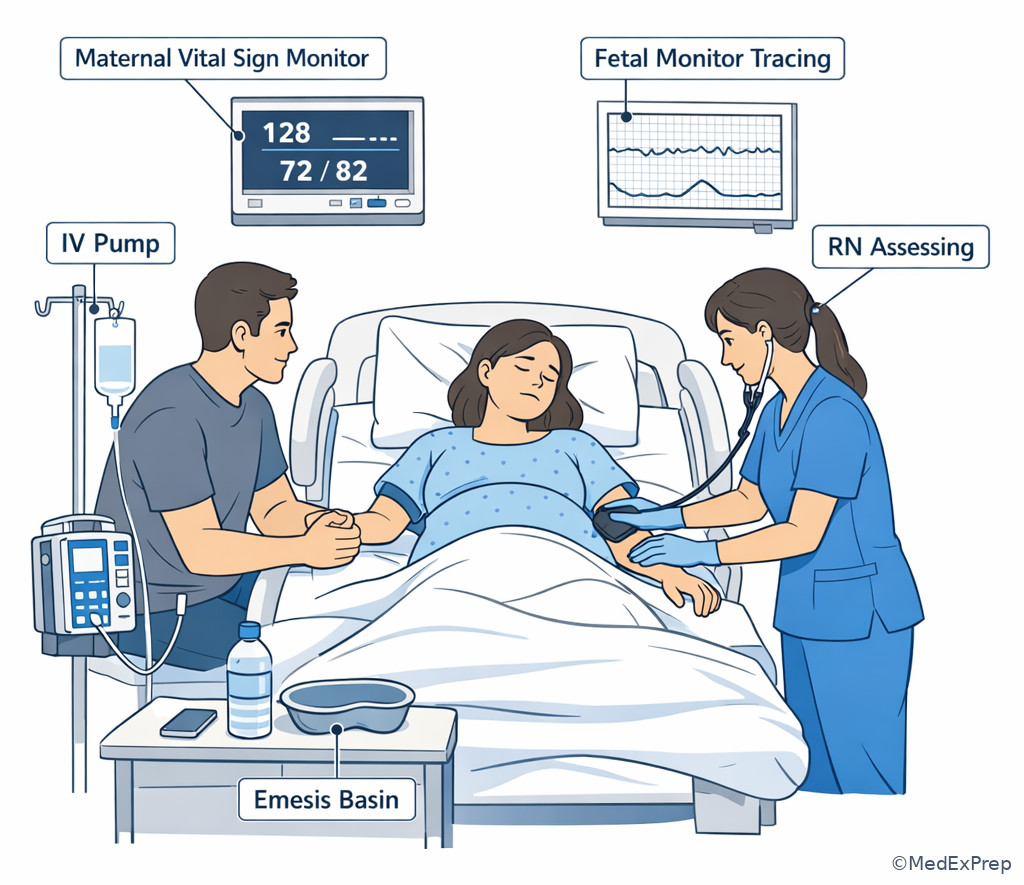
This means public content areas should be studied as overlapping lenses, not separate silos. A laboring patient with oxytocin running and recurrent late decelerations belongs to intrapartum care, fetal surveillance, pharmacology, and safety communication. The best answer will still be one RN action with highest priority. See Fig 3 for a decision map that shows how a mixed stem can still be simplified.
Exam takeaway: In combined-domain stems, act on the detail that changes immediate maternal-fetal safety.
flowchart TD
A[Mixed stem] --> B{Immediate threat?}
B -->|Maternal instability| C[Maternal stabilization first]
B -->|Nonreassuring fetal pattern| D[Bedside fetal response]
B -->|Medication adverse effect| E[Hold/monitor/escalate per order and policy]
B -->|No urgent threat| F[Continue targeted assessment and documentation]
C --> G[Notify provider/activate chain]
D --> G
E --> G
F --> H[Ongoing surveillance] Exam takeaway: In a busy room, the priority is the cue affecting immediate maternal-fetal safety, not the loudest distraction.
B Worked example
A 24-year-old nulliparous patient at 40 weeks is receiving oxytocin for augmentation. She has asthma and iron-deficiency anemia. Contractions are every 1.5 minutes, lasting 95 seconds, and the fetal tracing now shows recurrent late decelerations. Her partner says she is upset because the room is cold, and the patient requests more ice chips. Identify task → mixed intrapartum, fetal surveillance, and pharmacology stem. Extract key facts → tachysystole pattern, recurrent late decelerations, oxytocin infusion. Apply rule → immediate maternal-fetal safety overrides comfort requests. Eliminate distractors → adjusting room temperature and providing ice chips are valid but lower priority; calling dietary is irrelevant. Verify → choose the action that addresses uterine activity and fetal compromise while staying within nursing scope and protocol.
C Exam trap
Why it is tempting: The intervention itself may be appropriate later.
Single clue that eliminates it: The stem contains an active safety threat that must be addressed before education or routine comfort measures.
D Checkpoint
Question: A mixed stem includes severe postpartum bleeding, elevated pulse, a crying family, and a question about documentation. What should guide the first answer choice?
- The most complete documentation plan
- The family’s emotional distress
- The circulation threat and immediate bedside stabilization
- The probable diagnosis selected from hemorrhage causes
- A: Tempting because charting matters; wrong because documentation follows immediate stabilization.
- B: Tempting because family support is important; wrong because physiologic instability takes priority.
- C: Tempting because it is direct, and right because circulation threat is the current discriminator.
- D: Tempting because naming the cause sounds advanced; wrong because the RN must act within scope before definitive medical labeling.
1.1.1.6 Integration: study planning and cross-topic linking without inventing the blueprint
A Explanation
The final decision conflict is whether to study by isolated facts or by a public-content framework linked to testable nursing actions. The better choice is to build a matrix: content area on one axis, nursing task on the other. This avoids a common mistake—overstudying memorable emergencies while underpreparing routine but heavily testable surveillance, communication, and recovery tasks. WHY THIS IS TESTED: broad exam frameworks are meant to guide balanced preparation, and balanced preparation improves performance on integrated stems.
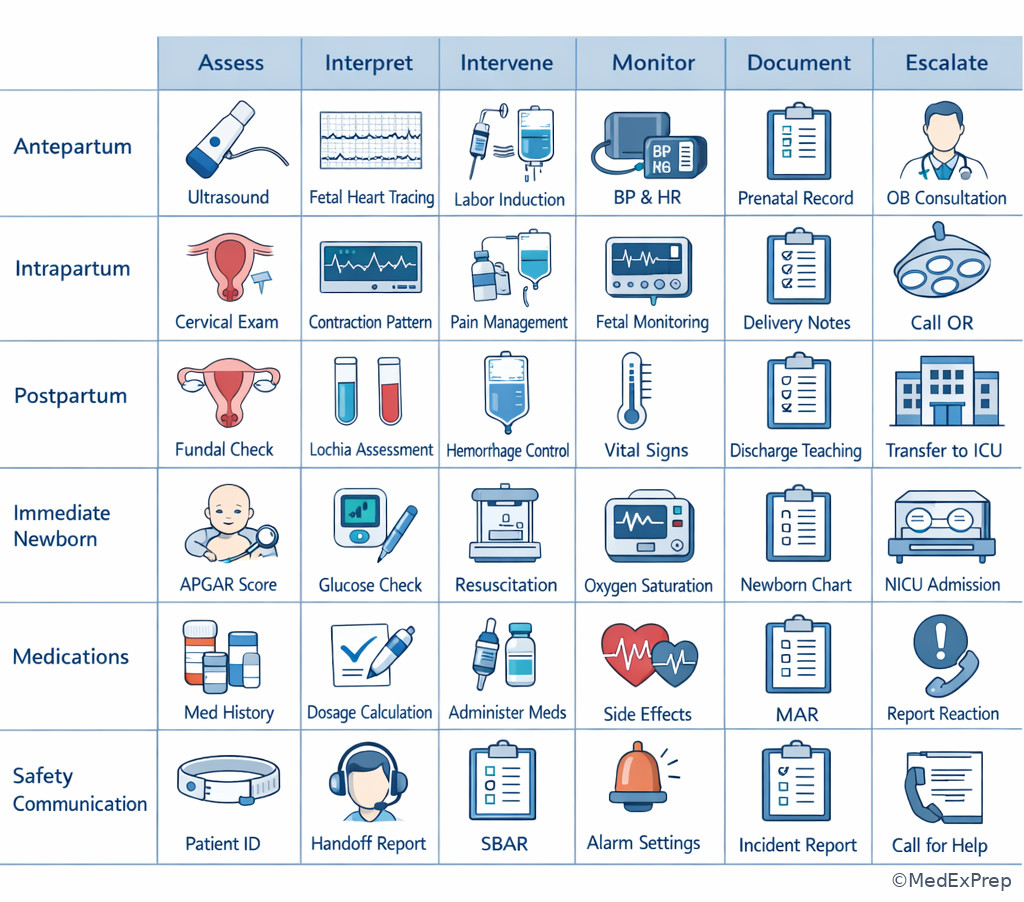
A practical study system uses the public areas as folders and fills each folder with the same recurring questions: What must I assess? What findings are expected vs concerning? What do I do first? What must I monitor after intervening? What requires prompt provider notification? What is within RN scope versus provider decision? This framework is durable across the entire course. It also prepares you for the next two topics: RN Scope Boundaries and Institutional Policy Variability. The first helps you reject answer choices outside RN authority; the second prevents you from treating local workflow as a universal exam rule.
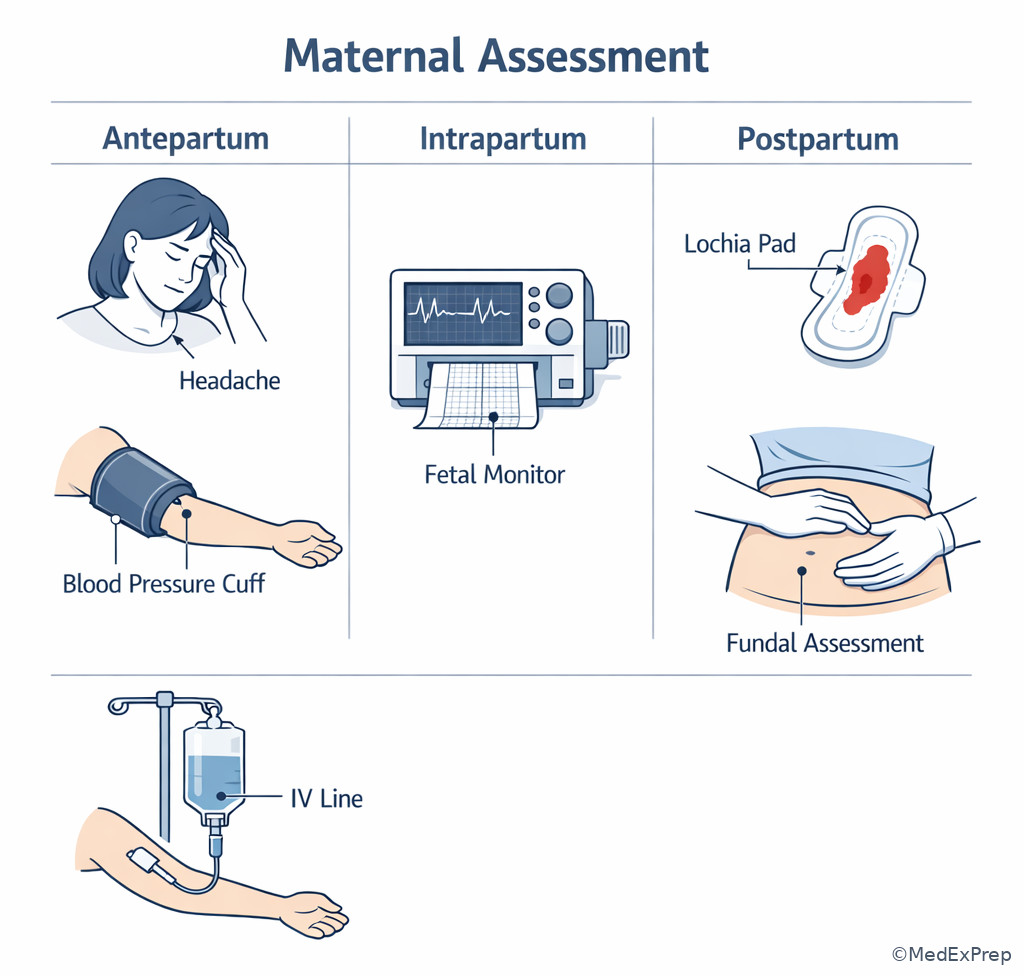
See Fig 5 for the study-grid concept and Fig 6 for an example of how inpatient obstetric nursing actions cluster visually across patient phases.
Exam takeaway: Organize studying by content area crossed with RN actions so broad blueprint labels become usable practice targets.
flowchart TD
A[Public content area] --> B[Assess]
A --> C[Interpret]
A --> D[Intervene]
A --> E[Monitor]
A --> F[Document]
A --> G[Escalate]
B --> H[Flashcards and checklists]
C --> I[Pattern recognition]
D --> J[Priority actions]
E --> K[Reassessment cues]
F --> L[SBAR and charting]
G --> M[Trigger thresholds]
Exam takeaway: A visual action matrix helps you study the same RN decision process across antepartum, labor, postpartum, and newborn care.
Exam takeaway: Grouping maternal warning signs by inpatient phase improves rapid recognition under exam time pressure.
Exam takeaway: Keep newborn content focused on initial transition findings relevant to the OB nurse’s recognition and escalation role.
{"prompt":"Clean nursing-education illustration on white background of immediate newborn transition assessment: infant under radiant warmer, nurse assessing respirations, tone, temperature, color, and ID band. Include labels for thermoregulation and early glucose risk cues. No NICU intensive procedure focus, no cartoon style.","caption":"Immediate newborn transition assessment panel\nExam takeaway: Keep newborn content focused on initial transition findings relevant to the OB nurse’s recognition and escalation role.","size":"1024x1024"} B Worked example
A nurse preparing for the exam says, “I know postpartum hemorrhage well, but I keep missing questions on fetal strips, oxytocin, and handoff.” She works postpartum nights, has two school-age children at home, and studies in short bursts after shifts. She notices she is drawn to dramatic emergency videos and avoids trace interpretation because it feels technical. Identify task → this is not content recall; it is study planning through public content areas. Extract key facts → overfocus on one dramatic area, weak overlap between fetal surveillance, pharmacology, and communication. Apply rule → build a balanced matrix and practice mixed stems. Eliminate distractors → studying only emergencies or memorizing unofficial percentages will worsen imbalance. Verify → the best plan redistributes study time across public content areas and RN tasks.
C Exam trap
Why it is tempting: Emergencies are memorable and emotionally salient.
Single clue that eliminates it: Public content areas also include routine surveillance, monitoring, handoff, teaching, and recovery—frequent sources of exam points.
D Checkpoint
Question: Which study strategy best reflects the purpose of public content areas for RNC-OB preparation?
- Memorize unofficial percentages from online forums and study only the largest category.
- Use content areas as folders and practice each one across assess, interpret, intervene, monitor, document, and escalate tasks.
- Ignore broad categories and memorize isolated lists of signs and symptoms only.
- Study only institutional protocols from one hospital because exam items use local workflow.
- A: Tempting because it seems efficient; wrong because unofficial weights are unreliable and narrow study creates blind spots.
- B: Tempting because it requires structure, and right because it turns broad public areas into testable nursing subskills.
- C: Tempting because memorization feels concrete; wrong because the exam tests decisions, not disconnected lists.
- D: Tempting because practice feels relevant; wrong because local policy must not be treated as a universal exam rule.
- The best study crosswalk is content area × RN action.
- True or False: Public content areas tell you institution-specific protocols. False.
- Name three RN actions that recur in every content area: assess, monitor, escalate.
Exam Traps & Differentiators
Most common wrong answer and why: The most common wrong answer is the option that sounds medically definitive: diagnosing the condition, selecting a route of delivery, changing the treatment plan independently, or waiting passively for the provider when immediate nursing action is indicated. It is tempting because it appears decisive. It is wrong because the RNC-OB exam centers the RN role in inpatient obstetric settings.
| Looks similar | But the exam is really testing | Single discriminator |
|---|---|---|
| Diagnosis naming | Recognition plus nursing action | If the stem asks for next action, choose assessment/intervention/escalation, not a label |
| Detailed pathophysiology recall | Priority bedside response | Abnormal maternal-fetal cue outweighs mechanism trivia |
| Comfort or teaching option | Immediate safety action | Bleeding, respiratory change, tracing deterioration, or toxicity cues come first |
| Correct intervention eventually | Correct intervention now | Priority and timing separate best answer from acceptable later step |
| Local protocol details | Policy-aware nursing judgment | Use verify order, follow policy, escalate concern language |
| Provider decision | RN scope boundary recognition | If action requires prescribing, diagnosing, or choosing definitive management, notify rather than do |
| If the stem says... | Think... |
|---|---|
| “Best next nursing action” with bleeding, tachycardia, or hypotension | Maternal stabilization and urgent reassessment |
| “Most important to monitor” during a medication infusion | Pharmacology adverse-effect surveillance |
| Recurrent decelerations, minimal variability, or tachysystole | Fetal surveillance plus bedside intrapartum response |
| Headache, visual change, RUQ pain, elevated blood pressure | Maternal warning signs and prompt escalation |
| Boggy fundus and increasing lochia | Postpartum recovery is no longer routine; prioritize circulation |
| Question asks what the nurse should do after noticing deterioration | Assess, intervene within scope, notify provider, document response |
Related future traps: The next topic, RN Scope Boundaries, creates a confusable pair with this one because broad content knowledge may tempt you to choose a provider-level action. The following topic, Institutional Policy Variability, creates another confusable pair because local workflows may resemble exam rules but are not universal.
Tables
| Study bucket | High-yield examples | What to monitor | When to escalate |
|---|---|---|---|
| Antepartum | warning signs, fetal movement, triage complaints | vital signs, symptoms, fetal status | decreased fetal movement, severe symptoms, bleeding |
| Intrapartum | labor progress, contraction pattern, coping, support | cervical change, uterine activity, maternal tolerance | arrest concerns, tachysystole, acute pain or bleeding |
| Fetal surveillance | baseline, variability, accelerations, decelerations | pattern trends, contraction relationship, response to measures | persistent nonreassuring findings |
| Emergencies | hemorrhage, seizure, cord prolapse, rupture cues | ABCs, bleeding, perfusion, fetal status | immediately |
| Postpartum | fundus, lochia, bladder, pain, infection signs | bleeding amount, uterine tone, vitals | heavy bleeding, fever, severe pain, thromboembolism cues |
| Immediate newborn | transition, temperature, respirations, glucose risk | tone, color, breathing, feeding cues | respiratory distress, persistent temperature instability |
| Pharmacology | oxytocin, magnesium, blood products, RhIG | desired effect, adverse effects, infusion accuracy | toxicity, adverse reaction, lack of expected response |
| Safety/communication | SBAR, critical results, delegation, chain of command | clarity, timeliness, completion | critical findings or unresolved concern |
| Comparison | Broad learner approach | Exam-winning approach |
|---|---|---|
| Study by chapter title | Memorize headings | Translate each heading into nursing tasks |
| Read stems for diagnosis first | Name disorder | Find the safest next nursing action |
| Value all cues equally | Treat details as equal | Prioritize the cue that changes safety now |
| Choose most advanced-sounding answer | Prefer definitive medical terms | Reject out-of-scope options |
| Use local routine as universal | Assume one protocol fits all | Use policy-aware language and escalation |
| Differential problem in test-taking | What it looks like | How to correct it |
|---|---|---|
| Scope error | Choosing provider-only management | Ask whether the action is within RN authority |
| Priority error | Picking a valid action too late | Use ABCs, circulation, bleeding, and fetal rescue cues |
| Noise error | Fixating on emotional or background details | Underline the abnormal cue driving immediate safety |
| Category error | Misclassifying the question type | Identify whether it tests recognition, response, monitoring, or escalation |
| Protocol error | Relying on one facility’s exact workflow | Use institutional-policy language instead of universal assumptions |
Algorithm / Approach
Use this every time: identify task → extract key maternal/fetal/newborn facts → determine urgency → apply the nursing rule → choose the best next step → verify maternal-fetal safety and scope.
Rapid Review
- Public content area → study organizer, not the answer by itself
- Antepartum stem → expected vs warning-sign discriminator
- Intrapartum stem → progress/safety discriminator
- Fetal surveillance stem → pattern-plus-response discriminator
- Emergency stem → deterioration-plus-escalation discriminator
- Postpartum stem → recovery vs instability discriminator
- Immediate newborn stem → normal transition vs distress discriminator
- Pharmacology stem → desired effect vs adverse-effect monitor
- Safety/communication stem → what must be reported, documented, or kept by RN
- Best next nursing action → choose priority, not complete long-term plan
- Tempting advanced answer → often a scope trap
- Emotional detail in stem → usually noise unless it changes immediate safety
- Local workflow detail → not a universal rule; use policy-aware language
- Mixed-domain question → follow the most actionable abnormal cue
Self-check quiz
1. A nurse is reviewing a practice item that asks about recurrent late decelerations during oxytocin augmentation in a laboring patient with obesity and diet-controlled gestational diabetes. Which public content area pairing best identifies the stem before choosing the answer?
- Fetal surveillance and pharmacology
- Immediate newborn care and discharge teaching
- Postpartum recovery and lactation support
- Antepartum education and home self-care
2. A postpartum nurse sees a practice stem describing a boggy fundus, saturating pads, pulse 118/min, and a partner asking multiple questions. Which first framework is most appropriate for answering the item?
- Focus on family teaching because anxiety may be increasing the patient’s distress
- Determine the exact hemorrhage diagnosis before taking any nursing action
- Classify it as postpartum stabilization and choose the highest-priority circulation-focused nursing action
- Wait to act until the provider arrives and documents the cause of bleeding
3. A 31-year-old G1P0 at 33 weeks presents with decreased fetal movement, mild headache, chronic hypertension, and edema. She also says she forgot her lunch and feels “shaky.” Which is the most appropriate first step in organizing the stem for an exam question?
- Center the stem on nutrition teaching because missing meals explains the complaint
- Center the stem on antepartum assessment with maternal-fetal warning-sign evaluation
- Center the stem on immediate newborn transition because fetal movement is mentioned
- Center the stem on postpartum recovery because edema may persist after birth
4. A labor nurse reads a question about a patient on magnesium sulfate who becomes increasingly somnolent and has respirations of 9/min. The stem also mentions that the family is upset about visiting restrictions. Which is the best next nursing-action framework?
- Address family distress first because psychosocial support is a nursing priority
- Use pharmacology monitoring and obstetric emergency recognition to guide immediate action
- Focus on routine antepartum teaching because the infusion was ordered earlier
- Defer to the provider because medication decisions are not part of nursing judgment
5. A nurse studying for RNC-OB spends most review time on shoulder dystocia and eclampsia videos but misses questions on SBAR, oxytocin monitoring, and postpartum assessment. Which study plan is most appropriate?
- Continue emergency-only review because catastrophic events are always the most tested
- Use public content areas as folders and review each through assess, interpret, intervene, monitor, document, and escalate tasks
- Ignore communication questions because they are not core obstetric content
- Study only the content area worked at most often in clinical practice
6. A 26-year-old G2P1 in labor has recurrent variable decelerations, reports rectal pressure, and has an oxytocin infusion running. Her chart also notes generalized anxiety disorder and a penicillin allergy. Which answer choice would most likely represent an out-of-scope trap rather than the best RN action?
- Reposition the patient and continue focused assessment of fetal response
- Notify the provider of persistent abnormal findings after initial nursing measures
- Independently decide to proceed with operative delivery because the tracing is concerning
- Document uterine activity, fetal pattern, interventions, and patient response
7. A 30-year-old postpartum patient with a history of asthma and prolonged labor has increasing lochia, dizziness, a boggy fundus, and blood pressure 92/56 mm Hg. The stem asks for the most appropriate immediate nursing action. Which option is the best answer category?
- A provider-level decision about the definitive hemorrhage cause
- A lower-priority but correct later action such as discharge education
- An immediate bedside circulation-focused intervention within RN scope
- A routine newborn transition assessment because birth just occurred
8. A nurse reviewing course topics asks how to handle local differences in induction, magnesium, and hemorrhage workflows while studying from public content areas. Which approach is most appropriate?
- Treat local unit policy as the universal exam rule because it reflects real practice
- Avoid studying broad content areas because policy variation makes them unreliable
- Use public content areas to organize nursing tasks and apply policy-aware language such as verify orders, follow protocol, and escalate concerns
- Answer every question as if the nurse were the independent provider making the final treatment decision
Answer key
1.1.1.7 1. Answer: A
A. Fetal surveillance and pharmacology — Tempting because the stem includes both a fetal heart rate pattern and an oxytocin infusion, and it is correct for this scenario. The priority principle is assessment and analysis of fetal status with medication-related bedside response. The single clue is recurrent late decelerations during oxytocin augmentation. This reflects nursing judgment within scope, not provider-level management. Sources: NCSBN Clinical Judgment framework principles; ANA Standards of Practice; Cunningham et al.
B. Immediate newborn care and discharge teaching — Tempting because obstetric questions often move toward birth and teaching, but it is incorrect because the patient is intrapartum and the urgent issue is current fetal status. The discriminating clue is that the baby is not yet in the immediate newborn phase.
C. Postpartum recovery and lactation support — Tempting because candidates may think ahead in the obstetric timeline, but it is incorrect because those actions are not priority while the fetus shows compromise during labor. The discriminating clue is active oxytocin augmentation with decelerations.
D. Antepartum education and home self-care — Tempting because gestational diabetes appears in the history, but it is incorrect because the patient is in labor and requires intrapartum fetal monitoring focus. The discriminating clue is the current labor room problem, not outpatient teaching needs.
1.1.1.8 2. Answer: C
A. Focus on family teaching because anxiety may be increasing the patient’s distress — Tempting because psychosocial support is a nursing responsibility, but it is incorrect in priority terms. By ABCs and circulation principles, active bleeding and tachycardia outrank teaching. The discriminating clue is boggy fundus with heavy lochia. Sources: NCSBN; ANA; Perry et al.
B. Determine the exact hemorrhage diagnosis before taking any nursing action — Tempting because understanding cause can guide treatment, but it is incorrect because the RN must assess and intervene immediately within scope. Nursing process places immediate assessment/intervention before definitive medical labeling. The discriminating clue is unstable postpartum findings already present.
C. Classify it as postpartum stabilization and choose the highest-priority circulation-focused nursing action — Tempting because it sounds broad, and it is correct because it frames the question appropriately: postpartum instability requiring immediate RN action. The discriminating clue is a circulation threat after birth.
D. Wait to act until the provider arrives and documents the cause of bleeding — Tempting because hemorrhage often requires provider management, but it is incorrect because waiting violates safety and nursing standards. The RN must initiate appropriate assessment and interventions per scope and policy. The clue is current heavy bleeding, not a future provider note.
1.1.1.9 3. Answer: B
A. Center the stem on nutrition teaching because missing meals explains the complaint — Tempting because “shaky” and missed lunch suggest hypoglycemia, which is a real nursing concern. It is incorrect because decreased fetal movement plus chronic hypertension are higher-priority maternal-fetal warning-sign cues. The single discriminating clue is decreased fetal movement at 33 weeks. Sources: NCSBN; ANA; Lowdermilk et al.
B. Center the stem on antepartum assessment with maternal-fetal warning-sign evaluation — Tempting because it integrates more than one clue, and it is correct. Nursing process prioritizes assessment of the potentially abnormal maternal-fetal findings before lower-risk explanations. The single clue is combination of decreased fetal movement and hypertension risk.
C. Center the stem on immediate newborn transition because fetal movement is mentioned — Tempting only if the learner overgeneralizes fetal topics, but it is incorrect because the patient is still pregnant. The discriminating clue is 33 weeks antepartum status.
D. Center the stem on postpartum recovery because edema may persist after birth — Tempting because edema is seen in postpartum patients too, but it is incorrect because the current phase is antepartum and the immediate issue is fetal well-being assessment. The discriminating clue is no birth has occurred.
1.1.1.10 4. Answer: B
A. Address family distress first because psychosocial support is a nursing priority — Tempting because family needs matter and nurses provide holistic care. It is incorrect because respirations of 9/min on magnesium signal possible toxicity, which takes priority by ABCs. The discriminating clue is respiratory depression. Sources: NCSBN; ANA; AWHONN practice principles.
B. Use pharmacology monitoring and obstetric emergency recognition to guide immediate action — Tempting because it combines categories, and it is correct. Monitoring an ordered infusion and recognizing deterioration are central RN responsibilities. The discriminating clue is somnolence plus low respiratory rate during magnesium therapy.
C. Focus on routine antepartum teaching because the infusion was ordered earlier — Tempting because magnesium may be discussed in antepartum care, but it is incorrect because a current adverse-effect cue outranks teaching. The discriminating clue is present deterioration, not the original indication.
D. Defer to the provider because medication decisions are not part of nursing judgment — Tempting because medication management involves orders, but it is incorrect because nurses must assess, intervene within policy, monitor, and escalate when deterioration occurs. The discriminating clue is that monitoring adverse effects is explicitly nursing scope.
1.1.1.11 5. Answer: B
A. Continue emergency-only review because catastrophic events are always the most tested — Tempting because dramatic emergencies feel high yield. It is incorrect because exam performance depends on broad coverage of surveillance, communication, routine assessment, and medication monitoring as well. The discriminating clue is repeated misses in nonemergency domains. Sources: NCSBN; ANA.
B. Use public content areas as folders and review each through assess, interpret, intervene, monitor, document, and escalate tasks — Tempting because it is structured, and it is correct. This approach balances content and mirrors actual nursing judgment tested on the exam. The discriminating clue is that the learner is missing several different nursing task types across domains.
C. Ignore communication questions because they are not core obstetric content — Tempting because candidates may undervalue “soft skills,” but it is incorrect because handoff, documentation, and escalation are explicit inpatient nursing competencies. The discriminating clue is missed SBAR questions, which indicate a real content gap.
D. Study only the content area worked at most often in clinical practice — Tempting because familiarity boosts confidence, but it is incorrect because the exam samples across the whole inpatient obstetric scope, not only one job assignment. The discriminating clue is imbalance across content areas already causing missed items.
1.1.1.12 6. Answer: C
A. Reposition the patient and continue focused assessment of fetal response — Tempting because it is an appropriate bedside nursing action, and it is incorrect only as an answer to the question asking for the out-of-scope trap. By nursing process, assessment/intervention for fetal response is within RN scope. The discriminating clue is that repositioning is a nursing intervention. Sources: NCSBN; ANA; AWHONN fetal monitoring principles.
B. Notify the provider of persistent abnormal findings after initial nursing measures — Tempting because escalation is a standard response, and it is also within RN scope. It is incorrect as the trap because notifying the provider is exactly what the nurse should do when abnormalities persist. The discriminating clue is persistent concerning findings.
C. Independently decide to proceed with operative delivery because the tracing is concerning — Tempting because it sounds decisive and safety-focused. It is correct as the out-of-scope trap because route or method of delivery is a provider-level decision, not the RN’s independent action. The single clue is the phrase “independently decide.”
D. Document uterine activity, fetal pattern, interventions, and patient response — Tempting because charting may seem secondary, but it remains a legitimate nursing responsibility and not a scope violation. It is incorrect as the trap because documentation is within RN scope. The discriminating clue is that it follows nursing standards of practice.
1.1.1.13 7. Answer: C
A. A provider-level decision about the definitive hemorrhage cause — Tempting because cause matters for full management. It is incorrect because the stem asks for the immediate nursing action, and circulation support comes before definitive etiology. The discriminating clue is current dizziness, hypotension, and boggy fundus. Sources: NCSBN; ANA; Perry et al.
B. A lower-priority but correct later action such as discharge education — Tempting because education is always needed eventually. It is incorrect because it fails the priority test; hemorrhage signs outrank teaching by circulation and safety principles. The discriminating clue is active instability.
C. An immediate bedside circulation-focused intervention within RN scope — Tempting because it sounds narrow, and it is correct. Nursing process and ABCs support immediate focused postpartum stabilization before later steps. The discriminating clue is boggy fundus with hypotension and dizziness.
D. A routine newborn transition assessment because birth just occurred — Tempting because obstetric nurses care for the dyad, but it is incorrect because maternal instability must be prioritized first. The discriminating clue is maternal circulation compromise now.
1.1.1.14 8. Answer: C
A. Treat local unit policy as the universal exam rule because it reflects real practice — Tempting because daily workflow is familiar and concrete. It is incorrect because the exam expects policy-aware nursing judgment, not one hospital’s exact protocol as a universal standard. The discriminating clue is “local differences.” Sources: NCSBN; ANA.
B. Avoid studying broad content areas because policy variation makes them unreliable — Tempting because variability feels confusing, but it is incorrect because public content areas remain the official high-level framework for preparation. The discriminating clue is that the problem is variation in implementation, not variation in broad domains.
C. Use public content areas to organize nursing tasks and apply policy-aware language such as verify orders, follow protocol, and escalate concerns — Tempting because it is balanced, and it is correct. It respects both the public framework and the reality that local workflows vary. The discriminating clue is the need to study safely without overgeneralizing one institution’s process.
D. Answer every question as if the nurse were the independent provider making the final treatment decision — Tempting only when candidates confuse obstetric knowledge with provider role authority. It is incorrect because it violates RN scope and exam guardrails. The discriminating clue is “independent provider.”
Keep going with the full RNC-OB Prep Course (RNC-OB)
You just studied the way members do, in the same lesson interface. Full access unlocks every lesson, the question bank and flashcards for a full year.
One payment · 1 year of access · No auto-renewal