1.1.1 - RNC-NIC Role Boundaries
RNC-NIC Role Boundaries
What you'll learn
- DOMAIN: Professional nursing judgment → Subskill: Distinguish bedside NICU RN actions from provider-only decisions.
- DOMAIN: Clinical prioritization → Subskill: Choose the most appropriate nursing response when a stem includes out-of-role tasks.
- DOMAIN: Safety and professional practice → Subskill: Protect the neonate while escalating abnormalities without delay.
- DOMAIN: Communication and documentation → Subskill: Recognize what must be reported, documented, and re-evaluated within RN scope.
- DOMAIN: Exam strategy → Subskill: Eliminate distractors that sound medically correct but exceed RN authority.
- Professional Practice → Scope, accountability, and legal boundaries in NICU nursing
- Clinical Judgment → Recognize instability, act within protocol, notify the neonatal provider
- Safety → Prevent delay, medication error, line/device harm, and communication failures
- Family-Centered Care → Provide education and support within RN role without assuming provider consent or diagnosis duties
Why it matters
- RNC-NIC items often test whether you recognize a dangerous finding and stay within bedside RN scope while acting urgently.
- Many wrong answers are tempting because they describe a medically appropriate end goal but skip the RN's immediate duty: assess, stabilize per protocol, notify, and reassess.
- Fragile neonates deteriorate quickly; delay caused by role confusion is a patient-safety event.
- Scope questions also test legal safety: accurate documentation, protocol adherence, double-check processes, and team communication.
Throughout this lesson, the recurring exam question is: What is the most appropriate nursing action right now? If a stem asks you to think like the prescribing provider, pause and reframe. See Fig 1 for the overall decision map.
Key Terms & Must-Know Facts
1.1.1.1 Key terms
- Scope of practice: The legal and professional boundary defining RN responsibilities and limits.
- Protocol-based action: A nursing action allowed by institutional policy, standing order, or approved pathway.
- Escalation: Prompt notification/collaboration when findings exceed routine management or RN authority.
- Provider-level decision: Diagnosis, prescribing, treatment selection, or procedural planning reserved for authorized clinicians.
- ABCs: Airway, breathing, circulation priority framework.
- Trend recognition: Interpreting serial findings, not single isolated data points.
- Stabilization: Immediate supportive measures within RN role to reduce harm while help is obtained.
- Delegation: Assigning appropriate tasks while retaining RN accountability for assessment and judgment.
- Closed-loop communication: Sending, receiving, and confirming critical information.
- Read-back: Safety step used for verbal/telephone orders per policy.
- Critical change: An abnormal finding requiring urgent reassessment and provider notification.
- Family education within role: Explaining nursing care and observations without making provider diagnoses or promises.
1.1.1.2 Must-know facts
- The RN recognizes instability, initiates allowed stabilization, and notifies the neonatal provider; the RN does not independently prescribe or diagnose.
- If an infant is acutely deteriorating, do not delay escalation to gather nonessential data.
- A medically sensible action can still be the wrong answer if it requires provider authority.
- On exam stems, the best RN answer often includes reassessment, safety action, and notification.
- Use neonatal context in every decision: gestational age, birth weight, postnatal age, support devices, trend over time.
- Delegation never transfers RN accountability for assessment, interpretation, teaching, or escalation.
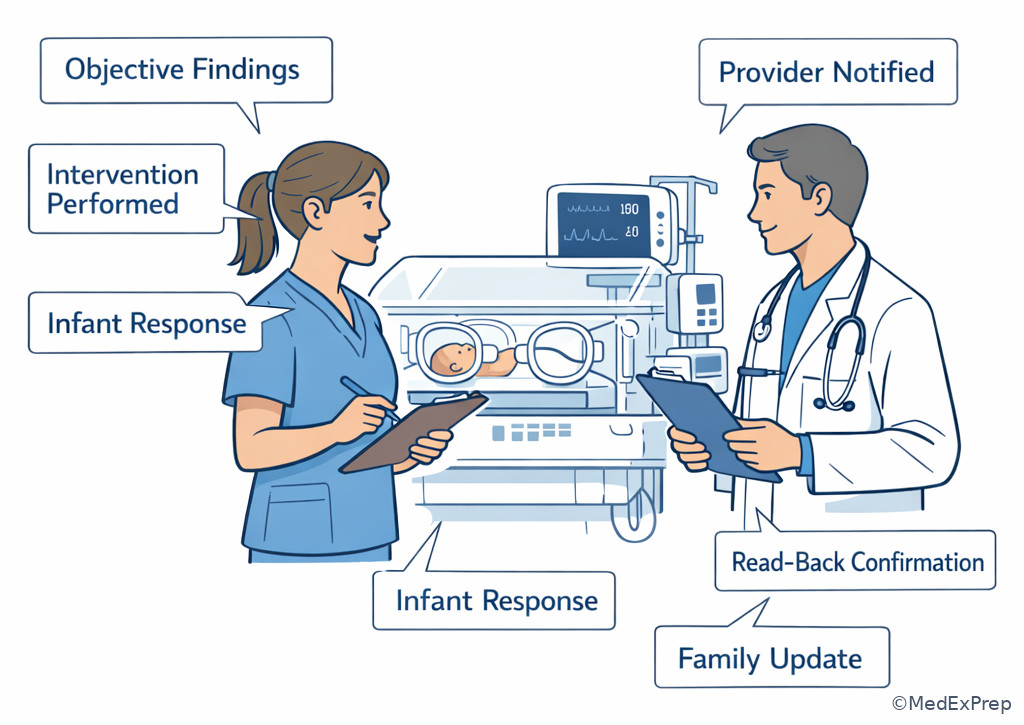
- Documentation should capture assessment, intervention, infant response, and whom you notified.
- Local protocols vary; when specific thresholds are not given, follow institutional protocol and escalate concerning findings.
Exam takeaway: Choose the action that protects the infant now while rejecting independent provider-level decisions.
flowchart TD
A[Abnormal neonatal finding] --> B{Immediate threat to ABCs or safety?}
B -->|Yes| C[Start allowed stabilization now]
C --> D[Reassess response]
D --> E[Notify provider / team urgently]
B -->|No| F{Within RN protocol / standing order?}
F -->|Yes| G[Implement protocol and monitor]
G --> H[Document assessment intervention response]
F -->|No| I[Gather focused relevant data only]
I --> E
E --> H Exam takeaway: Role-boundary questions are safest when you center bedside assessment, immediate stabilization, and team notification.
{"prompt":"Clean nursing-education illustration on white background showing a NICU registered nurse at bedside assessing a premature infant in an incubator, monitoring leads, pulse oximeter, IV line, and charting station; include visual cues for assess, intervene per protocol, notify provider, reassess; realistic NICU environment, no surgery, no cartoon style.","caption":"NICU RN at bedside with monitor, incubator, and closed-loop communication cues\nExam takeaway: Role-boundary questions are safest when you center bedside assessment, immediate stabilization, and team notification.","size":"1024x1024"} Core content
1.1.1.3 Foundational rule: what the NICU RN owns versus what must be escalated
A Explanation
In NICU exam stems, the decision conflict is usually act now within nursing scope versus cross into provider-level management. The single rule that resolves the conflict is: the bedside RN may assess, prioritize, implement ordered or protocol-based care, monitor, protect from harm, and escalate significant changes; the RN may not independently diagnose, prescribe, or choose definitive medical treatment. That means you can start warmth, position the airway, check patency, verify equipment, obtain ordered or protocol-driven data, stop a harmful infusion if policy supports it, support oxygen delivery already ordered, and urgently notify the provider. You should reject options that ask you to write orders, choose the ventilator mode independently, determine the surgical plan, or announce a diagnosis as your independent conclusion.
WHY THIS IS TESTED: Exam writers want to see whether you can preserve infant safety without overstepping licensure. The highest-yield distinction is not “Do nothing until a provider arrives” versus “manage everything yourself.” The tested pattern is independent nursing action plus prompt collaboration.
Because this is the first topic in the course, there is no prior lesson to review. A forward link matters here: the next topics on Priority Frameworks In NICU and Escalation And Team Communication will show how to rank these actions under ABCs and how to report them concisely.
See Fig 1 for the core map and Fig 2 for a choose-versus-reject grid.
Exam takeaway: Accept bedside assessment and protocol-based care; reject diagnosis, prescribing, and independent treatment selection.
flowchart LR
A[Exam option] --> B{Within bedside RN role?}
B -->|Yes| C[Assess trend and infant status]
C --> D[Implement ordered/protocol care]
D --> E[Reassess + document + notify as needed]
B -->|No| F[Reject option]
F --> G[Examples: prescribe drug, set vent mode independently, choose surgery, independently diagnose]
B Worked example
A 28-week infant, day of life 2, on CPAP has intermittent desaturations to 84%, increased work of breathing, and a mildly distended abdomen after a recent feed. Maternal history includes prolonged rupture of membranes and antenatal steroids. The nurse notes that the CPAP interface has shifted, the infant feels cool, and the last glucose was normal. A tempting clue is the abdominal distention, which can pull the learner toward feeding decisions first. The question asks for the most appropriate nursing action.
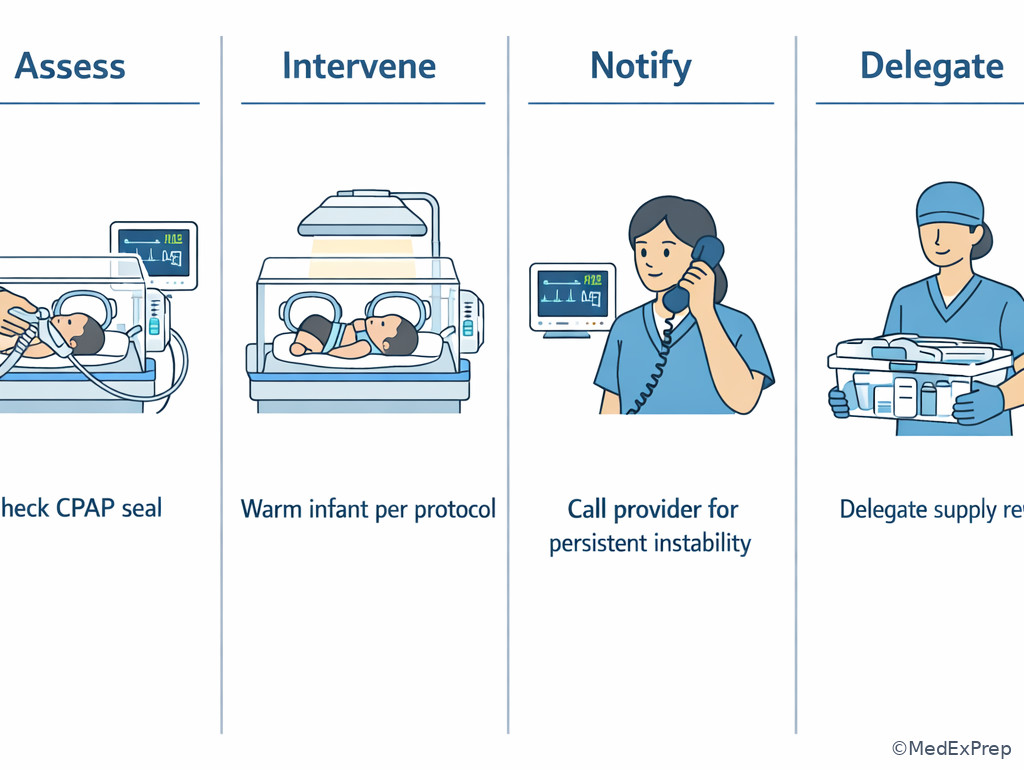
Reasoning chain: Identify task: this is a bedside priority-and-scope question. Extract key facts: desaturation and increased work of breathing are breathing threats; CPAP interface is displaced; temperature is low; the glucose result is distracting because it does not explain the acute respiratory change. Apply rule: the RN should correct immediate, allowed problems first—reposition/verify CPAP per protocol, support thermoregulation, reassess saturation and effort, and notify the provider if distress persists or worsens. Eliminate distractors: independently ordering an x-ray, diagnosing sepsis, or deciding to discontinue feeds without an order all exceed the role or skip the first respiratory fix. Verify: after the nursing intervention, assess whether saturation and effort improve and document response.
C Exam trap
D Checkpoint
Question: A 32-week infant on nasal cannula oxygen has a sudden drop in saturation from 95% to 82%, shallow respirations, and cool mottled skin. Which action is most appropriate for the RN first?
- Request an order for surfactant administration.
- Assess airway and oxygen delivery setup, provide immediate supportive care per protocol, and notify the provider if the infant does not rapidly improve.
- Document the event and continue to observe for 15 minutes to collect more trend data.
- Independently increase respiratory support settings beyond protocol limits.
- A: Tempting because worsening respiratory status may need escalation; wrong because surfactant selection is a provider-level treatment decision and not the first nursing action.
- B: Tempting because it may feel too basic; right because ABC assessment and immediate allowed stabilization come before provider-level treatment selection.
- C: Tempting because trends matter in NICU care; wrong because an acute oxygenation decline should not be observed passively before action.
- D: Tempting because fast action is needed; wrong because acting beyond protocol authority is outside RN role even during urgency.
1.1.1.4 Protocols, standing orders, and local policy: when “yes” depends on authorization
A Explanation
A common decision conflict is whether a nurse may perform an action because it is clinically sensible, or whether that action requires an order or defined protocol. The single rule is: if the intervention is covered by standing order, approved pathway, or institutional protocol, it may be within RN scope; if not, the RN should gather focused data, protect the infant, and escalate for direction. Many RNC-NIC stems intentionally omit institutional specifics. When that happens, the safest exam response uses wording like “follow institutional protocol” rather than assuming universal authority.
WHY THIS IS TESTED: NICU practice varies in thresholds, equipment, and workflows. The exam rewards nurses who avoid making unsupported assumptions. A protocol is not a loophole to practice independently; it is an authorized structure that defines exactly what the RN may initiate and monitor.
Examples of commonly protocol-driven actions may include glucose screening pathways, thermoregulation measures, some oxygen titration ranges, read-back procedures for verbal orders, and emergency activation steps. Examples usually outside RN independent authority include selecting the definitive respiratory mode, initiating a new medication without order, choosing surgical consultation, or changing the diagnosis communicated to the family as fact. See Fig 3 for the protocol test.
Exam takeaway: The presence or absence of authorization often decides whether an otherwise reasonable nursing action is correct.
flowchart TD
A[Need to act] --> B{Covered by order or protocol?}
B -->|Yes| C[Implement within stated limits]
C --> D[Monitor infant response]
D --> E[Document and communicate]
B -->|No| F[Do focused assessment]
F --> G[Protect infant from harm]
G --> H[Notify provider for direction]
B Worked example
A 36-week infant of a diabetic mother is 2 hours old, jittery, mildly tachypneic, and sleepy after a difficult delivery. The infant is under a warmer, has normal color, and had one small emesis. The unit has a hypoglycemia screening protocol for at-risk neonates. A tempting but wrong clue is the emesis, which may distract toward GI causes. The question asks which action the nurse should take first.
Reasoning chain: Identify task: this is a protocol-versus-provider-order question. Extract key facts: infant of diabetic mother, symptomatic, early postnatal age, local screening protocol exists. Apply rule: because the protocol authorizes screening and immediate nursing actions within defined steps, the RN should initiate the hypoglycemia protocol, obtain the bedside glucose per policy, support thermoregulation, and notify/escalate based on findings. Eliminate distractors: waiting for a provider to “diagnose” hypoglycemia wastes time; independently starting an IV dextrose infusion without an order may exceed protocol; focusing on emesis first ignores the higher-probability, protocol-defined risk. Verify: reassess symptoms after intervention and document exact timing and response.
C Exam trap
D Checkpoint
Question: A late preterm infant has borderline low temperatures and poor feeding cues. The unit has a thermoregulation pathway for at-risk infants. Which action best reflects appropriate role boundaries?
- Initiate warming measures and repeat temperature checks per protocol, then communicate persistent instability.
- Diagnose cold stress and write an order for IV fluids.
- Wait for the provider to assess before placing the infant under a warmer.
- Tell the family the infant definitely has sepsis because hypothermia can indicate infection.
- A: Tempting because it may seem too nurse-driven; right because protocol-based warming and reassessment are within scope.
- B: Tempting because cold stress can require escalated management; wrong because diagnosis and ordering fluids are provider functions.
- C: Tempting because it avoids overstepping; wrong because waiting delays allowed nursing care.
- D: Tempting because hypothermia can accompany infection; wrong because the RN should report concerning findings, not present an independent diagnosis as fact.
- The most common reason a medically sensible answer is still wrong on a scope question is it requires provider authority.
- True or False: If a protocol exists, the RN may act only within that protocol’s defined limits. True.
- Name the 3 key words that often signal the correct boundary response: assess, stabilize, notify.
1.1.1.5 Assessment, stabilization, and escalation: the RN response to deterioration
A Explanation
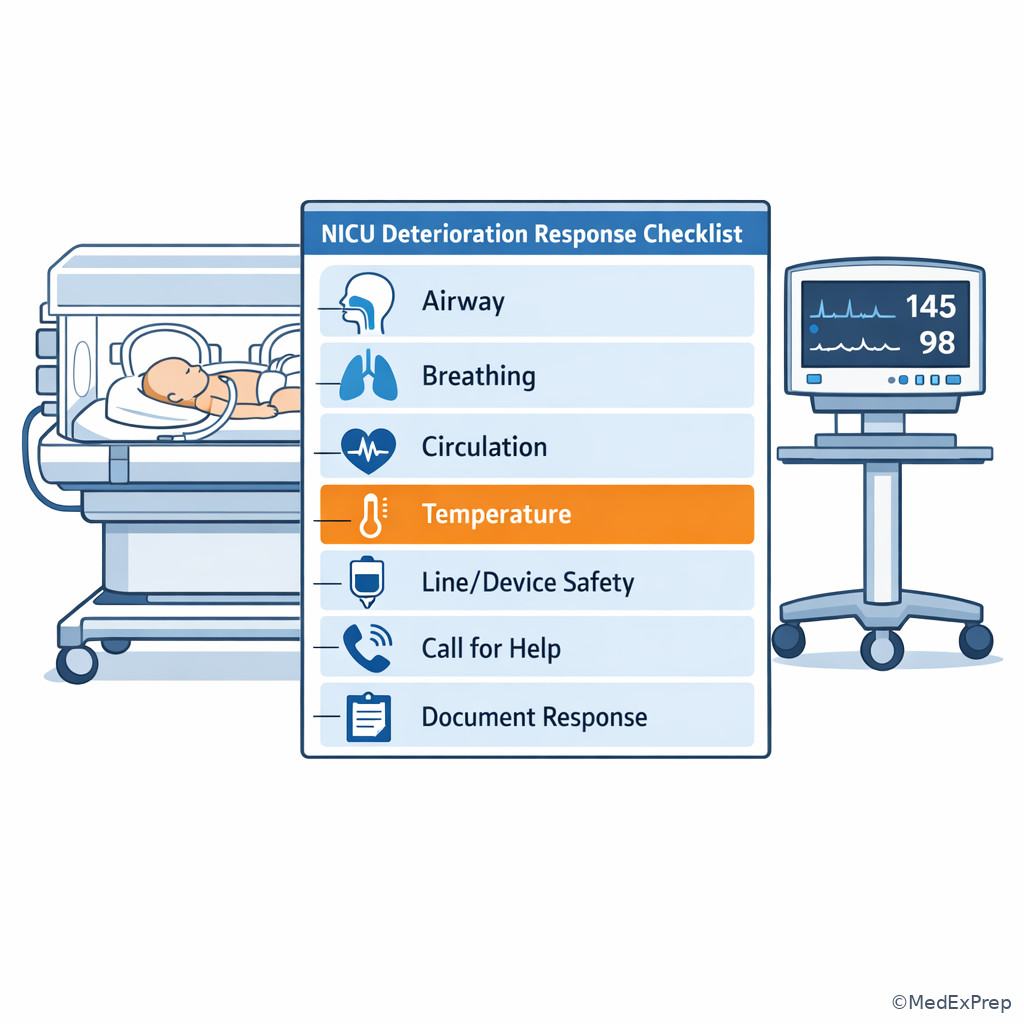
When an infant deteriorates, the decision conflict is whether to spend time collecting more information or to stabilize and escalate immediately. The rule is: acute threats to airway, breathing, circulation, temperature, or line/device safety override routine data gathering. The RN should not delay urgent response for nonessential tasks such as extended chart review, routine teaching, or low-yield confirmation steps. In scope terms, the RN does not choose the definitive medical plan, but the RN absolutely owns early recognition and immediate bedside response.
WHY THIS IS TESTED: The exam often makes one option sound “thorough” and another sound “urgent.” The high-yield pattern is that unstable findings demand nursing action and escalation first. A right action at the wrong time becomes a wrong answer.
Examples of appropriate immediate actions include checking patency of the airway or tube as applicable, verifying monitor leads and oxygen delivery, pausing a suspected harmful infusion per policy, supporting neutral thermal environment, performing a focused reassessment, calling for help, and preparing for advanced intervention. The RN documents after initiating immediate safety actions, not instead of them. See Fig 4 for the deterioration pathway.
Exam takeaway: In unstable neonates, immediate RN stabilization and escalation beat delayed data collection or provider-level improvisation.
flowchart TD
A[New instability noted] --> B{Airway breathing circulation threatened?}
B -->|Yes| C[Immediate nursing stabilization within protocol]
C --> D[Call provider / team]
D --> E[Prepare for advanced intervention]
E --> F[Continuous reassessment]
B -->|No| G[Focused assessment]
G --> H[Follow protocol / notify as indicated]
H --> F
B Worked example
A 25-week infant with a UVC and TPN develops sudden pallor, delayed capillary refill, abdominal discoloration, and increased apnea. The infant also has a recent mildly elevated bilirubin and a soft systolic murmur documented on admission. The question asks for the best initial nursing response. The distracting clues are the bilirubin and murmur, both real neonatal concerns but not the immediate priority.
Reasoning chain: Identify task: acute deterioration with line-related risk. Extract key facts: sudden change, perfusion concern, apnea, central line present. Apply rule: immediate focused assessment and stabilization within scope come first—assess ABCs, verify line/tubing, stop infusing if line complication is suspected and policy supports this safety step, call for help, and notify the provider urgently. Eliminate distractors: chart review for murmur history is not first; ordering imaging is provider-level or protocol-dependent; waiting to trend bilirubin is unrelated to the acute problem. Verify: reassess perfusion, color, apnea events, and document time-based response.
C Exam trap
D Checkpoint
Question: A ventilated neonate has a sudden heart rate drop, falling oxygen saturation, and diminished chest movement on one side. Which is the most appropriate nursing action?
- Continue routine charting and wait for the next scheduled blood gas.
- Recognize acute deterioration, perform immediate supportive assessment/interventions within protocol, summon help, and notify the provider.
- Independently diagnose tension pneumothorax and prepare a provider-only procedure without notification.
- Call the parents first so they are informed before the team intervenes.
- A: Tempting because blood gases are useful in ventilated infants; wrong because scheduled testing does not outrank acute ABC compromise.
- B: Tempting because it seems broad; right because it captures the RN’s actual job in deterioration—act, call, reassess.
- C: Tempting because the pattern suggests a serious complication; wrong because independent diagnosis and provider-only procedure planning exceed RN scope.
- D: Tempting because family-centered care matters; wrong because emergency stabilization always precedes nonurgent communication.
1.1.1.6 Communication, documentation, and family statements within RN scope
A Explanation
The decision conflict here is often between being helpful and speaking beyond one’s authority. The rule is: the RN communicates observations, trends, interventions, and concerns clearly; the RN does not make provider-level promises, consent explanations for surgery, or definitive diagnostic statements outside authorized communication pathways. Family-centered care does not mean speculating. Safe nursing communication sounds like: “Your baby is having increased breathing difficulty; I am supporting them now and the neonatal provider has been notified.” Unsafe communication sounds like: “Your baby definitely has pneumonia and will need intubation.”
WHY THIS IS TESTED: Professional practice includes legal safety and trust. The exam may offer warm, family-focused distractors that feel compassionate but exceed scope. The correct answer often protects both the infant and the family from misinformation.
Documentation is equally testable. The RN should record the relevant assessment, timing, interventions performed, infant response, and who was notified. Documentation should be factual and time-linked, not interpretive beyond nursing role. Read-back of verbal orders per policy is a safety behavior, not an optional courtesy. See Fig 5 for the communication loop.
Exam takeaway: Report objective findings and actions taken, avoid unsupported diagnoses, and document the full notification-response loop.
B Worked example
A term infant with meconium exposure is in the NICU for respiratory monitoring. The parents ask the nurse, “Does this mean our baby has permanent lung damage?” The infant currently needs supplemental oxygen, has intermittent tachypnea, and had one brief desaturation while crying. Maternal fever was present during labor, and a blood culture is pending. The question asks for the best nursing response.
Reasoning chain: Identify task: family communication within scope. Extract key facts: concern is understandable; clinical status is evolving; there is uncertainty; culture is pending. Apply rule: the RN should give accurate, supportive, non-speculative information, describe current nursing monitoring and that the provider is evaluating the baby, and avoid definitive prognostic claims or independent diagnoses. Eliminate distractors: promising a normal outcome is outside role and unsupported; stating the infant has pneumonia because maternal fever was present is diagnostic overreach; refusing to answer anything is not therapeutic. Verify: ensure the family understands the immediate plan and knows the provider will discuss diagnosis/treatment decisions.
C Exam trap
D Checkpoint
Question: Which charting statement best reflects appropriate NICU RN documentation after an apneic event?
- “Infant likely septic; antibiotics urgently needed.”
- “Apnea due to immature lungs; prognosis guarded.”
- “Apnea for 18 seconds with color change; stimulation provided per protocol, oxygen saturation improved from 76% to 93%, provider notified at 0212.”
- “Event occurred; see provider note for details.”
- A: Tempting because sepsis can cause apnea; wrong because it documents a diagnosis and treatment plan outside RN scope.
- B: Tempting because prematurity may explain apnea; wrong because it is interpretive and prognostic rather than objective charting.
- C: Tempting because it is detailed; right because it records observable findings, nursing action, response, and notification.
- D: Tempting because provider notes matter; wrong because the RN must independently document nursing assessment and intervention.
- True or False: Compassionate communication can include predicting outcome before evaluation is complete. False.
- The safest documentation pattern is finding → action → response → notification.
- Name the communication behavior that confirms a verbal order accurately: read-back.
1.1.1.7 Delegation, collaboration, and the “right action, wrong person” problem
A Explanation
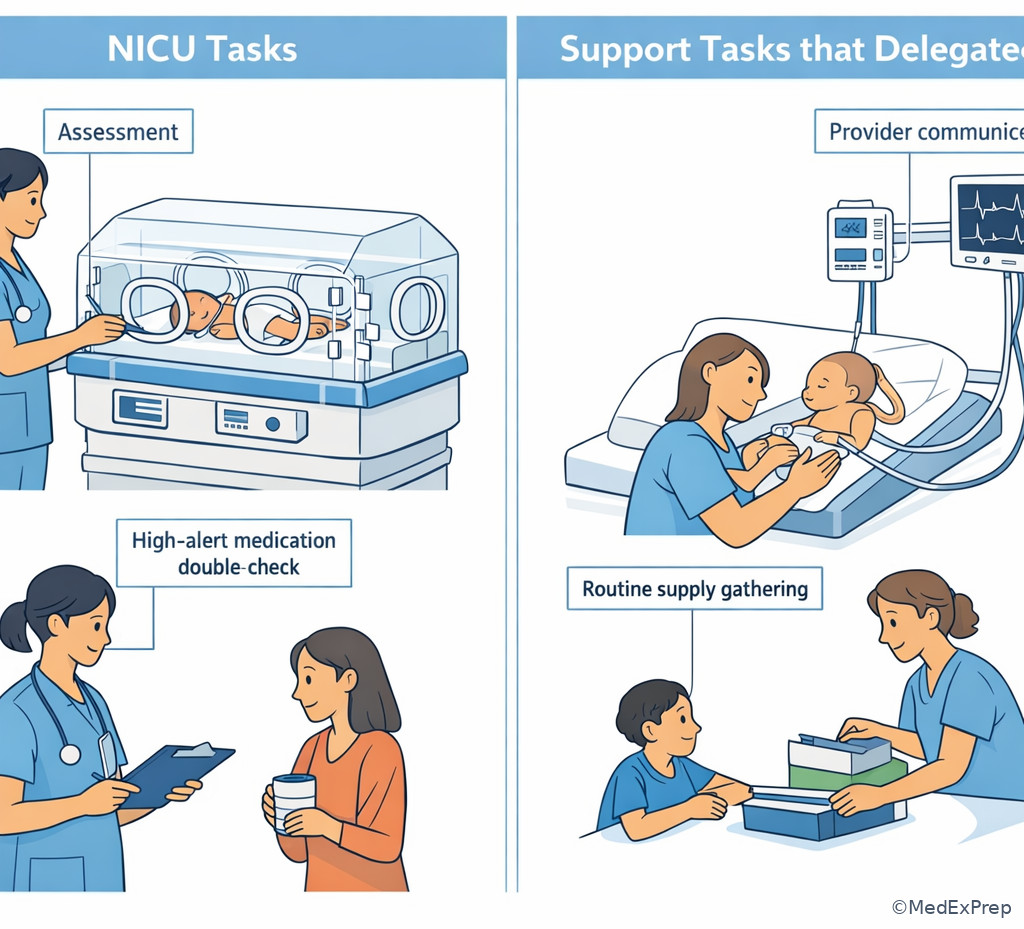
Many hard questions do not ask whether an action should happen; they ask who should do it. The decision conflict is between an appropriate task and an inappropriate assignee. The resolving rule is: tasks requiring assessment, clinical judgment, teaching, evaluation of instability, or provider communication remain the RN’s responsibility. Selected routine, predictable, nonjudgment tasks may be delegated per policy and staff role, but delegation never removes RN accountability. In NICU practice, fragile physiology, lines, medications, and rapidly changing status often narrow what can be safely delegated.
WHY THIS IS TESTED: Delegation distractors are highly plausible because they involve real work that must be done. The exam tests whether you know the difference between doing the right thing and assigning it safely. If the infant is unstable or the task requires interpretation, the RN keeps it.
Examples usually retained by the RN include initial or worsening assessments, response to desaturation/apnea, medication double-check for high-alert drugs per policy, central line assessment, family teaching about clinical changes, and provider notification. Potentially delegable activities, depending on policy and personnel, may include obtaining supplies, routine nonsterile comfort tasks, or transporting equipment. See Fig 6 for a delegation filter.
Exam takeaway: Routine support tasks may be shared, but unstable assessment, interpretation, teaching, and escalation remain RN work.
B Worked example
A 30-week infant receiving gavage feeds has frequent desaturation episodes, a PICC line, and intermittent temperature instability. The unit is short-staffed. A support staff member is available to help, and the parents are asking questions about the line and feeding plan. A recent electrolyte panel is pending, which may distract the learner toward lab follow-up. The stem asks which task the RN may delegate appropriately.
Reasoning chain: Identify task: delegation. Extract key facts: unstable episodes, central line, family questions, ongoing assessment needs. Apply rule: tasks with judgment, teaching, or instability stay with the RN. Therefore, obtaining additional linens or bringing feeding supplies may be delegated, but assessment of desaturation, line evaluation, interpretation of pending labs, and family teaching about the plan stay with the RN. Eliminate distractors: asking another team member to explain the feeding plan may sound efficient but does not remove the RN’s teaching/accountability role. Verify: after delegation of the routine task, the RN continues direct assessment and communication.
C Exam trap
D Checkpoint
Question: Which task is most appropriate for the NICU RN to delegate, following local policy and personnel competence?
- Reassessing an infant after a bradycardia-desaturation event.
- Explaining to the family why the provider may be concerned about sepsis.
- Retrieving sterile supplies while the RN remains at the bedside assessing the infant.
- Interpreting whether a central line insertion site suggests infiltration or infection.
- A: Tempting because reassessment is time-consuming; wrong because post-event clinical judgment stays with the RN.
- B: Tempting because family updates are important; wrong because teaching and interpretation require RN/provider involvement.
- C: Tempting because it seems minor; right because it is a predictable support task that does not require nursing judgment.
- D: Tempting because visual inspection may appear simple; wrong because interpretation of line complications requires assessment and escalation judgment.
Exam Traps & Differentiators
Role-boundary items become easier when you ask two questions in order: (1) Is the infant unstable right now? and (2) Is this action authorized for the RN? The most common wrong answer is the one that sounds medically advanced but skips bedside nursing responsibility.
| Stem feature | Think RN should do | Reject if option says | Why |
|---|---|---|---|
| Sudden apnea, bradycardia, desaturation | Immediate assessment, stimulation/support per protocol, call for help, notify provider | “Wait for more data first” | ABCs outrank routine data collection |
| Protocol exists for the risk pattern | Initiate authorized steps | “Do nothing until provider assesses” | Protocol grants defined nursing authority |
| Family asks for diagnosis/prognosis | Give factual update, explain current care, defer definitive diagnosis/prognosis | “Promise outcome” | Compassion does not permit speculation |
| Unstable infant with line/device concern | Assess device, protect infant, escalate urgently | “Independently order imaging” | Diagnostic ordering exceeds role |
| Delegation question with unstable infant | Keep assessment and interpretation with RN | “Delegate monitoring/interpretation” | Instability requires nursing judgment |
| Looks similar but isn't | Confusable pair | Discriminator |
|---|---|---|
| Calling provider before any action | Versus stabilizing within protocol then calling | If the infant is unstable and you can act safely now, act first and notify immediately after or during the response |
| Providing emotional reassurance | Versus predicting outcome | Supportive language is in role; definitive prognosis is not |
| Carrying out a standing order | Versus inventing a new intervention | Authorization is the pivot |
| Delegating a task | Versus delegating judgment | Assessment, interpretation, teaching, and evaluation stay with RN |
| Objective documentation | Versus diagnostic charting | RN notes findings/actions/response, not independent medical conclusions |
If the stem says...
- “The infant is suddenly deteriorating” → think ABCs, immediate allowed stabilization, urgent notification.
- “The unit has a protocol” → think follow the protocol exactly; do not exceed it.
- “The parents ask what diagnosis means” → think objective update and supportive explanation within role.
- “A helpful intervention sounds advanced” → think is this actually a provider-only treatment selection?
- “The team is busy; can someone else do it?” → think delegate routine tasks, not unstable assessment or judgment.
As the course progresses, you will see confusable pairs from neighboring topics: in Priority Frameworks In NICU, a correct intervention may still be wrong because it is not the first priority; in Escalation And Team Communication, a correct concern may still be communicated poorly if key trend information is omitted.
Exam takeaway: When instability appears, a structured bedside checklist helps the RN act within scope before nonessential tasks.
Tables
| Key reference | Within RN role | Outside independent RN role |
|---|---|---|
| Assessment | Focused and ongoing neonatal assessment; trend recognition; equipment checks | Independent medical diagnosis |
| Intervention | Ordered/protocol-based therapies; stabilization measures; safety actions | Prescribing medications or nutrition plans |
| Respiratory care | Monitor response to support; verify setup; intervene per protocol | Set new ventilator modes/settings independently outside protocol |
| Medication safety | Administer, double-check, monitor effect/adverse response | Initiate new medication without order/protocol |
| Communication | Notify provider, give structured report, document objectively | Obtain informed consent for surgery or promise prognosis |
| Delegation | Delegate routine support tasks per policy | Delegate unstable assessment, interpretation, or teaching |
| Comparison | Assess-first option | Implement-first option | Notify-first option |
|---|---|---|---|
| Monitor alarm with infant pink and active | Check lead placement/accuracy first | Not first unless a true event is confirmed | Not first if clearly artifact |
| Desaturation with displaced CPAP | Briefly assess airway/interface | Correct interface per protocol first | Notify if no rapid improvement or worsening |
| Protocol-driven glucose risk with symptoms | Assess symptoms and eligibility | Start protocol steps | Notify per threshold/response |
| Central line concern with sudden pallor | Focused assessment of perfusion/line | Protect infant and stop harmful infusion if policy supports | Urgent notification immediately |
| Parent asks for diagnosis | Assess understanding and concern | Provide factual update and support | Refer definitive diagnostic discussion to provider |
| Differential task type | Best owner | Exam clue |
|---|---|---|
| Initial recognition of change | RN | Bedside observation, trend, or monitor change |
| Protocol-based nursing response | RN | Stem states standing order/pathway/local protocol |
| Definitive diagnosis statement | Provider | Option names a disease as if conclusively established |
| Medication/treatment prescription | Provider | Option starts a new therapy without order or protocol |
| Routine supply/logistics task | Delegable per policy | No assessment or judgment required |
| Family teaching about current nursing care | RN | Objective explanation without independent diagnosis/prognosis |
| Consent for surgery/procedure | Authorized provider per policy | Option asks the nurse to obtain informed consent independently |
Exam takeaway: Similar-seeming nursing actions are separated by priority level and whether judgment or authorization is required.
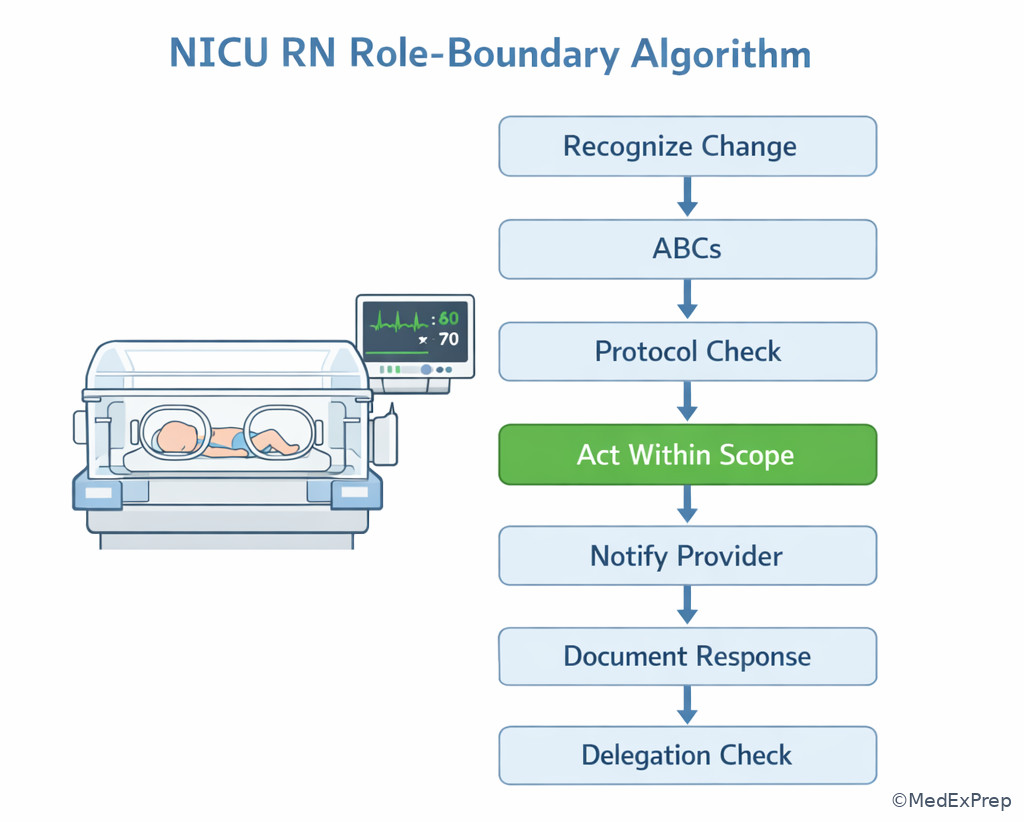
Algorithm / Approach
Exam takeaway: A simple bedside sequence helps you reject provider-level distractors and choose the safest nursing action quickly.
Rapid Review
- Scope question → choose the safest nursing action, not the most advanced medical action
- Unstable infant → ABCs and immediate allowed stabilization outrank extra data gathering
- Standing protocol → permits defined action, not improvisation beyond limits
- Family asks for diagnosis → give objective update, defer definitive diagnosis/prognosis
- Documentation → finding → action → response → notification
- Delegation → routine task may go; judgment task stays
- Desaturation with obvious equipment issue → fix setup first within protocol
- Tempting provider answer → reject if it requires prescribing or independent treatment selection
- Verbal order → read back per policy for safety
- Line/device concern with instability → protect infant and escalate urgently
- Correct action, wrong priority → still wrong on exam
- Compassionate reassurance → appropriate only if factual and nonpredictive
- Local variation → use “follow institutional protocol” when thresholds are not universal
- Delegation in NICU → monitors do not replace RN interpretation of instability
Self-check quiz
1. A 34-week infant in an isolette has a temperature of 36.1°C, mild acrocyanosis, and weak feeding cues. The unit has a thermoregulation protocol for at-risk infants. Which is the most appropriate nursing action?
- Initiate warming measures and repeat assessment per protocol.
- Write an order for IV dextrose and antibiotics.
- Wait for the provider to evaluate before changing the infant’s thermal environment.
- Tell the parents the infant most likely has sepsis.
2. A parent asks why a 29-week infant is having apnea episodes. Which response is most appropriate within RN role?
- “This definitely means the baby has a lung infection.”
- “Apnea can happen in premature infants; I’m monitoring closely and the neonatal provider is evaluating the pattern.”
- “I cannot discuss anything about your baby’s condition.”
- “The episodes will stop by tomorrow.”
3. A 27-week infant on CPAP has oxygen saturation drift from 93% to 84%, increased retractions, and a visibly loose CPAP interface. The abdomen is mildly distended after a feed, and a bilirubin level from earlier is slightly elevated. Which action is the best initial nursing response?
- Review the bilirubin trend before touching the respiratory support.
- Reposition and assess the CPAP interface and infant response per protocol.
- Independently switch the infant to mechanical ventilation.
- Call radiology for an urgent chest film before intervening.
4. A term infant of a diabetic mother is jittery and sleepy at 90 minutes of age. Respirations are 68/min, temperature is borderline low, and the unit has a neonatal hypoglycemia protocol. Which action is most appropriate?
- Initiate the hypoglycemia protocol and obtain the bedside glucose per policy.
- Wait for a provider to diagnose hypoglycemia before checking glucose.
- Document the symptoms and reassess after the next scheduled feed.
- Start IV dextrose without an order because the infant is high risk.
5. A ventilated neonate suddenly develops bradycardia, falling oxygen saturation, and asymmetrical chest movement. The charge nurse is nearby, and the parents are in the room. Which action is most appropriate?
- Notify the parents that the infant probably has a pneumothorax and then call the provider.
- Continue charting until the next blood gas confirms the change.
- Perform immediate supportive assessment/interventions within protocol, call for help, and notify the provider.
- Prepare independently for a provider-only decompression procedure without communication.
6. A 30-week infant with a PICC line has recurrent desaturations, intermittent temperature instability, and parents asking detailed questions about the feeding plan. Staffing is tight. Which task is most appropriate for the RN to delegate according to local policy?
- Reassessing the infant after each desaturation event.
- Explaining the implications of possible sepsis to the parents.
- Retrieving supplies while the RN remains at the bedside assessing the infant.
- Evaluating whether the PICC site suggests infiltration.
7. A 25-week infant with a UVC receiving fluids becomes pale with delayed capillary refill and increased apnea. A new graduate nurse suggests obtaining routine labs before contacting the provider. What is the best RN action?
- Obtain all routine labs first so the provider has more complete information.
- Assess ABCs and line status, initiate immediate safety measures within policy, and notify the provider urgently.
- Document the event and wait to see whether the next perfusion check improves.
- Independently diagnose line extravasation and discontinue all care until the provider arrives.
8. During a family update, the parents of a term infant with respiratory distress ask whether the baby will need surgery. The infant has rising oxygen needs, pending imaging, and stable blood pressure. Which nursing response best reflects appropriate role boundaries?
- “Yes, surgery is likely, and I expect it will happen today.”
- “The provider will decide after the evaluation; right now I can tell you the baby needs closer respiratory monitoring and the team has been updated.”
- “No, because babies with this pattern usually improve on their own.”
- “I cannot speak with you until the final diagnosis is entered in the chart.”
Answer key
1. Correct answer: A
- A: Tempting because it seems simple, but it is correct. By nursing-process and safety logic, the infant is mildly unstable in thermoregulation, and a protocol exists, so the RN should begin authorized warming and reassessment promptly. The single clue is thermoregulation protocol for at-risk infants. Source: NCSBN clinical judgment and safety principles; ANA scope/accountability standards.
- B: Tempting because hypothermia can coexist with metabolic or infectious issues; incorrect because writing orders and selecting treatment independently are provider functions. The single clue is write an order. Source: ANA Standards of Practice.
- C: Tempting because it avoids overstepping; incorrect because waiting delays a permitted nursing intervention. The single clue is protocol exists. Source: NCSBN safety and timely intervention principles.
- D: Tempting because hypothermia can raise concern for infection; incorrect because telling parents the infant likely has sepsis is a diagnostic statement beyond RN role. The single clue is most likely has sepsis. Source: ANA communication/accountability standards.
2. Correct answer: B
- A: Tempting because infection can be in the differential for apnea; incorrect because the RN should not present an independent diagnosis as fact. The single clue is definitely means. Source: ANA Standards; Saunders NCLEX communication principles.
- B: Tempting because it may feel nonspecific; correct because it gives factual, role-appropriate information and indicates ongoing team evaluation. The single clue is monitoring closely and provider evaluating. Source: NCSBN therapeutic communication and role accountability.
- C: Tempting because it avoids error; incorrect because the RN should still provide an objective supportive update within scope. The single clue is cannot discuss anything. Source: NCSBN communication standards.
- D: Tempting because families want reassurance; incorrect because it predicts outcome without support. The single clue is will stop by tomorrow. Source: ANA professional accountability.
3. Correct answer: B
- A: Tempting because bilirubin trends matter in NICU care; incorrect because a current breathing issue with a loose interface is a more immediate ABC concern. The single clue is visibly loose CPAP interface. Source: NCSBN ABC prioritization; Saunders priority frameworks.
- B: Tempting because it addresses an obvious mechanical issue; correct because the RN should correct the likely immediate cause within protocol and reassess. The single clue is oxygen saturation drop plus loose CPAP. Source: NCSBN safety and nursing intervention hierarchy.
- C: Tempting because worsening respiratory distress may eventually require intubation; incorrect because independent ventilation-mode changes exceed RN role. The single clue is independently switch. Source: ANA scope/accountability.
- D: Tempting because imaging may be needed if distress persists; incorrect because it delays correction of an obvious bedside problem. The single clue is before intervening. Source: NCSBN immediate care before nonessential diagnostics.
4. Correct answer: A
- A: Tempting because it is protocol-driven rather than diagnostic; correct because risk factors and symptoms are present, and the protocol authorizes action. The single clue is unit has a neonatal hypoglycemia protocol. Source: NCSBN timely intervention principles; neonatal nursing review sources.
- B: Tempting because diagnosis is not the nurse’s role; incorrect because the bedside glucose check is an authorized screening step, not independent diagnosis. The single clue is protocol. Source: ANA scope and protocol-based practice.
- C: Tempting because feeds are relevant to glucose stability; incorrect because symptomatic at-risk infants need prompt screening, not delayed observation. The single clue is jittery and sleepy. Source: NCSBN priority and safety.
- D: Tempting because the infant is high risk and may need dextrose; incorrect because starting IV therapy without an order is outside scope unless explicitly covered by protocol, which is not stated here. The single clue is without an order. Source: ANA Standards.
5. Correct answer: C
- A: Tempting because involving the family matters and the pattern suggests a complication; incorrect because emergency stabilization and team activation take priority, and the statement gives an unsupported diagnosis. The single clue is probably has a pneumothorax. Source: NCSBN ABCs; ANA communication boundaries.
- B: Tempting because blood gases help evaluate ventilation; incorrect because this is acute instability, not a wait-and-see situation. The single clue is suddenly develops bradycardia and falling saturation. Source: NCSBN immediate response to deterioration.
- C: Tempting because it is broad; correct because it follows ABCs, keeps the RN in scope, and prioritizes urgent action and escalation. The single clue is sudden deterioration. Source: NCSBN safety hierarchy; ANA duty to act.
- D: Tempting because preparation may be needed; incorrect because independent procedural planning without communication is outside role and delays coordinated response. The single clue is without communication. Source: ANA scope/accountability.
6. Correct answer: C
- A: Tempting because reassessment happens repeatedly and consumes time; incorrect because recurrent desaturation assessment requires RN judgment. The single clue is after each desaturation event. Source: NCSBN delegation principles; ANA accountability.
- B: Tempting because parents need information; incorrect because explaining sepsis implications requires interpretation and teaching that remain RN/provider responsibilities. The single clue is implications of possible sepsis. Source: ANA teaching/accountability standards.
- C: Tempting because it seems too simple; correct because retrieving supplies is a routine support task that does not require assessment or interpretation. The single clue is while the RN remains at the bedside assessing. Source: NCSBN delegation framework.
- D: Tempting because PICC site checks are visual; incorrect because evaluating a possible complication is assessment and clinical judgment. The single clue is suggests infiltration. Source: ANA scope and assessment responsibility.
7. Correct answer: B
- A: Tempting because more data can make a report stronger; incorrect because poor perfusion and increased apnea indicate instability, so urgent action cannot wait for routine labs. The single clue is pale with delayed capillary refill and increased apnea. Source: NCSBN ABCs and urgent escalation.
- B: Tempting because it combines several steps; correct because it follows ABCs, keeps action within scope, and prioritizes urgent provider notification. The single clue is assess ABCs and line status, initiate safety measures, notify urgently. Source: NCSBN priority-rationale; ANA duty to protect the patient.
- C: Tempting because trends matter in NICU care; incorrect because watchful waiting is unsafe in acute deterioration. The single clue is wait to see. Source: NCSBN safety principles.
- D: Tempting because line complications are plausible; incorrect because independently diagnosing the cause and halting all care overshoots the RN role and may delay needed support. The single clue is independently diagnose. Source: ANA scope boundaries.
8. Correct answer: B
- A: Tempting because families want a direct answer; incorrect because predicting surgery timing is a provider-level decision and not established yet. The single clue is pending imaging. Source: ANA communication boundaries; NCSBN therapeutic communication.
- B: Tempting because it may seem less reassuring; correct because it gives a factual update, states current nursing concern, and defers definitive treatment decisions appropriately. The single clue is provider will decide after the evaluation. Source: NCSBN communication and scope principles.
- C: Tempting because some infants do improve without surgery; incorrect because it minimizes uncertainty and gives unsupported prognostic reassurance. The single clue is usually improve on their own. Source: ANA professional accountability.
- D: Tempting because the diagnosis is incomplete; incorrect because the RN should still provide supportive factual information now. The single clue is cannot speak with you. Source: NCSBN therapeutic communication.
Keep going with the full RNC-NIC Prep Course (RNC-NIC)
You just studied the way members do, in the same lesson interface. Full access unlocks every lesson, the question bank and flashcards for a full year.
One payment · 1 year of access · No auto-renewal