1.1.1 - PANRE-LA Structure And Style
Why it matters
- PANRE-LA rewards safe, practical clinical decisions, not subspecialty trivia or obscure zebra diagnoses.
- Many wrong answers are technically reasonable in some patient, but not in this patient; success depends on spotting the one discriminating clue.
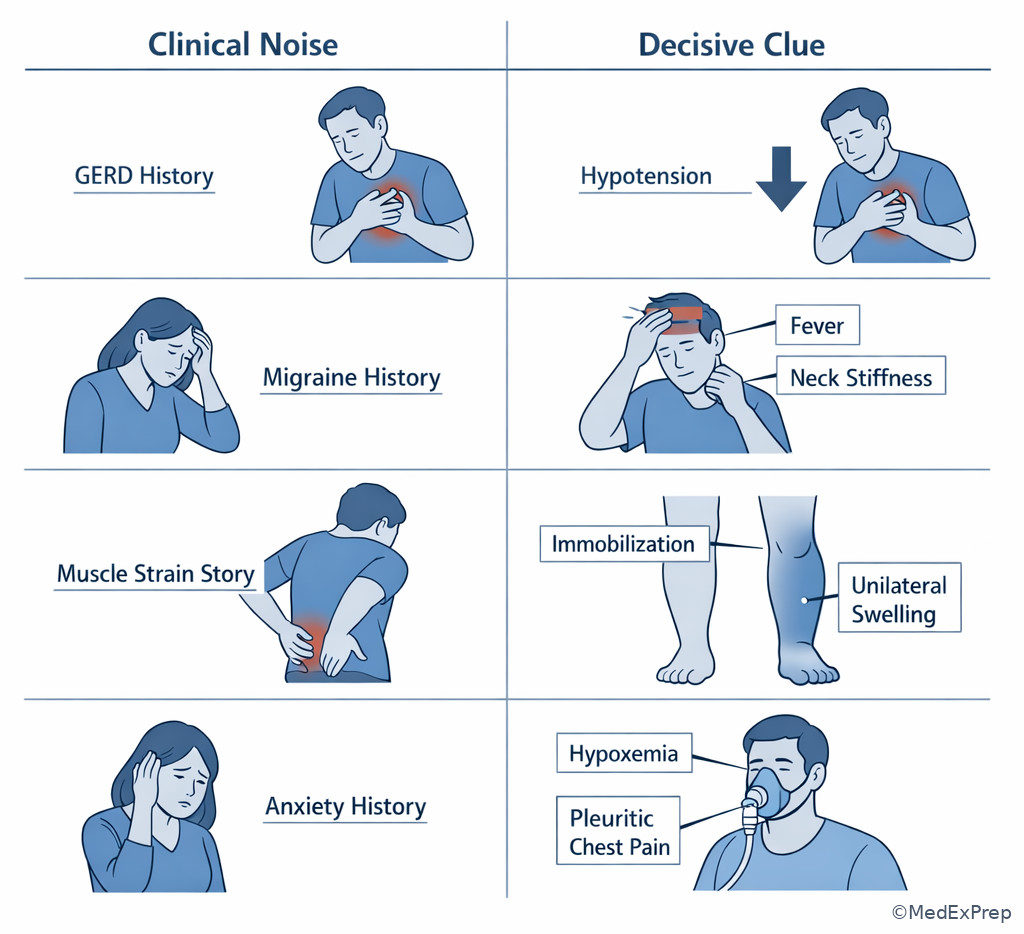
- Exam stems often include noise such as chronic comorbidities, mildly abnormal labs, or a familiar diagnosis that is not the true governing issue.
- Knowing the assessment style helps you study more efficiently: broad coverage, high-yield guidelines, red flags, contraindications, and next-best-step logic.
Key Terms & Must-Know Facts
1.1.1.1 Key terms
- Task-first reading — identify what the question asks before interpreting details.
- Best next step — the safest, highest-yield immediate action for the presented scenario.
- Red flag — a finding that changes urgency, disposition, or testing strategy.
- Distractor — a plausible wrong option supported by superficial clues.
- Clinical noise — details included to test prioritization rather than recall.
- Scope boundary — the point at which stabilization must be followed by consultation, transfer, or referral.
- Risk stratification — sorting patients by immediate danger and likely benefit of testing or treatment.
- Disposition — home, close follow-up, urgent referral, ED transfer, observation, or admission.
- Management hierarchy — stabilize first, then diagnose, then tailor therapy and follow-up.
- Close-call differential — competing diagnoses sharing multiple features, separated by one key finding.
- Contraindication — a reason to avoid a test or treatment despite otherwise appropriate indications.
- Pattern recognition — identifying a tested syndrome from clustered clues.
- Escalation threshold — instability, procedural need, specialist-only management, or high-risk uncertainty.
1.1.1.2 Must-know facts
- PANRE-LA-style reasoning is broad and front-line: outpatient, urgent care, inpatient, emergency recognition, prevention, and chronic disease follow-up.
- The exam generally tests what to do next, not just what a disease is called.
- The correct answer often prioritizes safety: airway, breathing, circulation, sepsis treatment, stroke recognition, medication contraindications, or urgent referral.
- A tempting wrong answer commonly fits the diagnosis but ignores acuity, pregnancy, instability, renal function, drug interaction, or scope limits.
- When a case exceeds usual PA generalist management, the right move is often start stabilization and escalate.
- Broad exam coverage means balanced preparation beats narrow prediction of “high-yield only” organ systems.
- Reading the last line first is often useful because it defines the task: diagnosis, test, treatment, monitoring, or disposition.
- Question wording matters: “best initial test,” “confirmatory test,” “most appropriate therapy,” and “requires immediate clarification” are different tasks.
Exam takeaway: Start with the task, then filter for instability and one governing clue before choosing an answer.
flowchart TD
A[Read final line first] --> B[Identify task type]
B --> C[Scan for instability or red flags]
C --> D[Extract 3 key clues]
D --> E[Apply one governing rule]
E --> F[Eliminate tempting distractor]
F --> G[Verify safety and disposition]
See Fig 1 for the core workflow that this entire course will repeatedly use.
Core content
1.1.1.3 Foundational exam structure: what PANRE-LA is really testing
A Explanation
The central decision conflict in this lesson is simple: Are you being tested on memorized disease facts, or on safe front-line clinical judgment? On PANRE-LA, choose the answer that reflects practical PA decision-making in common and high-impact situations. Reject answers that require acting like an unsupported subspecialist, bypass urgent transfer, or ignore collaboration when complexity warrants it.
WHY THIS IS TESTED: The assessment samples broad recertification-level care. That means item writers frequently place the learner in a realistic setting—clinic, urgent care, hospital follow-up, or ED triage mindset—and ask for the most appropriate next step, not encyclopedic detail.
The single rule that resolves many structure questions is this: match the answer to the role, urgency, and setting. If the patient is unstable, stabilize and escalate. If the patient is stable, choose focused testing or evidence-based treatment. If a scenario requires specialist-only intervention, the best generalist answer is usually recognition plus consultation or transfer, not definitive procedural management.
Key rule: PANRE-LA favors clinically safe, guideline-aligned, front-line actions over maximalist workups and specialist-level interventions.
Clinician Action: DIAGNOSE the true task before labeling the disease. ORDER targeted tests only after checking urgency. TREAT with first-line, safety-conscious measures. REFER/ESCALATE when instability, procedural need, or specialist complexity appears.
B Worked example
A 67-year-old man presents to urgent care with 40 minutes of crushing substernal chest pressure and diaphoresis. He has type 2 diabetes, hypertension, and chronic GERD. He says this feels “like heartburn after pizza,” and triage notes mild epigastric tenderness. Blood pressure is 88/56 mm Hg, heart rate 112/min, and he appears pale. The question asks for the most appropriate next step.
Identify task: This is management, not diagnosis naming. Extract key facts: acute chest pressure, diaphoresis, hypotension, diabetes risk, unstable vital signs. GERD and pizza are noise; epigastric tenderness is a tempting clue. Apply rule: unstable possible ACS requires immediate stabilization and emergency transfer/ED management, not outpatient reflux treatment or delayed testing. Eliminate distractors: oral antacid is tempting because of reflux history; outpatient stress testing is tempting because it evaluates coronary disease; waiting for office troponin delays care. Verify: the safest PA-level action is emergency activation and initial stabilization.
C Exam trap
Common wrong answer: Treat presumed GERD first because the patient mentions heartburn and has epigastric discomfort.
Why it is tempting: reflux is common, chest pain can burn, and the stem includes a familiar alternative diagnosis.
Single clue that eliminates it: hypotension with diaphoresis makes this a high-acuity cardiovascular emergency until proven otherwise.
D Checkpoint
Question: A PANRE-LA item asks for the most appropriate next step in a patient with dyspnea, fever, tachycardia, and confusion. Which principle should guide your first decision?
- Prioritize the rarest diagnosis — tempting because severe illness can reflect uncommon disease, but wrong because urgency and stabilization come before zebra hunting.
- Start with the longest differential list possible — tempting because broad thinking seems careful, but wrong because the immediate task is triage and safety.
- Identify instability and treat time-sensitive threats first — tempting because it may feel less “academic,” but correct because PANRE-LA rewards immediate risk-based action.
- Choose the most definitive specialist test first — tempting because definitive testing sounds thorough, but wrong because unstable patients need early stabilization and focused initial workup.
Answer: C
If you missed this: Review 1.1.1.1 Foundational exam structure: what PANRE-LA is really testing — focus on the rule that instability overrides exhaustive diagnosis-building.
Exam takeaway: Distinguish diagnosis, test selection, treatment, and disposition tasks before analyzing details.
flowchart LR
A[Question asks...] --> B{Task type}
B --> C[Most likely diagnosis]
B --> D[Best initial test]
B --> E[Most appropriate treatment]
B --> F[Needs urgent escalation]
C --> G[Pattern recognition]
D --> H[Targeted confirmation]
E --> I[Guideline-based action]
F --> J[Stabilize then transfer/consult]
See Fig 2 when deciding whether an item is asking for diagnosis, testing, treatment, or disposition.
1.1.1.4 Foundational item language: decode the task before the details
A Explanation
The decision conflict here is: Should you interpret every detail immediately, or first define the question verb? Choose task-first reading. Reject the impulse to chase every abnormality before you know what the item asks.
“Most likely diagnosis” tests pattern recognition. “Best initial test” asks for a safe and efficient first diagnostic step, not the gold-standard test in all contexts. “Best confirmatory test” asks for stronger proof after suspicion already exists. “Most appropriate initial therapy” asks what you do now. “Requires immediate clarification” often tests medication safety, contraindications, or a red-flag omission in the history.
WHY THIS IS TESTED: Learners often miss questions because they answer a different question than the stem asked. A perfectly correct disease fact can still be the wrong option if the item asks for disposition or monitoring.
Recall: In the upcoming topic Question Stem Deconstruction, we will break this into a repeatable reading method. Here, build the habit of defining the task before assigning meaning to the clues.
Memory anchor: TASK = Type of question, Acuity, Signal clues, Key next step. If you cannot state the task in one line, do not answer yet.
Clinician Action: DIAGNOSE the question task before the disease. ORDER only the test the task actually requests. TREAT only if the stem asks for management. REFER/ESCALATE if the task is disposition and instability is present.
B Worked example
A 54-year-old woman with obesity, migraine, and controlled hypothyroidism presents with sudden unilateral calf swelling after a 9-hour car ride. She takes estrogen therapy and says she “pulled a muscle gardening.” Oxygen saturation is 98% on room air, and she has no chest pain. The question asks for the best initial test.
Identify task: initial test. Extract key facts: unilateral calf swelling, recent immobility, estrogen use, stable vital signs. Gardening strain is the tempting wrong clue. Apply rule: suspected DVT in a stable symptomatic patient calls for venous duplex ultrasonography as the initial diagnostic study. Eliminate distractors: CT pulmonary angiography is for suspected PE, not isolated leg symptoms; D-dimer can be useful in selected low-risk settings but is less helpful when clinical suspicion is appreciable; MRI of the calf chases the muscle-strain story rather than the thrombotic pattern. Verify: stable patient, focused leg complaint, appropriate initial test selected.
C Exam trap
Common wrong answer: Choose the gold-standard or more “advanced” test even when the stem asks for the best initial test.
Why it is tempting: Advanced imaging feels more definitive and therefore smarter.
Single clue that eliminates it: the wording “best initial test” rewards the first efficient step in a stable patient, not the most comprehensive study possible.
D Checkpoint
Question: Which wording most strongly signals that the exam wants you to think about safety, contraindications, or missing history before choosing therapy?
- Most likely diagnosis — tempting because diagnosis affects all later decisions, but wrong because the phrase does not specifically cue a safety review.
- Best confirmatory test — tempting because testing can involve risk, but wrong because the main task is proof, not medication or history clarification.
- Requires immediate clarification — tempting because it feels indirect, but correct because this wording commonly flags a missing safety-critical fact.
- Most likely mechanism — tempting because mechanisms help explain choices, but wrong because it asks for pathophysiology rather than pre-treatment verification.
Answer: C
If you missed this: Review 1.1.1.2 Foundational item language: decode the task before the details — focus on how verb choice changes the required clinical action.
- The phrase most likely to demand a safety check before action is requires immediate clarification.
- True or False: “Best initial test” and “best confirmatory test” are interchangeable. False.
- Name the 3 fastest stem filters: task, acuity, governing clue.
| Question wording | What you should think | Common mistake | Best habit |
|---|---|---|---|
| Most likely diagnosis | Pattern recognition from clustered clues | Choosing a related disease after spotting one shared feature | Find the single discriminator |
| Best initial test | First efficient diagnostic step | Jumping to the most definitive study | Match test to stability and setting |
| Best confirmatory test | Higher-specificity proof after suspicion exists | Choosing screening-level or bedside-only data | Ask what secures the diagnosis |
| Most appropriate initial therapy | What to do now | Picking long-term maintenance treatment first | Stabilize or start first-line treatment |
| Most important to monitor | Safety, efficacy, or progression marker | Monitoring a less actionable variable | Choose what changes management fastest |
| Requires immediate clarification | Missing contraindication or safety-critical history | Continuing with therapy based on incomplete information | Search for pregnancy, allergy, renal function, interaction, red flag |
Exam takeaway: Label the task line, red flags, noise, and decisive clue to avoid answering the wrong question.
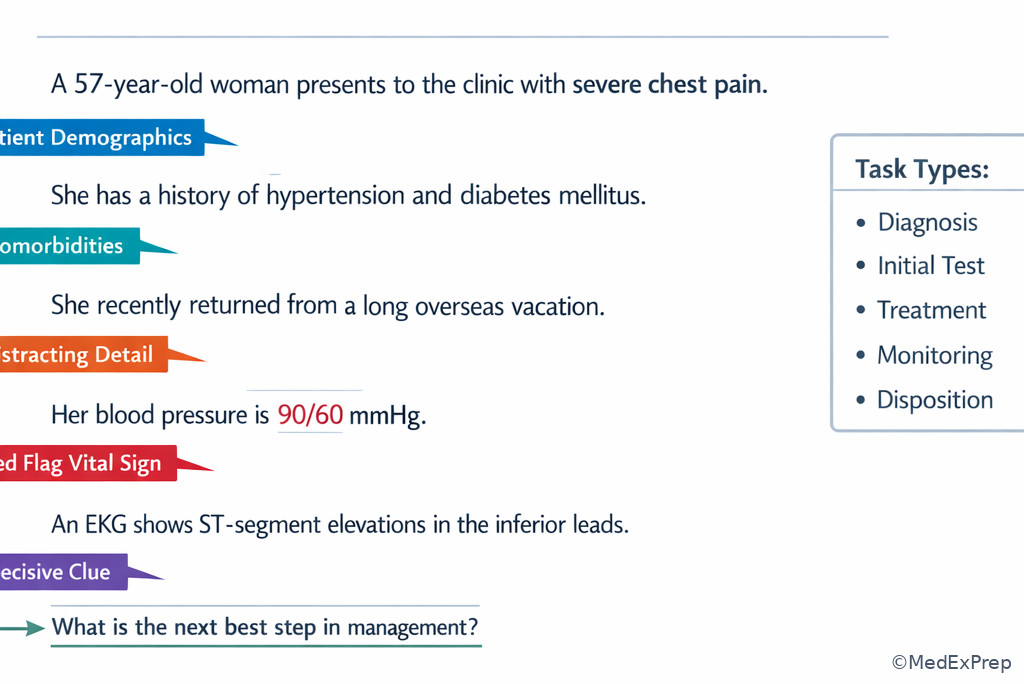
See Fig 3 for a visual way to mark task, noise, and the decisive clue in longer vignettes.
1.1.1.5 Application: recognize noise, red flags, and the governing clue
A Explanation
The decision conflict is: Should every clue carry equal weight? No. Choose prioritization. Reject flat reading. In PANRE-LA stems, some details are there to tempt a common but lower-priority answer, while one or two findings determine the correct response.
The highest-value sorting rule is: red flags outrank background diagnoses. Hypotension, altered mental status, hypoxemia, focal neurologic deficit, peritoneal signs, meningismus, severe bleeding, pregnancy-related instability, and suicidal intent all immediately narrow the correct action space. After red flags, look for the governing clue: a single element that separates two plausible options. Examples include timing, location, exposure, medication use, pregnancy status, renal function, anticoagulation, or a specific exam finding.
WHY THIS IS TESTED: Broad recertification questions often mimic clinical reality, where multiple diagnoses can be true in the chart, but only one matters right now. The exam tests your ability to prioritize the active threat or task-driving detail.
Key rule: Comorbidities are not automatically the answer. They matter only if they explain the current presentation better than the acute discriminating clue.
High-Yield Connection: This concept is tested alongside Red Flag Prioritization and Disposition And Follow-Up. Know both the dangerous presentation and the correct destination of care.
Clinician Action: DIAGNOSE by ranking clues, not collecting all of them equally. ORDER tests that answer the highest-priority threat. TREAT the time-sensitive problem first. REFER/ESCALATE when red flags elevate the required level of care.
B Worked example
A 28-year-old woman presents to clinic with severe headache, nausea, and photophobia. She has a history of migraine and takes a triptan as needed. Today she also reports a fever of 38.9°C, neck stiffness, and that the headache is “the worst of my life.” She recently started an oral contraceptive and mentions poor sleep due to work stress. The question asks for the most appropriate next step.
Identify task: management/disposition. Extract key facts: fever, neck stiffness, worst headache, severe acuity. Migraine history, sleep deprivation, and estrogen use are distracting because each could support another answer. Apply rule: meningitis or subarachnoid hemorrhage cannot be managed as routine migraine. The stem demands urgent evaluation and higher-level care. Eliminate distractors: triptan refill is tempting due to migraine history; outpatient brain MRI is tempting because of headache severity; sleep counseling matches the stress detail but ignores danger. Verify: emergency referral and acute workup are required.
C Exam trap
Common wrong answer: Treat the known chronic diagnosis because the stem names it explicitly.
Why it is tempting: exam-takers anchor on the prior history and stop processing the new pattern.
Single clue that eliminates it: a new red-flag feature—here fever plus neck stiffness—changes the entire urgency and differential.
D Checkpoint
Question: In a PANRE-LA vignette, which detail most often serves as the governing clue between two otherwise plausible answers?
- A chronic diagnosis listed in past history — tempting because it offers an immediate anchor, but wrong because it may be included as noise.
- The single finding that changes urgency or treatment — tempting because it may seem too narrow, but correct because exam items often hinge on one discriminator.
- The patient’s preferred explanation — tempting because patients provide context, but wrong because their framing is often a distractor.
- The oldest abnormal laboratory value in the chart — tempting because objective data feel authoritative, but wrong because current symptom-driving clues matter more.
Answer: B
If you missed this: Review 1.1.1.3 Application: recognize noise, red flags, and the governing clue — focus on the single clue that changes urgency or management.
Exam takeaway: Promote instability and decisive findings, and demote familiar but non-governing details.
flowchart TD
A[Stem details] --> B{Red flag present?}
B -->|Yes| C[Urgency rises]
B -->|No| D[Continue sorting]
C --> E[Disposition or stabilization may be answer]
D --> F{Single discriminator present?}
F -->|Yes| G[Use it to choose between close options]
F -->|No| H[Look for task wording and setting]
I[Known chronic disease] --> J[Use only if it explains current pattern better than acute clues]
See Fig 4 for the fast sorting rule used in close-call differentials.
Exam takeaway: Visual grouping of instability clues helps you recognize when disposition outweighs detailed diagnosis.
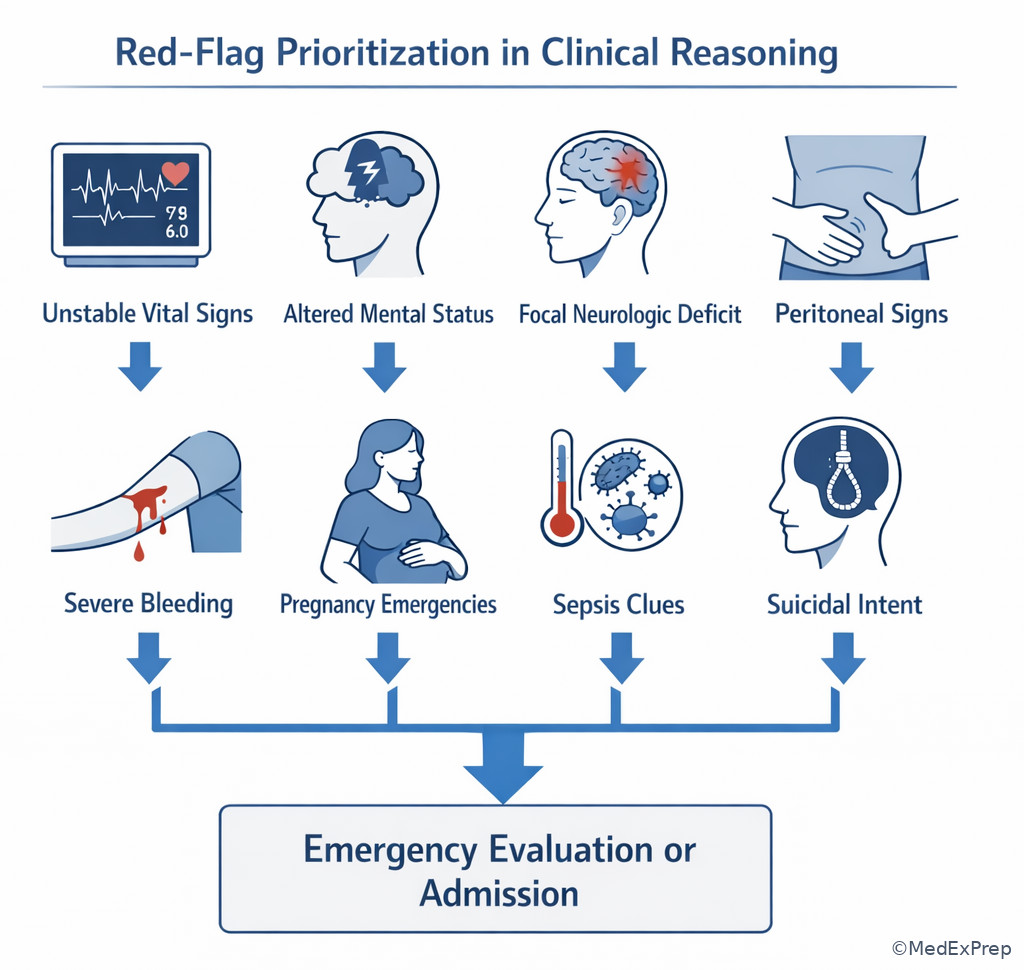
1.1.1.6 Application: common PANRE-LA task types and how answers differ
A Explanation
The decision conflict is: When the same patient could justify several true statements, which answer type does the item reward? Choose the option that matches the asked task. Reject answers that belong to a different phase of care.
For example, a suspected pulmonary embolism case can generate multiple true actions: assess stability, order testing, anticoagulate if appropriate, admit some patients, and counsel on follow-up. But if the item asks “best initial test” in a stable patient, imaging or pretest-risk-directed workup is the target; if it asks “most appropriate initial therapy” in a crashing patient, stabilization and emergent management dominate. The same content domain produces different correct answers depending on task wording.
WHY THIS IS TESTED: PANRE-LA assesses longitudinal clinical reasoning, so it tests different points along the patient journey: recognition, workup, treatment, monitoring, and disposition. Strong learners do not confuse these phases.
High-Yield Connection: This concept overlaps with Common Test Interpretation and Medication Contraindication Review. On exam day, know not only the diagnosis but also whether the item is about the first test, the safer drug, or the monitoring target.
Memory anchor: R-W-A-D = Recognize, Work up, Act, Dispose. Before choosing an option, decide which phase the stem lives in.
Clinician Action: DIAGNOSE only if the item asks for diagnosis. ORDER when the item asks for testing strategy. TREAT when immediate management is the focus. REFER/ESCALATE when disposition is the decisive step.
B Worked example
A 73-year-old man with COPD, atrial fibrillation on apixaban, and stage 3 CKD presents with melena and lightheadedness. He is pale but alert; blood pressure is 96/60 mm Hg, pulse 108/min. The question asks for the most appropriate initial therapy. One answer option is endoscopy.
Identify task: therapy, not definitive procedure. Extract key facts: active GI bleed pattern, tachycardia, borderline hypotension, anticoagulant use. CKD is important but not the first mover. Apply rule: initial management of suspected significant GI bleeding is stabilization—IV access, fluids/blood products as needed, anticoagulation review/reversal strategy in context, and urgent higher-level management—before definitive endoscopy. Eliminate distractors: endoscopy is tempting because it is important, but it is not the initial therapy in an unstable or borderline patient; oral PPI is too weak and too slow; outpatient follow-up ignores acuity. Verify: the answer must match the treatment phase and urgency.
C Exam trap
Common wrong answer: Choose a definitive specialist procedure when the question asks for initial therapy.
Why it is tempting: definitive interventions feel more advanced and therefore more correct.
Single clue that eliminates it: the word initial plus unstable or borderline vitals means stabilization comes before definitive intervention.
D Checkpoint
Question: A stem describes classic appendicitis and asks for the best confirmatory test in a stable nonpregnant adult. Which thinking pattern is correct?
- Choose the treatment because the diagnosis is already likely — tempting because management matters, but wrong because the task asks for confirmation.
- Choose the first available bedside sign — tempting because appendicitis has classic exam findings, but wrong because they are not confirmatory testing.
- Choose the test that best secures the diagnosis in this context — tempting because it requires slowing down, but correct because task wording controls the answer.
- Choose discharge instructions because stability is reassuring — tempting in mild presentations, but wrong because the item asks for diagnostic confirmation.
Answer: C
If you missed this: Review 1.1.1.4 Application: common PANRE-LA task types and how answers differ — focus on matching the option to the phase of care the stem requests.
- “Initial therapy” means what you do now, not the definitive specialist endpoint.
- True or False: A correct diagnostic test can still be the wrong answer if the item asks for disposition. True.
- Name the four care phases in the memory anchor: Recognize, Work up, Act, Dispose.
| Task type | Correct answer tends to look like | Tempting wrong answer | Single discriminator |
|---|---|---|---|
| Diagnosis | Closest pattern match | Related disease sharing one symptom | One defining clue |
| Initial test | Efficient first study | Gold-standard but not first-line test | Word “initial” |
| Confirmatory test | Higher-specificity proof | Screening or bedside-only evidence | Word “confirmatory” |
| Initial therapy | Stabilization or first-line treatment | Definitive procedure | Acuity plus word “initial” |
| Monitoring | Most actionable follow-up variable | Interesting but less management-changing metric | What detects harm or failure earliest |
| Disposition | Correct level of care | Good treatment in wrong setting | Need for observation, admission, or transfer |
Exam takeaway: The same case can support different correct actions depending on whether the item asks for diagnosis, workup, treatment, or disposition.
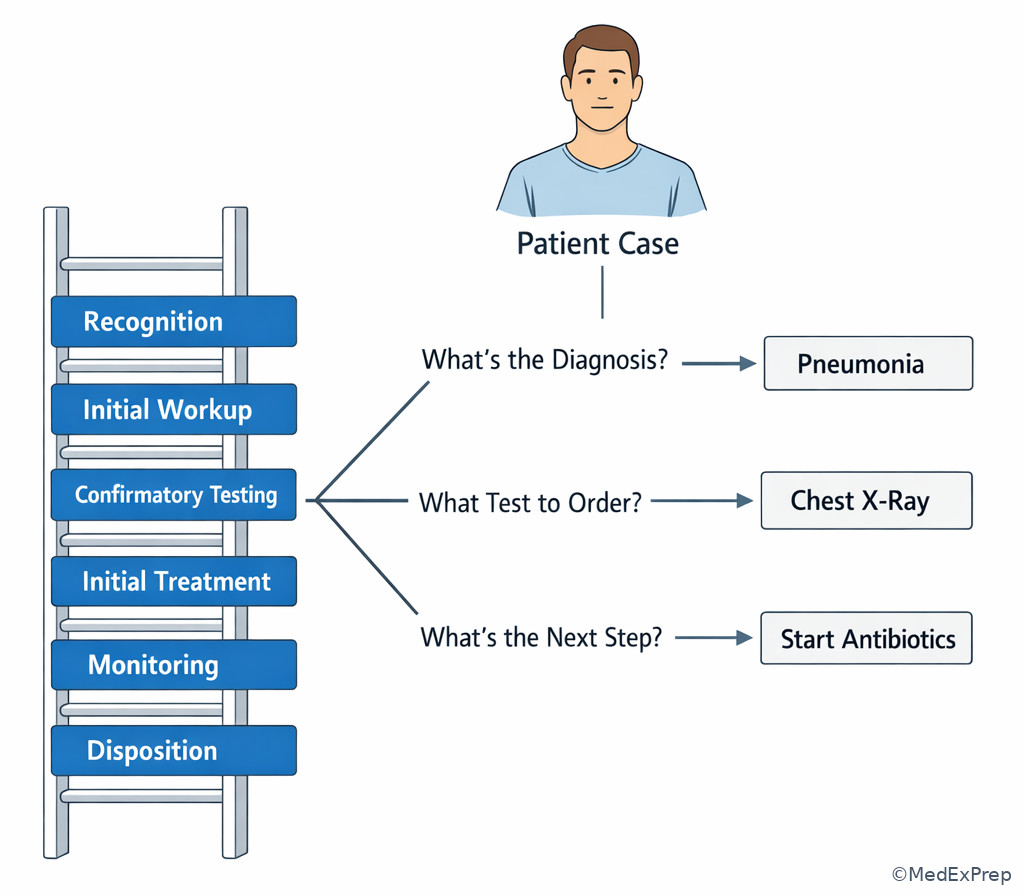
See Fig 5 when a case seems to support several true answers; the phase of care decides which one is best.
1.1.1.7 Integration: scope, escalation, and the safest PANRE-LA answer
A Explanation
The final decision conflict is: Should you choose the most complete intervention, or the safest role-appropriate next step? Choose role-appropriate action with escalation when needed. Reject answers that assume unrestricted independent subspecialty authority.
For PANRE-LA, you are reasoning as a certified PA managing common and high-impact conditions across settings under team-based practice. That means you can evaluate, order common tests, interpret common findings, initiate evidence-based treatment, counsel, monitor, and arrange follow-up. But if the case involves instability, procedural urgency, surgeon-only intervention, obstetric emergency, psychiatric danger, stroke window decisions, or another higher-complexity domain, the correct answer frequently becomes stabilize, begin the appropriate first steps, and consult/refer/transfer.
WHY THIS IS TESTED: Safety and scope are inseparable in real practice. The exam wants to know whether you can recognize the point where continuing outpatient or solo management would be unsafe.
Recall: In the upcoming topic PA Scope And Escalation, we will build a more detailed escalation framework. Here, the foundational rule is that recognizing when not to continue routine management is itself a high-yield correct answer.
Key rule: When a stem exceeds routine front-line management, the best answer is rarely “do nothing” and rarely “perform the specialist endpoint yourself.” It is usually stabilize + escalate.
Exam takeaway: If the patient is unstable or needs specialist-level intervention, start first-line stabilization and escalate promptly.
flowchart TD
A[Clinical scenario] --> B{Stable?}
B -->|No| C[Stabilize ABCs and urgent transfer/consult]
B -->|Yes| D{Within routine PA front-line management?}
D -->|Yes| E[Focused workup and evidence-based initial treatment]
D -->|No| F[Initiate safe first steps and arrange specialist evaluation]
C --> G[Reassess response and disposition]
E --> G
F --> G
See Fig 6 for the highest-yield scope rule in this lesson.
Clinician Action: DIAGNOSE when the problem is manageable within generalist practice. ORDER front-line tests that clarify risk and urgency. TREAT with evidence-based initial therapy you can safely start. REFER/ESCALATE for instability, specialist procedures, high-risk uncertainty, or settings beyond routine PA management.
B Worked example
A 31-year-old pregnant woman at 32 weeks presents to a primary care clinic with severe headache, visual changes, and right upper quadrant pain. She has chronic hypertension and obesity. Blood pressure is 174/112 mm Hg; urine dip is 3+ protein. She says she had similar headaches before pregnancy and wonders if this is just migraine. The question asks for the most appropriate next step.
Identify task: immediate management/disposition. Extract key facts: pregnancy, severe hypertension, neurologic symptoms, RUQ pain, proteinuria. Migraine history is the tempting wrong clue. Apply rule: this is a hypertensive emergency concern in pregnancy with possible severe preeclampsia; outpatient headache treatment is unsafe. A PA should initiate urgent stabilization measures per setting and arrange emergency obstetric evaluation. Eliminate distractors: triptan therapy matches headache history but ignores pregnancy emergency; routine outpatient labs delay care; next-week OB follow-up is dangerously insufficient. Verify: urgent escalation is the safest answer.
C Exam trap
Common wrong answer: Continue routine outpatient management because the patient is talking comfortably and has a familiar symptom.
Why it is tempting: stability is often judged by appearance alone, and prior migraine history creates false reassurance.
Single clue that eliminates it: severe-range blood pressure in pregnancy with visual symptoms changes the setting from outpatient symptom management to emergency escalation.
D Checkpoint
Question: Which answer best fits PANRE-LA expectations when a case exceeds routine front-line PA management?
- Perform the definitive specialist procedure immediately — tempting because it sounds decisive, but wrong because it often exceeds role and setting.
- Stabilize, begin indicated initial management, and arrange urgent consultation or transfer — tempting because it may feel incomplete, but correct because it matches safe PA practice and exam logic.
- Defer all treatment until the consultant arrives — tempting because escalation is needed, but wrong because initial stabilization should not be delayed.
- Discharge with precautions if the diagnosis is not yet certain — tempting when uncertainty exists, but wrong because high-risk uncertainty itself can mandate escalation.
Answer: B
If you missed this: Review 1.1.1.5 Integration: scope, escalation, and the safest PANRE-LA answer — focus on the stabilize-plus-escalate rule when complexity exceeds routine management.
Exam takeaway: Distinguish routine front-line actions from situations requiring consultation, referral, admission, or transfer.
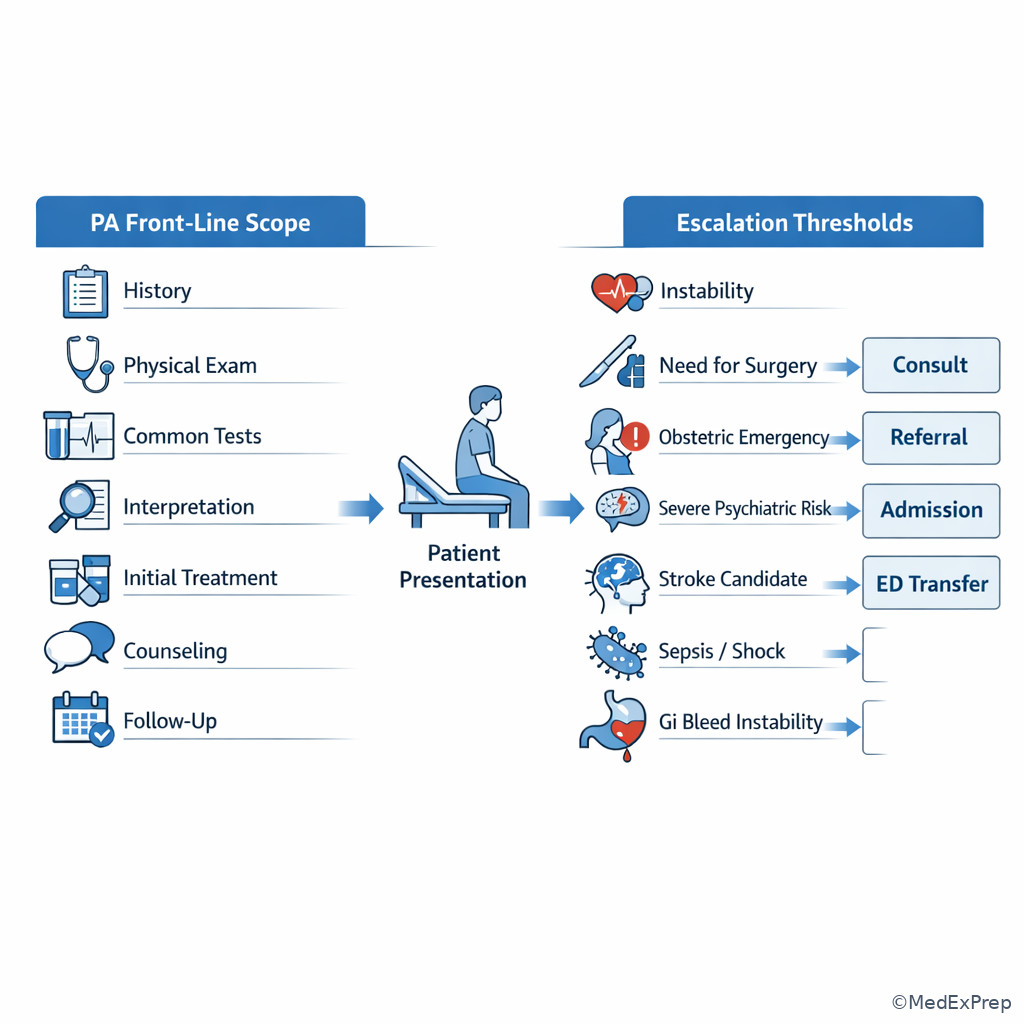
Exam takeaway: Seeing competing clues side-by-side trains you to recognize which finding truly determines the answer.
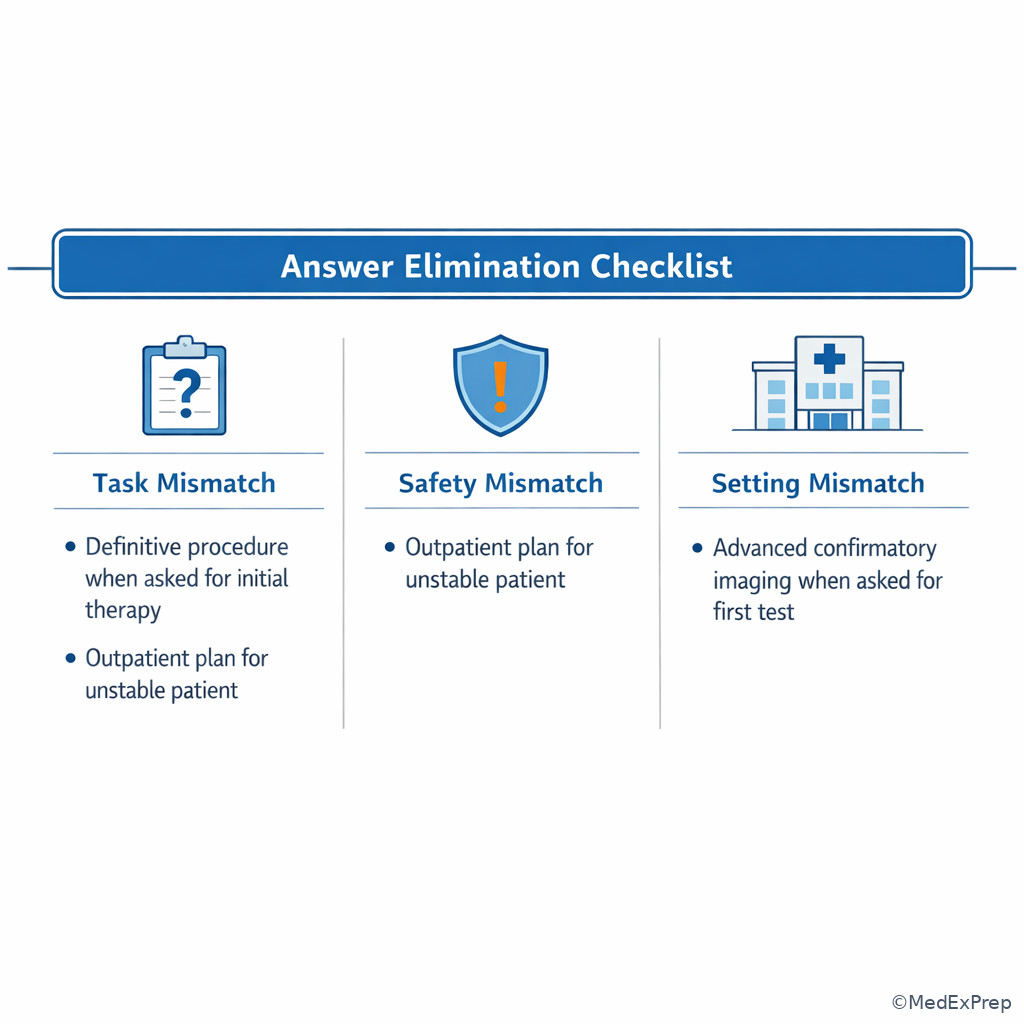
Exam takeaway: Eliminate options by task mismatch, safety mismatch, and setting mismatch before choosing among close calls.
Exam Traps & Differentiators
Most common wrong answer and why: The most common wrong answer is the option that is medically reasonable in a related scenario but mismatched to the stem’s task, urgency, or setting. Learners pick it because it matches the diagnosis at a surface level.
| Looks similar but isn’t | Why it tempts | Why it’s wrong here | What to think instead |
|---|---|---|---|
| Definitive test vs best initial test | Definitive sounds more correct | The stem asks for first step, not final proof | Start with efficient, context-appropriate workup |
| Definitive procedure vs initial therapy | Procedure solves the problem | Unstable patients need stabilization first | Treat urgency before endpoint management |
| Chronic diagnosis flare vs new emergency | Past history creates anchoring | New red flags outweigh familiar diagnosis | Re-rank clues by acuity |
| Outpatient management vs urgent escalation | Patient appears conversational and awake | Vital signs or danger findings change disposition | Choose level of care first |
| Specialist-level action vs PA-role action | Advanced answer feels authoritative | Scope and setting limit the immediate next step | Stabilize plus consult or transfer |
| Interesting abnormal data vs governing clue | Objective numbers seem decisive | They may be incidental or chronic | Find the one clue that changes management |
- If the stem says “best initial test,” think first efficient diagnostic step, not most definitive study.
- If the stem says “most appropriate next step” with instability, think stabilization and disposition before finer diagnostic precision.
- If the stem says “requires immediate clarification,” think pregnancy, allergy, renal function, drug interaction, anticoagulation, or other safety-critical missing data.
- If the stem gives a familiar chronic history plus a new red flag, think do not anchor on the chronic diagnosis.
- If the stem clearly exceeds routine management, think initiate safe first steps and escalate; do not pretend to be the subspecialist endpoint provider.
- If the stem offers several true statements, think only one matches the exact phase of care being tested.
High-Yield Connection: These traps frequently pair with upcoming lessons on PA Scope And Escalation and Question Stem Deconstruction. One teaches when to escalate; the other teaches how to detect the task and governing clue quickly.
Review connection: The traps above test task matching under safety constraints. If any felt unfamiliar, revisit 1.1.1.2 Foundational item language: decode the task before the details and 1.1.1.5 Integration: scope, escalation, and the safest PANRE-LA answer before attempting the Self-check quiz.
Algorithm / Approach
Use this approach with Fig 1 and Fig 6 as the visual anchors for the rest of the course.
Rapid Review
- Best next step → safety and urgency can beat diagnostic completeness.
- Best initial test → first efficient study, not automatic gold standard.
- Best confirmatory test → proof after suspicion, not screening.
- Known chronic disease → not the answer unless it explains the acute pattern better than new clues.
- Red flags → change disposition before they change nuance.
- Distractor → usually a true fact in the wrong phase of care.
- Outpatient vs ED → determined by instability, time-sensitive threat, and monitoring need.
- PA role → evaluate, start treatment, monitor, and escalate when complexity exceeds routine care.
- Advanced procedure option → often wrong unless the stem truly asks for specialist-level endpoint action.
- Requires immediate clarification → think contraindication, interaction, pregnancy, allergy, renal function, or omitted danger sign.
- Clinical noise → familiar but non-governing details that reward anchoring errors.
- Governing clue → the one detail that separates two close answers.
- Phase-of-care mismatch → classic reason a medically true option is still wrong.
- Stabilize + escalate → high-yield answer when routine front-line management is no longer enough.
Memory anchor: LAST = Look at final line, Assess acuity, Select governing clue, Test options for mismatch. Use it on every stem before reading answer choices.
Self-check quiz
1. A PANRE-LA stem ends with the phrase best initial test. Which answer type is most likely correct?
- The most definitive specialist study available
- The first efficient study that fits the patient’s stability and setting
- The treatment that would be given if the diagnosis were confirmed
- The highest-sensitivity screening test from any population
2. A 46-year-old woman with asthma and anxiety presents with chest tightness. She is speaking in full sentences, but her blood pressure is 78/44 mm Hg and she looks pale. The question asks for the most appropriate next step. Which principle should guide the answer?
- Prioritize chronic disease history
- Identify instability before pursuing diagnostic precision
- Choose the most advanced imaging option first
- Focus on the most common outpatient diagnosis
3. A 62-year-old man with diabetes, CKD stage 3, and hyperlipidemia presents with 2 hours of crushing chest pain and diaphoresis after yard work. He says he often gets reflux after spicy meals, and he took antacids without relief. Blood pressure is 84/58 mm Hg, heart rate 118/min, and oxygen saturation is 93%. Which is the most appropriate next step?
- Diagnose GERD and begin acid suppression with outpatient follow-up
- Order an outpatient stress test within 72 hours
- Initiate emergency evaluation and stabilization for suspected ACS
- Wait for office laboratory testing before deciding on disposition
4. A 29-year-old woman with migraine, obesity, and use of combined oral contraceptives presents with unilateral leg swelling after a long flight. She also mentions mild calf soreness after exercise. She is hemodynamically stable and has no chest pain. The stem asks for the best initial test. Which is most appropriate?
- CT pulmonary angiography
- Venous duplex ultrasonography
- MRI of the calf muscles
- Immediate thrombophilia panel
5. A 35-year-old pregnant woman at 30 weeks with chronic hypertension presents to clinic with severe headache, visual changes, and right upper quadrant pain. She has a history of migraine and says this feels similar except “more intense.” Blood pressure is 170/110 mm Hg. Which is the most appropriate next step?
- Refill her migraine medication and recheck in 48 hours
- Order outpatient brain MRI and routine prenatal follow-up
- Arrange emergency obstetric evaluation after initiating urgent management steps
- Advise home blood pressure logging and sodium restriction only
6. A 71-year-old man with atrial fibrillation on apixaban, coronary disease, and CKD presents with melena, weakness, and lightheadedness. Blood pressure is 94/60 mm Hg and pulse is 112/min. The stem asks for the most appropriate initial therapy. Which answer best fits the task?
- Urgent stabilization with IV access, resuscitative measures, and escalation for GI bleed management
- Immediate outpatient colonoscopy scheduling
- Oral proton pump inhibitor therapy alone with discharge precautions
- Iron supplementation and repeat CBC in one week
7. A 24-year-old man with a history of panic attacks and recent viral URI presents with shortness of breath, pleuritic chest pain, and tachycardia. He appears anxious, but oxygen saturation is 88% on room air. The question asks for the most appropriate next step. Which reasoning error would most likely produce the wrong answer?
- Using the low oxygen saturation as a red flag that changes disposition
- Anchoring on the prior panic disorder and dismissing the current danger sign
- Recognizing that psychiatric history can be clinical noise in an acute cardiopulmonary stem
- Prioritizing instability over the patient’s own explanation
8. A 58-year-old woman with rheumatoid arthritis, hypertension, and chronic NSAID use presents with abdominal pain and dark stools. She is pale, tachycardic, and mildly confused. The options include CT abdomen, endoscopy, discharge with a PPI, and initial stabilization with transfer. Which is the best reason that initial stabilization with transfer is correct?
- Because CT abdomen is never useful in abdominal pain
- Because endoscopy is contraindicated in all GI bleeding
- Because the stem’s red flags make disposition and stabilization more urgent than definitive procedure selection
- Because NSAID use proves the diagnosis and removes the need for further evaluation
Answer key
1.1.1.8 1. Question 1
Correct answer: B
- A. Tempting because definitive tests feel academically stronger. Incorrect for this task because “best initial test” asks for the first efficient step, not the maximal study. Single stem clue: the word initial. Source: Goldman-Cecil Medicine; UpToDate diagnostic strategy principles.
- B. Tempting because it sounds less impressive than a gold-standard study. Correct because initial testing should match stability, pretest probability, and setting before moving to more definitive confirmation. Single stem clue: “best initial test.” Source: Harrison’s Principles of Internal Medicine; UpToDate.
- C. Tempting because treatment and testing are tightly linked in real care. Incorrect because it answers a management question when the stem asked about workup. Single stem clue: question task mismatch. Source: Harrison’s; standard clinical reasoning frameworks.
- D. Tempting because high sensitivity is often desirable. Incorrect because screening tests are not automatically the right first diagnostic study in a symptomatic patient. Single stem clue: the patient-specific initial test must fit the clinical context. Source: Goldman-Cecil Medicine.
If you missed this: Review 1.1.1.2 Foundational item language: decode the task before the details — focus on how “initial test” differs from “definitive” or “confirmatory” testing.
1.1.1.9 2. Question 2
Correct answer: B
- A. Tempting because asthma and anxiety can both cause chest symptoms. Incorrect because hypotension is a danger sign that outranks chronic history. Single stem clue: blood pressure 78/44 mm Hg. Source: Harrison’s; emergency stabilization principles in UpToDate.
- B. Tempting because it simplifies the case to urgency rather than diagnosis labeling. Correct because unstable vitals make stabilization and urgent evaluation the primary task. Single stem clue: profound hypotension. Source: Goldman-Cecil Medicine; ACLS/emergency evaluation frameworks.
- C. Tempting because chest symptoms often lead to imaging. Incorrect because advanced imaging should not delay stabilization in an unstable patient. Single stem clue: instability comes before imaging choice. Source: Harrison’s.
- D. Tempting because common outpatient causes of chest tightness are frequent in practice. Incorrect because PANRE-LA rewards red-flag prioritization over base-rate comfort when vital signs are dangerous. Single stem clue: pale plus hypotension. Source: UpToDate; emergency triage principles.
If you missed this: Review 1.1.1.3 Application: recognize noise, red flags, and the governing clue — focus on how instability overrides familiar chronic diagnoses.
1.1.1.10 3. Question 3
Correct answer: C
- A. Tempting because reflux after meals and poor antacid response may coexist with chest pain histories. Incorrect because crushing pain, diaphoresis, and hypotension strongly support a high-risk cardiac emergency rather than outpatient reflux care. Single stem clue: BP 84/58 mm Hg with diaphoresis. Source: AHA/ACC ACS guidance; UpToDate.
- B. Tempting because stress testing is part of coronary evaluation in some stable patients. Incorrect because unstable suspected ACS is not a stress-test scenario. Single stem clue: hemodynamic instability. Source: AHA/ACC guidelines.
- C. Tempting because it may feel broad rather than diagnosis-specific. Correct because the pathophysiology suggests ongoing myocardial ischemia with instability, so emergency evaluation and stabilization are the appropriate initial management. Single stem clue: crushing chest pain plus shock-like vitals. Source: AHA/ACC; Harrison’s.
- D. Tempting because objective confirmation is attractive before disposition. Incorrect because waiting for office labs delays urgent care in a time-sensitive emergency. Single stem clue: 2 hours of ischemic symptoms with hypotension. Source: AHA/ACC; Goldman-Cecil.
If you missed this: Review 1.1.1.1 Foundational exam structure: what PANRE-LA is really testing — focus on the principle that unstable, time-sensitive threats require immediate action over outpatient reasoning.
1.1.1.11 4. Question 4
Correct answer: B
- A. Tempting because thromboembolism raises concern for PE. Incorrect because isolated unilateral leg swelling in a stable patient points first to DVT evaluation with leg imaging, not chest CTA. Single stem clue: no chest pain and hemodynamic stability. Source: CHEST/UpToDate venous thromboembolism workup.
- B. Tempting because it is less dramatic than CTA. Correct because the mechanism is venous stasis plus estrogen risk causing suspected lower-extremity DVT, and venous duplex ultrasonography is the usual best initial test. Single stem clue: unilateral leg swelling after long flight. Source: CHEST guidelines; UpToDate.
- C. Tempting because exercise soreness suggests a musculoskeletal source. Incorrect because the stem’s thrombotic risk factors are more decisive than the exercise-noise detail. Single stem clue: estrogen plus prolonged immobility. Source: Harrison’s; UpToDate.
- D. Tempting because young patients with thrombosis sometimes prompt hypercoagulable evaluation. Incorrect because thrombophilia panels are not the best initial diagnostic test for an acute symptomatic clot presentation. Single stem clue: the task is acute diagnosis, not etiology workup. Source: CHEST/ASH guidance.
If you missed this: Review 1.1.1.2 Foundational item language: decode the task before the details — focus on how “best initial test” prevents overreaching to more advanced or less relevant studies.
1.1.1.12 5. Question 5
Correct answer: C
- A. Tempting because migraine history and headache symptoms create anchoring. Incorrect because severe hypertension in pregnancy with neurologic symptoms and RUQ pain suggests severe preeclampsia until proven otherwise. Single stem clue: BP 170/110 mm Hg at 30 weeks. Source: ACOG guidance; UpToDate.
- B. Tempting because neuroimaging sounds thorough for severe headache. Incorrect because outpatient imaging misses the immediate obstetric emergency and delays urgent management. Single stem clue: pregnancy-specific red flags. Source: ACOG; Harrison’s.
- C. Tempting because it prioritizes safety over outpatient convenience. Correct because the pathophysiology is pregnancy-related hypertensive emergency risk requiring urgent evaluation and management at a higher level of care. Single stem clue: visual changes plus severe-range blood pressure. Source: ACOG Practice Bulletin; UpToDate.
- D. Tempting because chronic hypertension does require home monitoring. Incorrect because home monitoring is inadequate in the face of severe symptoms and severe-range pressures. Single stem clue: symptomatic severe hypertension. Source: ACOG.
If you missed this: Review 1.1.1.5 Integration: scope, escalation, and the safest PANRE-LA answer — focus on when pregnancy red flags mandate urgent escalation rather than routine outpatient symptom treatment.
1.1.1.13 6. Question 6
Correct answer: A
- A. Tempting because it feels less definitive than procedural management. Correct because the patient has likely significant GI bleeding with tachycardia, hypotension, anticoagulant exposure, and CKD; the immediate priority is resuscitative stabilization and urgent escalation, not a downstream endpoint. Single stem clue: melena with BP 94/60 mm Hg. Source: ACG upper GI bleeding guidance; UpToDate.
- B. Tempting because endoscopic evaluation is ultimately important in GI bleeding. Incorrect because outpatient colonoscopy is the wrong setting and timing for a hemodynamically concerning bleed. Single stem clue: lightheadedness with abnormal vital signs. Source: ACG guidance.
- C. Tempting because PPIs are used in upper GI bleeding. Incorrect because oral therapy alone with discharge ignores instability and anticoagulation-related risk. Single stem clue: tachycardia and borderline hypotension. Source: ACG; Harrison’s.
- D. Tempting because chronic blood loss can cause iron deficiency anemia. Incorrect because the case is acute, symptomatic, and hemodynamically concerning rather than a stable outpatient anemia workup. Single stem clue: current melena with lightheadedness. Source: Goldman-Cecil; ACG.
If you missed this: Review 1.1.1.4 Application: common PANRE-LA task types and how answers differ — focus on why “initial therapy” in an unstable patient means stabilization before definitive procedures.
1.1.1.14 7. Question 7
Correct answer: B
- A. Tempting because anxiety history might downplay the episode. Incorrect as a reasoning error because using hypoxemia as a red flag is exactly the right move. Single stem clue: oxygen saturation 88%. Source: UpToDate acute dyspnea/PE evaluation.
- B. Tempting because panic attacks can produce dyspnea, chest pain, and tachycardia. Correct because anchoring on prior panic disorder while ignoring hypoxemia and pleuritic pain is the classic wrong-answer pathway. Single stem clue: low oxygen saturation changes the frame from psychiatric to acute cardiopulmonary. Source: Harrison’s; UpToDate.
- C. Tempting because psychiatric history is clinically relevant. Incorrect as a reasoning error because recognizing it as possible noise in the presence of objective red flags is appropriate exam strategy. Single stem clue: danger signs override background history. Source: emergency triage principles.
- D. Tempting because patient explanations matter in communication. Incorrect as a reasoning error because prioritizing instability over the patient’s explanation is correct in acute assessment. Single stem clue: pleuritic pain plus hypoxemia. Source: UpToDate.
If you missed this: Review 1.1.1.3 Application: recognize noise, red flags, and the governing clue — focus on how objective danger signs override familiar psychiatric or chronic explanations.
1.1.1.15 8. Question 8
Correct answer: C
- A. Tempting because GI bleeding can distract from other abdominal diagnoses. Incorrect because CT may be useful in some abdominal pain contexts; the issue here is not that CT is never useful, but that it is not the first priority in an unstable bleed pattern. Single stem clue: tachycardia and confusion. Source: ACG guidance; Harrison’s.
- B. Tempting because unstable patients may not go directly to procedure before resuscitation. Incorrect because endoscopy is not universally contraindicated; it is often essential after stabilization. Single stem clue: the word “initial” is the key, not a blanket contraindication. Source: ACG upper GI bleeding guidance.
- C. Tempting because it emphasizes disposition rather than the most procedurally advanced option. Correct because the stem’s physiology suggests acute blood loss with instability or impending instability, so stabilization and transfer outrank definitive procedure selection in the moment. Single stem clue: confusion plus tachycardia in a patient with dark stools. Source: ACG; UpToDate.
- D. Tempting because chronic NSAID use strongly suggests peptic ulcer bleeding. Incorrect because likely etiology does not eliminate the need for urgent evaluation, stabilization, and definitive management planning. Single stem clue: presumed cause does not erase high-risk presentation. Source: Harrison’s; ACG.
If you missed this: Review 1.1.1.5 Integration: scope, escalation, and the safest PANRE-LA answer — focus on how red-flag disposition and stabilization can be the tested answer even when the definitive diagnosis seems obvious.
Keep going with the full PANRE-LA Prep Course (PANRE-LA)
You just studied the way members do, in the same lesson interface. Full access unlocks every lesson, the question bank and flashcards for a full year.
One payment · 1 year of access · No auto-renewal