1.1.1 - Public Exam Structure
Why it matters
- The exam structure tells you how to think under timed conditions, not just what to memorize.
- Many wrong answers become tempting when candidates forget the exam is written from the entry-level PTA perspective, not the independent PT perspective.
- Public structure knowledge helps you avoid common myths, such as chasing unofficial weighting, overstudying obscure trivia, or answering outside PTA scope.
- Board-style stems reward candidates who can identify the immediate task, screen for safety, stay within the established plan of care, and escalate when needed.
Key Terms & Must-Know Facts
1.1.1.1 Key terms
- NPTE-PTA: National licensure examination for physical therapist assistants.
- Public exam structure: Officially available information about exam format and broad expectations.
- Entry-level PTA perspective: Answer from the role of a PTA working under PT direction and supervision.
- Plan of care: The PT-established treatment framework within which the PTA implements care.
- Best next action: The safest, scope-appropriate response for the exact stem.
- Distractor: A plausible wrong answer designed to test reasoning.
- Scope boundary: The line between PTA-permitted actions and PT-only responsibilities.
- Data interpretation: Using collected findings to determine continue, modify, withhold, or escalate.
- Red flag: A finding suggesting risk, instability, or need for urgent communication.
- Clinical vignette noise: Extra details included to test prioritization.
- Pacing: Managing time across the exam without sacrificing safety logic.
- Content area: Broad exam-relevant category such as professional responsibilities, data collection, or interventions.
- Jurisdictional rules: State-specific legal and regulatory limits on practice.
1.1.1.2 Must-know facts
- The exam tests applied clinical judgment, not mere recall.
- Public information supports broad preparation; exact hidden weighting should not be invented.
- On ambiguous stems, the safest action within PTA scope is usually preferred.
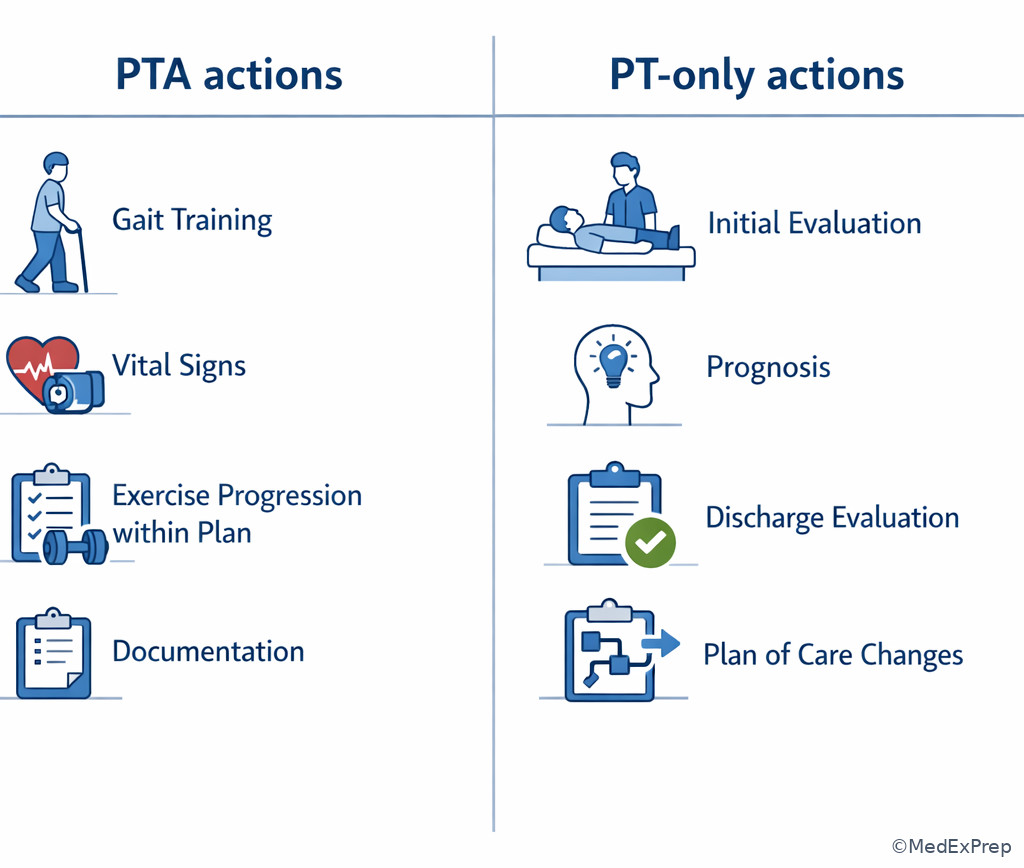
- PTAs can implement delegated care, monitor response, document findings, and notify the supervising PT of significant changes.
- PTAs do not independently perform the initial evaluation, determine prognosis, or establish the plan of care.
- A correct clinical action by the wrong provider can still be the wrong exam answer.
- Most board-style mistakes come from missing one discriminating clue.
- Noise in the stem should be filtered; do not let one attractive but irrelevant clue drive the answer.
Exam takeaway: Use structure knowledge to move from stem reading to the safest PTA-scoped answer instead of reacting to distracting details.
flowchart TD
A[Read the stem] --> B[Identify the task]
B --> C[Confirm PTA role]
C --> D[Scan for safety or red flags]
D --> E[Choose action within plan of care]
E --> F[Eliminate PT-only or unsafe options]
Exam takeaway: Broad categories matter more than unofficial weighting rumors when building a reliable study plan.
flowchart LR
A[Public exam structure] --> B[Professional responsibilities]
A --> C[Data collection]
A --> D[Interventions]
B --> E[Scope and safety]
C --> F[Interpret findings]
D --> G[Implement and monitor care]
Exam takeaway: Picture the exam as a clinical decision station where safety, scope, and monitoring cues must be prioritized over attractive distractors.

Exam takeaway: Keep the boundary clear between implementing care and making PT-only evaluation or plan-of-care decisions.
Exam takeaway: The single best answer usually depends on whether the patient is stable, expected, and still appropriate for PTA-delivered care.
flowchart TD
A[Collected finding during treatment] --> B{Expected and safe?}
B -- Yes --> C[Continue or progress within plan]
B -- No --> D{Minor intolerance but stable?}
D -- Yes --> E[Modify and monitor]
D -- No --> F[Withhold and notify PT or team] Exam takeaway: Most items can be solved by isolating the task, one key clue, and one rule that eliminates the closest distractor.
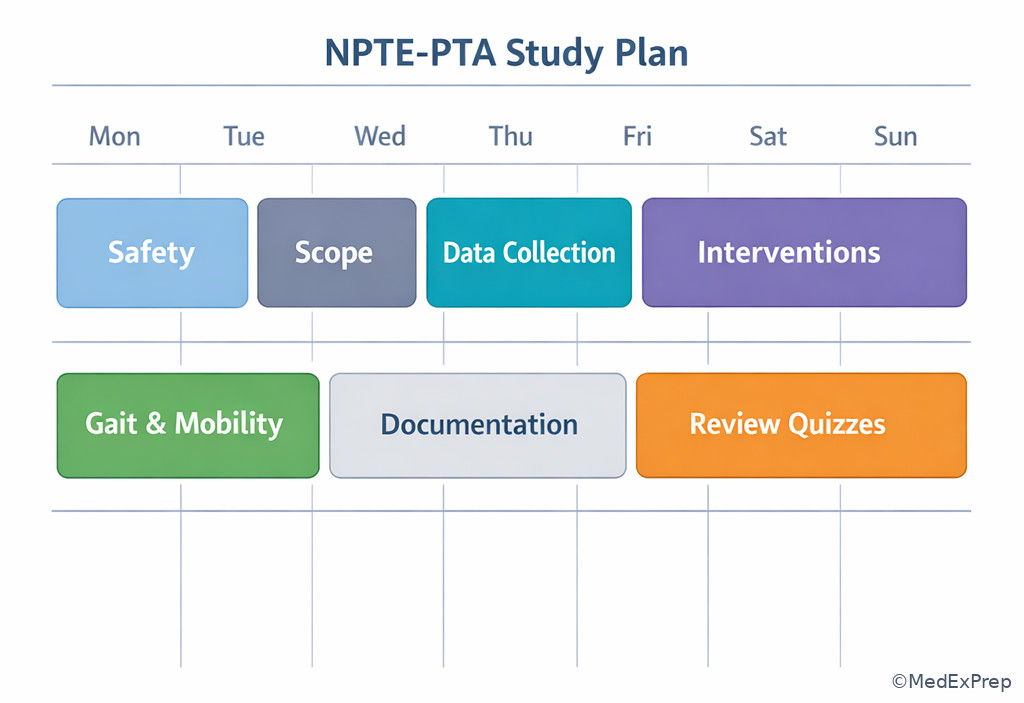
Exam takeaway: Balanced review across major exam-relevant domains beats guessing hidden weighting.
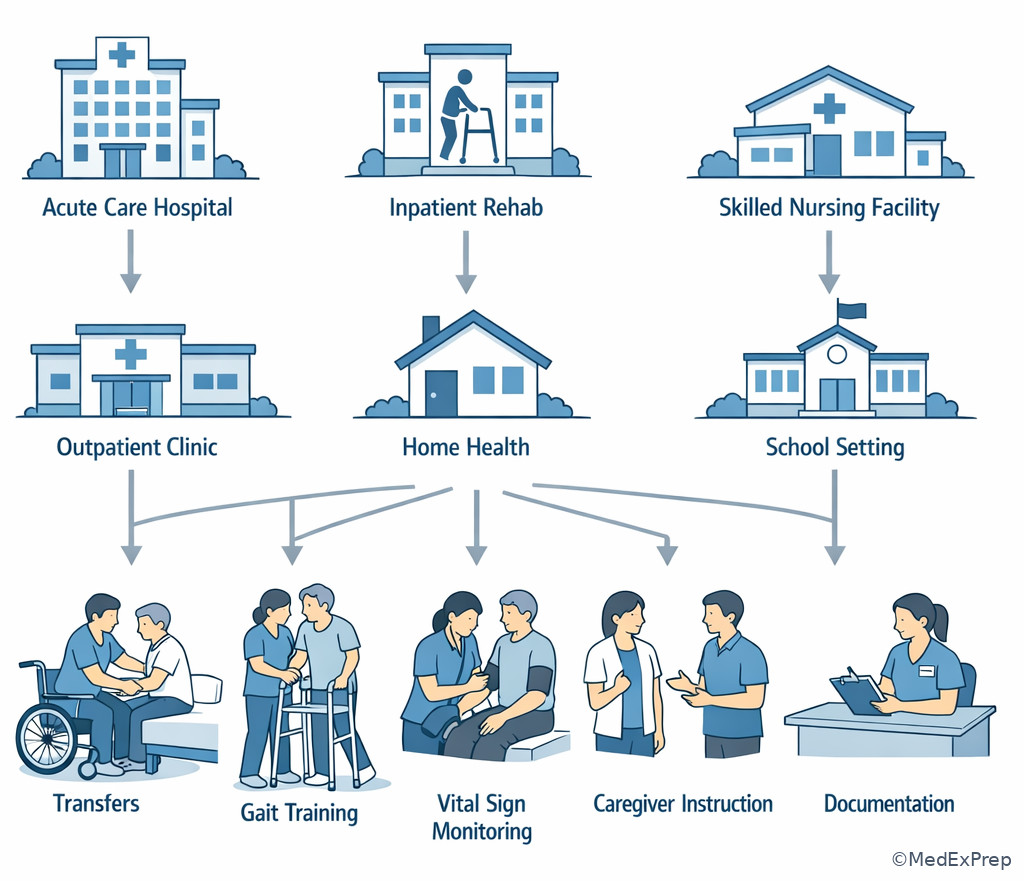
Exam takeaway: Expect applied questions from acute care, inpatient rehab, SNF, home health, outpatient, and school-related contexts.
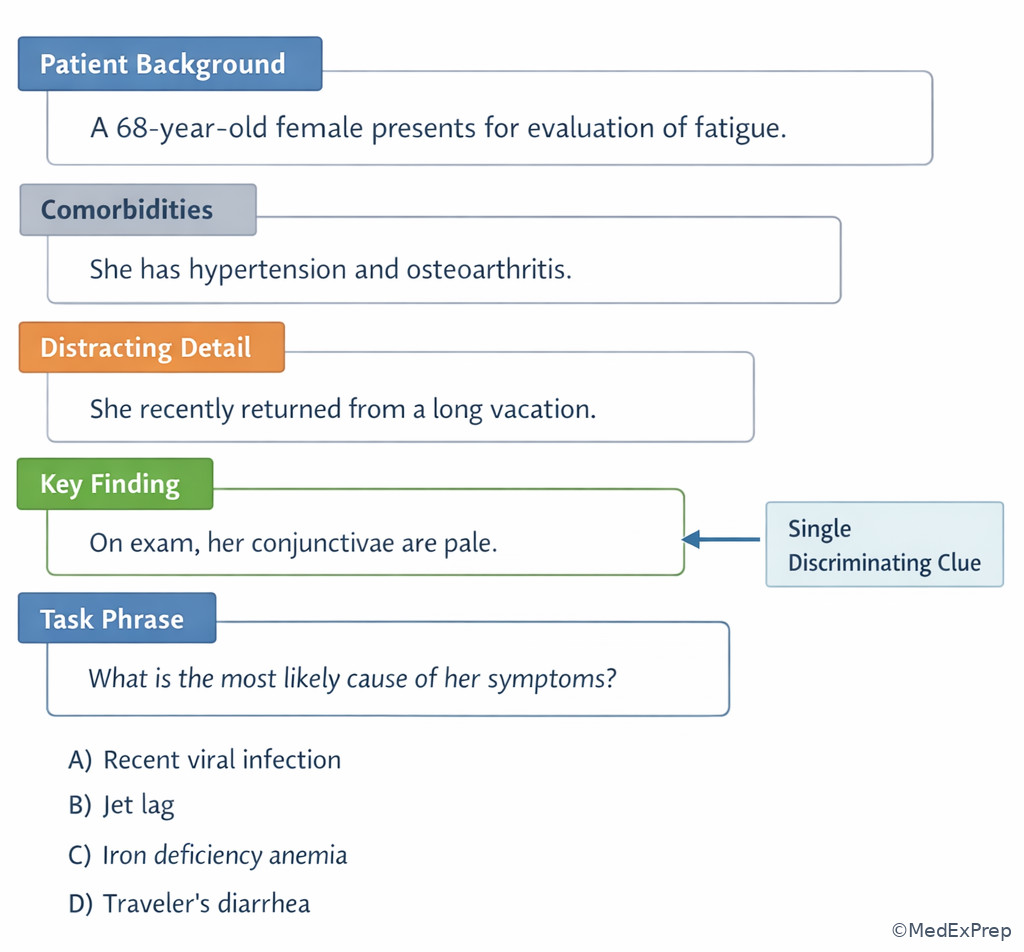
Exam takeaway: Words such as best next step, immediate action, and requires clarification should trigger a safety-first reasoning sequence.
flowchart LR
A[Best next step] --> B[Immediate action now]
C[Most important to monitor] --> D[Track response and risk]
E[Requires clarification] --> F[Check scope or safety mismatch]
Throughout this lesson, use Fig 1 as your base problem-solving path. When you need to separate broad preparation from rumor-driven preparation, see Fig 2. To keep your role clean on test day, return to Fig 4. For unstable-versus-stable treatment decisions, see Fig 5. For timed-item parsing, review Fig 6. The exam is not asking you to think like an independent PT; it is asking you to think like a safe, observant, entry-level PTA working under direction.
Core content
1.1.1.3 Foundational view: what the public exam structure does and does not tell you
A Explanation
The first decision conflict is simple: Should you treat public exam structure as a precise hidden blueprint, or as a broad test framework? The correct choice is the second. Public information helps you understand the exam’s purpose, candidate role, and broad content expectations. It does not justify guessing exact confidential item counts, secret weighting, or overfitting your study plan to internet claims. The single rule that resolves this conflict is: if it is not officially published or transparently supported, do not build your exam strategy around it.
WHY THIS IS TESTED: Candidates often miss easy safety and scope questions because they over-prioritize rumor-based “high-yield” niches instead of broad PTA decision-making. The exam rewards reliable reasoning across common settings and tasks.
For this topic, think in layers. Layer 1: the exam is a licensure exam intended to assess readiness for safe entry-level PTA practice. Layer 2: the questions are broad and applied, not merely vocabulary checks. Layer 3: your safest preparation model is balanced review across professional responsibilities, data collection, interventions, mobility, equipment, documentation, and safety. See Fig 2.
B Worked example
A 24-year-old PTA student, who also works part-time in outpatient orthopedics and is preparing after failing a prior attempt, asks how to spend the last 3 weeks before the exam. She has asthma and generalized anxiety disorder. A classmate tells her that “the exam is mostly obscure modalities and exact legal trivia this year,” and she plans to drop review of transfers, gait, vital sign response, and documentation. She also notes she scored well on flashcards of isolated terms. What is the most appropriate recommendation?
Reasoning chain: Identify task → advise on exam structure-based preparation. Extract key facts → prior failure, anxiety, rumor-driven narrowing, overreliance on recall drills, neglect of common applied domains. Apply rule → public structure supports broad, balanced, applied preparation. Eliminate distractors → do not chase unofficial weighting; do not study only strengths; do not assume one narrow category dominates. Verify → the safest recommendation is to restore balanced review with timed clinical reasoning practice across professional responsibilities, data collection, interventions, and mobility.
C Exam trap
D Checkpoint
Question: A candidate wants to use public exam structure information to guide final preparation. Which strategy is most appropriate?
- Study only the category most often mentioned on social media because repeated mention implies official weighting.
- Use public information to organize balanced review across major domains and practice board-style reasoning within PTA scope.
- Ignore the exam framework entirely and focus only on memorizing isolated definitions.
- Base the study plan on rare interventions because common tasks are unlikely to be tested.
Answer: B
- A: Tempting because candidates want efficiency; wrong because social media frequency is not official evidence.
- B: Tempting because it seems broad; right because public structure is best used to distribute preparation and improve applied decision-making.
- C: Tempting for anxious test takers who want concrete facts; wrong because the exam tests application, not recall alone.
- D: Tempting because rare topics feel scary; wrong because licensure exams emphasize safe common entry-level reasoning.
1.1.1.4 Foundational view: the exam is written for the entry-level PTA role
A Explanation
The next decision conflict is: When a stem sounds clinically complex, should you answer as the provider who could solve the whole case, or as the PTA in the moment? Always choose the PTA role in the moment. That means implementing within the established plan of care, monitoring response, adjusting within delegated parameters, guarding safety, documenting, and communicating meaningful changes. The single finding that resolves many questions is whether the option stays within PTA scope. See Fig 4.
WHY THIS IS TESTED: Many distractors are correct actions for the wrong clinician. A PT-only action can be clinically sensible in the abstract but still wrong as the PTA’s best answer.
The public exam structure matters here because it frames the candidate role. Questions may involve acute care, outpatient, skilled nursing, home health, or school settings, but the lens does not change: you are the PTA under direction and supervision, not the independent evaluator. When the patient’s status is unstable, unexpected, or clearly outside the current plan, your best action is often to withhold or modify treatment and notify the supervising PT. That is not avoidance; it is safe practice. See Fig 5.
B Worked example
A 72-year-old patient in inpatient rehabilitation is 4 days after total hip arthroplasty and has hypertension, type 2 diabetes, and mild chronic kidney disease. The established plan includes gait training with a rolling walker and transfer training. During treatment, the patient becomes more lightheaded than on prior sessions, reports new incisional pain, and asks whether the PTA can decide if discharge should be delayed. A distracting detail is that the patient also forgot hearing aids and seems mildly confused about room location. What is the most appropriate PTA response?
Reasoning chain: Identify task → immediate role-based action. Extract key facts → current treatment under established plan, new symptom change, patient asks for discharge-level judgment, confusion may be noise but also suggests need for caution. Apply rule → PTA does not determine discharge independently; new unexpected symptoms require safety response and communication. Eliminate distractors → do not independently change discharge status; do not push gait distance to finish goals; do not provide prognosis. Verify → stop or modify treatment for safety, reassess basic tolerance within scope, and notify the supervising PT and team as indicated.
C Exam trap
D Checkpoint
Question: Which option best reflects the entry-level PTA perspective expected on the exam?
- Determine the patient’s prognosis and revise long-term goals based on today’s mobility findings.
- Implement gait training within the established plan, monitor response, and report unexpected changes to the supervising PT.
- Independently complete the initial examination because the patient has a common diagnosis.
- Discharge the patient after confirming the patient can ambulate household distance.
Answer: B
- A: Tempting because mobility findings influence prognosis; wrong because prognosis and goal revision are PT responsibilities.
- B: Tempting because it seems less comprehensive; right because it matches PTA implementation and monitoring duties.
- C: Tempting because common diagnoses can feel routine; wrong because initial examination is not a PTA-independent task.
- D: Tempting because ambulation distance is functional; wrong because discharge evaluation is not independently determined by the PTA.
- The PTA may implement care within the established plan of care and monitor patient response.
- True or False: A clinically reasonable action can still be wrong if it belongs to the PT rather than the PTA. True.
- Name the 3 most common PTA-scope answer types: implement, monitor, communicate.
1.1.1.5 Application: how board-style stems are built and how to read them
A Explanation
Now move from framework to application. The decision conflict becomes: Should you chase every detail in the stem, or identify the task and the single discriminating clue? Choose the second approach. Board-style items commonly include age, setting, comorbidities, one distracting lab or symptom, and one highly relevant finding. The stem often asks for the most appropriate next step, best initial intervention within PTA scope, what requires immediate clarification, or what is most important to monitor. See Fig 6.
WHY THIS IS TESTED: The exam is not assessing whether you can memorize ideal textbook summaries; it is assessing whether you can prioritize clinically under noise. The single clue may be scope, safety, expected response, or the exact task phrase.
Use a fixed reading sequence. First, identify the task phrase. Second, ask whether the patient is stable or whether treatment should be modified or withheld. Third, confirm what the PTA is allowed to do now. Fourth, use one key finding to eliminate the closest distractor. This is the same logic path shown in Fig 1. If the question asks what requires immediate clarification, look for internal inconsistencies, precaution conflicts, or provider-level mismatch. If it asks what is most important to monitor, think risk variables rather than generic completeness.
B Worked example
A 68-year-old man in skilled nursing is receiving gait training after hospitalization for pneumonia and deconditioning. He has COPD, atrial fibrillation, and peripheral neuropathy. During ambulation with a rolling walker, he reports mild shortness of breath and asks whether he should switch to a cane because it looks easier. His oxygen saturation drops slightly but remains near his baseline documented range; a distracting clue is that he complains of chronic knee soreness unchanged from prior sessions. The question asks for the most appropriate next step.
Reasoning chain: Identify task → next step now, not long-term equipment prescription. Extract key facts → current device use, known cardiopulmonary and balance issues, slight but expected symptom change, cane suggestion is patient preference, chronic knee soreness is noise. Apply rule → choose the immediate PTA action within the plan, monitor tolerance, and avoid independent device prescription changes outside established direction. Eliminate distractors → do not switch to cane because it “looks easier”; do not stop automatically if symptoms remain expected and stable; do not independently prescribe a new device. Verify → continue with close monitoring and reinforce safe use of the current device unless the plan or safety status indicates otherwise.
C Exam trap
D Checkpoint
Question: Which reading strategy is most likely to improve performance on board-style NPTE-PTA stems?
- Read the answer choices first and select the option that sounds most comprehensive.
- Identify the task phrase, screen for safety, isolate the key clue, and then apply PTA scope to the options.
- Memorize disease definitions and avoid case-based practice because stems are too variable.
- Prioritize the most dramatic symptom in the vignette over the actual question being asked.
Answer: B
- A: Tempting because it feels efficient; wrong because comprehensiveness can hide scope or timing errors.
- B: Tempting because it is methodical; right because this sequence matches how exam stems are constructed.
- C: Tempting because recall is easier to practice; wrong because board-style performance depends on applied reasoning.
- D: Tempting because dramatic clues feel important; wrong because the task phrase controls the answer.
1.1.1.6 Application: how public structure guides pacing and study planning
A Explanation
The next conflict is practical: Should you prepare by random topic hopping, or by a structure-aligned system that mirrors exam demands? Choose the structured approach. Public exam structure is most useful for three things: setting broad content buckets, planning timed practice, and calibrating difficulty. Because this is a foundational lesson, your first goal is not ultra-specialized mastery; it is control of common PTA decision types. A candidate who can consistently answer safety, scope, monitoring, mobility, documentation, and intervention-adjustment questions will outperform one who knows scattered trivia.
WHY THIS IS TESTED: Poor pacing often reflects poor prioritization. Candidates either overread easy questions or rush through stems that require a brief safety check. Structure-aware study improves both confidence and time use.
Build your study plan by rotating broad domains and mixing recall with cases. Use tables for high-yield facts, but test them in vignettes. Review common settings because question context changes the best action even when the core principle is the same. Use incorrect questions to identify whether the miss came from a content gap, a scope error, a safety oversight, or failure to spot the single clue. See Fig 3 for a practical scratch-work model.
B Worked example
A 31-year-old repeat test taker, who has migraines and works evenings in home health, studies only one domain per week and avoids mixed quizzes because they feel discouraging. She scores well on isolated flashcards but poorly on mixed case blocks. One distracting detail is that she recently bought a new set of color-coded notes and believes a better note system will solve the problem. What is the best recommendation?
Reasoning chain: Identify task → recommend a study method using public exam structure. Extract key facts → weakness is transfer from recall to applied mixed blocks; note organization is not the primary issue. Apply rule → the exam requires broad, case-based reasoning under time. Eliminate distractors → do not keep isolated study only; do not fixate on materials aesthetics; do not narrow to one domain because real exams mix concepts. Verify → shift to mixed timed sets, error-pattern review, and balanced domain rotation.
C Exam trap
D Checkpoint
Question: Which study adjustment most directly uses public exam structure to improve readiness?
- Replace all case practice with memorization of term lists because definitions come first.
- Use mixed timed blocks across broad domains and review misses by scope, safety, content, or task-phrase error.
- Study only one setting, such as outpatient orthopedics, because settings do not affect answer choice.
- Skip documentation and professional responsibilities because those topics are less clinical.
Answer: B
- A: Tempting because memorization feels measurable; wrong because exam success depends on applied transfer.
- B: Tempting because it requires more work; right because it matches the broad, applied nature of the exam.
- C: Tempting because narrowing reduces overload; wrong because settings change precautions, priorities, and next actions.
- D: Tempting because those topics seem less exciting; wrong because scope and documentation are frequent decision drivers.
- The best use of public structure for study planning is broad domain coverage, not secret-weight guessing.
- True or False: Mixed case blocks are more exam-like than isolated flashcard drills. True.
- Name 4 miss categories: content, scope, safety, task-phrase error.
1.1.1.7 Integration: predicting the best answer from exam structure, scope, and safety
A Explanation
The final integration conflict is the one that most resembles the real exam: When multiple answers seem reasonable, what rule breaks the tie? The tiebreaker is usually one of four things: immediate safety, PTA scope, whether the action fits the established plan, or whether the patient response is expected versus unstable. Public exam structure prepares you for this because it tells you the exam centers on safe entry-level practice, not abstract academic completeness.
WHY THIS IS TESTED: High-quality distractors are usually partly right. The exam wants to know whether you can pick the best action for this exact patient, right now, in this role.
Use a hierarchy. First, eliminate unsafe answers. Second, eliminate out-of-scope answers. Third, eliminate answers that are not the immediate next step. Fourth, prefer the option that addresses the stem’s actual task with the least unsupported assumption. This is especially powerful when two options are both clinically beneficial but only one is appropriate for the PTA to perform now. See Fig 5.
B Worked example
A 79-year-old woman in acute care after heart failure exacerbation is on an established mobility plan of bed mobility, transfer training, and short-distance gait with close monitoring. She has osteoporosis, chronic anemia, and hearing loss. During sit-to-stand training, she develops new dizziness and pallor; a distracting detail is that she also mentions chronic shoulder arthritis. The answer choices include progressing gait with rest breaks, documenting and reporting after the session, independently revising goals to seated exercise only, or stopping the activity and notifying the supervising PT and nursing as indicated.
Reasoning chain: Identify task → immediate action. Extract key facts → new unstable symptoms during activity in acute care, chronic arthritis is unrelated noise, current plan exists but patient response changed. Apply hierarchy → unsafe answers out first, then out-of-scope goal revision, then delayed reporting. Eliminate distractors → do not continue gait, do not independently revise goals, do not wait until the end to communicate. Verify → withhold activity for safety and notify the PT and appropriate team members promptly.
C Exam trap
D Checkpoint
Question: When two answer options both seem clinically reasonable on the NPTE-PTA, which tiebreaker is most reliable?
- Choose the option that sounds most advanced because licensure exams prefer high-level interventions.
- Choose the option that includes the most documentation terms because documentation is always the top priority.
- Choose the safest option that remains within PTA scope and matches the immediate task in the stem.
- Choose the option that addresses every diagnosis mentioned, even if it goes beyond the current plan.
Answer: C
- A: Tempting because advanced sounds expert; wrong because exam answers are role- and safety-dependent, not prestige-dependent.
- B: Tempting because documentation is essential; wrong because it does not outrank immediate safety action.
- C: Tempting because it can feel conservative; right because safety, scope, and timing are the core tiebreakers.
- D: Tempting because it seems comprehensive; wrong because broadness can exceed PTA scope or skip the immediate need.
Exam Traps & Differentiators
- Most common wrong answer and why: choosing a PT-only action because it sounds thorough. This is tempting because thoroughness feels high-level, but the exam is written for PTA role execution and escalation.
- Looks similar but isn’t: “notify the PT after documenting later” versus “stop or modify now and notify promptly.” The first can be correct in a stable minor issue; the second is required when the response is unexpected or unsafe.
- If the stem says best immediate action, think what can the PTA safely do now.
- If the stem says requires clarification, think scope mismatch, precaution conflict, or an order that does not fit safety logic.
- If the stem says most important to monitor, think the variable tied to the main risk, not the longest checklist.
- If the stem says new dizziness, new neurologic change, unusual cardiopulmonary response, or unexpected pain, think withhold/modify and escalate rather than routine progression.
- If the stem says patient requests a new device or change in goals, think current plan and PTA scope before agreeing.
| Stem feature | What it often tests | Best first question to ask yourself |
|---|---|---|
| Best next step | Timing and prioritization | What action is needed now before any later steps? |
| Requires immediate clarification | Scope, order conflict, or safety concern | Is there a mismatch that makes acting now unsafe or out of role? |
| Most important to monitor | Risk-focused data collection | Which variable best predicts harm or expected tolerance? |
| Best initial intervention | Entry-level PTA action selection | What fits the established plan and current patient tolerance? |
| Unexpected finding during treatment | Continue vs modify vs withhold vs notify | Is this expected and stable, or unsafe and escalating? |
| Looks similar | Correct when | Incorrect when | Single discriminator |
|---|---|---|---|
| Continue treatment | Response is expected and safe | New unstable or unsafe findings appear | Patient stability |
| Modify within plan | Minor intolerance but still stable | Finding suggests a need for re-exam or urgent escalation | Expected vs unexpected change |
| Notify supervising PT | Status changes, lack of progress, or safety concern | Not enough alone if urgent team response is also needed | Need for escalation chain |
| Perform evaluative decision | Appropriate for PT | Wrong as PTA answer choice | Provider role |
| Common confusable pair | Why candidates confuse them | How to separate them |
|---|---|---|
| Broad exam framework vs exact blueprint weighting | Both sound like “exam structure” | Use public broad categories; reject invented hidden specifics |
| Implementing within plan vs changing the plan | Both involve treatment decisions | If goals, diagnosis-related direction, or major revision changes, involve PT |
| Monitoring expected response vs interpreting instability | Both use patient data | Unexpected unsafe change shifts from routine monitoring to escalation |
| Documentation vs immediate intervention | Both are professional responsibilities | Immediate safety action comes before routine documentation completion |
| Patient preference vs safest action | Patient request feels collaborative | Respect preference, but safety and plan-of-care limits still govern |
These traps connect directly to upcoming topics. In Exam-Relevant Content Areas, you will map these traps to the domains where they appear most often. In Best-Action Question Strategy, you will practice identifying the immediate task before reacting to distracting details. Related traps will later reappear in Allowed PTA Actions and Supervision Boundary Decisions, where the confusable pair is often “reasonable clinical idea” versus “permitted PTA action.”
Tables
| Reference point | High-yield meaning for this lesson | How to use it on exam day |
|---|---|---|
| Licensure exam | Tests safe entry-level readiness | Favor safe, practical actions over abstract completeness |
| Public structure | Broad official framework only | Use it for planning, not rumor-driven weighting guesses |
| PTA perspective | Implement, monitor, document, communicate | Reject options requiring independent evaluation or plan revision |
| Board-style stem | Contains noise plus one key clue | Find the task phrase first, then isolate the discriminator |
| Best next action | Immediate role-appropriate step | Do not skip to later actions like discharge planning or long-term progression |
| Unexpected response | Potential modify/withhold/escalate trigger | Use stability and scope as the tiebreakers |
| Study method | Strength | Limitation | Best use |
|---|---|---|---|
| Flashcards / term recall | Fast fact reinforcement | Weak transfer to complex stems | Pair with case practice after concept review |
| Single-topic quizzes | Good for targeted repair | Less exam-like mixing | Use after identifying a clear weak domain |
| Mixed timed blocks | Strongest exam simulation | Can feel harder and more fatiguing | Core method for final readiness |
| Error log review | Identifies repeat miss patterns | Requires discipline | Classify misses as content, scope, safety, or task-phrase error |
| Rumor-based narrowing | Feels efficient | High risk of imbalance | Avoid |
| Action type | Usually PTA-appropriate? | Example phrasing | Exam implication |
|---|---|---|---|
| Implement delegated intervention | Yes | Carry out gait training within plan | Often correct if patient is stable and plan supports it |
| Monitor response | Yes | Track symptoms, tolerance, vitals, quality of movement | Common when stem asks what is most important to monitor |
| Modify within plan | Yes, if delegated and appropriate | Reduce intensity after mild intolerance | Correct when response is expected but requires adjustment |
| Notify supervising PT | Yes | Report new neurologic or cardiopulmonary changes | Common correct answer when findings are unexpected or unsafe |
| Initial evaluation or prognosis | No | Determine diagnosis or prognosis | Classic wrong-answer distractor |
| Independent plan-of-care revision | No | Rewrite goals or frequency | Reject even if clinically reasonable |
Algorithm / Approach
This is the working algorithm for the rest of the course. It begins with structure because structure tells you what the exam wants: safe, broad, applied, entry-level reasoning. It then narrows the question using the same priorities a PTA uses clinically—safety, role, and appropriate communication. If you consistently apply this sequence, you will answer many questions correctly even before content mastery is perfect.
Rapid Review
- Public structure → broad official framework, not secret weighting
- Entry-level PTA lens → implement and monitor, do not independently evaluate or diagnose
- Best next action → immediate step now, not the eventual full plan
- Strong distractor → clinically attractive but wrong provider, wrong timing, or wrong risk level
- Task phrase → determines the rule you apply first
- Unexpected patient response → think modify/withhold/escalate before progression
- Patient request → does not override safety or scope
- Documentation option → necessary, but not before immediate safety action
- Mixed practice blocks → better exam transfer than isolated recall drills
- Study imbalance → often caused by rumor-driven narrowing
- Close-call answers → break ties with safety, scope, and immediacy
- Noise in stem → ignore details that do not change the task
- Correct action by wrong provider → still wrong on NPTE-PTA
- Exam readiness → broad domain competence plus reliable reasoning sequence
Self-check quiz
1. A candidate asks what public NPTE-PTA exam structure information is most appropriate to use during preparation. Which approach is best?
- Use broad official exam expectations to organize balanced review and case practice.
- Use forum posts to identify exact hidden weighting and narrow study time to those claims.
- Ignore exam structure and memorize only definitions from one textbook.
- Assume uncommon interventions will dominate because common tasks are too obvious.
2. During a study group, a learner says the best NPTE-PTA answer is usually the one that sounds most comprehensive, even if it involves revising goals. Which response is most appropriate?
- The best answer is the most advanced clinical action regardless of provider role.
- The best answer is the safest option that fits PTA scope and the immediate task.
- The best answer is the one with the most documentation details.
- The best answer is the one that addresses every diagnosis in the stem at once.
3. A 66-year-old man in outpatient therapy after rotator cuff repair has hypertension and obesity. The PT-established plan includes ROM within precautions and home program review. During treatment he asks the PTA to decide whether strengthening should begin early because he “feels ready.” He also mentions chronic low back stiffness that is unchanged. What is the most appropriate PTA response?
- Begin strengthening immediately because patient motivation predicts success.
- Explain that progression decisions must follow the established plan and communicate with the supervising PT if a plan change is needed.
- Independently rewrite the goals to accelerate return to work.
- Discharge the patient to home exercise because pain is minimal.
4. A 74-year-old patient in SNF after pneumonia has COPD, diabetes, and peripheral neuropathy. During gait training with a rolling walker, the patient reports mild baseline dyspnea but remains conversational and close to documented baseline tolerance. The stem asks for the most appropriate next step. Which choice is best?
- Continue the planned activity with close monitoring because the response appears expected and stable.
- Immediately discharge the patient from gait training for the day because any dyspnea is unsafe.
- Independently prescribe a cane because the walker may be too demanding.
- Rewrite the cardiopulmonary goals before continuing treatment.
5. A 59-year-old woman in acute care after abdominal surgery has anemia and chronic osteoarthritis. During transfer training, she develops new dizziness and pallor. The distracting detail is a long history of knee pain that is unchanged. Which answer best reflects board-style prioritization?
- Stop the activity, ensure safety, and notify the supervising PT and appropriate team members.
- Complete the transfer because chronic knee pain is the likely cause of symptoms.
- Document the event at the end of the session and continue with bed exercises.
- Independently lower future mobility goals for the week.
6. A 70-year-old inpatient rehabilitation patient after stroke has atrial fibrillation, dysphagia, and mild impulsivity. The established plan includes transfer training and short-distance gait with close guarding. Mid-session, the patient attempts to stand quickly without cueing and becomes noticeably more unsteady than earlier. A distracting clue is that the family asks whether outpatient therapy would be better after discharge. What is the most appropriate PTA action now?
- Stop the current activity, re-establish safety, and communicate the change in performance to the supervising PT.
- Answer the discharge-setting question first because family education is part of PTA care.
- Independently decide the patient now requires a wheelchair-only program and rewrite mobility goals.
- Progress gait distance to determine whether the unsteadiness resolves with repetition.
7. A 63-year-old home health patient after CHF hospitalization has chronic kidney disease, hypertension, and anxiety. The PTA is implementing an established endurance and mobility plan. Today the patient reports slightly increased fatigue but vital signs remain near documented resting values and symptoms improve with a brief seated rest. The patient asks whether visits should be increased to daily. Which is the most appropriate response?
- Increase visit frequency independently because fatigue suggests more supervised training is needed.
- Continue within the current plan as tolerated, monitor response, and relay any need for substantive plan changes to the supervising PT.
- Discontinue all activity because any increase in fatigue after CHF is unsafe.
- Independently certify the patient for discharge because vital signs are stable.
8. A 77-year-old patient in acute care after hip fracture repair has osteoporosis, coronary artery disease, and mild postoperative confusion. The PTA begins transfer training under an established plan. The patient suddenly reports chest pressure and appears pale. A distracting clue is that hip pain had improved earlier in the session. Which option best matches the exam’s safest-next-action logic?
- Withhold further mobility, ensure immediate safety, and notify the supervising PT and appropriate medical team members promptly.
- Continue bed-to-chair transfer because improved hip pain suggests the patient can tolerate activity.
- Independently adjust the long-term plan to seated exercise only for the next week.
- Finish treatment quickly so documentation reflects a complete session.
Answer key
1. Correct answer: A
- A: Tempting because it sounds broad rather than laser-focused; correct because public exam structure is best used to organize balanced review and applied practice. The single discriminating clue is that the question asks what public structure is appropriate to use, which supports broad official framework use. Sources: FSBPT public exam information; APTA description of PTA role and supervision standards.
- B: Tempting because candidates want efficiency and certainty; incorrect because forum claims are not official evidence of exact weighting. The discriminating clue is “public” information, not rumor. Sources: FSBPT public-facing exam materials; professional exam-preparation standards favor official sources.
- C: Tempting because definitions feel controllable; incorrect because the exam tests applied reasoning across settings and tasks. The discriminating clue is preparation strategy, which must align with case-based licensure expectations. Sources: FSBPT exam purpose statements; O’Sullivan and Siegelman, National Physical Therapy Examination Review & Study Guide.
- D: Tempting because rare topics feel risky; incorrect because licensure exams emphasize broad safe entry-level competence rather than niche overconcentration. The discriminating clue is use of broad official expectations. Sources: FSBPT public framework; APTA PTA role guidance.
2. Correct answer: B
- A: Tempting because advanced actions can sound expert; incorrect because the exam is role-specific, and advanced does not outrank scope or timing. The discriminating clue is that revising goals is outside PTA scope. Sources: APTA PTA direction and supervision principles; jurisdiction-sensitive PTA role descriptions.
- B: Tempting because it may feel less impressive; correct because safest, scope-appropriate, immediate action is the most reliable NPTE-PTA tiebreaker. The discriminating clue is provider role plus immediate task. Sources: APTA PTA role statements; FSBPT public exam purpose.
- C: Tempting because documentation is professionally important; incorrect because documentation does not automatically outrank immediate patient safety or role fit. The discriminating clue is prioritization. Sources: APTA documentation guidance; PTA practice standards.
- D: Tempting because comprehensiveness seems thorough; incorrect because it can exceed scope and skip the immediate question being asked. The discriminating clue is that NPTE-PTA questions are solved by the best next action, not maximal breadth. Sources: FSBPT and APTA role-based expectations.
3. Correct answer: B
- A: Tempting because the patient feels ready and strengthening progression is a normal rehab step; incorrect because starting a new phase early may require plan-confirmed progression rather than unilateral PTA decision-making. The discriminating clue is the request to decide whether strengthening should begin early, which implies plan change. Sources: APTA PTA supervision guidance; post-operative rehab protocols require adherence to precautions and plan.
- B: Tempting because it sounds cautious; correct because the PTA should follow the established plan and communicate when substantive progression decisions are needed. The discriminating clue is that the patient is asking for an early progression beyond the established plan. Sources: APTA PTA role guidance; Kisner and Colby, Therapeutic Exercise.
- C: Tempting because goal changes may improve return to work; incorrect because independently rewriting goals is PT-level plan-of-care revision. The discriminating clue is “rewrite the goals.” Sources: APTA PTA role and supervisory relationship documents.
- D: Tempting because minimal pain sounds like recovery progress; incorrect because discharge determination is not made independently by the PTA. The discriminating clue is independent discharge action. Sources: APTA role standards; FSBPT entry-level PTA expectations.
4. Correct answer: A
- A: Tempting because it may feel too simple; correct because the dyspnea is described as mild, baseline-like, and stable, so continuing with close monitoring fits the immediate PTA task. The discriminating clue is that the patient remains conversational and near documented baseline tolerance. Sources: APTA cardiopulmonary PTA practice expectations; ACSM exercise response principles.
- B: Tempting because dyspnea can signal risk; incorrect because not every dyspnea complaint mandates stopping when the response is expected and stable. The discriminating clue is baseline-like tolerance, not distress. Sources: ACSM guidelines; cardiopulmonary rehab monitoring principles.
- C: Tempting because a cane sounds less demanding; incorrect because independent device prescription/change is not justified by this stable scenario and may be outside delegated parameters. The discriminating clue is stable response during current walker use. Sources: O’Sullivan and Schmitz, Physical Rehabilitation; APTA PTA scope guidance.
- D: Tempting because cardiopulmonary goals matter; incorrect because rewriting goals is not the PTA’s independent role. The discriminating clue is plan-of-care revision language. Sources: APTA supervision and role standards.
5. Correct answer: A
- A: Tempting because it prioritizes safety rather than productivity; correct because new dizziness and pallor during activity suggest potential instability requiring immediate safety response and communication. The discriminating clue is new dizziness and pallor. Sources: Acute care rehabilitation safety standards; APTA PTA role guidance.
- B: Tempting because the stem includes chronic knee pain; incorrect because the knee pain is unchanged and therefore likely noise, while the new pallor and dizziness are the real discriminator. Sources: Clinical reasoning texts in acute care PT; APTA safety expectations.
- C: Tempting because documentation is required; incorrect because delayed documentation does not replace immediate intervention and communication in a potentially unstable response. The discriminating clue is acute symptom change during treatment. Sources: APTA documentation and patient safety principles.
- D: Tempting because lowering goals seems protective; incorrect because independent goal modification is outside PTA scope, and it also skips the immediate response needed. The discriminating clue is both urgency and scope. Sources: APTA PTA role guidance.
6. Correct answer: A
- A: Tempting because it may seem to interrupt treatment progress; correct because sudden increased unsteadiness in an impulsive post-stroke patient raises immediate fall risk and requires safety restoration plus PT communication. The discriminating clue is the patient becoming more unsteady than earlier. Sources: Stroke rehab safety principles; APTA PTA monitoring and communication expectations.
- B: Tempting because caregiver education is appropriate in rehab; incorrect because discharge-setting discussion is not the immediate priority during an active safety event. The discriminating clue is current mid-session instability. Sources: APTA patient education standards and acute safety prioritization principles.
- C: Tempting because wheelchair-only may sound protective; incorrect because independently rewriting mobility goals is outside PTA scope. The discriminating clue is plan revision language. Sources: APTA direction and supervision for PTAs.
- D: Tempting because observation during gait might seem informative; incorrect because progressing activity despite new unsteadiness increases fall risk. The discriminating clue is sudden unsafe change. Sources: O’Sullivan and Schmitz, Physical Rehabilitation; APTA safety guidance.
7. Correct answer: B
- A: Tempting because more visits may sound supportive; incorrect because independently changing visit frequency is a substantive plan decision outside the PTA’s solo authority. The discriminating clue is the request to increase visit frequency. Sources: APTA PTA supervisory relationship guidance; home health plan-of-care standards.
- B: Tempting because it may feel noncommittal; correct because the patient is near baseline, improves with rest, and remains appropriate for continued monitored activity within the current plan, while any substantive change should be relayed to the PT. The discriminating clue is symptom improvement with rest and stable values. Sources: ACSM exercise monitoring principles; APTA PTA role guidance.
- C: Tempting because CHF raises safety concerns; incorrect because the stem describes slight, recoverable fatigue rather than instability requiring full discontinuation. The discriminating clue is recovery with brief seated rest. Sources: Cardiopulmonary rehab practice principles; ACSM guidelines.
- D: Tempting because stable vitals sound reassuring; incorrect because stable vitals do not authorize independent discharge certification by the PTA. The discriminating clue is independent discharge action. Sources: APTA role documents; FSBPT entry-level PTA expectations.
8. Correct answer: A
- A: Tempting because it is safety-first rather than productivity-focused; correct because sudden chest pressure and pallor during mobility indicate a potentially urgent cardiopulmonary event requiring immediate cessation and escalation. The discriminating clue is new chest pressure with pallor. Sources: Acute care rehabilitation safety standards; cardiopulmonary emergency response principles; APTA PTA safety expectations.
- B: Tempting because hip pain improved, suggesting better mobility tolerance; incorrect because improved orthopedic pain does not override new cardiopulmonary warning signs. The discriminating clue is chest pressure, not hip pain. Sources: Acute care patient response monitoring principles.
- C: Tempting because seated exercise sounds safer; incorrect because it is an independent long-term plan modification and does not address the immediate urgent issue. The discriminating clue is urgency plus scope boundary. Sources: APTA PTA role guidance.
- D: Tempting because documentation completion matters; incorrect because completing the session in the setting of chest pressure is unsafe and delays urgent escalation. The discriminating clue is potential instability requiring prompt action. Sources: APTA patient safety and documentation sequencing principles.
Keep going with the full NPTE-PTA Prep Course (NPTE-PTA)
You just studied the way members do, in the same lesson interface. Full access unlocks every lesson, the question bank and flashcards for a full year.
One payment · 1 year of access · No auto-renewal