1.1.1 - Candidate Role And Scope
Why it matters
- PEPS rewards safe outpatient judgment, not heroic overreach; many wrong answers are attractive because they sound thorough but delay needed referral.
- The exam tests whether you act like an entry-level optometrist: focused history, targeted exam, patient comfort, accurate interpretation, and scope-aware disposition.
- Scope errors can occur in both directions: doing too much when referral is needed, or doing too little when a basic in-scope assessment would clarify urgency.
- Your note, counseling, and handoff must match what you actually performed; inventing certainty or specialist conclusions is a major professionalism failure.
Key Terms & Must-Know Facts
1.1.1.1 Key terms
- Focused encounter: a history and exam limited to data that changes diagnosis, urgency, or next step.
- Within scope: routine outpatient optometric actions expected of an entry-level candidate.
- Out of scope: actions requiring specialist procedures, inpatient management, or authority not assumed on PEPS.
- Urgent referral: same-day ophthalmic or medical evaluation without unsafe in-office delay.
- Emergent escalation: immediate referral to emergency care or emergency ophthalmic evaluation for vision- or life-threatening findings.
- Disposition: the planned next step after assessment: routine follow-up, urgent referral, emergency referral, or co-management.
- Safety netting: explicit return precautions and worsening symptoms instructions.
- Handoff: concise transfer of patient information, findings, concern, urgency, and requested evaluation.
- Core examination skills: visual acuity, pupils, extraocular motility, confrontation fields, slit lamp exam, fluorescein assessment, tonometry, and dilation decision-making when appropriate.
- Hypothesis-driven testing: selecting the next test because it changes management.
- Red flag: history or finding that raises concern for a sight-threatening, neurologic, vascular, or infectious emergency.
- Plain-language counseling: explaining findings and plan without jargon.
1.1.1.2 Must-know facts
- The PEPS candidate is not being tested as a surgeon, inpatient physician, or subspecialist.
- When a presentation is dangerous, the best answer is often recognize and escalate, not complete every possible office test.
- Safe basic assessment is still expected before referral when it does not delay care.
- You must stay aligned with conservative outpatient scope when local therapeutic authority varies.
- Documentation must report what was found, what was not done, why, and the urgency of follow-up.
- Consent, infection control, comfort, and identification are not optional “soft skills”; they are part of the scored encounter behavior.
- Low-yield data collection under time pressure is a common exam mistake.
- Referral urgency depends on the threat, not on your desire to finish the station elegantly.
Exam takeaway: Use this map to decide whether to assess in clinic, defer a step, or escalate immediately.
flowchart TD
A[Patient presents] --> B{Is there a vision or life threat red flag?}
B -->|Yes| C[Perform only immediate, non-delaying core assessment]
C --> D[Urgent or emergent referral]
B -->|No| E{Will the next test change diagnosis or disposition?}
E -->|Yes| F[Perform focused in-scope testing]
E -->|No| G[Do not over-test]
F --> H[Document findings and plan]
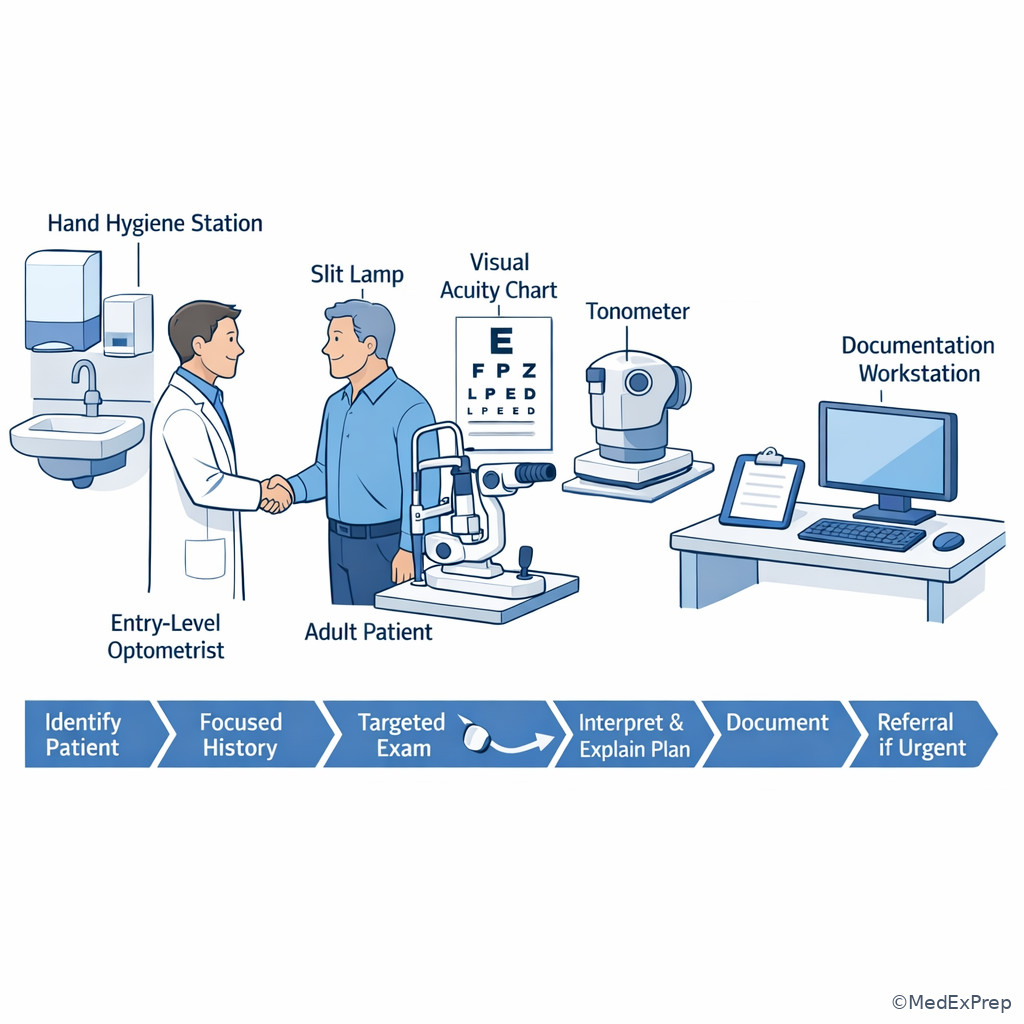
G --> H Exam takeaway: Visualize the outpatient exam room workflow so scope, safety, and sequencing stay organized.
Core content
1.1.1.3 Foundational role: what the candidate is expected to do
A Explanation
The first decision conflict on PEPS is not diagnosis; it is role definition. You must choose between entry-level outpatient optometric assessment and specialist-level management. The single rule that resolves this: if the action is a routine office-based assessment, counseling step, or disposition decision, it is usually within role; if it requires surgery, inpatient care, emergency-department management, advanced specialist intervention, or unrestricted prescribing assumptions, it is not your role on this exam.
WHY THIS IS TESTED: exam stems often tempt candidates with impressive-but-wrong specialist actions. The test is whether you can safely recognize the problem, perform limited appropriate assessment, and escalate rather than overmanage.
Within expected role: obtain focused ocular and systemic history, review medications and allergies, assess visual acuity, pupils, motility, confrontation fields, perform slit lamp exam, use fluorescein when indicated, measure IOP when appropriate, consider dilation safety, interpret common findings, counsel in plain language, document clearly, and select routine versus urgent follow-up. Outside expected role: performing ophthalmic surgery, laser procedures, inpatient admission decisions, definitive neurologic or vascular emergency management, or delaying referral for extra testing that will not change immediate disposition.
Think of PEPS scope as a three-part sentence: assess what is safe, recognize what is dangerous, communicate what happens next. See Fig 1.
B Worked example
A 63-year-old man presents with sudden painless monocular vision loss that started 45 minutes ago. He has hypertension and atrial fibrillation and mentions chronic dry eye as a distracting complaint. He asks whether you can “do a laser right now.” Board-style task: choose the most appropriate next step.
Reasoning chain: Identify task: disposition, not definitive procedural treatment. Extract key facts: sudden painless loss, vascular risk factors, time-sensitive emergency concern. Apply rule: your role is to recognize a potentially emergent retinal/vascular event and avoid delaying referral with low-yield testing. Eliminate distractors: offering in-office definitive procedure is out of role; spending the whole encounter on dry-eye history is low yield; routine follow-up is unsafe. Verify: brief focused assessment may be appropriate only if it does not delay emergency transfer, then document onset time, acuity, laterality, and urgency.
C Exam trap
D Checkpoint
Question: Which action best fits the PEPS candidate role in a routine outpatient station?
- A. Perform focused history, visual acuity, pupils, slit lamp evaluation, and document a same-day referral when red flags are found.
- B. Schedule the patient for laser peripheral iridotomy after identifying an angle emergency pattern.
- C. Admit the patient directly to the hospital for neurologic monitoring.
- D. Delay counseling until after every available office test has been completed.
Answer: A
- A is tempting and correct because it stays within core outpatient assessment and triage duties; the key discriminator is that referral, not procedure, follows red-flag recognition.
- B is tempting but wrong because the candidate may recognize the pattern, but performing the laser is a specialist procedure outside this exam role.
- C is tempting but wrong because emergencies may need hospital care, but the PEPS candidate does not independently manage admission decisions.
- D is tempting but wrong because students under time pressure may postpone explanation; however, communication and comfort are part of the encounter, not optional extras.
1.1.1.4 Foundational boundaries: what to reject, defer, or escalate
A Explanation
The second scope decision is choosing between continuing the office encounter and stopping to escalate. The single rule: when delay creates risk of vision loss, neurologic harm, systemic harm, or worsening infection, escalation outranks completion. This is where PEPS questions often test “when to reject X.” You must reject any action that sounds academically complete but clinically unsafe for the moment.
Typical emergency or urgent patterns that exceed routine station-level management include acute angle-closure pattern, suspected microbial keratitis, retinal detachment symptoms, retinal artery occlusion concern, giant cell arteritis suspicion, papilledema concern, and compressive third-nerve palsy pattern. Your obligation is not to solve the whole problem; it is to recognize the pattern quickly, avoid unsafe delay, explain urgency, and arrange the right handoff. Local protocols vary, but the conservative learner-safe wording is the same: perform limited immediate assessment if it does not delay care, then escalate.
Equally important is knowing what to defer. Tonometry may be deferred in a suspected open globe pattern. Dilation may be deferred if it delays urgent transfer or if safety concerns dominate. A full dry-eye workup is deferred when the complaint is flashes and a curtain. “More data” is not always better. The right amount of data is the amount that safely changes urgency or next step.
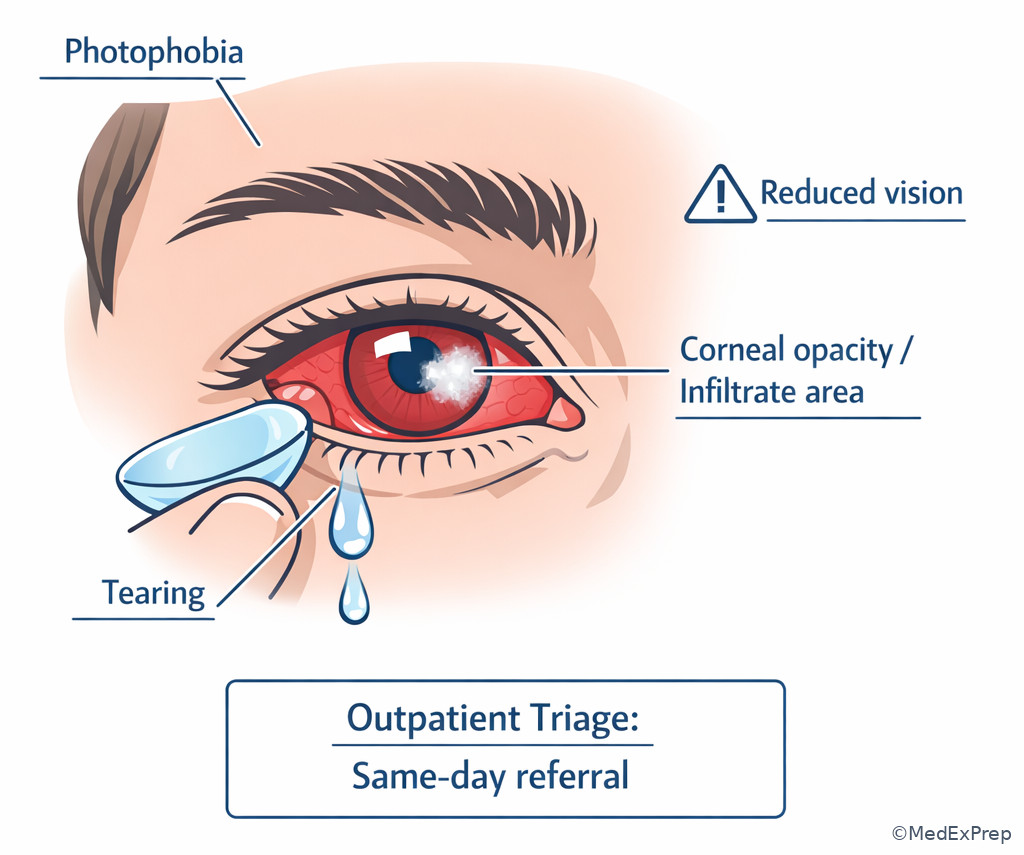
See Fig 2 for a choose-versus-avoid triage summary.
B Worked example
A 27-year-old contact lens wearer presents with severe unilateral pain, photophobia, and reduced vision since this morning. She has type 1 diabetes and seasonal allergies. A tempting but wrong clue is that she says “it feels like my usual allergy eye.” The task is the most appropriate next step in scope.
Reasoning chain: Identify task: distinguish routine irritation from potentially vision-threatening corneal infection. Extract key facts: contact lens wear, pain, photophobia, decreased vision. Apply rule: a potential corneal ulcer pattern requires urgent evaluation and should not be minimized by the allergy history. Eliminate distractors: routine allergy treatment ignores the severity clues; sending her home with delayed follow-up is unsafe; performing prolonged nonessential testing delays care. Verify: perform focused assessment within scope, explain urgency clearly, and arrange same-day ophthalmic evaluation per clinic protocol.
C Exam trap
D Checkpoint
Question: Which finding most strongly supports stopping routine data collection and escalating promptly?
- A. Mild chronic itching with normal vision
- B. Sudden new flashes with a curtain-like field defect
- C. Gradual blur improving with pinhole
- D. Stable meibomian gland dysfunction symptoms
Answer: B
- A is tempting but wrong because itching is common in benign ocular surface disease; the missing discriminator is acute field loss.
- B is tempting and correct because flashes plus curtain-like loss strongly suggest a retinal tear/detachment pattern where urgency dominates.
- C is tempting but wrong because blurred vision always draws attention, yet pinhole improvement points toward refractive or optical causes rather than emergent retinal threat.
- D is tempting but wrong because lid disease is common and symptomatic, but it does not usually demand emergent escalation.
- The safest response to a vision-threatening pattern is to recognize it and escalate.
- True or False: Completing every office test is always better than referring early. False.
- Name 3 red-flag categories: vision loss, severe pain/infection, neurologic/vascular concern.
Exam takeaway: In dangerous presentations, reject office steps that do not change immediate disposition.
flowchart LR
A[Red flag present] --> B{Will the test change urgent disposition?}
B -->|Yes| C[Do focused test now]
B -->|No| D[Defer test]
C --> E[Escalate with findings]
D --> E
E --> F[Document urgency and handoff] Exam takeaway: Use the pattern of pain, photophobia, decreased vision, and contact lens wear to think urgent corneal evaluation.
1.1.1.5 Application: selecting efficient in-scope assessment steps
A Explanation
Once you know you are within role and the patient is stable enough for office evaluation, the next decision is which tests are worth your time. The rule that resolves this conflict: start with the tests that most quickly localize the problem and affect urgency—usually visual acuity, pupils, gross external observation, focused history, and a targeted exam matched to the complaint. On PEPS, breadth without purpose is weaker than a short, well-ordered, hypothesis-driven sequence.
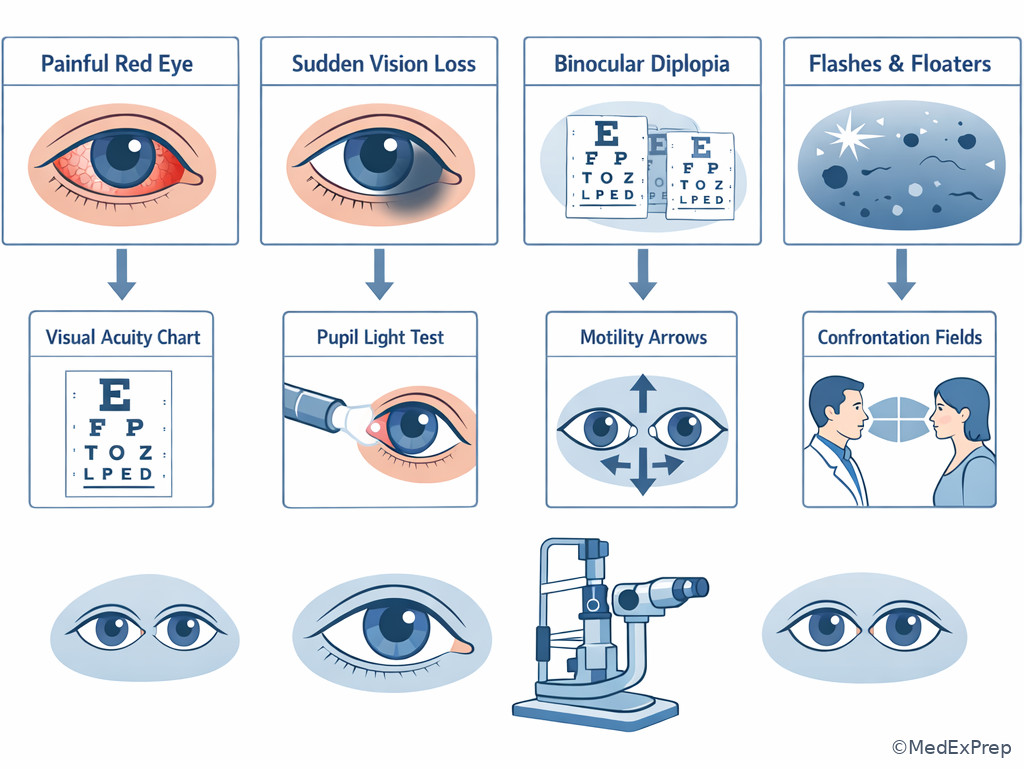
For example, a painful red eye often makes acuity, pupils, slit lamp findings, fluorescein, and selected pressure/dilation decisions relevant. Sudden diplopia makes history, pupils, ptosis check, motility, and neurologic red flags high yield. Flashes and floaters make symptom timing, field loss, acuity, and posterior-segment disposition questions central. The exam wants you to show that you know why you are doing the next step. If asked to justify, the answer should be: “This test is the most informative next step because it changes whether I reassure, follow closely, or escalate.”
Do not confuse “core exam skill” with “always perform in every case.” Tonometry, dilation, or fluorescein are tools, not rituals. Use them when indicated and safe. Reject them when they distract from the chief complaint or create delay. See Fig 3.
B Worked example
A 45-year-old woman presents with new binocular diplopia that is worse on left gaze. She has diabetes and migraine history, and she volunteers that her glasses are old, which is the tempting-but-wrong clue. The task asks for the most appropriate in-office focus before deciding disposition.
Reasoning chain: Identify task: targeted assessment of acute diplopia. Extract key facts: binocular, directional worsening, vascular risk factor, possible neuro-ophthalmic significance. Apply rule: start with acuity, pupils, ptosis observation, and extraocular motility before considering benign optical explanations. Eliminate distractors: refraction first is low yield because binocular diplopia is not explained by old glasses; complete anterior segment routine exam before motility wastes time; immediate reassurance is unsafe. Verify: a focused neuro-ocular screen can determine whether urgent referral is necessary.
C Exam trap
D Checkpoint
Question: A patient presents with acute painful red eye and blurred vision. Which test sequence is most appropriate initially?
- A. Dilated fundus exam first, then visual acuity if time remains
- B. Visual acuity, focused history, pupils, slit lamp assessment, then additional targeted testing as indicated
- C. Refraction before any medical assessment
- D. Full binocular vision workup before discussing symptoms
Answer: B
- A is tempting but wrong because posterior pathology matters in some cases, but skipping acuity and focused triage violates efficient prioritization.
- B is tempting and correct because it starts with the high-yield anchors that rapidly shape urgency and targeted next steps.
- C is tempting but wrong because blur makes refractive testing sound relevant, but painful red eye is a medical problem first.
- D is tempting but wrong because a comprehensive workup seems complete, yet it is mismatched to the acute complaint.
Exam takeaway: Match each chief complaint to the minimum high-yield exam steps that change urgency or diagnosis.
flowchart TD
A[Chief complaint] --> B{Category}
B -->|Painful red eye| C[Acuity + pupils + slit lamp + fluorescein]
B -->|Sudden vision loss| D[Acuity + pupils + fields + urgent posterior triage]
B -->|Diplopia| E[Acuity + pupils + ptosis check + motility]
B -->|Flashes/floaters| F[History timing + field symptoms + posterior urgency decision]
C --> G[Disposition]
D --> G
E --> G
F --> G Exam takeaway: Pair each symptom pattern with the most informative first office tests rather than running a generic full exam.
1.1.1.6 Application: patient communication, consent, and plain-language scope explanation
A Explanation
PEPS does not only test what you know; it tests whether a patient can understand and safely act on your plan. The decision conflict here is choosing between technical correctness and patient-ready communication. The rule: the best encounter language is medically accurate, brief, and action-oriented. If the patient needs referral, explain the concern in plain words, why timing matters, what you are doing now, and what symptoms require immediate return.
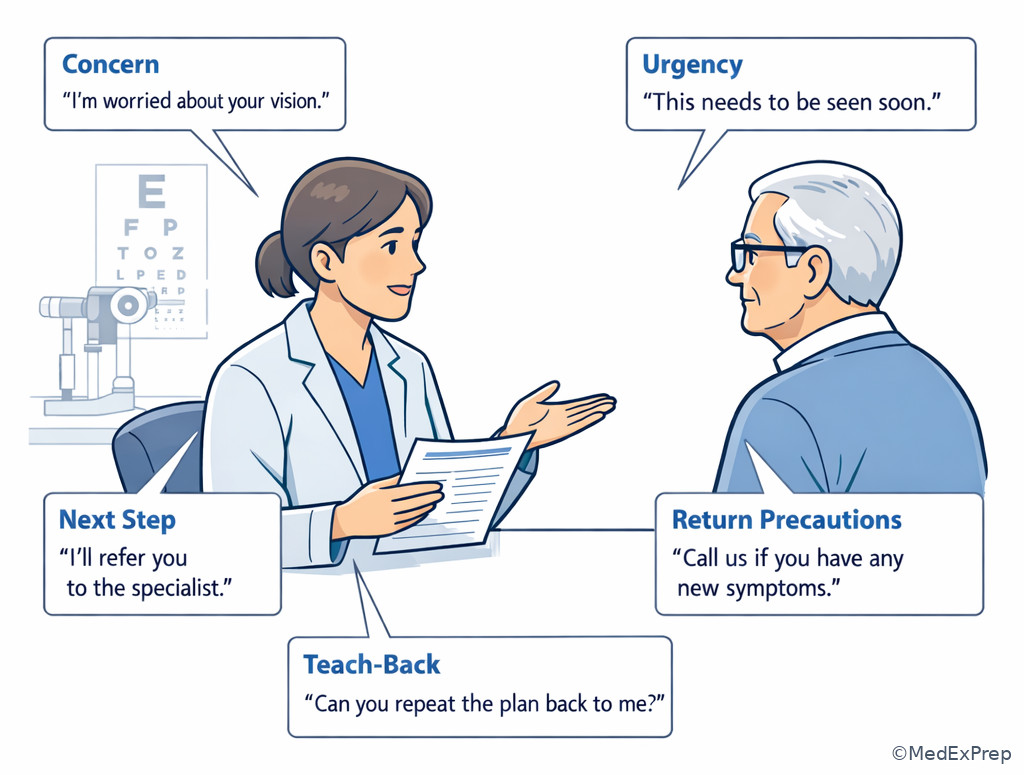
Scope communication matters most when the patient asks for definitive treatment or certainty you do not yet have. Good phrasing sounds like: “I’m concerned about a finding that needs urgent specialist evaluation today,” or “I can do the key exam steps here and then help arrange the next level of care.” Poor phrasing either overpromises (“I know exactly what this is and will fix it here”) or undercommunicates urgency (“You might want to get this checked sometime soon”). Consent is similarly practical: explain what you plan to do, why, and any expected discomfort or temporary effects. Protect dignity and comfort while staying efficient.
This is also where professionalism shows. Do not use fear-heavy language, but do not soften an emergency into a routine issue. See Fig 4.
B Worked example
A 71-year-old woman with headache, scalp tenderness, and transient monocular dimming asks, “Can you just give me drops and I’ll come back next week?” She also has cataracts and mild chronic blepharitis, which are distracting. The task is the best explanation and next step.
Reasoning chain: Identify task: communication plus disposition. Extract key facts: age, ischemic warning symptoms, potential systemic emergency pattern. Apply rule: do not promise office treatment; clearly explain that the symptoms could reflect a condition that threatens vision and needs urgent medical evaluation today. Eliminate distractors: discussing cataract progression misses the acute threat; giving vague routine return advice is unsafe; providing specialist-level medical management is outside role. Verify: brief, direct counseling plus urgent handoff is the safe PEPS answer.
C Exam trap
D Checkpoint
Question: Which counseling statement best matches PEPS expectations when urgent referral is needed?
- A. “This could represent a serious problem affecting your vision, so I want you evaluated today, and I’ll explain exactly where you need to go.”
- B. “I cannot help with this, so you should probably find a specialist at some point.”
- C. “I am sure this is harmless, but if it keeps happening, maybe consider urgent care.”
- D. “I will definitively manage the systemic cause here in clinic.”
Answer: A
- A is tempting and correct because it names concern, urgency, and next action in plain language without overpromising.
- B is tempting but wrong because it acknowledges limitation, yet it is vague and abandons the patient without an organized plan.
- C is tempting but wrong because reassurance feels comforting, but it dangerously minimizes an urgent pattern.
- D is tempting but wrong because confidence can sound appealing, but definitive systemic management exceeds PEPS candidate role.
- The best urgent counseling script includes: concern, reason timing matters, and next action.
- True or False: Good PEPS communication can be technically accurate but still fail if it does not give actionable instructions. True.
- Fill in the blank: Do not overpromise certainty; do provide clear disposition.
Exam takeaway: Patients need a concern-risk-action message, not jargon or false certainty.
flowchart TD
A[Finding identified] --> B[State concern clearly]
B --> C[Explain why timing matters]
C --> D[Give next action]
D --> E[Confirm understanding and return precautions]
Exam takeaway: Use direct, calm, plain-language explanation when a patient requires same-day referral.
1.1.1.7 Integration: documentation, handoff, and scope-safe decision framing
A Explanation
The final integration step is turning your reasoning into a note and handoff that are concise, truthful, and safe. The decision conflict is choosing between sounding impressive and being accurate. The single rule: document observations, interpretation level, uncertainty, urgency, and plan without claiming tests not performed or diagnoses not yet established by the appropriate evaluator.
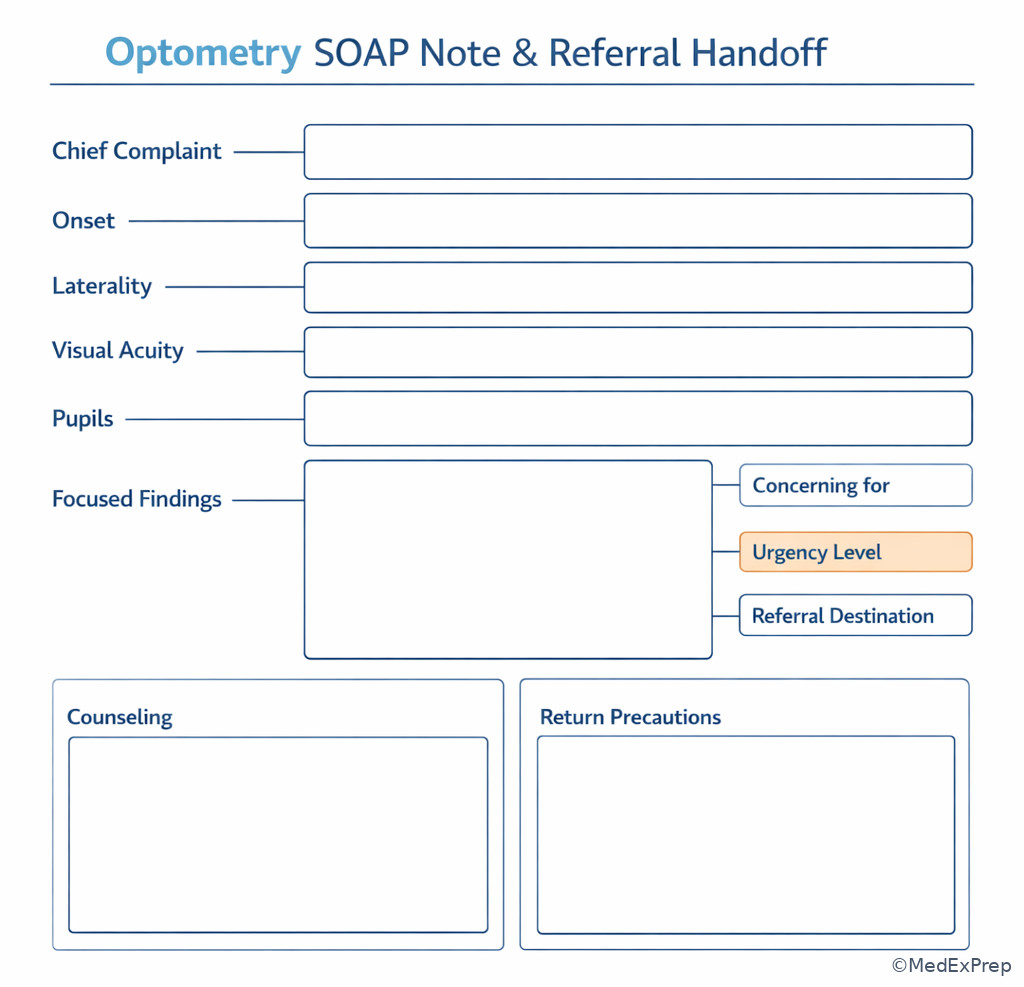
A strong PEPS note answers five questions: What was the complaint? What focused findings matter most? What is your prioritized concern? What is the urgency? What exactly was communicated and arranged? A strong handoff adds why the patient cannot safely wait. Weak notes often fail by omitting laterality, onset, acuity, reliability, or referral timing. Another common failure is writing specialist conclusions unsupported by the encounter, such as naming a definitive neurologic diagnosis when you have only recognized an urgent pattern.
Documentation is also where scope appears in wording. Prefer “suspicious for,” “concerning for,” “requires urgent evaluation,” or “same-day referral arranged” when appropriate. Avoid definitive language beyond your data. See Fig 5.
B Worked example
A 58-year-old man presents with binocular diplopia, right ptosis, and headache. He has diabetes and hyperlipidemia, and he also mentions long-standing floaters. A tempting wrong move is to document “microvascular palsy” as final diagnosis because of the diabetes history. The task is the best note framing and disposition.
Reasoning chain: Identify task: document concern and urgent next step. Extract key facts: diplopia, ptosis, headache, possible neuro-ophthalmic emergency. Apply rule: do not overcommit to a benign explanation when a dangerous alternative remains. Eliminate distractors: definitive outpatient diagnosis is unsupported; routine follow-up is unsafe; extensive unrelated floater documentation distracts from the key problem. Verify: document the pattern, state concern for urgent neuro-ophthalmic evaluation, and record the handoff and patient instructions.
C Exam trap
D Checkpoint
Question: Which assessment statement best fits scope-safe PEPS documentation?
- A. “Definitive aneurysmal third-nerve palsy diagnosed in clinic; neurosurgical plan arranged.”
- B. “Symptoms concerning for a neuro-ophthalmic process requiring urgent same-day evaluation; patient counseled and referral arranged.”
- C. “No serious issue suspected because the patient has diabetes.”
- D. “Likely benign; follow up in 6 months if still symptomatic.”
Answer: B
- A is tempting but wrong because it sounds decisive, but it overstates diagnostic certainty and claims specialist management beyond the encounter.
- B is tempting and correct because it records concern, urgency, counseling, and disposition without overreaching.
- C is tempting but wrong because a common risk factor can bias thinking, yet it does not exclude a dangerous cause.
- D is tempting but wrong because some diplopia cases are benign, but the acute associated findings make long routine follow-up unsafe.
Exam takeaway: A strong note records focused findings, concern level, urgency, and what was communicated without overstating certainty.
1.1.1.8 Integration: the safest next step when scope, urgency, and time all compete
A Explanation
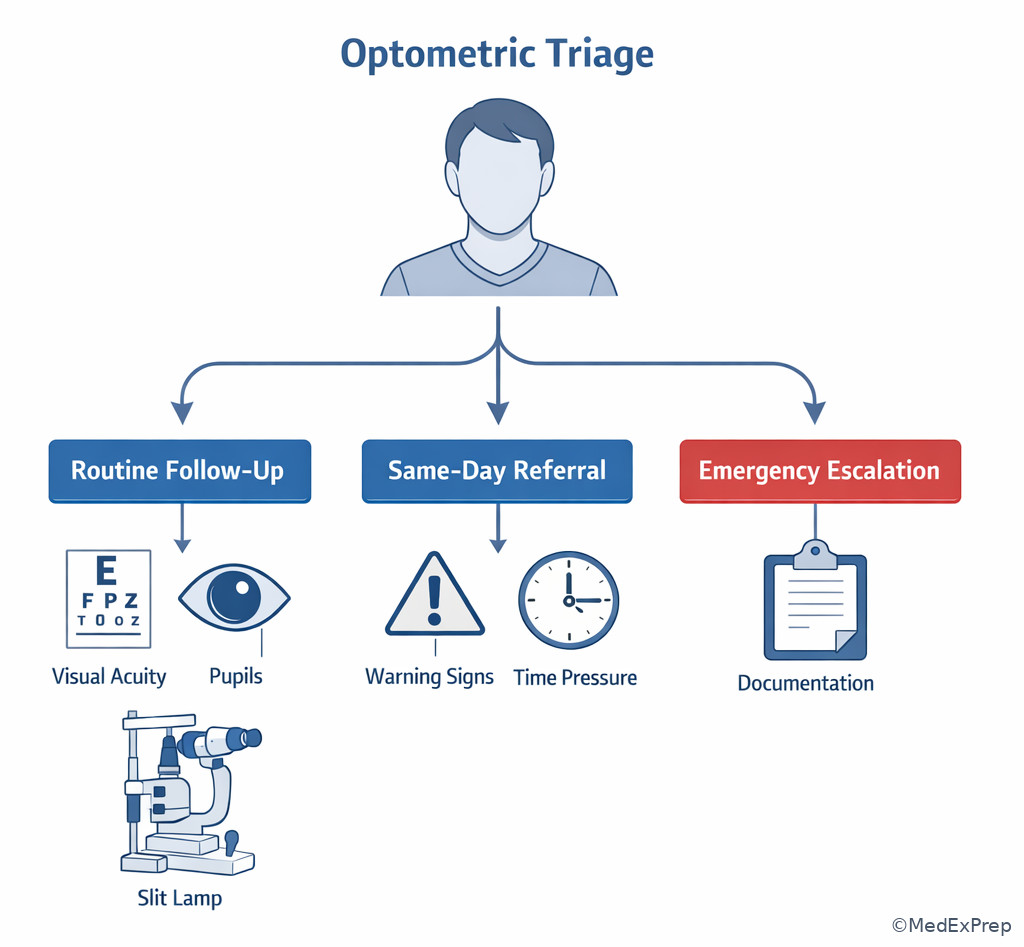
The highest-level PEPS decision is a three-way choice: continue routine exam, perform brief targeted assessment then refer, or refer immediately. The single finding/rule that resolves it is whether any additional office step meaningfully changes disposition without delaying appropriate care. If yes, do the brief step. If no, move the patient onward. This integrates role, test selection, communication, and documentation into one board-style habit.
Many stems create conflict by mixing one dangerous clue with several routine details. For example, a patient may have chronic blepharitis but also sudden painful diplopia; or long-standing floaters but a new curtain defect; or old dry eye but now severe photophobia in a contact lens wearer. The exam wants you to find the discriminating clue and let it dominate. The safest next step is often not the most comprehensive step. It is the step that protects vision and stays within outpatient optometric responsibility.
Forward-looking note: in the upcoming topics on encounter sequence and time management, you will operationalize this into station pacing. Here, the core takeaway is judgment: you do not win PEPS by doing the most things; you win by doing the right things in the right scope at the right time.
B Worked example
A 36-year-old man reports flashes and new floaters for 2 days. He has moderate myopia and controlled asthma. He also notes mild seasonal itch, making allergic disease tempting. The task is the most appropriate next step in a busy clinic near closing time.
Reasoning chain: Identify task: triage a posterior symptom complaint under time pressure. Extract key facts: new flashes and floaters, myopia, potential retinal pathology. Apply rule: time pressure does not justify downgrading risk; choose the most informative immediate evaluation and disposition path. Eliminate distractors: treating allergy symptoms first ignores the posterior warning pattern; routine return is unsafe; exhaustive unrelated testing wastes time. Verify: focus on the retinal-detachment question and arrange appropriate same-day disposition if concerning findings or limited evaluation capacity exists.
C Exam trap
D Checkpoint
Question: What is the best general PEPS rule when deciding whether to continue testing versus refer?
- A. Always complete the full standard exam before making any referral decision.
- B. Perform any available test as long as it increases documentation detail.
- C. Continue only with tests that change immediate diagnosis or disposition without unsafe delay.
- D. Refer every symptomatic patient immediately without basic assessment.
Answer: C
- A is tempting but wrong because standardization feels orderly, but it ignores urgency and time-sensitive danger.
- B is tempting but wrong because documentation detail matters, yet detail without management impact can be harmful if it delays care.
- C is tempting and correct because it integrates scope, efficiency, and patient safety into one usable rule.
- D is tempting but wrong because over-referral without basic assessment can also reflect poor judgment; focused in-scope evaluation is still expected when safe.
- Best general rule: do only what changes disposition.
- True or False: A busy clinic justifies postponing dangerous symptom evaluation. False.
- Complete the phrase: right things, right scope, right time.
Exam takeaway: The deciding question is whether another office step changes immediate disposition without delaying care.
flowchart TD
A[Chief complaint + key red flags] --> B{Immediate threat likely?}
B -->|No| C[Focused routine workup]
B -->|Yes| D{Will one more office step change disposition?}
D -->|Yes| E[Brief targeted test]
D -->|No| F[Immediate escalation]
E --> G[Urgent or emergent referral]
C --> H[Routine or expedited follow-up]
F --> G Exam takeaway: Visual triage helps separate routine follow-up from same-day and emergency referral decisions.
Exam Traps & Differentiators
Most common wrong answer and why: choosing the most comprehensive option instead of the safest scope-appropriate option. Students confuse thoroughness with quality. On PEPS, thoroughness is only valuable when it improves the immediate decision.
- Trap: “Do everything first.” Why tempting: sounds careful. Eliminating clue: a red flag already determines urgent disposition.
- Trap: “The patient requested treatment, so provide it.” Why tempting: patient-centeredness can be misread as agreement. Eliminating clue: patient request never expands exam scope.
- Trap: “Name the definitive diagnosis now.” Why tempting: certainty sounds confident. Eliminating clue: your data support concern and referral, not specialist-level final diagnosis.
- Trap: “Benign background history explains the whole case.” Why tempting: chronic dry eye, allergies, old glasses, and cataracts are common. Eliminating clue: a single new dangerous symptom outranks background noise.
| Stem says... | Think... | Why it matters |
|---|---|---|
| “Sudden” vision change | Urgency first | Acute onset often shifts the task from routine exam to triage. |
| “Contact lens wearer” with pain or photophobia | Corneal infection risk | Do not mislabel as routine conjunctivitis or allergy. |
| “Curtain” or field shadow | Retinal detachment concern | Posterior urgency dominates over benign floaters history. |
| Headache + diplopia + ptosis | Neuro-ophthalmic red flag | Do not settle for a benign glucose-related explanation too early. |
| Patient asks for surgery/procedure now | Scope boundary test | The right answer is often referral, not procedural action. |
| Clinic is busy / near closing | Time pressure trap | Operational inconvenience does not reduce danger. |
| Looks similar | But isn’t | Discriminator | Scope-safe response |
|---|---|---|---|
| Thorough | Safe | Safe actions avoid delay when urgency is already clear | Do targeted testing only |
| Confident | Accurate | Accuracy uses concern-based wording when certainty is unsupported | Document probable concern and urgency |
| Patient-centered | Patient-directed by request alone | Patient preference never overrides danger or scope | Explain and guide the patient |
| Routine exam sequence | Rigid ritual | Complaint and red flags determine the sequence | Adapt the exam |
If the stem says ___, think ___:
- If the stem says “most appropriate next step”, think safest action that changes disposition.
- If the stem says “requires immediate clarification”, think history element that determines urgency or scope.
- If the stem says “best explanation to the patient”, think concern + risk + action.
- If the stem says “document”, think what you found, what you suspect, what you did, where the patient is going.
- If the stem says “busy clinic”, think time pressure is a distractor, not a reason to down-triage.
Tables
| Core candidate task | Usually within scope on PEPS | Why it is testable |
|---|---|---|
| Focused ocular/systemic history | Yes | Drives urgency and targeted testing |
| Visual acuity | Yes | Fast severity anchor for almost all complaints |
| Pupil assessment | Yes | Helps localize optic nerve and neuro concerns |
| Extraocular motility | Yes | Essential for binocular diplopia and cranial nerve patterns |
| Confrontation fields | Yes | Rapid screen for neurologic/posterior complaints |
| Slit lamp exam | Yes | Core anterior segment evaluation |
| Fluorescein use | Yes, when indicated | Clarifies corneal epithelial patterns and injury |
| Tonometry | Yes, when appropriate | Useful but not automatic in every complaint |
| Dilation decision-making | Yes, when appropriate and safe | Tested as judgment, not ritual |
| Documentation and referral note | Yes | Shows safe closure of the encounter |
| Action | Choose | Avoid / defer | Single reason |
|---|---|---|---|
| Targeted core testing | When it changes diagnosis or urgency | When it is unrelated to the complaint | PEPS rewards hypothesis-driven testing |
| Urgent referral | When red flags suggest sight-threatening disease | When complaint is routine and stable | Urgency should match threat |
| Immediate emergency escalation | When delay risks vision or systemic harm | When basic in-office triage can safely clarify without delay | Do not over- or under-escalate |
| Plain-language counseling | Always | Never replace with jargon alone | Patient understanding is part of safe care |
| Definitive specialist treatment | Never as candidate action | Always avoid | Out of routine optometric PEPS scope |
| Presentation pattern | Likely PEPS role emphasis | Differential class | Disposition tendency |
|---|---|---|---|
| Mild itching, stable vision, bilateral watery discomfort | Focused office assessment and routine plan | Benign ocular surface process | Routine or short follow-up |
| Contact lens wearer with pain, photophobia, reduced vision | Recognize dangerous anterior segment pattern | Corneal infection/infiltrate concern | Same-day urgent referral |
| Sudden monocular vision loss | Rapid triage and escalation | Vascular/retinal/optic nerve emergency concern | Emergent or urgent referral |
| Binocular diplopia with ptosis or pupil abnormality | Neuro red-flag recognition | Cranial nerve/compressive process concern | Urgent or emergent referral |
| Flashes/floaters with curtain symptom | Posterior urgency recognition | Retinal tear/detachment concern | Same-day urgent evaluation |
Algorithm / Approach
Rapid Review
- Scope boundary → assess and triage; do not perform specialist procedures
- Best next step → the one that changes disposition without delay
- Sudden vision loss → urgency outweighs completeness
- Contact lens pain + photophobia → think corneal danger, not simple allergy
- Binocular diplopia → motility/localization problem before refraction problem
- Patient request for treatment → does not expand exam scope
- Documentation → concern-based wording beats unsupported certainty
- Handoff → include why the patient cannot safely wait
- Time pressure → changes pace, not safety thresholds
- Routine sequence → adaptable framework, not a rigid script
- Plain-language counseling → concern + risk + action
- Thoroughness → only valuable if it informs the next decision
- Deferred testing → acceptable when it would not change urgent referral
- Background benign history → never overrides a new red flag
Self-check quiz
1.1.1.9 Question 1
A patient with a new ocular complaint asks what you can do in the PEPS encounter. Which action is most appropriate for the candidate role?
- A. Perform focused history and core outpatient examination steps that guide disposition.
- B. Perform laser treatment immediately if the condition may worsen.
- C. Admit the patient directly for inpatient monitoring.
- D. Skip assessment and provide only a referral destination.
1.1.1.10 Question 2
A 29-year-old patient with seasonal allergies and stable vision presents with itching and tearing. Which principle best determines whether you should add more tests?
- A. Add every available test because more data are always safer.
- B. Add tests only if they change immediate diagnosis or disposition.
- C. Avoid all testing because symptoms are probably benign.
- D. Refer all symptomatic patients before any office assessment.
1.1.1.11 Question 3
A 67-year-old man with hypertension and atrial fibrillation presents with sudden painless vision loss in one eye for 30 minutes. He also mentions chronic dry eye and asks whether he needs new glasses. Which is the most appropriate next step?
- A. Begin a full refractive workup before discussing referral.
- B. Perform focused immediate assessment that does not delay emergent referral.
- C. Schedule routine follow-up in 1 week after home monitoring.
- D. Offer definitive vascular treatment in clinic.
1.1.1.12 Question 4
A 24-year-old contact lens wearer with type 1 diabetes presents with severe unilateral pain, photophobia, and decreased vision. She says it feels like “my normal allergies.” Which finding most strongly supports urgent same-day escalation rather than routine treatment?
- A. History of springtime itch
- B. Contact lens wear with pain and reduced vision
- C. Bilateral tearing last month
- D. Family history of glaucoma
1.1.1.13 Question 5
A 46-year-old woman with diabetes and migraine presents with new binocular diplopia worse on left gaze. She also says her glasses are old. What is the most appropriate in-office emphasis?
- A. Refraction first because old glasses commonly cause double vision
- B. Motility, pupil, and ptosis assessment before routine optical testing
- C. Dry-eye questionnaire before any ocular motor testing
- D. Defer all examination and reassure her that migraine is the only likely cause
1.1.1.14 Question 6
A 59-year-old man with diabetes and hyperlipidemia presents with binocular diplopia, right ptosis, and headache that began this morning. He also reports long-standing floaters. Which documentation statement is most appropriate?
- A. “Definitive benign diabetic palsy diagnosed; routine follow-up arranged.”
- B. “Symptoms concerning for urgent neuro-ophthalmic process; same-day evaluation arranged.”
- C. “Floaters are chronic, so no serious issue is present.”
- D. “Aneurysm confirmed clinically in office; neurosurgical plan initiated.”
1.1.1.15 Question 7
A 35-year-old myopic patient presents near closing time with new flashes and floaters for 1 day and says he also has mild itchy eyes from pollen. Which factor should most strongly drive your disposition?
- A. The clinic schedule is full, so routine follow-up is acceptable.
- B. The seasonal itch suggests allergy and lowers urgency.
- C. New flashes and floaters in a myopic patient may indicate retinal pathology.
- D. The patient is young, making urgent pathology unlikely.
1.1.1.16 Question 8
A 72-year-old woman with headache, scalp tenderness, and transient monocular dimming asks for eyedrops and wants to return next week because she cares for her spouse. Which response best matches PEPS expectations?
- A. “This may threaten your vision and needs urgent medical evaluation today; I’ll help arrange that now.”
- B. “Because you prefer to wait, we can try routine follow-up if the symptoms stop.”
- C. “I will definitively treat the systemic cause here and monitor you in clinic.”
- D. “This is most likely cataract-related because of your age.”
Answer key
1.1.1.17 Question 1: A
A. Tempting because it sounds basic rather than dramatic, but it is correct for this specific scenario because focused history and core outpatient examination are central PEPS duties. The discriminating clue is that the question asks about the candidate role, not specialist treatment. Source: American Optometric Association clinical practice resources and standard outpatient optometric exam expectations; PEPS scope framing emphasizes assessment, communication, triage, and documentation.
B. Tempting because immediate treatment sounds decisive, but it is incorrect because laser procedures are outside the candidate’s routine PEPS role. The discriminating clue is the procedural nature of the action. Source: PEPS role guardrails and routine optometric scope expectations.
C. Tempting because severe disease can require hospital care, but it is incorrect because direct inpatient management is not the candidate’s role on this exam. The clue is that admission is a hospital-level disposition, not an outpatient optometric encounter action. Source: scope guardrails for licensure encounter exams.
D. Tempting because referral can be safe, but it is incorrect because PEPS still expects appropriate focused assessment when safe and useful. The clue is that skipping all assessment misses core exam responsibilities. Source: AOA standards for comprehensive and problem-focused evaluation.
1.1.1.18 Question 2: B
A. Tempting because more information seems safer, but it is incorrect because unnecessary testing can waste time and distract from the complaint. The clue is the lesson’s core rule: testing must change diagnosis or disposition. Source: evidence-based outpatient evaluation principles and PEPS emphasis on time-efficient care.
B. Tempting and correct because it reflects hypothesis-driven care: add a test only if it changes immediate diagnosis, urgency, or plan. The clue is the decision principle itself. Source: AOA problem-focused exam guidance and PEPS course framework.
C. Tempting because the symptoms sound benign, but it is incorrect because even likely benign cases still require appropriate focused assessment rather than assumption alone. The clue is that the patient still has an active complaint needing evaluation. Source: routine optometric practice standards.
D. Tempting because referral feels safe, but it is incorrect because blanket referral without focused assessment shows poor judgment and ignores in-scope responsibilities. The clue is the absence of red flags in the stem. Source: outpatient triage principles.
1.1.1.19 Question 3: B
A. Tempting because the patient mentions glasses and refractive blur is common, but it is incorrect because sudden painless vision loss with vascular risk factors is an emergency pattern. The single clue is sudden painless monocular vision loss for 30 minutes. Source: American Academy of Ophthalmology emergency vision-loss guidance and retina/vascular emergency standards.
B. Tempting and correct because it stays within scope: perform focused immediate assessment that does not delay emergent referral. The clue is the time-sensitive onset plus high-risk profile. Source: AAO urgent ophthalmic evaluation guidance; AOA eye emergency recognition resources.
C. Tempting because home monitoring seems conservative, but it is incorrect because waiting risks vision loss in a possible retinal/vascular event. The clue is acute onset with threat to vision. Source: ophthalmic emergency referral standards.
D. Tempting because definitive treatment sounds helpful, but it is incorrect because such management exceeds entry-level outpatient optometric scope in PEPS. The clue is that the candidate role centers on recognition and referral, not emergency vascular intervention. Source: PEPS scope guardrails.
1.1.1.20 Question 4: B
A. Tempting because allergy history is common in red-eye complaints, but it is incorrect because prior itching does not explain severe pain, photophobia, and reduced vision in a contact lens wearer. The clue is the combination of dangerous current symptoms. Source: AAO corneal ulcer and contact-lens-related keratitis guidance.
B. Tempting and correct because contact lens wear plus pain and decreased vision strongly raises concern for a serious corneal process needing urgent evaluation. The clue is this exact triad. Source: AAO Preferred Practice Pattern on bacterial keratitis; AOA anterior segment evaluation guidance.
C. Tempting because bilateral tearing may suggest a benign past condition, but it is incorrect because last month’s symptoms do not explain today’s acute dangerous pattern. The clue is the mismatch between old bilateral symptoms and current unilateral severe symptoms. Source: corneal emergency practice standards.
D. Tempting because glaucoma is serious, but it is incorrect because family history alone is less urgent than the present corneal red flags. The clue is that current symptom pattern, not remote risk, drives same-day action. Source: outpatient triage prioritization standards.
1.1.1.21 Question 5: B
A. Tempting because patients often blame old glasses, but it is incorrect for binocular diplopia because alignment or motility pathology must be assessed first. The key clue is binocular diplopia worse on gaze direction. Source: neuro-ophthalmic screening principles and standard optometric motility assessment guidance.
B. Tempting and correct because motility, pupils, and ptosis assessment directly address the likely localization and urgency. The clue is the gaze-dependent binocular diplopia pattern. Source: AAO neuro-ophthalmology evaluation guidance; routine optometric motility standards.
C. Tempting because dry eye can cause visual complaints, but it is incorrect because it does not explain true binocular diplopia. The clue is that binocular diplopia disappears with monocular viewing, indicating alignment rather than tear film. Source: standard diplopia evaluation principles.
D. Tempting because migraine history can bias interpretation, but it is incorrect because new binocular diplopia still requires focused examination before reassurance. The clue is new onset with localizing features. Source: neuro-ophthalmic triage standards.
1.1.1.22 Question 6: B
A. Tempting because diabetes makes a microvascular explanation plausible, but it is incorrect because headache and ptosis keep a dangerous neuro-ophthalmic cause in play. The clue is the associated headache and ptosis. Source: AAO third-nerve palsy evaluation guidance and neuro-ophthalmic urgency standards.
B. Tempting and correct because it uses concern-based wording, records urgency, and avoids unsupported definitive diagnosis. The clue is that the question asks for the most appropriate documentation statement. Source: professional documentation standards and PEPS scope framing.
C. Tempting because chronic floaters can be benign, but it is incorrect because they are incidental noise here and do not negate acute diplopia with ptosis and headache. The clue is which symptom cluster is dangerous and current. Source: problem-focused documentation principles.
D. Tempting because it sounds decisive and urgent, but it is incorrect because it overstates diagnostic certainty and claims specialist-level management beyond the encounter. The clue is the unsupported confirmation of aneurysm. Source: PEPS scope limits and documentation accuracy standards.
1.1.1.23 Question 7: C
A. Tempting because operational pressure is real in clinic, but it is incorrect because schedule constraints never reduce urgency when retinal warning symptoms are present. The clue is new flashes and floaters. Source: retinal tear/detachment triage guidance.
B. Tempting because itchy eyes suggest allergy, but it is incorrect because that is background noise relative to the posterior warning pattern. The clue is that allergy does not explain flashes. Source: posterior symptom triage standards.
C. Tempting and correct because new flashes and floaters in a myopic patient raise concern for retinal pathology and should drive disposition. The clue is myopia plus acute symptom onset. Source: AAO retinal detachment and posterior vitreous detachment evaluation guidance.
D. Tempting because younger patients are often lower risk overall, but it is incorrect because age does not eliminate retinal urgency when high-risk symptoms are present. The clue is symptom pattern, not age alone. Source: retina triage standards.
1.1.1.24 Question 8: A
A. Tempting and correct because it states concern, urgency, and next action in plain language while staying within scope. The clue is the triad of headache, scalp tenderness, and transient monocular dimming in an older adult. Source: giant cell arteritis urgency guidance from ophthalmology and rheumatology practice standards.
B. Tempting because it respects patient preference, but it is incorrect because patient preference cannot override a possible vision-threatening systemic emergency. The clue is the high-risk symptom cluster. Source: emergency triage and informed-consent standards.
C. Tempting because active treatment sounds helpful, but it is incorrect because definitive systemic management exceeds routine PEPS optometric role. The clue is the phrase “definitively treat the systemic cause.” Source: scope guardrails and outpatient optometric role boundaries.
D. Tempting because age-related cataract is common, but it is incorrect because cataract does not explain scalp tenderness and transient acute dimming. The clue is the systemic ischemic warning pattern. Source: neuro-ophthalmic and ischemic emergency referral standards.
Keep going with the full NBEO Part III (PEPS) Prep Course (NBEO III)
You just studied the way members do, in the same lesson interface. Full access unlocks every lesson, the question bank and flashcards for a full year.
One payment · 1 year of access · No auto-renewal