1.1.1 - NBCOT Domain Map
Why it matters
- Many wrong answers look reasonable until you identify which OT process step the item is actually testing.
- NBCOT-style questions reward stage-appropriate clinical reasoning: evaluate before intervening, secure safety before long-term planning, and discharge only when function and supports are addressed.
- A transparent domain map helps you study broadly across the lifespan and settings without relying on unpublished weighting claims.
- When you know the domain, you can eliminate distractors that belong to a different stage of care or a different professional role.
Key Terms & Must-Know Facts
1.1.1.1 Key terms
- Occupational profile: Client-centered understanding of priorities, roles, context, and goals.
- Analysis of occupational performance: Breaking down performance problems, strengths, and barriers.
- Assessment selection: Choosing tools that match the question, setting, and client needs.
- Intervention planning: Determining goals, priorities, activities, and supports before treatment begins.
- Activity analysis: Examining task demands and required skills, contexts, and adaptations.
- Intervention implementation: Carrying out and grading treatment safely.
- Reassessment: Monitoring response and updating the plan based on outcomes.
- Discharge planning: Deciding supports, education, equipment, and follow-up for next setting.
- Scope of practice: What OT can and cannot do in the scenario.
- Client-centered care: Decisions tied to the client’s valued occupations and priorities.
- Safety screening: Immediate check for red flags, precautions, and tolerance.
- Professional reasoning: Ethical, collaborative, and documentation-based decision-making.
- Foundational knowledge applied: Anatomy, development, cognition, and conditions used to guide OT action.
1.1.1.2 Must-know facts
- NBCOT-style questions often test process placement more than obscure facts.
- The best answer is usually the most appropriate OT action at that stage, not the most advanced intervention overall.
- Evaluation answers gather or interpret needed information; intervention answers act on information already obtained.
- Immediate safety outranks efficiency, habit, and long-term goals.
- Options outside OT scope can still sound medically correct; they are wrong if the item asks for the OT’s action.
- Foundational science is tested when it changes assessment choice, activity grading, safety, or participation.
- Discharge questions focus on readiness, carryover, supports, equipment, and follow-up—not repeating the admission evaluation.
- Professional practice items frequently hinge on collaboration, documentation, supervision, or referral.
| Transparent domain | Typical task words | What the OT is deciding | Common wrong turn |
|---|---|---|---|
| Evaluation | screen, assess, identify, determine baseline, interpret findings | What information is needed now | Jumping to intervention before adequate data |
| Intervention Planning | prioritize, select goals, choose approach, plan, recommend strategy | What should be targeted and how | Choosing a treatment activity without linking it to function |
| Implementation and Management | initiate, grade, modify, train, monitor during session | How to carry out treatment safely | Picking the right intervention for the wrong intensity or time |
| Outcomes/Discharge | reassess, progress, discharge, transition, home program | Whether the plan is working and next-setting needs | Continuing treatment without checking readiness or carryover |
| Professional Practice/Safety | consult, refer, document, clarify, supervise, address risk | What must be done to stay safe, ethical, and within scope | Acting outside role or ignoring urgent findings |
| Foundations Applied | given this diagnosis, stage, deficit, or development pattern | How background knowledge changes OT action | Memorizing facts without connecting them to occupation |
Exam takeaway: Sort the stem by OT process stage first, then choose the answer that matches that stage and stays within OT scope.
flowchart TD
A[Read stem] --> B{What is the OT task?}
B --> C[Evaluation]
B --> D[Intervention Planning]
B --> E[Implementation and Management]
B --> F[Outcomes and Discharge]
B --> G[Professional Practice and Safety]
B --> H[Foundations Applied to OT Decisions]
C --> I[Need information or interpretation]
D --> J[Need goals priorities or approach]
E --> K[Need treatment grading or monitoring]
F --> L[Need reassessment or transition plan]
G --> M[Need safety referral scope or documentation]
H --> N[Use background knowledge only to guide action]
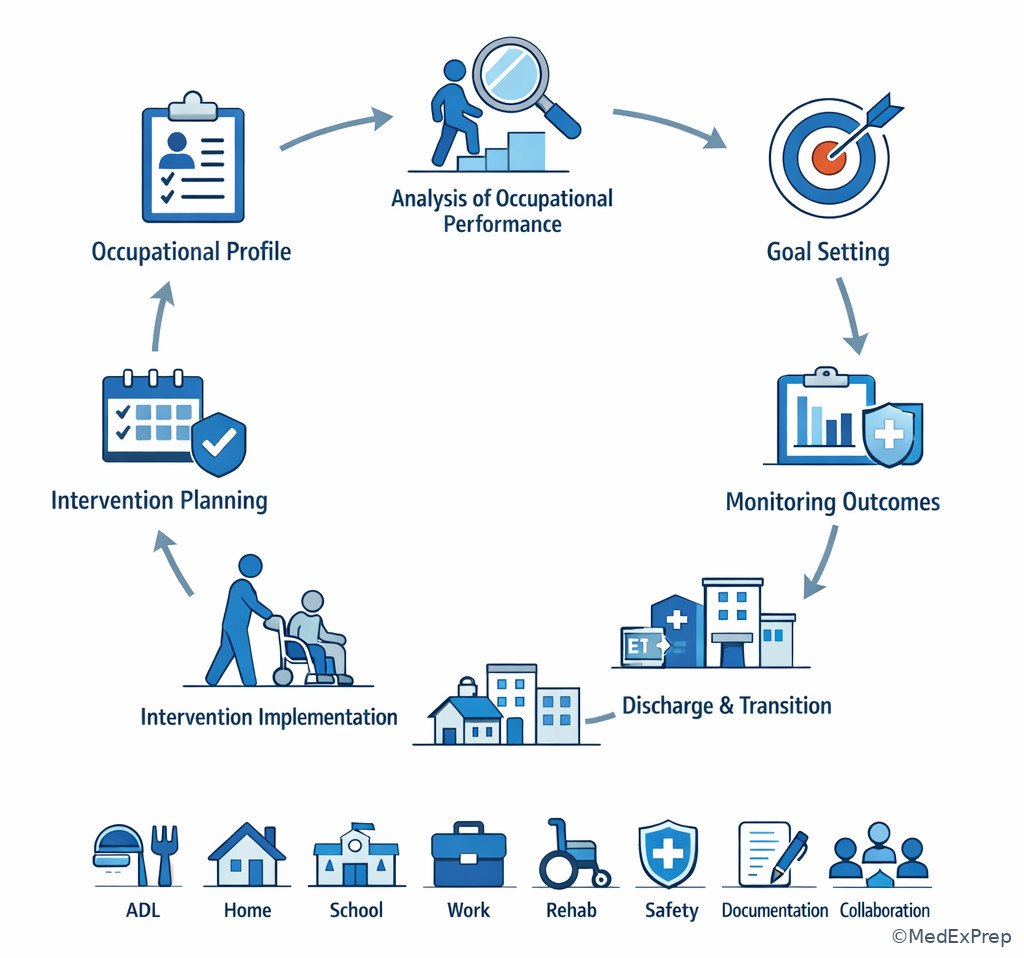
See Fig 1 for the core sorting rule used throughout this course.
Exam takeaway: Visualizing the OT process helps you reject answers that belong to the wrong stage of service.
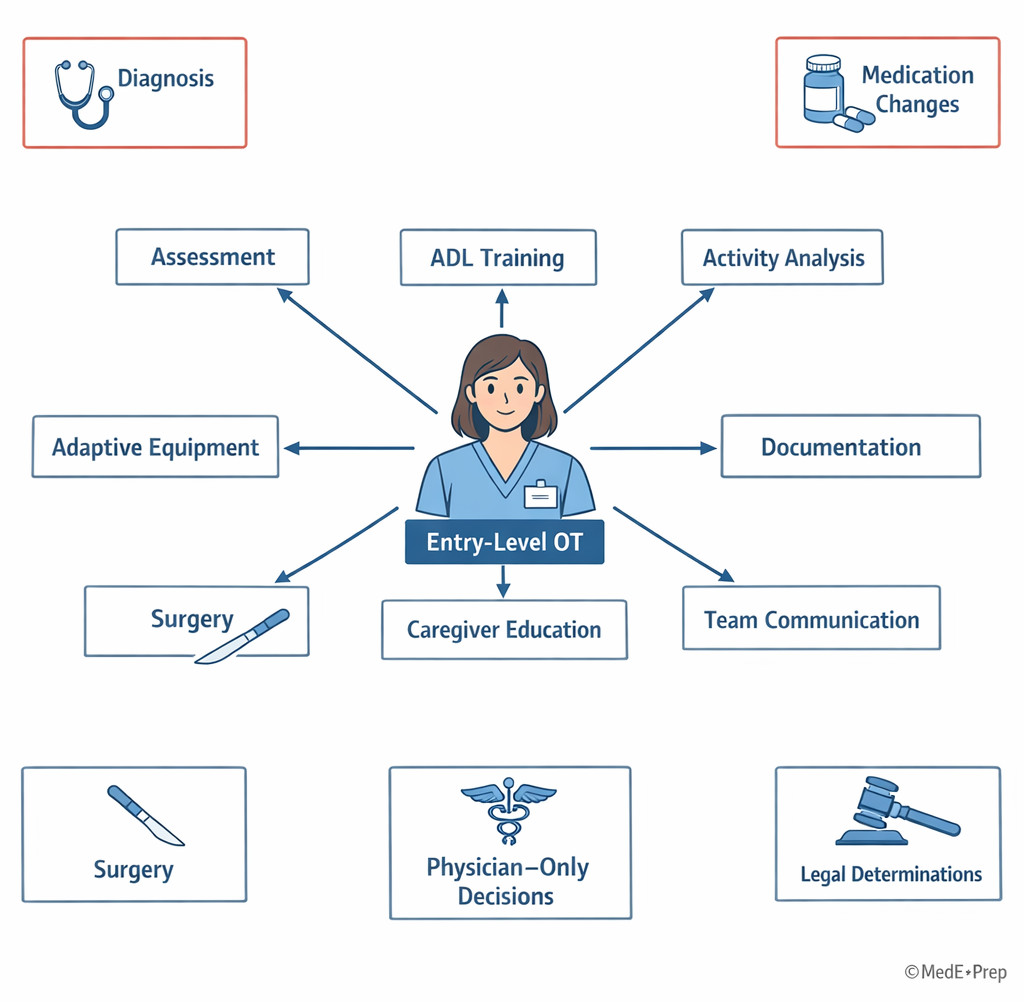
Exam takeaway: Identify what the OT can assess, implement, document, and refer versus what must be escalated to another provider.
Core content
1.1.1.3 Foundational map: what the domains are really testing
A Explanation
The first decision conflict on this exam is simple but high yield: Is the stem asking you to gather information, plan action, carry out action, judge outcomes, or manage safety/professional duties? Students miss easy items when they focus on diagnosis labels instead of the OT task. The single resolving rule is this: match the answer to the service stage named or implied in the stem. If the client is newly referred and information is missing, evaluation choices rise. If goals and barriers are already known, planning choices rise. If the intervention is underway, the question is about grading, cueing, monitoring, or modification. If the client is nearing transition, reassessment and discharge supports matter. If a red flag or scope issue appears, safety and referral override everything else.
WHY THIS IS TESTED: Many distractors are correct OT actions in general but wrong for this exact stage. The exam wants you to choose versus reject based on timing, not just content familiarity.
See Fig 1 for the master map and see Fig 2 for how typical item language points to one domain more strongly than the others.
B Worked example
A 74-year-old client in inpatient rehabilitation is 3 days post right hip fracture repair. She has hypertension, mild hearing loss, and long-standing osteoarthritis. The chart includes a distracting note that she “used to enjoy quilting,” and her daughter requests a home exercise program immediately. The OT receives the first treatment order and asks for the most appropriate initial OT action. Reasoning chain: identify task → first OT contact after referral means evaluation domain; extract key facts → acute post-op status, inpatient rehab, no baseline occupational performance data yet; apply rule → initial action should gather information related to function, precautions, and occupational priorities; eliminate distractors → a home program, kitchen training, or discharge equipment recommendation may all be appropriate later but are premature now; verify → the best answer is to complete the occupational profile and analyze current ADL performance within precautions.
The distracting quilting detail tempts activity selection, but the stem is not asking for a leisure intervention. The daughter’s request tempts discharge planning, but the client has not been fully evaluated. That mismatch is the test point.
C Exam trap
D Checkpoint
Question: An OT in acute care reviews a new referral for a client after stroke. The chart lists dysphagia, left neglect, and a spouse eager for bathroom equipment recommendations. Which action best matches the domain being tested if the question asks for the most appropriate initial OT action?
- Provide caregiver training on tub bench setup at bedside.
- Assess occupational performance, safety, and current self-care status.
- Recommend outpatient driver rehabilitation at discharge.
- Request a medication change for inattention.
- A: Tempting because caregiver education is often helpful early; wrong because equipment training is premature before evaluating present abilities and safety.
- B: Tempting because it feels slower than “doing something”; right because an initial OT action belongs to evaluation and must establish function and risks.
- C: Tempting because neglect affects community mobility; wrong because discharge planning is not the first step in this initial evaluation scenario.
- D: Tempting because medication could affect attention; wrong because medication management is outside OT scope and not the requested OT action.
Exam takeaway: Certain stem verbs strongly predict whether the item is testing evaluation, planning, implementation, discharge, or professional practice.
flowchart LR
A[Stem verb or clue] --> B{Best domain}
B --> C[Initial, identify, determine baseline -> Evaluation]
B --> D[Prioritize, select goals, choose approach -> Planning]
B --> E[Grade, cue, monitor response -> Implementation]
B --> F[Reassess, transition, home program -> Outcomes/Discharge]
B --> G[Clarify, consult, refer, document -> Professional Practice]
B --> H[Given diagnosis or stage -> Foundations Applied] Exam takeaway: Marking task words and stage clues helps separate assessment questions from intervention or discharge questions.
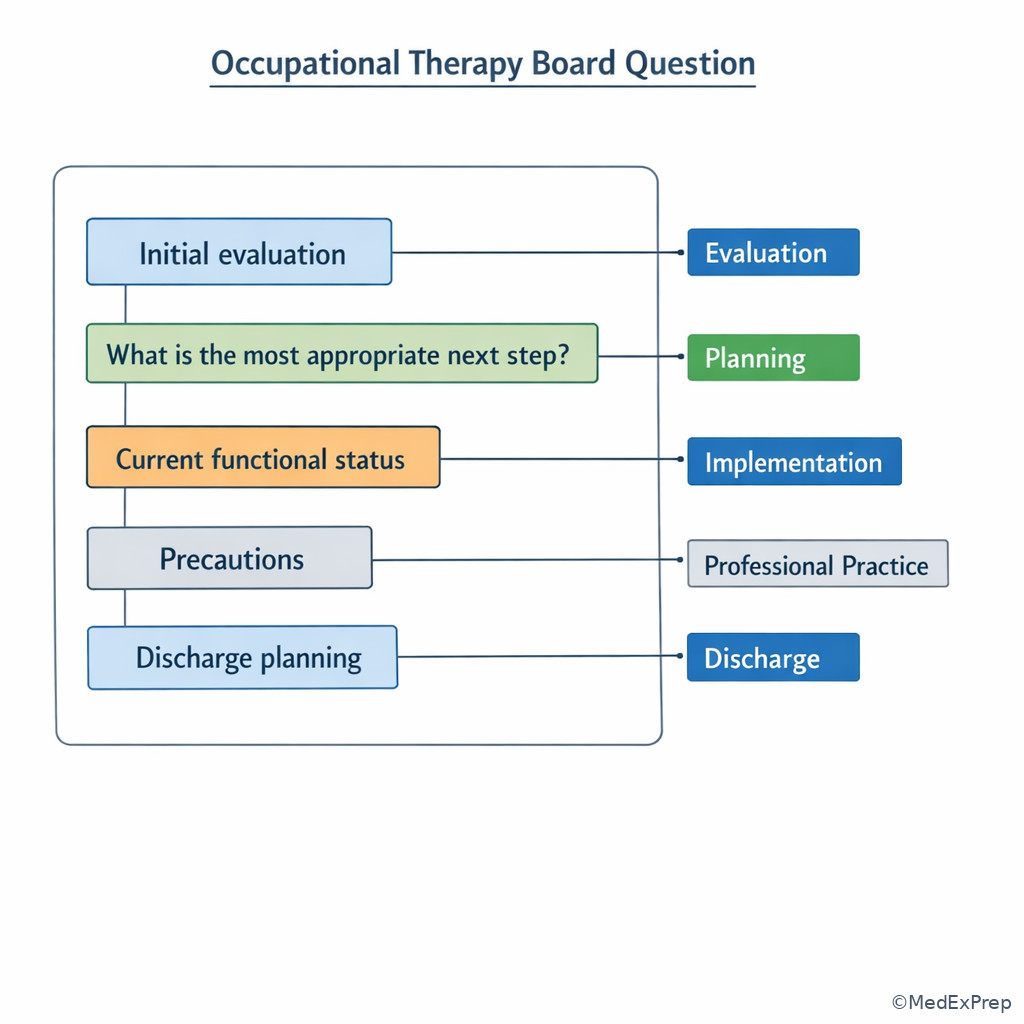
1.1.1.4 Foundational map: how the OT process becomes exam questions
A Explanation
Once you know the domains, the next conflict is choosing between adjacent OT process steps that look similar. The most common pairings are evaluation versus intervention planning, planning versus implementation, and implementation versus outcomes review. The single resolving rule is: ask what information is already established in the stem. If priorities are not yet identified, the item usually remains in evaluation. If priorities and barriers are known but no approach is chosen, it is planning. If a specific intervention has begun and the question asks about cueing, grading, sequencing, or tolerance, it is implementation. If performance change over time or next-setting needs are central, it is outcomes/discharge.
WHY THIS IS TESTED: NBCOT-style items often use realistic noise—family requests, diagnosis details, or tempting equipment questions—to make a later-stage answer look attractive before the earlier step is complete.
See Fig 3 for the process chain that turns broad content into exam-ready task categories. This is the logic that will support upcoming topics on scope and decision priority rules.
B Worked example
A school-based OT sees a 9-year-old student with ADHD, handwriting concerns, and asthma. The teacher reports frustration with written output; the parent wants a weighted vest, and the student says recess is “the only fun part of school.” The item asks for the best next OT action after the occupational profile identifies classroom participation as the main concern. Reasoning chain: identify task → the profile is already done, so this is no longer the opening evaluation step; extract key facts → classroom participation issue, teacher concern, parent request, potential sensory distractor; apply rule → before choosing an intervention such as a weighted vest, the OT must analyze performance in the target occupation and identify contributing factors; eliminate distractors → immediate equipment recommendation is premature, generic fine-motor drills may miss context, physician medication changes are outside scope; verify → the best action is targeted assessment/analysis of school task performance in the classroom context. This shows that “profile done” does not automatically mean “treat now”; sometimes evaluation still continues through analysis.
C Exam trap
D Checkpoint
Question: A client in outpatient hand therapy has already completed baseline range of motion, edema, and ADL assessment. The therapist asks which action best fits the next domain if the question focuses on prioritizing OT goals and selecting an occupation-based approach.
- Re-administer all baseline measures before any discussion of treatment.
- Set client-centered functional goals and choose tasks that match recovery status.
- Discharge the client with a final home program.
- Ask the surgeon to change the splinting protocol.
- A: Tempting because reassessment is familiar; wrong because baseline data are already available and the stem is asking for planning.
- B: Tempting because it seems less concrete than doing exercises; right because the next step after adequate evaluation is intervention planning.
- C: Tempting because home programs are functional; wrong because outcomes/discharge is a later domain.
- D: Tempting because protocols matter; wrong because changing medical orders is outside OT authority and not the planning task being tested.
- If baseline occupational performance is missing, the domain is usually evaluation.
- True or False: Completing the occupational profile always means the next step is treatment. False.
- Name the three commonly confused adjacent steps: evaluation vs planning, planning vs implementation, implementation vs outcomes.
Exam takeaway: Questions usually test a transition point between OT process steps, so identify what has happened already and what logically comes next.
flowchart TD
A[Occupational profile] --> B[Analysis of occupational performance]
B --> C[Priorities and goals]
C --> D[Intervention planning]
D --> E[Implementation and grading]
E --> F[Reassessment and outcomes]
F --> G[Discharge and transition]
H[Exam trap] --> I[Choosing step D before step B]
H --> J[Choosing step G before step F]
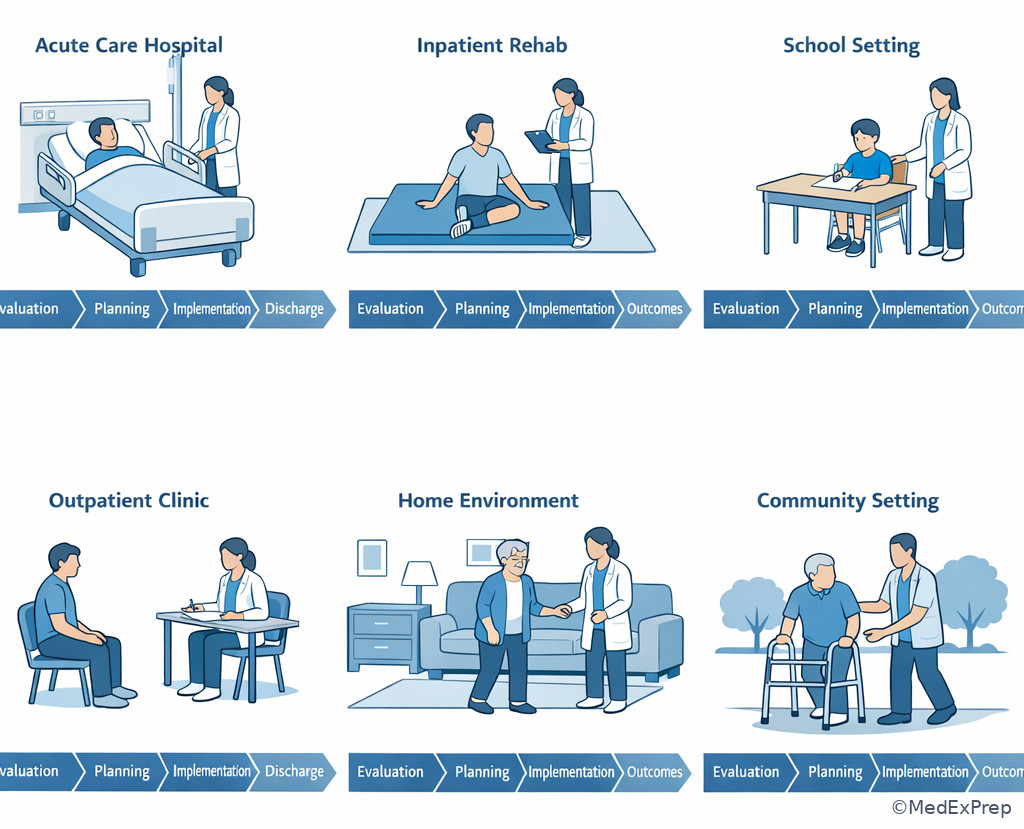
Exam takeaway: The same domain logic applies in acute care, school, rehab, outpatient, home, and community settings.
| Process clue in stem | Best domain | What strong answers usually contain | What to reject |
|---|---|---|---|
| New referral, no baseline | Evaluation | Profile, performance analysis, safety data | Full intervention plan or discharge recommendation |
| Main problems identified, goals not set | Intervention Planning | Priorities, measurable goals, task match | Repeating full assessment without reason |
| Session in progress, client struggling | Implementation | Cueing, grading, adaptation, monitoring | Starting over with new discharge planning |
| Several sessions completed, progress unclear | Outcomes/Reassessment | Outcome measure, compare change, modify plan | Unchanged treatment with no review |
| Urgent red flag, ethical issue, or scope conflict | Professional Practice/Safety | Stop, secure safety, clarify, consult, document | Continuing routine therapy as if nothing changed |
1.1.1.5 Application: using the domain map to eliminate distractors
A Explanation
Now move from naming the domain to using it as an elimination tool. The decision conflict here is between several individually reasonable OT actions. The single rule that resolves them is: the best answer is the safest, most client-centered, stage-matched OT action that can be taken now with the information available. This rule lets you reject three major distractor families: answers that are too early, answers that are too late, and answers outside OT role. In practice, if the item is evaluation, reject treatment-only options. If the item is intervention planning, reject discharge-only options. If the item is implementation, reject starting over with a full evaluation unless a major change occurred. If the item introduces an urgent red flag, reject routine continuation even if the activity itself would normally be therapeutic.
WHY THIS IS TESTED: Strong distractors are not absurd. They are often the right answer for a different patient, a different setting, a later visit, or a different provider.
See Fig 4 for a visual of the three biggest elimination categories. This is the skeleton for most future answer-review work in the course.
B Worked example
A 67-year-old client in home health has COPD, diabetes, and mild cognitive impairment. During the second OT visit, the client becomes visibly short of breath while organizing medications at the kitchen table. The spouse asks whether a shower chair should be ordered, and the chart includes a distracting note about recent appetite loss. The item asks for the most appropriate OT action. Reasoning chain: identify task → this is not initial evaluation; it is implementation/management with a possible safety issue; extract key facts → dyspnea during activity, home setting, medication task, second visit, spouse requesting equipment; apply rule → safety during the ongoing session outranks equipment recommendations and future planning; eliminate distractors → shower chair may be appropriate later, full discharge planning is premature, changing pulmonary medications is outside scope; verify → the best OT action is to stop or modify the task, assess tolerance within scope, ensure safety, and communicate/escalate as needed. The domain map keeps the answer anchored even when several helpful actions are visible.
C Exam trap
D Checkpoint
Question: An OT is midway through a feeding intervention with an adult client who suddenly shows increased lethargy and reduced attention. Which option is the best domain-matched response?
- Continue the session to finish the planned activity because consistency matters.
- Stop, assess safety and response, and communicate concerns per team process.
- Write final discharge goals based on prior sessions.
- Independently diagnose aspiration pneumonia.
- A: Tempting because follow-through and repetition are often helpful; wrong because immediate safety supersedes completion of the planned activity.
- B: Tempting because it interrupts the session; right because implementation shifts to safety management when status changes during treatment.
- C: Tempting because outcomes matter after multiple sessions; wrong because a new in-session issue must be addressed before discharge planning.
- D: Tempting because the change sounds medical; wrong because diagnosis is outside OT scope and the prompt asks for the OT action.
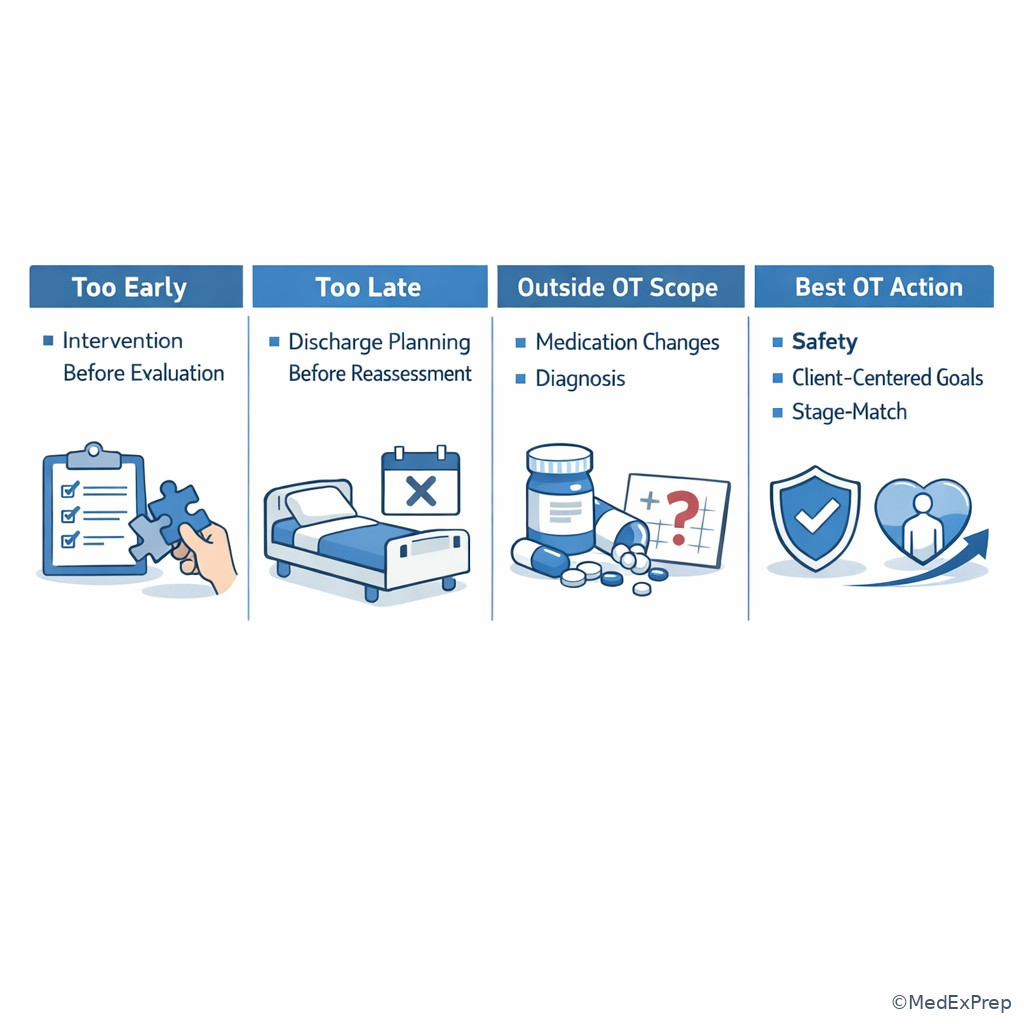
Exam takeaway: Most wrong answers can be removed because they are too early, too late, or outside OT scope for the exact scenario.
flowchart TD
A[Possible answer] --> B{Eliminate?}
B --> C[Too early: needs more evaluation data]
B --> D[Too late: jumps to discharge or long-term plan]
B --> E[Outside OT scope: diagnosis medication surgery legal determination]
B --> F[Keep: safe stage-matched OT action]
C --> G[Reject]
D --> G
E --> G Exam takeaway: Grouping distractors by timing and scope makes board-style options easier to sort under pressure.
1.1.1.6 Application: building a study plan from the domain map
A Explanation
The next decision conflict is not in a client stem but in your preparation strategy: Should you study by diagnosis list or by OT decision category? For this exam, the more reliable organizing rule is to study by domain and subskill, then plug diagnoses and settings into that framework. Why? Because the exam asks what the OT should do with information, not just what the diagnosis means. The single rule is: if a content area does not change assessment choice, intervention choice, safety monitoring, or discharge planning, it is lower-yield than a domain-linked fact. For example, learning stroke facts in isolation is less useful than learning how stroke findings affect initial evaluation, transfer training, neglect compensation, caregiver education, and discharge recommendations.
WHY THIS IS TESTED: Candidates often overinvest in narrow condition details and underinvest in transferable OT reasoning. The domain map prevents that imbalance and supports broad, efficient review.
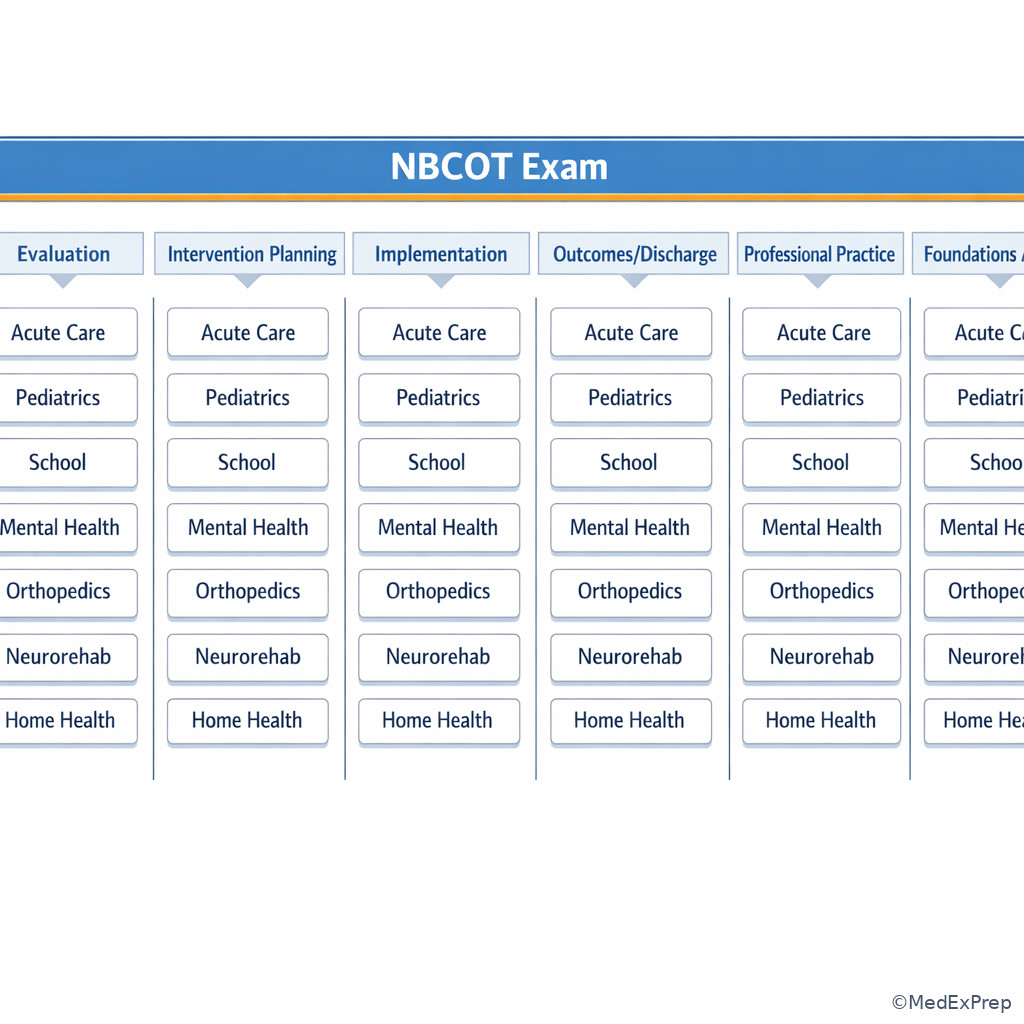
See Fig 5 for a practical study-planning grid. It shows how one domain map can organize different settings and populations without inventing hidden blueprint percentages.
B Worked example
A candidate notices repeated misses on questions involving pediatrics, orthopedics, and home health and concludes, “I need more diagnoses.” After reviewing missed items, however, the pattern is different: in each case the candidate selected intervention before enough evaluation data were available. One stem involved a toddler with sensory concerns and constipation; another involved an adult after rotator cuff repair with a tempting strengthening option; a third involved a client in home care where discharge equipment was selected before assessing current bathroom performance. Reasoning chain: identify the pattern → mixed diagnoses and settings but same error type; extract key fact → error is domain confusion, not content shortage; apply rule → build a study plan around evaluation-vs-intervention discrimination first; eliminate distractors → diagnosis-focused cramming alone will not fix process-stage errors; verify → the most effective plan is to review evaluation and planning tasks across several populations.
C Exam trap
D Checkpoint
Question: A student reviews 20 missed practice questions and notices the same error in acute care, school, and outpatient cases: choosing an appealing intervention before identifying the key barrier to occupational performance. What is the best next study action?
- Memorize more diagnosis facts without changing review structure.
- Reorganize study by OT domains, emphasizing evaluation-to-planning transitions.
- Focus only on one setting until it feels comfortable.
- Look for institution-specific billing rules to improve scoring.
- A: Tempting because diagnosis lists feel concrete; wrong because the error pattern is process-stage confusion, not isolated content recall.
- B: Tempting because it requires changing study habits; right because the same domain error appears across settings and diagnoses.
- C: Tempting because reducing variables can feel safer; wrong because the repeated issue generalizes across settings and needs a broader domain fix.
- D: Tempting because administrative details sound “practical”; wrong because unsupported local rules are not the core problem and vary by setting.
- The highest-yield organizing unit for this course is the OT decision domain.
- True or False: Foundational science should be studied separately from OT actions. False.
- Name one sign of a domain weakness: the same mistake appears across different diagnoses or settings.
Exam takeaway: Use domains as the main study structure and rotate diagnoses, ages, and settings through each domain rather than studying conditions in isolation.
flowchart TD
A[Study plan] --> B[Evaluation]
A --> C[Planning]
A --> D[Implementation]
A --> E[Outcomes/Discharge]
A --> F[Professional Practice]
B --> G[Adults Pediatrics School Mental Health]
C --> G
D --> G
E --> G
F --> G
G --> H[Add diagnoses only when they change OT action]
| Study approach | Strength | Weakness | Best use |
|---|---|---|---|
| Diagnosis-first only | Builds background familiarity | Can miss OT process reasoning | Supplemental review after domain framework is built |
| Setting-first only | Improves context awareness | Can fragment transferable reasoning | Useful for applying domains across environments |
| Domain-first | Matches exam decision structure | Requires active integration of populations and conditions | Primary study framework |
| Error-pattern review | Targets score-limiting habits quickly | Needs honest tracking of misses | Best after question banks or self-checks |
Exam takeaway: A visual study board organized by OT domains helps ensure balanced preparation across settings and populations.
1.1.1.7 Integration: linking domains, scope, and priority in real NBCOT-style reasoning
A Explanation
The final integration conflict is the one that drives many hard questions: more than one option fits the domain, but only one fits the domain, priority, and OT scope simultaneously. The single resolving rule is: when multiple stage-matched answers seem possible, choose the option that addresses the highest-priority occupational need while staying within OT authority and available information. This means you must integrate three filters in order: domain, urgency, and scope. For example, two options may both be evaluation actions, but one targets immediate safety during bathing while the other gathers less urgent leisure information. Two options may both be implementation actions, but one respects precautions and the other does not. Two options may both be “helpful,” but one requires physician authority or unsupported legal judgment.
WHY THIS IS TESTED: Entry-level practice is not about doing everything possible; it is about doing the right OT action first and collaborating when the next needed action belongs elsewhere.
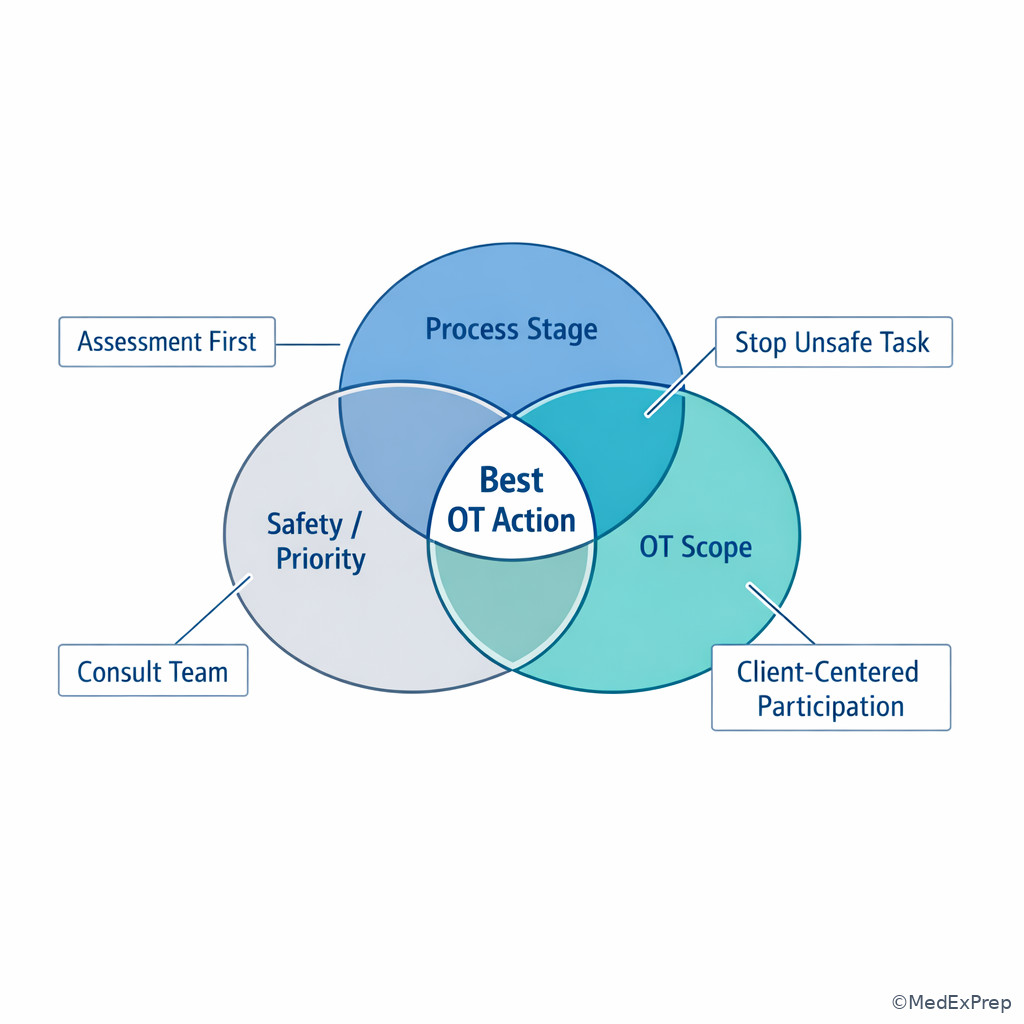
See Fig 6 for the integrated decision tree that combines the entire lesson. This figure previews the reasoning style used throughout the course.
B Worked example
A 56-year-old client in acute care after abdominal surgery is referred to OT for self-care and mobility. Comorbidities include obesity and anxiety; the nurse notes dizziness earlier, and the spouse wants immediate training on home bathroom setup. During chart review, the OT sees a newly posted precaution that was not present earlier. The item asks for the most appropriate OT action before initiating treatment. Reasoning chain: identify task → before treatment in acute care with new information, this is professional practice/safety linked to evaluation readiness; extract key facts → new precaution, recent dizziness, family pressure toward discharge planning, acute post-op status; apply rule → the OT must clarify and integrate current precautions and safety status before routine treatment or home setup training; eliminate distractors → immediate transfer practice is unsafe without clarification, discharge equipment training is too late-stage, changing surgical orders is outside scope; verify → the best action is to clarify precautions, assess readiness within scope, and coordinate with the team before proceeding.
C Exam trap
D Checkpoint
Question: A rehab OT can choose among several reasonable next steps for a client with new confusion during transfer training. Which option best reflects integrated domain, priority, and scope reasoning?
- Continue practicing transfers because repetition is needed for discharge readiness.
- Stop the transfer task, assess immediate safety, and communicate the change to the team.
- Diagnose delirium and document it as the primary medical problem.
- Finalize bathroom equipment recommendations because home access is a major barrier.
- A: Tempting because transfer independence is functionally important; wrong because new confusion creates a current safety issue that overrides routine progression.
- B: Tempting because it delays functional training; right because safety management during implementation is the highest-priority OT action and team communication stays within scope.
- C: Tempting because the change sounds medically significant; wrong because diagnosing the cause is outside OT authority.
- D: Tempting because discharge barriers matter in rehab; wrong because equipment planning does not address the immediate in-session risk.
Exam takeaway: When options are close, choose the answer that fits the process stage, addresses the highest-priority safety or participation issue, and stays within OT scope.
flowchart TD
A[Read stem] --> B[Identify OT domain]
B --> C{More than one option fits?}
C -->|No| D[Choose stage-matched OT action]
C -->|Yes| E[Rank urgency and safety]
E --> F{Still tied?}
F -->|No| G[Choose highest-priority occupational need]
F -->|Yes| H[Check OT scope and authority]
H --> I[Choose option within OT role and document/consult as needed] Exam takeaway: The strongest answer usually sits where process stage, safety priority, and OT scope all overlap.
Exam Traps & Differentiators
- Most common wrong answer and why: Selecting a treatment option in a stem that still lacks baseline occupational performance data. It is tempting because action feels efficient; it is wrong because evaluation has not been completed enough to justify that intervention.
- Looks similar but isn’t: “Occupational profile completed” does not always mean “start intervention now.” Analysis of occupational performance may still be needed before planning.
- Scope trap: A medically reasonable step such as changing medication, diagnosing a condition, or altering a surgeon’s protocol may be the right action for another provider, not the OT.
- Priority trap: Family requests or discharge concerns can distract from an immediate in-session safety issue.
- Premature discharge trap: Home programs, equipment, and next-setting recommendations are attractive but belong after readiness and current performance are assessed.
| Looks similar | Actually means | Single clue | Best thinking move |
|---|---|---|---|
| Initial OT action vs best intervention | Evaluation vs implementation | No baseline or performance analysis yet | Assess before treating |
| Goal selection vs treatment grading | Planning vs implementation | Question asks to prioritize or choose approach | Set goals and plan first |
| Progress review vs discharge planning | Outcomes vs transition | Need evidence of change or readiness | Reassess before discharging |
| Medical recommendation vs OT action | Scope issue | Requires diagnosis, prescription, or medical order change | Consult or refer |
| Helpful adaptation vs urgent safety step | Priority issue | Current red flag during session | Address safety first |
If the stem says...
- “Initial OT evaluation,” think profile + analysis + safety baseline.
- “Best next step after priorities are identified,” think planning.
- “During treatment the client begins to...,” think implementation with monitoring and safety.
- “After several sessions” or “at discharge,” think outcomes, transition, carryover, equipment, supports.
- “Clarify,” “consult,” “report,” or “new precaution,” think professional practice/safety.
Related traps will reappear in the upcoming lessons on Entry-Level OT Scope and OT Decision Priority Rules. Those topics create especially confusable pairs with this lesson: a stage-matched answer can still be wrong if it exceeds OT scope, and a scope-appropriate answer can still be wrong if it ignores immediate safety or the current service stage.
Algorithm / Approach
Rapid Review
- Initial referral → think evaluation before treatment selection.
- Profile done, barriers unclear → analysis still belongs to evaluation.
- Goals not yet chosen → planning domain, not implementation.
- Session already underway → cueing, grading, and monitoring rise.
- New red flag during activity → safety response outranks completion.
- Several sessions completed → reassessment and plan modification rise.
- Discharge/home transition language → outcomes, carryover, supports, equipment.
- Medication or diagnosis option → likely wrong-provider distractor.
- Family request alone → not enough to bypass evaluation or safety sequence.
- Helpful but premature equipment recommendation → too late-stage for an initial or unstable scenario.
- Foundational science fact → useful only if it changes OT action.
- Same error across many diagnoses → likely a domain weakness, not a content-island weakness.
Self-check quiz
- Assess occupational performance, precautions, and baseline self-care status.
- Issue a finalized home bathroom equipment list.
- Advance to community mobility training in the therapy gym.
- Change the analgesic regimen to improve participation.
- Set client-centered school participation goals and choose a targeted intervention approach.
- Repeat the full baseline assessment without a new concern.
- Write final discharge recommendations for next semester.
- Ask the pediatrician to adjust stimulant medication.
- Stop or modify the task, assess immediate tolerance within OT scope, and communicate concerns as needed.
- Continue the activity because consistency is more important than symptom fluctuation.
- Finalize a discharge plan because home activity tolerance has now been observed.
- Independently alter the medication timing to support endurance.
- Analyze classroom occupational performance to identify specific barriers before selecting intervention.
- Issue the weighted vest because the parent reports success at home.
- Start a daily handwriting drill program because written output is the visible problem.
- Refer for discharge because school staff already have ideas.
- Choose functional priorities and set graded goals linked to daily hand use.
- Restart the entire evaluation from the beginning for completeness.
- Discharge with a permanent home program because assessment is complete.
- Rewrite the surgeon’s protocol to speed progress.
- Clarify current precautions and readiness, then proceed only if safe within OT scope.
- Begin transfer training because the referral has already been placed.
- Recommend bathroom equipment and skip bedside assessment to save energy.
- Remove the precaution because early mobility is usually beneficial.
- Stop the task, address immediate safety, and communicate the change in status to the team.
- Proceed with dressing because the session goal was already established.
- Complete a driving readiness decision during the same session.
- Document a new medical diagnosis explaining the confusion.
- Rebuild the study plan around OT domains, especially evaluation-to-planning and safety-priority transitions.
- Study diagnoses by body system only and ignore process-stage errors for now.
- Memorize more equipment names because many missed items mention devices.
- Focus only on one practice setting until every scenario in that setting is comfortable.
Answer key
1.1.1.8 Question 1
Correct answer: A. Assess occupational performance, precautions, and baseline self-care status.
- A: Tempting because it feels slower than immediate treatment; correct because a first OT contact with no prior OT note belongs to evaluation. The single stem clue is “most appropriate initial OT action”. This matches the OT process and AOTA evaluation standards for occupational profile and analysis before intervention selection. Source: American Occupational Therapy Association; Schell and Gillen.
- B: Tempting because hip fracture clients often need bathroom equipment; incorrect because a finalized discharge equipment list is premature before baseline function and precautions are assessed. The single clue is the absence of prior OT evaluation data. Source: AOTA; Radomski and Trombly Latham.
- C: Tempting because mobility training is relevant in rehab; incorrect because advanced intervention cannot be the initial OT action when baseline abilities and safety have not been established. The single clue is new referral status. Source: AOTA.
- D: Tempting because pain control affects participation; incorrect because medication changes are outside OT scope. The single clue is that the prompt asks for the OT action, not the physician’s. Source: AOTA Occupational Therapy Practice Framework; NBCOT candidate-role expectations.
1.1.1.9 Question 2
Correct answer: A. Set client-centered school participation goals and choose a targeted intervention approach.
- A: Tempting because it seems administrative rather than therapeutic; correct because classroom observation and handwriting assessment are already completed, moving the process into intervention planning. The single clue is “best next OT action to prioritize services” after assessment. Source: AOTA; Case-Smith and O’Brien.
- B: Tempting because repetition can improve confidence in findings; incorrect because there is no new concern justifying a repeat full baseline. The single clue is that assessment has already been completed. Source: AOTA.
- C: Tempting because school services require future planning; incorrect because discharge belongs to a later stage and the student has not yet begun the planned intervention approach. The clue is next step after evaluation, not final step. Source: AOTA.
- D: Tempting because medication can affect participation; incorrect because medication adjustment is outside OT authority. The discriminating clue is role boundary. Source: AOTA Practice Framework.
1.1.1.10 Question 3
Correct answer: A. Stop or modify the task, assess immediate tolerance within OT scope, and communicate concerns as needed.
- A: Tempting because it interrupts functional training; correct because implementation shifts to safety management when symptoms increase during activity. The key clue is “becomes increasingly short of breath” during the task. OT should respond within scope and collaborate as needed. Source: AOTA; acute/home care safety principles in Radomski and Trombly Latham.
- B: Tempting because endurance is built through practice; incorrect because continuing despite worsening symptoms ignores immediate safety and tolerance. The discriminating clue is symptom escalation during intervention. Source: AOTA.
- C: Tempting because the home context invites discharge thinking; incorrect because observing one unsafe episode does not make discharge planning the priority. The clue is the active safety issue in-session. Source: AOTA.
- D: Tempting because medication timing can affect function; incorrect because independently altering medication timing exceeds OT scope. The clue is provider role boundary. Source: AOTA Practice Framework; NBCOT scope expectations.
1.1.1.11 Question 4
Correct answer: A. Analyze classroom occupational performance to identify specific barriers before selecting intervention.
- A: Tempting because it delays action requested by adults; correct because the occupational profile identifies concern but targeted analysis of performance in the classroom is still missing. The single clue is “No targeted classroom task analysis has been completed.” Source: AOTA; Case-Smith and O’Brien.
- B: Tempting because parent report suggests a familiar sensory strategy; incorrect because intervention selection without identifying the relevant school-performance barrier is premature. The clue is missing performance analysis in the target context. Source: AOTA.
- C: Tempting because handwriting is the visible school difficulty; incorrect because direct drills may not address the actual participation barrier without further analysis. The clue is that the exam asks for the best next action, not a generic intervention. Source: AOTA.
- D: Tempting because collaboration with school staff matters; incorrect because existing ideas from others do not replace OT evaluation and planning. The clue is that the student’s barriers have not yet been sufficiently analyzed. Source: AOTA.
1.1.1.12 Question 5
Correct answer: A. Choose functional priorities and set graded goals linked to daily hand use.
- A: Tempting because goals can seem less urgent than exercise; correct because the stem states that the main occupational barriers are already known and asks for the next step to organize therapy, placing the question in intervention planning. The discriminating clue is baseline data already assessed and barriers known. Source: AOTA; rehabilitation planning principles in Radomski and Trombly Latham.
- B: Tempting because thoroughness feels safe; incorrect because there is no indication that the prior evaluation was insufficient or that status changed dramatically. The clue is that assessment was just completed last week. Source: AOTA.
- C: Tempting because home programs are common in hand therapy; incorrect because discharge is premature when therapy is just being organized. The clue is current phase of care. Source: AOTA.
- D: Tempting because protocol progression affects intervention; incorrect because rewriting surgical protocol exceeds OT authority. The clue is scope boundary. Source: AOTA Practice Framework.
1.1.1.13 Question 6
Correct answer: A. Clarify current precautions and readiness, then proceed only if safe within OT scope.
- A: Tempting because it may feel like “not doing therapy”; correct because a new precaution and recent dizziness must be integrated before starting the first session. The key clue is “newly posted precaution” plus earlier dizziness. OT must clarify, assess readiness, and collaborate. Source: AOTA; acute care safety principles in Radomski and Trombly Latham.
- B: Tempting because early mobility is often beneficial; incorrect because the referral alone does not override a new precaution or current readiness concern. The discriminating clue is changed safety information before treatment. Source: AOTA.
- C: Tempting because spouse concern highlights home function; incorrect because equipment recommendation is a later-stage action and cannot replace bedside assessment and precaution clarification. The clue is immediate safety uncertainty in acute care. Source: AOTA.
- D: Tempting because mobility promotion matters postoperatively; incorrect because the OT cannot remove a posted precaution independently. The clue is role and authority boundary. Source: AOTA Practice Framework; NBCOT scope expectations.
1.1.1.14 Question 7
Correct answer: A. Stop the task, address immediate safety, and communicate the change in status to the team.
- A: Tempting because it disrupts task-specific practice; correct because new confusion plus unsafe standing behavior during dressing training creates an immediate safety event. The discriminating clue is newly confused and attempts to stand without assistance. Source: AOTA; safety and interprofessional communication standards.
- B: Tempting because repetition of dressing practice supports rehab goals; incorrect because routine task completion cannot outrank new safety risk. The clue is acute status change during the session. Source: AOTA.
- C: Tempting because family questions about driving are realistic in rehab; incorrect because discharge-level community mobility decisions are not the priority during an unsafe in-session event. The clue is immediate risk versus future planning. Source: AOTA.
- D: Tempting because documenting the cause sounds thorough; incorrect because diagnosing the medical reason for confusion is outside OT role. The clue is provider authority boundary. Source: AOTA Practice Framework.
1.1.1.15 Question 8
Correct answer: A. Rebuild the study plan around OT domains, especially evaluation-to-planning and safety-priority transitions.
- A: Tempting because it requires changing study structure instead of adding more facts; correct because the misses cluster around the same reasoning error across multiple diagnoses and settings. The discriminating clue is same pattern across pediatrics, orthopedics, home health, and mental health. Source: AOTA reasoning framework; course-wide domain-based study planning principles.
- B: Tempting because body-system study feels comprehensive; incorrect because diagnosis-only review does not directly correct process-stage reasoning errors. The clue is the cross-setting consistency of the mistake. Source: Schell and Gillen; AOTA.
- C: Tempting because devices appear often in OT questions; incorrect because the problem described is premature treatment choice, not equipment vocabulary. The clue is selecting treatment before defining barrier or safety issue. Source: AOTA.
- D: Tempting because narrowing to one setting reduces complexity; incorrect because the same reasoning error is appearing across settings, so a setting-only fix is inefficient. The clue is broad transfer of the error pattern. Source: AOTA.
Keep going with the full NBCOT-OTR Prep Course (NBCOT OTR)
You just studied the way members do, in the same lesson interface. Full access unlocks every lesson, the question bank and flashcards for a full year.
One payment · 1 year of access · No auto-renewal