1.1.1 - OTA Role Boundaries
Why it matters
- Many NBCOT-COTA items are not asking what is clinically ideal in the abstract; they are asking what is the most appropriate OTA action within supervision and safety limits.
- The best answer often turns on a single role boundary clue: implementation and reporting are usually in role; interpretation, goal setting, plan revision, and independent discharge decisions are not.
- Scope errors on the exam mimic real practice errors: over-interpreting findings, changing treatment independently, or failing to report a significant client change.
- Understanding role boundaries early makes later topics easier, especially documentation, evaluation contribution, supervision, and ethics. See Fig 1.
Key Terms & Must-Know Facts
1.1.1.1 Key terms
- Delegated intervention: Service activity the OTA carries out within the established OT plan of care.
- Evaluation contribution: OTA gathers selected data and observations under OT direction.
- Evaluative interpretation: Meaning-making from assessment findings to determine clinical conclusions; OT-level responsibility.
- Plan of care: OT-directed intervention framework, goals, and service decisions.
- Reassessment: Review of status requiring OT judgment when interpretation or plan revision is involved.
- Objective documentation: Measurable, descriptive recording of performance and response.
- Escalation: Prompt communication of significant change, risk, or barrier to the supervising OT or team.
- Role drift: Gradual movement into tasks beyond authorized OTA scope.
- Significant status change: New or worsening medical, cognitive, psychosocial, or functional finding that may affect safety or the plan.
- Reinforcement education: OTA repeats and supports previously established teaching within delegated parameters.
- Supervision parameters: Boundaries set by law, policy, payer rules, and OT direction.
- Functional performance data: Observable client ability in occupations, tasks, transfers, endurance, safety, and participation.
1.1.1.2 Must-know facts
- The OTA may observe, implement, monitor, document, and report.
- The OTA should not independently interpret the full evaluation.
- The OTA should not set or revise goals independently.
- The OTA should not independently create or change the plan of care.
- If the client has a significant change, the OTA should address immediate safety and notify the supervising OT promptly.
- Documentation should describe what happened, not unsupported conclusions about why it happened.
- A tempting wrong answer on this exam is often the action an OT could do, but an OTA should not do independently.
- When local rules differ, follow current NBCOT materials and local practice requirements.
Exam takeaway: Sort answer choices by whether the action is implementation/reporting versus evaluation interpretation or plan change.
flowchart TD
A[Exam stem asks for OTA next step] --> B{Is task within established plan?}
B -->|Yes| C[Implement or adapt setup within delegated parameters]
C --> D[Monitor response and safety]
D --> E[Document objectively and report as needed]
B -->|No or unclear| F{Does action require OT judgment?}
F -->|Yes| G[Pause if needed for safety and contact supervising OT]
F -->|No| H[Clarify delegated parameters before proceeding] Exam takeaway: Visualize the divide between OTA implementation tasks and OT-only evaluative responsibilities.
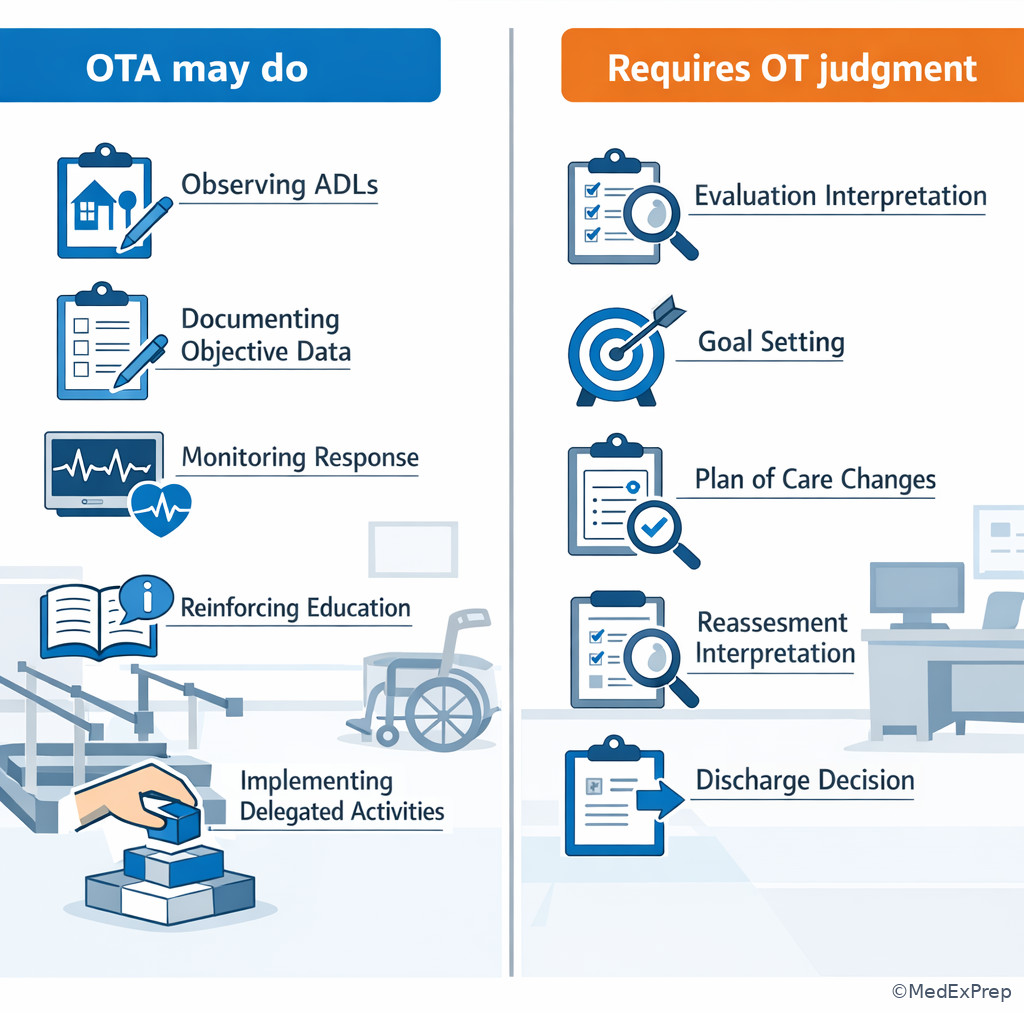
Core content
1.1.1.3 Foundational boundary rule: implement and report vs interpret and decide
A Explanation
The first exam conflict is simple but heavily tested: Should the OTA act, or should the OTA escalate? The resolving rule is this: if the task is part of implementing an established plan, monitoring client response, or documenting observed performance, it is usually within OTA role. If the task requires clinical interpretation that determines goals, plan changes, evaluative conclusions, or independent discharge decisions, it belongs to the OT.
WHY THIS IS TESTED: The exam rewards role-appropriate action, not maximal action. A wrong answer is often tempting because it sounds proactive or clinically sophisticated, but it crosses into OT-only judgment.
Choose the answer that keeps the OTA in the lane of carrying out delegated services, observing function, and communicating findings. Reject the answer that asks the OTA to independently decide what the evaluation means, rewrite goals, or change the plan of care. In a noisy stem, words like determine, interpret, establish, revise, reassess, discharge are warning lights. See Fig 2.
Key rule: If the answer choice changes the meaning of findings or changes the treatment direction independently, it likely exceeds OTA role.
Memory anchor: OIMR = Observe, Implement, Monitor, Report. If the option goes beyond OIMR into interpret, set, revise, discharge, be suspicious.
B Worked example
A 74-year-old client in inpatient rehabilitation is seen by the OTA after a left hemispheric stroke. The client has hypertension, type 2 diabetes, and mild osteoarthritis. During lower-body dressing training, the client demonstrates new impulsivity and requires more verbal cues than yesterday. The spouse mentions poor sleep overnight. A tempting clue is that the client also dropped a sock twice because of hand weakness, which could make strengthening seem like the priority.
Identify task: Choose the most appropriate OTA response to a change during delegated intervention.
Extract key facts: There is a new cognitive-behavioral change compared with prior performance. Sleep loss is noise unless it fully explains the change. The hand weakness is not new and is not the key discriminator.
Apply rule: The OTA may monitor and document the observed change, address immediate safety during the session, and report the significant change to the supervising OT. The OTA should not independently reinterpret the client's status or revise treatment goals.
Eliminate distractors: Reject choices such as independently changing the cognitive goals, documenting that the client has worsening neglect as a new evaluation conclusion, or discharging dressing training from the plan. Those require OT evaluative judgment.
Verify: The safest, role-appropriate answer is to modify the activity setup for immediate safety within delegated parameters, document the increased cues and impulsivity objectively, and notify the supervising OT promptly.
C Exam trap
Common wrong answer: “Revise the treatment goals to focus on impulse control before resuming ADL training.”
Why it is tempting: It sounds client-centered and responsive to the newly observed problem.
Single clue that eliminates it: Revise the treatment goals is OT-level plan-of-care authority, not an independent OTA action.
D Checkpoint
Question: During a delegated grooming session, a client with Parkinson disease demonstrates more freezing and needs substantially more physical assistance than in the previous two sessions. What is the most appropriate next step for the OTA?
- A. Independently rewrite the short-term goals to reflect decline in mobility.
- B. Continue the session exactly as planned to avoid interrupting the treatment routine.
- C. Modify for immediate safety, document the observed change objectively, and report the change to the supervising OT.
- D. Complete a formal reassessment and determine whether discharge is indicated.
- A: Tempting because goals should reflect function, but wrong because rewriting goals is not within independent OTA authority.
- B: Tempting because consistency matters, but wrong because a significant functional change should not be ignored.
- C: Correct because it matches OTA role: address safety, monitor performance, document objectively, and escalate the change.
- D: Tempting because reassessment sounds thorough, but wrong because reassessment interpretation and discharge decision exceed OTA role.
Exam takeaway: Action verbs in the answer choice often reveal whether the option matches OTA scope.
flowchart LR
A[In role] --> A1[Implement]
A --> A2[Observe]
A --> A3[Monitor]
A --> A4[Document]
A --> A5[Report]
B[Out of role independently] --> B1[Interpret evaluation]
B --> B2[Set goals]
B --> B3[Revise plan]
B --> B4[Determine discharge]
B --> B5[Authorize major change]
Exam takeaway: The OTA delivers delegated intervention while tracking safety, function, and response rather than independently redefining the plan.
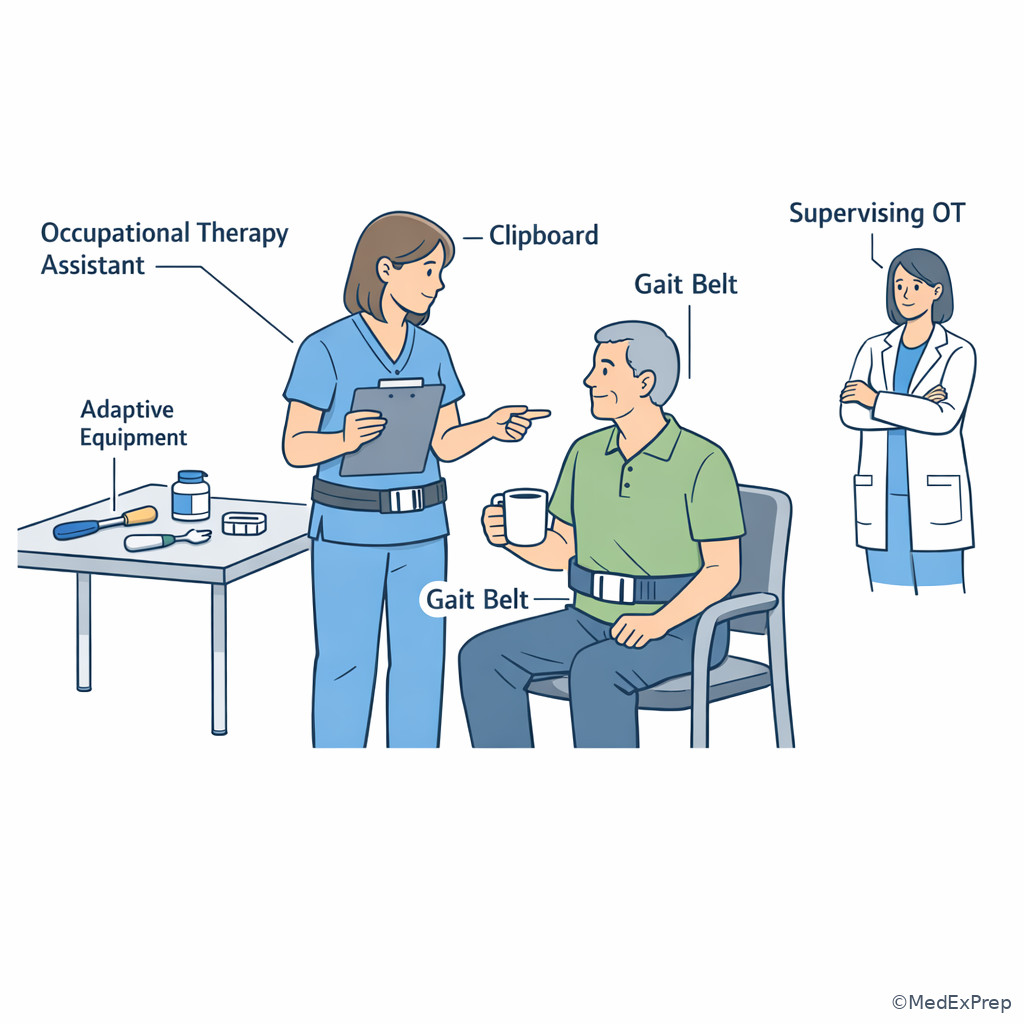
1.1.1.4 Evaluation contribution: what the OTA can gather without interpreting
A Explanation
Another common exam conflict asks: Can the OTA collect this information, or does collecting it become interpretation? The OTA may contribute to the evaluation by gathering selected data under OT direction: ADL performance, transfer ability, endurance, cueing needs, environmental barriers, observations of motor or cognitive behavior, and client-reported concerns. The OTA should reject choices that turn those observations into diagnostic-style conclusions or a full evaluative summary.
The single resolving rule: Data gathering is permitted; independent meaning-making that determines evaluation conclusions is not. For example, “Client required moderate assistance for lower-extremity dressing and three verbal cues for sequencing” is in role. “Client demonstrates apraxia that limits occupational performance and therefore requires a revised cognitive-perceptual treatment plan” is not an OTA-authored evaluative conclusion.
WHY THIS IS TESTED: Exam writers know learners confuse observing with interpreting. Both use clinical language, but only one stays within OTA role.
Choose answer choices that stay concrete and measurable. Reject answer choices that summarize the evaluation, identify causation beyond the observed data, or convert raw findings directly into plan decisions. See Fig 3.
Recall: This is the first scope lesson in the course. In the upcoming topic OT-Only Responsibilities, you will separate these same observations from the OT tasks of evaluation interpretation, goal setting, and plan creation.
B Worked example
A 9-year-old student in a school-based setting is observed by the OTA under OT direction during classroom handwriting and cutting tasks. The student has ADHD, mild asthma, and a history of prematurity. The teacher reports “sensory issues,” which is a tempting-but-vague clue. During the activity, the student leaves the seat twice, grasps the scissors awkwardly, and needs repeated redirection to finish a two-step craft task.
Identify task: Determine what the OTA can appropriately document and communicate from the observation.
Extract key facts: The OTA has direct observations of attention to task, seating behavior, grasp pattern, and cueing needs. The teacher’s statement “sensory issues” is not enough to independently conclude a sensory processing disorder pattern.
Apply rule: The OTA can document that the student left the seat twice in 10 minutes, required five verbal redirections, used an immature grasp on scissors, and completed one of two task steps with minimal assistance. The OTA should not independently interpret these findings as a specific sensory profile or decide a new intervention plan.
Eliminate distractors: Reject any choice that says to determine that the student has a sensory modulation disorder, write new school-based goals, or alter service frequency independently.
Verify: The best answer is to provide objective observational data to the OT for integration into evaluation or plan review.
C Exam trap
Common wrong answer: “Document that the child’s poor regulation confirms a sensory processing deficit requiring new sensory-based goals.”
Why it is tempting: The observed behaviors and the teacher’s comment make a sensory interpretation feel plausible.
Single clue that eliminates it: Confirms and requiring new goals convert observations into OT evaluative interpretation and planning.
D Checkpoint
Question: Which documentation entry is most appropriate for an OTA contributing selected evaluation data under OT direction?
- A. “Client exhibits executive dysfunction causing unsafe medication management and should begin compensatory cognitive retraining.”
- B. “Client needed 4 verbal cues to locate pill organizer compartments and misplaced 2 of 7 mock pills during setup.”
- C. “Client has moderate neglect and therefore requires immediate change to the plan of care.”
- D. “Client’s reduced insight indicates likely poor discharge potential to home alone.”
- A: Tempting because it sounds clinically precise, but wrong because it interprets deficits and recommends a plan change independently.
- B: Correct because it is objective, measurable, and limited to observed performance data.
- C: Tempting because safety is relevant, but wrong because it draws evaluative conclusions and changes the plan.
- D: Tempting because discharge planning depends on insight, but wrong because discharge potential requires broader OT/team judgment.
- The OTA may gather selected data, but the full evaluation is interpreted by the OT.
- True or False: “Needs a new goal” is objective documentation. False.
- Name the 3 safest documentation elements: performance, assistance, cues.
Exam takeaway: Stay on the observation side unless the OT is making the evaluative judgment.
flowchart TB
A[Raw observation] --> B[Objective description]
B --> C[Report to OT]
C --> D[OT interprets meaning]
D --> E[OT sets goals or plan changes]
A --> X[Error: OTA jumps directly to interpretation]
X --> Y[Risk: scope violation and weak documentation]
Exam takeaway: Concrete, measurable observations support safe OTA contribution without over-interpretation.
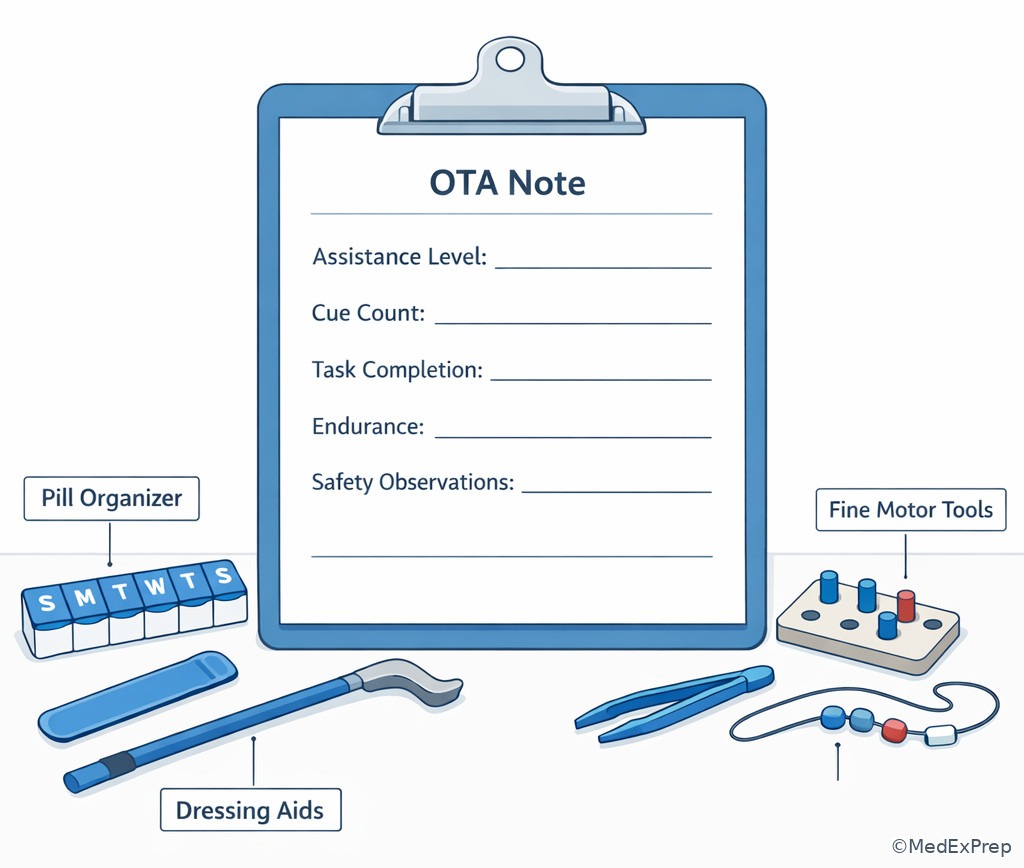
1.1.1.5 Intervention implementation: adapting within the plan vs changing the plan
A Explanation
In practice and on the exam, the OTA often must decide whether a treatment adjustment is a routine in-session adaptation or an unauthorized plan change. The OTA may grade, pace, sequence, or simplify a delegated activity to support participation and safety within established parameters. The OTA should reject answer choices that independently replace the intervention focus, add new treatment goals, or authorize a major shift in intervention strategy without OT involvement.
The key deciding question is: Am I changing how the current plan is carried out, or am I changing what the plan fundamentally is? Using a larger-handled utensil during feeding training, lowering task demands during fatigue, or adding rest breaks during a delegated endurance activity is usually in role. Deciding that feeding training should be discontinued and replaced by a new cognitive compensation program is not.
WHY THIS IS TESTED: OTA items often present subtle wording. The right answer may still involve changing something, but only the delivery, not the plan authority. See Fig 4.
Common pitfall: “Adjusting treatment” is not always wrong. What matters is whether the adjustment stays within delegated grading and safety parameters or becomes an independent plan revision.
Memory anchor: Grade, don’t rewrite. The OTA may grade the task; the OTA should not rewrite the plan.
B Worked example
A 66-year-old client in a skilled nursing facility is receiving a delegated morning self-care session after a hip fracture repair. The client has COPD, anxiety, and chronic low back pain. Mid-session, the client becomes short of breath with repeated bending and says, “I can’t do this much all at once.” A tempting clue is the anxiety history, which could mislead a learner into treating the problem as purely behavioral.
Identify task: Determine whether the OTA should adapt the session or independently alter the plan.
Extract key facts: The issue arises during a current delegated ADL activity. The client shows reduced tolerance, but the overall intervention goal remains self-care training. No stem cue says the plan itself is inappropriate.
Apply rule: The OTA can break the task into shorter segments, add rest breaks, use adaptive equipment already consistent with the plan, and monitor response. The OTA should not independently discontinue ADL training permanently, order a new intervention approach, or rewrite goals around cardiopulmonary endurance.
Eliminate distractors: Reject answers that declare a new treatment focus or discharge ADL retraining. Also reject answers that ignore symptoms and push through.
Verify: Best answer: grade the activity within the established plan, monitor tolerance, document response, and report if the pattern suggests the OT should review the plan.
C Exam trap
Common wrong answer: “Replace the current ADL session with a new endurance-training protocol and document that the treatment plan has been updated.”
Why it is tempting: It responds directly to the tolerance issue and sounds efficient.
Single clue that eliminates it: Treatment plan has been updated signals an independent plan change outside OTA authority.
D Checkpoint
Question: A client becomes mildly fatigued during a delegated meal-preparation session but remains safe and motivated. Which action is most appropriate for the OTA?
- A. Grade the task by simplifying steps and adding seated rest breaks while keeping the session goal unchanged.
- B. Independently change the long-term goal from meal prep to energy conservation training only.
- C. End all kitchen-related intervention for the week without informing the OT.
- D. Complete a reevaluation and determine whether community living remains realistic.
- A: Correct because grading delivery within the current plan is a routine, scope-appropriate OTA action.
- B: Tempting because fatigue matters functionally, but wrong because changing long-term goals is OT-level authority.
- C: Tempting because rest may be needed, but wrong because unilateral service suspension without communication is inappropriate.
- D: Tempting because realistic discharge planning matters, but wrong because reevaluation interpretation exceeds OTA role.
Exam takeaway: The OTA may change task demand and setup, but not the independent treatment direction or goals.
flowchart TD
A[Client struggles during delegated task] --> B{Same treatment aim still appropriate?}
B -->|Yes| C[Grade task: simplify, pace, cue, rest, adapt setup]
C --> D[Monitor and document response]
B -->|No or unclear| E[Pause for safety as needed]
E --> F[Report to OT for plan review] Exam takeaway: Visualize changing task demand, positioning, and setup without independently changing the intervention plan.
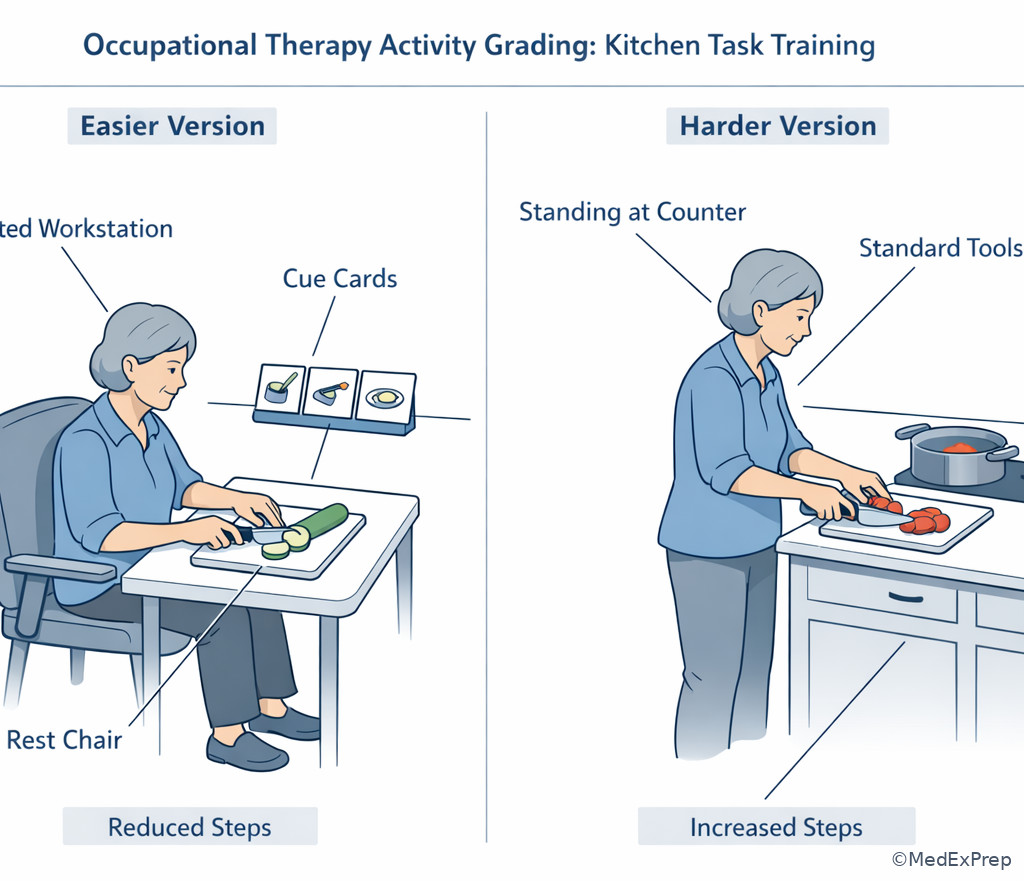
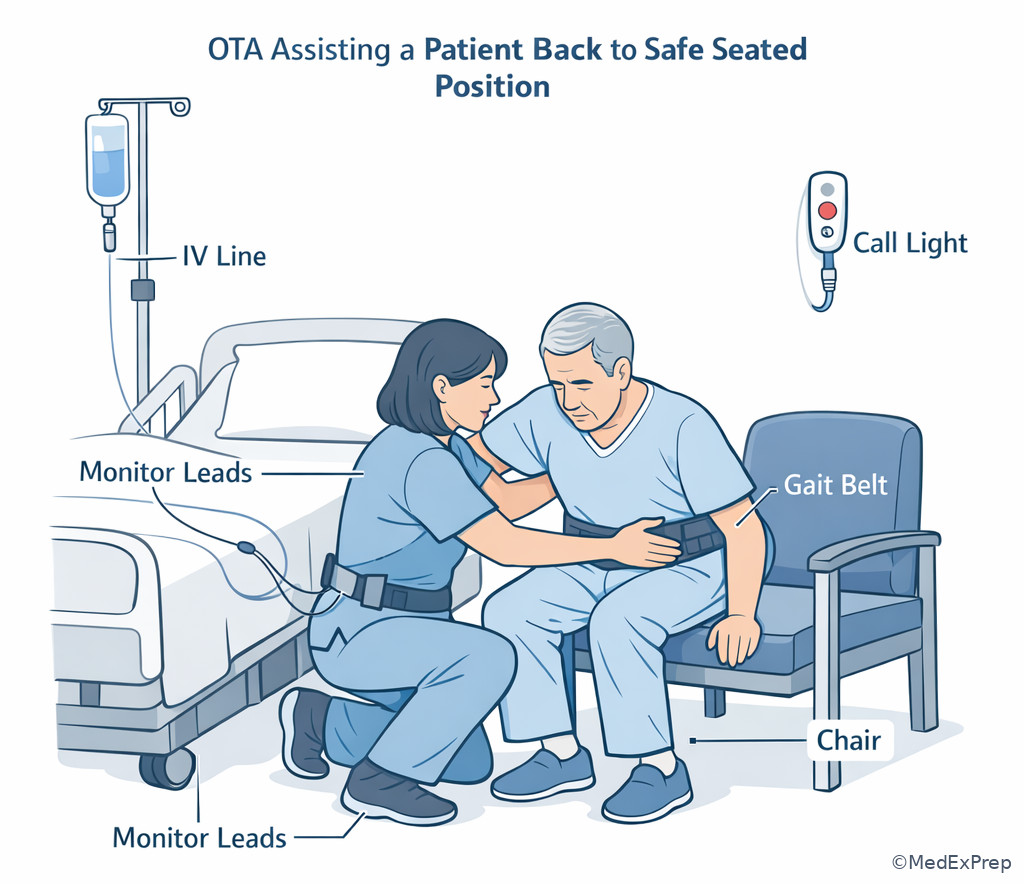
1.1.1.6 Significant change, safety, and escalation: when the OTA must stop, adjust, and report
A Explanation
The exam often places the OTA in a session where something changes: new dizziness, chest discomfort, confusion, pain spike, unusual fatigue, emotional crisis, or unsafe behavior. The conflict is not “Can the OTA solve this independently?” The real decision is: What immediate safety action is within role, and what must be communicated right away?
The OTA must not ignore significant changes. Immediate in-role action may include stopping the task, securing the client, returning to a safe position, applying precautions, obtaining assistance per facility procedure, and notifying the supervising OT and relevant team members. The OTA should reject answers that continue treatment despite red flags, or independently diagnose the event and redesign the plan.
WHY THIS IS TESTED: Safety is weighted heavily in allied health reasoning. The single clue is often the presence of a new risk that makes “continue as planned” unsafe. See Fig 5.
High-Yield Connection: This concept is tested alongside Vital Sign Response Patterns and Priority and Escalation Cues. Know both the safety threshold and the OTA communication step; stems frequently pair a clinical change with a scope boundary decision.
Recall: In the upcoming topic Supervision and Collaboration, you will build this into a communication workflow: clarify delegated parameters early, then report significant changes quickly and specifically.
B Worked example
A 58-year-old client in acute care is seen for bedside self-feeding training after abdominal surgery. The client has coronary artery disease, obesity, and anxiety. During edge-of-bed sitting, the client suddenly becomes pale, reports dizziness, and leans backward. The monitor alarm sounds briefly, which is a distracting detail because the exact reading is not given. A tempting wrong clue is the anxiety history.
Identify task: Select the best immediate OTA action.
Extract key facts: The client shows a new safety concern during treatment. Anxiety history does not justify assuming the dizziness is benign. The stem does not ask the OTA to diagnose the cause.
Apply rule: Immediate safety comes first: stop the activity, assist the client to a safe supported position, follow facility procedure, and notify the appropriate personnel including the supervising OT. Then document the objective signs and actions taken.
Eliminate distractors: Reject “coach through it” answers, independent medical interpretation, or unilateral plan rewrite answers.
Verify: The best answer protects the client now and escalates the concern promptly.
C Exam trap
Common wrong answer: “Continue the activity with calming cues because the client has a history of anxiety.”
Why it is tempting: Anxiety can cause dizziness, and therapeutic use of self is valuable.
Single clue that eliminates it: New pallor and postural instability during treatment make this a safety event first, not a reassurance-first situation.
D Checkpoint
Question: During toilet transfer training, a client with heart failure and chronic kidney disease reports new chest pressure and becomes diaphoretic. What is the most appropriate OTA action?
- A. Complete the transfer quickly so the session goals are met before reporting the symptom.
- B. Stop the activity, ensure immediate safety, follow emergency procedure as indicated, and notify the supervising OT and relevant team.
- C. Document that the client is likely having angina and recommend a revised cardiopulmonary treatment plan.
- D. Ask the client to rate the discomfort after three more transfer trials to collect enough data.
- A: Tempting because toilet urgency can feel time-sensitive, but wrong because new chest pressure makes continued exertion unsafe.
- B: Correct because it prioritizes immediate safety and role-appropriate escalation.
- C: Tempting because the symptom suggests a cause, but wrong because diagnosing and revising the plan independently exceed OTA role.
- D: Tempting because more data sounds thorough, but wrong because delay in response to a possible urgent event is unsafe.
- If the stem gives a new red flag during treatment, your first move is usually safety before continuation.
- True or False: The OTA should independently determine the medical cause of new chest pressure before reporting it. False.
- Name the 3 response elements: stop or adjust, secure safety, report.
Exam takeaway: New instability, poor tolerance, or emergent symptoms require safety action and prompt communication rather than independent interpretation.
flowchart TD
A[New symptom or unsafe change] --> B{Immediate threat to safety?}
B -->|Yes| C[Stop task and secure client]
C --> D[Follow emergency or facility procedure]
D --> E[Notify OT and relevant team]
B -->|No but significant| F[Modify or hold task]
F --> G[Document objective findings]
G --> E Exam takeaway: In acute clinical changes, OTA reasoning starts with positioning and immediate safety before communication and documentation.
1.1.1.7 Documentation and communication: objective language that stays inside scope
A Explanation
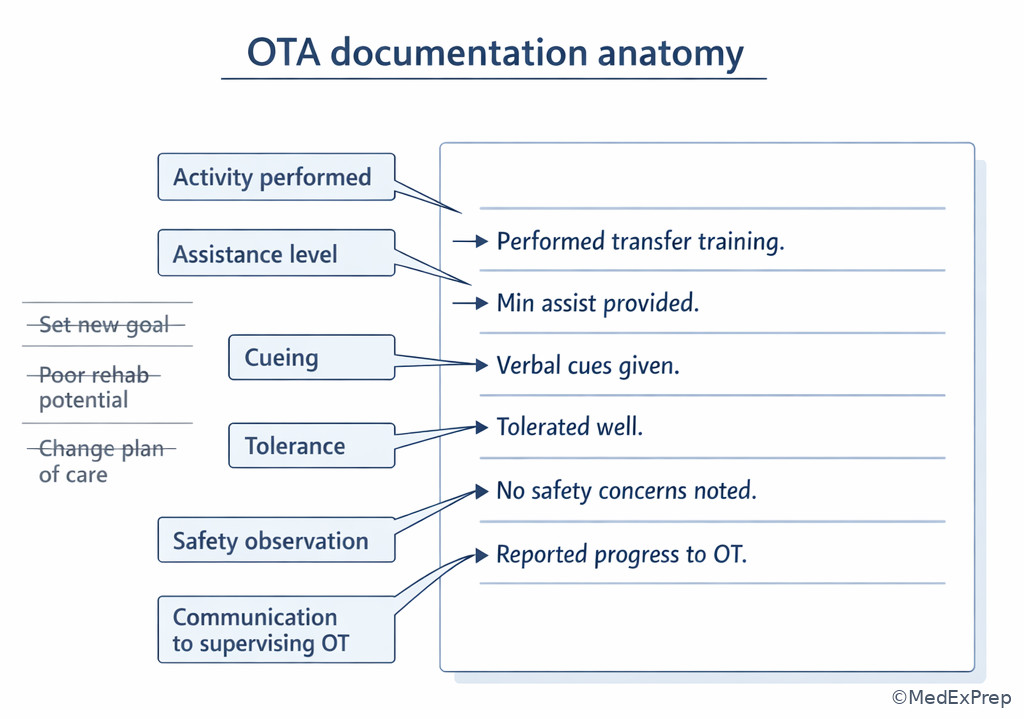
The final foundational layer is how the OTA writes and communicates. The exam often asks which note is best or what should be reported. The conflict: Should the OTA write a clinically impressive note, or a role-appropriate one? The answer is role-appropriate. Good OTA documentation is accurate, timely, objective, functional, and tied to client response. It should communicate what happened during service delivery and what follow-up is needed, without sounding like an independent OT reevaluation.
Use performance-based language: assistance levels, cueing, distance, duration, errors, safety issues, tolerance, participation, and client statements. Avoid unsupported causation, prognosis declarations, or plan-authority language unless the note is clearly reporting communication to the OT rather than asserting an independent decision. The OTA can document that the supervising OT was notified of a change; the OTA should not document that the plan was revised unless that decision came from the OT and is reflected appropriately per policy.
WHY THIS IS TESTED: Documentation items test both professional communication and scope boundaries. A precise but over-interpreted note can still be wrong. See Fig 6.
High-Yield Connection: This concept overlaps with Objective Note Writing and Progress and Change Reporting later in the course. For exam day, know not only what to say, but what not to claim independently.
B Worked example
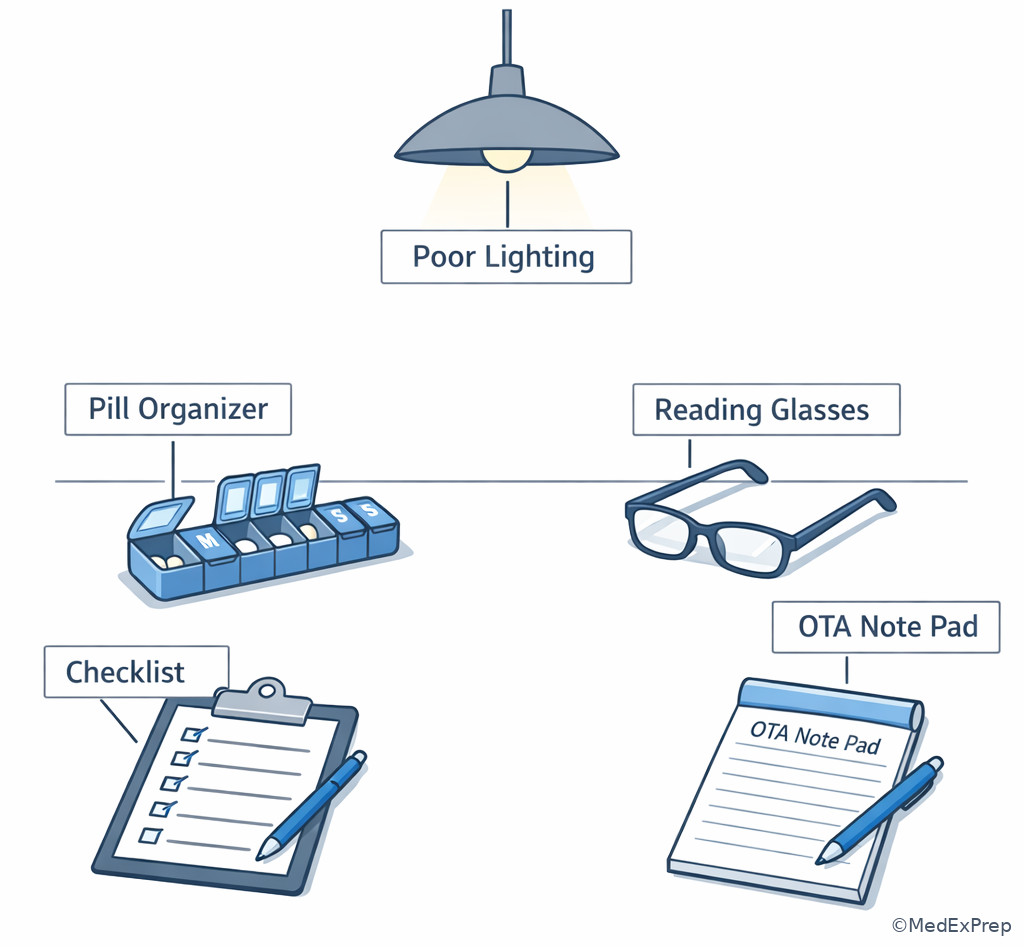
A 79-year-old home health client with mild cognitive impairment, heart failure, and visual impairment completes medication-management practice with the OTA. The client misses two evening-dose compartments, needs four verbal cues to scan the organizer, and states, “My daughter usually fixes this.” The home has poor lighting, which is a relevant environmental finding. A distracting detail is that the client jokes about “always being forgetful.”
Identify task: Choose the most appropriate documentation approach.
Extract key facts: The OTA has observed errors, cues, environmental barriers, and the client statement. The joke about forgetfulness does not justify an independent conclusion about dementia progression.
Apply rule: Document objective performance and note communication to the supervising OT if the pattern suggests a safety concern or need for plan review. Do not independently write that the client lacks capacity, cannot live alone, or requires discharge to a higher level of care.
Eliminate distractors: Reject notes that announce prognosis or definitive discharge disposition. Reject vague notes lacking measurable data.
Verify: Best note includes task details, measurable errors, cueing, environmental factors, and the fact that concerns were communicated appropriately.
C Exam trap
Common wrong answer: “Client unsafe to remain home alone; discharge to supervised setting recommended.”
Why it is tempting: The observation does raise safety concerns, and the recommendation sounds protective.
Single clue that eliminates it: It makes an independent discharge-level determination rather than reporting observed medication-management deficits and notifying the OT.
D Checkpoint
Question: Which OTA note excerpt is most appropriate after a delegated bathing session?
- A. “Client remains inappropriate for discharge home due to global cognitive decline.”
- B. “Client completed upper-body bathing with setup, required mod assist for lower-body bathing, and needed 3 verbal cues to maintain hip precautions; supervising OT notified of increased cueing needs.”
- C. “Client demonstrates poor rehab potential and should transition to custodial care.”
- D. “Plan of care changed today to prioritize cognition over self-care.”
- A: Tempting because discharge readiness matters, but wrong because it gives an evaluative discharge conclusion.
- B: Correct because it uses objective functional data and reports communication without overstepping scope.
- C: Tempting because prognosis can seem implied, but wrong because rehab potential judgments exceed independent OTA documentation.
- D: Tempting because priorities may change clinically, but wrong because the OTA should not independently state a plan change as self-determined.
Exam takeaway: Strong OTA notes report measurable performance and communication completed without independent evaluative conclusions.
Exam takeaway: Environmental barriers and performance errors should be documented as observed facts, then communicated for OT review when needed.
Exam Traps & Differentiators
The most common wrong answer is the one that sounds clinically advanced but belongs to the OT, not the OTA.
| Looks right on the surface | Why it is tempting | Why it is wrong for the OTA | What to choose instead |
|---|---|---|---|
| Set new goals after observing decline | Goals should match current function | Goal setting requires OT judgment | Document decline objectively and notify OT |
| Interpret assessment findings into diagnosis-level conclusions | Observed pattern seems obvious | Evaluation interpretation exceeds OTA authority | Report selected data under OT direction |
| Independently revise intervention focus | Session problem appears to need a new strategy | Plan-of-care changes require OT authority | Grade the current task within delegated parameters |
| Continue treatment despite new red flags | Productivity or routine pressure | Safety takes priority over routine completion | Stop or modify for safety and escalate |
| Document prognosis or discharge recommendation as your own conclusion | Performance seems clearly poor | Independent discharge-level judgment is outside OTA role | Record objective performance and communicate concern |
| If the stem says... | Think... |
|---|---|
| “New confusion,” “new chest pressure,” “sudden dizziness,” “unsafe behavior” | Safety first; stop or adjust, then report promptly |
| “Determine,” “interpret,” “establish goals,” “revise plan,” “discharge” | Likely OT-only or requires OT involvement |
| “Under OT direction,” “selected data,” “observed performance” | OTA may gather and report objective findings |
| “Client tolerated less than before,” “needed more cues,” “function changed” | Document measurable change and notify supervising OT |
| “Within the established plan of care” | Implementation and grading are more likely appropriate |
| “Independent change to goals or treatment frequency” | Reject as outside OTA authority |
Looks similar but isn’t: In the upcoming topic OT-Only Responsibilities, answer choices may look almost identical except for one authority verb. “Document and report need for review” is very different from “revise the plan.” In Supervision and Collaboration, a correct answer may be “clarify delegated parameters before proceeding,” which is not the same as refusing all action.
Common traps & distractors: Wrong options often include one action that is clinically reasonable but belongs to the wrong provider. Another frequent distractor is the “do nothing new” option that ignores a clear status change. Eliminate both by asking: What can the OTA safely do now, and what must be escalated?
Tables
| Task type | OTA may do | Requires OT judgment |
|---|---|---|
| Evaluation process | Gather selected data, observe ADLs, report client performance | Interpret the full evaluation and determine evaluative conclusions |
| Goals | Work toward established goals and report barriers | Establish or independently revise goals |
| Intervention plan | Implement delegated interventions and grade tasks within parameters | Create or independently change the plan of care |
| Reassessment | Observe change and recommend OT review | Interpret reassessment findings and make plan decisions |
| Discharge | Report current function and equipment/training needs | Make independent discharge decisions requiring OT judgment |
| Documentation | Write objective service notes and report communication | Document independent evaluative interpretations as if self-determined |
| Comparison | In-role OTA wording | Out-of-role wording |
|---|---|---|
| Observation | “Needed min assist and 3 verbal cues” | “Demonstrates severe executive dysfunction requiring new plan” |
| Response to change | “Session modified for safety; OT notified” | “Plan changed today due to decline” |
| Education | “Reinforced use of dressing aid per established training” | “Initiated new caregiver program and goals” |
| Discharge language | “Reported current transfer status and equipment needs” | “Client inappropriate for home discharge” |
| Evaluation contribution | “Collected selected ADL data under OT direction” | “Completed evaluation summary and interpreted findings” |
| Differential exam cue | Best OTA response | Why |
|---|---|---|
| Client needs more cues but remains medically stable | Grade task, document, report pattern if meaningful | Implementation and monitoring remain in role |
| Client shows new emergent symptom during treatment | Stop or adjust for safety, follow procedure, notify OT/team | Safety and escalation override routine continuation |
| Answer choice asks OTA to set goals | Reject | Goal setting requires OT authority |
| Answer choice asks OTA to collect objective ADL data | Usually choose | Selected data collection is within OTA contribution |
| Answer choice asks OTA to decide discharge placement | Reject | Independent discharge decisions may exceed OTA role |
| Answer choice asks OTA to notify OT after significant change | Usually choose | Prompt communication is expected within supervision model |
Algorithm / Approach
Rapid Review
- Evaluation contribution → gather selected data; do not interpret the full evaluation.
- Goal language → if the option says establish or revise goals, reject for independent OTA action.
- Plan of care → grade the task, do not rewrite the treatment direction.
- Significant change → safety first, then prompt OT/team communication.
- Objective note → assistance level plus cues beats abstract clinical labels.
- Discharge question → report function and needs; do not independently determine discharge disposition.
- Tempting expert-sounding answer → often correct for the OT, wrong for the OTA.
- Teacher/caregiver opinion in stem → useful context, not a substitute for objective observation.
- New symptom during treatment → continuing as planned is usually wrong.
- Documentation overreach → prognosis, diagnosis-level conclusions, and independent plan change wording are red flags.
- Best OTA action → Observe, Implement, Monitor, Report.
- Unclear delegation → clarify with supervising OT before proceeding.
Memory anchor: “Do, view, tell — not decide.” OTA does delegated treatment, views performance objectively, and tells the OT about change; the OTA does not independently decide evaluative conclusions.
Self-check quiz
1. An OTA is helping gather selected evaluation data under OT direction for a client after total knee arthroplasty. Which action is most appropriate for the OTA?
- A. Measure and document the client’s dressing performance, assistance level, and cueing needs.
- B. Interpret the entire evaluation and determine the occupational performance deficits driving the plan.
- C. Establish short-term goals for lower-body dressing independence.
- D. Decide that outpatient services will be more appropriate than home health after discharge.
Tag: DOMAIN 1: Evaluation and data gathering contribution -> selected observations under OT direction
2. During a delegated upper-extremity dressing session, a client with osteoarthritis and hypertension needs more time and two extra verbal cues but remains medically stable. Which OTA action is most appropriate?
- A. Grade the task and document the extra cueing and time required.
- B. Independently revise the intervention plan to remove dressing goals.
- C. Complete a formal reassessment and determine new long-term goals.
- D. Document that the client has poor rehabilitation potential.
Tag: DOMAIN 2: Intervention implementation and service delivery -> delegated intervention and grading
3. A 72-year-old client in inpatient rehabilitation after right CVA has diabetes and chronic kidney disease. During a delegated grooming session, the OTA notices the client now ignores items on the left side of the sink and requires twice as many cues as yesterday. The family reports the client slept poorly. What is the most appropriate next step?
- A. Document the increased cueing and left-side inattention objectively, ensure safety, and notify the supervising OT.
- B. Independently diagnose worsening unilateral neglect and rewrite the treatment goals.
- C. Continue the session exactly as planned and wait to see whether the change persists for several days.
- D. Discharge grooming training because cognitive-perceptual deficits are now the primary issue.
Tag: DOMAIN 3: Intervention review, reporting, and documentation -> reporting significant change
4. A school-based OTA observes a 7-year-old student with ADHD and developmental coordination difficulties during a handwriting task under OT direction. The student leaves the seat three times, requires five verbal redirections, and uses an awkward grasp pattern. Which documentation entry is most appropriate?
- A. “Student demonstrates sensory modulation disorder requiring immediate plan revision.”
- B. “Student left seat 3 times in 15 minutes, required 5 verbal redirections, and used inefficient scissor grasp during seated task.”
- C. “Student has significant executive dysfunction and should receive a different service model.”
- D. “Student’s behavior confirms poor classroom placement fit.”
Tag: DOMAIN 1: Evaluation and data gathering contribution -> objective observation language
5. A 64-year-old client in a skilled nursing facility after hip fracture repair has COPD and anxiety. During delegated lower-body dressing training, the client becomes mildly short of breath with repeated bending but recovers quickly with rest and remains safe. Which action is most appropriate for the OTA?
- A. Grade the task by adding rest breaks and simplifying setup while keeping the established treatment aim.
- B. Independently replace ADL training with a new endurance protocol and document the plan update.
- C. Push through the entire session because the symptom is likely only anxiety.
- D. Determine that the client no longer has discharge potential to home.
Tag: DOMAIN 2: Intervention implementation and service delivery -> grading within the plan
6. A 59-year-old client in acute care is seen by the OTA for edge-of-bed ADL training after abdominal surgery. The client has coronary artery disease, obesity, and anemia. Mid-session, the client becomes pale, reports new dizziness, and starts leaning backward. What action is most appropriate?
- A. Stop the task, assist the client to a safe supported position, follow facility procedure, and notify the supervising OT and relevant team members.
- B. Coach the client to continue because transient dizziness is common after bed rest.
- C. Document probable orthostatic hypotension and revise the treatment plan to bed-level activity only.
- D. Ask the client to complete one more grooming step so you can better determine the cause of the dizziness.
Tag: DOMAIN 4: Professional standards, safety, ethics, and collaboration -> safety and escalation
7. A 78-year-old home health client with mild cognitive impairment, macular degeneration, and heart failure practices medication management with the OTA. The client misplaces two evening pills, needs repeated visual scanning cues, and says the daughter usually sets up the organizer. Which note is most appropriate?
- A. “Client unsafe to remain home alone; discharge to supervised living recommended.”
- B. “Client missed 2 evening compartments during organizer setup, required 4 verbal cues to scan labels, and reported daughter usually completes setup; supervising OT notified of medication-management concerns.”
- C. “Client lacks capacity for medication self-management and requires immediate service plan revision.”
- D. “Client demonstrates rapidly progressing dementia affecting overall prognosis.”
Tag: DOMAIN 3: Intervention review, reporting, and documentation -> objective reporting without evaluative overreach
8. A 68-year-old client with Parkinson disease, hypertension, and depression is receiving delegated morning routine training. Over three sessions, the OTA notes increased freezing, more time for toileting, and more physical assistance needed for transfers. The supervising OT is not on the unit at that moment. What is the most appropriate OTA action?
- A. Independently revise the transfer and toileting goals to reflect decline, then continue treatment.
- B. Hold the session for safety if needed, document the observed trend objectively, and communicate the change to the supervising OT as soon as possible.
- C. Continue all tasks exactly as written until the formal weekly review occurs.
- D. Discharge the client from transfer training because the decline suggests poor potential.
Tag: DOMAIN 4: Professional standards, safety, ethics, and collaboration -> reporting trend changes within supervision boundaries
Answer key
1. Correct answer: A
A. Tempting because it may seem basic, but it is correct for this scenario because gathering and documenting selected functional performance data under OT direction is within OTA contribution. The single stem clue is gather selected evaluation data under OT direction, which fits OTA data collection rather than interpretation. Authoritative guidance supports OTA contribution to data gathering while reserving evaluation interpretation for the OT. Sources: AOTA Standards of Practice; NBCOT exam-aligned OTA role expectations.
B. Tempting because interpreting the evaluation may seem efficient after seeing the client perform, but it is incorrect because the OTA should not independently determine the overall meaning of evaluation findings. The discriminator is interpret the entire evaluation. Sources: AOTA Standards of Practice; AOTA Guidelines for Supervision, Roles, and Responsibilities.
C. Tempting because dressing independence is relevant to care planning, but it is incorrect because establishing goals requires OT judgment. The discriminator is establish short-term goals. Sources: AOTA official role documents; NBCOT OTA scope expectations.
D. Tempting because discharge setting affects occupational performance, but it is incorrect because deciding the most appropriate service setting requires broader evaluative and team judgment beyond independent OTA authority. The discriminator is decide outpatient vs home health after discharge. Sources: AOTA Standards of Practice; supervision and collaboration guidance.
2. Correct answer: A
A. Tempting because it sounds modest compared with other options, and it is correct because grading a delegated activity and documenting observed performance remain within OTA role. The clue is that the client is medically stable and simply needs more time and cues. Sources: AOTA Standards of Practice; OTA implementation role guidance.
B. Tempting because increased cueing may suggest goals need to change, but it is incorrect because independently revising the intervention plan exceeds OTA authority. The discriminator is revise the intervention plan. Sources: AOTA Guidelines for roles and responsibilities.
C. Tempting because reassessment sounds thorough, but it is incorrect because a formal reassessment with new long-term goal determination involves OT evaluative judgment. The discriminator is determine new long-term goals. Sources: AOTA Standards; NBCOT scope distinctions.
D. Tempting because the client needed more help, but it is incorrect because “poor rehabilitation potential” is an evaluative conclusion, not an objective OTA note. The discriminator is poor rehabilitation potential. Sources: AOTA documentation and professional role standards.
3. Correct answer: A
A. Tempting because it seems less decisive than rewriting goals, but it is correct because the OTA should note the new change from yesterday, ensure safety, and report it to the supervising OT. The discriminating clue is the new left-side inattention and increased cueing need, which signals significant change requiring communication. Sources: AOTA supervision and service delivery standards; NBCOT safety-oriented role expectations.
B. Tempting because the symptoms fit neglect clinically, but it is incorrect because diagnosing worsening neglect and rewriting goals are both beyond independent OTA scope. The discriminator is diagnose and rewrite. Sources: AOTA Standards of Practice.
C. Tempting because sleep loss could explain temporary fluctuation, but it is incorrect because a meaningful new performance change during therapy should not be ignored for several days. The discriminator is twice as many cues as yesterday, showing notable decline now. Sources: safety and monitoring standards.
D. Tempting because cognition and perception affect grooming, but it is incorrect because the OTA cannot independently discontinue one intervention focus and determine a new treatment priority. The discriminator is discharge grooming training. Sources: AOTA role and plan-of-care authority guidance.
4. Correct answer: B
A. Tempting because the teacher may suspect sensory concerns, but it is incorrect because it converts observed behavior into a diagnostic-style interpretation and immediate plan revision. The discriminator is sensory modulation disorder requiring immediate plan revision. Sources: AOTA evaluation and role guidance.
B. Tempting because it may feel too simple, and it is correct because it records direct observations: frequency, redirection need, and grasp pattern. The discriminator is objective counts and behaviors. Sources: AOTA documentation standards.
C. Tempting because attention and motor planning issues can suggest executive difficulty, but it is incorrect because it interprets and changes service approach independently. The discriminator is should receive a different service model. Sources: AOTA supervision and OT-only judgment standards.
D. Tempting because school placement affects participation, but it is incorrect because classroom placement recommendations based on evaluative interpretation exceed the observed-data role of the OTA in this stem. The discriminator is confirms poor classroom placement fit. Sources: AOTA school-based practice guidance and OTA role expectations.
5. Correct answer: A
A. Tempting because it appears less comprehensive than launching a new protocol, and it is correct because the client remains safe and the original ADL aim still fits. The OTA may grade the task through rest breaks and simplified setup. The single discriminator is mild shortness of breath that recovers quickly with rest and remains safe. Sources: AOTA intervention implementation standards; OTA delegated treatment expectations.
B. Tempting because endurance is clearly relevant, but it is incorrect because independently replacing ADL training and documenting a plan update is an unauthorized plan change. The discriminator is new endurance protocol and plan update. Sources: AOTA role boundaries.
C. Tempting because anxiety can worsen breathing, but it is incorrect because symptoms during activity should be addressed by grading and monitoring rather than pushing through. The discriminator is repeated bending caused symptoms, so task demand should be adjusted. Sources: safety-first practice standards.
D. Tempting because endurance affects home function, but it is incorrect because determining discharge potential is not an independent OTA decision. The discriminator is determine discharge potential. Sources: AOTA discharge-related role guidance.
6. Correct answer: A
A. Tempting because it may feel interruptive to treatment, and it is correct because new dizziness, pallor, and backward leaning signal an immediate safety issue. The OTA should secure the client, stop the task, follow procedure, and notify the OT and team. The discriminator is new dizziness with pallor and postural instability mid-session. Sources: AOTA Standards of Practice; patient safety and escalation expectations in rehab settings.
B. Tempting because dizziness after bed rest is common, but it is incorrect because common does not mean safe to ignore in the moment. The discriminator is starts leaning backward, showing immediate fall risk. Sources: safety and emergency response guidance.
C. Tempting because orthostatic hypotension is plausible, but it is incorrect because diagnosing the cause and revising the plan independently exceed OTA role. The discriminator is probable orthostatic hypotension and revise the treatment plan. Sources: AOTA scope standards.
D. Tempting because more information can help, but it is incorrect because continuing activity to gather more data delays an appropriate safety response. The discriminator is one more grooming step despite an active instability sign. Sources: safety-first professional standards.
7. Correct answer: B
A. Tempting because medication errors raise real home safety concerns, but it is incorrect because this statement makes an independent discharge-level recommendation beyond OTA scope. The discriminator is discharge to supervised living recommended. Sources: AOTA documentation and discharge role guidance.
B. Tempting because it may feel incomplete without a broader conclusion, and it is correct because it captures measurable performance, cueing, client report, and communication to the OT. The discriminator is objective errors plus OT notified. Sources: AOTA documentation standards; OTA reporting expectations.
C. Tempting because repeated cueing can suggest limited self-management, but it is incorrect because “lacks capacity” and “requires immediate service plan revision” are evaluative and plan-authority conclusions. The discriminator is lacks capacity. Sources: AOTA ethics and role standards.
D. Tempting because cognition may be worsening, but it is incorrect because the OTA should not independently diagnose progression of dementia from this single session. The discriminator is rapidly progressing dementia affecting prognosis. Sources: AOTA role guidance and objective documentation standards.
8. Correct answer: B
A. Tempting because trends across sessions often require goal adjustment, but it is incorrect because independently revising goals exceeds OTA authority. The discriminator is revise the transfer and toileting goals. Sources: AOTA role and supervision standards.
B. Tempting because it may feel less decisive than rewriting the plan, and it is correct because a documented trend of decline should be addressed through safety adjustments and prompt communication to the supervising OT. The discriminator is over three sessions, increased freezing and assistance needed, which suggests a meaningful trend requiring OT review rather than independent OTA plan change. Sources: AOTA monitoring/reporting standards; NBCOT scope expectations.
C. Tempting because the OT is not immediately present and the weekly review is scheduled, but it is incorrect because delaying communication about a meaningful decline is not appropriate. The discriminator is increased freezing and more physical assistance, signaling nontrivial change. Sources: AOTA supervision and timely communication guidance.
D. Tempting because decline can reduce treatment yield, but it is incorrect because discharge from transfer training based on poor potential is not an independent OTA decision. The discriminator is discharge the client from transfer training. Sources: AOTA discharge-related authority standards.
Keep going with the full NBCOT-COTA Prep Course (NBCOT COTA)
You just studied the way members do, in the same lesson interface. Full access unlocks every lesson, the question bank and flashcards for a full year.
One payment · 1 year of access · No auto-renewal