1.1.1 - Entry-Level PT Scope
Why it matters
- The NBCE PT exam repeatedly tests whether you act as a safe entry-level physiotherapist, not as a physician, surgeon, pharmacist, or radiologist.
- Many wrong answers are clinically sophisticated but incorrect because they exceed scope, skip safety screening, or ignore referral thresholds.
- Knowing your role improves every later topic: history taking, neurologic screening, MSK assessment, cardiopulmonary monitoring, intervention selection, and documentation all depend on scope boundaries.
- On exam day, the best answer is often the safest in-scope next step rather than the most definitive medical action.
Exam takeaway: Start with patient safety and scope before choosing assessment, intervention, or referral.
flowchart TD
A[Patient presents] --> B{Immediate red flag or instability?}
B -->|Yes| C[Stop routine PT and escalate urgently]
B -->|No| D{Question is within PT scope?}
D -->|Yes| E[Assess, interpret, treat, monitor, document]
D -->|No| F[Consult, refer, or seek authorized provider input]
E --> G{Response safe and functional?}
G -->|Yes| H[Progress or continue plan]
G -->|No| I[Modify plan or re-screen]
See Fig 1. This lesson’s core testable pattern is simple: if safety is unclear, screen first; if action exceeds scope, do not choose it even if it sounds medically advanced.
Key Terms & Must-Know Facts
1.1.1.1 Key terms
- Entry-level physiotherapist: clinician expected to practice safely, ethically, and independently within legislated and workplace scope.
- Scope of practice: the set of actions permitted by profession, legislation, competence, and workplace policy.
- Clinical impression: physiotherapy interpretation of findings that guides plan of care and prognosis.
- Red flag: finding suggesting serious pathology or urgent concern requiring escalation or referral.
- Systems review: initial screening across body systems to identify precautions, instability, or the need for further assessment.
- Contraindication: reason an intervention or examination should not be performed.
- Precaution: condition requiring modification, closer monitoring, or limited progression.
- Referral: directing the patient to an appropriate provider when findings exceed PT scope or require medical follow-up.
- Escalation: urgent action to protect patient safety when serious signs are present.
- Informed consent: patient agreement after explanation of proposed PT actions, risks, benefits, and alternatives.
- Plan of care: PT-directed goals, interventions, dosage, monitoring, and reassessment strategy.
- Monitoring response: checking symptoms, vitals, function, and tolerance during and after intervention.
- Functional relevance: linking findings to activity, participation, and meaningful goals.
1.1.1.2 Must-know facts
- The exam tests the safest next step, not the most aggressive one.
- PTs can assess, interpret, educate, exercise, mobilize, prescribe gait aids, and document; they do not independently prescribe medications or perform physician-exclusive actions.
- If a stem suggests fracture, cauda equina, DVT, infection, malignancy, abuse, or acute cardiopulmonary instability, stop routine treatment and escalate.
- A physiotherapy clinical impression is appropriate; a physician-level final medical diagnosis is not the primary role tested.
- When authority is jurisdiction-dependent, choose conservative learner-safe action and note that local legislation varies.
- The best answer often begins with assess, protect safety, modify, or refer.
- Out-of-scope distractors are often technically reasonable actions by the wrong provider.
- Documentation must capture findings, reasoning, actions taken, patient response, and any escalation.
| Category | Usually within entry-level PT scope | Usually outside PT scope or requires other provider authority |
|---|---|---|
| History and screening | Interview, symptom behavior, red-flag screening, systems review | Physician-exclusive medical clearance decisions without policy support |
| Examination | ROM, strength, neuro screen, gait, balance, vitals, functional testing | Restricted tests or imaging orders where not authorized |
| Interpretation | PT clinical impression, prognosis, movement diagnosis, precaution identification | Final physician-exclusive diagnosis as the primary tested action |
| Intervention | Exercise, mobility training, education, positioning, gait aids, safe manual/exercise progression | Medication prescription, surgery, invasive procedures outside scope |
| Safety response | Stop treatment, monitor, notify team, refer/escalate appropriately | Ignoring urgent signs and continuing routine treatment |
| Documentation | Objective findings, response, goals, plan, communication | Documenting certainty beyond findings or beyond role |
Exam takeaway: Visualize how PT assessment, exercise, mobility, and referral decisions fit within team-based care.
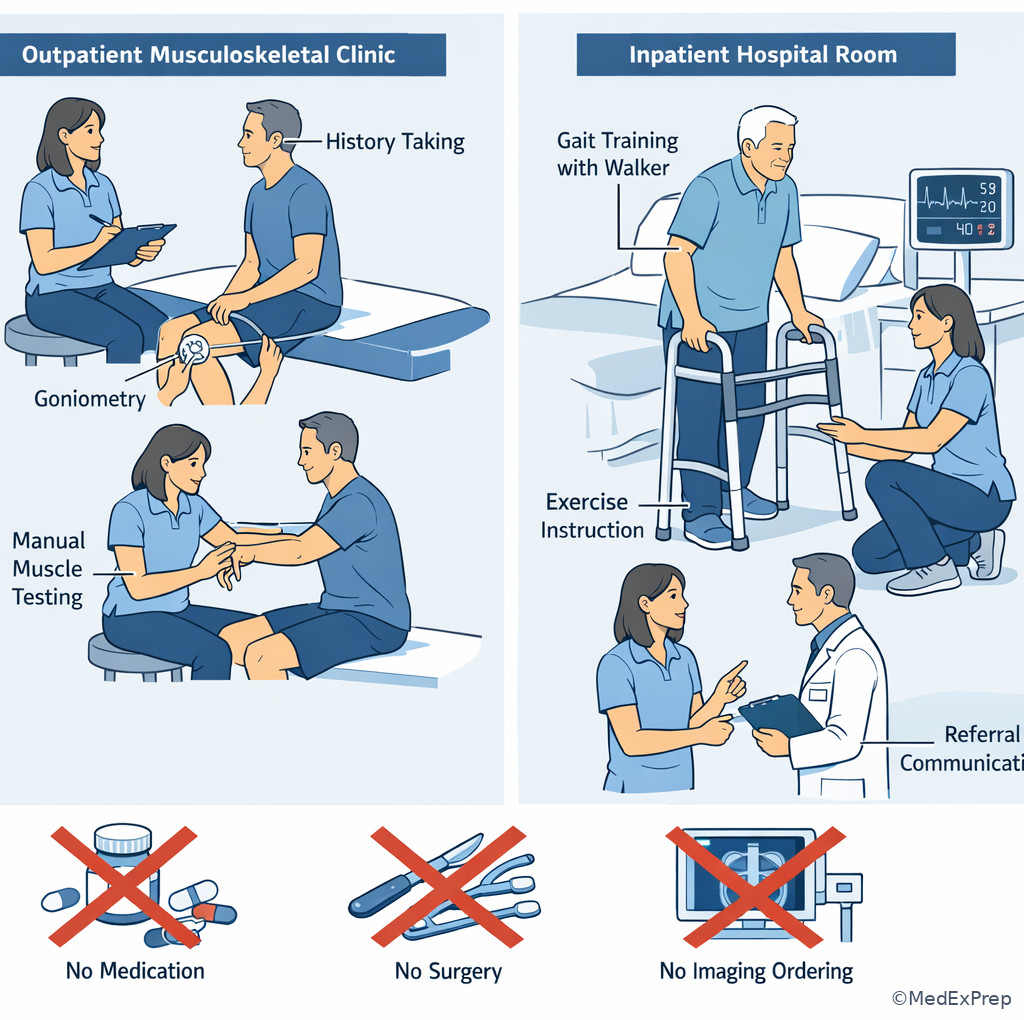
Core content
1.1.1.3 Foundational scope: what you are expected to do
A Explanation
The first decision conflict on this exam is not “What diagnosis is this?” but “What action belongs to an entry-level physiotherapist right now?” Choose assessment, interpretation, intervention, monitoring, education, and documentation when the patient is stable and the task falls within PT practice. Reject medication changes, surgical planning, independent medical clearance, and restricted diagnostic ordering unless explicit local authority is established in the stem. The single rule that resolves most scope questions is this: pick the safest action that advances care within PT role boundaries.
WHY THIS IS TESTED: exam items often place a correct medical action beside a correct physiotherapy action; only one matches the role being tested. For example, in a patient with knee pain after a twist injury, the PT answer is to assess weight bearing, swelling, function, ligament/meniscal signs, precautions, and referral need—not to independently order imaging.
See Fig 1 for the overall boundary logic.
B Worked example
A 46-year-old warehouse worker presents to outpatient PT with 3 weeks of lateral elbow pain after repetitive lifting. He has type 2 diabetes and controlled hypertension. He asks whether you can “give something stronger than ibuprofen” because his family physician appointment is next week. A previous urgent care note mentions “possible tendon irritation.” Grip is painful, cervical screen is negative, and he reports mild numbness in the ring finger after sleeping awkwardly last night.
Reasoning chain: Identify task: role/scope question with MSK noise. Extract key facts: stable outpatient presentation, probable mechanical upper-limb complaint, no urgent neurologic loss, request for medication. Apply rule: PT may assess contributing impairments, educate on load modification, provide exercise/manual care within precautions, and recommend medical follow-up for medication questions. Eliminate distractors: independently prescribing or altering analgesics is out of scope; diagnosing a tendon tear with certainty exceeds the role tested; urgent ED referral is unsupported by the stem. Verify best next step: continue PT assessment and conservative management within scope, advise follow-up with authorized prescriber for medication concerns, and document the discussion.
C Exam trap
D Checkpoint
Question: A stable outpatient asks the physiotherapist whether today’s plan should include walking aid training, exercise progression, and review of a home program after hip arthroplasty. Which action is most appropriate within entry-level PT scope?
- Provide gait training, monitor response, reinforce precautions, and document progress.
- Independently discontinue the anticoagulant because bruising is present.
- Write a new opioid prescription to improve exercise tolerance.
- Clear the patient for unrestricted return to work without considering surgeon or workplace requirements.
- A: Tempting because it is routine and practical; it is correct because it stays within PT assessment/intervention/monitoring scope for postoperative rehab.
- B: Tempting because bruising raises safety concern; it is wrong because medication changes require authorized medical management, though the concern should be communicated.
- C: Tempting because pain limits function; it is wrong because prescribing analgesics is outside conservative PT scope.
- D: Tempting because mobility is improving; it is wrong because unrestricted work clearance may require broader medical and workplace review beyond PT-only judgment.
1.1.1.4 Foundational boundaries: what you must reject or escalate
A Explanation
The second foundational skill is recognizing that not every clinically relevant problem should be handled through routine PT. Choose stop, protect, escalate when the stem introduces signs of serious pathology, acute instability, or risk beyond conservative management. Reject answers that continue routine exercise, manual therapy, or “observe and reassess later” when urgent clues are present. The single rule here is: if the immediate risk of harm outweighs the benefit of continued PT, escalation becomes the best next step.
Examples include new saddle anesthesia, rapidly progressive weakness, suspected DVT, acute shortness of breath at rest, chest pressure with unstable vitals, fever with severe nonmechanical spinal pain, suspected fracture after trauma, or signs of abuse/safeguarding concern. You are not expected to finalize the medical diagnosis; you are expected to recognize that PT should pause and that urgent evaluation is needed.
Exam takeaway: The presence of urgent red flags overrides routine physiotherapy progression.
flowchart LR
A[Findings collected] --> B{Stable and no major red flags?}
B -->|Yes| C[Continue PT exam or treatment]
B -->|Borderline/precaution| D[Modify, monitor, proceed carefully]
B -->|No| E[Stop routine PT]
E --> F[Urgent referral or escalation]
D --> G[Reassess response and safety]
C --> G
See Fig 2. This logic will be expanded in the upcoming topic Red Flags And Escalation.
B Worked example
A 68-year-old man in outpatient rehab is referred for “lumbar mobility exercise.” He has osteoporosis, atrial fibrillation, and recent weight loss that he attributes to stress. During the subjective interview he reports severe night pain, new difficulty starting urination, and numbness around the groin since yesterday. He also mentions chronic knee osteoarthritis, which makes walking slower than usual.
Reasoning chain: Identify task: safest next step in a patient presenting for PT. Extract key facts: age, severe night pain, urinary change, saddle-region sensory complaint, recent unexplained weight loss. The knee OA is noise. Apply rule: possible cauda equina or other serious pathology means routine exercise is not appropriate. Eliminate distractors: lumbar ROM testing, manual therapy, or education alone all delay urgent care; calling this “just chronic back pain” ignores clustered red flags. Verify best next step: stop routine PT and arrange urgent medical evaluation immediately.
C Exam trap
D Checkpoint
Question: A patient arrives for PT after calf pain developed over 2 days following recent surgery and reduced mobility. The calf is warm and swollen compared with the other side. What is the most appropriate next step?
- Begin gentle ankle pumps and ambulation to reduce stiffness before reassessing.
- Stop routine treatment, protect safety, and arrange urgent medical evaluation.
- Apply deep massage to the calf because muscle tightness is the likely driver.
- Proceed with strengthening because the surgeon already referred the patient to PT.
- A: Tempting because early mobility is often beneficial postoperatively; it is wrong because unilateral warmth and swelling raise concern for DVT, which must be escalated first.
- B: Tempting because it may feel conservative; it is correct because suspected vascular red flags override routine rehab progression.
- C: Tempting because the calf is painful and tender; it is wrong because massage is unsafe when DVT is suspected.
- D: Tempting because referral implies rehab is expected; it is wrong because current findings, not the referral source, determine the safest next step.
- The safest response to suspected DVT is to ___ routine treatment and ___.
- True or False: A surgeon’s referral automatically means all PT interventions are safe to perform.
- Name 3 red-flag clusters that should trigger urgent escalation rather than routine PT.
1.1.1.5 Applied scope in examination and clinical impression
A Explanation
Once safety is established, the exam shifts to what you do during PT examination and how you communicate findings. Choose actions that generate useful clinical information within PT scope: subjective history, systems review, observation, ROM, strength, neurologic screen, balance, gait, functional tests, vitals, symptom reproduction/relief patterns, and response to movement. Then form a physiotherapy clinical impression: for example, “findings are consistent with a mechanical shoulder pain pattern with rotator cuff–related impairments affecting overhead reach,” or “presentation suggests reduced exercise tolerance limiting safe ambulation.”
Reject answers that overreach into physician-exclusive certainty when the stem only supports PT-level interpretation. The single finding/rule that resolves this conflict is whether the statement guides PT management from observed function and exam findings, rather than claiming definitive medical authority beyond the data provided. A PT can identify likely patterns, impairments, precautions, prognosis considerations, and referral needs. A PT should avoid claiming final medical diagnosis when that is not required for safe physiotherapy care.
Exam takeaway: Organize findings into body systems, function, safety, and plan-of-care implications rather than physician-style final diagnosis.
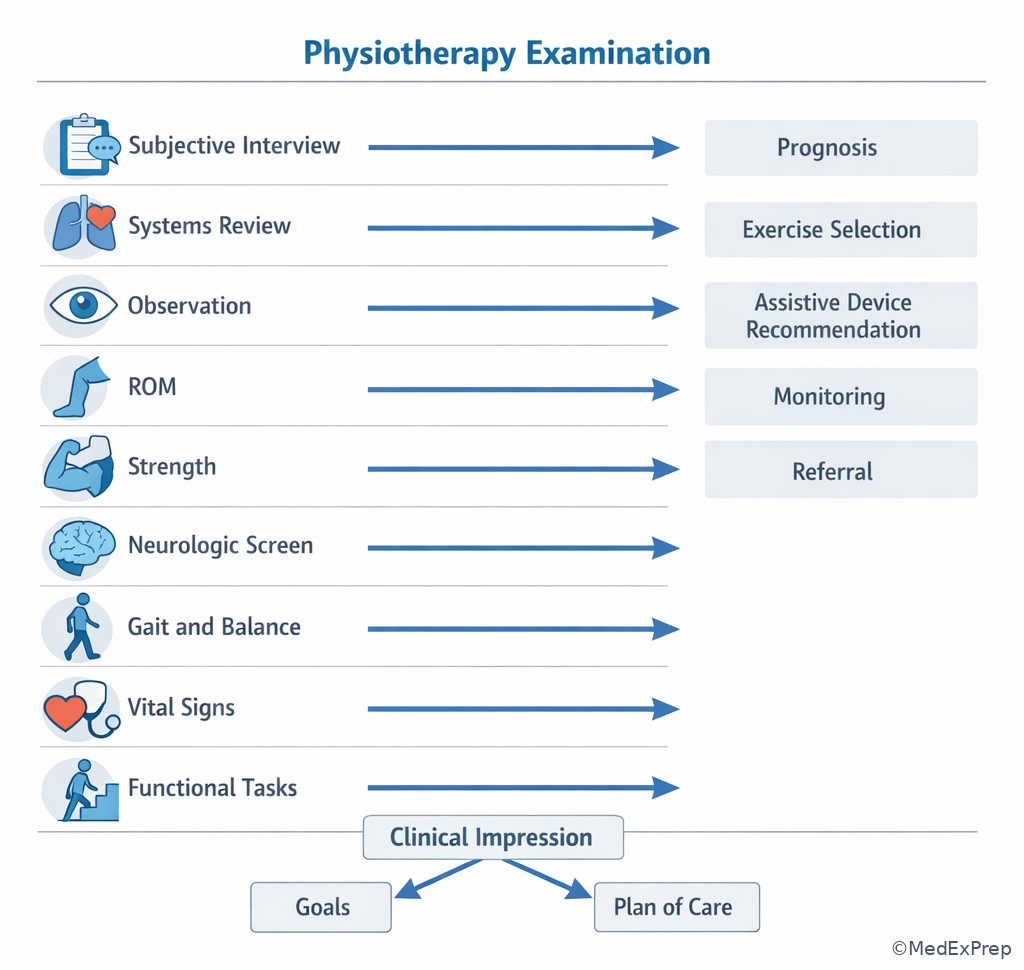
See Fig 3. The exam rewards structured interpretation: findings → pattern → implication → next PT action.
B Worked example
A 59-year-old woman is seen in community rehab 5 weeks after hospitalization for pneumonia. She has obesity, osteoarthritis, and mild peripheral neuropathy. She reports “leg weakness” and fear of falling. SpO2 is stable with walking, but she needs rest after 2 minutes and uses furniture for support at home. She worries she has “permanent nerve damage” because her cousin had neuropathy.
Reasoning chain: Identify task: form an in-scope PT impression and next plan. Extract key facts: post-illness deconditioning, reduced endurance, balance concerns, stable oxygenation, preexisting mild neuropathy as noise. Apply rule: phrase the impression around observed exercise intolerance, reduced functional mobility, balance deficits, and rehab needs rather than declaring a final neurologic diagnosis. Eliminate distractors: “diagnose progressive polyneuropathy” is unsupported; “no PT needed because oxygenation is stable” ignores functional limitation; “order nerve conduction studies” exceeds conservative authority. Verify best next step: document a PT clinical impression of deconditioning with impaired endurance and balance affecting ambulation, then design graded mobility and conditioning within monitoring limits.
C Exam trap
D Checkpoint
Question: Which statement best reflects an in-scope physiotherapy clinical impression?
- “The patient definitely has a full-thickness rotator cuff tear and requires surgery.”
- “Findings suggest a shoulder pain pattern with weakness and painful overhead function; PT will address load tolerance and monitor response while referring if recovery plateaus or red flags emerge.”
- “The patient’s pain is psychosomatic and no further assessment is needed.”
- “The patient requires immediate corticosteroid injection before exercise can begin.”
- A: Tempting because severe weakness can suggest tear; it is wrong because it overstates diagnostic certainty and directs surgical management beyond PT scope.
- B: Tempting because it sounds less decisive; it is correct because it links findings to PT management and includes referral conditions.
- C: Tempting because examination may be nonspecific; it is wrong because it dismisses the patient and exceeds evidence-based interpretation.
- D: Tempting because pain may limit participation; it is wrong because injection decisions are outside conservative PT authority.
1.1.1.6 Applied scope in intervention, monitoring, and modification
A Explanation
After examination, the PT must choose an intervention that is safe, functionally relevant, and adjustable. Choose exercise, mobility training, gait aid instruction, transfer practice, education, pacing, positioning, breathing strategies, and other PT interventions that match the impairments and goals. Reject interventions when contraindications are present, and reject “continue unchanged” if the patient’s response indicates poor tolerance. The single rule that resolves intervention questions is: the best PT intervention is the one you can justify from current findings and safely monitor in real time.
Monitoring matters because scope is not just about what you start; it is also about knowing when to progress, regress, pause, or seek input. If the patient becomes dizzy, markedly short of breath, unusually fatigued, neurologically worse, or pain escalates far beyond expected behavior, you reassess and adjust. Entry-level practice is not passive protocol-following—it is active response monitoring.
Exam takeaway: Interventions remain in scope only when the physiotherapist continuously checks tolerance, safety, and functional effect.
flowchart TD
A[Select PT intervention] --> B[Teach and begin]
B --> C[Monitor symptoms, vitals, movement quality]
C --> D{Expected safe response?}
D -->|Yes| E[Progress or continue]
D -->|Borderline| F[Regress, cue, or shorten dosage]
D -->|No| G[Stop, reassess, consider referral]
E --> H[Document outcome]
F --> H
G --> H
See Fig 4. Monitoring turns a treatment choice into defensible clinical reasoning.
B Worked example
A 74-year-old inpatient recovering from abdominal surgery is referred for mobility progression. She has COPD, chronic kidney disease, and longstanding anxiety. She is eager to “push hard” because she wants discharge home. During sit-to-stand training she becomes pale and reports light-headedness; heart rate rises modestly, but she insists this always happens when she is nervous. Incision pain is mild and oxygen tubing is in place.
Reasoning chain: Identify task: choose scope-appropriate intervention response. Extract key facts: postoperative patient, multiple comorbidities, symptom change during mobility, anxious personality as tempting noise. Apply rule: PT should stop, recheck vitals/symptoms, ensure safety, modify or defer progression, and communicate concerns as needed. Eliminate distractors: continuing because the patient wants to progress is unsafe; changing oxygen or medications independently is out of scope; ignoring symptoms because “it’s just anxiety” is unsupported. Verify best next step: protect safety, reassess, and document response before any further mobility progression.
C Exam trap
D Checkpoint
Question: During gait training, a patient reports sudden marked dizziness and appears unsteady. What is the most appropriate immediate PT action?
- Stop the activity, guard the patient, reassess vitals and symptoms, and modify or escalate based on findings.
- Tell the patient dizziness is expected and continue to improve confidence.
- Administer a medication change to reduce orthostatic symptoms.
- Discharge the patient from PT because symptoms occurred during therapy.
- A: Tempting because it may seem cautious; it is correct because it addresses immediate safety and uses monitoring to guide next steps.
- B: Tempting because reassurance can help anxious patients; it is wrong because dizziness requires objective reassessment before continuation.
- C: Tempting because symptoms may have a hemodynamic basis; it is wrong because medication management is not an independent PT action.
- D: Tempting because symptoms create concern; it is wrong because the next step is reassessment and modification, not automatic discharge.
- Fill in the blank: An intervention remains appropriate only if it is justified by current findings and can be safely ___ in real time.
- True or False: Patient motivation alone is enough reason to continue a poorly tolerated intervention.
- Name 3 PT actions that are appropriate when a patient becomes unexpectedly symptomatic during treatment.
1.1.1.7 Integration: referral, team communication, and documentation within scope
A Explanation
The final integration skill is what you do when PT care intersects with other providers and legal-professional obligations. Choose communication that is timely, specific, and role-appropriate: notify the physician, nurse, emergency services, or safeguarding pathway when indicated; explain findings using objective data; and document what was observed, what action was taken, and why. Reject vague documentation, unsupported certainty, or silent continuation after concerning findings.
The decision conflict is often between “fix it yourself” and “coordinate care safely.” The single rule: when the next best action requires authority, diagnostics, or management beyond PT scope, your role is to communicate, refer, and document clearly enough for safe handoff. This includes medication concerns, postoperative complications, unexpected neurologic decline, unstable vitals, suspected infection, or abuse-related concerns. It also includes routine team coordination, such as informing nursing about mobility status or discharge barriers.
Exam takeaway: Safe physiotherapy practice includes structured escalation and clear interdisciplinary communication when patient needs exceed PT-only management.
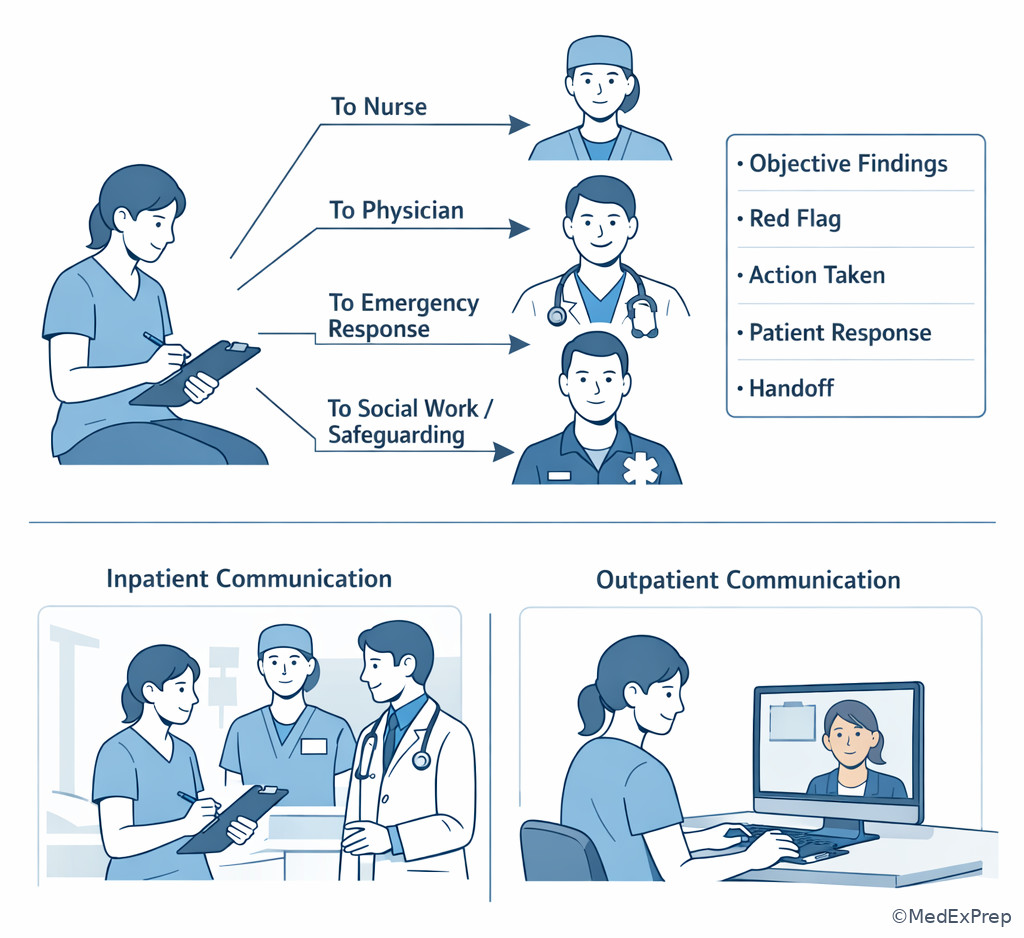
See Fig 5. Communication is part of scope, not an afterthought.
B Worked example
A 33-year-old postpartum patient attends pelvic and low back PT. She has a history of anemia and migraine. During the visit she becomes tearful and quietly reports that her partner “doesn’t like me talking to providers,” controls transportation, and shoved her last week. She asks you not to write anything down because it will “make things worse.” Her back pain is otherwise mechanical and she can move without neurologic deficit.
Reasoning chain: Identify task: professional scope with safety and documentation implications. Extract key facts: disclosure of possible abuse, concern for personal safety, desire for secrecy, no emergent neurologic deficit. Apply rule: PT must prioritize patient safety, follow safeguarding/reporting pathways according to local policy, use trauma-informed communication, and document appropriately within legal/professional obligations. Eliminate distractors: ignoring the disclosure to preserve rapport is unsafe; confronting the partner directly may increase risk; continuing routine exercise as if nothing happened misses the key issue. Verify best next step: respond supportively, assess immediate safety, follow institutional safeguarding procedures, and document per policy.
C Exam trap
D Checkpoint
Question: A patient develops concerning symptoms during treatment that require physician notification. Which documentation element is most important?
- A brief note saying the session was “poor” without specifics.
- Exact findings, timing, action taken, who was notified, and patient status after communication.
- Only the patient’s subjective complaint because objective data may be interpreted later.
- A definitive medical diagnosis to make the referral appear more urgent.
- A: Tempting because short notes save time; it is wrong because vague language does not support clinical reasoning or handoff safety.
- B: Tempting because it takes more effort; it is correct because it documents the full reasoning and communication chain.
- C: Tempting because the patient narrative matters; it is wrong because referral-quality documentation requires objective findings and actions too.
- D: Tempting because certainty can seem persuasive; it is wrong because PT documentation should be accurate, objective, and within scope.
Exam Traps & Differentiators
Exam takeaway: Distinguish in-scope PT actions from medically tempting distractors by asking who should act next and why.
flowchart TB
A[Answer choice] --> B{Can a PT do this safely now?}
B -->|Yes| C{Does it match the stem's urgency?}
C -->|Yes| D[Likely correct]
C -->|No| E[Modify or reject]
B -->|No| F{Does it require another provider?}
F -->|Yes| G[Choose refer/notify/escalate option]
F -->|No| H[Reject as irrelevant]
See Fig 6 when you are stuck between a sophisticated medical option and a role-appropriate PT option.
| Looks similar | Actually in-scope PT response | Confusable wrong answer | Single discriminator |
|---|---|---|---|
| Patient requests pain relief adjustment | Educate, modify activity, communicate with authorized prescriber if needed | Change medication regimen | Medication management is not an independent PT action |
| Suspected serious pathology | Stop treatment and escalate | Complete full PT examination first | Urgency outweighs routine data gathering |
| Need for clearer diagnostic picture | Use PT examination findings and refer appropriately | Independently order restricted imaging | Authority is not assumed unless explicit in stem |
| Return-to-work question | Document function and communicate limits/recommendations | Provide unrestricted medical clearance | Broader clearance may exceed PT-only authority |
| Unexpected symptoms during treatment | Stop, reassess, modify, or escalate | Continue because symptoms are probably benign | Change in safety status must be addressed immediately |
| Possible abuse disclosure | Use safeguarding pathway and document per policy | Ignore to preserve rapport | Safety obligations override passive nondocumentation |
| If the stem says... | Think... |
|---|---|
| “What is the most appropriate next step for the physiotherapist?” | Role first; reject physician-only actions unless specifically authorized |
| “During treatment the patient becomes...” | Monitor response, reassess safety, then modify or escalate |
| “The patient asks for medication advice/change” | Education and referral/communication, not prescribing |
| “There is recent trauma, severe night pain, fever, chest symptoms, unilateral calf swelling, saddle anesthesia...” | Stop routine PT and escalate |
| “Which statement best describes the PT impression/plan?” | Pattern + function + plan implication, not unsupported final diagnosis |
| “Local authority is unclear” | Choose conservative, learner-safe action and acknowledge policy variation |
Exam takeaway: Many wrong answers are attractive because they are clinically reasonable actions performed by the wrong provider or at the wrong time.
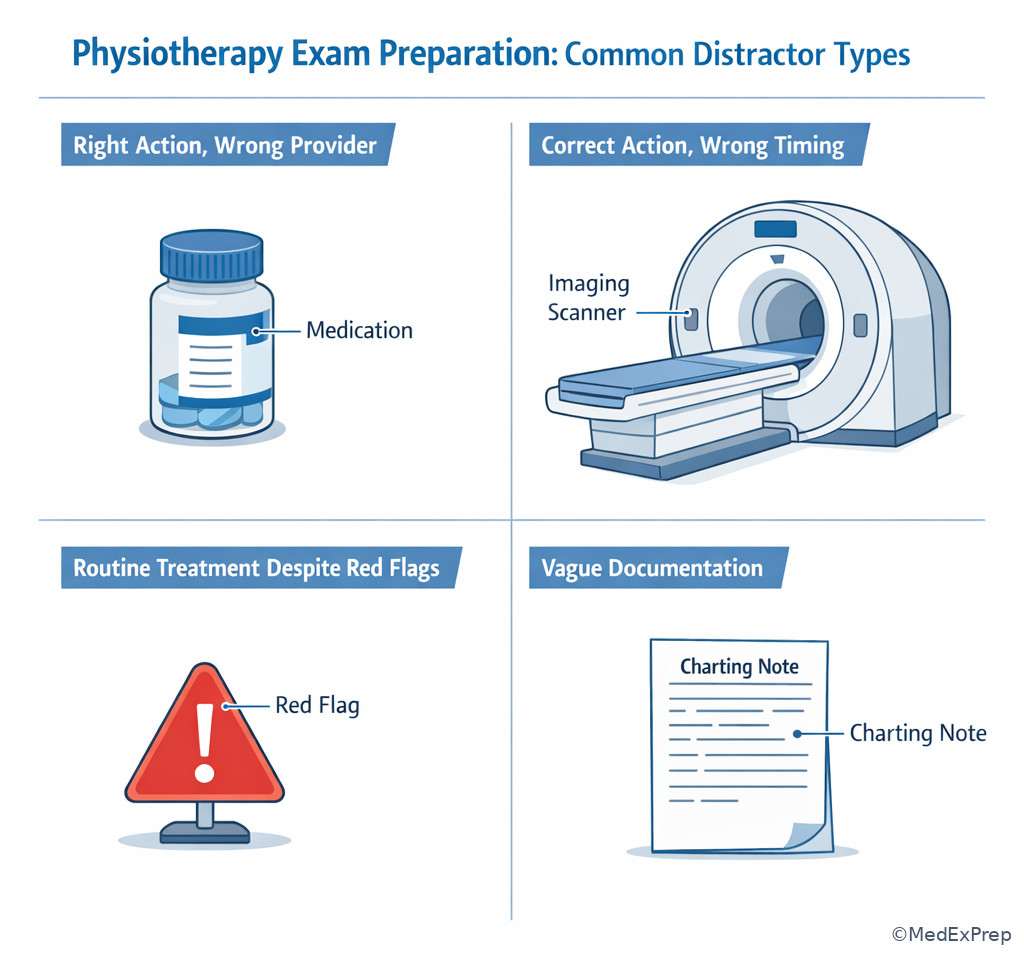
Tables
| High-yield reference | Choose this PT action | Avoid this error |
|---|---|---|
| Stable mechanical complaint | Assess, form PT impression, begin conservative management | Skipping examination and jumping to physician-style diagnosis |
| Medication question | Educate within scope and refer to authorized prescriber | Altering regimen independently |
| Unexpected symptom during treatment | Stop, guard, reassess, modify or escalate | Assuming it is benign without objective reassessment |
| Possible urgent pathology | Stop routine PT and arrange urgent evaluation | Continuing manual therapy or exercise |
| Functional discharge question | Document performance, risks, supports, and recommendations | Giving unrestricted clearance beyond role/policy |
| Interprofessional concern | Communicate findings promptly and document handoff | Leaving a vague note with no action trail |
| Comparison | In-scope PT wording | Out-of-scope or overreaching wording |
|---|---|---|
| Interpretation | “Findings suggest a mechanical low back pain pattern limiting lifting.” | “The patient definitively has disc herniation requiring surgery.” |
| Pain concern | “Pain limits participation; I will modify dosage and communicate concerns.” | “I will prescribe stronger analgesics.” |
| Imaging concern | “Findings warrant medical review; I will refer/communicate.” | “I will order MRI independently.” |
| Acute symptom change | “I will stop treatment, reassess, and escalate if indicated.” | “I will continue because symptoms are probably anxiety.” |
| Return to activity | “I will report current functional capacity and precautions.” | “I will provide unrestricted medical clearance.” |
| Differential/classification | Routine PT management likely appropriate | PT modification/monitoring needed | Immediate referral/escalation needed |
|---|---|---|---|
| Mechanical pain, stable vitals, reproducible symptoms | Yes | Maybe if irritability is high | No |
| Post-op fatigue but stable response to mobility | Often yes | Yes, dose and monitor carefully | No unless deterioration occurs |
| Dizziness during treatment with instability | No | Yes initially, then decide | If concerning findings persist or worsen |
| Unilateral warm swollen calf after surgery | No | No | Yes |
| Saddle anesthesia and urinary change | No | No | Yes |
| Medication refill request | No direct prescribing | Can continue PT if safe | Refer/communicate for medication management |
Exam takeaway: Good notes connect findings, clinical impression, intervention, response, and referral actions in one traceable chain.
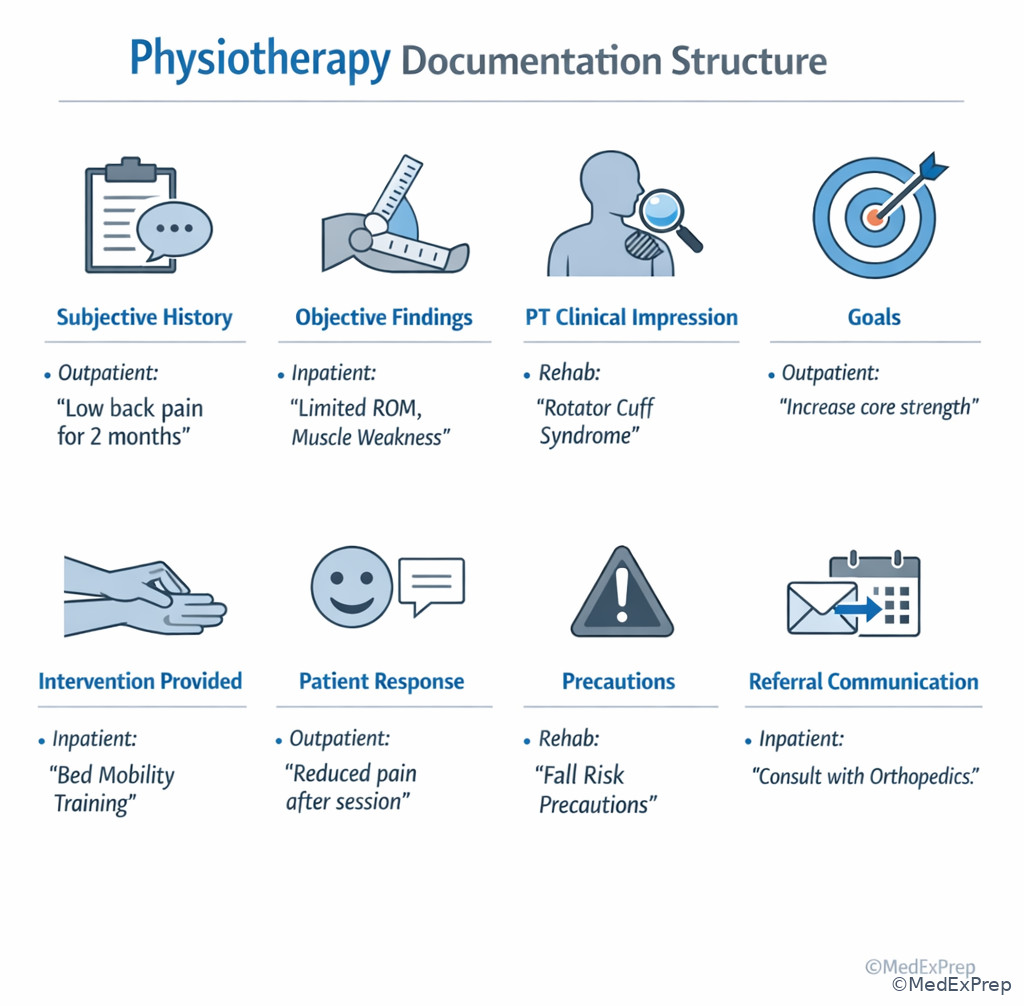
Algorithm / Approach
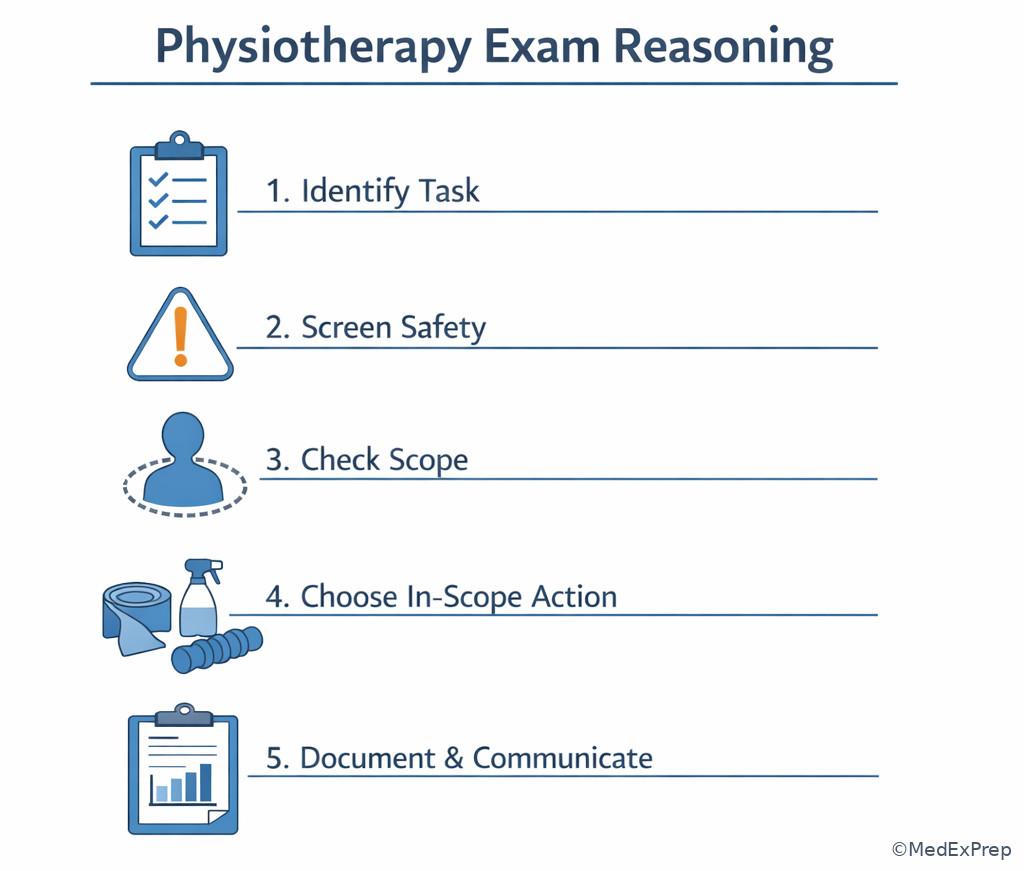
Exam takeaway: A repeatable scope-first checklist helps eliminate advanced but incorrect answer choices.
Rapid Review
- Scope question → safest PT next step beats more definitive out-of-role action
- Medication request → educate and communicate; do not prescribe or adjust independently
- Red-flag cluster → stop routine treatment before more detailed PT testing
- Clinical impression → pattern + function + plan implication, not unsupported final diagnosis
- Intervention selection → must be justified by findings and monitorable in real time
- Unexpected symptom during treatment → reassess first, interpret second
- Referral logic → triggered by urgency, authority limits, or serious pathology suspicion
- Documentation → exact findings, timing, action taken, and communication trail
- Surgeon/physician referral present → does not cancel the PT duty to re-screen safety
- Patient preference → matters, but does not override safety obligations
- Work/sport return question → report function and precautions, not broad unrestricted clearance unless clearly authorized
- Borderline tolerance → modify dosage before abandoning PT altogether
- Abuse or safeguarding concern → patient safety and policy-based escalation outrank passive silence
- Best exam habit → identify task → screen safety → check scope → choose action → document
Self-check quiz
1.1.1.8 Question 1
A patient in outpatient PT asks the physiotherapist to increase the dose of a prescription pain medication because exercise is uncomfortable. Which is the most appropriate response?
- Adjust the medication dose today and document the change.
- Explain that medication changes require an authorized prescriber, continue PT within tolerance, and communicate concerns if needed.
- Stop all physiotherapy until medication is changed.
- Recommend the patient double the next dose before the home exercise program.
1.1.1.9 Question 2
A physiotherapist is writing an initial assessment note. Which statement best reflects an in-scope clinical impression?
- “Definitive lumbar disc herniation requiring immediate surgery.”
- “Mechanical low back pain pattern with movement-related limitation affecting bending and transfers; begin graded mobility and monitor for neurologic change.”
- “Chronic pain behavior with no need for objective testing.”
- “Immediate opioid management is necessary before PT can proceed.”
1.1.1.10 Question 3
A 71-year-old inpatient 2 days after abdominal surgery is seen for mobility training. She has COPD and hypertension. During standing, she becomes pale, reports dizziness, and grips the walker tightly. Her incision pain is mild, and she insists she just wants to walk farther because she hopes to go home tomorrow. What is the most appropriate next step?
- Continue ambulation because discharge motivation predicts good outcome.
- Stop the activity, guard the patient, reassess vitals and symptoms, and modify or escalate based on findings.
- Increase oxygen flow independently to allow continuation of gait training.
- Discontinue PT permanently because the patient did not tolerate one attempt.
1.1.1.11 Question 4
A 52-year-old office worker presents to outpatient PT with 4 weeks of shoulder pain. He has hyperlipidemia and controlled diabetes. The referral says “evaluate and treat.” He asks whether you can order an MRI because overhead reaching is painful and he is worried about a tear. Strength is mildly painful but largely preserved; no trauma or red flags are reported. Which is the most appropriate next step?
- Independently order MRI to confirm the diagnosis before any exercise begins.
- Perform PT examination, form a movement-based clinical impression, begin appropriate management, and refer if findings later warrant medical review.
- Assure the patient he definitely has bursitis and will not need further evaluation.
- Advise complete immobilization until a surgeon evaluates him.
1.1.1.12 Question 5
A 66-year-old woman is referred to outpatient PT for low back pain. She has osteoporosis and recent appetite loss. During history taking, she reports severe night pain, increasing unsteadiness, and new urinary difficulty since yesterday. She also mentions long-standing knee OA. What is the most appropriate next step?
- Proceed with lumbar ROM and repeated movement testing to classify the pain pattern.
- Begin gentle manual therapy because osteoarthritis often limits mobility.
- Stop routine PT and arrange urgent medical evaluation.
- Provide a home exercise program and review again next week.
1.1.1.13 Question 6
A 63-year-old man 8 days after total knee arthroplasty presents for home-care PT. He has obesity, atrial fibrillation, and controlled heart failure. He reports calf tightness since yesterday. On exam, one calf is more swollen and warm than the other. Knee flexion is limited, and he says he skipped exercises because of pain. Which is the most appropriate next step?
- Use deep calf massage and ankle mobility to improve postoperative stiffness.
- Stop routine treatment and seek urgent medical evaluation for possible DVT.
- Progress gait distance because limited knee flexion is the primary problem.
- Call the pharmacy to request an anticoagulant adjustment.
1.1.1.14 Question 7
A 28-year-old patient in pelvic health PT reports low back pain after lifting her infant. She has a history of anxiety and migraines. Near the end of the visit she states that her partner shoved her last week and controls when she can leave the house. She asks the physiotherapist not to tell anyone because “it will just create trouble.” She denies loss of consciousness and has no focal neurologic deficits. What is the most appropriate next step?
- Respect the request fully, avoid documentation, and continue exercise to preserve rapport.
- Calmly assess immediate safety, follow local safeguarding/reporting procedures, and document according to policy.
- Personally confront the partner by phone during the session.
- Discharge the patient from PT because the issue is not musculoskeletal.
1.1.1.15 Question 8
A 57-year-old man attends outpatient PT 3 weeks after hospitalization for pneumonia. He has type 2 diabetes and mild chronic low back pain. During a 2-minute walk test, oxygenation remains stable, but he becomes markedly fatigued and uses furniture for support afterward. He asks whether this means he has “permanent nerve damage” and wants a definitive diagnosis. Which PT response is most appropriate?
- Diagnose progressive neuropathy and recommend nerve conduction studies immediately.
- Document a PT clinical impression of reduced endurance and impaired balance affecting function, begin graded conditioning and mobility work, and refer if the pattern becomes inconsistent with expected recovery.
- Tell him no physiotherapy is needed because oxygenation did not drop.
- Prescribe medication for exertional fatigue to improve rehab tolerance.
Answer key
1.1.1.16 Question 1: B
A: Tempting because pain control affects participation, but it is incorrect because independent medication adjustment is outside conservative entry-level PT scope. Single clue: the action requested is a prescription change. Source support: PT practice standards emphasize assessment, education, intervention, and referral/communication rather than prescribing authority.
B: Tempting because it may seem less decisive than changing medication, but it is correct because it keeps care within PT scope: educate, continue safe treatment, and communicate concerns to an authorized prescriber. Single clue: the patient is otherwise stable and the problem is a medication request, not an emergency.
C: Tempting because pain matters, but it is incorrect because PT can often continue with modification while medication concerns are addressed separately. Single clue: no red flag requires stopping all PT.
D: Tempting because home exercise adherence may improve if pain is reduced, but it is incorrect because recommending an unsanctioned dose change is still medication management beyond PT role. Single clue: “double the dose” remains a prescribing-type instruction.
Rationale: The correct answer is the one that preserves function and therapeutic progress without crossing scope boundaries. Entry-level PTs may educate about symptom pacing and communicate concerns to the medical team, but not prescribe or alter medication regimens independently. Authoritative professional standards and entry-to-practice frameworks consistently place medication prescribing outside routine PT scope unless specific jurisdictional authority exists, which is not provided here.
1.1.1.17 Question 2: B
A: Tempting because disc pathology is a common back pain concern, but it is incorrect because it claims definitive medical diagnosis and surgical direction unsupported by the PT role. Single clue: the question asks for an in-scope clinical impression.
B: Tempting because it sounds less dramatic, but it is correct because it states a movement-related pattern, functional effect, and monitoring plan that directly guide PT management. Single clue: it links findings to PT action without overreaching.
C: Tempting when pain appears persistent or behaviorally influenced, but it is incorrect because it dismisses the need for objective examination and overinterprets the presentation. Single clue: “no need for objective testing” conflicts with PT assessment responsibilities.
D: Tempting because pain may limit participation, but it is incorrect because medication necessity and opioid management are not PT decisions. Single clue: the answer centers on prescribing rather than PT management.
Rationale: An in-scope PT impression identifies a clinically meaningful pattern, ties it to activity limitation, and supports a plan of care. It avoids physician-exclusive certainty or medication management. This aligns with rehabilitation documentation principles and physiotherapy competency expectations centered on examination, clinical impression, prognosis, and intervention planning.
1.1.1.18 Question 3: B
A: Tempting because patient motivation and discharge goals are clinically important, but it is incorrect because safety changes during treatment override motivational factors. Single clue: new pallor and dizziness during standing.
B: Tempting because it may feel conservative, but it is correct because unexpected symptoms during treatment require immediate guarding, reassessment, and dose modification or escalation. Single clue: symptom change occurred during mobility, making safety reassessment the next PT duty.
C: Tempting because COPD and inpatient mobility often involve oxygen considerations, but it is incorrect because independent oxygen prescription/adjustment may exceed role and the problem requires assessment first. Single clue: the stem does not direct a known oxygen protocol issue; it describes a symptomatic event needing reassessment.
D: Tempting because intolerance may suggest poor readiness, but it is incorrect because one symptomatic episode calls for reassessment and modification, not permanent discharge from PT. Single clue: the question asks for the next step, not the final disposition.
Rationale: The physiotherapist’s immediate responsibility is to protect the patient, stop the provoking activity, and reassess symptoms and objective status. This is a classic scope-and-monitoring question: the best answer is not the most aggressive nor the most final, but the safest in-scope response. Acute care and mobility standards support close monitoring and modification when symptoms emerge during treatment.
1.1.1.19 Question 4: B
A: Tempting because imaging seems like the fastest route to clarity, but it is incorrect because independent MRI ordering is not assumed within conservative PT authority and is not the best first step in a stable mechanical presentation. Single clue: no trauma or red flags, and the stem asks what the PT should do now.
B: Tempting because it appears less definitive, but it is correct because PT examination and movement-based interpretation are appropriate first-line actions in a stable shoulder complaint. Single clue: preserved strength, no trauma, and no red flags support PT management first.
C: Tempting because bursitis is a common lay label for shoulder pain, but it is incorrect because it overstates certainty and may prematurely close differential thinking. Single clue: the current data support a PT clinical impression, not definitive pathology labeling.
D: Tempting because rest can reduce symptoms, but it is incorrect because complete immobilization is usually excessive in a stable outpatient pattern without alarming findings. Single clue: this is a treatable functional shoulder complaint, not a clear surgical emergency.
Rationale: Stable musculoskeletal complaints are often best managed with PT assessment, load analysis, symptom behavior evaluation, and targeted intervention. The presence of a physician referral does not remove the PT’s responsibility to examine, interpret, and decide whether PT management is appropriate. Practice standards support PT-led examination and referral when findings later suggest a need for further medical workup.
1.1.1.20 Question 5: C
A: Tempting because classification and repeated movement testing are standard PT tools for back pain, but it is incorrect because alarming associated symptoms shift priority to urgent referral. Single clue: urinary difficulty plus severe night pain and systemic concern.
B: Tempting because stiffness may coexist with pain, but it is incorrect because manual therapy is inappropriate before serious pathology is ruled out. Single clue: osteoporosis, appetite loss, and new concerning symptoms elevate risk.
C: Tempting because it interrupts the normal PT workflow, but it is correct because clustered red flags require stopping routine PT and arranging urgent medical evaluation. Single clue: new urinary change with severe night pain is not a routine mechanical pattern.
D: Tempting because home exercise is a common conservative first step, but it is incorrect because delaying evaluation in the presence of red flags is unsafe. Single clue: next-week follow-up is too slow for this presentation.
Rationale: This is a safety-first question. The PT is not expected to make the definitive medical diagnosis; the PT is expected to recognize that the pattern is potentially serious and urgent. Entry-level practice standards emphasize protection of patient safety, immediate change of plan, and prompt referral/escalation when red-flag clusters emerge.
1.1.1.21 Question 6: B
A: Tempting because postoperative calves are commonly tight and ankle mobility is often appropriate, but it is incorrect because warmth and unilateral swelling after surgery raise possible DVT concern, making massage unsafe. Single clue: warm, swollen unilateral calf after recent surgery.
B: Tempting because it may seem to delay rehab, but it is correct because suspected DVT requires stopping routine treatment and obtaining urgent medical evaluation. Single clue: postoperative vascular red-flag pattern.
C: Tempting because knee ROM limitations are common after arthroplasty, but it is incorrect because the calf findings change the safety profile and take priority. Single clue: calf asymmetry overrides expected ROM deficit.
D: Tempting because the patient is already on anticoagulation-related management after surgery, but it is incorrect because the PT does not independently request medication changes as the next step; urgent medical evaluation is the priority. Single clue: immediate safety concern comes before medication adjustment decisions.
Rationale: Hard questions often hinge on a single detail that changes the answer from routine PT progression to escalation. Here, knee stiffness is expected postoperative noise, but unilateral warm swelling is not. Vascular red flags supersede rehabilitation goals, and the PT’s correct role is to stop treatment and initiate urgent referral communication.
1.1.1.22 Question 7: B
A: Tempting because respecting patient autonomy and rapport matters, but it is incorrect because disclosures of possible abuse trigger safety and professional obligations beyond silent continuation. Single clue: report of being shoved and controlled by partner.
B: Tempting because it requires stepping outside pure musculoskeletal management, but it is correct because the PT must assess immediate safety, follow safeguarding procedures, and document according to policy. Single clue: the safety concern changes the visit’s priority.
C: Tempting because immediate action feels protective, but it is incorrect because personally confronting the partner may increase risk and bypass established safeguarding pathways. Single clue: professional response requires structured, policy-based action.
D: Tempting because the issue extends beyond MSK care, but it is incorrect because PT still has a duty to respond safely rather than simply discharge the patient. Single clue: referral and safeguarding are part of safe professional practice.
Rationale: Scope includes not only treatment but also safety recognition, appropriate team communication, and documentation. Abuse-related concerns are not “outside the PT role” in the sense of being ignorable; they are outside routine MSK management and therefore require safeguarding action. Professional standards support trauma-informed communication, patient safety assessment, and adherence to reporting procedures.
1.1.1.23 Question 8: B
A: Tempting because the patient mentions nerve damage and has diabetes, but it is incorrect because the current data more strongly support deconditioning and balance impairment after illness than definitive progressive neuropathy. Single clue: stable oxygenation with exertional fatigue and furniture support after recent pneumonia.
B: Tempting because it does not provide a dramatic diagnosis, but it is correct because it frames findings as a PT clinical impression tied to function, treatment, and future referral criteria. Single clue: the question asks for the most appropriate PT response to current findings.
C: Tempting because oxygenation is stable, but it is incorrect because functional endurance and balance impairment still justify PT management. Single clue: marked fatigue and support seeking after the walk test.
D: Tempting because fatigue limits participation, but it is incorrect because medication prescribing is outside PT scope. Single clue: the answer depends on pharmacologic management rather than PT planning.
Rationale: This integration question tests whether you can resist premature medical labeling and instead provide a functional, scope-appropriate PT interpretation. The correct answer links impairments to function, guides intervention, and leaves room for referral if recovery is atypical. That is the hallmark of an entry-level PT response under licensure exam logic.
Keep going with the full NBCE Physiotherapy Prep Course (NBCE PT)
You just studied the way members do, in the same lesson interface. Full access unlocks every lesson, the question bank and flashcards for a full year.
One payment · 1 year of access · No auto-renewal