1.1.1 - Chief Complaint Frameworks
Why it matters
- The chief complaint is the first filter for every board-style case: if you frame it wrong, every later decision becomes easier to miss.
- NBCE stems often hide the key diagnosis in the complaint’s time course, location, or associated symptom, not in the final sentence.
- In chiropractic practice, the safest answer is often determined before the physical exam: some complaints support routine care, while others demand imaging, medical evaluation, or urgent referral.
- A structured complaint framework prevents “buzzword matching” and rewards disciplined reasoning: identify task → extract key facts → apply rule → eliminate distractors → verify.
Key Terms & Must-Know Facts
1.1.1.1 Key terms
- Chief complaint (CC): the patient’s main reason for seeking care, ideally in the patient’s own words.
- Problem representation: a compact summary combining age, tempo, location, and key associated features.
- Onset: when and how the symptom began.
- Provocation/palliation: factors that worsen or relieve the complaint.
- Quality: symptom character such as dull, sharp, burning, throbbing, deep, or pressure-like.
- Region/radiation: primary location and spread of symptoms.
- Severity: intensity and functional impact, not just a pain number.
- Temporal pattern: constant, intermittent, morning-predominant, night pain, acute, subacute, chronic, progressive.
- Associated symptoms: fever, numbness, weakness, dizziness, bowel/bladder change, weight loss, nausea, dyspnea, and others that reframe the complaint.
- Mechanism: trauma, overuse, spontaneous onset, positional stress, infection risk, vascular trigger, or systemic process.
- Red flag: a complaint feature suggesting serious pathology or contraindication to routine manipulation.
- Differential diagnosis: the prioritized list of plausible causes based on available data.
- Scope-safe action: chiropractic assessment/management that remains appropriate to the candidate role and patient safety needs.
1.1.1.2 Must-know facts
- A complaint framework is not a script; it is a sorting tool.
- The most testable first-pass variables are location, onset, quality, radiation, modifiers, and associated symptoms.
- The single complaint feature that most often changes the answer is an associated red-flag symptom.
- Night pain, unexplained weight loss, fever, significant trauma, progressive neurologic deficit, and bowel/bladder dysfunction should change the management pathway immediately.
- A pain score alone rarely determines the correct answer; pattern and context do.
- “Sharp with movement” tends to support a mechanical source; “constant, deep, unrelenting, or nonmechanical” should raise caution.
- “Radiation” is not synonymous with radiculopathy; distribution matters.
- Board questions often include a tempting musculoskeletal clue plus one nonmusculoskeletal feature that overrides it.
- The safest chiropractic answer is to avoid manipulation when the chief complaint suggests fracture, infection, malignancy, vascular emergency, or significant neurologic compromise.
Exam takeaway: Use a structured complaint map to decide whether the patient fits routine musculoskeletal care or immediate escalation.
flowchart TD
A[Chief complaint stated] --> B[Localize symptom]
B --> C[Define onset and tempo]
C --> D[Characterize modifiers and quality]
D --> E[Check associated symptoms]
E --> F{Red flag or nonmechanical pattern?}
F -->|Yes| G[Refer or urgent evaluation]
F -->|No| H[Proceed with focused MSK assessment]
See Fig 1 for the simplest high-yield framing sequence. This is the starting structure for nearly every board-style stem in this chapter.
Exam takeaway: The quickest discriminator is whether the complaint changes predictably with movement, position, or load.
flowchart LR
A[Chief complaint] --> B{Pattern}
B -->|Worse with motion or load| C[Mechanical more likely]
B -->|Constant or progressive at rest| D[Nonmechanical concern]
C --> E[Assess function and regional findings]
D --> F[Screen red flags and systemic clues]
F --> G[Consider referral before manipulation]
See Fig 2 when a stem tries to distract you with tenderness or limited motion even though the true clue is a nonmechanical pattern.
Exam takeaway: Accurate symptom localization prevents premature labeling of all spreading pain as radicular.
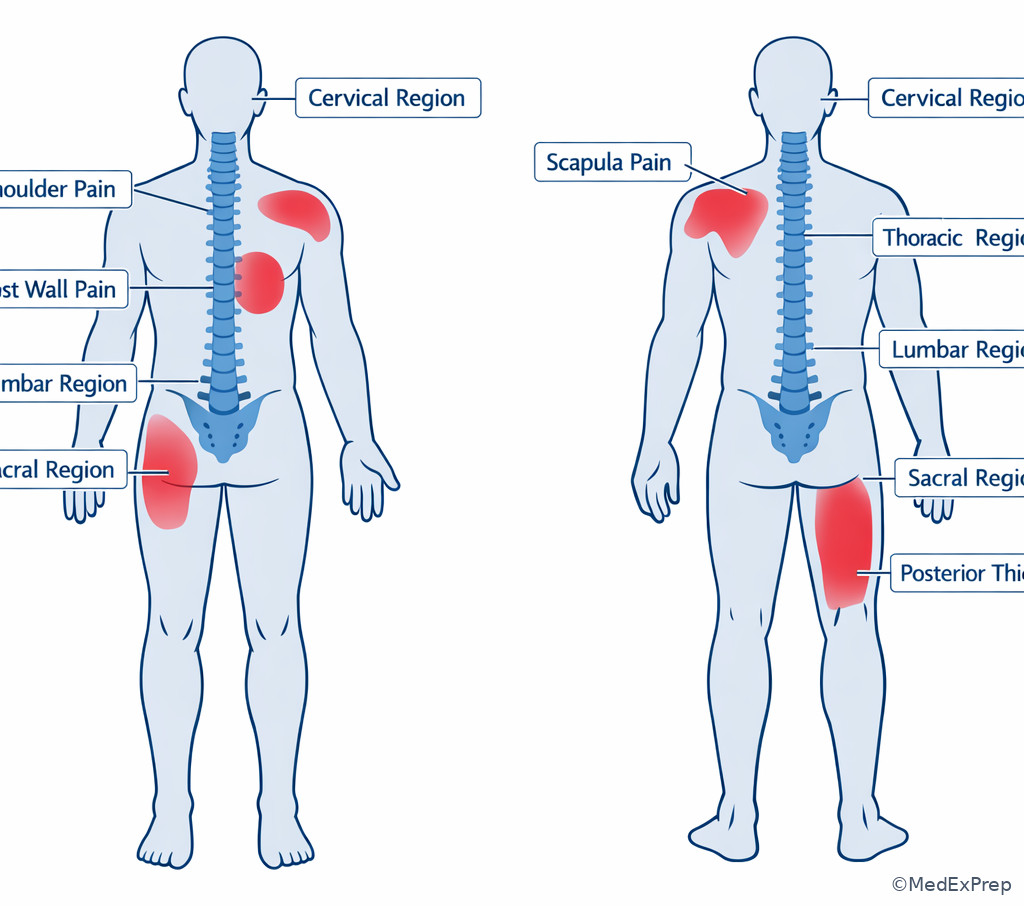
Exam takeaway: On exam stems, one associated symptom such as fever, weakness, or bowel change can outweigh several mechanical clues.
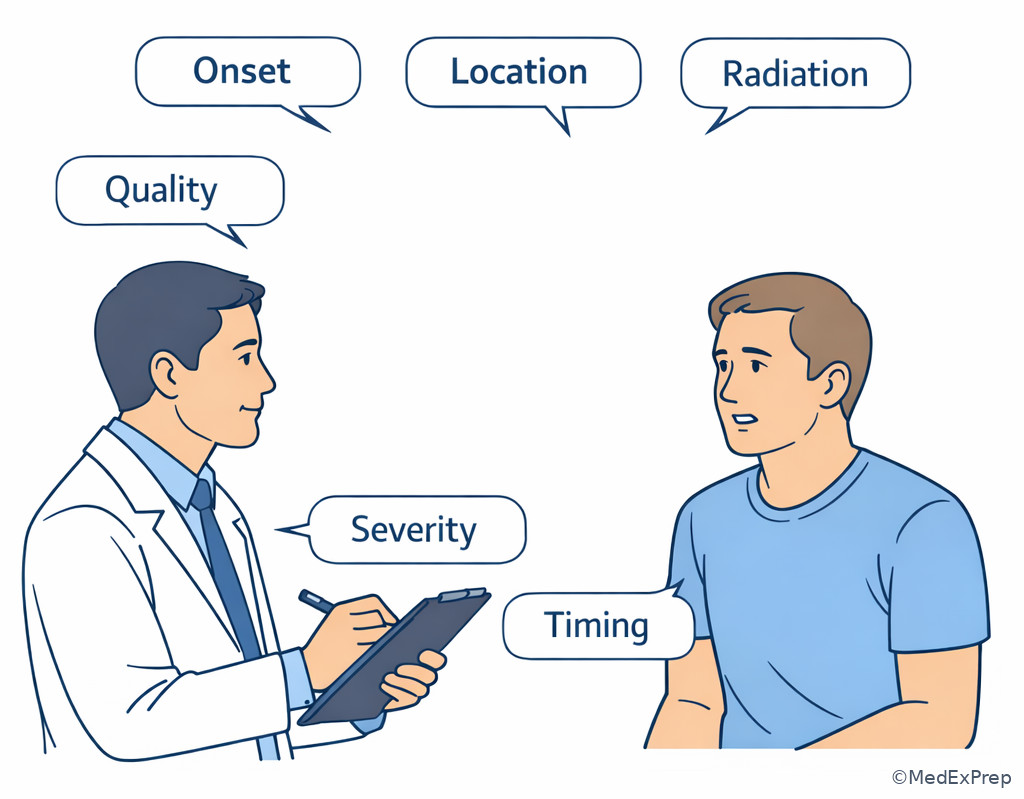
See Fig 3 for the complaint elements that most often determine the best answer before any test is performed.
Core content
1.1.1.3 Foundational complaint structure: turn words into a usable problem representation
A Explanation
The decision conflict is simple: Do you treat the complaint as an undifferentiated symptom list, or do you compress it into a board-usable pattern? The single rule that resolves this is: always convert the patient’s wording into a structured problem representation before choosing a diagnosis or plan. A workable representation includes age, primary symptom, region, tempo, major modifier, and one key associated feature. Example: “54-year-old with acute low back pain after lifting, worse with flexion, no systemic symptoms” is more useful than “back pain for 2 days.”
WHY THIS IS TESTED: NBCE-style questions often bury the answer in organization, not obscurity. Students miss stems because they memorize diagnoses rather than sorting complaints. A structured complaint framework prevents overcalling benign mechanical pain and undercalling dangerous nonmechanical patterns.
Choose a location-first approach when the complaint is diffuse or vague. Choose a time-course-first approach when the complaint changes rapidly, progresses, or has a triggering event. Reject premature diagnostic labels when the patient’s own language has not yet been translated into mechanism, pattern, and risk. For chiropractic decision-making, the complaint framework is your first safety screen: if the complaint is poorly localized but includes constitutional or neurologic features, routine manipulation should not be your reflex answer.
Key rule: A chief complaint becomes clinically useful only after you define where, when, how it behaves, and what travels with it.
Memory anchor: Think LOQSMAT — Location, Onset, Quality, Spread, Modifiers, Associated symptoms, Tempo. If you can fill those seven boxes, you can usually narrow the stem correctly.
B Worked example
A 46-year-old warehouse worker presents with “back pain.” He has type 2 diabetes and obesity. He reports it began 3 days ago after lifting boxes, is sharp in the right low back, worse when bending forward, and eases with lying still. He mentions one episode of urinary urgency this morning after drinking extra coffee. He denies fever, saddle anesthesia, leg weakness, or weight loss. Board-style task: determine the most appropriate next step in complaint framing.
Reasoning chain: Identify task → this is not yet a diagnosis question; it is a complaint-organization question. Extract key facts → acute onset after lifting, localized low back pain, mechanical aggravation, relief with rest, no major neurologic/systemic red flags, distracting urinary clue likely nonspecific. Apply rule → build a problem representation consistent with uncomplicated mechanical low back pain pending exam. Eliminate distractors → reject cauda equina because there is no retention, saddle anesthesia, or progressive deficit; reject infection because no fever or systemic illness despite diabetes risk. Verify → the safest and best-supported first pass is focused musculoskeletal assessment, not immediate urgent escalation.
C Exam trap
Common wrong answer: Labeling the complaint as “possible cauda equina syndrome” based on the urinary detail alone.
Why it is tempting: Students are trained to fear bowel/bladder clues and may react to any urinary symptom without context.
Single clue that eliminates it: The stem gives urgency after extra coffee, not urinary retention, overflow, saddle anesthesia, or progressive bilateral neurologic loss.
D Checkpoint
Question: A 39-year-old patient reports “neck pain.” Which additional detail most improves the chief complaint framework before choosing a diagnosis?
- A. Whether the patient prefers a specific chiropractic technique
- B. The exact location, onset, radiation, and associated neurologic symptoms
- C. Whether a family member has had similar pain
- D. Whether prior massage gave temporary relief
Correct answer: B
- A: Tempting because treatment preferences matter later, but wrong because they do not establish complaint pattern or safety.
- B: Tempting because it feels like more work, and right because these variables determine mechanism, differential, and red-flag screening.
- C: Tempting because family history matters in some diseases, but wrong because it is not the highest-yield first-pass discriminator for undifferentiated neck pain.
- D: Tempting because response to prior care can inform management, but wrong because it is secondary to structure, onset, and associated findings.
1.1.1.4 Foundational sorting: mechanical, neurologic, visceral, or systemic?
A Explanation
The decision conflict here is: Is this complaint primarily mechanical musculoskeletal pain, or is it better explained by neurologic, visceral, or systemic disease? The single finding that often resolves this is whether the complaint behaves predictably with position, motion, and load. Mechanical complaints usually worsen with specific movement or prolonged posture and improve with rest or unloading. Nonmechanical complaints are more likely constant, unrelated to movement, progressive, or accompanied by systemic features.
WHY THIS IS TESTED: NBCE questions frequently pair a classic musculoskeletal clue with one incompatible feature. You must choose the governing pattern, not the most familiar symptom. A patient can have reproducible tenderness and still require referral if the complaint is deep, constant, febrile, or associated with visceral symptoms.
Choose a mechanical frame when the complaint is load-sensitive, movement-dependent, regionally reproducible, and unsupported by systemic warning signs. Choose a neurologic frame when sensory, motor, reflex, or dermatomal features dominate. Choose a visceral/systemic frame when the complaint is poorly localized, unrelated to movement, associated with constitutional symptoms, or accompanied by chest, abdominal, urinary, vascular, or constitutional clues. Reject the assumption that all spine-region pain comes from the spine.
Common pitfall: Reproducible pain with palpation does not rule out a nonmusculoskeletal condition; it only shows a tender area is present.
Recall: In the upcoming topic Pain Patterns & Radiation, we build on this by separating somatic, radicular, referred, and visceral spread patterns. Here, the first task is broader: decide whether the complaint even belongs in a routine musculoskeletal lane.
B Worked example
A 61-year-old woman presents with mid-thoracic pain for 6 weeks. She has osteoporosis and a remote history of treated breast cancer. She says the pain is worse at night and not clearly changed by movement. She also notes mild fatigue but says stretching briefly “loosens it up,” which is the tempting clue. She denies trauma. Board-style task: determine the best first complaint classification.
Reasoning chain: Identify task → classify the complaint pattern before selecting management. Extract key facts → older age, thoracic pain, night pain, nonmechanical behavior, fatigue, cancer history, osteoporosis. Apply rule → this is not routine mechanical spine pain until proven otherwise; serious pathology must be considered. Eliminate distractors → reject “postural strain” despite temporary relief with stretching; reject uncomplicated facet irritation because night pain and cancer history dominate. Verify → the complaint fits a nonmechanical/systemic red-flag frame requiring medical evaluation and likely imaging referral rather than routine manipulation.
C Exam trap
Common wrong answer: Treating the thoracic complaint as postural dysfunction because the patient reports temporary improvement with stretching.
Why it is tempting: Students often overvalue a modifier that fits a common benign diagnosis.
Single clue that eliminates it: Night pain not clearly altered by movement is a stronger discriminator than temporary symptom fluctuation after stretching.
D Checkpoint
Question: Which complaint pattern most strongly supports a mechanical musculoskeletal source as the first working frame?
- A. Constant thoracic ache with fatigue and unintentional weight loss
- B. Low back pain that worsens with lifting and improves with lying supine
- C. Cervical discomfort with fever and progressive malaise
- D. Lumbar pain with urinary retention and saddle numbness
Correct answer: B
- A: Tempting because thoracic ache can be postural, but wrong because the systemic features argue against a routine mechanical frame.
- B: Tempting because it sounds almost too straightforward, and right because predictable load aggravation plus positional relief supports a mechanical source.
- C: Tempting because neck pain is common, but wrong because fever and malaise shift the frame toward infection or systemic illness.
- D: Tempting because lumbar pain is often mechanical, but wrong because bowel/bladder-related neurologic warning signs override that assumption.
- The quickest first-pass discriminator for mechanical pain is dependence on movement, load, or posture.
- True or False: Reproducible tenderness rules out serious pathology. False.
- Name the 3 broad nonroutine lanes a complaint may fit besides mechanical: neurologic, visceral, systemic.
Exam takeaway: When the symptom pattern is nonmechanical or paired with systemic clues, referral beats routine spinal care.
flowchart TD
A[Patient complaint] --> B{Changed predictably by movement or load?}
B -->|Yes| C{Any major red flags?}
B -->|No| D[Nonmechanical concern]
C -->|No| E[Focused chiropractic assessment]
C -->|Yes| F[Do not manipulate; refer]
D --> G{Neurologic, visceral, or constitutional clues?}
G -->|Yes| H[Medical evaluation first]
G -->|No| I[Continue targeted history before deciding]
See Fig 4 for a compact decision tree that turns vague complaint language into a safe first-pass pathway.
1.1.1.5 Application: identify the single complaint feature that changes the safest next step
A Explanation
The decision conflict in board stems is rarely “What diagnosis comes to mind?” It is usually Which single complaint detail forces you to reject the obvious answer? The rule is: when several features suggest a benign musculoskeletal complaint but one feature suggests serious pathology, the single high-risk feature governs the immediate next step. This is especially important in entry-level chiropractic reasoning because patient safety and referral judgment are tested as strongly as diagnosis.
WHY THIS IS TESTED: Examiners reward candidates who can identify the discriminating clue. Examples include fever in a patient with spinal pain, progressive weakness in a patient with limb pain, chest pressure in a patient with thoracic pain, or bowel/bladder dysfunction in a patient with low back pain. The stem may include range-of-motion limitation or muscle spasm to bait a routine mechanical answer. The best candidate notices the clue that changes risk.
Choose to pause routine care when the complaint contains a feature inconsistent with uncomplicated musculoskeletal pain. Reject reassuring but nonspecific details such as temporary relief from heat, tenderness, prior episodes, or stress-related worsening when a stronger red-flag clue is present. Monitoring matters too: if a complaint begins mechanically but becomes progressive, constant, or neurologically complicated, the management lane changes.
High-Yield Connection: This concept is tested alongside Red-Flag History Clues. Know both the complaint framework and the red-flag trigger list for exam day — stems frequently pair a common musculoskeletal presentation with one dangerous exception.
B Worked example
A 33-year-old office worker presents with acute neck pain after sleeping awkwardly. She has migraine history and mild anxiety. The pain is worse with rotation and improved slightly by heat. She also reports a new severe occipital headache and dizziness that began suddenly during yoga yesterday. She denies limb numbness. The tempting clue is the awkward sleep position; the distracting clue is anxiety. Board-style task: identify the most appropriate next step.
Reasoning chain: Identify task → choose the safest response to the complaint pattern. Extract key facts → acute neck pain plus sudden severe occipital headache and dizziness, onset during activity, not just local stiffness. Apply rule → the vascular-type warning pattern outweighs the benign mechanical explanation. Eliminate distractors → reject simple cervical strain despite movement-provoked pain; reject migraine recurrence because the new neck-plus-dizziness context changes risk. Verify → chiropractic manipulation is not the appropriate immediate step; urgent medical evaluation is the safest answer.
C Exam trap
Common wrong answer: Proceeding with routine cervical manual care because the neck pain is worse with rotation and followed poor sleep.
Why it is tempting: Those are classic mechanical clues and very common in outpatient practice.
Single clue that eliminates it: Sudden severe occipital headache with dizziness is a pattern breaker that requires caution and referral.
D Checkpoint
Question: A patient with new low back pain reports one additional symptom. Which one most strongly changes the safest next step away from routine musculoskeletal management?
- A. Pain improves when lying with knees bent
- B. Pain began after lifting a heavy box
- C. New urinary retention with saddle anesthesia
- D. Pain is rated 8 of 10
Correct answer: C
- A: Tempting because positional relief matters, but wrong because it still supports a mechanical frame rather than changing it.
- B: Tempting because mechanism is important, but wrong because lifting is a common benign trigger and not the key safety discriminator here.
- C: Tempting because it seems dramatic, and right because retention plus saddle anesthesia is a major neurologic red-flag pattern requiring urgent escalation.
- D: Tempting because severe pain feels alarming, but wrong because intensity alone does not outrank a specific neurologic warning symptom.
Exam takeaway: One high-risk associated symptom can outweigh several otherwise mechanical findings.
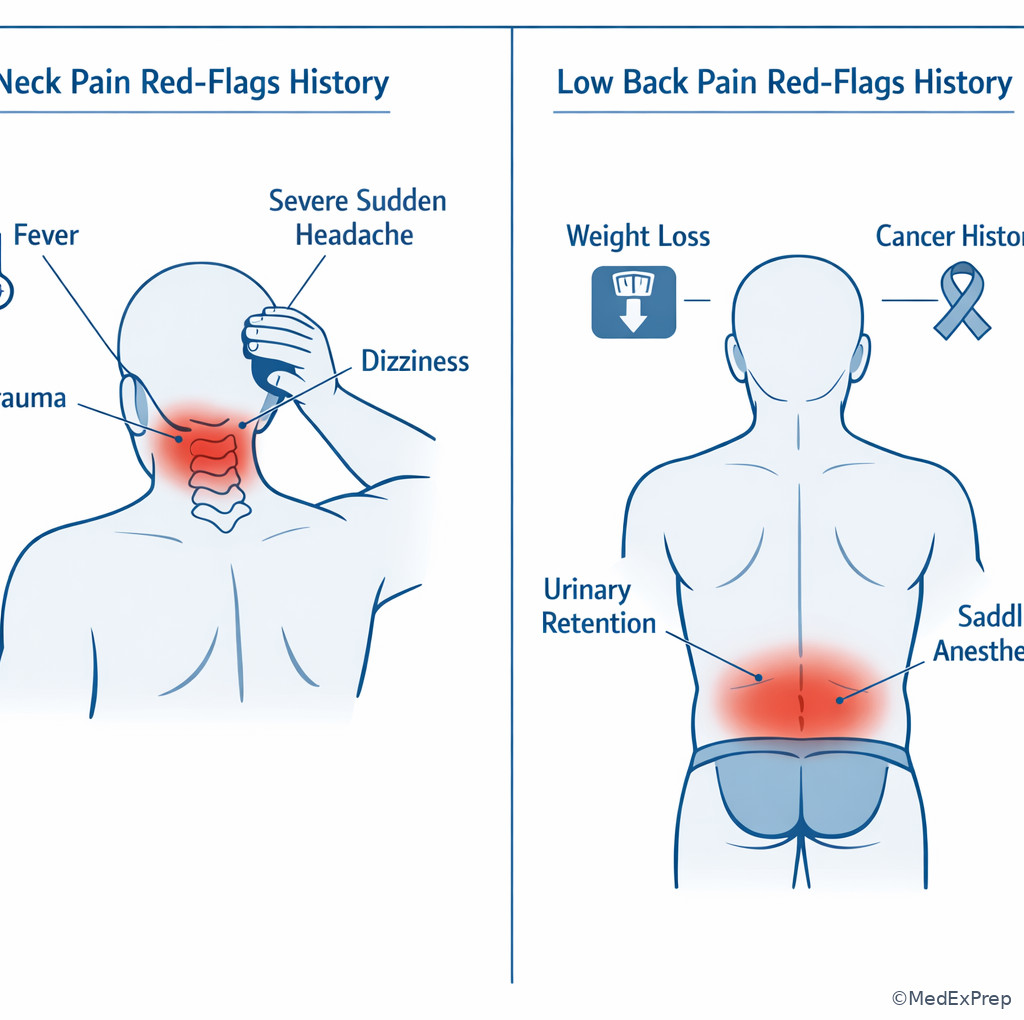
Exam takeaway: Predictable change with posture or load supports a mechanical source, while constant or night-predominant symptoms require caution.
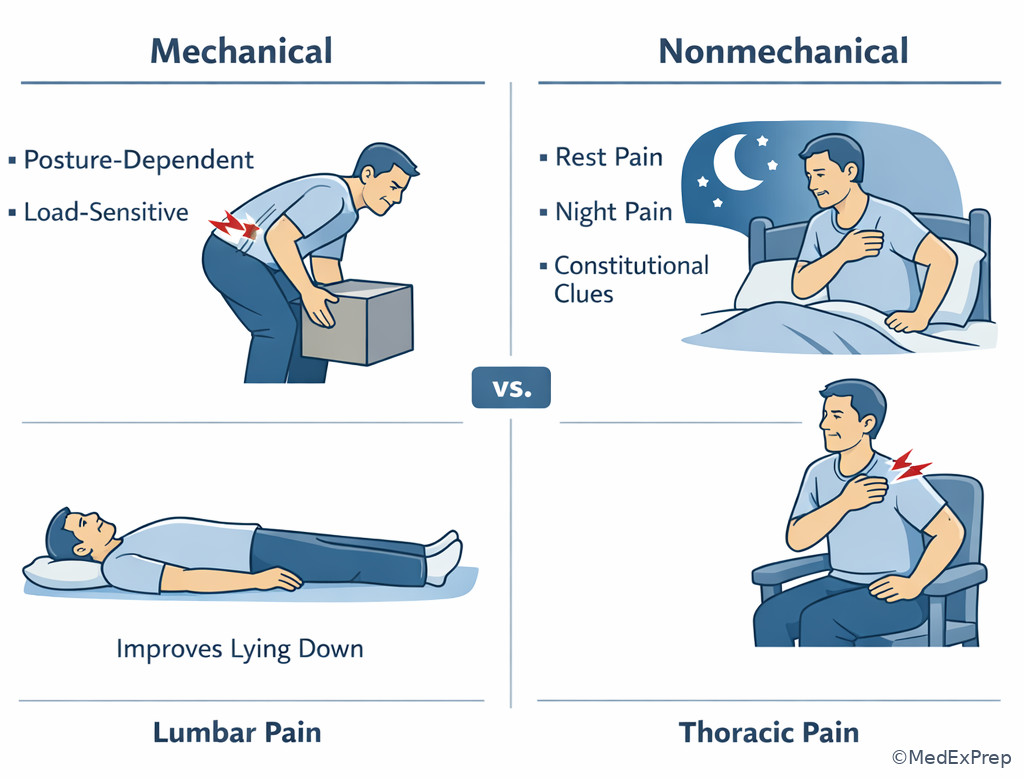
1.1.1.6 Application: build a board-style differential from the complaint before the exam
A Explanation
The decision conflict is: Should you jump to one diagnosis, or should you generate a short, ranked differential from the complaint pattern? The rule is to create a working differential of 2–4 categories before the physical exam. This improves safety and makes the exam purposeful. For example, “low back pain” may initially be framed as mechanical lumbar strain/discogenic pain, radicular process, referred visceral pain, or serious spinal pathology. The chief complaint alone should tell you which of these deserve attention first.
WHY THIS IS TESTED: Board questions often ask for the “most likely diagnosis,” “best next step,” or “most appropriate initial management.” You cannot answer reliably unless the complaint has already generated a ranked list. A good differential is complaint-driven, not test-driven. It uses age, onset, quality, distribution, modifiers, and associated features to narrow categories before physical findings arrive.
Choose a narrow differential when the complaint has a classic pattern and no warning signs. Choose a broad safety differential when age, nonmechanical behavior, or associated symptoms expand the risk profile. Reject the habit of listing every possible disease; boards reward prioritized reasoning, not encyclopedic recall. For an entry-level chiropractic candidate, the crucial question is whether the complaint supports routine outpatient evaluation or whether a nonroutine diagnosis must stay high on the list.
Memory anchor: Use LAMP to build a fast differential: Local mechanical, Affecting nerve, Medical/visceral mimic, Pathology/red flag. If you can place a complaint into these four buckets, your exam reasoning becomes cleaner.
High-Yield Connection: This concept overlaps with Musculoskeletal Versus Visceral Pain and Referral Threshold Decisions. On exam day, know not only what complaint patterns suggest MSK disease, but also which details force you to keep a visceral or urgent diagnosis on the list.
B Worked example
A 57-year-old man presents with right shoulder and upper thoracic pain for 4 days. He has hypertension and hyperlipidemia. He says it started “for no reason,” is deep and pressure-like, and is not clearly worsened by arm movement. He also reports mild nausea and shortness of breath climbing stairs this week. The tempting clue is that he spent a weekend painting. Board-style task: form the best complaint-based differential and next-step direction.
Reasoning chain: Identify task → rank complaint categories before exam. Extract key facts → age, vascular risk factors, spontaneous deep pressure-like pain, nonmechanical behavior, nausea, exertional dyspnea. Apply rule → visceral/cardiac mimic must rank above local shoulder strain despite recent painting. Eliminate distractors → reject rotator cuff overuse because movement is not the dominant aggravator; reject thoracic facet syndrome because associated cardiopulmonary symptoms are not explained. Verify → the complaint framework supports urgent medical evaluation rather than routine shoulder-focused chiropractic care.
C Exam trap
Common wrong answer: Diagnosing overuse shoulder pain from the recent painting activity.
Why it is tempting: The recent activity gives a plausible mechanical story and feels satisfyingly specific.
Single clue that eliminates it: Pressure-like pain with nausea and exertional dyspnea fits a visceral/cardiac concern better than a shoulder overuse pattern.
D Checkpoint
Question: Which is the best complaint-based differential frame for a patient with acute posterior leg pain, tingling to the dorsum of the foot, and worse symptoms with coughing after lifting?
- A. Local muscle strain, vascular claudication, renal colic
- B. Discogenic/radicular process, local mechanical back pain, serious neurologic compression
- C. Hip osteoarthritis, gallbladder disease, thoracic outlet syndrome
- D. Fibromyalgia, inflammatory bowel disease, migraine
Correct answer: B
- A: Tempting because posterior leg pain can be muscular or vascular, but wrong because tingling to the dorsum of the foot and cough provocation point more strongly to neural involvement.
- B: Tempting because it keeps several spine-related categories open, and right because the complaint suggests nerve-root irritation while still preserving local mechanical and higher-risk compression possibilities.
- C: Tempting because leg pain has many sources, but wrong because these options do not match the distribution and cough-related provocation.
- D: Tempting only if the student abandons pattern recognition; wrong because none of these categories fit the complaint behavior.
- The four LAMP buckets are Local mechanical, Affecting nerve, Medical/visceral mimic, Pathology/red flag.
- True or False: A complaint-based differential should include every possible diagnosis. False.
- The most useful pre-exam differential is ranked by fit and risk.
Exam takeaway: Rank complaints into mechanical, neurologic, visceral, and pathology buckets before choosing any exam or management step.
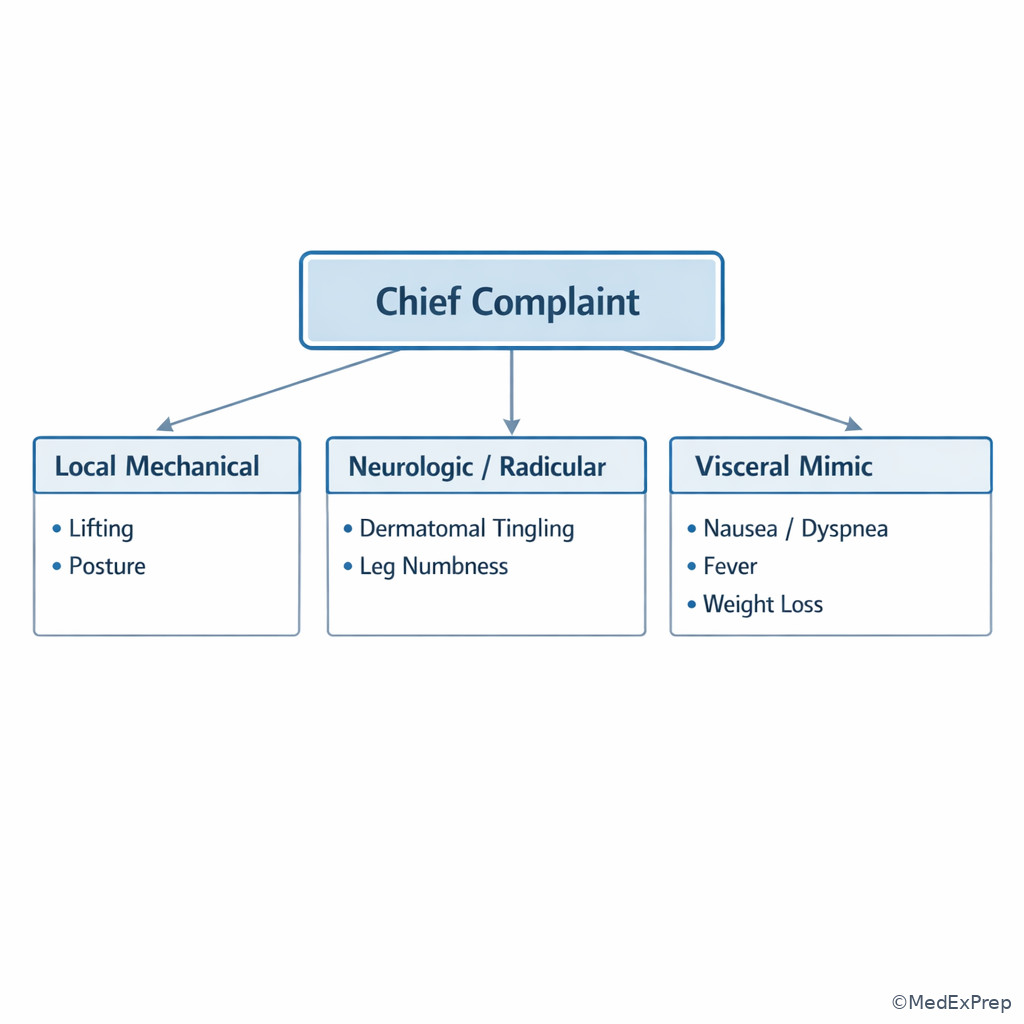
See Fig 5 when you need a rapid way to move from raw symptom wording to a ranked differential.
1.1.1.7 Integration: choose chiropractic assessment, referral, or urgent escalation from the complaint alone
A Explanation
The decision conflict is the most clinically important one in this lesson: Does the chief complaint support routine chiropractic evaluation, nonurgent referral/co-management, or urgent escalation? The single rule is: if the complaint suggests unstable, progressive, or serious pathology, avoid unsafe manipulation and escalate appropriately. Entry-level chiropractic reasoning on NBCE Part II is judged not by specialist treatment plans but by safe recognition, scope awareness, and disciplined next-step selection.
WHY THIS IS TESTED: Many exam stems are really safety questions disguised as diagnosis questions. The correct answer may not require a final diagnosis at all. If the complaint suggests fracture, infection, malignancy, vascular emergency, or major neurologic compromise, your job is to recognize the problem and refer. Conversely, when the complaint clearly fits a benign mechanical pattern without red flags, the correct answer is often to proceed with focused examination rather than over-order testing.
Choose routine chiropractic assessment for complaints with clear mechanical behavior, no serious associated symptoms, and no major contraindication clues. Choose nonurgent medical referral or co-management for complaints with concerning but not emergent patterns such as persistent nonmechanical pain, constitutional symptoms, or possible systemic disease. Choose urgent escalation for sudden severe neurologic, vascular, traumatic, infectious, or cauda equina-type complaint patterns. Reject overconfidence: if the complaint itself is unsafe, the board-safe answer is not to manipulate “carefully.”
Key rule: When the complaint is unsafe, the correct action is to defer chiropractic manipulation, not to modify technique and continue anyway.
Recall: In the upcoming topic Red-Flag History Clues, you will learn the exact danger patterns in more detail. Here, the skill is broader: recognize when the complaint alone already changes the management lane.
B Worked example
A 72-year-old man presents with new lumbar pain after slipping on wet steps yesterday. He has osteopenia, chronic corticosteroid use for COPD, and longstanding mild degenerative back pain. He says the current pain is more severe than usual, constant, and painful with standing. He can still walk, and the tempting clue is that he has had “back pain for years.” He denies fever and bowel/bladder dysfunction. Board-style task: choose the most appropriate disposition.
Reasoning chain: Identify task → determine routine care versus further evaluation. Extract key facts → older adult, recent trauma, bone fragility risk, new severe pain different from baseline. Apply rule → complaint suggests possible fracture until proven otherwise; routine manipulation is unsafe. Eliminate distractors → reject “exacerbation of chronic degenerative pain” because trauma plus osteopenia/corticosteroid exposure changes risk; reject “treat conservatively and observe” because the consequence of missing fracture is high. Verify → imaging/medical evaluation is the safest next step before chiropractic manual intervention.
C Exam trap
Common wrong answer: Proceeding with conservative chiropractic care because the patient has a long history of back pain.
Why it is tempting: Chronic back pain is common, and candidates may anchor on prior benign episodes.
Single clue that eliminates it: New pain after trauma in a patient with osteopenia and chronic steroid use changes the complaint into a possible fracture pattern.
D Checkpoint
Question: Which chief complaint most appropriately supports immediate routine focused chiropractic assessment rather than referral first?
- A. Acute lumbar pain after lifting, worse with flexion, improved by rest, no neurologic or constitutional symptoms
- B. Mid-thoracic pain with fever and recent infection
- C. Neck pain with sudden severe occipital headache and dizziness
- D. Low back pain with urinary retention and saddle numbness
Correct answer: A
- A: Tempting because it may seem too ordinary, and right because the pattern is mechanical and lacks complaint-level warning features.
- B: Tempting because thoracic pain can be musculoskeletal, but wrong because fever and infection history make routine care unsafe.
- C: Tempting because neck pain is common, but wrong because the associated vascular-type warning features demand urgent evaluation.
- D: Tempting because low back pain is often benign, but wrong because the neurologic red-flag pattern overrides it completely.
Exam takeaway: The complaint alone can justify routine assessment, nonurgent referral, or urgent escalation before any hands-on care.
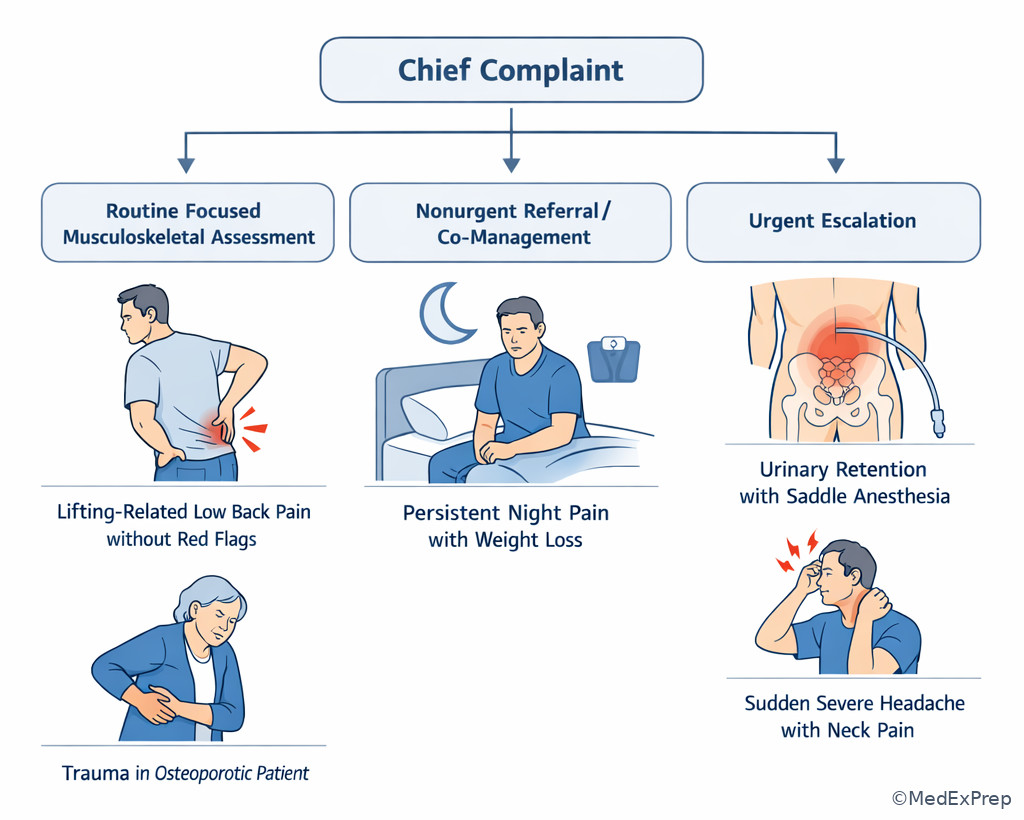
See Fig 6 for the high-yield endpoint of this lesson: your complaint framework should always end in a clear, safe disposition.
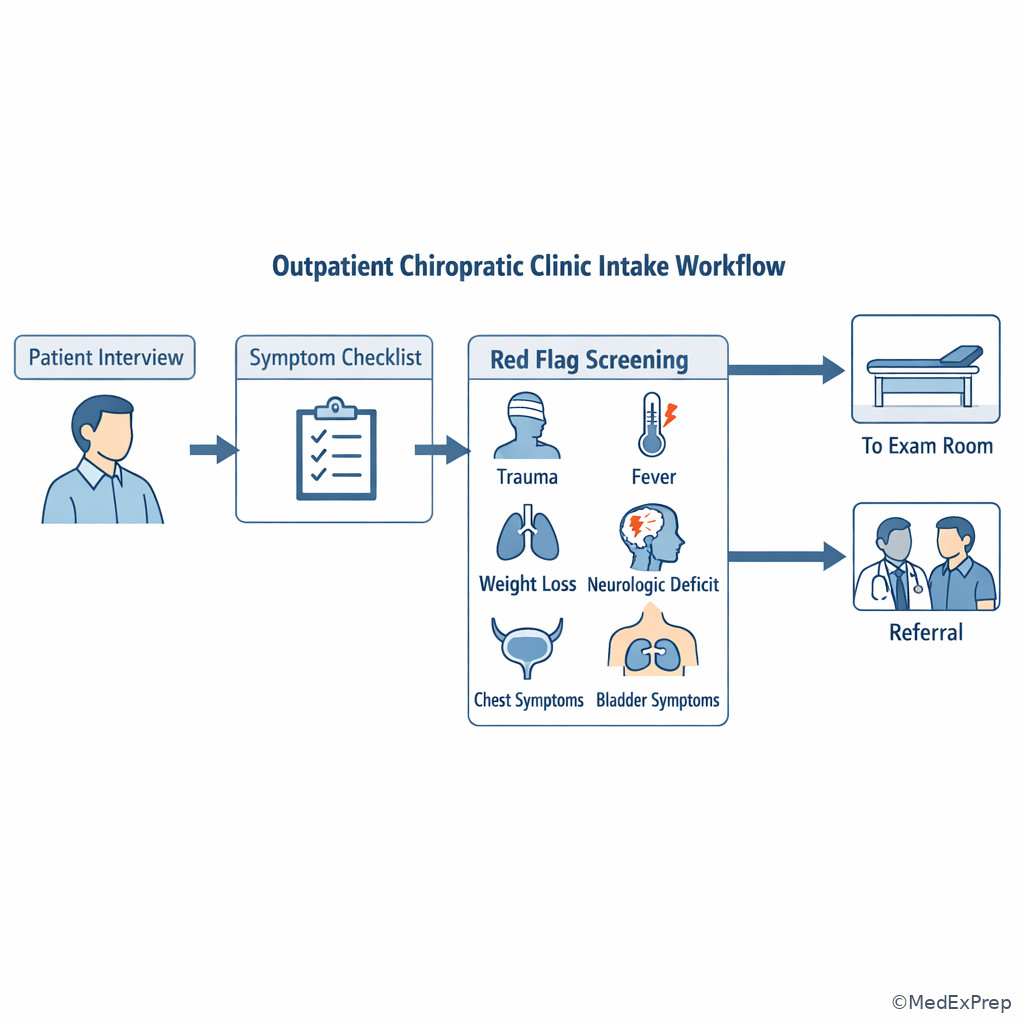
Exam takeaway: Structured intake improves safety by separating routine musculoskeletal complaints from cases needing immediate escalation.
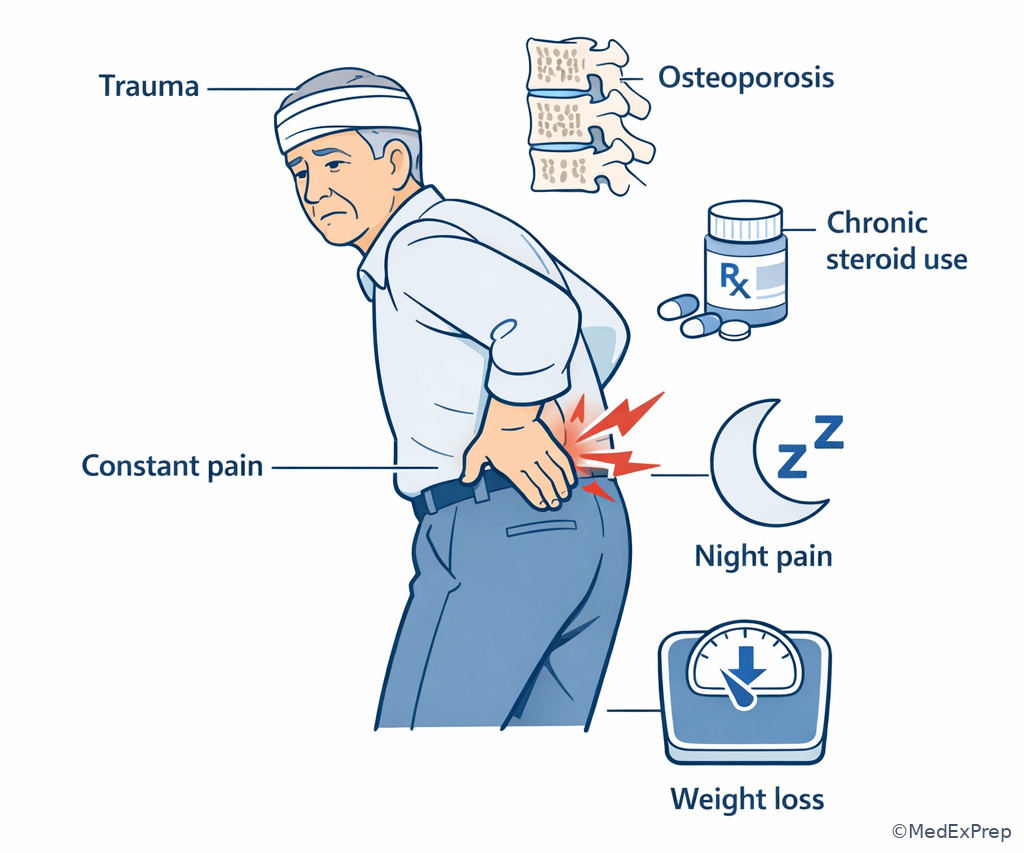
Exam takeaway: Age, trauma, bone fragility, and nonmechanical behavior shift a common complaint into a fracture or pathology workup lane.
Tables
| Complaint element | What to ask | Why it matters on NBCE |
|---|---|---|
| Location | Where is the symptom primary, and where does it spread? | Separates local, referred, and nerve-related possibilities. |
| Onset | Sudden, gradual, post-trauma, post-exertion, spontaneous? | Suggests strain, disc event, fracture, vascular event, or systemic illness. |
| Quality | Sharp, aching, burning, pressure-like, deep, throbbing? | Improves mechanism-based pattern recognition. |
| Radiation | Does it stay local or travel in a meaningful distribution? | Prevents overcalling all spread as radiculopathy. |
| Modifiers | What worsens or relieves it? | Movement/load dependence supports mechanical causes; nonresponse raises caution. |
| Temporal pattern | Intermittent, constant, night-predominant, progressive? | Night/rest/progressive patterns often shift the answer. |
| Associated symptoms | Fever, weight loss, weakness, dizziness, bowel/bladder change? | Often the single clue that changes the safest next step. |
| Context/risk | Trauma, cancer history, infection risk, osteoporosis, vascular risks? | Raises or lowers threshold for referral and imaging. |
| Pattern | Favors | Reject when | Typical next step |
|---|---|---|---|
| Movement- and load-dependent pain | Mechanical musculoskeletal source | Major neurologic or systemic clues coexist | Focused MSK exam |
| Dermatomal symptoms with cough/sneeze provocation | Nerve-root involvement | Distribution is vague or nonneural | Neurologic exam and safety screening |
| Deep, pressure-like, poorly localized pain | Visceral mimic | Clearly reproducible mechanical pattern explains all findings | Medical evaluation if suspicious |
| Constant, progressive, or night pain | Nonmechanical/pathologic process | There is a clearly benign alternative with no warning signs | Referral or further workup |
| Post-traumatic pain in high-risk bone patient | Fracture concern | Risk factors and mechanism are absent | Imaging/medical evaluation before manipulation |
| Complaint clue | Common tempting interpretation | Better differential frame |
|---|---|---|
| Low back pain after lifting, better with rest | “Probably just pain” without structure | Mechanical lumbar complaint first |
| Thoracic pain with weight loss and night pain | Postural strain | Pathology/nonmechanical concern |
| Shoulder/thoracic pain with nausea and dyspnea | Overuse shoulder strain | Visceral/cardiac mimic |
| Neck pain with sudden severe headache and dizziness | Acute cervical strain | Vascular warning pattern |
| Back pain with urinary retention and saddle anesthesia | Severe disc pain | Urgent neurologic compression pattern |
| Back pain after minor fall in steroid-dependent older adult | Exacerbation of chronic degeneration | Possible fragility fracture |
| Disposition | Complaint profile | Chiropractic implication |
|---|---|---|
| Routine focused assessment | Stable mechanical pattern, no major red flags | Proceed with history/exam within scope |
| Nonurgent referral/co-management | Persistent nonmechanical symptoms, constitutional concern, possible systemic disease | Defer unsafe care; coordinate further evaluation |
| Urgent escalation | Cauda equina pattern, vascular warning pattern, infection concern, fracture concern, severe neurologic progression | No manipulation; immediate appropriate referral |
Exam Traps & Differentiators
Most common wrong answer and why: The most common error is choosing the familiar mechanical diagnosis because the complaint occurs in the neck or back and includes tenderness or motion restriction. This is tempting because musculoskeletal complaints are common and the stem often includes one “normal” clinic-style clue. The antidote is to identify the single clue that does not fit a routine mechanical pattern.
| Looks similar | But isn’t | Discriminator |
|---|---|---|
| Mechanical low back pain | Cauda equina-type presentation | Urinary retention/saddle anesthesia, not just severe pain |
| Thoracic postural pain | Neoplastic/infectious concern | Night pain, fever, weight loss, nonmechanical behavior |
| Cervical strain | Vascular emergency mimic | Sudden severe headache, dizziness, neurologic change |
| Shoulder overuse pain | Cardiopulmonary referral | Pressure-like quality, exertional symptoms, nausea, dyspnea |
| Chronic degenerative back pain flare | Fragility fracture | Trauma plus osteoporosis/steroid exposure |
- If the stem says “worse with lifting, better with rest, no systemic or neurologic symptoms,” think mechanical first-pass framework.
- If the stem says “night pain, weight loss, fever, or deep constant pain,” think nonmechanical pathology until proven otherwise.
- If the stem says “new severe headache with neck pain and dizziness,” think urgent vascular caution, not routine cervical care.
- If the stem says “urinary retention, saddle anesthesia, or progressive bilateral symptoms,” think urgent neurologic compression pattern.
- If the stem says “shoulder or thoracic pain plus nausea, dyspnea, or exertional symptoms,” think visceral/cardiac mimic.
- If the stem says “minor trauma in older patient with osteoporosis or chronic steroid use,” think possible fracture before manipulation.
Common traps & distractors: Related traps appear again in Pain Patterns & Radiation and Red-Flag History Clues. The confusable pair is often “spine-region pain with benign modifier” versus “spine-region pain with a hidden systemic clue.” The board-safe move is to let the risk clue outrank the familiar musculoskeletal clue.
Algorithm / Approach
Rapid Review
- Chief complaint → patient words first, clinician structure second.
- Problem representation → age + region + tempo + modifier + key associated clue.
- Mechanical pattern → predictable change with motion, posture, or load.
- Nonmechanical pattern → constant, progressive, rest/night-predominant, or systemic.
- Best first discriminator → what makes it worse or better.
- Highest-yield override → one associated red-flag symptom beats several benign clues.
- Radiation → spread alone is not radiculopathy; distribution decides.
- Thoracic pain → lower threshold for caution when nonmechanical or constitutional features appear.
- Older adult after minor trauma → think fracture before “flare of degeneration.”
- Shoulder/upper thoracic pressure with nausea/dyspnea → think visceral mimic, not rotator cuff first.
- Neck pain plus sudden severe headache/dizziness → urgent vascular caution.
- Low back pain plus retention/saddle anesthesia → urgent neurologic compression pattern.
- LAMP differential → Local mechanical, Affecting nerve, Medical mimic, Pathology.
- Board-safe management → unsafe complaint means defer manipulation and refer.
Memory anchor: “Pattern before plan.” Do not ask “What treatment?” until you ask “What pattern?”
Self-check quiz
1. A 28-year-old graduate student presents with low back pain after moving apartments yesterday. She has mild asthma and seasonal allergies. The pain is worse when bending and improves when lying down. She denies numbness, fever, weight loss, or bowel/bladder changes. Which complaint feature most strongly supports a mechanical first-pass framework?
- A. Her age
- B. Pain improvement with rest and worsening with bending
- C. Her history of asthma
- D. The fact that symptoms began yesterday
2. A 42-year-old patient reports neck pain and asks for a same-day adjustment. Which additional complaint detail requires the most immediate clarification before proceeding?
- A. Whether the pain is sharp or dull
- B. Whether the pain radiates to the shoulder only after long desk work
- C. Whether there is new severe headache with dizziness
- D. Whether a heating pad provided relief
3. A 59-year-old woman presents with 1 month of thoracic pain. She has osteopenia and a past history of breast cancer in remission. The pain is worse at night, not clearly related to movement, and is accompanied by fatigue. She says stretching helps “a little.” What is the most appropriate next step?
- A. Proceed with routine thoracic manipulation because stretching provides relief
- B. Perform a vigorous mechanical exam first because thoracic pain is commonly postural
- C. Recognize a nonmechanical complaint pattern and arrange medical evaluation before routine care
- D. Reassure the patient because lack of trauma lowers concern
4. A 35-year-old man with obesity and GERD presents with right shoulder and upper back pain after painting his house. The pain is deep and pressure-like, not clearly worsened by arm motion, and he notes nausea and shortness of breath with stair climbing. Which complaint category should rank highest before the exam?
- A. Rotator cuff overuse syndrome
- B. Visceral/cardiopulmonary mimic
- C. Cervical radiculopathy
- D. Simple myofascial trigger point pain
5. A 31-year-old woman presents with acute neck pain after yoga. She has migraine history and generalized anxiety. The pain increases with rotation, but she also reports a sudden severe occipital headache and dizziness since symptom onset. What is the most appropriate next step?
- A. Proceed with gentle cervical adjustment because the pain is movement-provoked
- B. Treat as a migraine recurrence because she has a past history
- C. Recognize a vascular warning pattern and seek urgent medical evaluation
- D. Schedule reevaluation in 1 week after home stretching
6. A 71-year-old man presents with new lumbar pain after slipping on a wet floor. He has chronic low back pain, COPD treated with long-term corticosteroids, and osteopenia. He is able to walk but says this pain is constant and much worse than his usual episodes. What is the most appropriate next step?
- A. Treat as an exacerbation of chronic degeneration because he remains ambulatory
- B. Suspect possible fracture and obtain appropriate evaluation before manipulation
- C. Begin lumbar traction because the pain is severe and constant
- D. Delay workup unless neurologic deficits develop
7. A 47-year-old office worker presents with low back pain for 2 days after lifting boxes. He has type 2 diabetes and obesity. Pain is sharp in the right low back, worse with flexion, and better lying down. He reports one episode of urinary urgency after several cups of coffee but denies retention, saddle anesthesia, weakness, fever, or weight loss. Which is the best complaint-based disposition?
- A. Urgent referral for cauda equina syndrome
- B. Routine focused musculoskeletal assessment
- C. Immediate workup for spinal infection
- D. Assume renal colic because urinary symptoms are present
8. A 63-year-old woman presents with posterior neck and upper thoracic pain for 3 weeks. She has rheumatoid arthritis and hypertension. She reports the pain is progressive, wakes her at night, and is not clearly tied to movement. She also notes low-grade fever after a recent dental infection. Which complaint feature is the strongest discriminator against routine mechanical management?
- A. Her hypertension
- B. Pain location in the upper thoracic region
- C. Progressive night pain with fever after infection
- D. Duration of 3 weeks
Answer key
1. Correct answer: B
- A: Tempting because younger age lowers some serious-pathology risk, but incorrect because age alone does not define the complaint mechanism. Single stem clue: the complaint’s behavior, not age, is the key discriminator. Source: Bickley; Haldeman et al.
- B: Tempting because it sounds textbook, and correct because worsening with bending and relief with rest strongly support a mechanical pattern. Single stem clue: predictable motion/position dependence. Source: Bickley; World Health Organization low back pain red-flag framing principles.
- C: Tempting because comorbidities can matter, but incorrect because asthma does not explain or classify this complaint. Single stem clue: no respiratory symptom linkage to the pain. Source: Bickley.
- D: Tempting because acute onset after exertion can fit mechanical pain, but incorrect because onset alone is less discriminating than symptom behavior. Single stem clue: pain changes with bending and rest. Source: Bickley.
2. Correct answer: C
- A: Tempting because quality helps refine mechanism, but incorrect because it rarely outranks a vascular-type warning clue. Single stem clue: the question asks what requires immediate clarification. Source: Bickley; Haldeman et al.
- B: Tempting because radiation matters, but incorrect because shoulder radiation after desk work can still fit benign cervical/mechanical patterns. Single stem clue: this lacks a high-risk associated symptom. Source: Bickley.
- C: Correct because new severe headache with dizziness paired with neck pain is a pattern breaker that may require urgent medical evaluation rather than routine care. Single stem clue: sudden severe headache plus dizziness. Source: Haldeman, Dagenais, and Budgell; cervical vascular safety literature.
- D: Tempting because relief from heat can support a mechanical source, but incorrect because it does not clarify the highest-risk possibility. Single stem clue: heat response is lower priority than warning symptoms. Source: Bickley.
3. Correct answer: C
- A: Tempting because some symptom relief suggests a benign mechanical process, but incorrect because minor temporary relief does not override night pain, fatigue, and cancer history. Single stem clue: nonmechanical night pain with cancer history. Source: Bickley; Haldeman et al.; Deyo and Weinstein.
- B: Tempting because thoracic pain is often postural in practice, but incorrect because the complaint already contains significant red-flag features. Single stem clue: not clearly movement-related. Source: Bickley.
- C: Correct because this is a nonmechanical complaint pattern requiring medical evaluation before routine care. Single stem clue: night pain plus cancer history and fatigue. Source: Haldeman et al.; NCCIH safety-oriented conservative care literature.
- D: Tempting because absence of trauma lowers fracture suspicion, but incorrect because malignancy or other pathology does not require trauma. Single stem clue: the concern is nontraumatic pathology, not acute injury. Source: Bickley.
4. Correct answer: B
- A: Tempting because recent painting makes overuse plausible, but incorrect because the pain is deep, pressure-like, and not strongly movement-related. Single stem clue: nausea and exertional shortness of breath. Source: Bickley; clinical cardiopulmonary symptom interpretation references.
- B: Correct because a visceral/cardiopulmonary mimic must rank highest given the symptom quality and associated exertional symptoms. Single stem clue: pressure-like pain with nausea/dyspnea. Source: Bickley; Haldeman et al.
- C: Tempting because shoulder/upper back complaints can arise from cervical structures, but incorrect because no clear radicular distribution or neck-driven provocation is given. Single stem clue: associated systemic/visceral symptoms dominate. Source: Bickley.
- D: Tempting because myofascial pain is common, but incorrect because it does not explain exertional dyspnea and nausea. Single stem clue: nonmusculoskeletal associated symptoms. Source: Bickley.
5. Correct answer: C
- A: Tempting because rotation-provoked neck pain sounds mechanical, but incorrect because the sudden severe headache and dizziness are stronger safety clues. Single stem clue: sudden severe occipital headache. Source: Haldeman, Dagenais, and Budgell; vascular safety discussions in cervical spine care.
- B: Tempting because migraine history is a classic distractor, but incorrect because the stem describes a new complaint pattern in a neck-pain context with dizziness. Single stem clue: new onset during activity rather than known recurrent pattern. Source: Bickley.
- C: Correct because the complaint includes a vascular warning pattern requiring urgent medical evaluation before chiropractic manual care. Single stem clue: sudden severe headache plus dizziness with neck pain. Source: Haldeman et al.
- D: Tempting because many benign strains improve with time, but incorrect because watchful waiting is unsafe when a major pattern breaker is present. Single stem clue: urgent warning features already exist. Source: Haldeman et al.
6. Correct answer: B
- A: Tempting because chronic back pain can flare after slips and the patient is still walking, but incorrect because new severe constant pain after trauma in a steroid-exposed osteopenic patient raises fracture concern. Single stem clue: trauma plus fragility risk. Source: Haldeman et al.; standard musculoskeletal fracture risk teaching texts.
- B: Correct because possible fracture must be evaluated before manipulation. Single stem clue: long-term corticosteroids and osteopenia with new post-traumatic pain. Source: Haldeman et al.; imaging indication principles.
- C: Tempting because severe constant pain can push candidates toward symptom-relief maneuvers, but incorrect because intervention before excluding fracture is unsafe. Single stem clue: the diagnosis is not yet secure. Source: chiropractic safety standards texts.
- D: Tempting because neurologic deficits matter, but incorrect because fracture can exist without initial neurologic loss. Single stem clue: fragility fracture risk does not depend on deficits. Source: imaging and trauma screening references.
7. Correct answer: B
- A: Tempting because urinary symptoms can trigger fear of cauda equina, but incorrect because urgency after excess caffeine is not the same as retention, and there is no saddle anesthesia or progressive deficit. Single stem clue: urgency rather than retention. Source: Bickley; spine red-flag teaching references.
- B: Correct because the complaint overall fits acute mechanical low back pain pending focused exam. Single stem clue: lifting onset, flexion aggravation, rest relief, and absent major red flags. Source: Bickley; conservative spine assessment frameworks.
- C: Tempting because diabetes increases infection risk, but incorrect because there is no fever, constitutional illness, or infection-style complaint pattern. Single stem clue: clear mechanical onset and behavior. Source: Bickley.
- D: Tempting because urinary symptoms plus flank-region pain can suggest renal issues, but incorrect because the pain is low back mechanical pain tied to lifting and flexion. Single stem clue: predictable musculoskeletal provocation. Source: Bickley.
8. Correct answer: C
- A: Tempting because vascular comorbidity can matter, but incorrect because hypertension does not explain the shift away from routine care here. Single stem clue: other features are more discriminating. Source: Bickley.
- B: Tempting because thoracic-region pain deserves respect, but incorrect because location alone is not the strongest deciding factor. Single stem clue: the symptom behavior and fever are more important. Source: Bickley.
- C: Correct because progressive night pain plus fever after recent infection is a strong nonmechanical/infectious warning pattern. Single stem clue: progressive night pain with fever after infection. Source: Haldeman et al.; infection red-flag teaching in musculoskeletal practice.
- D: Tempting because duration may suggest persistence, but incorrect because 3 weeks alone does not determine urgency without the associated infection and night pain pattern. Single stem clue: quality and associated symptoms, not duration alone. Source: Bickley.
Keep going with the full NBCE Part II Prep Course (NBCE II)
You just studied the way members do, in the same lesson interface. Full access unlocks every lesson, the question bank and flashcards for a full year.
One payment · 1 year of access · No auto-renewal