1.1.1 - Planes, Terms, And Positions
Why it matters
- NBCE stems often hide easy points behind orientation language; missing one term can make the entire question wrong.
- Anatomical position is the fixed reference that prevents confusion when limbs move or when the body is described from different views.
- Directional terms are reused across gross anatomy, spinal anatomy, neuroanatomy, imaging, and pathology.
- Planes and positions become essential when you later interpret cavities, organ relationships, vertebral landmarks, and sectional diagrams.
Key Terms & Must-Know Facts
1.1.1.1 Key terms
- Anatomical position
- Supine
- Prone
- Sagittal plane
- Midsagittal plane
- Parasagittal plane
- Frontal (coronal) plane
- Transverse (horizontal/axial) plane
- Oblique plane
- Superior
- Inferior
- Anterior (ventral)
- Posterior (dorsal)
- Medial
- Lateral
- Proximal
- Distal
- Superficial
- Deep
- Ipsilateral
- Contralateral
1.1.1.2 Must-know facts
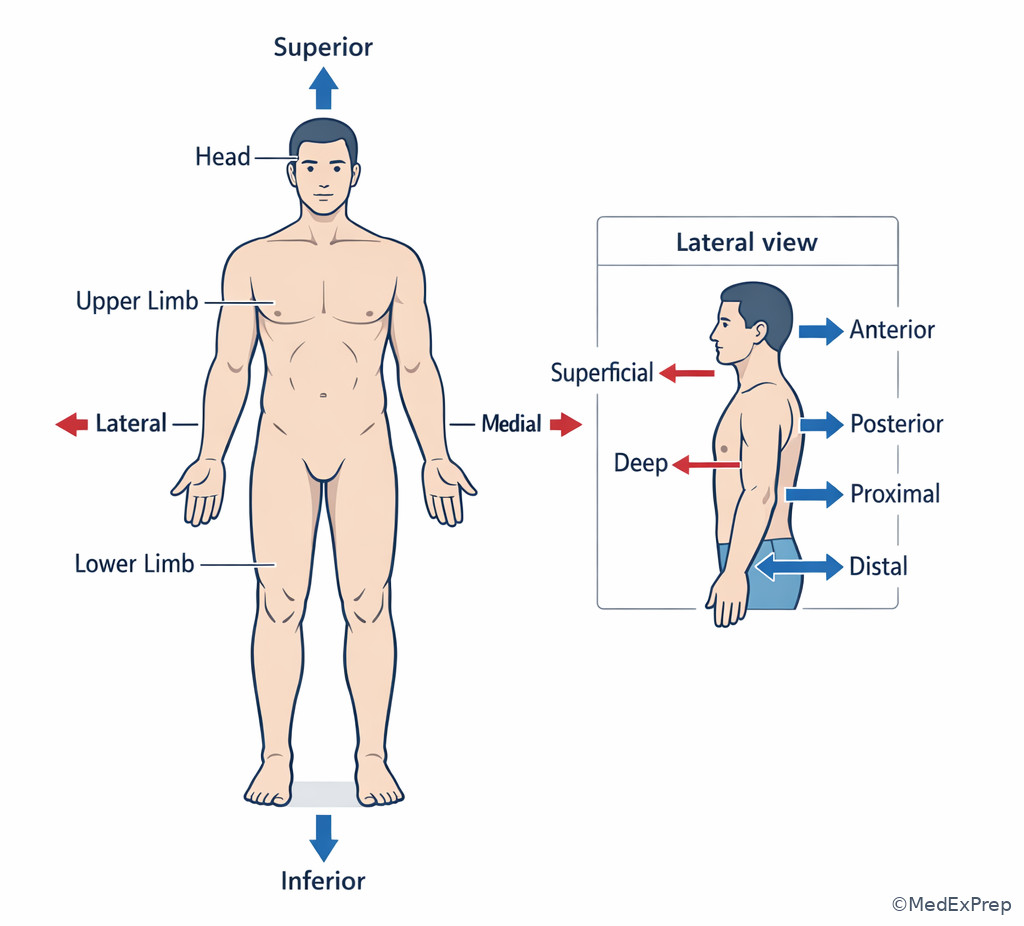
- Anatomical position means standing upright, face forward, upper limbs at sides, palms forward, feet directed forward.
- Left and right always refer to the subject's left and right, not the observer's.
- Midsagittal divides the body into equal right and left halves; parasagittal divides into unequal right and left parts.
- Frontal plane separates anterior from posterior portions.
- Transverse plane separates superior from inferior portions.
- Proximal and distal are used most reliably for limbs and structures with a point of origin.
- Superficial means closer to the body surface; deep means farther from the body surface.
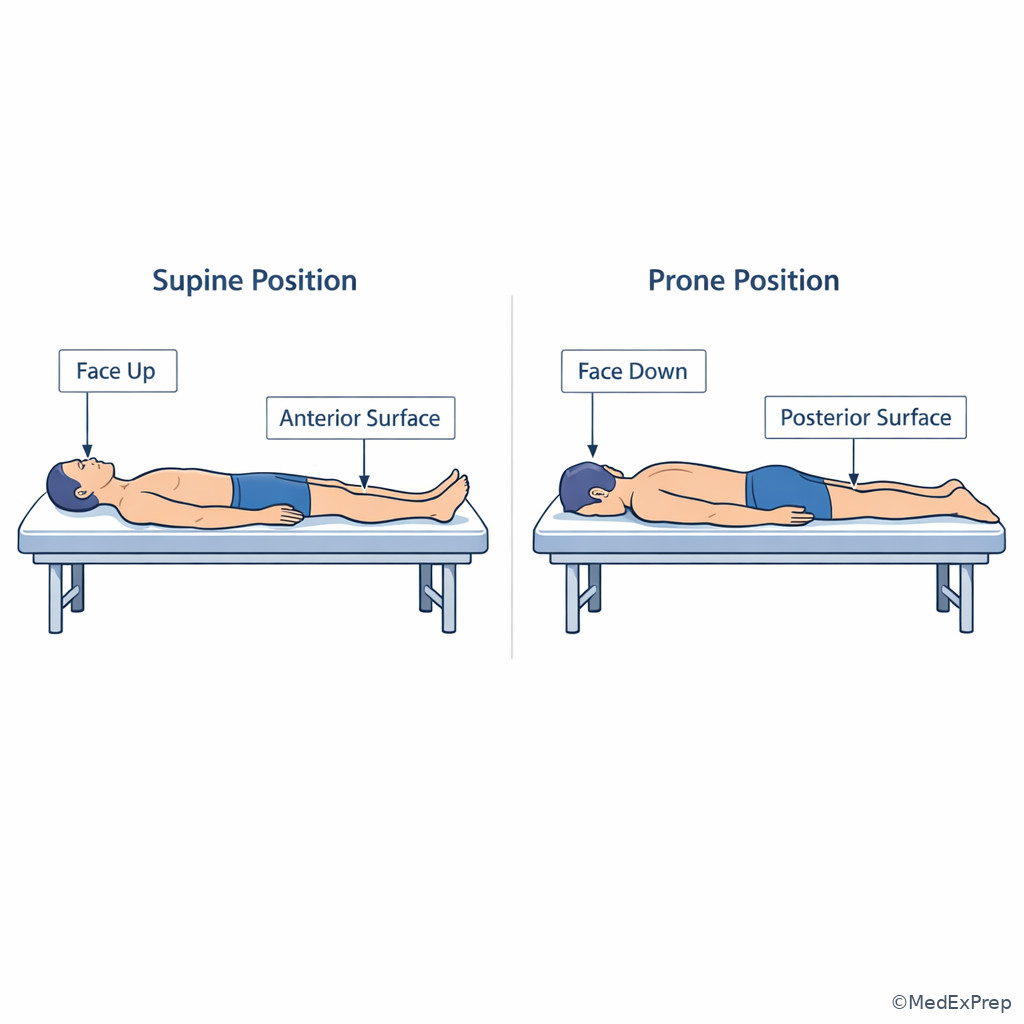
- Supine means lying face up; prone means lying face down.
- Ventral and anterior are usually paired in humans; dorsal and posterior are usually paired in humans.
- Medial/lateral and proximal/distal are not interchangeable.
Exam takeaway: Anchor every directional term to anatomical position before interpreting the stem.
flowchart TD
A[Read anatomy stem] --> B[Set subject in anatomical position]
B --> C[Choose relationship type]
C --> D[Midline based: medial or lateral]
C --> E[Vertical based: superior or inferior]
C --> F[Front-back based: anterior or posterior]
C --> G[Limb/origin based: proximal or distal]
D --> H[Reject observer perspective]
E --> H
F --> H
G --> H
Exam takeaway: Palms forward and subject-centered left-right orientation eliminate many board-style distractors.
Exam takeaway: Supine and prone questions test face-up versus face-down orientation, not limb direction terms.
| Term | Best meaning | High-yield opposite | Common misuse |
|---|---|---|---|
| Superior | Toward the head | Inferior | Confused with anterior |
| Anterior | Toward the front | Posterior | Confused with superior |
| Medial | Toward the midline | Lateral | Confused with proximal |
| Proximal | Nearer the origin or trunk | Distal | Used incorrectly for organs |
| Superficial | Closer to the surface | Deep | Confused with external |
| Ipsilateral | Same side | Contralateral | Confused with medial |
Core content
1.1.1.3 Foundational reference: anatomical position and subject-centered orientation
A Explanation
The first decision conflict on exam questions is simple but decisive: should you interpret the stem from the observer's view or the subject's standard reference? The single rule that resolves it is anatomical position. Unless a stem explicitly changes position, every directional term is anchored to a body standing upright with face forward, arms at the sides, palms facing forward, and feet forward. That is why the radius is lateral to the ulna in anatomical position even though the forearm can rotate in life. On NBCE-style items, the tempting wrong move is to picture the person as you usually see them in casual posture or from your own perspective. Reject that. Left means the subject's left. Anterior means the body's front surface. Superior means toward the head, not merely “higher on the page.”
WHY THIS IS TESTED: testable pattern = stems deliberately include rotated images, examiner viewpoint language, or upper-limb clues to see whether you default to anatomical position or to visual intuition. See Fig 1 and Fig 2.
B Worked example
A 24-year-old anatomy lab student with mild scoliosis history and seasonal allergies is shown an anterior-view diagram of the forearm while standing relaxed with elbows flexed. A distracting note says the wrists are partially pronated after exercise. The item asks which structure is lateral in anatomical position. The tempting clue is the pictured pronation, which makes the ulna appear more lateral on the page. Identify the task: determine the true lateral forearm bone. Extract key facts: the question asks about anatomical position, not the temporary pose. Apply the rule: in anatomical position, palms face forward and the radius lies lateral, the ulna medial. Eliminate distractors that follow the picture rather than the reference. Verify: “lateral” means farther from the midline; in the forearm, the thumb side is lateral in anatomical position, so radius is correct.
C Exam trap
D Checkpoint
Question: A specimen image shows the body from the front with the forearms crossed after movement. Which statement is most appropriate?
- A. Left and right should be assigned from the observer's perspective because the image is frontal.
- B. The ulna is lateral to the radius because the forearms appear rotated inward.
- C. Anatomical position remains the reference unless the question specifically asks about the posed posture.
- D. Superior and anterior become interchangeable when the body is viewed upright.
Answer: C
- A: Tempting because students often read images visually first; wrong because left-right are always the subject's, not the observer's.
- B: Tempting because forearm rotation changes visible orientation; wrong because anatomical position places the radius laterally.
- C: Correct because standard reference governs unless the item explicitly asks you to interpret the changed posture.
- D: Tempting because both can seem “up/front” in a quick mental picture; wrong because superior is headward and anterior is frontward.
1.1.1.4 Directional terms: choose the correct relational pair
A Explanation
The next decision conflict is choosing between similar relationship words. Students commonly confuse medial with proximal, superior with anterior, and superficial with external. The resolving rule is to identify what axis the question is testing. Midline questions use medial/lateral. Head-to-foot questions use superior/inferior. Front-back questions use anterior/posterior. Limb-origin questions use proximal/distal. Surface-depth questions use superficial/deep. Side-matching questions use ipsilateral/contralateral. This sounds basic, but exam writers often package it in a structure pair that could fit more than one axis unless you choose carefully. For example, the knee is inferior to the hip and distal to the hip; each is true, but only one matches the tested axis. In spinal anatomy, the spinous process is posterior to the vertebral body, not superior to it. The sternum is anterior to the heart, not superficial to it in the same sense used for tissue depth.
WHY THIS IS TESTED: testable pattern = distractors come from the correct answer family but name the wrong axis of comparison. See Fig 1.
B Worked example
A 67-year-old man used in a board-style vignette has obesity, chronic low back discomfort, and controlled type 2 diabetes. The question notes a visible skin scar over the posterior shoulder and a distracting comment that the patient points to “the top of the arm.” It asks for the best term to describe the elbow relative to the shoulder. Identify the task: choose a relational term. Extract key facts: both elbow and shoulder are on the same limb; the question is about position along that limb, not about front-back or up-down. Apply the rule: limb-origin axis uses proximal/distal. The elbow is distal to the shoulder. Eliminate inferior because the elbow is indeed lower in the standing body, but that is not the best limb-specific descriptor. Eliminate lateral because both structures are on the same upper limb rather than defined by distance from the midline. Verify: distal means farther from the trunk or point of origin on a limb.
C Exam trap
D Checkpoint
Question: In anatomical position, which statement is most appropriate?
- A. The heart is medial to the sternum.
- B. The thumb is lateral to the little finger.
- C. The knee is proximal to the hip.
- D. The skin is deep to skeletal muscle.
Answer: B
- A: Tempting because the heart lies near the midline; wrong because it is posterior to the sternum, not medial to it.
- B: Correct because in anatomical position the thumb is on the lateral side of the hand.
- C: Tempting because both are lower-limb structures; wrong because the knee is distal and inferior to the hip, not proximal.
- D: Tempting if surface layers are mentally reversed; wrong because skin is superficial to muscle.
- The paired opposite of proximal is distal.
- True or False: medial and proximal test the same spatial axis. False.
- Name the 3 most mixed-up pairs: medial/lateral, superior/inferior, proximal/distal.
1.1.1.5 Planes of the body: section choice and what each plane separates
A Explanation
Another frequent exam conflict is deciding between a plane of movement or cut. The key rule is to ask what portions are being separated. A sagittal plane divides the body into right and left portions. If the halves are equal, it is midsagittal; if unequal, parasagittal. A frontal or coronal plane divides anterior and posterior portions. A transverse, horizontal, or axial plane divides superior and inferior portions. An oblique plane cuts at an angle that is not parallel to the major standard planes. On exams, the question may describe an imaging slice, a dissection cut, or a motion screenshot. The plane is still identified by the relation of the parts separated, not by how the picture is turned on the page. If a CT-like stem describes a cross-section through the abdomen producing an upper and lower part, that is transverse. If a section produces left and right parts through the midline of the nose and umbilicus, that is midsagittal. See Fig 3 and Fig 4.
WHY THIS IS TESTED: testable pattern = stems hide the plane behind synonyms such as axial, horizontal, longitudinal, or median and expect you to distinguish equal versus unequal right-left sections.
Exam takeaway: Identify each plane by the portions it separates, not by the drawing angle on the page.
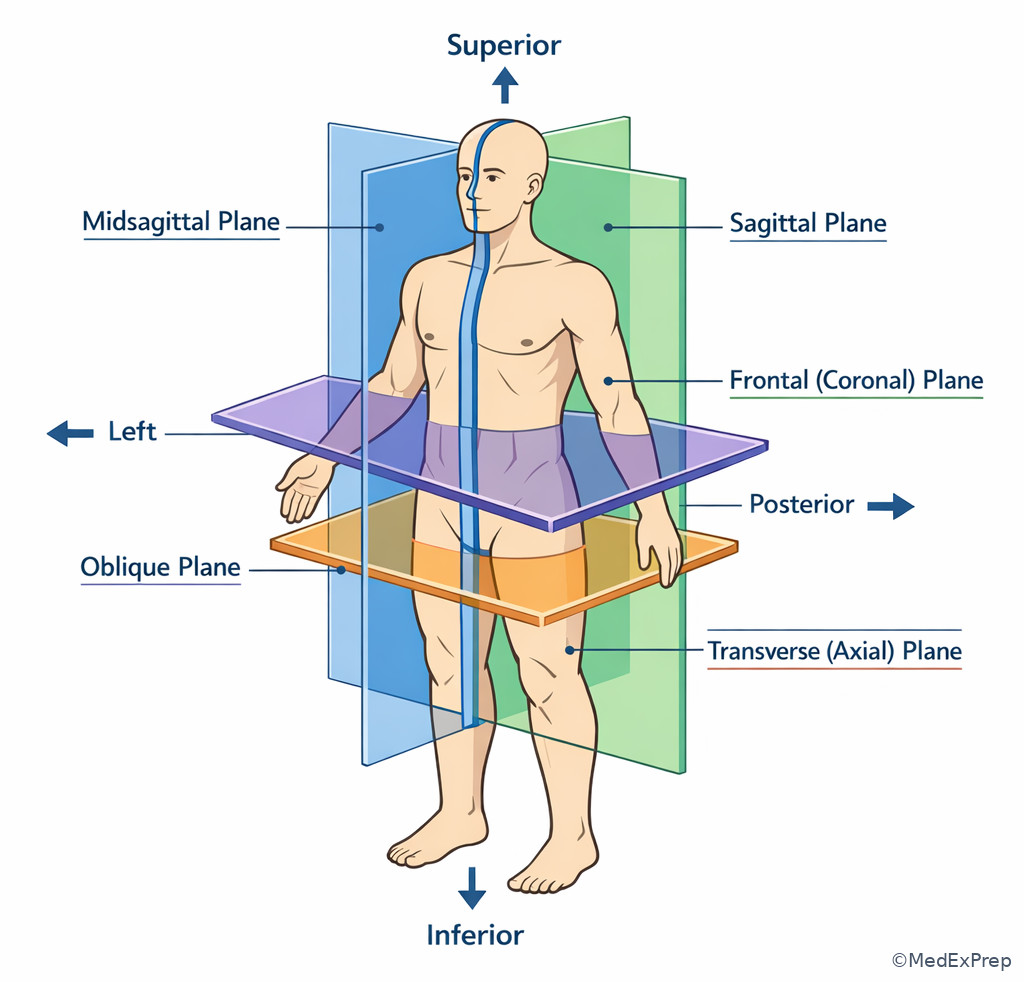
Exam takeaway: Use the separated portions first, then refine to midsagittal versus parasagittal.
flowchart TD
A[Question asks for a plane] --> B{What is separated?}
B -->|Right and left| C[Sagittal]
B -->|Anterior and posterior| D[Frontal or coronal]
B -->|Superior and inferior| E[Transverse or axial]
C --> F{Equal halves?}
F -->|Yes| G[Midsagittal]
F -->|No| H[Parasagittal]
B -->|Angled cut| I[Oblique] B Worked example
A 38-year-old recreational runner with asthma and prior ankle sprains appears in a radiology-style teaching vignette. The prompt says an image slice passes horizontally through the abdomen at the level of the umbilicus; a distracting sentence notes that the patient is lying supine. The question asks which plane was used. Identify the task: name the plane of section. Extract key facts: the slice is horizontal through the abdomen and creates upper and lower portions. The body position is noise. Apply the rule: superior-inferior separation means transverse. Eliminate frontal because supine positioning can make students picture a front-to-back relation. Eliminate sagittal because no left-right separation is described. Verify by synonym recall: axial and transverse are paired terms.
C Exam trap
D Checkpoint
Question: A section passing through the midline produces equal right and left halves. Which term is most appropriate?
- A. Parasagittal
- B. Midsagittal
- C. Frontal
- D. Oblique
Answer: B
- A: Tempting because it still separates right and left; wrong because parasagittal creates unequal portions.
- B: Correct because equal right and left halves through the midline define the midsagittal plane.
- C: Tempting if “through the middle” is misread as front/back center; wrong because frontal divides anterior and posterior.
- D: Tempting because angled cuts can look asymmetrical; wrong because the defining clue is equal right-left halves.
1.1.1.6 Positions and relational language in board-style stems
A Explanation
Once you know the base terms, the applied challenge is translating whole stem language efficiently. Questions may state that a subject is prone, supine, erect, or side-lying and ask you for a relational interpretation. The rule is to separate body position terms from anatomical directional terms. Prone and supine tell you which surface faces upward or downward in that moment. They do not redefine anterior/posterior, medial/lateral, or superior/inferior. Thus, a patient lying supine still has the sternum anterior to the heart, even though the anterior surface now faces upward. Likewise, when a person is prone, the posterior surface faces upward, but posterior still means toward the back. This distinction becomes especially important in spinal anatomy, where vertebral spinous processes are posterior regardless of whether the model is standing or face down. See Fig 5.
WHY THIS IS TESTED: testable pattern = the stem changes posture to make students incorrectly change the directional vocabulary itself.
Exam takeaway: Body posture changes which surface faces up, but it does not redefine anterior, posterior, or other anatomical terms.
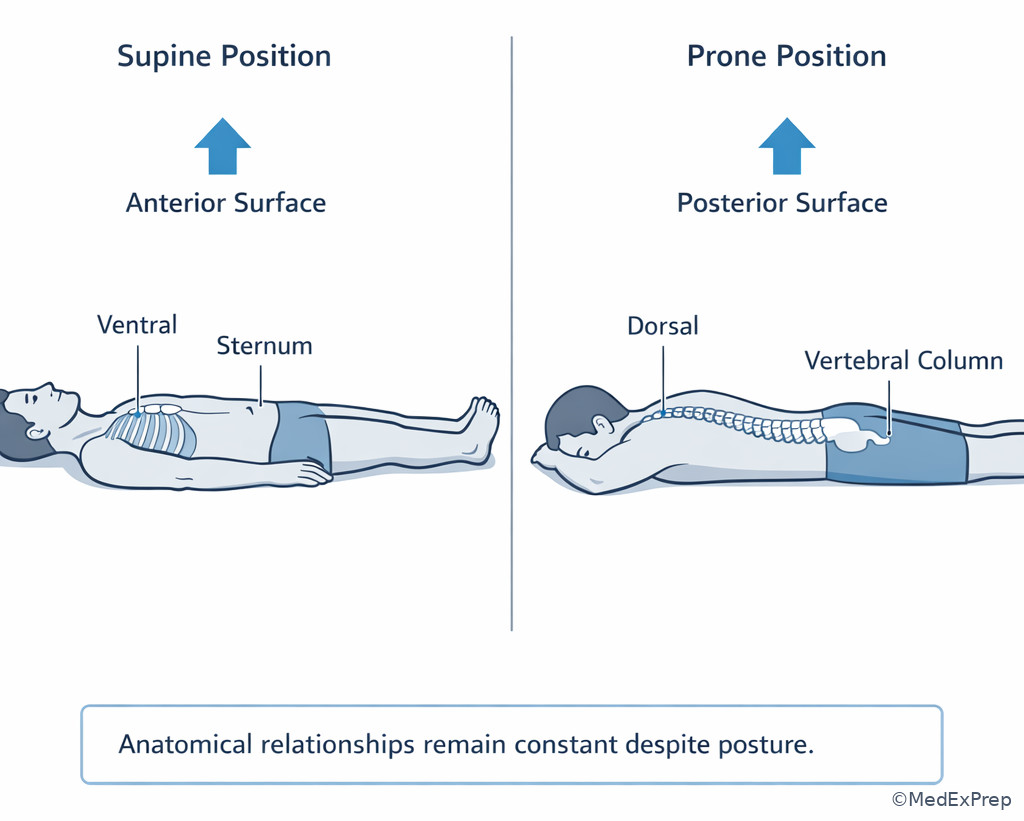
Exam takeaway: In vertebral anatomy, posterior and anterior landmarks remain fixed regardless of patient posture.
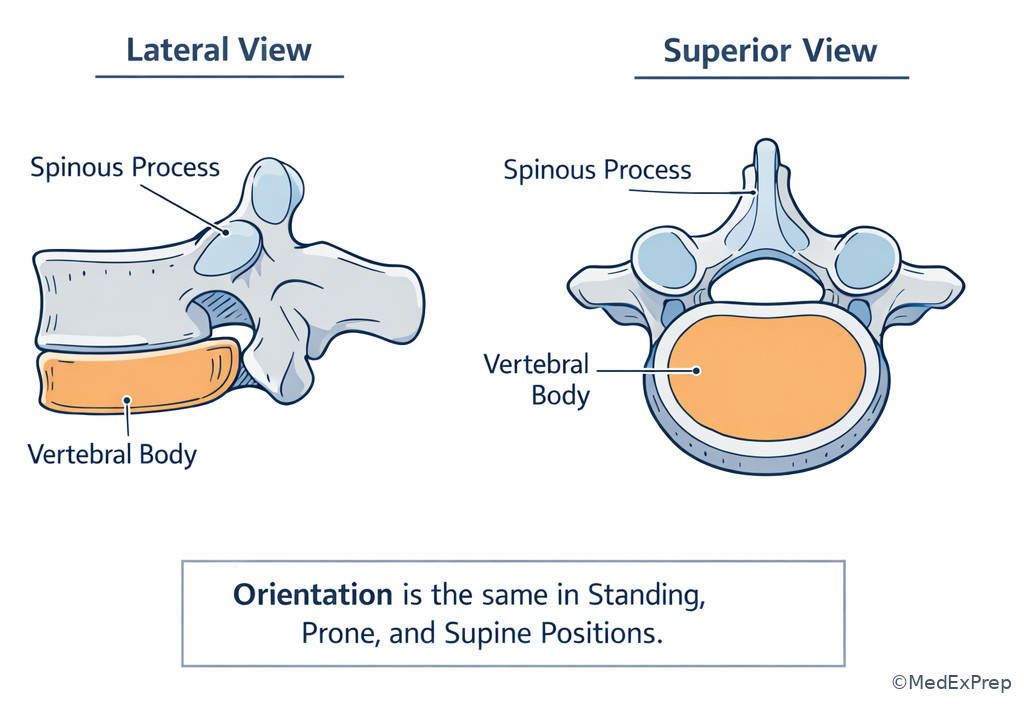
B Worked example
A 54-year-old woman in a practical exam stem has osteoarthritis, obesity, and a history of peptic ulcer disease. She is described as lying supine on a table during a teaching demonstration. A distracting clue says “the posterior torso is against the table.” The item asks which statement remains true. Identify the task: choose a stable anatomical relationship despite position change. Extract key facts: supine means face up; posterior surface contacts the table; relationships among structures do not change. Apply the rule: the vertebral column remains posterior to the heart. Eliminate an option stating the sternum is now superior to the heart because surface orientation changed. Eliminate a choice claiming anterior becomes upward, so anterior is redefined. Verify: posture affects which surface points upward, not front-back anatomy itself.
C Exam trap
D Checkpoint
Question: A subject is lying prone during a demonstration. Which statement is most appropriate?
- A. The anterior surface is facing upward.
- B. The posterior surface is facing upward.
- C. Posterior now means toward the floor.
- D. Superior now means toward the table.
Answer: B
- A: Tempting if prone and supine are reversed; wrong because prone means face down, so anterior is facing downward.
- B: Correct because the posterior surface faces upward in the prone position.
- C: Tempting because posture shifts which surface contacts the table; wrong because posterior still means toward the back, not toward the floor.
- D: Tempting if superior is confused with “upward”; wrong because superior remains toward the head.
- \(Supine = face\) up; \(prone = face\) down.
- True or False: anterior means upward in a supine patient. False.
- The vertebral column is posterior to the sternum in any body posture.
1.1.1.7 Integration: near-neighbor distinctions and high-yield spatial reasoning
A Explanation
The final exam-level challenge is synthesis: several answer choices may all be partially true, but only one uses the best anatomical language. The single resolving principle is precision. Use the most specific correct term for the relationship tested. For limb comparisons, prefer proximal/distal over superior/inferior when both could sound true. For tissue layering, use superficial/deep rather than anterior/posterior unless the relationship is explicitly front-back. For same-side versus opposite-side symptoms or findings, ipsilateral/contralateral are more precise than right/left alone. For equal right-left halves, use midsagittal rather than sagittal if the stem gives that exact clue. Board writers reward precise anatomy vocabulary, not merely acceptable everyday wording. This precision also helps in later spinal and neuroanatomy units, where structures can be posterior and medial, or inferior and contralateral, at the same time.
WHY THIS IS TESTED: testable pattern = multiple options may sound reasonable, but only one matches the most discriminating anatomical rule in the stem. See Fig 6.
Exam takeaway: When several terms seem true, choose the most precise term tied to the tested axis or relationship.
flowchart LR
A[Need most precise term] --> B{What is being compared?}
B -->|Same limb from trunk| C[Proximal or distal]
B -->|Distance from midline| D[Medial or lateral]
B -->|Surface layering| E[Superficial or deep]
B -->|Same side vs opposite side| F[Ipsilateral or contralateral]
B -->|Exact equal right-left section| G[Midsagittal]
C --> H[Reject superior or inferior if limb-specific clue is present]
D --> H
E --> H
F --> H
G --> H Exam takeaway: A visual side-by-side comparison helps separate similar terms that test different axes.
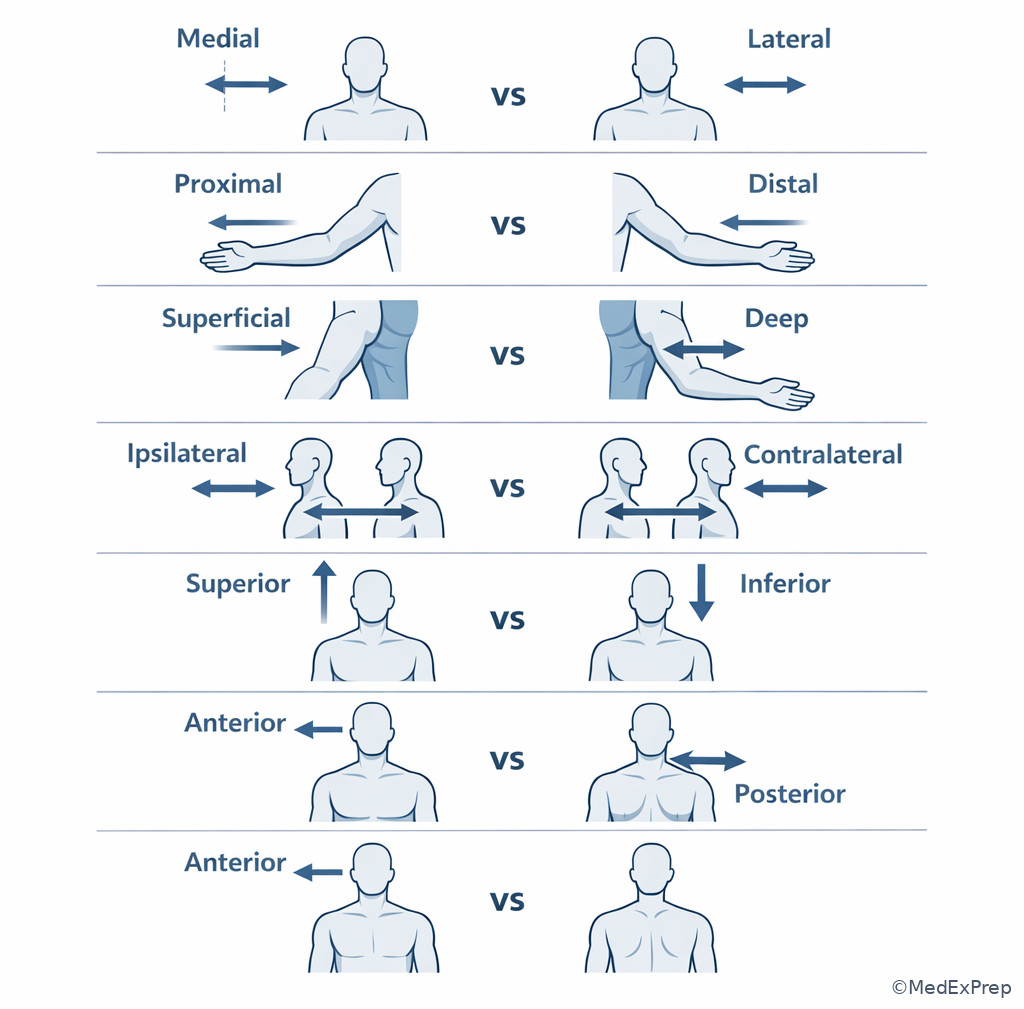
B Worked example
A 19-year-old student athlete with eczema and a healed wrist fracture is asked during a practical review: “Relative to the shoulder, the fingers are most appropriately described as which?” A distracting note mentions that when standing naturally, the fingers are also inferior to the shoulder. Identify the task: pick the best anatomical descriptor. Extract key facts: both structures are on the same limb and the question asks for the most appropriate term. Apply the precision rule: distal is better than inferior because the relationship is along the limb from the trunk. Eliminate inferior as a broadly true but less specific distractor. Eliminate lateral because it tests a different axis. Verify: on board exams, “most appropriate” often means “most precise anatomical term,” not just “a true statement.”
C Exam trap
D Checkpoint
Question: Which option provides the most precise description of the wrist relative to the elbow in anatomical position?
- A. Inferior
- B. Distal
- C. Lateral
- D. Superficial
Answer: B
- A: Tempting because the wrist is lower than the elbow in an upright person; wrong because limb relationships are more precisely described by proximal/distal.
- B: Correct because the wrist is farther from the limb origin and trunk than the elbow.
- C: Tempting if hand position is imagined relative to the body; wrong because the tested relationship is along the limb, not from the midline.
- D: Tempting because skin over the wrist is superficial; wrong because this does not compare wrist to elbow as whole regions.
Exam Traps & Differentiators
- Most common wrong answer and why: using observer perspective for left/right. Tempting because diagrams are seen from outside; wrong because anatomical language is always subject-centered.
- Looks similar but isn't: inferior versus distal. Both may be true on a standing limb, but distal is the precise limb-origin term.
- Looks similar but isn't: anterior versus superior in a supine body. Surface facing upward does not redefine anatomical direction.
- Looks similar but isn't: sagittal versus midsagittal. Equal right-left halves are required for midsagittal.
- Looks similar but isn't: superficial versus anterior. One describes depth from the surface; the other describes front-back orientation.
| Confusable pair | What the correct term tests | Why the wrong option is tempting | Single discriminator |
|---|---|---|---|
| Distal vs inferior | Position along a limb | The distal structure is often also lower | If both structures are on one limb, prefer proximal/distal |
| Medial vs proximal | Distance from midline | Both can imply “closer in” | Midline clue = medial/lateral |
| Anterior vs superficial | Front-back relation | Front structures may also be near the surface | Layering clue = superficial/deep |
| Midsagittal vs sagittal | Equal right-left halves | Both are right-left cuts | Equal halves required for midsagittal |
| Prone vs posterior | Current body posture | Both involve the back | Prone is position; posterior is direction |
| Supine vs anterior | Current body posture | The front faces upward | Supine is posture only |
| If the stem says... | Think... |
|---|---|
| “In anatomical position” | Reset the body to subject-centered standard reference |
| “Equal right and left halves” | Midsagittal |
| “Horizontal slice” or “axial image” | Transverse plane |
| “Same limb, farther from trunk” | Distal |
| “Closer to the skin surface” | Superficial |
| “Same side as” | Ipsilateral |
Related traps will reappear in the neighboring topic on body cavities. For example, students who confuse anterior with superior also tend to confuse ventral with “upward” in a supine body. Build the fixed body-centered frame now so that cavity and organ relationship questions feel easier later.
Algorithm / Approach
Rapid Review
- Anatomical position -> subject-centered reference, not observer-centered
- Midsagittal -> equal right-left halves, not just any sagittal cut
- Frontal plane -> separates anterior from posterior
- Transverse plane -> separates superior from inferior
- Proximal/distal -> best for same-limb comparisons
- Medial/lateral -> best for distance from the midline
- Superficial/deep -> best for tissue layering
- Ipsilateral/contralateral -> same side versus opposite side
- Supine -> face up; does not redefine anterior
- Prone -> face down; does not redefine posterior
- Radius -> lateral forearm bone in anatomical position
- Spinous process -> posterior to vertebral body regardless of posture
- “Most appropriate” -> choose the most precise anatomical term, not just a true one
- Axial image -> synonym for transverse section
Self-check quiz
1.1.1.8 Question 1
A first-year chiropractic student studies an anterior body diagram while standing next to the lab table. The image appears mirrored on the screen, and a distracting note says the monitor was rotated 180 degrees earlier. Which structure is lateral to the ulna in anatomical position?
- A. Radius
- B. Humerus
- C. Scapula
- D. Sternum
1.1.1.9 Question 2
A review stem states that a plane passes through the body to create equal right and left halves. The cadaver is lying supine, and a distracting sentence notes the examiner is standing at the head of the table. Which plane is most appropriate?
- A. Frontal
- B. Parasagittal
- C. Midsagittal
- D. Transverse
1.1.1.10 Question 3
A 42-year-old woman in a teaching vignette has obesity and controlled hypothyroidism. She is lying prone during a palpation demonstration, and a distracting note says the anterior torso is against the table. Which statement is the best anatomical interpretation?
- A. The posterior surface is facing upward.
- B. Posterior now means toward the table.
- C. Superior now means upward from the table.
- D. The sternum is posterior to the vertebral column in this position.
1.1.1.11 Question 4
A 33-year-old man with prior ankle sprains and mild asthma is described in anatomical position. The item asks for the most appropriate description of the ankle relative to the knee. A distracting clue notes the ankle is also lower than the knee when standing. Which answer is best?
- A. Inferior
- B. Distal
- C. Medial
- D. Superficial
1.1.1.12 Question 5
A 26-year-old anatomy tutor with eczema and corrected vision is reviewing sectional images. One image shows a horizontal slice through the trunk at the level of the umbilicus; a distracting note says the image is displayed in portrait orientation on the computer screen. Which plane produced this image?
- A. Transverse
- B. Frontal
- C. Parasagittal
- D. Midsagittal
1.1.1.13 Question 6
A 58-year-old man with hypertension and chronic shoulder pain is used in a board-style anatomy stem. He is shown supine with the arms slightly abducted. The item asks which relationship remains correct despite the change in body position, and a distracting clue states that the anterior surface is now facing upward. Which answer is most appropriate?
- A. The heart is superior to the head.
- B. The vertebral column is posterior to the sternum.
- C. The sternum becomes superior to the heart because it faces upward.
- D. The scapula is anterior to the clavicle when the patient is supine.
1.1.1.14 Question 7
A 21-year-old student athlete with a healed wrist fracture and seasonal allergies is asked to identify the most precise anatomical term for the fingers relative to the elbow. A distracting comment notes that the fingers are also farther from the midline when the arm is abducted. Which answer is best?
- A. Lateral
- B. Inferior
- C. Distal
- D. Superficial
1.1.1.15 Question 8
A 49-year-old woman with obesity and chronic low back stiffness reviews a spinal anatomy figure. The prompt asks which statement best integrates standard anatomical language with vertebral relationships. A distracting note mentions that the figure is viewed from above in a rotated orientation. Which answer is most appropriate?
- A. The spinous process is anterior to the vertebral body.
- B. The vertebral body is posterior to the spinous process in a superior view.
- C. The spinous process is posterior to the vertebral body regardless of viewing angle.
- D. Posterior means closer to the viewer in a superior view.
Answer key
1.1.1.16 Question 1: A. Radius
A. Radius: Tempting because many students remember the radius on the thumb side but can get thrown by mirrored images; it is correct because in anatomical position the radius is lateral to the ulna. The single stem clue is in anatomical position, which overrides the mirrored screen view. Source: Moore, Dalley, and Agur; Tortora and Derrickson.
B. Humerus: Tempting because it is in the same upper limb and proximal to the forearm bones; incorrect because the question asks what is lateral to the ulna, and the humerus is not the paired lateral forearm bone. The discriminating clue is the ulna-specific comparison.
C. Scapula: Tempting because it lies laterally on the posterior thorax relative to the midline; incorrect because it is not the direct lateral counterpart to the ulna within the forearm. The single clue is that the answer family should be comparable upper-limb structures.
D. Sternum: Tempting because it provides a central landmark for medial-lateral reasoning; incorrect because the sternum is medial in the thorax and unrelated to the ulna's immediate paired relation. The discriminating clue is forearm anatomy.
1.1.1.17 Question 2: C. Midsagittal
A. Frontal: Tempting because students may think “through the body vertically” means frontal; incorrect because frontal divides anterior and posterior, not equal right and left halves. The single clue is equal right and left halves. Source: Moore, Dalley, and Agur.
B. Parasagittal: Tempting because it still divides right and left; incorrect because parasagittal creates unequal right and left portions. The discriminating clue is equal.
C. Midsagittal: Correct because a midline cut producing equal right and left halves defines the midsagittal plane. The supine position and examiner location are noise.
D. Transverse: Tempting because students may visualize a cross-section table setup; incorrect because transverse divides superior and inferior. The discriminating clue is right-left division.
1.1.1.18 Question 3: A. The posterior surface is facing upward.
A. The posterior surface is facing upward: Correct because prone means face down, so the back or posterior surface faces upward. The discriminating clue is the position term prone. Source: Tortora and Derrickson.
B. Posterior now means toward the table: Tempting because the body is contacting the table anteriorly and students may convert direction to gravity; incorrect because posterior remains toward the back, not toward any external object. The single clue is that directional terms remain body-centered.
C. Superior now means upward from the table: Tempting because “upward” sounds intuitive in a prone subject; incorrect because superior always means toward the head. The discriminating clue is the fixed definition of superior.
D. The sternum is posterior to the vertebral column in this position: Tempting if the student reverses front and back because of posture; incorrect because the sternum remains anterior to the vertebral column. The single clue is that posture does not reverse anatomy.
1.1.1.19 Question 4: B. Distal
A. Inferior: Tempting because the ankle is indeed lower than the knee in an upright person; incorrect because the question asks for the most appropriate term along the same limb. The single clue is same-limb comparison. Source: Moore, Dalley, and Agur.
B. Distal: Correct because the ankle is farther from the limb origin and trunk than the knee. The discriminating clue is that proximal/distal is the precise limb axis.
C. Medial: Tempting because students may picture the medial malleolus and mix structure-specific facts into a region question; incorrect because the question compares ankle to knee along the limb, not to the midline. The single clue is region-to-region limb relation.
D. Superficial: Tempting because bony landmarks at the ankle are palpable near the surface; incorrect because superficial/deep compares tissue depth, not overall limb segment position. The discriminating clue is wrong axis.
1.1.1.20 Question 5: A. Transverse
A. Transverse: Correct because a horizontal slice through the trunk separates superior and inferior portions. The discriminating clue is horizontal slice. Source: Tortora and Derrickson.
B. Frontal: Tempting because a screen may display the image as if viewed from the front; incorrect because frontal sections divide anterior and posterior, not top and bottom. The single clue is the type of separation rather than the display orientation.
C. Parasagittal: Tempting because many imaging stems mention slices that miss the midline; incorrect because parasagittal still divides right and left portions. The discriminating clue is superior-inferior division.
D. Midsagittal: Tempting because umbilicus suggests midline anatomy; incorrect because the described cut is horizontal, not a midline right-left division. The single clue is horizontal level.
1.1.1.21 Question 6: B. The vertebral column is posterior to the sternum.
A. The heart is superior to the head: Tempting because students may misread “remains correct” and rush past the obvious impossibility; incorrect because the head remains superior to the heart. The discriminating clue is basic vertical orientation. Source: Moore, Dalley, and Agur.
B. The vertebral column is posterior to the sternum: Correct because this front-back relationship is fixed relative to the body and does not change in the supine position. The single clue is that posture changes which surface faces upward, not anatomical direction.
C. The sternum becomes superior to the heart because it faces upward: Tempting because in supine position the anterior surface faces upward; incorrect because superior is headward, not upward relative to gravity. The discriminating clue is distinction between body-centered terms and gravity-based intuition.
D. The scapula is anterior to the clavicle when the patient is supine: Tempting because rotated views can distort shoulder relationships; incorrect because the scapula remains posterior relative to the clavicular anterior framework. The single clue is that supine posture does not invert anterior/posterior.
1.1.1.22 Question 7: C. Distal
A. Lateral: Tempting because when the arm is abducted the fingers move farther from the midline; incorrect for this scenario because the stem asks for the most precise term relative to the elbow on the same limb. The discriminating clue is same-limb origin. Source: Moore, Dalley, and Agur.
B. Inferior: Tempting because the fingers may hang lower than the elbow in standing posture; incorrect because inferior is less precise than distal for limb segment comparison. The discriminating clue is “most precise anatomical term.”
C. Distal: Correct because the fingers are farther from the trunk and point of origin than the elbow. The single clue is the same-limb comparison.
D. Superficial: Tempting if a student thinks of skin or nails on the fingers; incorrect because superficial/deep does not compare overall position of fingers to elbow. The discriminating clue is wrong relationship type.
1.1.1.23 Question 8: C. The spinous process is posterior to the vertebral body regardless of viewing angle.
A. The spinous process is anterior to the vertebral body: Tempting only if the student lets a rotated superior view reverse the image mentally; incorrect because the spinous process projects posteriorly. The discriminating clue is fixed vertebral anatomy. Source: Standring; Moore, Dalley, and Agur.
B. The vertebral body is posterior to the spinous process in a superior view: Tempting because rotated figures can trick page-based orientation; incorrect because viewpoint does not reverse true relationships. The single clue is standard anatomical language.
C. The spinous process is posterior to the vertebral body regardless of viewing angle: Correct because anatomical directions describe the structure itself, not the way the figure is presented. The discriminating clue is independence from viewing angle.
D. Posterior means closer to the viewer in a superior view: Tempting because students confuse camera perspective with anatomy; incorrect because posterior means toward the back of the body, not toward the observer. The discriminating clue is subject-centered orientation.
Keep going with the full NBCE Part I Prep Course (NBCE I)
You just studied the way members do, in the same lesson interface. Full access unlocks every lesson, the question bank and flashcards for a full year.
One payment · 1 year of access · No auto-renewal