1.1.1 - Health Supervision Schedule
Why it matters
- On exam stems, the “best next step” often depends first on how old the child is and whether the encounter is a routine health supervision visit.
- Many pediatrics questions hide preventive care logic inside common complaints: missed vaccines, overdue growth checks, delayed milestones, school forms, or adolescent confidentiality.
- Knowing the schedule prevents a common trap: ordering a test or counseling point that belongs to a different age.
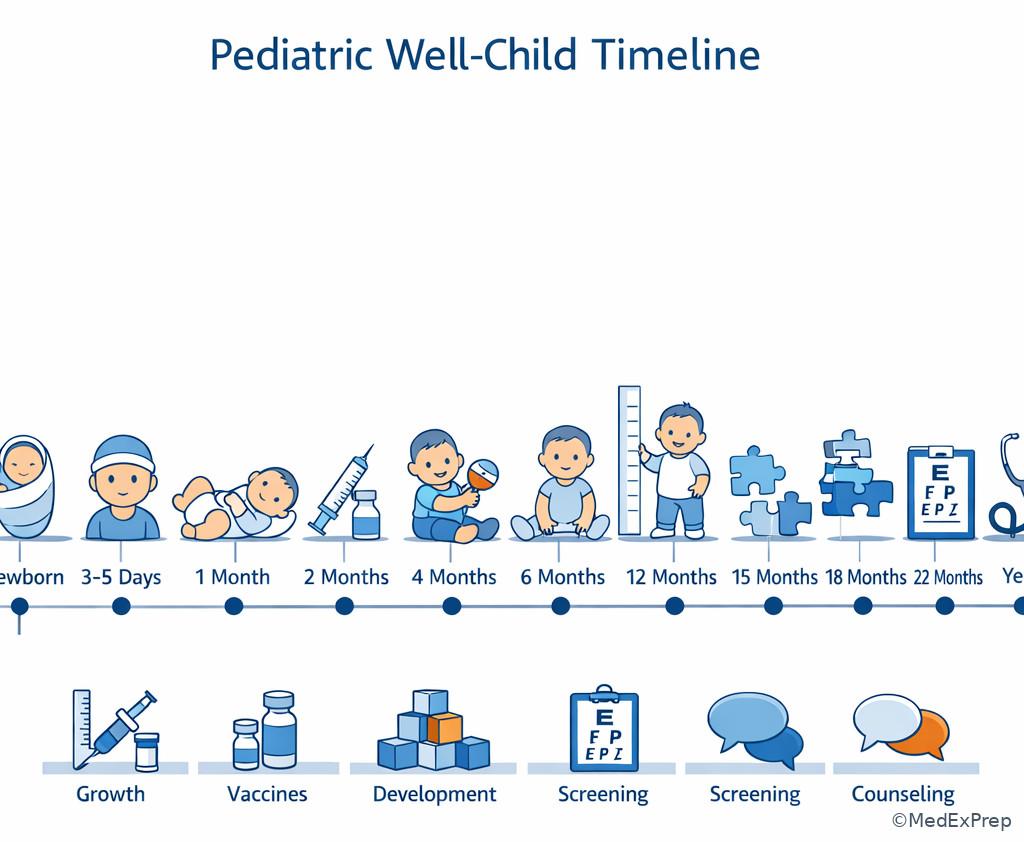
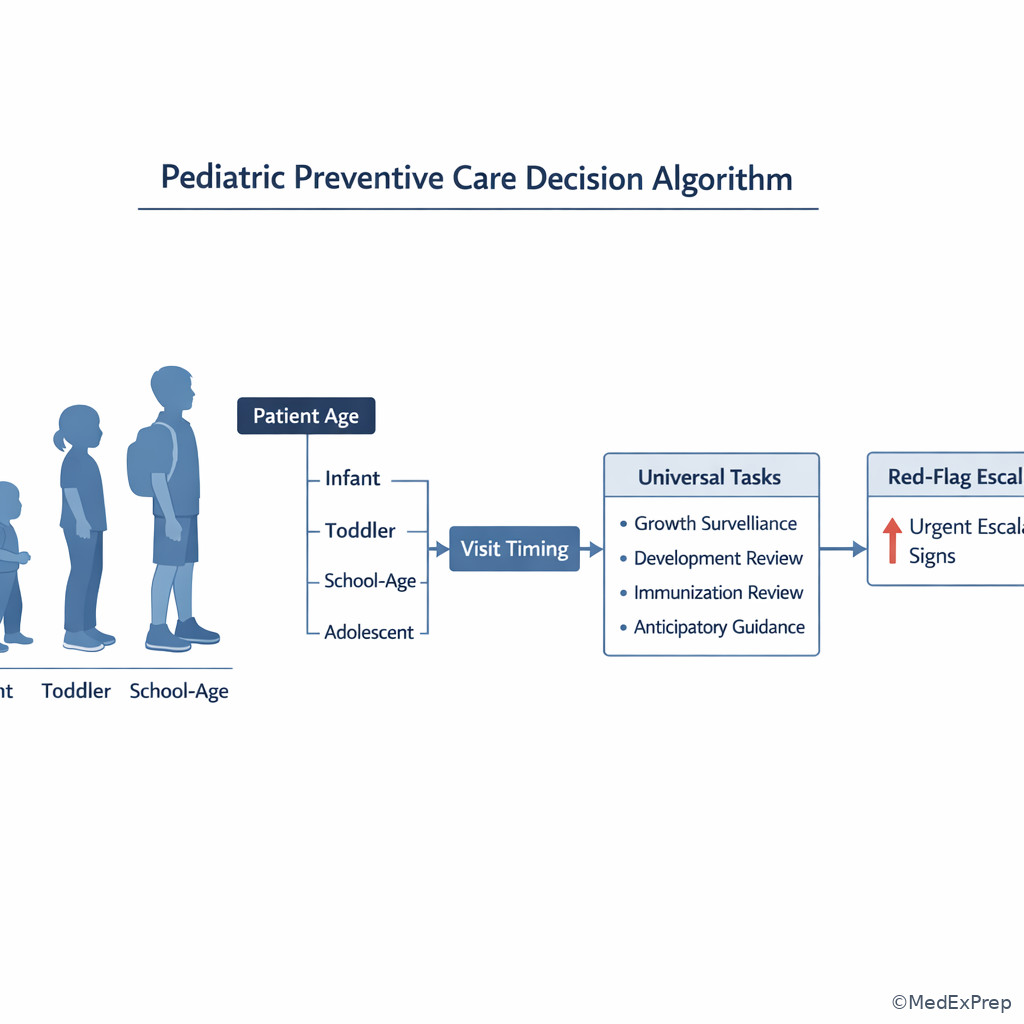
- Health supervision is where growth, development, screening, immunizations, and anticipatory guidance are integrated into one decision framework. See Fig 1.
Key Terms & Must-Know Facts
1.1.1.1 Key terms
- Health supervision visit — routine preventive pediatric visit focused on growth, development, immunizations, screening, and counseling.
- Well-child check — practical synonym for a health supervision visit.
- Developmental surveillance — ongoing review of milestones, behavior, and caregiver concerns at every visit.
- Screening — standardized test or risk-based assessment performed at selected ages or when indicated.
- Anticipatory guidance — age-specific counseling on feeding, sleep, safety, behavior, and prevention.
- Growth monitoring — serial weight, length/height, head circumference when age-appropriate, and BMI when age-appropriate.
- Newborn visit — early post-discharge assessment, often within the first days after birth.
- Periodic visit schedule — the expected sequence of preventive visits through adolescence.
- Catch-up preventive care — re-entry into age-appropriate preventive care after missed visits.
- Problem-focused visit — illness- or complaint-directed encounter, distinct from routine health supervision even if combined in practice.
- Medical home — continuous, coordinated, family-centered pediatric care.
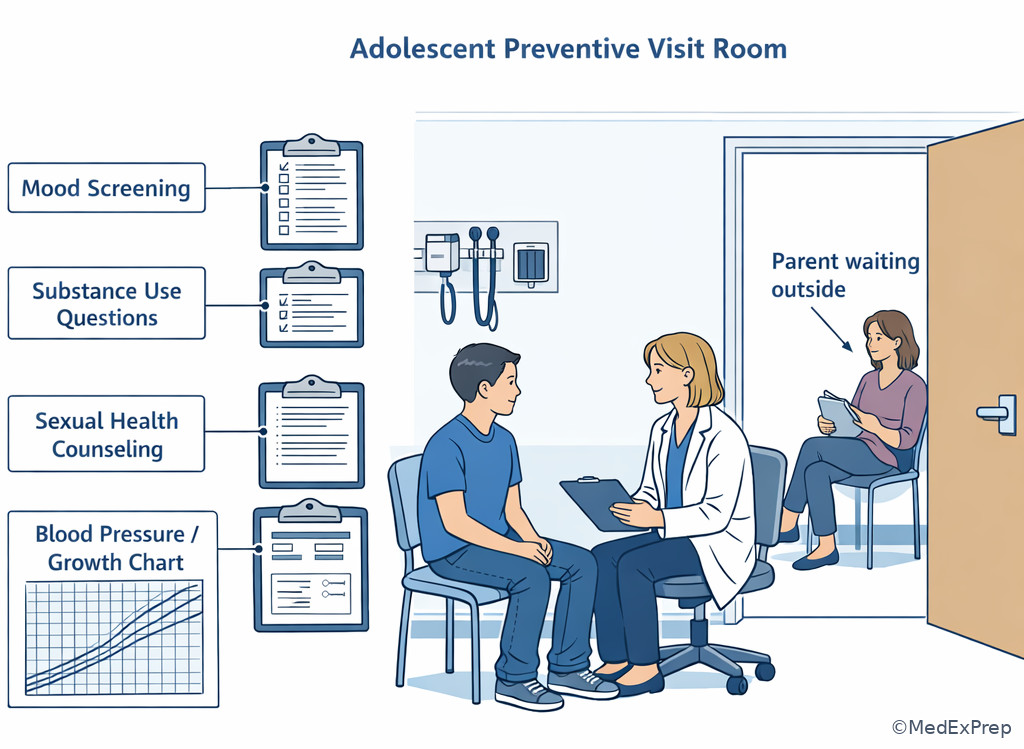
- Adolescent confidential time — part of the teen visit that allows discussion of sensitive issues.
1.1.1.2 Must-know facts
- Infancy has the densest health supervision schedule because growth, feeding, vaccines, and developmental changes are rapid.
- The classic preventive visit ages that recur on exams are: newborn, 3–5 days, 1 month, 2, 4, 6, 9, 12, 15, 18, 24, 30 months, then yearly.
- 30 months is a frequent test point because learners often skip it.
- After age 3 years, routine health supervision is typically annual.
- Every well visit includes growth review, developmental surveillance, immunization review, and anticipatory guidance.
- Formal screening is not the same as surveillance; this difference becomes critical in the next topic.
- If a child misses several preventive visits, return to an age-appropriate current visit; do not resume by “catching up” every missed interval as separate mandatory visits.
- A well visit becomes urgent if red flags appear: dehydration, respiratory distress, altered mental status, abuse concern, failure to thrive with instability, or severe depression/suicidality.
| Age | Usual health supervision timing | High-yield exam emphasis |
|---|---|---|
| Newborn | Nursery/discharge period + early outpatient follow-up | Feeding, weight, jaundice, safety, parent adjustment |
| 3–5 days | Early post-discharge visit | Weight loss, hydration, jaundice, breastfeeding adequacy |
| 1 month | Early infancy | Growth velocity, feeding, sleep patterns |
| 2, 4, 6 months | Frequent infant visits | Vaccines, milestones, feeding progression, safety |
| 9 months | Late infancy | Mobility, sleep, stranger anxiety, injury prevention |
| 12, 15, 18 months | Toddler transition | Language, gait, nutrition shift, behavior, screening milestones |
| 24 months | Early toddler | Language burst, autonomy, behavior counseling |
| 30 months | Late toddler bridge visit | Development and behavior reassessment; commonly forgotten |
| 3 years and older | Annual | School readiness, BMI, behavior, sports/school issues, adolescent confidentiality later |
Exam takeaway: Anchor preventive pediatrics by visit timing first, then attach the age-specific tasks to the correct visit.
flowchart LR
A[Birth and discharge] --> B[3 to 5 day visit]
B --> C[1 month]
C --> D[2 months]
D --> E[4 months]
E --> F[6 months]
F --> G[9 months]
G --> H[12 months]
H --> I[15 months]
I --> J[18 months]
J --> K[24 months]
K --> L[30 months]
L --> M[Yearly from age 3 onward]
Exam takeaway: Use age landmarks to separate infant, toddler, school-age, and adolescent preventive priorities.
Core content
1.1.1.3 Foundational schedule: when well-child visits occur
A Explanation
The decision conflict is simple but heavily tested: Is this child due for a routine health supervision visit now, or are you mixing up the schedule with screening or vaccine timing? The single rule that resolves most questions is this: infancy is frequent, toddler years still include fixed milestone visits, and after age 3 the usual schedule becomes annual. In practical exam terms, think newborn/early follow-up, then 1 month; 2, 4, 6, 9 months; 12, 15, 18, 24, 30 months; then yearly.
WHY THIS IS TESTED: questions often present an age and ask the most appropriate next preventive step. The trap is skipping 30 months or assuming annual visits begin before age 3. Another trap is choosing a problem-focused answer because the stem includes mild noise like spit-up, picky eating, or sleep resistance; if the child is otherwise stable, the preventive schedule still governs the visit type.
Choose the standard periodic schedule when the child is clinically stable and the question is about routine supervision. Reject invented schedules such as every 6 months for all toddlers or “only annual after infancy.” Monitor continuity: missed visits increase the risk of delayed vaccines, missed growth abnormalities, and missed developmental concerns, but the correction is to re-enter the child into age-appropriate preventive care rather than reconstruct every missed interval as separate required visits.
B Worked example
A 29-month-old boy is brought for daycare paperwork. He was born at term, has mild eczema and a history of two prior ear infections, and his grandmother is worried that he is “small like his father.” He had a 24-month visit but missed one appointment after the family moved. He is active, afebrile, and eats a limited diet. A CBC drawn at urgent care 3 months ago for a viral illness was normal. The stem asks for the most appropriate preventive follow-up timing.
Reasoning chain: Identify task: this is a preventive scheduling question, not an acute illness question. Extract key facts: age 29 months, stable, missed one visit, no urgent abnormality. Apply rule: after 24 months, there is still a 30-month health supervision visit before annual visits begin at age 3. Eliminate distractors: “annual at age 4 only” ignores ongoing pediatric preventive care; “return at 36 months because toddlers are seen yearly” starts annual care too early; “schedule multiple make-up visits for each missed interval” misuses the preventive schedule. Verify safety: no instability requiring escalation. Best answer: schedule the 30-month well visit.
C Exam trap
D Checkpoint
Question: A healthy 17-month-old girl presents for routine preventive care. Which visit framework is most appropriate?
- Annual visits beginning now
- Next routine visit at 18 months, then 24 months
- Next routine visit at 2 years only
- Every 6 months until kindergarten
Correct answer: B.
- A: Tempting because school-age children are usually seen yearly, but this is wrong because annual scheduling starts later; the discriminating clue is age 17 months.
- B: Tempting because it sounds specific, and it is right because toddler fixed visits include 18 months and 24 months.
- C: Tempting because 2 years is a memorable milestone, but wrong because it skips the important 18-month visit.
- D: Tempting because frequent follow-up feels safe, but wrong because the standard schedule is not generic every 6 months.
1.1.1.4 What happens at every well visit versus what is age-specific
A Explanation
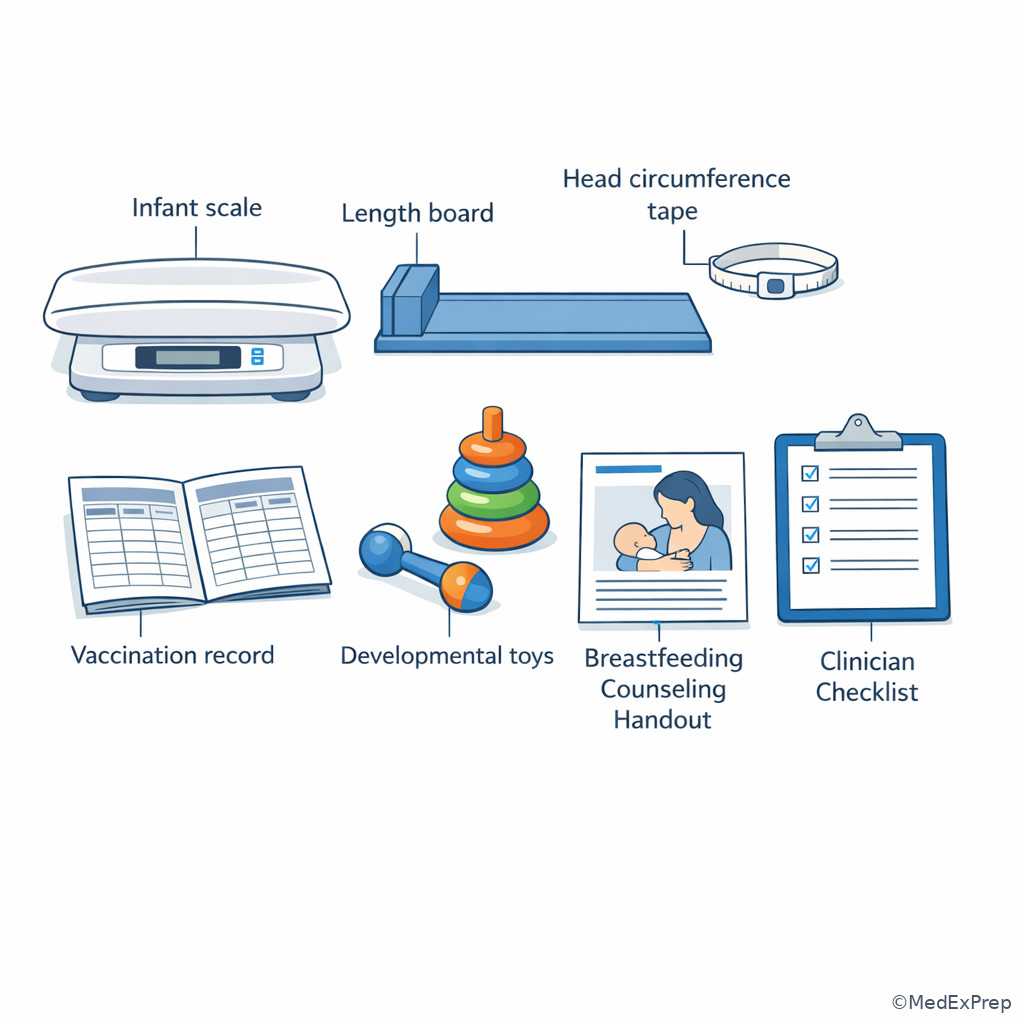
The decision conflict here is what belongs at every routine health supervision visit versus what is attached to selected ages. The resolving rule: every well-child visit includes broad surveillance and preventive review, but only some interventions are age-anchored. Across ages, always think growth measurements, interval history, nutrition review, developmental surveillance, physical examination, immunization review, and anticipatory guidance. The age-specific details change, but the scaffold stays constant. See Fig 2.
WHY THIS IS TESTED: exam stems frequently ask for the “most important additional assessment” or “best next step” during a routine visit. If you know the universal components, you can reject distractors that belong only to acute care or to future screening lessons. For example, a healthy 4-month-old with sleep concerns still needs growth tracking and developmental surveillance at that same visit. A healthy adolescent presenting for sports clearance still needs psychosocial review and confidential discussion when appropriate, not just musculoskeletal clearance.
Choose universal tasks first when the answer choices mix surveillance, screening, immunizations, counseling, and unrelated acute testing. Reject acute disease workups unless the stem gives red flags. This is also where students confuse surveillance with screening: surveillance is continuous, broad observation and questioning at every visit; formal screening uses tools or tests at selected ages or risk states. The upcoming topic on screening builds directly on this distinction.
B Worked example
A 13-year-old girl presents for a school sports form. She has mild intermittent asthma and obesity, takes no daily medicines, and reports occasional fatigue during menses. Her mother mainly wants the paperwork signed. She is up to date on major childhood vaccines, and her blood pressure today is normal. A tempting clue is knee pain after soccer practice. The question asks for the most appropriate additional component of this routine visit.
Reasoning chain: Identify task: not an orthopedic workup first, but a health supervision encounter in an adolescent. Extract key facts: age 13, routine/preparticipation context, stable, no red flags. Apply rule: every well visit includes broader preventive review; in adolescents, confidential psychosocial assessment and risk counseling become especially high yield. Eliminate distractors: immediate knee imaging is not indicated without acute injury findings; random broad laboratory testing is not a universal well-visit component; deferring all preventive care because the visit is for forms misunderstands health supervision. Verify safety: stable, no emergent concerns. Best answer: include routine preventive assessment, including psychosocial review and age-appropriate counseling.
C Exam trap
D Checkpoint
Question: Which task is most appropriate at every routine health supervision visit?
- Developmental surveillance and interval review
- Formal anemia screening
- Formal lead testing
- Routine vision screening instrument use in all ages
Correct answer: A.
- A: Tempting because it sounds broad, and it is right because surveillance is continuous at all well visits.
- B: Tempting because anemia matters in pediatrics, but wrong because formal screening is age- or risk-based rather than universal at every visit.
- C: Tempting because lead is a classic preventive topic, but wrong because testing depends on age and risk context.
- D: Tempting because vision care is preventive, but wrong because the methods and timing vary by age.
- The most commonly forgotten fixed toddler preventive visit is 30 months.
- True or False: Formal screening and developmental surveillance are the same process. False.
- Name the 3 universal well-visit pillars: growth review, developmental/interval surveillance, preventive counseling/immunization review.
Exam takeaway: Separate universal well-visit components from age-specific screenings so you do not choose a test that is not due.
flowchart TB
A[Routine well visit] --> B[Always do: growth and vitals]
A --> C[Always do: interval history and development]
A --> D[Always do: exam and vaccine review]
A --> E[Always do: anticipatory guidance]
A --> F[Sometimes do: formal age-specific or risk-based screening]
Exam takeaway: Visualize how growth, developmental observation, feeding review, and caregiver counseling happen in one integrated encounter.
1.1.1.5 Age-linked priorities: infancy, toddler years, school age, adolescence
A Explanation
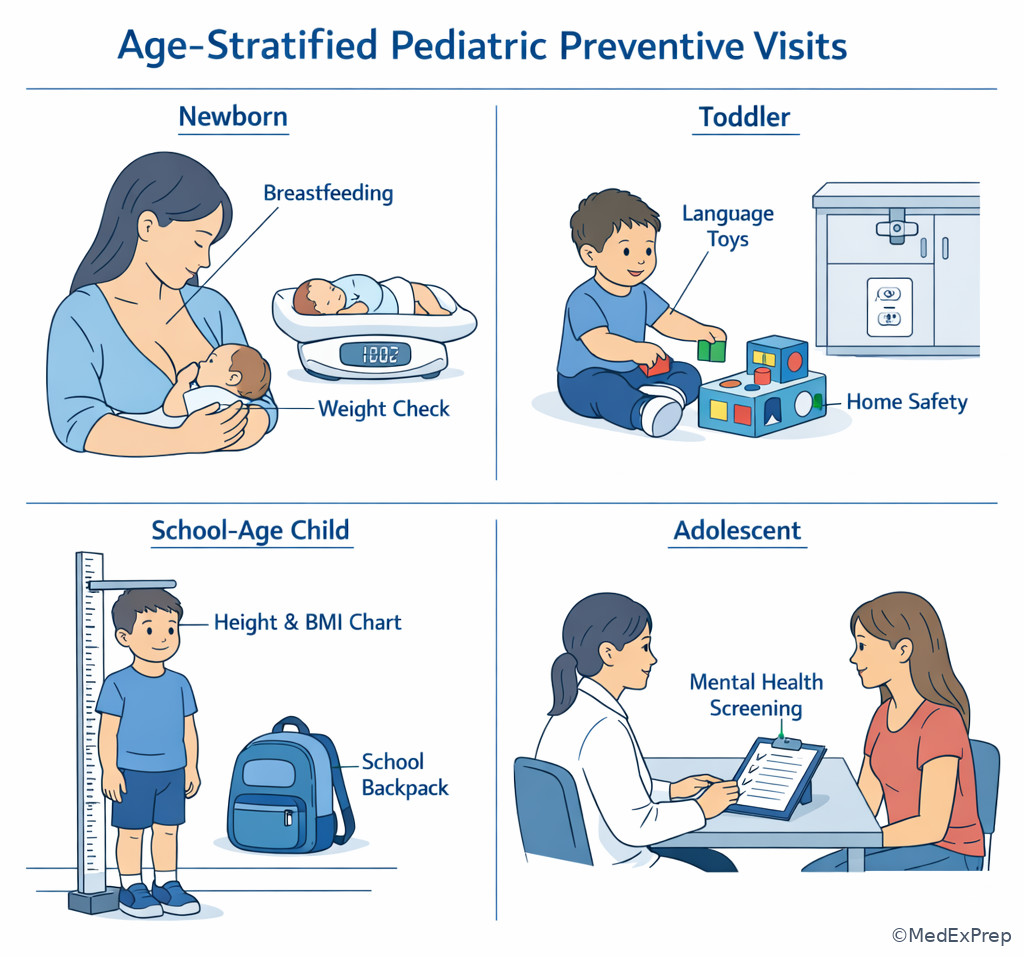
The decision conflict is not just when the visit happens, but what priority should dominate at that age. The single rule: prioritize what is changing fastest. In early infancy, feeding adequacy, weight trend, jaundice follow-up, parent adjustment, and early safety dominate. In later infancy, mobility and injury prevention rise. Toddler visits emphasize language, behavior, autonomy, sleep boundaries, nutrition transitions, and injury prevention. School-age visits shift toward school performance, exercise, behavior, and BMI trends. Adolescent visits add confidentiality, risk behaviors, mood screening logic, reproductive health, and independence planning. See Fig 3.
WHY THIS IS TESTED: the stem may ask for the “most important anticipatory topic” or “best next routine counseling point.” The correct answer is often not the most severe-sounding topic overall, but the one most linked to that child’s developmental stage. For example, drowning prevention is important broadly, but feeding adequacy and jaundice risk outrank it in a 4-day-old. Confidential psychosocial assessment is central in adolescents, not in toddlers.
Choose the answer that fits the age-development pair. Reject counseling that belongs to another stage even if it is generally good advice. This is also where vaccine timing can distract you; the question may look like an immunization stem but is actually asking about developmental priorities during a scheduled health supervision visit. The next topic on anticipatory guidance will refine this further.
B Worked example
A 4-day-old breastfed newborn presents for early follow-up. She was born at 39 weeks, has an older sibling in daycare, and the mother has hypothyroidism and anxiety. The infant has lost 7% of birth weight, has 4 wet diapers today, and appears mildly jaundiced to the upper chest but feeds every 2–3 hours. The father asks whether they should mainly discuss future toilet training because their toddler was difficult. The question asks for the most appropriate priority of this visit.
Reasoning chain: Identify task: determine the dominant preventive priority at this age. Extract key facts: 4 days old, breastfeeding, early weight change, jaundice concern, hydration data available. Apply rule: early newborn follow-up prioritizes feeding adequacy, hydration/weight, jaundice assessment, and caregiver support. Eliminate distractors: toilet training belongs to a later developmental stage; sports participation counseling is irrelevant; annual school performance review is age-mismatched. Verify safety: this infant still may need jaundice/feeding evaluation, so the encounter can remain preventive but with close clinical attention. Best answer: newborn feeding, weight, and jaundice follow-up are the key priorities.
C Exam trap
D Checkpoint
Question: During a routine 15-year-old preventive visit, which additional focus is most appropriate compared with a school-age visit?
- Exclusive emphasis on booster-seat positioning
- Confidential psychosocial risk assessment
- Primary focus on separation anxiety with strangers
- Detailed counseling on introducing solid foods
Correct answer: B.
- A: Tempting because injury prevention always matters, but wrong because the distinctive adolescent addition is confidential psychosocial assessment.
- B: Tempting because it feels like an advanced step, and it is right because adolescent health supervision adds confidential discussion of risk, mood, and sexual health.
- C: Tempting because behavior concerns appear in pediatrics, but wrong because stranger-related separation patterns are not the central adolescent priority.
- D: Tempting only if the learner ignores age; it is wrong because feeding solids belongs to infancy.
Exam takeaway: When answer choices all sound reasonable, choose the one tied most tightly to the child’s developmental stage.
flowchart TD
A[Infancy] --> A1[Feeding and growth]
A --> A2[Sleep and safe sleep]
A --> A3[Early injury prevention]
B[Toddler] --> B1[Language and behavior]
B --> B2[Nutrition habits]
B --> B3[Home injury prevention]
C[School age] --> C1[School and peers]
C --> C2[Activity and BMI]
C --> C3[Family routines]
D[Adolescent] --> D1[Confidentiality]
D --> D2[Mood and substances]
D --> D3[Sexual health and safety]
Exam takeaway: A visual comparison of infant, toddler, school-age, and adolescent visits helps you avoid choosing counseling from the wrong age group.
1.1.1.6 Missed visits, catch-up logic, and when a well visit is no longer routine
A Explanation
The decision conflict is twofold: How do you handle missed preventive visits, and when must you stop treating the encounter as purely routine? The resolving rule for missed care is to re-enter the child into care at the current age-appropriate health supervision visit and address overdue preventive items there or through catch-up plans. Do not create a fictional requirement to revisit every missed age as a separate mandatory stop. The resolving rule for escalation is different: if instability or danger appears, the encounter shifts from preventive scheduling to acute evaluation and supervised escalation.
WHY THIS IS TESTED: exam stems love mixed presentations — a child comes for a well visit but is found to have weight faltering, respiratory distress, severe depressive symptoms, or suspected abuse. Students who cling to the “routine visit” framing miss the emergency cue. Conversely, students may overreact to mild noise such as picky eating or a low-grade viral history and forget the main preventive task.
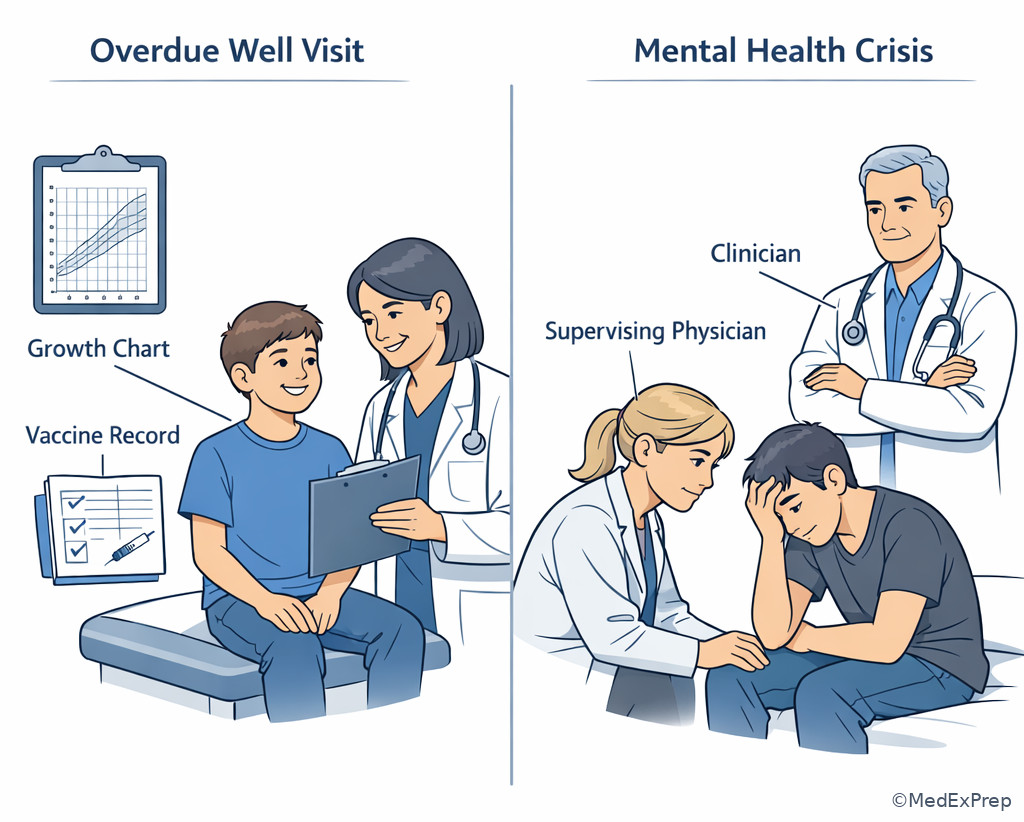
Choose catch-up preventive care when the child is stable and overdue. Reject the idea that the child must return for every previously missed time point. Choose escalation when the stem includes red flags: toxic appearance, severe dehydration, hypoxemia, altered mental status, unstable vitals, suicidal ideation, suspected nonaccidental trauma, or neonatal feeding failure with concerning weight loss. As a supervised PA learner, the correct next step often includes urgent stabilization concepts and notifying the supervising clinician rather than independent definitive management. See Fig 4.
B Worked example
A 7-year-old boy presents after missing preventive care for 2 years because the family changed insurance. He has ADHD, mild persistent asthma, and a recent school concern for inattention. His mother also mentions he has had vomiting for one day. He is interactive, drinking well, and has normal vital signs. A urinalysis from urgent care last month was normal. The question asks for the most appropriate next step in preventive care planning.
Reasoning chain: Identify task: overdue well-child care in a stable school-age child. Extract key facts: missed visits, currently stable, mild distracting symptom but no dehydration or toxicity. Apply rule: perform the current age-appropriate health supervision visit and address overdue preventive items now; do not schedule separate retrospective visits for age 5 and 6. Eliminate distractors: sending to the emergency department is unsupported without red flags; restarting the schedule at infancy/toddler intervals is nonsensical; postponing all preventive care until all minor acute symptoms fully resolve is excessive in a stable child. Verify safety: no emergent instability. Best answer: resume age-appropriate routine care today and arrange needed follow-up items.
C Exam trap
D Checkpoint
Question: A 16-year-old presents for a routine physical but reports 2 weeks of worsening depression and admits to a current suicide plan. What is the most appropriate next step?
- Continue the routine preventive visit and revisit mood next year
- Provide general wellness counseling only
- Initiate urgent mental health safety evaluation and notify the supervising clinician
- Schedule a standard annual follow-up in 6 months
Correct answer: C.
- A: Tempting if the learner overcommits to the well-visit framework, but wrong because active suicidality overrides routine scheduling.
- B: Tempting because counseling belongs to preventive care, but wrong because safety assessment must come first.
- C: Tempting because it changes the visit type, and it is right because danger to self requires immediate supervised escalation.
- D: Tempting because follow-up is good practice, but wrong because the stem requires immediate action now.
- True or False: A child who missed 3 years of preventive care should repeat all prior age-specific visits one by one. False.
- The most important first question when a child presents for overdue preventive care is: Is the child stable, or is there a red flag requiring acute escalation?
- Name 3 red flags that end a routine well-visit frame: respiratory distress, altered mental status, suicidality.
Exam takeaway: Overdue preventive care is managed by current age and stability; instability immediately shifts the question to acute evaluation.
flowchart TD
A[Child presents for well visit] --> B{Any red flags?}
B -- Yes --> C[Urgent evaluation and notify supervising clinician]
B -- No --> D[Resume age-appropriate preventive care]
D --> E[Address overdue vaccines, surveillance, counseling, and needed screening] Exam takeaway: Distinguish the stable child returning to care from the child whose preventive visit uncovers a same-day emergency.
1.1.1.7 Putting it together on exam stems: schedule, surveillance, and next best step
A Explanation
The final integration task is to answer board-style stems efficiently. The conflict is usually between four plausible options: the right visit timing, the right routine task, the right age-specific priority, and an acute distractor. The single rule that resolves these stems is to move in order: identify the visit type → anchor the child’s age → decide whether the child is stable → choose the age-appropriate preventive action. If you skip that order, distractors win.
WHY THIS IS TESTED: pediatrics exams frequently layer normal preventive care with distracting details such as daycare exposure, minor viral symptoms, parental anxiety, or a past lab value. The test is not whether you memorize isolated ages; it is whether you can maintain the correct frame. See Fig 5.
Choose a preventive answer when the stem is stable and asks about scheduling, routine review, or counseling. Reject answers that sound impressive but belong to disease workups. Choose an acute or escalated response only when the discriminating clue points to instability or danger. In this lesson, your goal is not to master every screening tool or every counseling detail yet. Your goal is to know the skeleton of pediatric preventive care so future lessons have a place to attach.
B Worked example
A 30-month-old girl presents after moving from another state. She has atopic dermatitis, a history of prematurity at 35 weeks, and a father who is worried about speech because “her cousin was reading at 2.” She recently recovered from rhinovirus, and an outside chest x-ray done 6 months ago for cough was normal. She is playful with normal vital signs. The question asks for the best next step in health supervision scheduling.
Reasoning chain: Identify task: routine health supervision timing. Extract key facts: 30 months, stable, developmental concern may require attention but does not erase the preventive schedule. Apply rule: 30 months is itself a standard preventive visit. Eliminate distractors: defer until age 3 is wrong because the child is due now; send for emergency evaluation is unsupported; schedule solely a speech pathology visit without completing current preventive care ignores the main question. Verify safety: stable, but developmental concern should be addressed within or after this visit. Best answer: perform the 30-month health supervision visit now and address the speech concern appropriately.
C Exam trap
D Checkpoint
Question: Which sequence best solves most pediatrics health supervision stems?
- Choose screening test first, then estimate age, then decide if stable
- Identify visit type, anchor age, assess stability, choose age-appropriate action
- Order broad labs, then review growth, then ask caregiver concerns
- Assume the complaint overrides preventive care unless the stem says “well visit” twice
Correct answer: B.
- A: Tempting because screening is high-yield, but wrong because you must define the preventive frame before selecting tests.
- B: Tempting because it sounds algorithmic, and it is right because it mirrors the safest exam-solving order.
- C: Tempting because labs seem thorough, but wrong because routine health supervision is not broad laboratory screening by default.
- D: Tempting because complaints can distract, but wrong because stability and visit framing matter more than repeated wording.
Exam takeaway: Solve preventive pediatrics stems in a fixed order so mild noise does not push you into the wrong clinical frame.
flowchart LR
A[Read the stem] --> B[What is the task?]
B --> C[How old is the patient?]
C --> D{Red flags present?}
D -- No --> E[Choose current age-appropriate well-visit action]
D -- Yes --> F[Urgent evaluation and escalation] Exam takeaway: On exam day, use age plus stability to decide whether to stay in routine supervision or switch to urgent evaluation.
| Developmental stage | What the exam most wants you to think about | What to reject |
|---|---|---|
| Newborn/early infant | Feeding adequacy, weight change, jaundice, safe sleep | Toilet training, school performance issues, adolescent risk counseling |
| Later infancy | Mobility, sleep, complementary feeding, injury prevention | Confidential sexual history, booster-seat transition counseling for teens |
| Toddler | Language, behavior, home safety, autonomy, picky eating patterns | Sports clearance as the main focus |
| School age | School performance, physical activity, BMI trend, peer/social function | Newborn feeding troubleshooting |
| Adolescent | Confidentiality, mood, substances, sexual health, independence | Stranger anxiety counseling or infant sleep training |
| Encounter feature | Stay in routine health supervision | Shift to acute evaluation / escalation |
|---|---|---|
| Vitals | Age-appropriate and stable | Shock, hypoxemia, severe hypertension, abnormal perfusion |
| Hydration/feeding | Mild concerns but taking fluids and well appearing | Poor intake with dehydration or concerning neonatal weight change |
| Respiratory status | No distress | Retractions, cyanosis, increased work of breathing |
| Mental health | Routine psychosocial review | Suicidal ideation with plan, severe safety concern |
| Safeguarding | No injury concern | Suspicion for abuse or neglect |
| Neurologic status | Alert, age-appropriate interaction | Altered mental status, lethargy, seizure concern |
Exam takeaway: Early post-discharge visits prioritize feeding effectiveness, hydration, weight trend, and jaundice reassessment.
{"prompt":"Realistic textbook-quality pediatric illustration on white background showing newborn early follow-up exam with breastfeeding assessment, infant scale, diaper count chart, mild jaundice body map, and weight change graph. Precise medical labels, atlas style, no cartoon or stock-photo appearance.","caption":"Newborn follow-up jaundice and feeding assessment\nExam takeaway: Early post-discharge visits prioritize feeding effectiveness, hydration, weight trend, and jaundice reassessment.","size":"1024x1024"} Exam takeaway: Adolescent well care differs from childhood visits by adding confidential psychosocial, substance, mood, and sexual health assessment.
Exam Traps & Differentiators
- Most common wrong answer: forgetting the 30-month visit. Why: annual scheduling feels cleaner. Discriminator: annual visits begin after the fixed toddler schedule is completed.
- Looks similar but isn’t: surveillance versus formal screening. Why: both happen in preventive care. Discriminator: surveillance is continuous at every visit; formal screening is age- or risk-based.
- Looks similar but isn’t: routine visit versus acute evaluation during a routine visit. Why: the stem may open as “well-child check.” Discriminator: instability, suicidality, abuse concern, dehydration, or respiratory distress overrides routine care.
- Looks similar but isn’t: general pediatric advice versus age-matched priority. Why: many counseling points are broadly useful. Discriminator: choose the counseling point tied most tightly to the child’s developmental stage.
| If the stem says... | Think... | Do not jump to... |
|---|---|---|
| “29 months,” “daycare form,” “missed one visit” | 30-month preventive visit due | Annual care already started |
| “Routine sports physical” in a teen | Still a preventive visit; include broader adolescent review | Musculoskeletal-only framing |
| “Well visit” plus current suicide plan | Urgent safety evaluation and supervised escalation | Routine follow-up scheduling |
| “Most appropriate additional routine assessment” | Universal well-visit scaffold first | Random disease workup or unrelated lab testing |
| “Most important counseling point” with a specific age | Choose age-linked priority | Generic prevention answer from another developmental stage |
| “Overdue preventive care for 2 years” | Resume current age-appropriate care | Recreate every missed visit separately |
Related confusable pairs from neighboring topics are coming soon: in Screening in Pediatric Visits, the trap will be assuming every preventive concern needs a formal test; in Anticipatory Guidance Priorities, the trap will be choosing a counseling point that belongs to another age. This lesson gives you the scheduling frame that prevents both errors.
Algorithm / Approach
Rapid Review
- 30-month visit → classic forgotten fixed toddler checkpoint
- Age 3 and older → routine health supervision usually becomes annual
- Surveillance → every well visit, broad and ongoing
- Formal screening → selected ages or risk states, not automatic at every encounter
- Newborn early follow-up → think feeding, weight, jaundice, hydration
- Toddler visit → think language, behavior, autonomy, injury prevention
- School-age visit → think school performance, activity, BMI pattern, peer function
- Adolescent visit → think confidentiality, mood, substance use, sexual health
- Missed preventive care → resume current age-based schedule, not every missed visit
- Routine sports physical → still preventive care unless red flags change the frame
- “Well visit” plus suicidality → urgent safety evaluation overrides routine care
- Board-style strategy → visit type first, age second, stability third, action fourth
Self-check quiz
1. A healthy 28-month-old boy presents for a routine visit after moving to a new city. He has mild eczema and attends daycare. His mother says he missed “some checkups” during the move, but he is otherwise well. Which is the most appropriate routine health supervision timing?
- Return at age 3 years for the next annual visit
- Schedule a 30-month well-child visit
- Restart the schedule at 24 months
- See him every 6 months until kindergarten
2. A healthy 6-year-old girl presents for a routine school physical. Which component is most appropriate at every well-child visit?
- Developmental and interval surveillance
- Universal formal lead testing
- Universal formal anemia screening
- Universal hearing instrument screening regardless of age or risk
3. A 4-day-old breastfed newborn is seen after discharge. He was born at 38 weeks, has lost 6% of birth weight, has 5 wet diapers today, and his mother is worried he “sleeps too much.” He has a healthy older sibling in preschool and a father asking about future dental visits. Which is the most appropriate priority of this health supervision visit?
- School readiness counseling
- Feeding adequacy, weight trend, and jaundice assessment
- Confidential psychosocial risk assessment
- Sports preparticipation clearance
4. A 13-year-old girl presents for a routine sports physical. She has mild asthma, obesity, and regular menses with some cramps. She denies acute injury, and vital signs are normal. Her mother wants the form completed quickly. What is the most appropriate additional step?
- Limit the visit to musculoskeletal screening because the chief purpose is sports clearance
- Include routine adolescent preventive assessment with confidential psychosocial review
- Order knee radiographs because sports participation can uncover occult injury
- Defer preventive care because sports forms are not health supervision visits
5. A 7-year-old boy returns after missing preventive care for 2 years. He has ADHD and mild asthma. Today he has one day of rhinorrhea and low-grade fever but is playful, drinking fluids, and has normal oxygen saturation. Which is the most appropriate next step?
- Resume current age-appropriate well-child care and address overdue preventive items
- Schedule separate make-up visits for each missed year before any current care
- Send him to the emergency department because mild viral symptoms make a well visit inappropriate
- Restart the toddler preventive schedule since continuity was interrupted
6. A 30-month-old girl presents for a routine visit. She was born at 35 weeks, has expressive speech delay concerns, and had bronchiolitis 4 months ago. She is afebrile, playful, and has normal vital signs. Which is the most appropriate best next step?
- Defer routine care until the annual 3-year visit because 30 months is not a standard preventive visit
- Perform the 30-month health supervision visit and address the developmental concern within that framework
- Schedule only a problem-focused language visit because developmental concerns replace routine preventive care
- Obtain broad laboratory testing before any preventive assessment because prematurity increases risk of occult disease
7. A 16-year-old boy presents for an annual physical before starting part-time work. He has acne and a history of migraines. During the interview, he reports depressed mood for 2 weeks and admits to a current suicide plan. His mother is in the waiting room, and he asks you not to tell anyone. What is the most appropriate next step?
- Continue the routine visit and schedule outpatient follow-up within 1 month
- Respect confidentiality and document the disclosure without further action
- Initiate urgent safety evaluation, involve the supervising clinician, and escalate care immediately
- Provide sleep hygiene counseling and reassess after school stress improves
8. A 2-month-old infant presents for routine preventive care. She has mild spit-up after feeds, normal weight gain, and no fever. Her grandmother worries because an older cousin had anemia, and the father asks whether she should already have annual visits “like adults.” Which reasoning approach is most appropriate for this stem?
- Choose anemia screening first because family history overrides the preventive schedule
- Anchor the child’s age, recognize this as a routine infant visit, and complete age-appropriate preventive care
- Defer the visit because spit-up makes the encounter problem-focused only
- Switch to annual visits because she is clinically stable
Answer key
1. Correct answer: B — Schedule a 30-month well-child visit.
The mechanism-to-management logic is schedule based: children still have a fixed preventive visit at 30 months before transitioning to yearly visits from age 3 onward. The child is stable, so the best next step is the current age-appropriate health supervision visit. This follows standard pediatric preventive care schedules summarized by Bright Futures and the AAP.
- A: Tempting because annual visits are a familiar default, but incorrect here because annual scheduling has not yet replaced the fixed 30-month visit. Discriminating clue: age 28 months. Source: Hagan et al.; AAP Bright Futures.
- B: Tempting because it seems oddly specific, and correct because 30 months is a standard health supervision stop. Discriminating clue: he is approaching but has not yet completed that visit. Source: Bright Futures/AAP periodicity schedule.
- C: Tempting because missed care can feel like it requires backtracking, but incorrect because preventive care resumes by current age, not by replaying old ages. Discriminating clue: stable child returning to care. Source: AAP preventive care framework.
- D: Tempting because extra follow-up sounds safe, but incorrect because there is no standard every-6-month schedule for all preschool children. Discriminating clue: question asks for routine health supervision timing. Source: Bright Futures periodicity recommendations.
2. Correct answer: A — Developmental and interval surveillance.
The mechanism-to-management logic is universal preventive structure: developmental surveillance and interval review occur at every well-child visit, whereas formal screening tests such as lead, anemia, vision, or hearing depend on age and/or risk. This distinction is central in preventive pediatrics and is supported by Bright Futures guidance.
- A: Tempting because it sounds broad, and correct because surveillance is continuous. Discriminating clue: the question asks what happens at every well visit. Source: AAP Bright Futures.
- B: Tempting because lead is high yield in pediatrics, but incorrect because formal lead testing is not universal at every age. Discriminating clue: age 6 years and the word every. Source: AAP and public health screening guidance.
- C: Tempting because anemia screening is common in pediatrics, but incorrect because it is not a universal every-visit test. Discriminating clue: all visits versus selected ages. Source: Bright Futures preventive schedule.
- D: Tempting because hearing matters for learning and development, but incorrect because hearing screening methods and timing vary. Discriminating clue: “regardless of age or risk” overstates the rule. Source: AAP Bright Futures periodicity schedule.
3. Correct answer: B — Feeding adequacy, weight trend, and jaundice assessment.
The mechanism-to-management logic is developmental-stage prioritization: in a 4-day-old newborn, the most important routine follow-up tasks are feeding effectiveness, hydration/weight trajectory, and jaundice reassessment. Early infancy changes rapidly, so those items outrank counseling points from later stages. This is standard newborn follow-up logic in pediatric preventive care.
- A: Tempting because school readiness is important prevention, but incorrect because it is developmentally mismatched to a newborn. Discriminating clue: age 4 days. Source: Bright Futures; Nelson Textbook of Pediatrics.
- B: Tempting because it focuses on common newborn issues, and correct because those are the highest-yield priorities at this visit. Discriminating clue: breastfed newborn, weight loss data, diaper count, and jaundice mention. Source: AAP newborn follow-up guidance.
- C: Tempting because psychosocial issues are important in adolescents, but incorrect because confidential risk assessment is not the defining priority of a neonatal visit. Discriminating clue: newborn age. Source: Bright Futures age-based care.
- D: Tempting because preparticipation clearance is a routine pediatric task, but incorrect because it belongs to older children and adolescents. Discriminating clue: developmental stage is neonatal. Source: AAP preventive care framework.
4. Correct answer: B — Include routine adolescent preventive assessment with confidential psychosocial review.
The mechanism-to-management logic is that adolescent health supervision differs from younger-child visits by adding confidential assessment of mood, substances, sexual health, and safety. A sports physical may overlap with preventive care, but it does not replace broader adolescent well-visit tasks. This approach is supported by Bright Futures and standard adolescent preventive care recommendations.
- A: Tempting because sports forms often highlight musculoskeletal issues, but incorrect because the visit remains a preventive opportunity requiring broader review. Discriminating clue: adolescent routine sports physical. Source: AAP/Bright Futures adolescent health supervision guidance.
- B: Tempting because it adds more work than a simple form, and correct because confidential psychosocial review is central to adolescent preventive care. Discriminating clue: age 13 years. Source: Bright Futures.
- C: Tempting because sports can involve injury, but incorrect because no injury findings justify imaging. Discriminating clue: denies acute injury, normal exam context. Source: evidence-based sports preparticipation evaluation guidance.
- D: Tempting because administrative visits may seem narrow, but incorrect because sports physicals often function as preventive visits. Discriminating clue: stable routine context. Source: AAP preparticipation and preventive visit guidance.
5. Correct answer: A — Resume current age-appropriate well-child care and address overdue preventive items.
The mechanism-to-management logic is catch-up preventive care: a stable child who missed visits should re-enter care based on current age rather than repeating every missed interval. Mild viral symptoms without instability do not automatically cancel routine care. This reflects standard continuity-of-care logic in outpatient pediatrics.
- A: Tempting because it combines prevention with practical catch-up, and correct because he is stable and overdue. Discriminating clue: playful, drinking, normal oxygen saturation. Source: AAP preventive care framework.
- B: Tempting because it sounds thorough, but incorrect because current age determines the visit schedule. Discriminating clue: missed care is addressed within the present framework. Source: Bright Futures continuity principles.
- C: Tempting because fever can sound incompatible with preventive visits, but incorrect because mild upper respiratory symptoms without distress do not mandate ED transfer. Discriminating clue: clinically stable appearance. Source: standard pediatric triage principles; Nelson Textbook of Pediatrics.
- D: Tempting because interrupted continuity suggests restarting, but incorrect because the schedule does not reset backward. Discriminating clue: age 7 years. Source: Bright Futures periodicity schedule.
6. Correct answer: B — Perform the 30-month health supervision visit and address the developmental concern within that framework.
The mechanism-to-management logic is integrated preventive care: 30 months is a standard scheduled visit, and a stable developmental concern should be addressed within that visit rather than replacing it. Prematurity and prior bronchiolitis add noise but do not change the basic schedule in a clinically stable toddler. This aligns with Bright Futures periodic care and developmental surveillance principles.
- A: Tempting because many learners forget the 30-month visit, but incorrect because 30 months is a scheduled preventive checkpoint. Discriminating clue: exact age 30 months. Source: AAP Bright Futures periodicity schedule.
- B: Tempting because it requires combining two tasks, and correct because the health supervision visit should proceed while incorporating the developmental concern. Discriminating clue: stable vitals and playful appearance. Source: Bright Futures; developmental surveillance recommendations.
- C: Tempting because the language concern is clinically important, but incorrect because it does not erase the need for due preventive care. Discriminating clue: routine visit is due now. Source: AAP preventive care model.
- D: Tempting because prematurity can raise vigilance, but incorrect because broad laboratory testing is not the default response to stable speech concerns in this context. Discriminating clue: no signs of occult systemic illness. Source: Nelson Textbook of Pediatrics; Bright Futures.
7. Correct answer: C — Initiate urgent safety evaluation, involve the supervising clinician, and escalate care immediately.
The mechanism-to-management logic is safety override: active suicidal ideation with a current plan transforms a routine preventive visit into an urgent mental health emergency. Confidentiality in adolescent care is important, but it does not prevent action when there is imminent risk to self. As a supervised PA learner, the correct response is immediate safety evaluation and urgent escalation. This is supported by adolescent mental health safety recommendations and standard clinical practice.
- A: Tempting because outpatient follow-up is common for nonacute mood symptoms, but incorrect because a current plan signals imminent risk. Discriminating clue: suicidality with plan. Source: AAP adolescent mental health guidance; standard suicide risk management principles.
- B: Tempting because confidentiality matters in adolescent visits, but incorrect because imminent self-harm risk overrides routine confidentiality limits. Discriminating clue: safety risk requiring immediate action. Source: adolescent confidentiality and safety standards.
- C: Tempting because it interrupts the preventive workflow, and correct because urgent escalation is required. Discriminating clue: active suicide plan. Source: AAP guidance; Nelson Textbook of Pediatrics.
- D: Tempting because sleep hygiene can help mood symptoms, but incorrect because supportive counseling alone is inadequate in the setting of immediate danger. Discriminating clue: suicidal plan, not just insomnia or stress. Source: evidence-based suicide risk assessment recommendations.
8. Correct answer: B — Anchor the child’s age, recognize this as a routine infant visit, and complete age-appropriate preventive care.
The mechanism-to-management logic is exam-solving sequence: routine pediatric preventive stems are best answered by identifying visit type, age, stability, then current age-appropriate action. Mild spit-up with normal growth is common infant noise, not a cue to abandon the well-visit framework. Family concern about anemia may matter later, but it does not replace the routine logic of a stable 2-month visit.
- A: Tempting because family history can make screening feel urgent, but incorrect because schedule and current routine visit framing come first in a stable infant. Discriminating clue: normal weight gain and no acute illness. Source: Bright Futures preventive care approach.
- B: Tempting because it sounds like a test-taking strategy, and correct because this is the right framework for most health supervision questions. Discriminating clue: stable 2-month infant in a routine visit. Source: AAP periodicity schedule and preventive visit structure.
- C: Tempting because spit-up can suggest reflux, but incorrect because mild spit-up with normal growth does not convert the entire encounter into problem-only care. Discriminating clue: normal growth and absence of red flags. Source: Nelson Textbook of Pediatrics.
- D: Tempting because adults are often seen annually, but incorrect because infancy uses frequent fixed visits due to rapid growth and preventive needs. Discriminating clue: age 2 months. Source: Bright Futures periodicity schedule.
Keep going with the full EOR Pediatrics Prep Course (EOR Peds)
You just studied the way members do, in the same lesson interface. Full access unlocks every lesson, the question bank and flashcards for a full year.
One payment · 1 year of access · No auto-renewal