1.1.1 - End-To-End Supply Chain Scope
Why it matters
- Many CSCP questions are not asking for the fastest or cheapest functional action; they are asking for the best enterprise action.
- Wrong answers often improve one department while worsening service, working capital, resilience, or total landed cost elsewhere.
- Understanding end-to-end scope helps you eliminate distractors that ignore upstream causes or downstream consequences.
- This topic is the foundation for upcoming lessons on Competitive Priorities and Customer Value and Enterprise Alignment Tradeoffs.
Key Terms & Must-Know Facts
1.1.1.1 Key terms
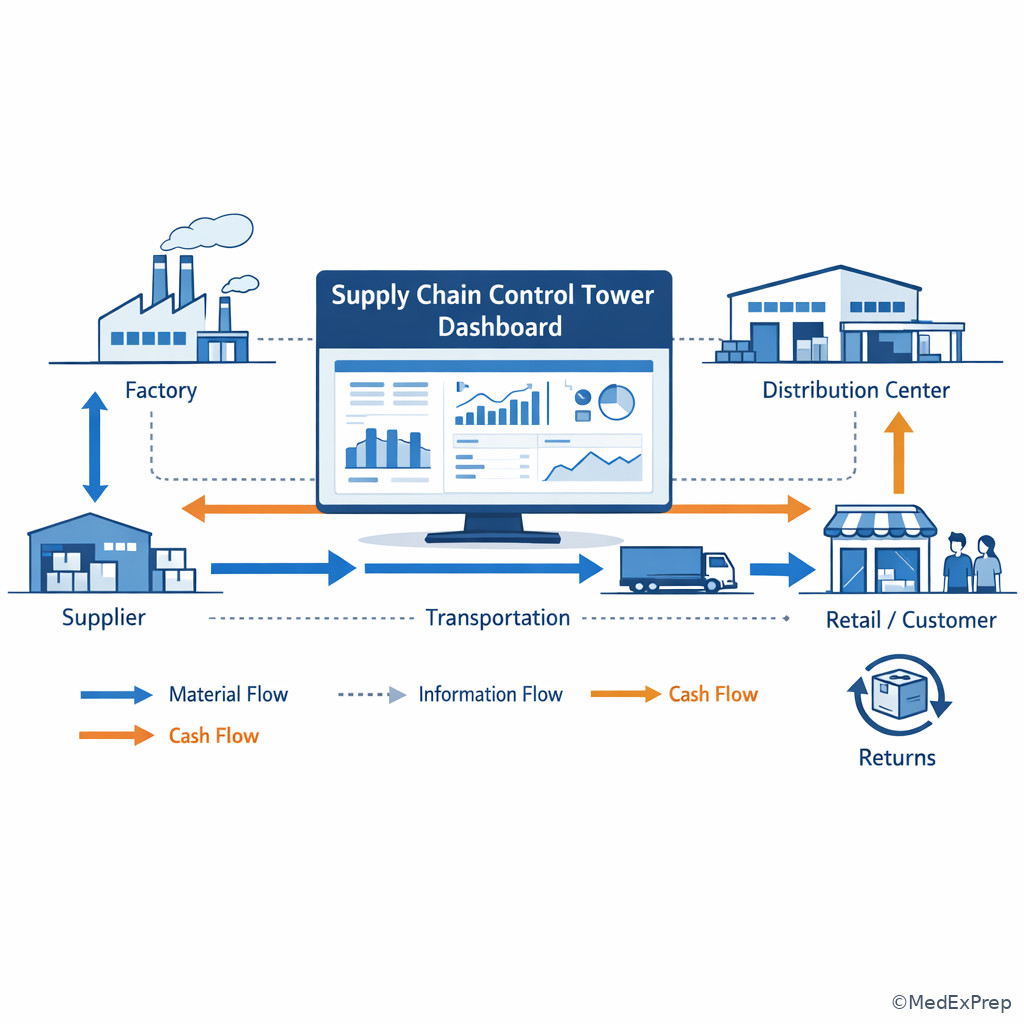
- End-to-end supply chain: The connected flow of materials, information, and funds from suppliers through the enterprise to customers and reverse flows.
- Total network performance: Overall outcome across service, cost, inventory, capacity, risk, and compliance.
- Silo optimization: Improving one function while harming enterprise performance.
- Cross-functional alignment: Consistency among sales, operations, procurement, logistics, finance, and technology decisions.
- Demand signal: Information indicating customer demand, whether actual orders or forecast inputs.
- Supply response: The enterprise and supplier actions used to meet demand.
- Order winner: A capability that causes customers to choose one offering over another.
- Order qualifier: A minimum acceptable requirement to compete.
- Tradeoff: A gain in one objective that creates a loss in another objective.
- Working capital: Capital tied up in day-to-day operations, especially inventory and receivables.
- Visibility: Access to timely, reliable data across processes and partners.
- Governance: Decision rights, escalation rules, and policy boundaries.
- Resilience: The ability to prepare for, respond to, and recover from disruption.
1.1.1.2 Must-know facts
- The CSCP lens is enterprise-first, not department-first.
- Materials, information, and funds all matter; the supply chain is not just physical movement.
- The best answer usually aligns with customer requirements and business objectives.
- Lower unit cost alone does not guarantee the best supply chain choice.
- Inventory is a buffer, but also a cost and a working-capital commitment.
- Lead time, variability, and visibility are common hidden drivers in case stems.
- Compliance and quality are constraints, not optional tradeoffs.
- When specialist legal or regulatory interpretation is required, the supply chain professional should coordinate and escalate rather than act outside role.
| Concept | What it includes | Common exam mistake | Best decision lens |
|---|---|---|---|
| End-to-end scope | Plan, source, make, move, deliver, return, data, cash | Treating only transportation or warehousing as the supply chain | Total flow across functions |
| Enterprise alignment | Customer needs, strategy, constraints, KPIs | Choosing a functionally efficient but strategically misaligned action | Business objective first |
| Tradeoff analysis | Service, cost, inventory, risk, speed, flexibility | Optimizing a single metric in isolation | Balanced outcome |
| Governance boundary | Policy, quality, compliance, escalation rights | Ignoring approval or escalation requirements | Act within role and coordinate |
| Visibility | Shared data, event tracking, timing, accuracy | Assuming more data always means better decisions | Decision-useful information |
Core content
1.1.1.3 Foundational scope: what “end-to-end” actually means
A Explanation
The first decision conflict on exam stems is whether the problem should be viewed as a single-function issue or an end-to-end system issue. The resolving rule is simple: if a decision changes upstream supply, internal operations, downstream service, or information flow, it is an end-to-end decision. The supply chain is not only trucks, warehouses, or purchasing. It includes supplier coordination, forecasting inputs, planning logic, production response, inventory policy, fulfillment, transportation, customer service implications, reverse flow, and the information that links them.
WHY THIS IS TESTED: Candidates often choose an answer that fixes the visible symptom in one node of the chain while ignoring the true bottleneck or downstream consequence. Boards-style items reward the option that improves total flow and preserves alignment across functions.
Use a choose-versus-reject rule. Choose the option that accounts for materials, information, and funds across the network. Reject the option that narrows the problem to one department without checking service, inventory, lead time, risk, and policy effects. See Fig 1.
B Worked example
A consumer electronics distributor sees late deliveries rising at one regional DC. The warehouse supervisor argues for immediate overtime and more pickers. The company also has a recent promotion, inbound supplier delays from one component source, and a transportation carrier on-time decline. Inventory records show acceptable total stock at the network level, but the problem DC is short on two high-volume SKUs. Finance also notes a favorable labor budget variance, which is distracting but not decisive.
Reasoning chain: Identify task: determine whether this is a local labor issue or an end-to-end flow issue. Extract key facts: promotion changed demand, supplier delays changed availability, carrier decline changed replenishment timing, and network inventory exists but is not positioned correctly. Apply rule: multiple upstream and downstream nodes are involved, so the correct lens is end-to-end. Eliminate distractors: adding labor may help picking speed, but it does not correct inventory positioning or inbound timing. Verify: the best next action is a cross-functional review of demand spike, replenishment status, allocation, and transportation recovery rather than a warehouse-only response.
C Exam trap
Exam trap: The common wrong answer is “increase warehouse labor immediately.”
Why it is tempting: The visible symptom is delayed orders at the DC, so a local execution fix feels practical and fast.
The single clue that eliminates it: The stem includes supplier delay, promotion-driven demand change, and network inventory mispositioning, proving the problem crosses functions.
D Checkpoint
Question: A firm is deciding how to respond to declining customer fill rate after a new product launch. Procurement reports long supplier lead times, planning reports forecast error, transportation reports missed inbound appointments, and sales requests expedited shipments. Which is the most appropriate first framing of the problem?
- A. Treat it as a transportation exception because late inbound appointments directly affect receipt timing.
- B. Treat it as an end-to-end issue because demand, supply, and execution signals all appear in the stem.
- C. Treat it as a sales issue because the launch created demand beyond operations capability.
- D. Treat it as a procurement issue because lead times are longer than expected.
Answer: B.
- A: Tempting because inbound lateness is operationally visible, but wrong because it ignores forecast and sourcing contributors.
- B: Correct because multiple linked drivers across plan-source-deliver require an enterprise lens.
- C: Tempting because launch decisions can create imbalance, but wrong because sales is only one part of the chain.
- D: Tempting because long lead time is a common root cause, but wrong because the stem explicitly includes additional cross-functional causes.
Exam takeaway: Track how demand, supply, execution, and cash signals move together before choosing a corrective action.
flowchart LR
A[Customer demand] --> B[Forecast and planning]
B --> C[Sourcing and supplier response]
C --> D[Production or service execution]
D --> E[Inventory positioning]
E --> F[Fulfillment and transport]
F --> G[Customer service outcome]
G --> H[Returns and feedback]
H --> B
G --> I[Cash and performance signals]
I --> B
Exam takeaway: Visualize the chain as connected flows rather than isolated departments.
1.1.1.4 The three flows: materials, information, and funds
A Explanation
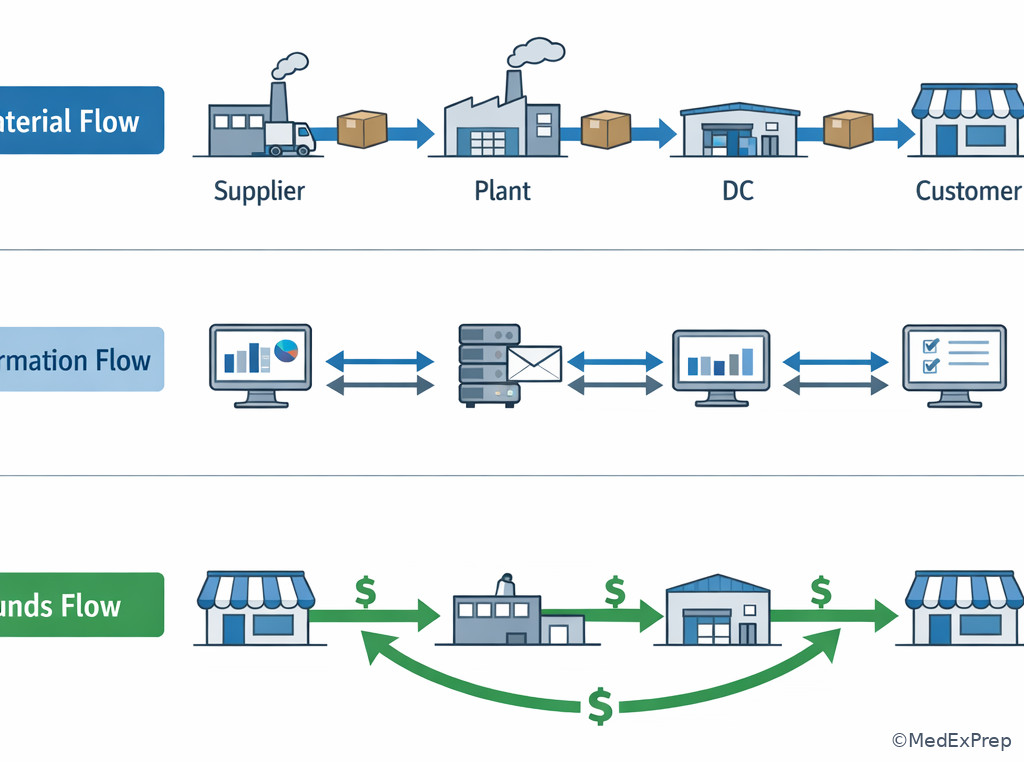
The next foundational conflict is deciding which flow is actually failing. Many candidates focus only on materials. Stronger answers identify whether the limiting factor is physical flow, information flow, or financial/working-capital flow. The single rule that resolves most stems is this: if inventory exists but cannot be allocated or trusted, the likely issue is information flow; if data are accurate but material is physically late, the issue is material flow; if a feasible supply option is rejected because of cash, payment terms, or capital constraints, funds flow is influencing the decision.
WHY THIS IS TESTED: Exam items often hide the true problem behind a visible stockout or delay. The operational symptom may be caused by poor master data, late visibility, payment constraints, or incentive misalignment instead of lack of supply alone.
Choose the answer that fixes the constrained flow. Reject the answer that adds cost to the wrong part of the system. See Fig 2.
B Worked example
A food manufacturer reports frequent stockouts of packaging materials. Buyers want to raise safety stock. However, cycle counts show adequate on-hand quantity, the ERP has duplicate item masters for nearly identical packaging, and planners are manually overriding requirements. The supplier is reliable and lead times are stable. Treasury has recently tightened payment approval thresholds, which is a tempting clue but not the main root cause here.
Reasoning chain: Identify task: determine which flow is constrained. Extract facts: physical inventory exists, supplier reliability is adequate, but the system record is corrupted by duplicate masters and manual overrides. Apply rule: this is an information-flow failure, not a materials shortage. Eliminate distractors: increasing safety stock adds working capital without solving record integrity. Verify: the best action is to correct master data and planning governance first, then reassess stocking policy.
C Exam trap
Exam trap: The common wrong answer is “increase inventory buffers.”
Why it is tempting: Stockout language pushes candidates toward more stock as an immediate fix.
The single clue that eliminates it: The stem states that on-hand inventory is adequate but system records are inaccurate, pointing to an information issue.
D Checkpoint
Question: A company has enough finished goods in the network, but customer orders are backordered because orders are allocated to the wrong item-location combinations after a product code conversion. Which flow is most directly failing?
- A. Materials flow
- B. Information flow
- C. Funds flow
- D. Reverse flow
Answer: B.
- A: Tempting because customers are not receiving product, but wrong because the material exists in the network.
- B: Correct because code conversion and incorrect allocation are data and system-governance failures.
- C: Tempting if capital constraints were present, but none are stated as the primary issue.
- D: Tempting because returns can complicate records, but the scenario centers on order allocation after code conversion.
- The three core supply chain flows are materials, information, and funds.
- True or False: A stockout always means a materials-flow problem. False.
- Name the clue that points to information-flow failure: inventory exists, but records, visibility, or allocation are wrong.
Exam takeaway: Separate physical shortage from visibility failure and capital constraint before selecting a remedy.
flowchart TD
A[Service problem appears] --> B{What is missing?}
B -->|Product not physically available| C[Materials flow issue]
B -->|Inventory exists but signals are wrong| D[Information flow issue]
B -->|Supply option exists but cash or terms block action| E[Funds flow issue]
C --> F[Review capacity, replenishment, transport]
D --> G[Review master data, visibility, allocation, timing]
E --> H[Review payment terms, working capital, approvals] Exam takeaway: Map each business problem to the constrained flow before choosing corrective action.
1.1.1.5 Functional silos versus enterprise optimization
A Explanation
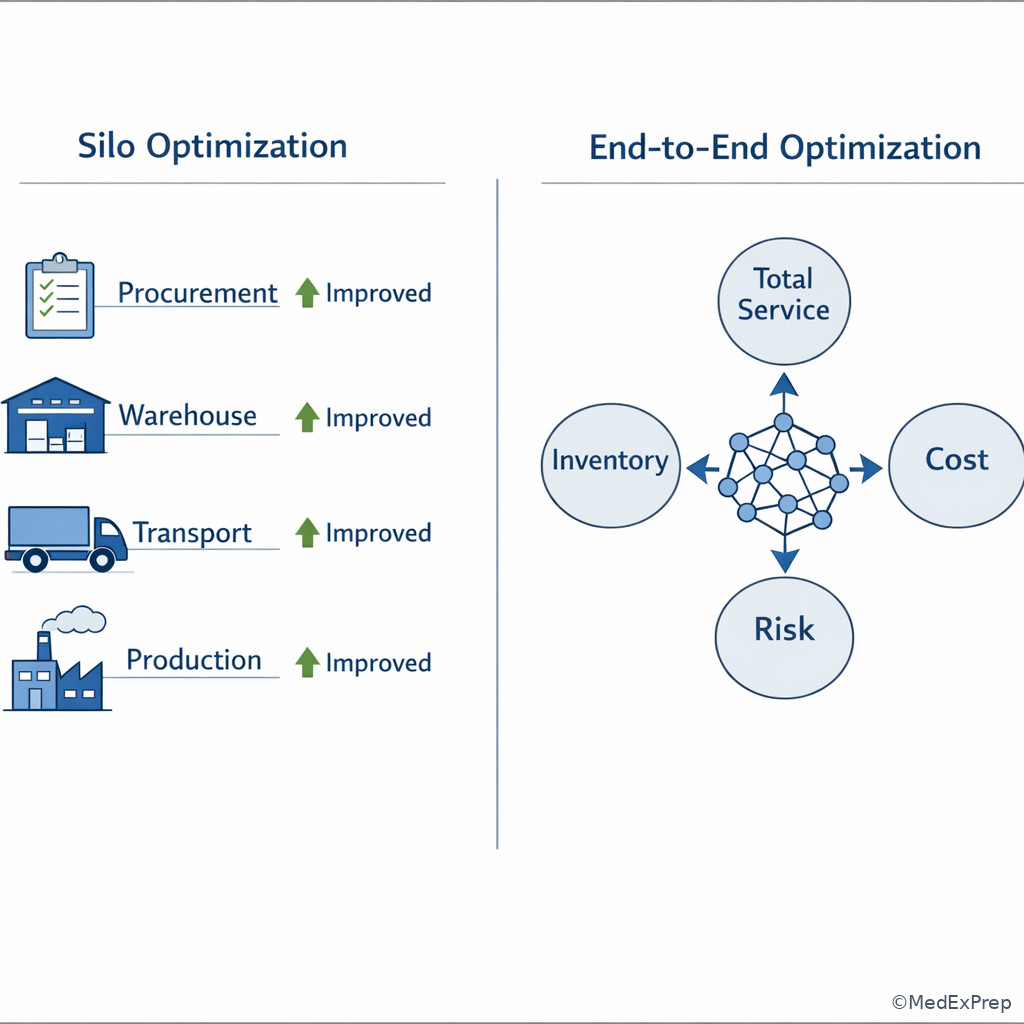
Once you know the chain is end-to-end, the next conflict is deciding whether an action creates local efficiency or global improvement. This is one of the most tested CSCP patterns. A warehouse may reduce labor cost by batching larger waves, procurement may lower unit price with larger buys, transportation may cut freight rate with slower modes, and manufacturing may improve utilization with longer runs. Each may look good locally. The exam asks whether the action improves total cost-to-serve, service performance, inventory exposure, flexibility, and risk.
WHY THIS IS TESTED: Distractors are often built from true statements about one function. The wrong answer is tempting because the local logic is valid, just incomplete. The single resolving rule is: if an option improves a department KPI but worsens the enterprise objective, reject it.
Choose-versus-reject framing matters here. Choose answers that balance tradeoffs across the chain. Reject answers that celebrate a favorable local metric without checking downstream or upstream consequences. See Fig 3.
B Worked example
A manufacturer of seasonal goods is under pressure to reduce purchase price variance. Procurement proposes a larger annual buy from a distant supplier at a lower unit cost. The offer increases order quantity, extends replenishment lead time, and requires ocean transport instead of regional ground transport. Sales forecasts are still volatile, product life cycle is short, and markdown risk is meaningful. Operations is excited because larger lots reduce changeovers; finance likes the apparent unit-cost savings.
Reasoning chain: Identify task: choose whether lower purchase price is the best supply chain action. Extract key facts: seasonality, forecast uncertainty, longer lead time, larger lot size, and markdown risk increase inventory exposure and reduce responsiveness. Apply rule: a lower local purchase price can be inferior if it worsens total network performance. Eliminate distractors: unit cost reduction and production efficiency are attractive but partial. Verify: the better end-to-end answer likely protects flexibility, lowers obsolescence risk, and aligns with demand uncertainty even if the unit cost is higher.
C Exam trap
Exam trap: The common wrong answer is “select the lowest unit-cost source.”
Why it is tempting: Cost reduction is a real business objective, and the stem may include pressure from finance or procurement.
The single clue that eliminates it: Short product life cycle plus demand uncertainty means flexibility and inventory risk matter more than lowest purchase price alone.
D Checkpoint
Question: Which proposal most clearly reflects silo optimization rather than enterprise optimization?
- A. Consolidate weekly shipments into monthly shipments to reduce transportation cost, even though customer lead time agreements will be missed.
- B. Improve supplier schedule visibility so planning can reduce expedites and stabilize delivery.
- C. Rebalance inventory across DCs to improve fill rate without increasing total stock.
- D. Review forecast assumptions with sales before increasing production for a promotion.
Answer: A.
- A: Correct because it improves freight cost locally while knowingly harming agreed service performance.
- B: Tempting to dismiss as indirect, but it supports better cross-functional decisions and reduces total disruption cost.
- C: Tempting because rebalancing can be complex, but it is an enterprise action that improves service without more inventory.
- D: Tempting because it slows action, but it strengthens alignment and prevents avoidable overproduction.
Exam takeaway: Reject options that improve one function only by moving cost, delay, or risk to another function.
flowchart LR
A[Proposed functional improvement] --> B{Does it improve enterprise objective?}
B -->|Yes| C[Potentially valid]
B -->|No or unclear| D[Likely silo optimization]
C --> E[Check service, inventory, risk, compliance]
D --> F[Reject or redesign]
E --> G{Tradeoffs acceptable?}
G -->|Yes| H[Adopt]
G -->|No| F Exam takeaway: A favorable departmental metric can still be the wrong enterprise decision.
| Functional action | Why it looks good locally | Potential enterprise downside | Best screening question |
|---|---|---|---|
| Larger purchase lots | Lower unit price | Higher inventory, lower flexibility, obsolescence risk | What happens to working capital and demand mismatch? |
| Longer production runs | Higher utilization, fewer setups | More cycle stock, slower response to mix changes | Does utilization gain outweigh service loss? |
| Cheaper slower transport | Lower freight spend | Longer lead time, lower service, more safety stock | What is the total landed and service impact? |
| Tighter labor budget | Lower direct labor cost | Backlogs, delays, quality errors, overtime later | Is cost avoided now just paid later elsewhere? |
| Maximize truck fill | Better transportation utilization | Shipment delay, missed promised dates | Does consolidation break customer commitments? |
1.1.1.6 Decision levels: strategic, tactical, and operational scope
A Explanation
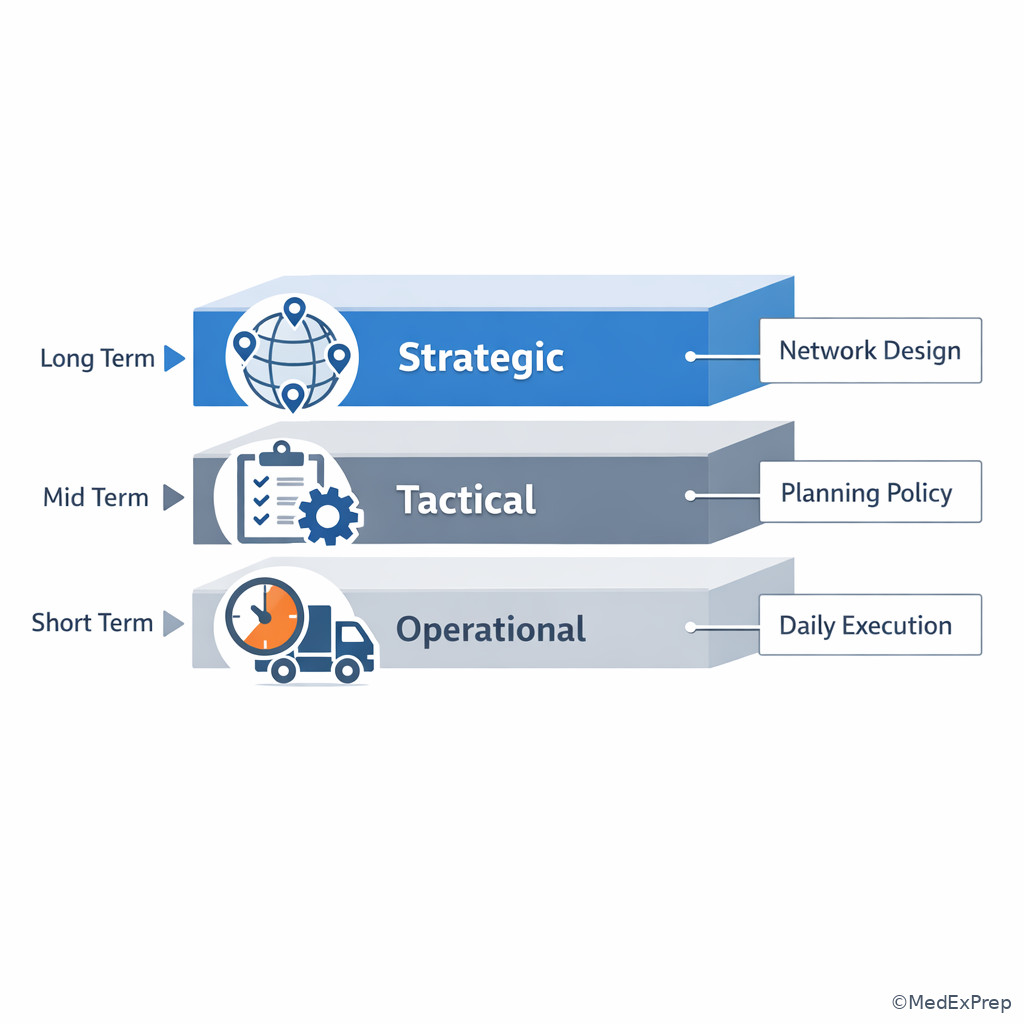
Another frequent exam conflict is choosing the wrong decision horizon. Strategic decisions set long-term structure and capabilities. Tactical decisions translate strategy into plans, policies, and resource positioning. Operational decisions execute day-to-day flow. The single resolving clue is timescale plus reversibility. If a decision changes the network, sourcing model, or capability design and is hard to reverse, think strategic. If it sets inventory targets, replenishment rules, or aggregate plans over a medium horizon, think tactical. If it sequences orders, expedites shipments, or resolves today’s exception, think operational.
WHY THIS IS TESTED: Candidates often choose an operational firefight when the stem asks for a policy-level fix, or choose a strategic redesign when the problem is a short-term execution exception.
Choose the option at the correct decision level. Reject overbuilt answers that are too large for the problem or too narrow for a recurring structural issue. See Fig 4.
B Worked example
A national retailer experiences repeated stock imbalances across regions for six months. Stores in the south overstock seasonal apparel, while northern stores run short. The operations manager wants daily transfer approvals and more expediting. Merchandising wants a new store-allocation policy. The COO asks whether to redesign the full distribution network. The firm also has a temporary carrier labor issue, which is a tempting but secondary detail.
Reasoning chain: Identify task: determine the right decision level. Extract key facts: problem persists for months, pattern is repeatable, and it involves inventory positioning rules across regions. Apply rule: this is larger than a one-day execution issue but smaller than a complete network redesign; it is mainly a tactical policy problem. Eliminate distractors: daily transfer approvals are operational bandages, and full network redesign is too strategic for evidence given. Verify: revising allocation and planning policies is the best-fit response.
C Exam trap
Exam trap: The common wrong answer is “redesign the network immediately.”
Why it is tempting: Persistent problems make large structural answers look decisive and executive-level.
The single clue that eliminates it: The issue is recurring regional allocation imbalance, which points first to policy and planning settings, not necessarily to facility structure.
D Checkpoint
Question: Which action is best classified as a tactical supply chain decision?
- A. Choosing today’s shipment priority for a customer backorder
- B. Setting next quarter’s inventory targets and replenishment policy by segment
- C. Deciding to build a new regional distribution center
- D. Rebooking a missed inbound appointment for tomorrow morning
Answer: B.
- A: Tempting because it involves planning judgment, but it is a day-to-day operational exception.
- B: Correct because policy setting over a medium horizon is tactical.
- C: Tempting because it affects supply chain performance significantly, but it is strategic due to structural and long-term impact.
- D: Tempting because it influences flow, but it is an immediate execution action.
- Strategic decisions are usually long-term and hard to reverse.
- True or False: An expedite decision is typically tactical. False.
- The medium-horizon layer that translates strategy into policies is tactical.
Exam takeaway: Match the action to the time horizon and reversibility of the problem in the stem.
flowchart TD
A[Supply chain problem] --> B{How long and how reversible?}
B -->|Immediate, day-to-day| C[Operational action]
B -->|Medium-term policy or plan| D[Tactical action]
B -->|Long-term structure or capability| E[Strategic action]
C --> F[Prioritize, expedite, reschedule]
D --> G[Set targets, policies, allocations]
E --> H[Design network, sourcing model, capability] Exam takeaway: Classify the decision level before evaluating answer choices.
| Decision level | Typical horizon | Examples | Common wrong substitution |
|---|---|---|---|
| Strategic | Long-term | Network footprint, sourcing model, capability design | Using a redesign answer for a short-term exception |
| Tactical | Medium-term | Inventory policy, capacity plan, allocation rules, segment targets | Using day-to-day expediting for a recurring policy problem |
| Operational | Short-term / real-time | Schedule changes, expedites, order prioritization, appointments | Using long-term planning when immediate recovery is needed |
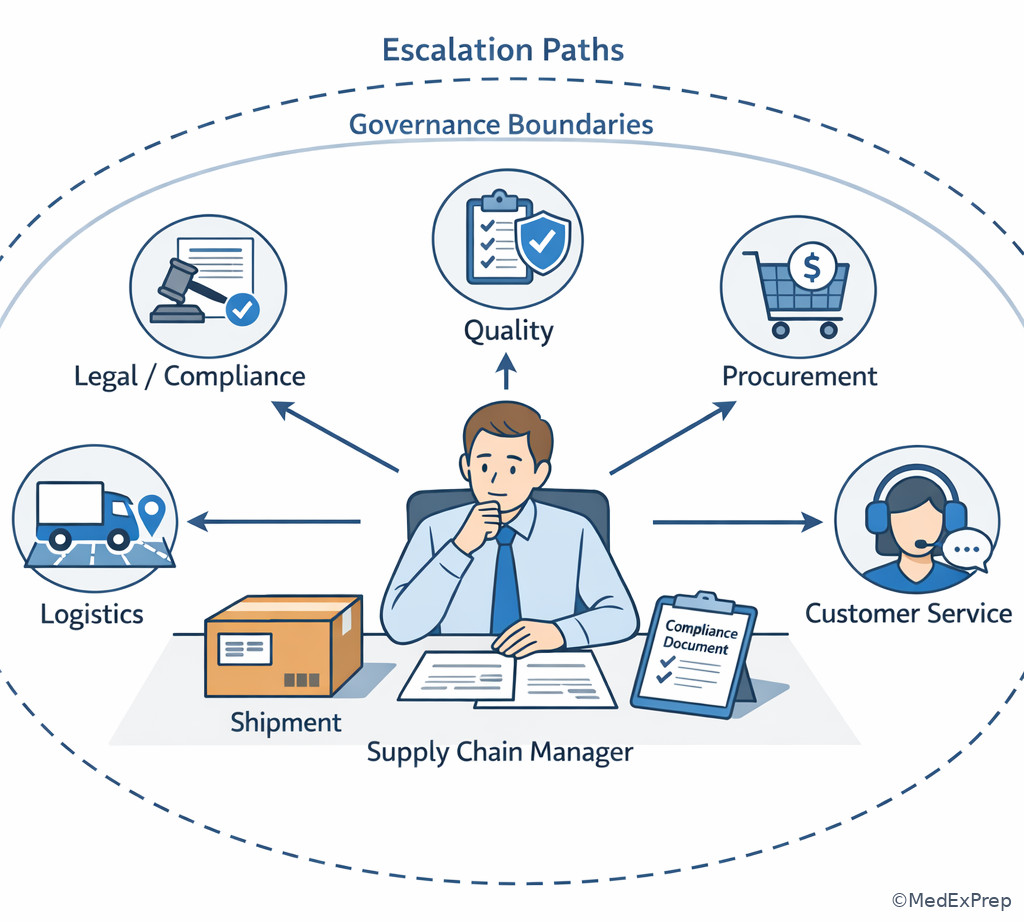
1.1.1.7 Governance, escalation, and CSCP decision boundaries
A Explanation
The final integration layer is knowing what an end-to-end supply chain professional should decide versus what should be coordinated or escalated. CSCP scope includes recommending tradeoffs, analyzing impacts, prioritizing actions, and aligning functions. It does not include acting as legal counsel, customs broker, regulator, tax accountant, or engineer beyond operational requirements. The resolving rule is this: if the stem requires specialized legal interpretation, formal regulatory filing, or an action that would bypass compliance, quality, or ethics, the best answer is to coordinate with the responsible function while managing supply chain impact.
WHY THIS IS TESTED: Some distractors appear decisive because they “solve the business problem fast,” but they cross governance boundaries or ignore mandatory constraints. Compliance, safety, and quality are not optional. A good CSCP answer balances service and cost within policy.
Choose responses that stay within supply chain decision rights and escalate specialist issues appropriately. Reject responses that ignore contracts, override quality holds, bypass trade rules, or optimize one function at the expense of compliance. See Fig 5.
B Worked example
A global distributor faces a customs documentation issue that may delay a high-revenue shipment. Sales wants the shipment released immediately to avoid penalties. Operations suggests relabeling documentation internally and shipping first, then fixing paperwork later. The compliance manager is unavailable for two hours. Customer service warns of a major account escalation, and finance notes that month-end revenue is at risk.
Reasoning chain: Identify task: choose the best end-to-end action within CSCP scope. Extract key facts: the issue involves customs documentation and compliance interpretation, which is outside normal unilateral supply chain authority. Apply rule: the supply chain professional should not bypass trade compliance to protect service or revenue. Eliminate distractors: shipping first may look customer-centric, but it violates governance boundaries. Verify: the best response is to escalate to the appropriate compliance or trade function, assess alternatives such as compliant rerouting or customer communication, and manage downstream impact transparently.
C Exam trap
Exam trap: The common wrong answer is “release the shipment now and correct the documents later.”
Why it is tempting: It appears to protect the customer and preserve revenue in the short term.
The single clue that eliminates it: Customs documentation and trade compliance are explicit governance boundaries that require proper escalation and compliant handling.
D Checkpoint
Question: Which action is most appropriate for a CSCP-level supply chain professional when a proposed shipment change raises a possible regulatory compliance issue?
- A. Approve the shipment if customer penalties exceed the likely risk of noncompliance
- B. Escalate to the appropriate compliance function while assessing service and inventory impact of compliant alternatives
- C. Ignore the issue because trade interpretation is outside supply chain scope
- D. Ask the warehouse to proceed and let legal correct the issue afterward
Answer: B.
- A: Tempting because it uses visible cost logic, but wrong because compliance is a hard constraint.
- B: Correct because it stays within role while still managing end-to-end operational consequences.
- C: Tempting because the issue is specialized, but wrong because supply chain still owns impact assessment and coordination.
- D: Tempting because it preserves flow, but wrong because it bypasses governance and creates avoidable risk.
Exam takeaway: Stay within end-to-end decision scope and escalate specialist legal or regulatory issues while managing supply chain impact.
flowchart TD
A[Business issue in the supply chain] --> B{Within supply chain decision rights?}
B -->|Yes| C[Analyze tradeoffs and choose best enterprise action]
B -->|No or specialist interpretation needed| D[Escalate to proper function]
D --> E[Assess service, cost, inventory, and timing impact]
E --> F[Coordinate compliant response]
C --> G[Monitor enterprise result] Exam takeaway: Fast action is not the best action when compliance, quality, or legal interpretation is involved.
1.1.1.8 Integrating the scope: how to read CSCP stems in this chapter
A Explanation
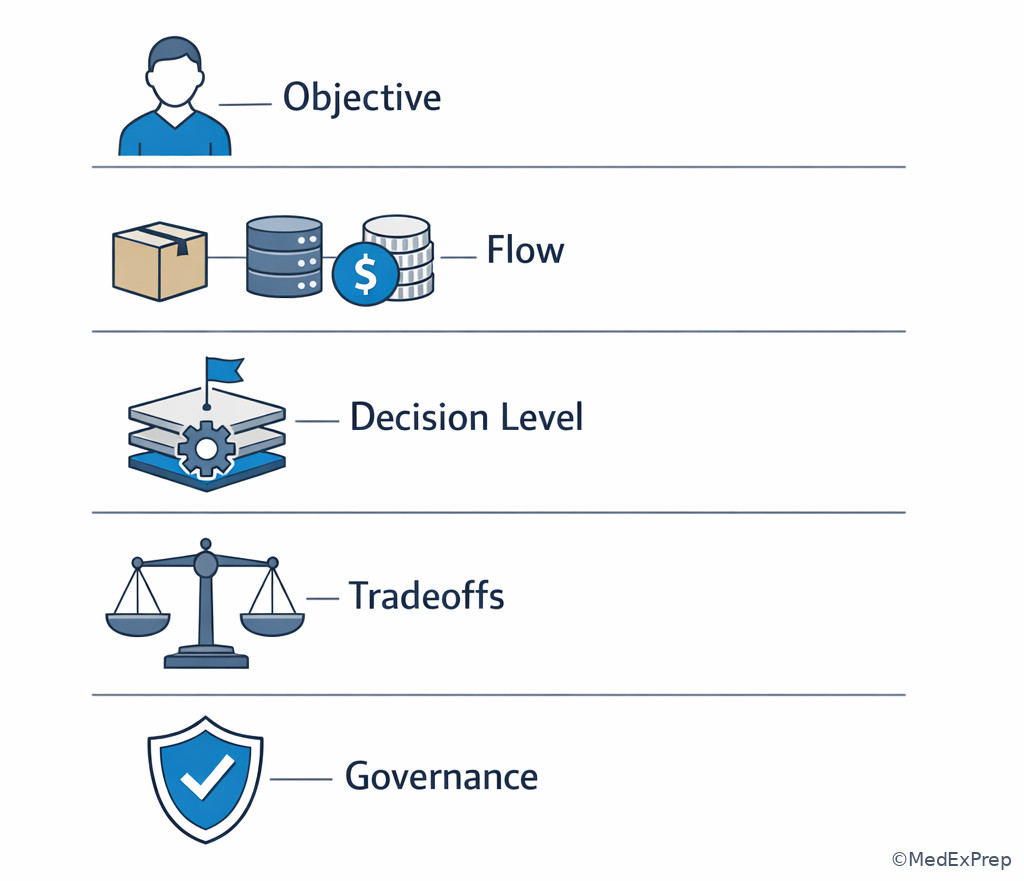
This final integration section turns the previous concepts into an exam-reading method. On CSCP items, your first job is not to jump to a tool. Your first job is to frame the business objective, identify the constrained flow, classify the decision level, and test enterprise impact. The single rule that resolves many close-call choices is this: the best answer usually improves customer and business outcomes without violating governance and without simply shifting pain elsewhere.
WHY THIS IS TESTED: Early-course topics build the filter you will use for the rest of the exam. Stems may mention unit cost, utilization, labor efficiency, or urgent customer needs. Those clues are intentionally tempting. The stronger candidate asks, “What is the total system consequence?”
Choose answers that align objective, flow diagnosis, decision level, and boundary conditions. Reject options that are too narrow, too large, noncompliant, or driven by a single metric. See Fig 6 for a decision algorithm you can apply across later topics.
B Worked example
A medical device company faces a sudden demand spike for one product family after a competitor recall. Sales wants all available inventory diverted to the highest-margin channel. Operations wants longer runs to maximize throughput. Logistics proposes premium freight for all orders. Quality has an open investigation on one supplier lot, and planning data lag by two days because channel POS data are not fully integrated. A local manager pushes for immediate shipment prioritization to protect one region’s monthly target.
Reasoning chain: Identify task: choose the most appropriate managerial approach. Extract key facts: objective is not just margin; service continuity, quality, and visibility matter. There may be material and information constraints, plus a quality governance issue. Apply rule: before committing to premium freight or channel diversion, the company must confirm quality hold scope, improve visibility to true demand, and allocate using enterprise priorities rather than one region’s target. Eliminate distractors: longer runs and premium freight may be appropriate later but are premature if quality status and data visibility are unresolved. Verify: the best answer is a cross-functional end-to-end review that protects compliance, validates demand signals, and then allocates supply according to enterprise and customer-service priorities.
C Exam trap
Exam trap: The common wrong answer is “send all product to the highest-margin channel immediately.”
Why it is tempting: Margin pressure feels financially sophisticated, especially during shortage conditions.
The single clue that eliminates it: The stem includes an open quality investigation and delayed demand visibility, so immediate channel-maximization could create compliance and service misallocation risk.
D Checkpoint
Question: Which statement best reflects the CSCP end-to-end decision lens?
- A. The best action is the one that improves the nearest visible KPI most quickly
- B. The best action is the one that lowers unit cost, because cost reductions usually improve competitiveness
- C. The best action is the one that aligns customer needs, enterprise objectives, cross-functional tradeoffs, and governance constraints
- D. The best action is the one chosen by the function that owns the largest budget
Answer: C.
- A: Tempting because fast KPI recovery feels operationally strong, but wrong because the nearest visible KPI can be misleading.
- B: Tempting because cost matters, but wrong because cost is only one component of enterprise performance.
- C: Correct because CSCP prioritizes end-to-end alignment and compliant cross-functional decision-making.
- D: Tempting in politically realistic organizations, but wrong because budget ownership is not the decision standard.
- The first screen for most stems is the business objective.
- True or False: A lower local cost is enough to make an answer best. False.
- Name the five-step sequence: objective, flow, decision level, tradeoffs, governance.
Exam takeaway: Use a repeatable screen to eliminate locally attractive but enterprise-poor choices.
flowchart TD
A[Read the stem] --> B[Identify business objective]
B --> C[Diagnose constrained flow]
C --> D[Match strategic tactical or operational level]
D --> E[Screen service cost inventory risk tradeoffs]
E --> F{Any governance or compliance boundary?}
F -->|Yes| G[Coordinate and escalate appropriately]
F -->|No| H[Choose best enterprise action]
G --> H Exam takeaway: A structured reading method improves elimination of close-call distractors.
Exam Traps & Differentiators
Common traps & distractors: Early CSCP questions often reward the answer that protects the system, not the answer that sounds the most active.
- Most common wrong answer and why: “Take the fastest local action.” It is tempting because it addresses the visible pain point, but it fails when the root cause sits upstream or when service is preserved by breaking another constraint.
- Looks similar but isn’t: A transportation delay is not always a transportation problem; it may be a planning or supplier signal problem causing reactive freight use.
- Looks similar but isn’t: A stockout is not always low inventory; it may be poor item master control, allocation rules, or inaccurate location visibility.
- Looks similar but isn’t: A recurring execution issue may actually be a tactical policy problem, not a daily operating issue.
- Looks similar but isn’t: A profitable rush request may still be the wrong answer if it violates quality, trade, or governance constraints.
| If the stem says... | Think... | Why |
|---|---|---|
| “Network inventory exists, but orders still backorder” | Information or allocation issue | Physical stock exists; visibility or decision rules are failing |
| “One function shows improvement, others worsen” | Silo optimization trap | True best answer must support total performance |
| “Problem has repeated for months” | Tactical or strategic fix may be needed | Persistence suggests policy or design, not just expediting |
| “Compliance, quality hold, or regulatory interpretation” | Governance boundary and escalation | Supply chain manages impact but does not bypass the constraint |
| “Lowest unit cost” | Check total landed cost and flexibility | Cheap source may increase lead time, risk, and inventory |
| “Urgent customer request” | Verify enterprise priority and policy | Fastest action is not always the best aligned action |
Related confusable pairs from upcoming topics matter here. In Competitive Priorities and Customer Value, you will learn that different customers value different combinations of speed, cost, quality, and flexibility. In Enterprise Alignment Tradeoffs, you will learn how these priorities must shape KPI design and decisions. The trap in this lesson is choosing an answer that seems efficient without first asking what the business is trying to win on.
Algorithm / Approach
Rapid Review
- End-to-end scope - multi-function impact means the problem is not local
- Materials vs information - inventory can exist physically and still fail operationally if visibility is wrong
- Funds flow - working-capital or terms constraints can block otherwise feasible supply actions
- Silo optimization - local savings that reappear as service loss or inventory cost are bad answers
- Unit cost - never enough alone; test total landed and response implications
- Strategic decisions - structural, long-term, hard to reverse
- Tactical decisions - policy, targets, and medium-horizon balancing actions
- Operational decisions - day-to-day execution and exception handling
- Governance boundary - compliance and quality constraints are not optional tradeoffs
- Escalation - supply chain owns impact analysis even when a specialist must decide
- Enterprise lens - best answer aligns customer value and business objectives
- Recurring problem - repeated issues suggest policy or design, not endless expediting
- Data quality clue - duplicate masters, manual overrides, and stale visibility point to information-flow failure
- Best-answer pattern - objective -> flow -> horizon -> tradeoffs -> governance
Self-check quiz
1. A distributor has adequate physical inventory across the network, but customer orders are backordered because item-location records are inaccurate after a system conversion. Which is the most likely primary issue?
- A. Materials flow constraint
- B. Information flow constraint
- C. Funds flow constraint
- D. Reverse logistics constraint
2. A company is deciding whether to build a new regional distribution center to support long-term market expansion. Which decision level best fits this action?
- A. Operational
- B. Tactical
- C. Strategic
- D. Transactional
3. A home goods manufacturer faces repeated stock imbalances across regions for four months. Stores in one region hold excess stock while others miss sales. Transportation reliability is normal, but allocation rules are outdated and planners repeatedly override transfers manually. What is the most appropriate next step?
- A. Increase emergency inter-DC transfers each week to restore local service immediately
- B. Redesign the entire network footprint because regional imbalances indicate a structural failure
- C. Review and reset allocation and replenishment policies, then limit manual overrides through governance
- D. Increase total inventory across all regions to ensure no store stocks out
4. A retailer launches a promotion on a fast-moving SKU. Sales wants premium freight for all replenishment orders. The supplier confirms normal lead time, but forecast assumptions were not updated for the promotion, and on-hand inventory exists at another DC. What is the best next action?
- A. Approve premium freight immediately because transport speed is the fastest visible lever
- B. Rebalance existing inventory and update planning assumptions before using broad expediting
- C. Increase next month’s purchase order quantity without changing current allocation
- D. Delay any action until the promotion ends so post-event data can be analyzed
5. A manufacturer can reduce purchase price by sourcing from a distant supplier with a larger minimum order quantity and longer lead time. Demand for the item is highly uncertain and product obsolescence risk is high. Which is the most appropriate interpretation?
- A. Choose the lower unit-cost supplier because procurement savings outweigh other concerns
- B. Prefer the option that preserves flexibility, even if purchase price is higher
- C. Increase safety stock to offset the longer lead time and still capture the lower unit cost
- D. Move all shipments to slower transport so the sourcing model remains internally consistent
6. A global distributor has a high-priority customer order ready to ship, but export documentation may not meet a new country requirement. Sales requests immediate release to avoid penalties. Operations says the documents can be corrected after departure. The compliance team is reviewing the change, and alternative compliant routing would add two days. What is the best action?
- A. Ship immediately and correct the documents later because customer penalties are certain
- B. Hold shipment until the compliance review is completed and evaluate compliant alternatives with customer communication
- C. Cancel the order and remove the customer from future allocation to reduce risk exposure
- D. Ask the warehouse manager to make the decision locally because the shipment is already packed
7. A consumer products company has missed fill-rate targets for three consecutive quarters. Procurement blames suppliers, transportation blames inbound schedule failures, and the plant blames forecast volatility. Analysis shows service drops mainly occur after promotions, inventory exists in the network but not at the right locations, and each function is measured on separate local KPIs. Which action is most appropriate?
- A. Add more safety stock to every node because repeated service failure proves inventory is insufficient
- B. Create a cross-functional review to align promotion planning, allocation rules, and shared enterprise KPIs
- C. Replace the transportation carrier because service failure is visible at inbound appointments
- D. Mandate daily expediting approval by the plant scheduler to improve responsiveness
8. A medical supplies company sees a sudden surge in demand after a competitor disruption. Sales wants all available stock sent to the highest-margin accounts. Planning data are two days old, one supplier lot is on quality hold, and manufacturing suggests longer runs to maximize utilization. Which is the best immediate managerial approach?
- A. Allocate all available supply to the highest-margin channel to protect profitability first
- B. Release the quality-hold lot to avoid customer shortages while the investigation continues
- C. Validate quality status and demand visibility, then allocate supply using enterprise priorities
- D. Run longer production batches immediately because utilization gains will offset allocation delays
Answer key
1. Correct answer: B
- A. Materials flow constraint: Tempting because customers are backordered, which often looks like a physical shortage. Incorrect for this scenario because the stem says adequate inventory physically exists. The single clue is “item-location records are inaccurate after a system conversion.”
- B. Information flow constraint: Tempting because system conversion problems commonly disrupt visibility and allocation. Correct because inaccurate records prevent the enterprise from using inventory that is already present. The single clue is record inaccuracy despite adequate stock.
- C. Funds flow constraint: Tempting if capital or payment terms were restricting action, but no such facts are present. Incorrect because the issue is visibility, not financing.
- D. Reverse logistics constraint: Tempting if returns or disposition were involved, but the stem is about current order allocation after conversion. Incorrect because there is no reverse-flow evidence.
2. Correct answer: C
- A. Operational: Tempting because DC activity affects daily execution, but incorrect because building a facility is not a short-term execution action. The single clue is “long-term market expansion.”
- B. Tactical: Tempting because network capacity planning has medium-horizon elements. Incorrect because constructing a new DC changes structural footprint and is hard to reverse.
- C. Strategic: Correct because facility footprint decisions are long-term structural choices. The single clue is the new regional distribution center for expansion.
- D. Transactional: Tempting as business language, but not the best classification for CSCP decision layers. Incorrect because this is a structural design decision.
3. Correct answer: C
- A. Increase emergency inter-DC transfers each week: Tempting because it may restore service quickly. Incorrect because the problem has repeated for four months, so constant transfers are an operational patch for a tactical policy issue. The single clue is the recurring duration and outdated allocation rules.
- B. Redesign the entire network footprint: Tempting because persistent imbalance can suggest a major structural problem. Incorrect because normal transportation reliability and outdated allocation rules point first to policy, not footprint redesign. The single clue is manual overrides and outdated rules.
- C. Review and reset allocation and replenishment policies: Correct because this is a medium-horizon policy mismatch. Governance around manual overrides addresses the information and control failure behind the imbalance. The single clue is months-long recurrence plus policy evidence.
- D. Increase total inventory across all regions: Tempting because stockouts invite buffer thinking. Incorrect because excess already exists in some regions; the issue is placement and policy, not total volume. The single clue is simultaneous excess and shortage.
4. Correct answer: B
- A. Approve premium freight immediately: Tempting because transport speed can rescue service quickly. Incorrect because supplier lead time is normal and inventory already exists elsewhere, so broad expediting treats the symptom, not the cause. The single clue is “on-hand inventory exists at another DC.”
- B. Rebalance existing inventory and update planning assumptions: Correct because the problem reflects both inventory positioning and planning input error. It addresses information flow and materials flow before adding unnecessary freight cost. The single clue is promotion assumptions were not updated.
- C. Increase next month’s purchase order quantity: Tempting because promotions can justify more supply. Incorrect because it does not solve current allocation or planning error and may create excess later. The single clue is that present network inventory exists now.
- D. Delay any action until the promotion ends: Tempting because clean data are attractive for analysis. Incorrect because the firm needs an immediate enterprise response, not passive observation. The single clue is active promotional demand requiring action now.
5. Correct answer: B
- A. Choose the lower unit-cost supplier: Tempting because procurement savings are tangible and measurable. Incorrect because high demand uncertainty and obsolescence make flexibility more valuable than lower purchase price. The single clue is uncertain demand plus high obsolescence risk.
- B. Prefer the option that preserves flexibility: Correct because the total enterprise risk from long lead time and larger lots outweighs unit-cost savings in this setting. The single clue is longer lead time with uncertain demand.
- C. Increase safety stock to offset the longer lead time: Tempting because it appears to manage service risk while keeping the cheaper source. Incorrect because it increases working capital and obsolescence exposure in a volatile product. The single clue is high obsolescence risk.
- D. Move all shipments to slower transport: Tempting because it seems consistent with a low-cost sourcing posture. Incorrect because it worsens responsiveness further and does not address the real tradeoff. The single clue is the need for flexibility, not more delay.
6. Correct answer: B
- A. Ship immediately and correct later: Tempting because customer penalties are visible and urgent. Incorrect because the issue involves export documentation compliance, which is a hard governance boundary. The single clue is “may not meet a new country requirement.”
- B. Hold shipment until compliance review is completed and evaluate compliant alternatives: Correct because it respects governance while still managing service impact and customer communication. The single clue is that the compliance team is actively reviewing the requirement.
- C. Cancel the order and remove the customer from future allocation: Tempting because it appears risk-averse. Incorrect because it overreacts and ignores compliant alternatives that only add two days. The single clue is “alternative compliant routing would add two days.”
- D. Ask the warehouse manager to make the decision locally: Tempting because the shipment is operationally ready. Incorrect because warehouse readiness does not confer authority over export compliance interpretation. The single clue is the specialist nature of the requirement.
7. Correct answer: B
- A. Add more safety stock to every node: Tempting because repeated fill-rate misses often point to insufficient buffers. Incorrect because inventory already exists in the network; the bigger issue is promotional alignment, placement, and conflicting local KPIs. The single clue is “inventory exists in the network but not at the right locations.”
- B. Create a cross-functional review to align promotion planning, allocation rules, and shared enterprise KPIs: Correct because the root cause is cross-functional misalignment compounded by silo metrics. The single clue is separate local KPIs plus post-promotion service drops.
- C. Replace the transportation carrier: Tempting because inbound schedule failures are visible and easy to blame. Incorrect because the broader data pattern points to promotion-driven misalignment, not carrier performance alone. The single clue is the concentration of service drops after promotions.
- D. Mandate daily expediting approval by the plant scheduler: Tempting because it appears to improve responsiveness. Incorrect because it is an operational patch for a recurring enterprise coordination problem. The single clue is three consecutive quarters of failure.
8. Correct answer: C
- A. Allocate all available supply to the highest-margin channel: Tempting because margin protection sounds financially strong during shortage. Incorrect because demand visibility is stale and quality status is unresolved, so channel-maximization could misallocate or create compliance exposure. The single clue is “planning data are two days old” plus “supplier lot is on quality hold.”
- B. Release the quality-hold lot: Tempting because shortages create pressure to use every available unit. Incorrect because quality hold is a governance constraint, not an optional buffer. The single clue is the explicit quality hold.
- C. Validate quality status and demand visibility, then allocate supply using enterprise priorities: Correct because it addresses governance first, then information flow, then enterprise allocation. The single clue is simultaneous quality uncertainty and stale planning data.
- D. Run longer production batches immediately: Tempting because utilization gains may increase output. Incorrect because maximizing utilization can delay the right product mix and ignores unresolved quality and visibility issues. The single clue is that the immediate uncertainty is allocation quality, not just throughput.
Keep going with the full CSCP Prep Course (CSCP)
You just studied the way members do, in the same lesson interface. Full access unlocks every lesson, the question bank and flashcards for a full year.
One payment · 1 year of access · No auto-renewal