1.1.1 - Age-Specific Norms And Red Flags
Why it matters
- Pediatric exam questions often hide the answer inside age context: a heart rate that is normal in an infant may be concerning in an adolescent, while a blood pressure that looks “acceptable” may actually indicate late shock in a child.
- Children compensate differently from adults; hypotension is frequently a late finding, so earlier clues such as tachycardia, altered interaction, delayed capillary refill, and increased work of breathing carry more exam weight.
- Board stems reward trend recognition: worsening respiratory effort, declining mental status, falling urine output, or caregiver-reported deviation from baseline usually outrank a single isolated number.
- Accurate age-specific interpretation improves both safety and test performance because the “most appropriate next step” depends on whether you classify the patient as stable, compensating, or decompensating.
Key Terms & Must-Know Facts
1.1.1.1 Key terms
- Tachycardia: heart rate above expected range for age and context
- Bradypnea: respiratory rate below expected range for age; often more ominous than mild tachypnea
- Compensated shock: poor perfusion with preserved blood pressure
- Decompensated shock: poor perfusion plus hypotension or worsening end-organ dysfunction
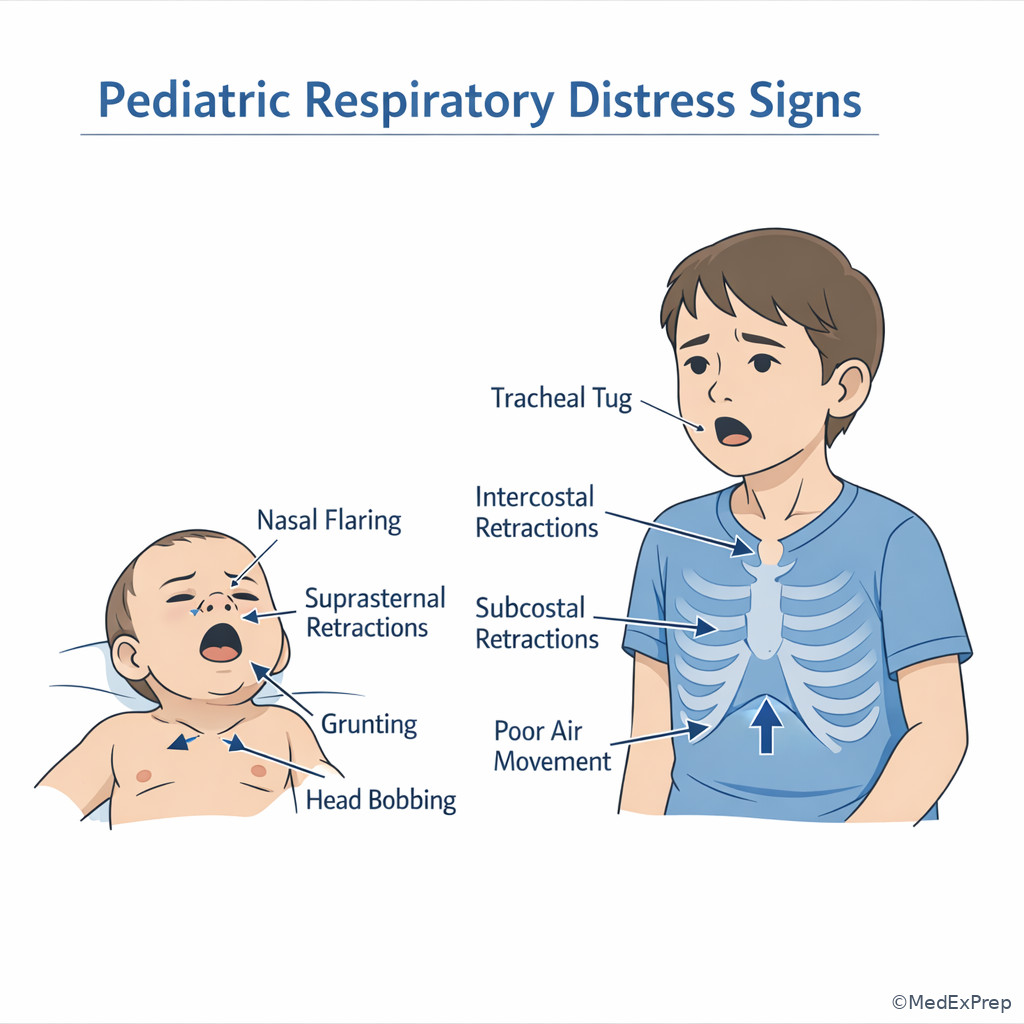
- Work of breathing: visible effort required for ventilation, including retractions, nasal flaring, grunting
- Capillary refill: peripheral perfusion marker; prolonged refill suggests hypoperfusion when interpreted in context
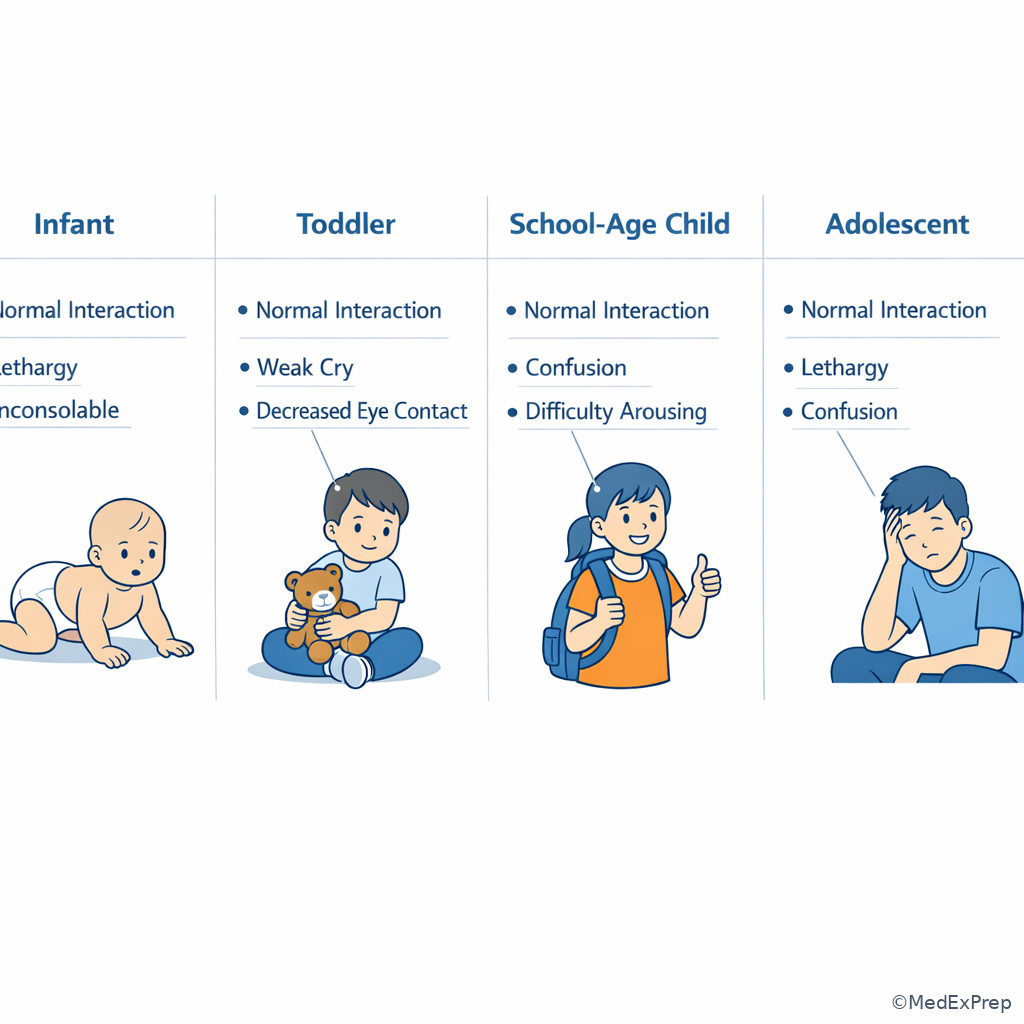
- Mentation: level of alertness, interaction, and responsiveness relative to developmental baseline
- Fontanelle: infant anterior fontanel; bulging or sunken findings can signal pathology or dehydration
- Perfusion: adequacy of tissue blood flow, assessed by pulses, refill, skin temperature, urine output, mental status
- Red flag: finding that requires urgent reassessment, escalation, or intervention
- Baseline function: usual neurologic, respiratory, feeding, and activity status for that child
- Developmental norm: expected age-appropriate behavior or physical finding that should not be overcalled as pathology
1.1.1.2 Must-know facts
- Hypotension in children is a late and dangerous sign of shock.
- Tachycardia has many causes; persistent tachycardia with poor perfusion is more concerning than tachycardia alone.
- Infants normally have higher heart and respiratory rates than older children.
- A quiet child with decreased interaction can be sicker than a crying child with normal perfusion.
- Increased work of breathing may appear before oxygen saturation falls.
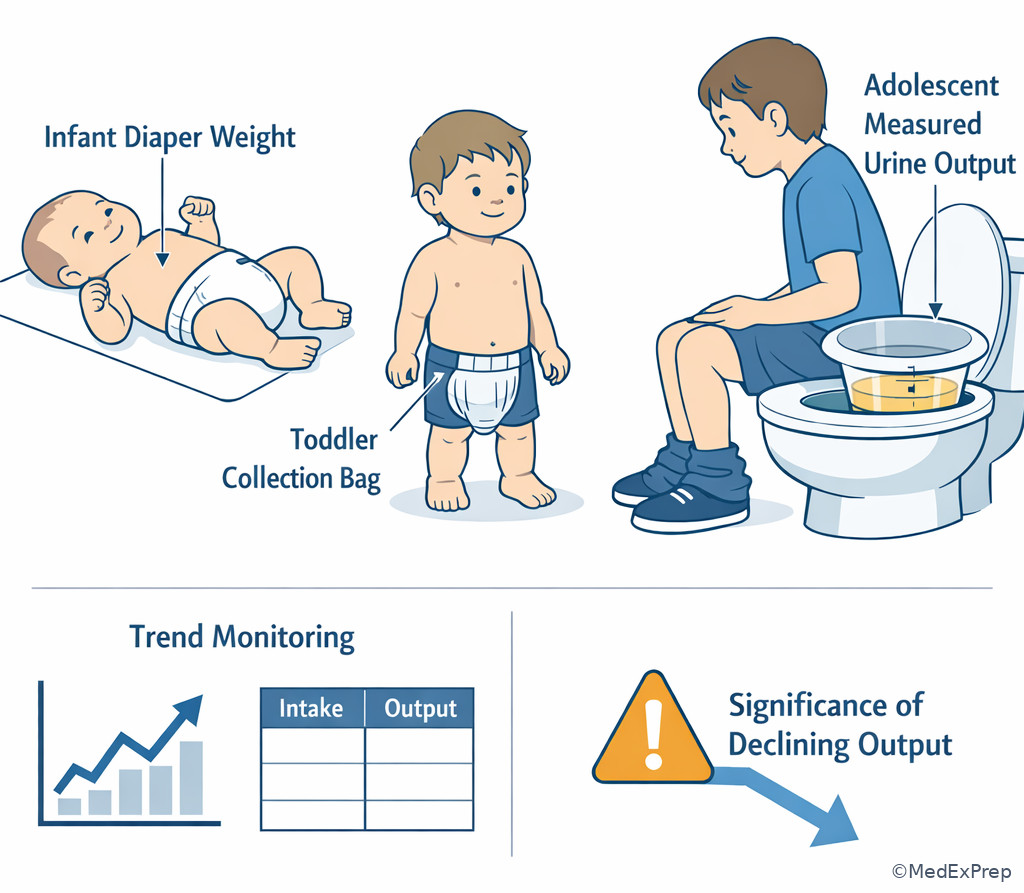
- Urine output is a practical perfusion marker; declining output supports concern for hypoperfusion or dehydration.
- Caregiver report of “not acting like themselves” is high-yield and should not be dismissed.
- Mottling, weak distal pulses, prolonged capillary refill, or cool extremities are circulation red flags.
- Grunting, head bobbing, apnea, or poor air movement signal possible respiratory failure.
- Age, fever, pain, and anxiety modify vital signs, but they do not excuse persistent abnormal trends with worsening exam findings.
Exam takeaway: Use age plus appearance plus trend to decide whether a finding is normal, compensating, or dangerous.
flowchart TD
A[Start with age group] --> B[Check HR RR BP and temp against age expectations]
B --> C[Assess appearance and work of breathing]
C --> D[Assess perfusion: pulses refill skin urine output]
D --> E{Normal exam and stable trend?}
E -->|Yes| F[Likely age-appropriate or mild illness]
E -->|No| G[Red flag: reassess, intervene, escalate] Exam takeaway: Children often move from compensation to collapse quickly, so act on work of breathing and perfusion changes before hypotension appears.
flowchart LR
A[Stressor: infection dehydration airway disease] --> B[Tachycardia tachypnea anxiety]
B --> C[Increased work of breathing or poor perfusion]
C --> D[Altered mental status weak pulses low urine output]
D --> E[Hypotension or bradypnea]
E --> F[Impending arrest]
Exam takeaway: Retractions, nasal flaring, grunting, and head bobbing are more concerning than a single normal pulse oximetry reading.
Exam takeaway: Capillary refill, skin temperature, pulse quality, and mental status together outperform blood pressure alone for early shock recognition.
{"prompt":"Clean pediatric acute care illustration with white background showing a toddler perfusion assessment. Label capillary refill check on finger, central versus peripheral pulses, cool mottled extremities, urine collection measurement, and altered interaction posture. Add concise labels for delayed cap refill, weak distal pulse, cool extremities, mottling, and decreased responsiveness. Nursing education style.","caption":"Fig 4. Pediatric perfusion assessment cues\nExam takeaway: Capillary refill, skin temperature, pulse quality, and mental status together outperform blood pressure alone for early shock recognition.","size":"1024x1024"} Exam takeaway: Any age-inappropriate vital sign plus abnormal appearance, breathing, or perfusion should trigger immediate reassessment and team escalation.
flowchart TD
A[Abnormal finding noted] --> B{Airway or breathing red flag?}
B -->|Yes| C[Position support oxygen monitor escalate]
B -->|No| D{Perfusion or mental status red flag?}
D -->|Yes| E[Obtain full set of vitals establish access notify team]
D -->|No| F[Reassess trend and context]
F --> G{Persistent abnormality?}
G -->|Yes| H[Escalate evaluation]
G -->|No| I[Continue monitoring] Exam takeaway: Developmental context prevents both overcalling normal findings and missing subtle neurologic decline.
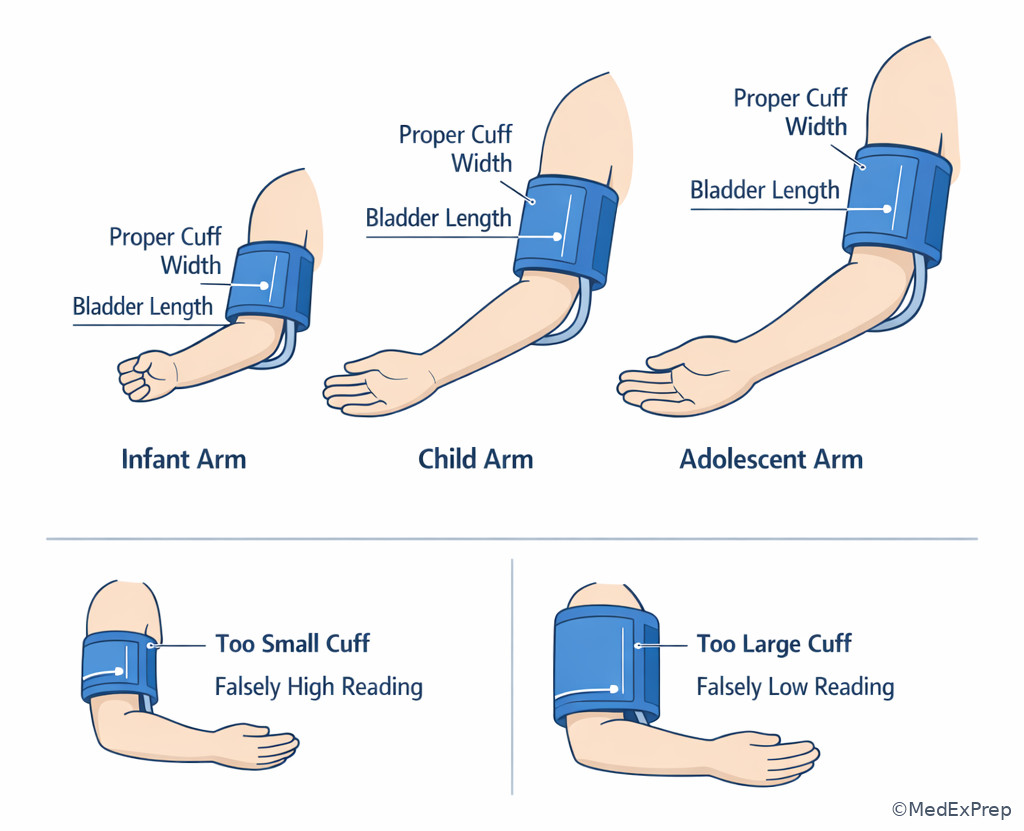
Exam takeaway: Wrong cuff size can create false blood pressure readings and misclassify stability.
Exam takeaway: Low urine output is a practical end-organ perfusion warning sign when paired with other red flags.
Exam takeaway: A sunken fontanelle supports dehydration, while a bulging fontanelle with illness raises concern for increased intracranial pressure or CNS infection.
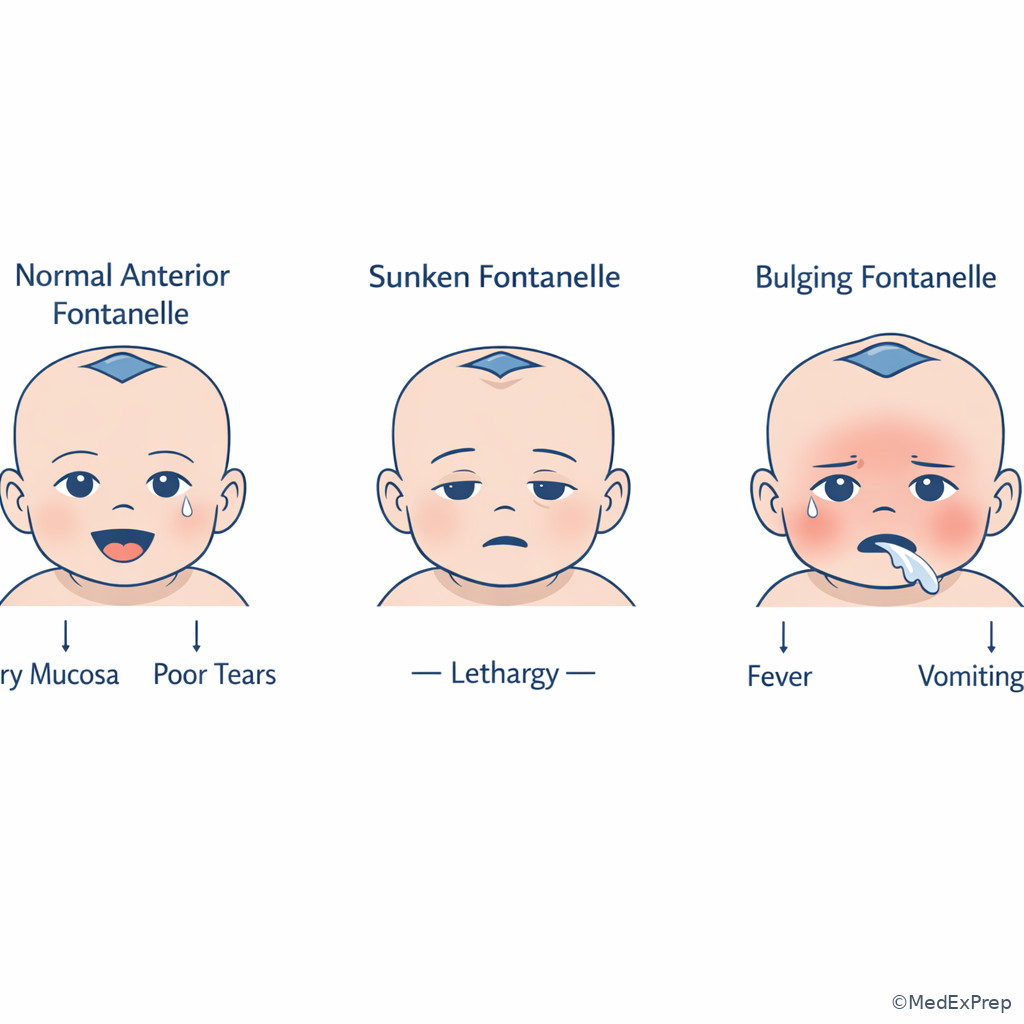
Exam takeaway: The same vital sign can mean pain, fever, compensation, or failure depending on perfusion and appearance.
flowchart TD
A[Tachycardia] --> B[Fever pain anxiety]
A --> C[Dehydration shock hypoxia]
D[Bradypnea] --> E[Fatigue CNS depression impending failure]
F[Normal oxygen saturation] --> G[Can coexist with rising work of breathing]
H[Normal blood pressure] --> I[Can coexist with compensated shock]
Exam takeaway: Caregiver baseline report is often the clue that distinguishes chronic abnormal from new deterioration.
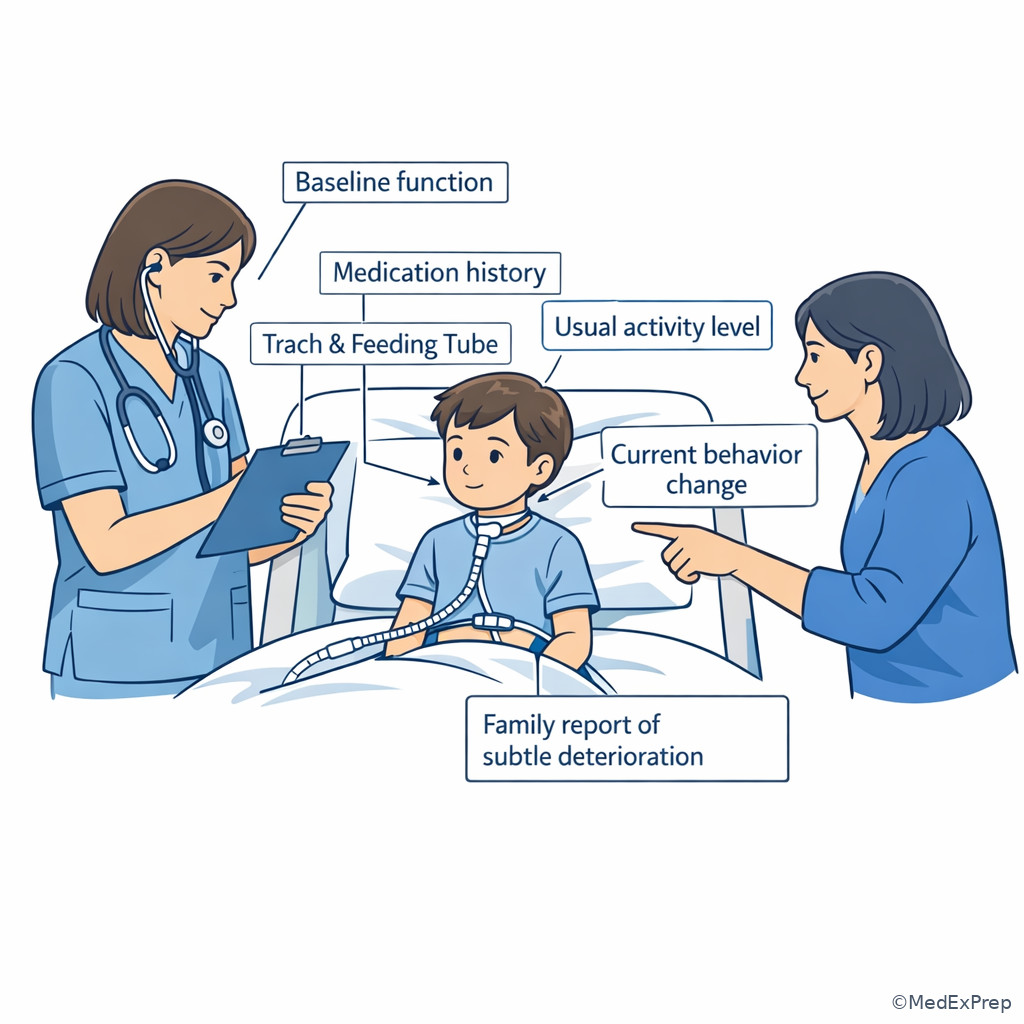
Core content
1.1.1.3 Foundational age bands: what counts as normal before you call it abnormal
A Explanation
The first decision conflict is simple but heavily tested: Is this number abnormal for age, or are you applying the wrong age standard? The rule that resolves it is to interpret every vital sign through an age band first, then through clinical context. Infants normally run faster heart and respiratory rates than adolescents. That means a respiratory rate that is reassuring in a 12-year-old may be a red flag in an infant if it is too low, while a heart rate that seems fast to an adult clinician may be physiologic in a crying toddler. See Fig 1.
WHY THIS IS TESTED: Exam stems commonly tempt you to overreact to normal infant tachycardia or underreact to age-inappropriate bradypnea and hypotension. The board-style task is not memorization alone; it is choosing whether to reassure, reassess, or escalate.
Use age in layers: first compare to expected range, then ask whether fever, crying, pain, or activity explains the finding, then ask whether the rest of the exam supports compensation or deterioration. A mildly febrile toddler with warm extremities, brisk capillary refill, interactive behavior, and normal hydration can tolerate a faster heart rate differently than a pale toddler with delayed refill and decreased urine output. On the exam, isolated values rarely win over pattern recognition.
B Worked example
A 7-month-old infant is brought to an acute care clinic for cough and poor feeding. He was born at 35 weeks, has mild reflux, and had routine vaccines yesterday. Temperature is 38.1°C, heart rate 168/min, respiratory rate 52/min, blood pressure 86/50 mm Hg, oxygen saturation 97% on room air. He is fussy but consolable, has mild nasal congestion, brisk capillary refill, moist mucous membranes, and takes small amounts by bottle. A distractor clue in the stem is the recent immunizations, which may tempt you to dismiss the vital signs as “post-vaccine fussiness.”
Reasoning chain: Identify task: decide whether vitals are abnormal for age and whether escalation is needed. Extract key facts: infant, low-grade fever, mild tachycardia and tachypnea, but normal oxygenation, good perfusion, moist mucosa, consolable. Apply rule: infants normally have faster HR and RR than older children; fever and crying can elevate both. Eliminate distractors: this is not shock because perfusion is intact; not respiratory failure because oxygenation and effort are acceptable; not normal simply because of vaccines because the full exam still matters. Verify: likely mild illness with close reassessment rather than emergent escalation.
C Exam trap
D Checkpoint
Question: A 14-year-old with gastroenteritis has T 38.2°C, HR 132/min, RR 18/min, BP 96/60 mm Hg, dry mucous membranes, and delayed capillary refill. Which finding most strongly argues that this is not simply “fever-related tachycardia”?
- Temperature of 38.2°C
- Respiratory rate of 18/min
- Delayed capillary refill
- History of vomiting for 12 hours
Answer: C. Delayed capillary refill.
- A: Tempting because fever can increase HR, but this does not separate benign fever from hypoperfusion; it is the explanation being tested, not the discriminator.
- B: Tempting because a normal RR may falsely reassure, but respiratory rate does not rule out dehydration-related circulatory compromise.
- C: Correct because poor perfusion shifts the interpretation from isolated fever tachycardia to volume depletion/compensation.
- D: Tempting because vomiting supports dehydration, but the physical sign of delayed refill is the stronger urgency clue.
1.1.1.4 Respiratory norms versus respiratory red flags
A Explanation
The next tested conflict is increased work of breathing versus normal noisy childhood breathing. The single rule: work of breathing beats oxygen saturation early. A child can maintain a normal pulse oximetry reading while tiring. Retractions, grunting, nasal flaring, head bobbing, apnea, cyanosis, altered voice/cry, and poor air movement matter more than one reassuring SpO2 number. See Fig 3 and Fig 2.
Infants are obligate or preferential nasal breathers, have compliant chest walls, and fatigue quickly. That is why nasal flaring and head bobbing in infants carry more weight than mild tachypnea alone. Older children may compensate with faster respiratory rates and accessory muscle use before they desaturate. Bradypnea in a previously tachypneic child is especially dangerous because it may reflect fatigue or central depression rather than improvement.
WHY THIS IS TESTED: Exams often hide impending respiratory failure behind a normal oxygen saturation or distract you with wheezing/noisy breathing when the real danger is diminished air entry and fatigue. Choose escalation when effort is worsening, mental status is changing, or ventilation is failing; reject false reassurance from isolated pulse oximetry.
B Worked example
A 3-year-old with eczema and a history of intermittent wheeze presents in winter with cough and “breathing fast.” He also has autism spectrum disorder and becomes distressed with exam. Temperature is 37.4°C, HR 148/min, RR 40/min, oxygen saturation 95% on room air. He has suprasternal and subcostal retractions, nasal flaring, prolonged expiratory phase, and decreased bilateral air entry. A tempting wrong clue is the oxygen saturation of 95%, which may lead you to underrate severity.
Reasoning chain: Identify task: classify respiratory severity and decide priority action. Extract key facts: preschool child, retractions, flaring, prolonged expiration, decreased air movement. Apply rule: work of breathing and poor air movement predict severity better than saturation alone. Eliminate distractors: this is not mild because the exam shows effort and reduced aeration; not simple anxiety because objective signs persist; not safe for delayed reassessment only because fatigue can develop quickly. Verify: this child requires prompt respiratory intervention, continuous monitoring, and escalation if response is inadequate.
C Exam trap
D Checkpoint
Question: A 10-month-old with bronchiolitis has RR 64/min, mild fever, nasal congestion, subcostal retractions, intermittent grunting, and oxygen saturation 94% on room air. Which finding most strongly requires immediate escalation?
- Nasal congestion
- Mild fever
- Intermittent grunting
- Oxygen saturation of 94%
Answer: C. Intermittent grunting.
- A: Tempting because infants are sensitive to upper-airway obstruction, but congestion alone is common and not the strongest severity marker.
- B: Tempting because fever can worsen tachypnea, but it does not itself indicate respiratory failure.
- C: Correct because grunting reflects an attempt to maintain end-expiratory pressure and is a major distress sign.
- D: Tempting because oxygenation matters, but a saturation of 94% is less alarming here than the work-of-breathing sign.
- The most concerning change from tachypnea to ______ is bradypnea.
- True or False: A normal SpO2 always rules out severe respiratory distress. False.
- Name 3 high-yield work-of-breathing signs: retractions, nasal flaring, grunting.
1.1.1.5 Perfusion and circulation: compensation before hypotension
A Explanation
This section addresses one of the highest-yield pediatric acute care rules: children maintain blood pressure until compensation begins to fail. The exam decision conflict is whether to wait for hypotension or act on earlier evidence of shock. The rule is to choose early action when tachycardia is paired with abnormal perfusion, even if blood pressure looks “okay.” See Fig 4 and Fig 5.
Early circulatory red flags include tachycardia out of proportion to fever or pain, cool extremities, weak distal pulses, delayed capillary refill, mottling, decreased urine output, and altered interaction or irritability. Late signs include hypotension, bradycardia, and marked mental status depression. Many board questions test whether you recognize that a child with normal BP can still be in compensated shock. Another common test point: pulse pressure, skin findings, and mental status often tell you more than a single cuff reading. Incorrect cuff size can also mislead; an inappropriately small cuff may falsely elevate BP and mask concern.
WHY THIS IS TESTED: Learners trained on adult patterns often wait too long. Pediatric questions reward those who act on perfusion clues and urine output trends rather than anchoring on blood pressure.
B Worked example
An 8-year-old with vomiting, type 1 diabetes, and ADHD presents after 18 hours of poor intake. He received ibuprofen at home, which is a distracting detail because it can shift attention to medication exposure. Vitals: T 37.8°C, HR 146/min, RR 28/min, BP 102/68 mm Hg, oxygen saturation 99%, capillary refill 4 seconds, cool hands, weak pedal pulses, and urine output reported as “only once since this morning.”
Reasoning chain: Identify task: determine whether normal BP excludes shock. Extract key facts: school-age child, significant tachycardia, delayed refill, cool extremities, low urine output. Apply rule: compensated shock can exist before hypotension. Eliminate distractors: not just anxiety because perfusion findings are objective; not benign dehydration requiring delayed follow-up because urine output is reduced and refill is prolonged; not adequate perfusion because BP is “normal” because pediatric BP falls late. Verify: early hemodynamic concern requiring prompt reassessment, access, monitoring, and escalation.
C Exam trap
D Checkpoint
Question: Which child most strongly fits compensated shock rather than simple fever response?
- A 2-year-old with T 39.5°C, HR 156/min, warm extremities, brisk refill, drinking juice, and playful behavior
- A 6-year-old with HR 142/min, normal BP, cool feet, capillary refill 4 seconds, and decreased urine output
- A 12-year-old with T 38.9°C, HR 118/min, crying with ear pain, and normal pulses
- An infant with HR 165/min after a prolonged crying episode and immediate normalization when soothed
Answer: B.
- A: Tempting because HR is high, but warm well-perfused behavior and intake support fever response rather than shock.
- B: Correct because poor perfusion and low urine output outweigh the normal BP and identify compensation.
- C: Tempting because fever plus tachycardia raises concern, but the degree and context fit pain/fever better without perfusion signs.
- D: Tempting because the HR looks high, but normalization with soothing argues against persistent hemodynamic compromise.
1.1.1.6 Mental status, behavior, and developmental context
A Explanation
The tested conflict here is normal developmental behavior versus altered mental status. The rule that resolves it: judge neurologic status against both age and the child’s baseline. A toddler resisting exam is often reassuring; a toddler who is unusually quiet, poorly interactive, or difficult to arouse is more concerning. In adolescents, confusion, slowed responses, or inability to sustain attention can indicate systemic compromise, intoxication, neurologic pathology, or metabolic derangement. In infants, weak cry, poor feeding, decreased eye contact, hypotonia, or reduced spontaneous movement may be the equivalent of “altered mental status.”
WHY THIS IS TESTED: Pediatric stems commonly use subtle wording such as “less interested,” “not acting like herself,” or “harder to wake” rather than dramatic coma language. Caregiver report is often the deciding clue. A chronic neurologic condition or developmental difference is a classic distractor; the right move is to compare current function with baseline, not with an imagined typical child. See Fig 1.
Also remember that agitation can be an early sign of hypoxia, pain, or poor perfusion, while lethargy is later and more ominous. In board-style questions, a previously irritable child who becomes quiet without clear comfort may be worsening, not improving. For infants, fontanelle findings, feeding change, tone, and consolability are high-yield companion clues. For any age, altered mentation plus abnormal vitals should be treated as a red flag until proven otherwise.
B Worked example
A 16-month-old with repaired congenital heart disease and mild developmental delay presents with fever and decreased intake. Parents say, “He usually fights everyone and cries, but today he just lies on us.” Vitals: T 38.7°C, HR 170/min, RR 48/min, BP 82/46 mm Hg, capillary refill 3–4 seconds. The tempting-but-wrong clue is the developmental delay, which may lure the learner into attributing low interaction to baseline.
Reasoning chain: Identify task: determine whether behavior change is a neurologic/circulatory red flag. Extract key facts: parent-reported deviation from baseline, lethargy-like behavior, tachycardia, tachypnea, borderline-low perfusion markers. Apply rule: baseline comparison outranks assumptions about chronic developmental status. Eliminate distractors: not “just tired from fever” because the behavior is specifically different and paired with abnormal perfusion; not baseline developmental delay because caregiver denies that; not safe for routine observation. Verify: concerning change requiring urgent reassessment and escalation.
C Exam trap
D Checkpoint
Question: Which finding in a febrile 9-month-old is most concerning for acute deterioration rather than routine illness behavior?
- Crying during ear examination
- Sleeping after feeding and waking to stimuli
- Poor eye contact, weak cry, and decreased feeding
- Brief stranger anxiety with clinging to parent
Answer: C.
- A: Tempting because crying can look dramatic, but resisting an ear exam is developmentally expected.
- B: Tempting because sleepiness may worry clinicians, but waking appropriately after feeding is reassuring.
- C: Correct because weak cry and decreased interaction/feeding in an infant are significant red flags.
- D: Tempting because clinging appears distressed, but stranger anxiety is age-appropriate behavior.
- The quiet child who is difficult to arouse is usually more concerning than the crying child with good perfusion.
- True or False: Developmental delay means caregiver report of baseline matters less. False.
- Name 3 infant neurologic red flags: weak cry, poor feeding, decreased eye contact.
1.1.1.7 Integrating the whole picture: choose reassessment, intervention, or escalation
A Explanation
Now bring the pieces together. The exam conflict is which abnormal finding can be watched versus which requires immediate action. The resolving rule is: an abnormal number becomes a true red flag when it aligns with abnormal appearance, breathing, perfusion, mental status, or a worsening trend. See Fig 5. One isolated borderline value may justify reassessment; a clustered pattern requires action.
Use a layered triage framework: first assess airway and breathing, then circulation and mental status, then context such as fever, pain, chronic disease, or device dependence. Trend matters more than one snapshot. A child whose HR drops from very high to “normal” while becoming more lethargic and less interactive may be tiring, not improving. A child with chronic cyanotic heart disease or baseline low saturations must be judged against their known baseline, not generic norms. Similarly, a technology-dependent child may have unusual baseline sounds or devices; what matters is the change from usual function.
WHY THIS IS TESTED: Questions often present multiple abnormalities and ask for the priority action. The strongest answer uses ABCs, age norms, trend interpretation, and baseline function together. The best option is rarely the most comprehensive intervention; it is the highest-priority next step that addresses immediate risk within NP/nursing scope.
B Worked example
A 12-year-old with cerebral palsy and chronic aspiration risk presents from home with cough, increased secretions, and poor oral intake. Baseline oxygen saturation is 93% on room air. Current vitals: HR 138/min, RR 34/min, BP 94/58 mm Hg, oxygen saturation 92%, capillary refill 4 seconds, sleepy but arousable. A distracting clue is the “baseline low oxygen saturation,” which may tempt you to underreact to the respiratory component.
Reasoning chain: Identify task: determine priority next step. Extract key facts: chronic complex child, near-baseline saturation, but tachycardia, tachypnea, delayed refill, decreased alertness, increased secretions. Apply rule: trend and clustering beat one “near-baseline” monitor value. Eliminate distractors: not safe to watch because mental status and perfusion are worsening; not purely chronic baseline because caregiver reports change; not only a secretion-management issue because circulatory and respiratory signs cluster. Verify: this child needs urgent reassessment, support, and team escalation.
C Exam trap
D Checkpoint
Question: Which scenario most requires immediate escalation rather than routine repeat vitals in 30 minutes?
- A crying toddler with HR above age norm that normalizes when held by parent
- A febrile school-age child with mild tachycardia, warm extremities, and brisk refill
- An infant with normal oxygen saturation, head bobbing, poor feeding, and decreasing responsiveness
- An adolescent with isolated mild hypertension after severe pain from a fracture
Answer: C.
- A: Tempting because the HR is initially high, but rapid normalization with comfort argues against ongoing instability.
- B: Tempting because fever can precede deterioration, but perfusion is intact and the pattern is less urgent.
- C: Correct because clustered respiratory effort, feeding decline, and changing responsiveness indicate impending failure.
- D: Tempting because abnormal BP gets attention, but pain-related mild hypertension is lower priority than airway/breathing red flags.
1.1.1.8 Special context clues: fever, pain, devices, and chronic baseline without getting fooled
A Explanation
The final integration task is choosing between a benign explanation and a dangerous one when the stem includes confounders. Fever, pain, crying, recent albuterol use, chronic lung disease, congenital heart disease, neurodisability, tracheostomy, or feeding tube dependence can all change expected findings. The tested rule is to accept a confounder only if the rest of the exam stays reassuring. If perfusion, work of breathing, mentation, or trend are abnormal, do not over-credit the confounder.
For example, fever can raise HR; it does not explain weak pulses and delayed refill. Pain can elevate BP; it does not explain lethargy. Baseline low oxygen saturation in cyanotic heart disease does not explain new retractions or altered behavior. A trach-dependent child may have chronic noisy secretions, but increased work of breathing, color change, or reduced interaction still matters. This is where caregiver baseline report becomes decisive.
WHY THIS IS TESTED: Exam writers intentionally include a tempting explanation. The correct answer comes from the single clue the confounder cannot explain. That clue often appears in the circulation or neurologic portion of the stem. See Fig 5.
B Worked example
A 9-year-old with sickle cell disease and chronic pain presents with fever and chest pain. He received oxycodone at home, which is the tempting-but-wrong clue because it can explain some sleepiness. Vitals show HR 136/min, RR 32/min, oxygen saturation 93% from a baseline of 98%, mild suprasternal retractions, and decreased left-sided breath sounds. He is quieter than usual.
Reasoning chain: Identify task: decide whether symptoms are medication effect/pain-related or a red-flag respiratory process. Extract key facts: fever, new saturation drop from baseline, retractions, unilateral decreased breath sounds, behavior change. Apply rule: opioid use may explain sleepiness but not new work of breathing, focal lung findings, or oxygen decline. Eliminate distractors: not routine chronic pain, not simple fever tachycardia, not just medication effect. Verify: this is a high-risk pattern requiring urgent evaluation and escalation.
C Exam trap
D Checkpoint
Question: Which finding most strongly defeats the explanation of “just fever and crying” in a 2-year-old?
- Heart rate 158/min during a rectal temperature check
- Tearful behavior while separated from parent
- Capillary refill 5 seconds with cool mottled legs
- Respiratory rate briefly elevated while screaming
Answer: C.
- A: Tempting because the number is high, but crying and fever can explain tachycardia in isolation.
- B: Tempting because distress draws attention, but separation anxiety is developmentally common.
- C: Correct because mottling and prolonged refill indicate impaired perfusion beyond emotional distress.
- D: Tempting because tachypnea can be concerning, but a brief elevation while screaming is less discriminating than perfusion failure.
Exam Traps & Differentiators
- Most common wrong answer and why: “Normal BP means stable.” Tempting because BP seems objective; wrong because pediatric hypotension is late.
- Looks similar but isn’t: crying tachycardia versus compensated shock; both raise HR, but only shock adds poor perfusion or altered mentation.
- Looks similar but isn’t: noisy breathing versus respiratory distress; distress adds retractions, grunting, poor air movement, or fatigue.
- Looks similar but isn’t: developmental stranger anxiety versus lethargy; lethargy reduces interaction and arousal rather than producing active resistance.
- Related trap from upcoming Pediatric Triage and Deterioration: do not wait for dramatic collapse. Early compensation is where the exam expects recognition.
| Stem says... | Think... | Why it matters |
|---|---|---|
| “Not acting like himself” | Baseline change is a red flag until explained | Caregiver report often identifies early neurologic or perfusion decline |
| “BP is still normal” | Compensated shock may still be present | Look at pulses, refill, urine output, mentation |
| “SpO2 95% on room air” with retractions | Respiratory distress may precede desaturation | Work of breathing and air movement drive urgency |
| “Recently got pain medicine” | Do not anchor if respiratory or perfusion findings are abnormal | Confounders must explain the whole picture, not one symptom |
| “Chronic baseline low saturation” | Compare to usual baseline and look for new distress | New trend or clustered findings still require action |
| “Much quieter than usual” | Possible worsening, not comfort | A quiet child can be sicker than a crying child |
| Confusable pair | Tempting surface logic | Single clue that separates them |
|---|---|---|
| Fever tachycardia vs shock tachycardia | Both can have high HR | Shock adds delayed refill, weak pulses, oliguria, altered mentation |
| Simple wheeze vs impending respiratory failure | Both may wheeze and breathe fast | Poor air entry or fatigue is more ominous than loud wheeze |
| Sleepy after medication vs acute deterioration | Medication explains drowsiness | Medication does not explain new retractions, desaturation, or poor perfusion |
| Baseline disability vs new neurologic change | Chronic condition can bias interpretation | Caregiver report of deviation from baseline defeats the anchor |
Tables
| Age group | Typical HR tendency | Typical RR tendency | BP interpretation pearl | Exam caution |
|---|---|---|---|---|
| Infant | Highest baseline | Highest baseline | Lower BP than older children can be normal | Bradypnea or poor feeding is especially concerning |
| Toddler | Still relatively fast | Faster than school-age child | Hypotension remains late | Crying can distort vitals; repeat when calm if safe |
| Preschool/school-age | Progressively slower | Progressively slower | Normal BP does not rule out compensated shock | Look for behavior change, intake/output trend |
| Adolescent | Closer to adult range | Closer to adult range | Still use pediatric context, especially with chronic disease | Do not default to adult-only reasoning |
| Finding | More often reassuring | More often dangerous |
|---|---|---|
| Heart rate | Brief rise with crying, pain, or fever that improves | Persistent tachycardia with poor perfusion or lethargy |
| Respiratory pattern | Transient fast breathing while upset | Grunting, apnea, head bobbing, decreased air movement |
| Behavior | Vigorous crying, stranger anxiety, consolable distress | Quietness, weak cry, poor interaction, difficult arousal |
| Perfusion | Warm extremities, brisk refill, normal urine output | Cool mottled skin, delayed refill, weak pulses, oliguria |
| Oxygenation | Near baseline with minimal effort | Normal saturation with worsening work of breathing can still be dangerous |
| Differential/classification | Key clues | Best immediate frame |
|---|---|---|
| Normal developmental resistance | Cries, fights exam, consoles with caregiver, remains interactive | Likely reassuring behavior for age |
| Early respiratory distress | Tachypnea, retractions, flaring, prolonged expiration | ABCs first; assess effort and aeration |
| Compensated shock | Tachycardia, cool extremities, delayed refill, low urine output, preserved BP | Circulatory red flag despite normal BP |
| Neurologic/mental status decline | Poor feeding, weak cry, confusion, hard to arouse, baseline deviation | Treat as urgent until cause clarified |
| Late decompensation | Hypotension, bradypnea, bradycardia, marked lethargy | Immediate emergency escalation |
| Monitoring target | What to track | Why trend matters |
|---|---|---|
| Heart rate | Response after fever control, fluid support, calming | Persistent elevation is more concerning than an initial spike |
| Respiratory status | Rate, retractions, air movement, grunting, saturation | Effort may worsen before oxygenation declines |
| Perfusion | Refill, pulses, skin temp, mottling | Early shock is a trend diagnosis |
| Neurologic status | Interaction, arousal, console ability, orientation | Subtle decline often precedes collapse |
| Urine output | Frequency, amount, diaper weights when relevant | Falling output signals reduced perfusion or dehydration |
Algorithm / Approach
Rapid Review
- Infant vitals → faster HR/RR are normal; bradypnea is the sharper danger sign.
- Normal BP in a child → does not exclude shock.
- Retractions + normal SpO2 → still respiratory distress.
- Poor air entry → worse than loud wheeze.
- Quiet, hard-to-console child → may be less concerning than quiet, hard-to-arouse child; arousal is the discriminator.
- Crying tachycardia → should improve with soothing; persistent tachycardia needs explanation.
- Capillary refill → strongest when paired with pulses, skin temp, and mentation.
- Urine output drop → think end-organ perfusion problem, not just intake history.
- Caregiver says “not baseline” → high-value exam clue, especially in chronic complex children.
- Fever explanation → fails if refill, pulses, or mentation are abnormal.
- Medication explanation → fails if desaturation, focal respiratory findings, or poor perfusion appear.
- Trend toward bradycardia or bradypnea → think fatigue or late decompensation.
Self-check quiz
1. A 15-month-old with rhinorrhea is crying during triage. HR is 162/min, RR 34/min, oxygen saturation 99%, capillary refill 2 seconds, and the child calms when held by the parent. Which action is most appropriate?
- Repeat the heart rate after the child is calm and continue full assessment
- Activate emergency escalation because the heart rate is above adult normal
- Document compensated shock and obtain immediate fluid resuscitation
- Assume the respiratory rate indicates impending respiratory failure
2. A 9-month-old with fever is less interested in feeding. Which finding most requires immediate clarification during assessment?
- Weak cry and poor eye contact
- Crying when the tympanic membrane is examined
- Brief tachycardia while rectal temperature is obtained
- Sleeping after a full bottle and waking to touch
3. A 6-year-old with vomiting, mild asthma, and recent ibuprofen use has HR 144/min, RR 26/min, BP 100/64 mm Hg, cool feet, capillary refill 4 seconds, and only one urine void in 10 hours. Which action is the best priority?
- Recognize possible compensated shock and escalate reassessment despite normal BP
- Delay action because the blood pressure is still within range for age
- Attribute the tachycardia to ibuprofen exposure and recheck in 4 hours
- Focus on asthma because tachypnea alone is the strongest concern
4. A 4-year-old with viral symptoms has RR 38/min, oxygen saturation 95%, suprasternal retractions, prolonged expiration, and diminished air entry. Which action is most appropriate?
- Prioritize respiratory support/escalation because work of breathing outweighs the saturation alone
- Observe only because oxygen saturation is above 94%
- Reassure the family because wheezing usually sounds louder when severe
- Address fever first because respiratory findings can wait if oxygenation is normal
5. A 13-year-old with anxiety and appendicitis pain has BP 138/84 mm Hg, HR 118/min, warm extremities, brisk capillary refill, and normal mentation. Which interpretation is best?
- Isolated mild hypertension may reflect pain and is lower priority than ABC abnormalities
- The elevated blood pressure proves decompensated shock
- Warm extremities are a late sign of circulatory failure
- Normal mentation rules out the need for any reassessment
6. A 2-year-old with repaired tracheoesophageal fistula and chronic noisy breathing has a baseline oxygen saturation of 94%. Today the child has RR 48/min, new subcostal retractions, decreased intake, capillary refill 4 seconds, and is quieter than usual. Which finding is the strongest discriminator that this is not just baseline respiratory noise?
- Baseline oxygen saturation of 94%
- History of chronic noisy breathing
- Capillary refill 4 seconds with behavior change
- Age younger than 3 years
7. A 17-year-old with sickle cell disease, fever, and chest pain took oxycodone at home. Now the patient is sleepy, HR 134/min, RR 30/min, oxygen saturation 93% from a baseline of 98%, with mild retractions and decreased left breath sounds. Which action is the best priority?
- Urgently escalate respiratory evaluation because opioid use does not explain the new oxygen drop and focal exam findings
- Observe for medication effect because the oxycodone best explains the sleepiness
- Focus on pain scoring only because tachycardia is expected with pain crisis
- Delay further action until hypotension develops
8. A 10-month-old born prematurely presents with bronchiolitis, congenital hypotonia, and poor feeding. At first the infant has RR 62/min with retractions and is irritable. Thirty minutes later RR is 34/min, retractions are less obvious, the infant is difficult to arouse, and oxygen saturation has fallen from 96% to 91%. Which interpretation is most appropriate?
- The lower respiratory rate shows improvement, so continue observation
- The infant may be tiring with impending respiratory failure and requires immediate escalation
- The change is expected because hypotonia lowers respiratory drive at baseline
- The oxygen saturation decline is minor and can be reassessed after feeding
Answer key
1. Best answer: A.
- A: Tempting because it feels less dramatic, and it is correct because nursing-process priority starts with accurate reassessment in context; a crying toddler may have transient tachycardia that normalizes when calm. Discriminating clue: consolable behavior with normal perfusion and oxygenation. Source: NCSBN clinical judgment principles; Lewis.
- B: Tempting because the HR looks high to adult eyes, but ABCs and pediatric age norms eliminate emergency activation here. Discriminating clue: the child is crying and quickly calms with parent. Source: Saunders; NCSBN.
- C: Tempting because tachycardia can reflect shock, but this option over-prioritizes circulation without perfusion abnormalities. Discriminating clue: capillary refill is 2 seconds and saturation is normal. Source: Lewis; ANA Standards.
- D: Tempting because RR matters in toddlers, but 34/min without distress signs is not the key threat here. Discriminating clue: no retractions, hypoxemia, or altered mental status are present. Source: Saunders.
2. Best answer: A.
- A: Tempting because it sounds nonspecific, and it is correct because weak cry plus poor eye contact in an infant suggests altered status and possible serious illness; ABCs/Maslow prioritize this over routine fever behaviors. Discriminating clue: decreased interaction. Source: Saunders; Lewis.
- B: Tempting because crying can look severe, but active resistance is generally more reassuring than lethargy in this age group. Discriminating clue: crying during ear exam is expected. Source: Saunders.
- C: Tempting because tachycardia can be serious, but brief procedure-related increases are less urgent than altered behavior. Discriminating clue: the rise occurs during temperature measurement. Source: NCSBN.
- D: Tempting because sleepiness can worry clinicians, but waking appropriately to touch after feeding is more reassuring. Discriminating clue: arousable and recently fed. Source: Lewis.
3. Best answer: A.
- A: Tempting because it escalates despite a normal BP, and it is correct because pediatric priority uses circulation findings over BP alone; delayed refill, cool extremities, and low urine output indicate compensated shock. Discriminating clue: poor perfusion despite preserved BP. Source: Lewis; NCSBN.
- B: Tempting because BP feels objective, but pediatric shock can be present before hypotension. Discriminating clue: capillary refill of 4 seconds. Source: Saunders.
- C: Tempting because medication history is a distractor, but ibuprofen does not explain objective perfusion deficits. Discriminating clue: oliguria and cool feet. Source: ANA Standards; Lewis.
- D: Tempting because the child has asthma history, but the stem’s circulation findings are more urgent than the mild tachypnea. Discriminating clue: no major respiratory distress markers are described. Source: NCSBN.
4. Best answer: A.
- A: Tempting because it prioritizes intervention before dramatic desaturation, and it is correct because ABCs place work of breathing and air movement above a borderline-normal saturation. Discriminating clue: diminished air entry with retractions. Source: Saunders; Lewis.
- B: Tempting because monitor numbers feel safe, but SpO2 alone can lag behind severity. Discriminating clue: suprasternal retractions. Source: NCSBN.
- C: Tempting because wheeze is common in viral illness, but the stem emphasizes decreased aeration, not reassuring noise. Discriminating clue: diminished air entry. Source: Lewis.
- D: Tempting because fever treatment is reasonable, but it is the right action at the wrong priority. Discriminating clue: ABC issue exists now. Source: NCSBN; ANA Standards.
5. Best answer: A.
- A: Tempting because it seems to downplay an abnormal BP, and it is correct because pain can transiently increase BP and HR; with warm extremities, brisk refill, and intact mentation, this is lower priority than ABC compromise. Discriminating clue: reassuring perfusion exam. Source: Saunders; Lewis.
- B: Tempting because vital sign abnormalities can suggest instability, but hypertension is not the typical late sign of pediatric shock. Discriminating clue: warm extremities and brisk refill. Source: NCSBN.
- C: Tempting because circulatory terms can blur together, but warm extremities are not a classic late shock clue in this context. Discriminating clue: no weak pulses or delayed refill are present. Source: Lewis.
- D: Tempting because normal mentation reassures, but all abnormal vitals still need reassessment and context. Discriminating clue: pain still requires follow-up even if not emergent. Source: ANA Standards.
6. Best answer: C.
- A: Tempting because a low baseline saturation can dominate your thinking, but baseline saturation does not address perfusion or new behavior change. Discriminating clue: saturation is baseline, not the new problem. Source: Lewis; NCSBN.
- B: Tempting because chronic noisy breathing encourages anchoring, but chronic findings do not explain new systemic deterioration. Discriminating clue: history is baseline, not the distinguishing red flag. Source: Saunders.
- C: Correct because delayed capillary refill with quieter-than-usual behavior identifies a change that baseline respiratory noise cannot explain. By priority reasoning, circulation and mental status abnormalities escalate concern. Discriminating clue: cap refill 4 seconds plus behavior change. Source: NCSBN; ANA Standards.
- D: Tempting because younger children decompensate faster, but age alone does not distinguish baseline from acute change in this stem. Discriminating clue: the new perfusion and behavior findings do. Source: Saunders.
7. Best answer: A.
- A: Correct because ABC priority places the new oxygen drop, retractions, and focal decreased breath sounds above the tempting medication explanation. The opioid may contribute to sleepiness, but it does not explain the respiratory findings. Discriminating clue: desaturation from baseline with focal lung exam change. Source: Lewis; Saunders.
- B: Tempting because oxycodone can cause sedation, but this is the classic anchor trap. Discriminating clue: mild retractions and unilateral decreased breath sounds are not expected from simple medication effect. Source: NCSBN.
- C: Tempting because pain crisis is common in sickle cell disease, but focusing on pain only misses a respiratory emergency pattern. Discriminating clue: oxygen saturation has fallen from baseline. Source: Saunders.
- D: Tempting because hypotension is dramatic, but waiting violates pediatric early-deterioration principles. Discriminating clue: action should occur before hypotension. Source: ANA Standards; Lewis.
8. Best answer: B.
- A: Tempting because the RR is lower and retractions appear less visible, but this is the right observation interpreted in the wrong direction; falling effort with reduced arousability can mean fatigue. Discriminating clue: harder to arouse with worsening oxygenation. Source: Lewis; NCSBN.
- B: Correct because the pattern shows tiring and progression toward respiratory failure. In pediatric priority terms, declining mental status plus worsening saturation outweigh the apparently lower RR. Discriminating clue: decreased arousability after prior distress. Source: Saunders; ANA Standards.
- C: Tempting because chronic hypotonia is a real confounder, but baseline conditions do not explain the worsening trend from this encounter. Discriminating clue: deterioration over 30 minutes. Source: NCSBN.
- D: Tempting because feeding is important in bronchiolitis, but feeding is not the priority when respiratory failure may be developing. Discriminating clue: saturation fell and arousability worsened. Source: Lewis.
Keep going with the full CPNP-AC Prep Course (CPNP-AC)
You just studied the way members do, in the same lesson interface. Full access unlocks every lesson, the question bank and flashcards for a full year.
One payment · 1 year of access · No auto-renewal