PREREQS Pregnancy Dating And Gravidity; basic prenatal visit structure
OUTPUTS You should be able to choose routine baseline prenatal labs versus risk-based add-ons, separate screening from confirmatory testing, and identify when urine, blood type/Rh, antibody, infectious disease, CBC, and STI results change the next step.
What you'll learn
OB-APC: Baseline prenatal assessment -> list the routine initial prenatal laboratory panel and explain why each test is obtained.
OB-APC: Maternal-fetal safety -> use blood type, Rh status, and antibody screening to identify alloimmunization risk and appropriate follow-up concepts.
OB-APC: Infection screening -> recognize routine infectious disease screening in pregnancy, including HIV, hepatitis B, syphilis, rubella immunity, and urine testing for asymptomatic bacteriuria.
OB-APC: Risk-based testing -> identify when additional STI testing is indicated based on age, exposure risk, symptoms, or local prevalence.
OB-APC: Test sequencing -> distinguish screening tests from confirmatory diagnostic tests and select the safest next step in COMAT-style vignettes.
Blueprint mapping
Domain: OB-APC Antepartum Care -> Prenatal Visit Foundations -> Initial Prenatal Laboratory Panel. Weight: blueprint detail not publicly confirmed; treat this as foundational antepartum care tested through screening, diagnostic sequencing, risk recognition, and next-best-step reasoning.
WHY
Why it matters
The initial prenatal panel establishes maternal baseline status before complications arise; the exam often asks what must be checked early rather than what is checked later.
Several tests identify preventable fetal or neonatal harm: Rh incompatibility risk, congenital or perinatal infection risk, anemia, and asymptomatic bacteriuria.
COMAT-style questions frequently hinge on sequencing: screen first, confirm abnormal results when required, treat pregnancy-specific risks promptly, and escalate abnormal findings within supervised care.
The most common wrong answers are incomplete panels, nonpregnancy screening habits, or definitive actions chosen before a screening abnormality has been interpreted.
Fig 1. Initial prenatal lab map Exam takeaway: The first prenatal panel is a baseline safety screen, not a random collection of unrelated tests.
graph TD;A[First prenatal visit]-->B[Maternal blood baseline];A-->C[Immunity and infection];A-->D[Urine screening];A-->E[Risk-based add-ons];B-->B1[ABO Rh antibody screen CBC];C-->C1[Rubella Hep B HIV syphilis];D-->D1[Urinalysis and culture];E-->E1[GC CT and other STI testing when indicated]
Use Fig 1 as the organizing framework for this lesson: the panel answers four questions--what is the mother's baseline blood status, what infections or immunity gaps matter, is urine screening abnormal, and does risk require additional testing?
KEY TERMS
Key Terms & Must-Know Facts
1.1.2.1 Key terms
Initial prenatal panel
Baseline laboratory testing obtained early in prenatal care to identify maternal, fetal, and neonatal risks.
ABO blood type
Maternal blood group used with Rh status to guide transfusion awareness and obstetric risk assessment.
Rh status
Presence or absence of the D antigen; Rh-negative patients require antibody screening and prevention planning when not sensitized.
Antibody screen
Maternal serum screen for clinically significant red-cell antibodies that may affect the fetus.
CBC
Complete blood count used to assess anemia, platelet baseline, and general hematologic status.
Rubella immunity
Serologic evidence of immunity; nonimmune patients are counseled to avoid exposure and receive postpartum vaccination rather than live vaccination during pregnancy.
HBsAg
Hepatitis B surface antigen screening that identifies maternal hepatitis B infection and neonatal prophylaxis needs.
HIV screen
Routine prenatal screening because diagnosis changes maternal treatment and perinatal transmission prevention.
Syphilis screen
Routine serologic screening because untreated infection can cause severe fetal and neonatal outcomes.
Asymptomatic bacteriuria
Significant bacteriuria without urinary symptoms; in pregnancy it is screened for and treated because of pyelonephritis and obstetric risk.
Risk-based STI testing
Additional testing, commonly including gonorrhea and chlamydia, guided by age, exposure risk, symptoms, prevalence, or prior history.
Screening test
A test used to identify risk or possible disease in a population; abnormal results may need confirmation.
Confirmatory diagnostic test
A more definitive test used after a positive screen or high clinical suspicion to establish diagnosis or guide management.
1.1.2.2 Must-know facts
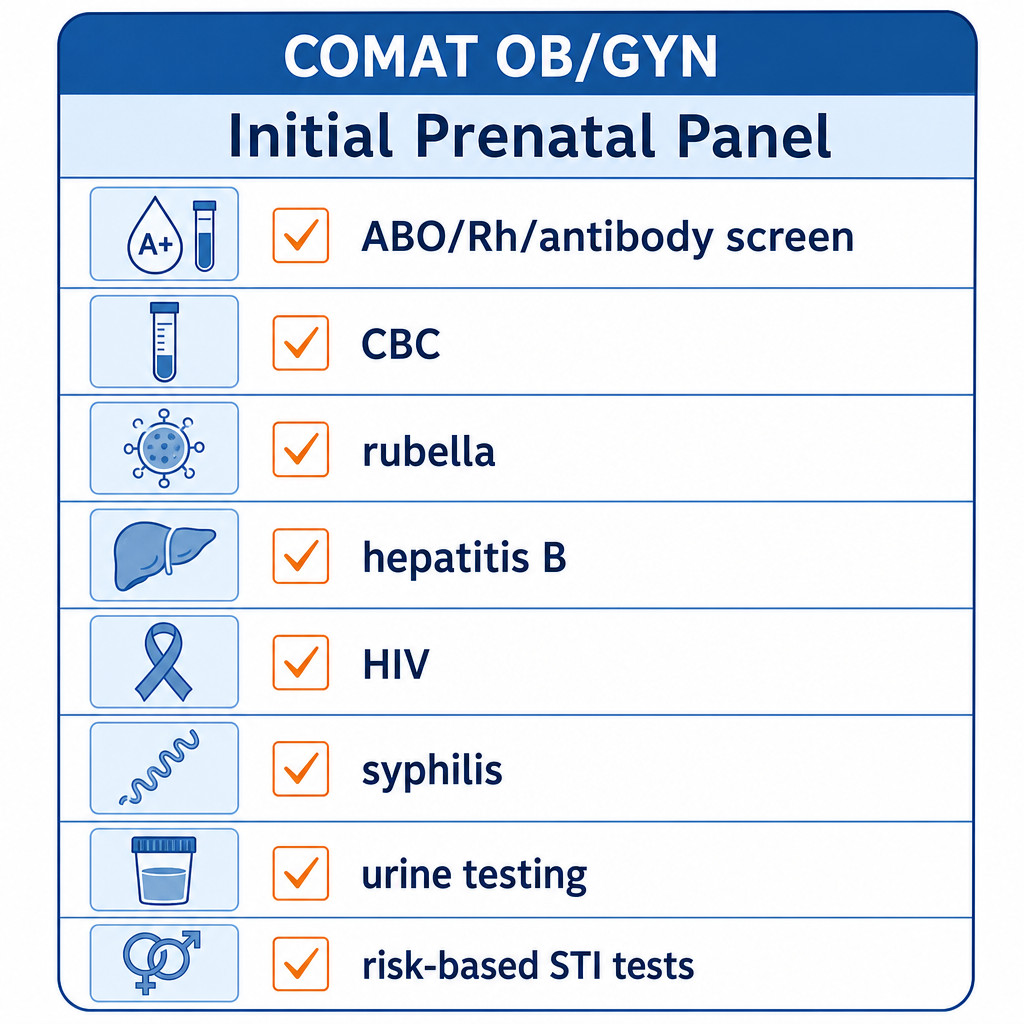
Routine initial prenatal labs include blood type, Rh, antibody screen, CBC, rubella, hepatitis B, HIV, syphilis, and urine testing.
Urine testing includes screening for asymptomatic bacteriuria; symptoms are not required for screening in pregnancy.
Additional STI testing is risk-based, but age, new or multiple partners, prior STI, symptoms, or high-prevalence setting should lower the threshold.
A positive screening result is not always the final diagnosis; the next step often depends on confirmatory testing or linked management protocols.
Rh-negative status alone is not the same as alloimmunization; the antibody screen determines whether sensitization is present.
Rubella nonimmunity is an antepartum counseling issue and a postpartum vaccination issue, not a reason to give live vaccine during pregnancy.
Abnormal results are interpreted in clinical context: gestational age, symptoms, prior records, and maternal-fetal safety determine urgency.
Local protocols may vary in exact timing or repeat testing, but the COMAT concept is stable: establish baseline, detect preventable infections, and sequence follow-up safely.
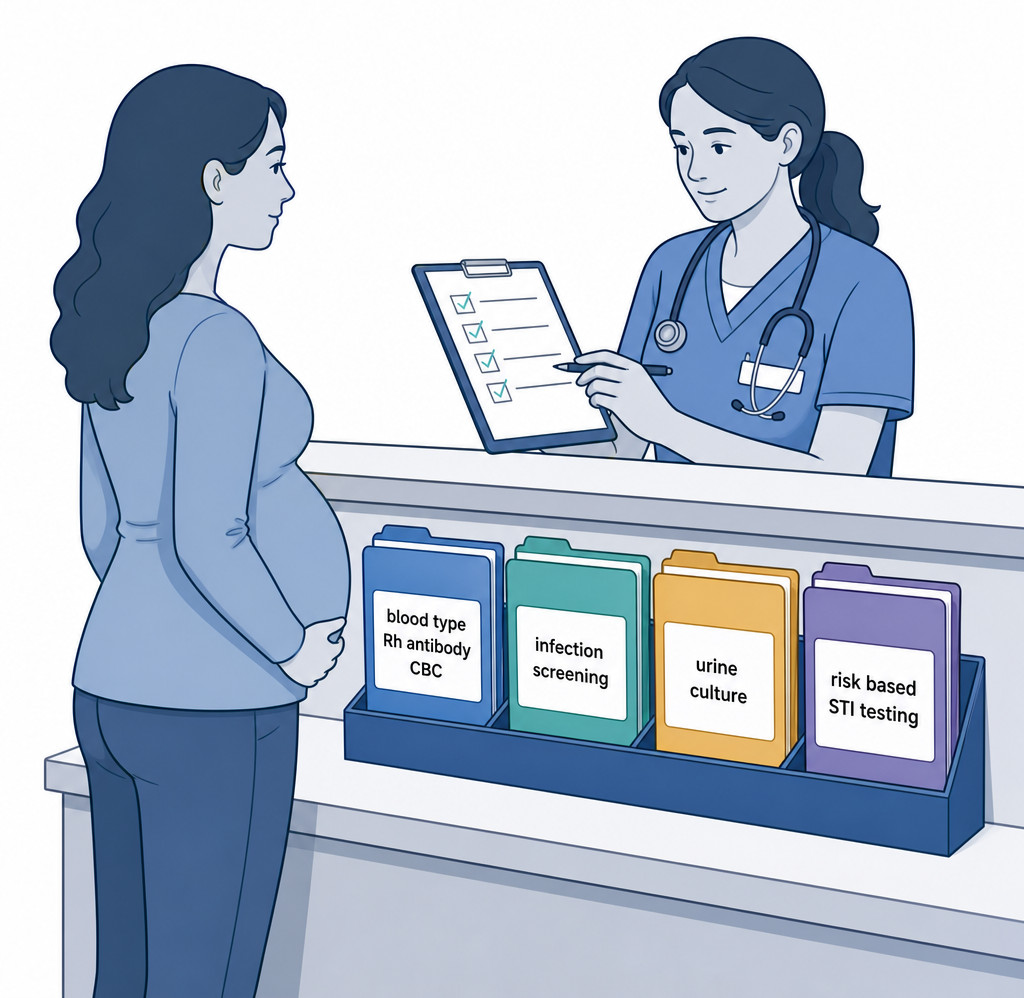
Fig 6. First prenatal visit laboratory station Exam takeaway: Visualize the first prenatal panel as a structured intake workflow rather than a memorized list.
CORE
Core content
1.1.2.3 1. Routine panel components: choose the baseline set, not a scattered workup
A. Explanation
Decision conflict: In an early prenatal visit, the question is usually not, “What test could ever be useful?” It is, “Which baseline tests are routinely obtained now for essentially all pregnant patients?” The correct set includes maternal blood status, hematologic baseline, immunity and infection screening, and urine testing. WHY THIS IS TESTED: COMAT-style stems often provide a normal first pregnancy visit and ask for the next appropriate screening step; learners miss these items by over-ordering later tests or forgetting a baseline infectious screen.
The routine panel includes ABO blood type, Rh status, antibody screen, CBC, rubella immunity, hepatitis B screening, HIV screening, syphilis screening, and urine testing. These are foundational because they identify risks that can be prevented, monitored, or treated before symptoms appear. This topic connects directly to later lessons on Rh alloimmunization prevention, genetic screening pathways, and routine prenatal visit priorities.
First prenatal visitConfirm pregnancy context and datingOrder baseline blood and infection panelAdd urine testingLayer risk-based STI testsPlan follow-up for abnormal results
Fig 2. Baseline versus risk-based testing Exam takeaway: Routine tests are for nearly all pregnancies; add-ons require a clue such as risk, symptoms, exposure, or abnormal screening.
graph LR;A[Prenatal lab decision]-->B[Routine for all];A-->C[Risk based add on];B-->D[ABO Rh antibody CBC];B-->E[Rubella Hep B HIV syphilis];B-->F[Urine testing];C-->G[GC CT if indicated];C-->H[Other STI or condition specific testing];C-->I[Follow local and risk guidance]
See Fig 2 when deciding whether a test belongs in the universal initial panel or is justified by a risk clue.
Panel category
Routine examples
Primary reason it matters
Common exam pivot
Blood type and immune hematology
ABO, Rh, antibody screen
Identifies alloimmunization risk and baseline transfusion information
Rh-negative patient with negative versus positive antibody screen
Hematology
CBC
Assesses anemia and platelet baseline
Fatigue or pallor should not replace routine CBC ordering
Infection and immunity
Rubella, hepatitis B, HIV, syphilis
Identifies preventable congenital, neonatal, or perinatal infection risk
Screening in asymptomatic patients is still routine
Urine
Urinalysis and/or culture depending on protocol
Detects bacteriuria and urinary disease relevant to pregnancy
Asymptomatic bacteriuria is screened even without dysuria
Risk-based STI testing
Gonorrhea, chlamydia, and others when indicated
Targets infections based on age, exposure, symptoms, or prevalence
Young age or STI risk changes the appropriate panel
B. Worked example
A 24-year-old G1P0 at 9 weeks by last menstrual period presents for her first prenatal visit. She has mild asthma and hypothyroidism, takes levothyroxine, and reports nausea without vomiting. She has no dysuria, fever, vaginal bleeding, or pelvic pain. A urine pregnancy test is positive. Her heart rate is 96/min, which is slightly distracting but she is otherwise stable. The question asks for the most appropriate initial laboratory evaluation.
Reasoning chain: Identify the task: first prenatal laboratory panel. Extract key facts: early viable pregnancy context, no acute symptoms, first visit, stable patient. Apply the rule: obtain routine baseline prenatal labs, including blood type/Rh/antibody screen, CBC, rubella, hepatitis B, HIV, syphilis, and urine testing. Eliminate distractors: aneuploidy screening may be discussed by gestational age but does not replace the baseline panel; urine culture is still appropriate despite no dysuria; thyroid monitoring may be relevant because of hypothyroidism but is not the core routine panel tested here. Verify: the safe next step is broad baseline prenatal screening plus condition-specific follow-up as indicated.
C. Exam trap
Common wrong answer: Order only symptom-driven tests because the patient feels well. Why it is tempting: Many nonpregnant outpatient workups are complaint-driven. Single clue that rules it out: This is the first prenatal visit, where baseline screening is routine even when asymptomatic.
D. Checkpoint MCQ
A 30-year-old G2P1 at 8 weeks presents for initial prenatal care. She has chronic hypertension and seasonal allergies. She denies urinary symptoms and has no vaginal bleeding. Which test grouping is most appropriate as part of the routine initial prenatal laboratory panel?
Fetal fibronectin, contraction stress test, and group B streptococcus culture
Oral glucose tolerance test, bile acids, and fetal nonstress test
Amniocentesis, cell-free DNA, and detailed fetal echocardiography
Answer: A. Option A is correct because it matches the routine baseline prenatal panel. Option B is tempting because all items relate to obstetrics, but they are not first-visit baseline labs. Option C is tempting because gestational diabetes and cholestasis matter in pregnancy, but these tests are not routine initial prenatal screening in an uncomplicated 8-week visit. Option D is tempting because it sounds comprehensive, but it mixes genetic/diagnostic and specialized fetal testing rather than baseline labs.
If you missed this: Review Routine panel components: choose the baseline set, not a scattered workup - focus on the discriminating rule that the first prenatal visit requires routine baseline screening even when asymptomatic.
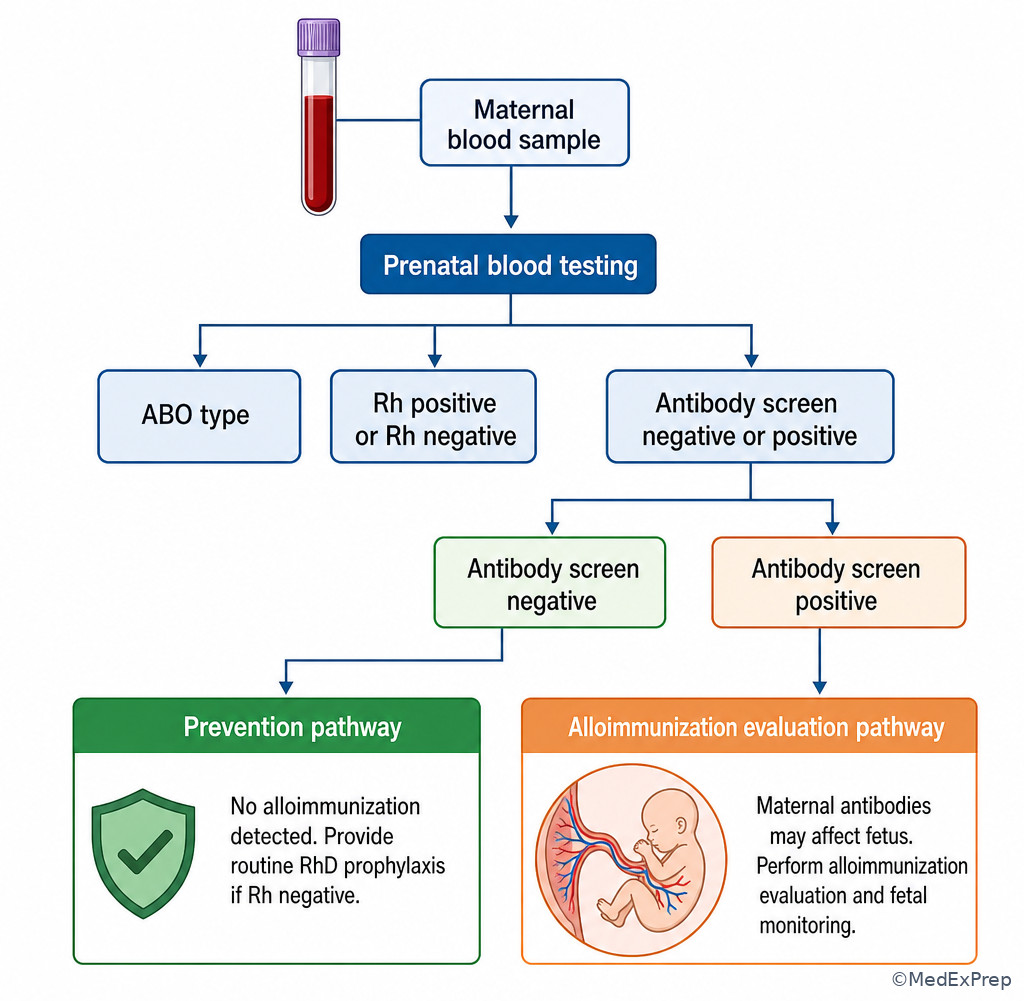
Decision conflict: Do not stop at “blood type known” or “Rh-negative.” The initial prenatal visit needs a paired understanding of Rh status plus antibody screen, because an unsensitized Rh-negative patient is managed differently from a patient who already has clinically significant antibodies. WHY THIS IS TESTED: COMAT questions use Rh-negative status as a pivot; the exam expects you to recognize that antibody status determines whether the issue is prevention planning or evaluation of alloimmunization.
The CBC provides baseline hemoglobin/hematocrit and platelet information. It may reveal anemia or thrombocytopenia that requires follow-up, but the foundational COMAT move is to include it in the initial panel and interpret abnormalities in context. Blood type and antibody testing also prepare the team for pregnancy-related bleeding events, transfusion considerations, and future Rh-related decision points.
ABO/Rh resultAntibody screenIf Rh-negative and screen negative: prevention conceptIf antibody positive: evaluate significanceCBC baseline guides anemia or platelet follow-up
Rh and antibody screen split pathway
Exam takeaway: Rh-negative status is incomplete without the antibody screen result.
Result pattern
How to interpret it
Exam-safe next thought
Rh-positive, antibody screen negative
No Rh-D prevention issue identified by this pattern
Continue routine prenatal care and interpret other labs
Rh-negative, antibody screen negative
Not sensitized based on screen
Think prevention planning at appropriate times and after sensitizing events
Rh-negative or Rh-positive with positive antibody screen
Possible clinically significant maternal red-cell antibody
Do not treat as simple prophylaxis only; evaluate antibody significance and titers through supervised care
Low hemoglobin on CBC
Possible anemia requiring pregnancy-appropriate evaluation
Do not ignore because patient is asymptomatic
B. Worked example
A 28-year-old G3P1011 at 10 weeks presents for prenatal care. She has type 1 diabetes and a history of postpartum hemorrhage in a prior delivery. She recently recovered from a viral upper respiratory infection and has mild fatigue. Labs show blood type O negative and a negative antibody screen. The platelet count is normal, and hemoglobin is mildly low. The question asks what the Rh-related result means.
Reasoning chain: Identify the task: interpret blood type/Rh/antibody screen. Extract key facts: Rh-negative, antibody screen negative, early pregnancy, no current bleeding. Apply the rule: Rh-negative with a negative antibody screen suggests she is not currently sensitized, so this is a prevention-planning situation rather than established alloimmunization. Eliminate distractors: prior postpartum hemorrhage may sound dramatic but does not by itself prove sensitization; mild fatigue may relate to anemia but does not alter the Rh interpretation. Verify: future Rh prophylaxis concepts and evaluation after sensitizing events will matter, but the current screen is negative.
C. Exam trap
Common wrong answer: Treat every Rh-negative patient as already alloimmunized. Why it is tempting: Rh-negative status is repeatedly emphasized in obstetrics. Single clue that rules it out: The antibody screen is negative, so the patient is not shown to be sensitized in the stem.
D. Checkpoint MCQ
A 26-year-old G1P0 at 11 weeks has blood type A negative and a positive antibody screen during initial prenatal testing. Which interpretation is most appropriate?
The positive screen suggests possible maternal red-cell alloantibody that requires further evaluation.
The result is normal because all Rh-negative pregnant patients have positive antibody screens.
The next step is to ignore the antibody screen until delivery.
The result proves fetal anemia and mandates immediate delivery.
Answer: A. Option A is correct because a positive antibody screen identifies possible clinically significant antibodies. Option B is tempting if Rh-negative status is conflated with sensitization, but Rh-negative patients can have negative screens. Option C is tempting in a stable early pregnancy, but abnormal screening should not be ignored. Option D is tempting because fetal anemia is a feared complication, but the screen alone does not prove fetal anemia or justify delivery.
If you missed this: Review Blood type, Rh status, antibody screen, and CBC: identify baseline hematologic risk - focus on the difference between Rh-negative status and a positive antibody screen.
Quick Recall:
Fill in the blank: Rh-negative + negative antibody screen = prevention planning, not established ________.
True/false: CBC is part of the routine initial prenatal laboratory panel.
One-liner: What result must be paired with Rh status to determine whether sensitization is present?
1.1.2.5 3. Infectious disease and immunity screening: prevent perinatal and neonatal harm
A. Explanation
Decision conflict: The initial prenatal visit is not limited to infections with symptoms. HIV, hepatitis B, syphilis, and rubella immunity screening are routine because identifying risk early changes counseling, prevention, treatment, neonatal planning, or postpartum vaccination. WHY THIS IS TESTED: COMAT vignettes often describe a healthy patient and ask whether screening is still appropriate; the correct answer is yes for routine prenatal infection and immunity tests.
Rubella testing is an immunity screen. If nonimmune, the key exam point is counseling during pregnancy and vaccination after delivery, because live vaccines are generally avoided during pregnancy. Hepatitis B screening matters because maternal infection changes neonatal prophylaxis planning. HIV and syphilis screening matter because timely diagnosis can reduce adverse maternal-fetal outcomes. The exact repeat-testing schedule can vary by risk and protocol, but the initial panel concept is stable.
Screen earlyIdentify infection or nonimmunityConfirm or stage when neededTreat or plan preventionProtect fetus/newborn
Fig 3. Infection screening logic Exam takeaway: Routine prenatal infection screening is performed because positive results change prevention, treatment, or neonatal planning.
graph TD;A[Routine infection and immunity screen]-->B[Rubella immunity];A-->C[Hepatitis B];A-->D[HIV];A-->E[Syphilis];B-->B1[If nonimmune counsel now vaccinate postpartum];C-->C1[Plan maternal evaluation and neonatal prevention];D-->D1[Link to treatment to reduce transmission];E-->E1[Confirm and treat to prevent congenital infection]
See Fig 3 for the core logic: a screen is valuable when a positive result changes the pregnancy or neonatal plan.
Prenatal infectious disease prevention board Exam takeaway: Infection screening is routine even without symptoms because fetal and neonatal consequences may be preventable.
{"prompt":"Professional medical education illustration of a prenatal infectious disease prevention board with labeled icons for rubella immunity, hepatitis B surface antigen, HIV test, syphilis serology, and newborn protection; include a clinician pointing to a timeline from first prenatal visit to delivery; no logos","caption":"Routine prenatal infection screening","size":"1024x1024"}
B. Worked example
A 19-year-old G1P0 at 12 weeks presents for prenatal care. She has obesity and mild intermittent asthma. She reports no fever, rash, genital lesions, dysuria, or vaginal discharge. She recently moved and does not have vaccine records. Her partner’s history is unclear, which is a distracting but relevant risk clue for STI thinking. The question asks which infectious screening tests belong in routine initial prenatal care.
Reasoning chain: Identify the task: routine prenatal infectious screening. Extract key facts: initial visit, asymptomatic, no rubella documentation. Apply the rule: screen for rubella immunity, hepatitis B, HIV, and syphilis as routine prenatal tests. Eliminate distractors: absence of rash does not remove rubella immunity testing; absence of dysuria does not remove urine bacteriuria screening; partner uncertainty may support additional STI testing but does not replace the routine infection panel. Verify: if rubella nonimmune, counsel during pregnancy and plan postpartum vaccination rather than antepartum live vaccination.
C. Exam trap
Common wrong answer: Wait for symptoms before screening for HIV, syphilis, or hepatitis B. Why it is tempting: Symptom-driven testing feels intuitive in general medicine. Single clue that rules it out: The patient is at the initial prenatal visit, where these are routine screening tests.
D. Checkpoint MCQ
A pregnant patient is found to be rubella nonimmune during initial prenatal testing. She is currently 10 weeks pregnant and asymptomatic. Which counseling point is most appropriate at the student level?
Avoid exposure during pregnancy and plan postpartum vaccination.
Give live rubella vaccine immediately during pregnancy.
No counseling is needed because rubella immunity is unrelated to pregnancy.
Proceed directly to amniocentesis because nonimmunity proves fetal infection.
Answer: A. Option A is correct because nonimmunity prompts counseling now and vaccination after delivery. Option B is tempting because vaccination corrects nonimmunity, but live vaccination is not given during pregnancy in standard board-style teaching. Option C is tempting if the patient is asymptomatic, but immunity status matters. Option D is tempting because congenital infection is feared, but nonimmunity does not prove fetal infection.
If you missed this: Review Infectious disease and immunity screening: prevent perinatal and neonatal harm - focus on the rule that rubella nonimmunity is managed with antepartum counseling and postpartum vaccination planning.
1.1.2.6 4. Urine testing and asymptomatic bacteriuria: symptoms are not required
A. Explanation
Decision conflict: Should urine testing be ordered only if the patient reports dysuria, urgency, or flank pain? In pregnancy, no. Screening for asymptomatic bacteriuria is part of prenatal care because untreated bacteriuria can progress and has pregnancy-specific consequences. WHY THIS IS TESTED: COMAT stems commonly include “denies urinary symptoms” to tempt learners away from urine screening.
Urine testing at the initial prenatal visit may include urinalysis and culture depending on the exact protocol, but the key principle is that asymptomatic bacteriuria is screened for in pregnancy. If bacteriuria is identified, treatment decisions should use pregnancy-compatible antibiotics and follow-up per standard supervised care. The exam will usually test recognition and next step, not institution-specific culture thresholds beyond the concept of significant bacteriuria.
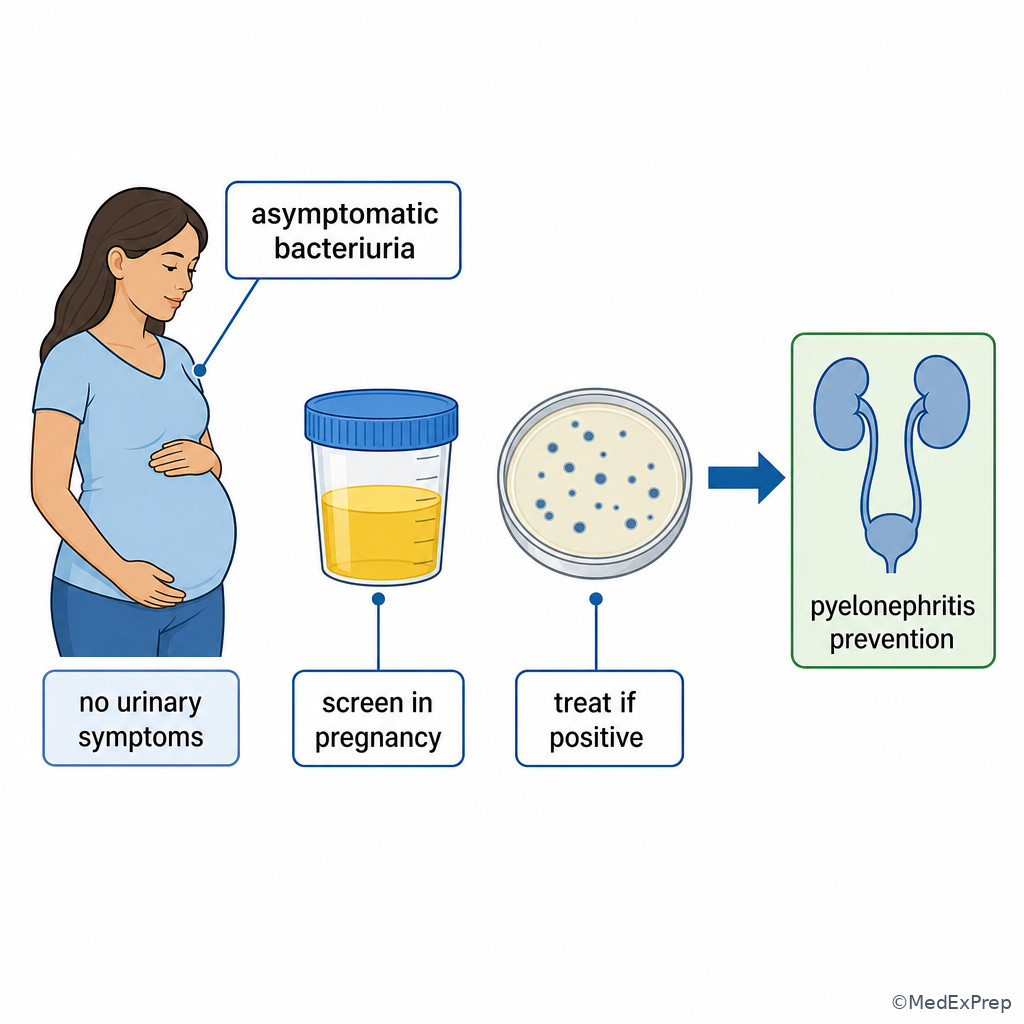
Pregnant patientInitial prenatal urine screenNo symptoms does not exclude bacteriuriaPositive screen/culture prompts treatmentReduce pyelonephritis risk
Fig 4. Urine screening decision tree Exam takeaway: Pregnancy changes the threshold for urine screening because asymptomatic bacteriuria is clinically important.
graph TD;A[Initial prenatal visit]-->B{Urinary symptoms?};B--Yes-->C[Evaluate UTI symptoms and send urine testing];B--No-->D[Still screen for asymptomatic bacteriuria];C-->E[Pregnancy compatible treatment if infection confirmed];D-->E;E-->F[Follow response and prenatal plan]
See Fig 4 for the key branch: urinary symptoms change urgency and differential, but lack of symptoms does not eliminate screening.
Asymptomatic bacteriuria screening in pregnancy
Exam takeaway: The absence of dysuria is a distractor, not a reason to omit urine screening.
B. Worked example
A 33-year-old G4P3 at 10 weeks presents for initial prenatal care. She has sickle cell trait and chronic constipation. She denies dysuria, urinary frequency, fever, flank pain, and suprapubic pain. Her urinalysis from a workplace physical two weeks ago had trace protein, which is a tempting distractor. The question asks whether urine culture screening is appropriate.
Reasoning chain: Identify the task: decide if asymptomatic urine screening is needed. Extract key facts: pregnant, initial prenatal care, no urinary symptoms. Apply the rule: screen for asymptomatic bacteriuria in pregnancy. Eliminate distractors: trace protein from an outside test does not answer whether bacteriuria is present; absence of dysuria does not remove screening. Verify: if significant bacteriuria is found, use pregnancy-appropriate treatment and follow-up rather than waiting for pyelonephritis.
C. Exam trap
Common wrong answer: Reassure and skip urine testing because she has no urinary symptoms. Why it is tempting: In many adult patients, asymptomatic bacteriuria is not routinely treated. Single clue that rules it out: She is pregnant, a setting where screening for asymptomatic bacteriuria is recommended.
D. Checkpoint MCQ
A 22-year-old G1P0 at 9 weeks denies urinary symptoms during her first prenatal visit. Which statement best reflects urine screening in this setting?
Screening for asymptomatic bacteriuria is appropriate in pregnancy.
Urine testing is unnecessary unless dysuria is present.
Urine testing should be delayed until the third trimester in all patients.
A negative symptom review definitively excludes bacteriuria.
Answer: A. Option A is correct because asymptomatic bacteriuria is screened for in pregnancy. Option B is tempting because symptomatic UTI testing is familiar, but pregnancy is a special screening context. Option C is tempting because some prenatal tests occur later, but this is part of early prenatal care. Option D is tempting because symptoms are reassuring, but bacteriuria can be asymptomatic.
If you missed this: Review Urine testing and asymptomatic bacteriuria: symptoms are not required - focus on the rule that pregnancy warrants screening even without urinary symptoms.
Quick Recall:
True/false: No dysuria means urine screening can be skipped at the first prenatal visit.
Fill in the blank: In pregnancy, asymptomatic ________ is screened for because it can progress and affect maternal-fetal outcomes.
One-liner: What is the single pregnancy clue that changes the usual approach to bacteriuria?
1.1.2.7 5. Risk-based STI testing and screening-versus-diagnostic sequencing
A. Explanation
Decision conflict: Should every possible STI test be ordered for every pregnant patient, or should testing be individualized? The routine initial panel includes key infections for all pregnant patients, while additional STI testing is guided by risk, symptoms, exposure, age, prevalence, or prior infection history. WHY THIS IS TESTED: Board-style questions reward recognizing the clue that changes a routine panel into a broader evaluation.
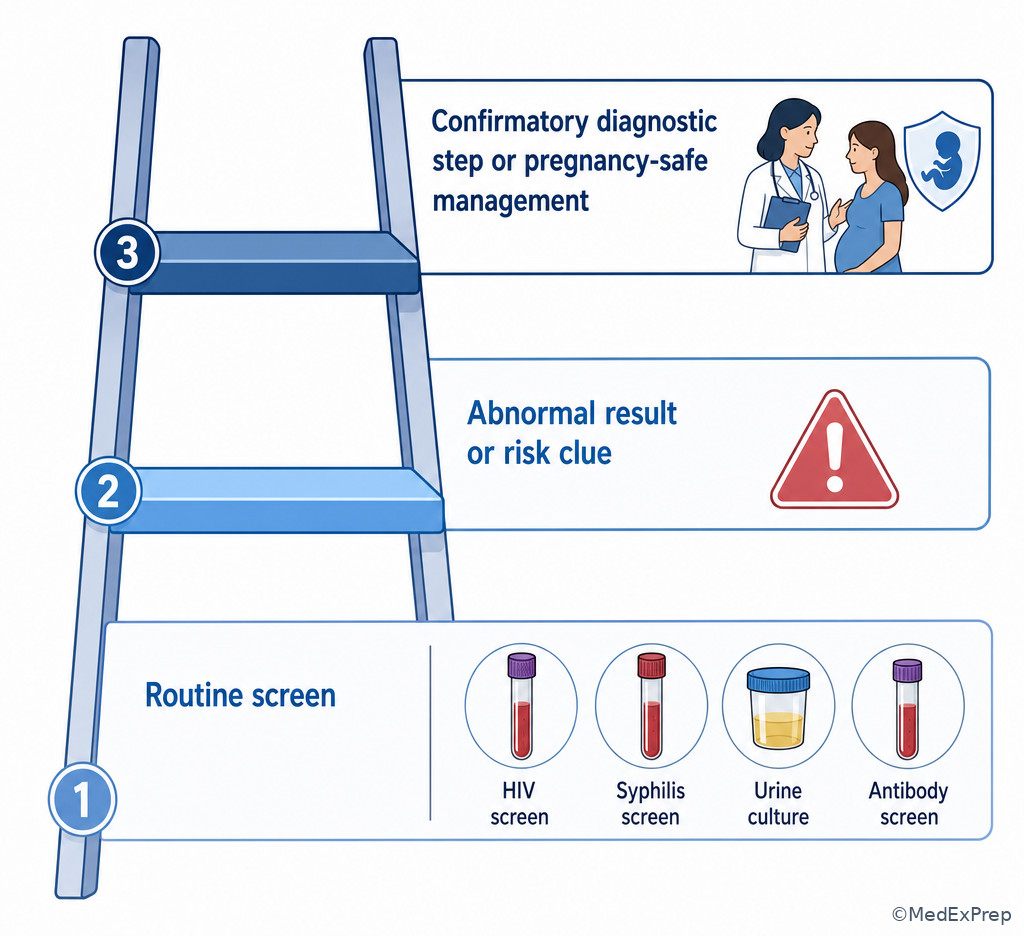
Common triggers for additional STI testing include young age, new or multiple partners, partner with STI risk, prior STI, inconsistent barrier protection, symptoms of cervicitis or vaginitis, genital ulcers, or high-prevalence settings. The exam may also test screening versus diagnostic sequencing: a screening result identifies risk or possible disease; confirmatory diagnostic tests or disease-specific follow-up may be required before definitive labeling. This principle is especially important when the answer choices include invasive procedures, definitive treatment, or reassurance.
Routine panel completedLook for risk clueAdd targeted STI testingInterpret screen resultConfirm or treat based on disease pathway
Fig 5. Screening versus diagnostic sequencing Exam takeaway: A positive screen usually changes the next step; it does not always equal the final diagnosis.
graph TD;A[Patient at prenatal visit]-->B[Routine screen];B-->C{Result or risk clue};C--Normal and no risk-->D[Routine follow up];C--Risk present-->E[Add targeted STI testing];C--Screen positive-->F[Confirm stage or link to condition specific management];F-->G[Treat counsel notify team as appropriate]
See Fig 5 for the common exam structure: a screening test creates a fork, and the safest next step depends on what the screen does and does not prove.
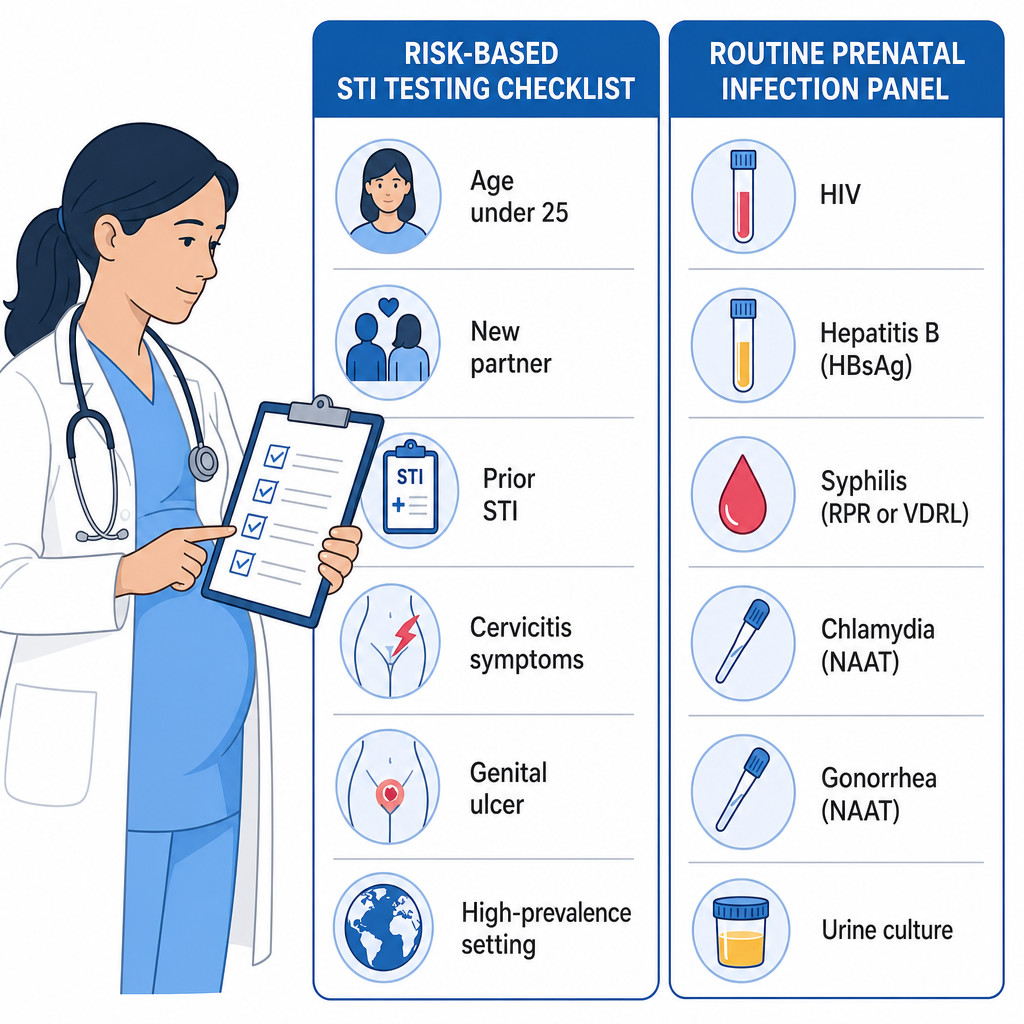
Risk-based STI add-on testing
Exam takeaway: Additional STI testing is not random; it is triggered by risk, symptoms, exposure, or epidemiologic clues.
Stem clue
Why it matters
Likely testing implication
Wrong answer to avoid
Age under 25 or high-risk sexual exposure
Higher STI risk in many screening frameworks
Add gonorrhea/chlamydia testing when indicated
Only routine blood panel with no STI consideration
Mucopurulent discharge or cervicitis
Symptoms suggest active lower genital tract infection
Targeted STI testing and pregnancy-safe management
Assume physiologic discharge without evaluation
Genital ulcer
Raises ulcer disease differential
Targeted testing based on presentation
Treat as simple irritation only
Positive screening test
May require confirmation, staging, or linked protocol
Choose the next disease-specific step
Jump to unrelated invasive testing
B. Worked example
A 21-year-old G1P0 at 10 weeks presents for first prenatal care. She has migraine without aura and depression treated with psychotherapy. She reports a new partner in the last three months and intermittent spotting after intercourse. She denies pelvic pain and fever. A normal hemoglobin is a distracting reassuring detail. The question asks which additional testing should be considered beyond the routine initial panel.
Reasoning chain: Identify the task: determine risk-based add-on testing. Extract key facts: young age, new partner, postcoital spotting, pregnancy, no acute pelvic pain. Apply the rule: additional STI testing, commonly including gonorrhea and chlamydia evaluation, is indicated when risk or cervicitis-type clues are present. Eliminate distractors: normal hemoglobin does not rule out STI; absence of fever does not rule out cervicitis; immediate invasive fetal diagnostic testing is unrelated. Verify: continue routine prenatal labs while adding targeted STI evaluation and supervised follow-up.
C. Exam trap
Common wrong answer: Order only the universal panel and ignore sexual risk clues. Why it is tempting: The lesson emphasizes routine baseline tests. Single clue that rules it out: New partner plus postcoital spotting suggests a risk-based indication for additional STI testing.
D. Checkpoint MCQ
A 23-year-old pregnant patient at her first prenatal visit reports a prior chlamydia infection and a new partner. She has no pelvic pain. What is the most appropriate interpretation of these details?
They support additional risk-based STI testing beyond the universal prenatal panel.
They make HIV, syphilis, and hepatitis B screening unnecessary.
They prove pelvic inflammatory disease and require inpatient treatment.
They require amniocentesis to diagnose fetal infection.
Answer: A. Option A is correct because prior STI and new partner are risk clues. Option B is tempting if testing is viewed as either routine or risk-based, but routine infectious screening still applies. Option C is tempting because chlamydia can be associated with upper tract infection, but the stem lacks PID findings. Option D is tempting because pregnancy raises fetal concerns, but these clues do not justify amniocentesis.
If you missed this: Review Risk-based STI testing and screening-versus-diagnostic sequencing - focus on the rule that risk clues add testing without replacing routine prenatal screening.
TRAPS
Exam Traps & Differentiators
Common traps & distractors:
Skipping urine testing because there is no dysuria -> tempting because symptom-driven UTI testing is familiar; ruled out by pregnancy, where asymptomatic bacteriuria is screened.
Calling Rh-negative status alloimmunization -> tempting because Rh status is high-yield; ruled out by a negative antibody screen.
Giving rubella vaccine during pregnancy -> tempting because nonimmunity sounds correctable; ruled out by pregnancy because postpartum vaccination is the standard board-style concept.
Using aneuploidy testing as the answer to a baseline lab question -> tempting because first trimester genetic screening is also discussed early; ruled out by the task asking for the initial prenatal laboratory panel.
Ignoring STI risk clues -> tempting because the universal panel is already broad; ruled out by age, new partner, prior STI, cervicitis symptoms, or ulcer findings.
Looks similar but isn't
Key discriminator
Best exam interpretation
Routine infection screen vs risk-based STI test
Universal prenatal screen versus specific risk clue
Do routine screening for all; add targeted STI testing when risk is present
Serology showing immunity status versus symptomatic infection concern
Nonimmunity alone means counsel and vaccinate postpartum
Asymptomatic bacteriuria vs symptomatic UTI
No symptoms versus dysuria, fever, flank pain, or suprapubic pain
Both require attention in pregnancy; asymptomatic bacteriuria is still screened
Choose-versus-avoid prenatal testing visual Exam takeaway: Match the answer to the task: routine panel, risk-based add-on, or follow-up of an abnormal result.
graph LR;A[Question task]-->B[Routine first visit?];A-->C[Risk clue?];A-->D[Abnormal screen?];B-->E[Choose baseline panel];C-->F[Add targeted testing];D-->G[Confirm evaluate or manage];E-->H[Avoid late pregnancy tests as distractors];F-->I[Avoid ignoring exposure clues];G-->J[Avoid calling screen final diagnosis when confirmation needed]
If the stem says...
First prenatal visit, asymptomatic -> think routine baseline panel.
Rh-negative -> look immediately for the antibody screen.
No dysuria -> do not let that exclude asymptomatic bacteriuria screening.
Initial prenatal panel checklist card
Exam takeaway: A compact checklist helps prevent omission of the routine panel under vignette pressure.
1. Confirm first prenatal context and gestational age2. Order routine baseline panel3. Interpret Rh plus antibody screen together4. Screen urine even if asymptomatic5. Add STI tests when risk clues appear6. Treat screens as screens: confirm or follow disease pathway
In exam mode, ask: Is this an initial prenatal visit? Is the patient stable? Which routine labs are missing? Is there a clue that adds testing? Is the test a screen or a diagnosis? This sequence prevents most distractor errors.
Screening versus confirmation ladder
Exam takeaway: The safest next step often comes from knowing whether the test identifies risk or establishes disease.
QUIZ
Self-check quiz
1.1.2.8 Question 1 - easy
A 27-year-old G1P0 presents at 8 weeks for her first prenatal visit. She has no urinary symptoms and no vaginal bleeding. Which belongs in the routine initial prenatal laboratory panel?
Amniocentesis and fetal karyotype for all patients
1.1.2.9 Question 2 - easy
A 31-year-old G2P1 is Rh-negative with a negative antibody screen at her initial prenatal visit. What is the best interpretation?
She is already alloimmunized.
She is Rh-negative without evidence of sensitization on this screen.
The antibody screen is irrelevant because Rh status alone determines sensitization.
The fetus has confirmed hemolytic disease.
1.1.2.10 Question 3 - moderate
A 20-year-old pregnant patient reports a new partner and a prior chlamydia infection. She denies pelvic pain and fever. What is the most appropriate testing principle?
Risk-based STI testing should be considered in addition to routine prenatal screening.
Routine infectious screening should be skipped because STI testing is risk-based.
The findings prove pelvic inflammatory disease.
All testing should wait until the postpartum visit.
1.1.2.11 Question 4 - moderate
A pregnant patient is rubella nonimmune on initial prenatal labs. She is asymptomatic. Which plan is most appropriate?
Give rubella vaccine during pregnancy today.
Counsel to avoid exposure and plan postpartum vaccination.
Ignore the result because rubella does not affect pregnancy counseling.
Diagnose congenital rubella infection.
1.1.2.12 Question 5 - hard
A 34-year-old G3P2 at 9 weeks presents for first prenatal care. She has chronic hypertension and anxiety. She denies dysuria, fever, pelvic pain, and vaginal discharge. She is worried because a friend needed antibiotics for a kidney infection during pregnancy. Which is the best next step regarding urine evaluation?
Do not test urine unless dysuria develops.
Screen for asymptomatic bacteriuria as part of prenatal care.
Order fetal nonstress testing to assess infection risk.
Give empiric antibiotics to all pregnant patients regardless of urine results.
ANSWERS
Answer key & explanations
1.1.2.13 Question 1
Correct answer: A. A is correct because it lists the routine baseline first prenatal panel. B is tempting because group B streptococcus is obstetric screening, but it is not the initial prenatal laboratory panel. C is tempting because fetal testing sounds safety-focused, but antepartum fetal surveillance is not routine at an uncomplicated 8-week first visit. D is tempting because genetic diagnosis can be discussed in prenatal care, but invasive diagnostic testing is not universal baseline laboratory screening. If you missed this: Review Routine panel components: choose the baseline set, not a scattered workup — focus on the exact routine panel categories.
1.1.2.14 Question 2
Correct answer: B. A is tempting because Rh-negative status is associated with alloimmunization risk, but a negative antibody screen does not show sensitization. B is correct because Rh-negative status and a negative antibody screen indicate no detected sensitization on the screen. C is tempting if Rh and antibody concepts are merged, but the antibody screen is the discriminator. D is tempting because hemolytic disease is a feared complication, but nothing in the stem confirms fetal disease. If you missed this: Review Blood type, Rh status, antibody screen, and CBC: identify baseline hematologic risk — focus on interpreting Rh status together with antibody screen.
1.1.2.15 Question 3
Correct answer: A. A is correct because new partner and prior STI are risk clues supporting additional STI testing. B is tempting because it separates routine from risk-based testing too sharply; routine infectious screening still applies. C is tempting because prior chlamydia can be linked to upper tract disease, but there is no pelvic pain, fever, or PID syndrome. D is tempting if the patient is asymptomatic, but prenatal screening is performed during pregnancy, not deferred until postpartum. If you missed this: Review Risk-based STI testing and screening-versus-diagnostic sequencing — focus on the rule that risk clues add targeted testing without replacing routine screening.
1.1.2.16 Question 4
Correct answer: B. A is tempting because vaccination corrects nonimmunity, but live rubella vaccination is not given during pregnancy in standard exam teaching. B is correct because nonimmunity is managed with counseling during pregnancy and vaccination after delivery. C is tempting if the patient is asymptomatic, but rubella immunity status matters for pregnancy counseling. D is tempting because congenital rubella is high-impact, but nonimmunity alone does not diagnose fetal infection. If you missed this: Review Infectious disease and immunity screening: prevent perinatal and neonatal harm — focus on rubella nonimmunity counseling and postpartum vaccination planning.
1.1.2.17 Question 5
Correct answer: B. A is tempting because UTI evaluation is often symptom-driven outside pregnancy, but pregnancy warrants screening for asymptomatic bacteriuria. B is correct because asymptomatic bacteriuria screening is part of prenatal care. C is tempting because fetal testing sounds protective, but it does not evaluate maternal bacteriuria at 9 weeks. D is tempting because pyelonephritis is serious, but antibiotics require an appropriate indication rather than universal empiric use. If you missed this: Review Urine testing and asymptomatic bacteriuria: symptoms are not required — focus on the pregnancy-specific screening rule.