1.1.1 - USPSTF Screening Logic
USPSTF Screening Logic
What you’ll learn
- Apply a practical outpatient rule set to choose whether a screening test is indicated, deferred, or avoided for an asymptomatic patient. FM Domain: Preventive Care → Screening decision logic
- Distinguish screening from diagnostic evaluation when a patient has symptoms, abnormal prior results, or high-risk history. FM Domain: Preventive Care → Screening vs diagnostic workup
- Use age, sex, risk factors, life expectancy, pregnancy status, and prior test history to select the most appropriate next step. FM Domain: Preventive Care → Risk-stratified screening
- Recognize common COMAT traps involving premature testing, overuse, false reassurance, and failure to escalate red flags. FM Domain: Preventive Care → Screening harms and safe triage
- Counsel patients on benefits, harms, and follow-up after positive, negative, or indeterminate screening results. FM Domain: Patient Counseling → Shared decision-making in prevention
Blueprint mapping
- FM Domain: Preventive Care and Health Maintenance → Screening decision logic
- FM Domain: Preventive Care and Health Maintenance → Risk-stratified outpatient screening
- FM Domain: Data Interpretation → Interpreting common screening results and next steps
- FM Domain: Counseling and Follow-up → Benefits, harms, and interval planning
Why it matters
- COMAT Family Medicine commonly tests the best next preventive step, not the most exhaustive workup.
- Many wrong answers are tempting because they are reasonable tests in the wrong patient: too young, symptomatic instead of asymptomatic, low benefit, or high harm.
- Outpatient family medicine requires choosing screening that changes outcomes while avoiding cascades from incidental findings and false positives.
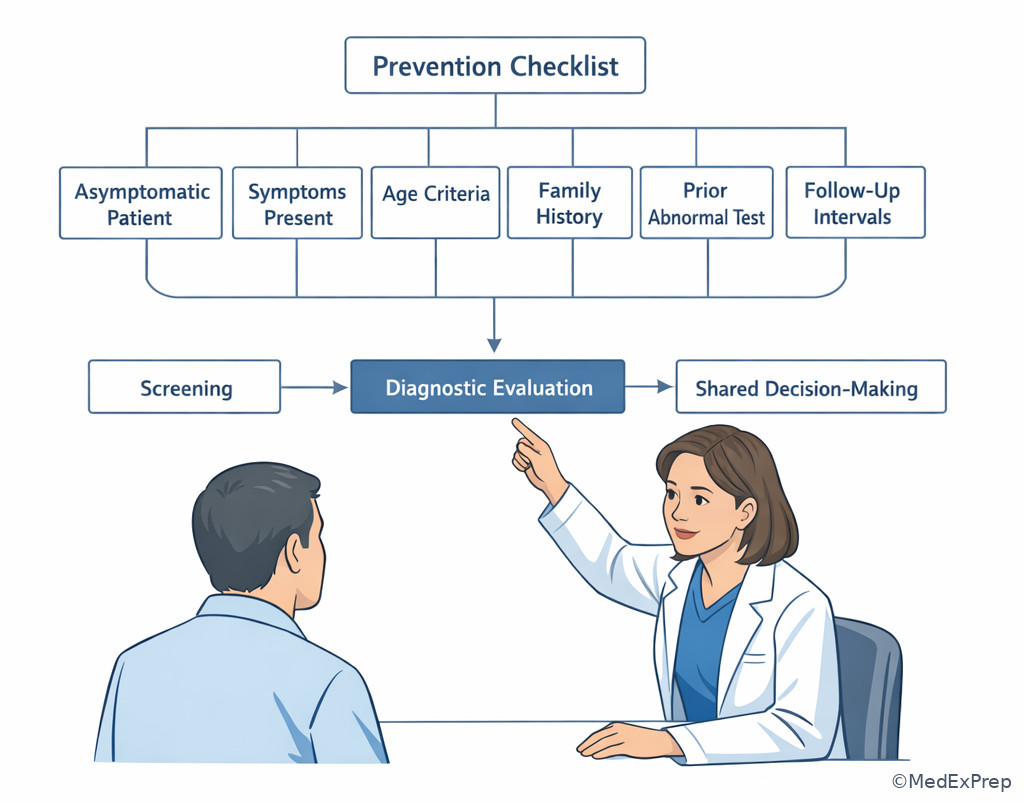
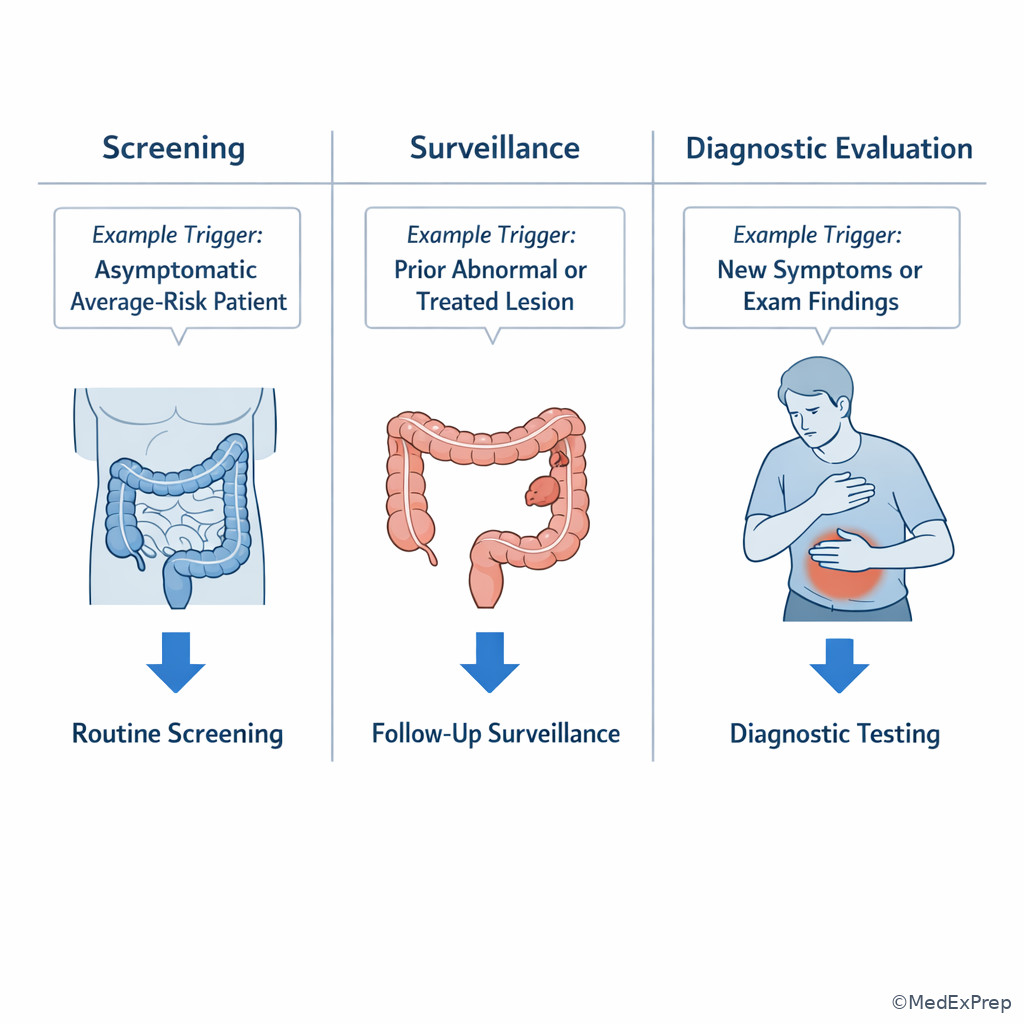
- Good screening logic helps you answer future topics faster, especially cardiometabolic prevention and overuse questions. See Fig 1.
Key Terms & Must-Know Facts
1.1.1.1 Key terms
- Screening: testing an asymptomatic person to detect disease early
- Diagnostic evaluation: testing prompted by symptoms, signs, or a prior abnormal result
- Average risk: no major risk-enhancing history beyond the general population baseline
- High risk: family history, prior abnormal findings, known exposures, comorbid disease, or other risk-enhancing features that change the plan
- Pretest probability: estimated chance of disease before testing
- False positive: abnormal screen without true disease
- Overdiagnosis: detection of disease that would not have caused harm in the patient’s lifetime
- Lead-time bias: apparent survival increase from earlier detection without true outcome benefit
- Shared decision-making: clinician-patient discussion when benefits and harms are closely balanced
- Grade B recommendation: moderate or substantial net benefit; generally offer/service indicated
- Grade C recommendation: selective offering based on individual circumstances
- Grade D recommendation: do not routinely provide the service
- I statement: insufficient evidence; do not guess that “more testing” is automatically better
1.1.1.2 Must-know facts
- A patient with symptoms usually needs diagnostic evaluation, not screening.
- The first question is often: Is this patient asymptomatic?
- Age-only screening rules apply best to average-risk patients.
- A test can be accurate yet still be a poor screening test if harms outweigh benefits.
- Positive screening tests generally need confirmatory or follow-up diagnostic testing.
- Negative screening tests do not override red flags, symptoms, or concerning exam findings.
- Family medicine questions often reward appropriate restraint more than maximal testing.
- If life expectancy is limited or competing mortality is high, benefit from screening may fall.
- Board stems often hide the key clue in prior test history, not just current age.
| USPSTF grade | What it means on exams | Usual action |
|---|---|---|
| A | High certainty of substantial net benefit | Offer routinely unless patient-specific exception |
| B | High certainty of moderate benefit or moderate certainty of moderate to substantial benefit | Offer routinely in the indicated population |
| C | Small net benefit | Selectively offer based on individual patient values/risk |
| D | No net benefit or harms outweigh benefits | Do not routinely screen |
| I statement | Insufficient evidence | Do not assume “screen everyone”; individualize if another reason exists |
Exam takeaway: Start with asymptomatic status, average-risk vs high-risk context, and whether the result would change management.
flowchart TD
A[Patient in clinic] --> B{Symptoms or abnormal finding?}
B -->|Yes| C[Diagnostic evaluation, not screening]
B -->|No| D{Average-risk population match?}
D -->|No| E[Modify plan for high-risk or special population]
D -->|Yes| F{Recommended age/sex/risk window?}
F -->|Yes| G[Offer screening and explain benefits/harms]
F -->|No| H[Do not screen now; reassess later]
G --> I{Abnormal result?}
I -->|Yes| J[Confirmatory or follow-up testing]
I -->|No| K[Resume interval screening if indicated] Exam takeaway: In prevention visits, organize decisions by asymptomatic status, age band, risk factors, and prior results.
Core content
1.1.1.3 Foundational step 1: Is this screening or diagnostic evaluation?
A Explanation
The first decision conflict is simple but heavily tested: choose screening for an asymptomatic patient, reject screening language when the patient already has symptoms or an abnormal finding. A screening test is designed for people without signs or symptoms of the disease. Once a patient reports rectal bleeding, a breast mass, hemoptysis, weight loss, syncope, or postmenopausal bleeding, the task changes. You are no longer asking, “Should we screen?” You are asking, “What diagnostic evaluation is most appropriate now?”
WHY THIS IS TESTED: exam stems often tempt you with a familiar preventive test, but the single resolving clue is that the patient is not asymptomatic. For example, stool-based colorectal screening fits average-risk asymptomatic adults, but overt iron deficiency anemia or hematochezia shifts the question to diagnostic colon evaluation rather than routine screening logic.
Choose screening when the patient is well, attending a health maintenance or follow-up visit, and the issue is whether a preventive service should be offered. Reject screening when there are symptoms, prior abnormal tests needing follow-up, physical exam abnormalities, or high-risk findings that require direct workup. Also reject “reassure and repeat at routine interval” when symptoms persist despite a previously negative screening test. Screening does not trump clinical judgment.
Key rule: “Asymptomatic” is the gatekeeper word. If symptoms are present, move from population screening logic to problem-oriented diagnostic reasoning.
B Worked example
A 57-year-old man presents for an annual visit. He has obesity, hypertension, and osteoarthritis. He asks whether he should “do one of those home stool tests” because his neighbor recently did one. He also reports 2 months of intermittent maroon-colored stools and increased fatigue. Hemoglobin is 10.8 g/dL, and he takes ibuprofen most days. A recent home blood pressure log is normal, which is distracting because it is unrelated to the main task. The tempting wrong clue is that stool-based colorectal tests are common screening tools.
Reasoning chain: Identify the task: not “which screening test is due?” but “what is the best next step?” Extract key facts: age over usual screening threshold, but now he has gastrointestinal bleeding symptoms and anemia. Apply the rule: symptomatic patients need diagnostic evaluation, not routine screening. Eliminate distractors: FIT or stool DNA are screening tools for asymptomatic individuals; repeating CBC alone delays evaluation; attributing anemia to NSAIDs without colon evaluation is unsafe. Verify: the best next step is diagnostic colon evaluation under supervision/referral pathways appropriate to clinic.
C Exam trap
Common wrong answer: order the standard screening test because the patient is in the “correct age group.”
Why it is tempting: COMAT stems frequently mention preventive visits, and age-based screening recommendations are familiar.
Single clue that eliminates it: the patient has symptoms or a prior abnormal result; once that appears, this is no longer a pure screening question.
D Checkpoint
Question: A 52-year-old woman with type 2 diabetes and obesity presents for a routine visit. She has never completed colorectal screening. She also reports new bright red blood per rectum for 3 weeks after initially assuming it was hemorrhoids. Which is the most appropriate next step?
- Order FIT because it is an acceptable first-line colorectal screening option
- Order multitarget stool DNA testing because she is overdue for routine prevention
- Arrange diagnostic evaluation for lower GI bleeding rather than routine screening
- Reassure and repeat hemoglobin in 3 months if symptoms persist
Answer: C
- A: Tempting because FIT is high-yield for average-risk colorectal screening; wrong because active bleeding symptoms make this diagnostic, not screening.
- B: Tempting because it sounds more sensitive and thorough; wrong because a symptom-based presentation requires direct evaluation, not a stool screening panel.
- C: Correct because the presence of rectal bleeding changes the clinical task from prevention to diagnostic workup.
- D: Tempting if you anchor on hemorrhoids as a common benign cause; wrong because persistent new bleeding in a screening-eligible adult requires evaluation.
1.1.1.4 Foundational step 2: Average risk, higher risk, and the age-window rule
A Explanation
Once the patient is confirmed asymptomatic, the next decision conflict is: choose the standard age-based recommendation for average-risk patients, or reject it because the patient has risk factors that change the timing, interval, or type of screening. The age-window rule is a shortcut, not a complete answer. Family history, smoking history, prior high-grade lesions, immunocompromise, chronic viral infection, occupational exposure, pregnancy, and prior screening results can all override the default path.
WHY THIS IS TESTED: many stems place a patient just outside an age band or add one risk factor that changes everything. The single resolving clue is often not age alone but risk category. For example, average-risk screening logic should not be applied blindly to someone with a strong family history of early disease, known prior abnormal screening, or a high-risk exposure profile.
Board-style prevention questions reward a structured sequence: confirm asymptomatic status, define average versus higher risk, check whether the person falls within the recommended age window, then choose the recommended modality and interval. If the patient is outside the routine age range but has higher risk, you do not automatically abandon screening; instead, you shift to individualized or risk-modified logic. Conversely, do not invent “higher risk” from weak clues. A grandparent with late-onset disease does not carry the same weight as a first-degree relative with early disease.
See Fig 2 for a practical way to sort average-risk and modified-risk decisions.
Exam takeaway: A single higher-risk feature can change timing, interval, or modality even when the patient looks close to an average-risk age rule.
flowchart LR
A[Asymptomatic patient] --> B{Average risk?}
B -->|Yes| C[Use standard age/sex/risk window]
B -->|No| D[Identify risk modifier]
D --> E[Family history]
D --> F[Exposure history]
D --> G[Prior abnormal result]
D --> H[Comorbidity or special population]
C --> I[Offer routine screening if due]
E --> J[Individualize timing and method]
F --> J
G --> J
H --> J B Worked example
A 43-year-old woman presents for an annual physical. She has migraines without aura and controlled hypothyroidism. She is asymptomatic. Her mother was diagnosed with colon cancer at age 47. The distracting detail is her mildly elevated LDL cholesterol, which may push you toward a cardiometabolic answer instead of the immediate screening logic task. The tempting wrong clue is that she is younger than the age you may reflexively associate with average-risk colorectal screening.
Reasoning chain: Identify task: preventive screening recommendation in an asymptomatic patient. Extract key facts: first-degree relative, early-onset colorectal cancer, younger patient. Apply rule: average-risk age-based rules do not fully govern when there is strong family history. Eliminate distractors: “too young for any screening” ignores the risk modifier; stool testing by routine average-risk logic may be incomplete depending on the scenario; deferring until the usual average-risk age is the classic trap. Verify: individualized earlier screening is warranted because risk category, not age alone, is decisive.
C Exam trap
Common wrong answer: defer screening because the patient is not yet in the standard average-risk age band.
Why it is tempting: average-risk age cutoffs are easier to memorize than exceptions.
Single clue that eliminates it: a strong first-degree family history or prior abnormal result moves the patient out of the average-risk pathway.
D Checkpoint
Question: A 44-year-old asymptomatic man with obesity and well-controlled asthma asks whether he needs colorectal screening. His father developed colorectal cancer at age 49. Which logic is most appropriate?
- Use the average-risk age threshold only and defer because he is younger
- Recognize that first-degree early family history changes him from average-risk to a modified-risk pathway
- Defer all screening because asthma is his more urgent preventive issue
- Order testing only if a CBC first shows iron deficiency anemia
Answer: B
- A: Tempting because average-risk age rules are often memorized first; wrong because a strong family history changes the pathway.
- B: Correct because first-degree early-onset family history is the discriminating clue that moves him out of average-risk screening logic.
- C: Tempting if you think prevention requires choosing only one domain per visit; wrong because multiple preventive needs can coexist, and family history matters.
- D: Tempting because anemia would certainly strengthen concern; wrong because screening decisions do not require waiting for symptoms or anemia in a higher-risk asymptomatic patient.
- The first screening question is: Is the patient asymptomatic or symptomatic?
- True or False: Age alone is always enough to determine screening eligibility. False.
- Name the 3 key modifiers beyond age: risk factors, prior results, and current symptoms/signs.
1.1.1.5 Application: Choosing when a preventive test helps more than it harms
A Explanation
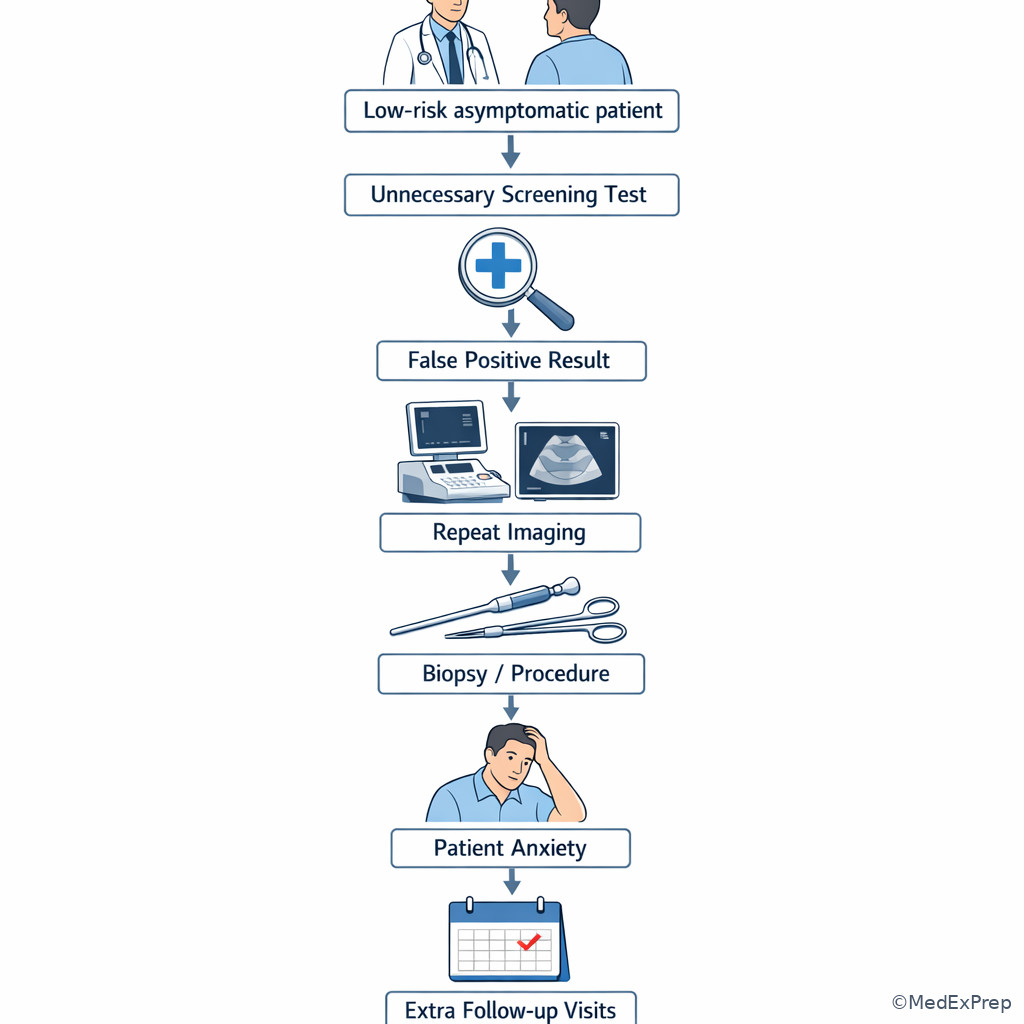
Now move from “who qualifies” to “should this test be used at all?” The decision conflict is: choose screening when early detection improves meaningful outcomes and harms are acceptable; reject screening when false positives, invasive follow-up, anxiety, radiation, unnecessary procedures, or overdiagnosis outweigh expected benefit. In family medicine exam stems, this often appears as a patient requesting “every possible test,” or as a clinician considering a low-value test in a low-risk, asymptomatic patient.
WHY THIS IS TESTED: COMAT questions frequently reward avoiding unnecessary testing. The single resolving rule is whether the screening service has sufficient net benefit in this patient population. A test can detect disease and still be a poor population screening tool if it triggers more harm than benefit. Low pretest probability increases the chance that a positive result is false or clinically unhelpful.
Choose screening when there is evidence that detecting disease earlier changes outcomes in the target population. Reject screening when the patient is outside the recommended population, the condition is too rare in that group, the test is poorly specific, the downstream workup is harmful, or life expectancy is limited enough that benefit is unlikely to emerge. On board questions, “but it is noninvasive” does not rescue a bad screening choice. Likewise, “the patient is anxious and wants certainty” is not itself an indication for low-value testing.
See Fig 3 for a compare-and-contrast view of benefit and harm drivers. This section also sets up the next lesson on overuse.
Exam takeaway: High-yield answers favor tests with outcome benefit in the right population and reject low-value testing driven only by anxiety or availability.
flowchart TB
A[Consider screening test] --> B[Potential benefits]
A --> C[Potential harms]
B --> B1[Earlier disease detection]
B --> B2[Reduced morbidity or mortality]
B --> B3[Improved counseling or prevention]
C --> C1[False positives]
C --> C2[Invasive follow-up]
C --> C3[Overdiagnosis]
C --> C4[Radiation or cost]
B1 --> D{Net benefit positive?}
B2 --> D
B3 --> D
C1 --> D
C2 --> D
C3 --> D
C4 --> D
D -->|Yes| E[Offer screening]
D -->|No or unclear| F[Avoid routine screening] Exam takeaway: A single low-value screening test can trigger repeat imaging, procedures, anxiety, and incidental findings.
B Worked example
A 29-year-old man presents for a wellness visit. He has allergic rhinitis and a remote ankle sprain. He feels well and requests “a full-body scan” because his coworker’s cancer was found late. He has no family history of early cancer, no tobacco use, and no red-flag symptoms. A tiny stable lipoma on his shoulder is a distracting physical finding. The tempting wrong clue is his fear of missed disease, which may make “more testing” feel compassionate.
Reasoning chain: Identify task: decide whether broad screening imaging is appropriate in an asymptomatic, average-risk adult. Extract key facts: low-risk, no symptoms, no specific target condition, high anxiety. Apply rule: screening requires evidence of benefit in a defined population; indiscriminate whole-body testing has poor net benefit and may cause harm through false positives and incidental findings. Eliminate distractors: ordering imaging “for reassurance” is low-value; extensive labs without indication do not improve outcomes; dismissing the patient’s concern entirely misses counseling. Verify: the best next step is evidence-based preventive counseling and selective guideline-concordant screening only where indicated.
C Exam trap
Common wrong answer: order extra testing because the patient is anxious and wants a comprehensive check.
Why it is tempting: reassurance feels patient-centered, and non-targeted testing sounds thorough.
Single clue that eliminates it: there is no defined high-risk population match or evidence that the proposed test improves outcomes.
D Checkpoint
Question: An asymptomatic 32-year-old woman with mild eczema asks for a chest CT “just to be safe” because a relative smoked heavily and developed lung cancer. She has never smoked. Which is the most appropriate response?
- Order the CT because lung cancer is more treatable when found early
- Order a chest x-ray instead because it has lower radiation
- Explain that screening should be reserved for populations with proven net benefit and avoid routine imaging here
- Order sputum cytology because it is less invasive than CT
Answer: C
- A: Tempting because earlier detection sounds universally beneficial; wrong because screening benefit depends on the studied risk population, which she does not match.
- B: Tempting as a compromise option; wrong because a lower-radiation but still low-value screen is not the right answer.
- C: Correct because she is asymptomatic and outside the population in which lung cancer screening shows benefit.
- D: Tempting because it sounds safer and targeted; wrong because it is not an appropriate routine screen in this setting.
1.1.1.6 Application: Interpreting prior results, intervals, and “what now?”
A Explanation
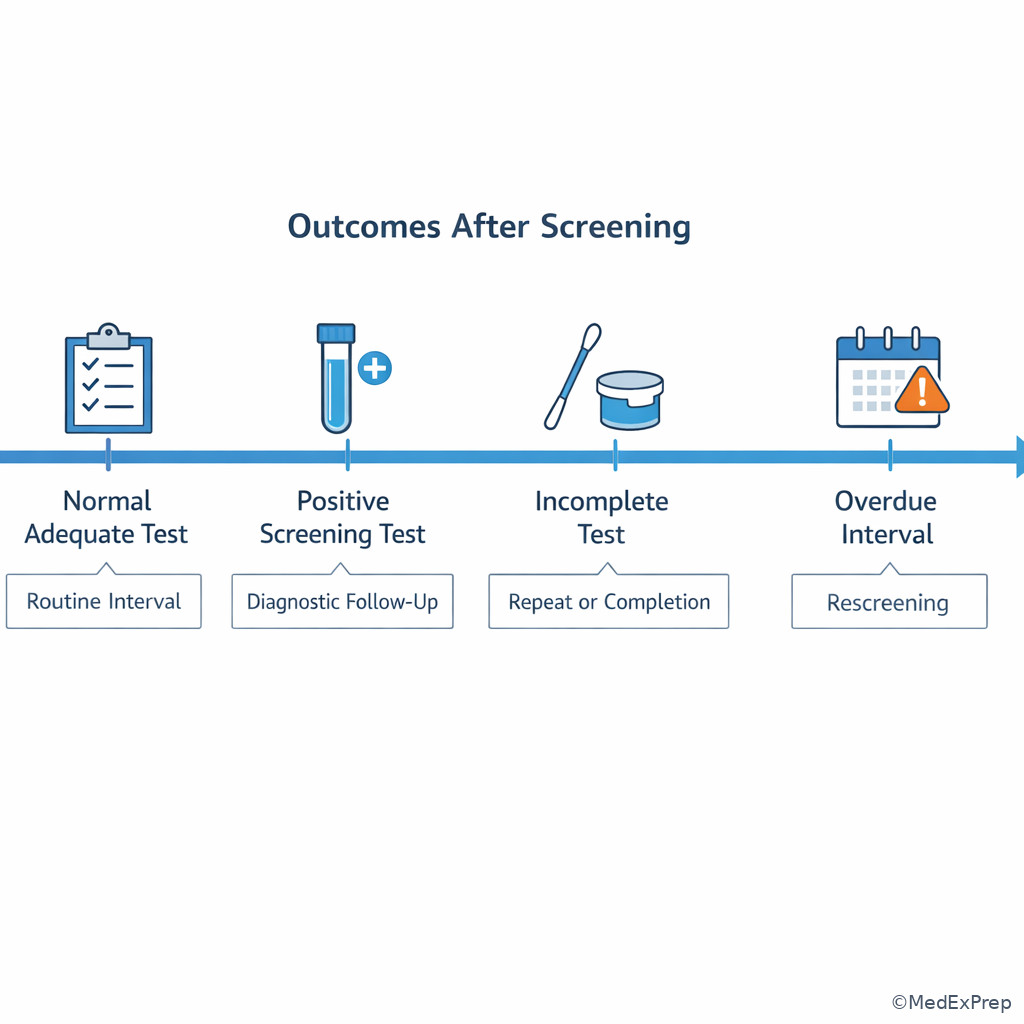
Many prevention questions are not about starting screening; they are about whether it is due now. The decision conflict is: choose repeat screening at the correct interval when prior testing was normal and complete; reject unnecessary early repetition when a recent adequate negative test already answers the preventive question. A parallel branch is that abnormal or incomplete prior tests usually trigger follow-up evaluation rather than routine interval screening.
WHY THIS IS TESTED: stems commonly include a previous normal test that learners overlook. The single clue that resolves the item is often the date and quality of the prior screen. Board questions punish two opposite mistakes: repeating tests too soon and ignoring required follow-up after an abnormal result.
When reading the stem, ask four interval questions: Was the previous test done? Was it the correct modality? Was it normal or abnormal? Was the study adequate and completed? A patient with a normal recent evidence-based screen may need no action today other than documentation and future interval planning. A patient with a positive screening test, inadequate prep, incomplete imaging, or missed follow-up does not return to the routine “screening due/not due” branch; that patient needs the next diagnostic or surveillance step.
See Fig 4 for a practical interval framework. This logic is especially helpful in health maintenance vignettes packed with distracting chronic disease details.
Exam takeaway: A recent adequate negative screen usually means defer repeat testing, while abnormal or incomplete studies require follow-up rather than routine rescreening.
flowchart TD
A[Screening question today] --> B{Prior test exists?}
B -->|No| C[Determine eligibility and offer if due]
B -->|Yes| D{Prior test adequate and normal?}
D -->|Yes| E{Interval reached?}
E -->|Yes| F[Repeat routine screening]
E -->|No| G[Defer and document next due date]
D -->|No| H[Abnormal, positive, or incomplete]
H --> I[Follow-up diagnostic or surveillance step] Exam takeaway: Distinguish routine interval rescreening from surveillance and diagnostic follow-up by reading the prior test history carefully.
B Worked example
A 61-year-old woman with hypertension, osteopenia, and GERD presents for a routine visit. She is asymptomatic and asks whether she “needs everything repeated.” She had a normal screening colonoscopy 3 years ago with adequate prep and no polyps. Her husband recently needed a repeat procedure after an inadequate prep, which is the tempting wrong clue because it may make repeating hers sound prudent. She also notes occasional bloating after beans, a distracting nonspecific symptom without alarm features.
Reasoning chain: Identify task: determine which preventive service is due now. Extract key facts: asymptomatic, average-risk framing, recent normal adequate test, no new red flags. Apply rule: routine screening should not be repeated early without indication. Eliminate distractors: repeating colonoscopy now confuses surveillance with routine interval screening; stool testing after a recent normal colonoscopy is redundant; broad labs for bloating are not the preventive priority here. Verify: defer repeat colorectal screening for now and document the next due interval based on the prior adequate normal result.
C Exam trap
Common wrong answer: repeat a recently normal screening test because “it cannot hurt” or because another modality might be more thorough.
Why it is tempting: learners often focus on disease seriousness and forget interval logic.
Single clue that eliminates it: the prior study was recent, adequate, and normal.
D Checkpoint
Question: A 60-year-old asymptomatic man with hyperlipidemia and obesity presents for preventive care. He had a normal screening colonoscopy 4 years ago with good prep. Which is the most appropriate colorectal screening plan today?
- Repeat colonoscopy now because colorectal cancer risk rises with age
- Order FIT now because stool testing is less invasive than colonoscopy
- Defer repeat colorectal screening now because a recent adequate normal colonoscopy already answers the preventive question
- Order CT abdomen because it evaluates extracolonic disease as well
Answer: C
- A: Tempting because age increases baseline risk; wrong because interval logic matters once a recent adequate normal colonoscopy has been done.
- B: Tempting as a seemingly safer alternative; wrong because adding another screen soon after a normal colonoscopy is redundant.
- C: Correct because the prior recent adequate negative test means repeat screening is not due now.
- D: Tempting if you overvalue comprehensiveness; wrong because CT is not the appropriate routine colorectal screening step here.
- True or False: A recent adequate negative screening test usually means no repeat test is needed today. True.
- Positive screening result → next step is usually diagnostic follow-up, not routine interval rescreening.
- Incomplete or inadequate study → think completion/repeat for adequacy, not reassurance.
1.1.1.7 Integration: Shared decision-making, limited benefit populations, and safe outpatient triage
A Explanation
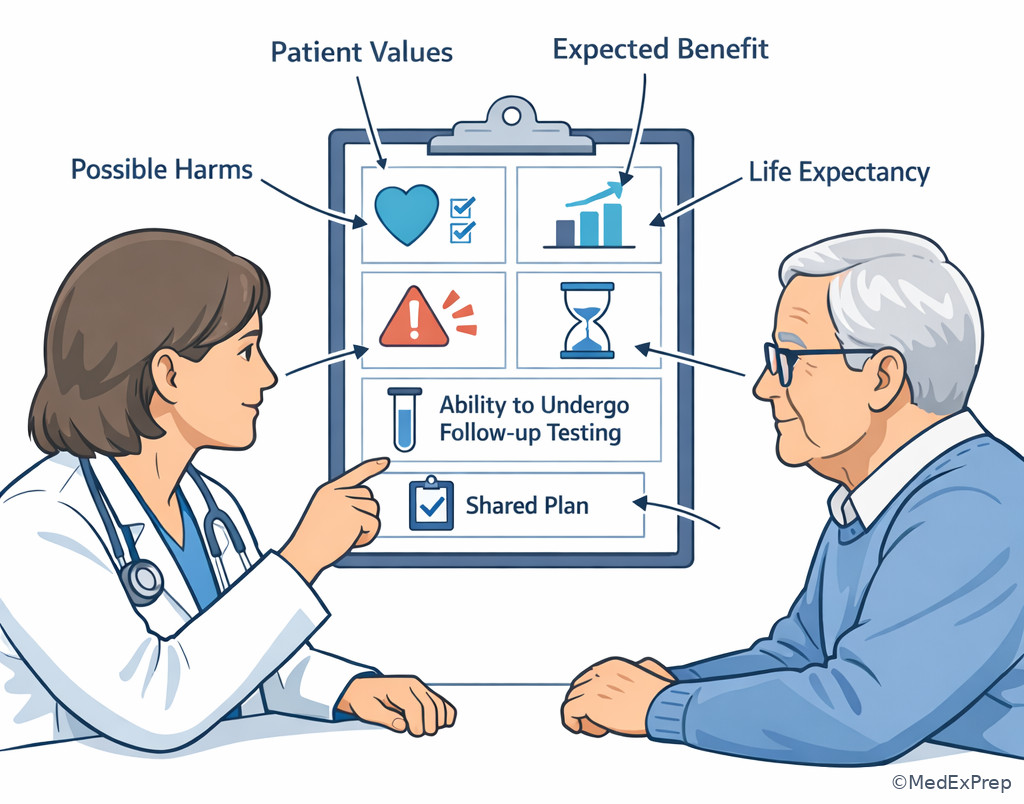
The final decision conflict is the most nuanced: choose individualized counseling when benefit is small, uncertain, or dependent on patient values; reject automatic screening when life expectancy, comorbidity burden, or patient context makes net benefit low. This is where grades C and I, limited life expectancy, and preference-sensitive prevention decisions appear. Family medicine questions test whether you can discuss benefits and harms while staying within a clerkship-level outpatient role.
WHY THIS IS TESTED: board writers like cases where the “guideline answer” is not simply “screen everyone.” The single resolving clue may be a major competing illness, advanced frailty, severe multimorbidity, prior refusal after informed discussion, or need for urgent evaluation of a different problem first. Screening is not inherently beneficial if the patient is unlikely to live long enough to benefit or cannot safely undergo follow-up treatment.
Choose shared decision-making when the recommendation is selective or preference-sensitive. Choose deferral when another acute issue takes priority, when the patient’s risk-benefit profile is poor, or when the expected time-to-benefit exceeds likely life expectancy. Reject one-size-fits-all prevention language in patients with advanced disease burden or severe frailty. However, do not overuse “life expectancy” to avoid straightforward, beneficial preventive care in otherwise functional older adults. The key is individualized net benefit, not ageism.
See Fig 5 for the outpatient counseling algorithm. Also note the forward link to Screening Harms And Overuse, where false positives and cascades are explored in greater detail.
Key rule: If a patient has red flags, acute instability, or concerning symptoms, prevention can wait. Safe triage beats routine maintenance.
Exam takeaway: When benefit is small or uncertain, the best answer is often individualized counseling rather than automatic testing or reflexive dismissal.
flowchart TD
A[Preventive question] --> B{Urgent symptoms or red flags?}
B -->|Yes| C[Escalate or evaluate acute issue first]
B -->|No| D{Clear population-level net benefit?}
D -->|Yes| E[Offer screening]
D -->|No| F{Small/uncertain benefit but possible value?}
F -->|Yes| G[Shared decision-making]
F -->|No| H[Defer or avoid routine screening]
G --> I[Discuss preferences, life expectancy, and follow-up burden] Exam takeaway: Preference-sensitive screening questions are answered by weighing net benefit, patient values, and the burden of follow-up testing.
B Worked example
An 84-year-old woman presents with her daughter for continuity care. She has severe COPD on home oxygen, heart failure with frequent exacerbations, weight loss, and moderate functional decline. She is asymptomatic from a cancer-screening standpoint and asks whether she should continue every routine screening test because she has “always stayed on top of things.” Her recent urgent-care visit for dyspnea is a distracting detail only in the sense that it reminds you of her competing illness burden. The tempting wrong clue is her admirable prior adherence, which may push you toward automatic continuation.
Reasoning chain: Identify task: decide whether routine screening remains beneficial. Extract key facts: advanced age alone is not enough, but severe multimorbidity, reduced functional reserve, and limited life expectancy lower expected time-to-benefit. Apply rule: when benefit is uncertain or unlikely to be realized, use shared decision-making and consider stopping or deferring routine screening. Eliminate distractors: “continue all screening because prevention is always good” ignores net benefit; “stop all prevention because she is old” is also wrong because counseling and symptom-guided care still matter. Verify: individualized discussion about which screening services still offer value is the best outpatient answer.
C Exam trap
Common wrong answer: continue screening automatically because the patient has always been adherent and prevention seems universally beneficial.
Why it is tempting: stopping screening can feel like withholding care.
Single clue that eliminates it: severe comorbidity and limited expected time-to-benefit reduce net benefit from routine screening.
D Checkpoint
Question: An 81-year-old man with severe dementia, metastatic noncurable cancer, and recurrent hospitalizations presents with his son for continuity care. He is asymptomatic from a colorectal standpoint. Which is the most appropriate outpatient approach to routine screening questions today?
- Continue all age-based screening because early detection is always beneficial
- Use shared decision-making and recognize that routine screening may have little net benefit given competing illness burden
- Automatically stop all preventive care because age over 80 excludes benefit
- Order the least invasive available screen so that no opportunity is missed
Answer: B
- A: Tempting because prevention is often beneficial in healthier adults; wrong because competing mortality and follow-up burden matter.
- B: Correct because advanced illness reduces expected benefit and makes individualized counseling the best answer.
- C: Tempting if you overcorrect; wrong because age alone is not the rule, and some preventive care may still remain appropriate depending on context.
- D: Tempting because “least invasive” sounds safe; wrong because low-value testing remains low-value even if the test itself is easy.
Exam Traps & Differentiators
Common traps & distractors: The most common wrong answer is a familiar screening test offered in the wrong context. It is tempting because the patient appears to be at a health maintenance visit and the modality is guideline-recognized. The single clue that rules it out is usually one of four things: symptoms, a high-risk modifier, a recent adequate negative test, or low expected net benefit.
| Looks similar | Actually means | Discriminator | Best next step |
|---|---|---|---|
| Routine preventive visit + rectal bleeding | Diagnostic evaluation, not screening | Symptom present | Work up bleeding rather than order routine stool screening |
| Younger patient + strong first-degree family history | Modified-risk screening pathway | Risk factor overrides average-risk age shortcut | Individualize earlier or different screening approach |
| Recent normal adequate screen | Not due yet | Date and quality of prior test | Defer repeat testing; document next interval |
| Anxious asymptomatic patient requesting extra tests | Potential overuse scenario | No proven net benefit in this population | Counsel; avoid low-value testing |
| Severe multimorbidity with limited time-to-benefit | Preference-sensitive or low-benefit screening decision | Competing mortality/follow-up burden | Shared decision-making or defer |
If the stem says...
- “Asymptomatic annual visit” → think screening eligibility pathway
- “Reports new bleeding, mass, weight loss, cough with hemoptysis, or postmenopausal bleeding” → think diagnostic evaluation, not screening
- “Father diagnosed at age 48” → think high-risk modifier, not average-risk default
- “Normal colonoscopy 3 years ago with good prep” → think not due yet
- “Wants every possible test for peace of mind” → think harms, false positives, and net benefit
- “Advanced frailty or severe comorbidity” → think individualized benefit and shared decision-making
Related future trap: in Screening Harms And Overuse, the confusable pair is “thorough care” versus “harmful excess.” In Cardiometabolic Risk Reduction, the confusable pair is “screening due” versus “risk counseling needed even if no test is due.”
Exam takeaway: Similar tests can serve different purposes, and the purpose is determined by symptoms, prior results, and risk context.
Tables
| Decision element | Ask yourself | If yes | If no |
|---|---|---|---|
| Symptoms present? | Is there a complaint, red flag, or abnormal exam? | Move to diagnostic evaluation | Continue screening logic |
| Average-risk match? | Any strong family history, exposures, prior abnormalities, or special population factors? | Use routine recommendation only if average risk | Modify timing/modality or individualize |
| Correct age/risk window? | Does the patient fit the target group for benefit? | Offer if due | Defer or avoid routine screening |
| Prior test adequate and recent? | Was there a completed normal screen already? | Defer until interval is reached | Screen now if due or follow up abnormality |
| Net benefit favorable? | Will results likely improve outcomes more than cause harm? | Offer and counsel | Avoid low-value testing |
| Comparison | Screening | Diagnostic evaluation | Surveillance/follow-up |
|---|---|---|---|
| Patient status | Asymptomatic | Symptoms/signs present | Known prior abnormality or treated condition |
| Trigger | Population health recommendation | Complaint or abnormal finding | Prior result dictates next step |
| Main question | Is this patient due? | What explains the current problem? | Has known risk or disease progressed/resolved? |
| Common trap | Ordering in symptomatic patients | Using a screening test to work up symptoms | Confusing follow-up with routine prevention |
| Example logic | Offer due screen at preventive visit | Evaluate bleeding, mass, weight loss, or pain | Repeat based on prior abnormality or incomplete study |
| Differential screening decision error | Why it happens | What clue fixes it |
|---|---|---|
| Premature screening | Anchoring on age alone | Patient is outside target age/risk window |
| Missed high-risk exception | Using average-risk logic for everyone | Strong first-degree family history or prior abnormality |
| Wrongly reassured by negative screen | Forgetting that symptoms override screening results | New red flag symptom means diagnostic workup |
| Repeating too soon | Ignoring recent adequate normal results | Prior completed negative test within interval |
| Low-value overtesting | Responding to anxiety with maximal testing | No evidence of net benefit in this population |
| Automatic continuation late in illness | Assuming screening is always beneficial | Competing illness burden limits time-to-benefit |
Exam takeaway: A compact checklist prevents the common board errors of forgetting symptoms, risk modifiers, prior results, and time-to-benefit.
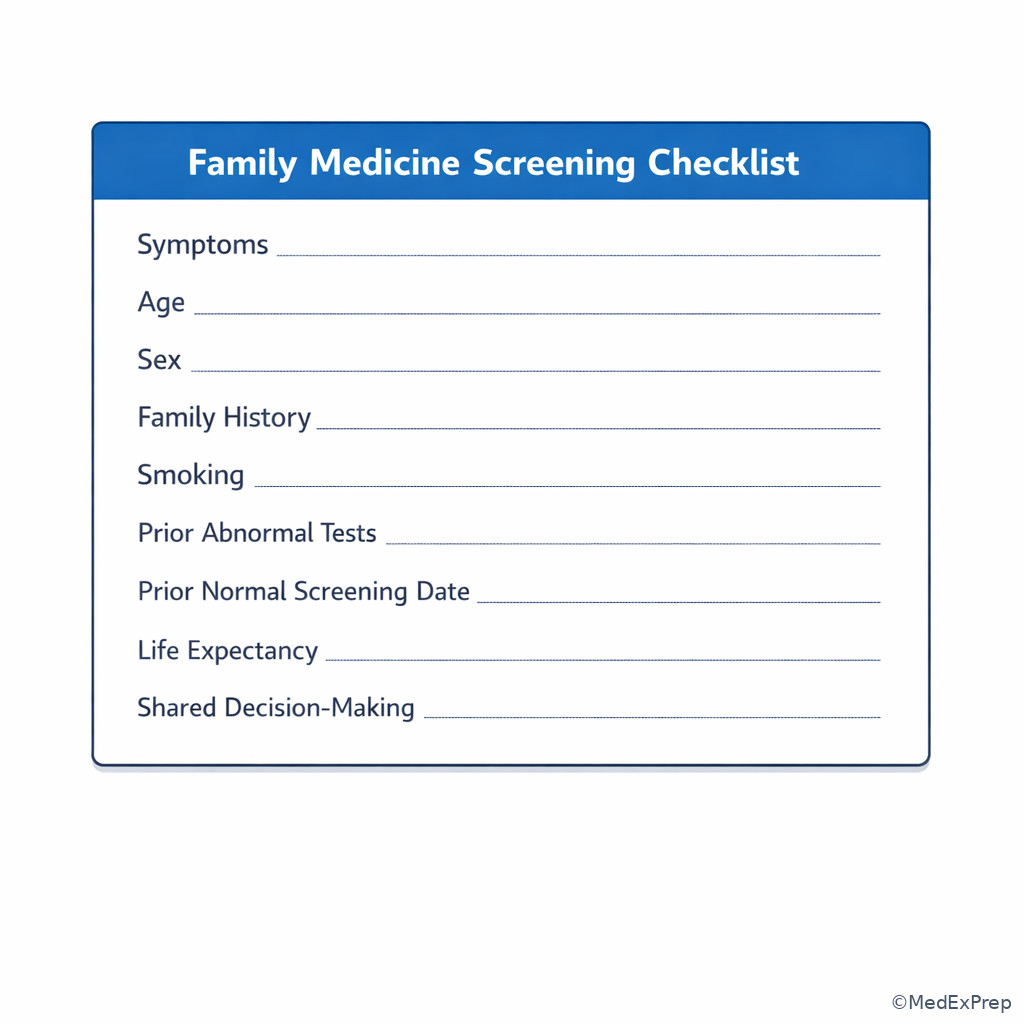
Algorithm / Approach
Exam takeaway: Use a fixed sequence—asymptomatic, risk tier, age window, prior results, net benefit—to choose the safest next step on COMAT-style prevention questions.
Use this algorithm whenever a stem asks for the most appropriate next step in preventive care. See Fig 6. It prevents the four biggest board errors: screening symptomatic patients, ignoring high-risk exceptions, repeating recent adequate tests, and ordering low-value tests in low-benefit populations.
Rapid Review
- Screening vs diagnosis → symptoms convert prevention into problem-oriented evaluation
- Average-risk rule → applies only after major risk modifiers are excluded
- Family history → first-degree early disease beats age shortcut
- Recent normal adequate test → usually defer, do not repeat early
- Positive screen → requires follow-up, not routine interval return
- Incomplete study → completion or repeat for adequacy, not reassurance
- Patient anxiety alone → not an indication for low-value screening
- Noninvasive test → can still be wrong if no net benefit exists
- Older age alone → does not automatically stop or continue screening
- Competing illness burden → lowers time-to-benefit and may shift to shared decision-making
- Negative prior screening → does not rule out disease if red flags develop later
- Preventive visit wording → may hide a diagnostic problem in the stem
- Best COMAT strategy → asymptomatic, risk, due, benefit, follow-up
Self-check quiz
1. A 50-year-old man with obesity and controlled hypertension presents for a wellness visit. He feels well and asks whether he should start a recommended cancer screening test. He denies bleeding, weight loss, pain, or change in bowel habits. Which single feature most strongly supports using screening logic rather than diagnostic evaluation?
- He is asymptomatic
- He has hypertension
- He is male
- He is 50 years old
2. A 42-year-old woman with obesity and migraine without aura presents for an annual visit. She feels well. Her mother had colorectal cancer at age 46. Which factor most strongly moves her out of an average-risk screening pathway?
- Female sex
- Obesity
- First-degree relative with early disease
- Migraine history
3. A 58-year-old woman with type 2 diabetes and osteoarthritis presents for preventive care. She is overdue for colorectal screening by age, but she also reports 2 months of intermittent hematochezia and new fatigue. Which is the most appropriate next step?
- Order FIT because it is recommended for routine screening
- Arrange diagnostic evaluation for lower GI bleeding
- Repeat CBC in 6 months before deciding
- Order stool DNA testing because it is more comprehensive
4. A 61-year-old asymptomatic man with hyperlipidemia and GERD presents for a checkup. He had a normal screening colonoscopy 4 years ago with adequate prep. His brother recently had polyps removed, which makes him anxious. Which is the most appropriate next step today?
- Repeat colonoscopy now because a sibling had polyps
- Order FIT now because it is noninvasive
- Defer repeat colorectal screening because his recent adequate normal colonoscopy is still within interval
- Order CT colonography for extra reassurance
5. A 34-year-old woman with mild asthma and no smoking history asks for chest CT screening because her aunt died of lung cancer. She is asymptomatic, exercises regularly, and has normal vitals. Which is the most appropriate outpatient response?
- Order low-dose chest CT because earlier detection always improves outcomes
- Order chest x-ray instead to reduce radiation
- Explain that routine screening should be offered only to populations with proven net benefit and avoid imaging here
- Order pulmonary function testing as an alternative screen
6. A 47-year-old man with obesity, former tobacco use, and well-controlled depression presents for a wellness visit. He is asymptomatic. His father developed colorectal cancer at age 48. He had a negative FIT 1 year ago obtained through a workplace program. Which is the most appropriate interpretation?
- He can return to average-risk interval screening because last year’s FIT was negative
- He should be managed through a modified-risk pathway because the strong family history is the key discriminator
- No further screening decisions are needed until symptoms develop
- He should only have repeat stool testing because colon-based evaluation is reserved for symptomatic patients
7. An 83-year-old woman with severe COPD, heart failure, chronic kidney disease, and multiple recent hospitalizations presents for continuity care. She is asymptomatic and asks to continue every routine cancer screening test because she has “never missed one.” Which is the most appropriate approach?
- Continue all screening because prior adherence predicts benefit
- Stop all preventive care because age alone makes screening inappropriate
- Use shared decision-making and consider deferring routine screening with low expected net benefit given competing illness burden
- Order the least invasive version of each screening test so no opportunity is missed
8. A 56-year-old woman with obesity, hypertension, and chronic constipation presents for an annual visit. She had a positive FIT 3 months ago but never completed follow-up because of scheduling issues. She currently denies overt bleeding and asks whether she can simply repeat the stool test because she feels well. Which is the most appropriate next step?
- Repeat FIT because she is asymptomatic now
- Return to routine interval screening next year because false positives are common
- Arrange the indicated diagnostic follow-up rather than repeat routine screening
- Order abdominal ultrasound to look for a structural cause before any bowel evaluation
Answer key
1. Correct answer: A
- A. He is asymptomatic: Tempting because it seems almost too simple; correct because screening is defined by testing asymptomatic individuals, and this is the single clue that keeps the stem in prevention mode. The discriminating finding is absence of symptoms. Source: USPSTF recommendation statement methods and general screening principles; Jameson et al., Harrison’s Principles of Internal Medicine.
- B. He has hypertension: Tempting because chronic disease often coexists with preventive care needs; incorrect because hypertension does not determine whether the question is screening versus diagnostic evaluation. The discriminating clue is that symptoms, not comorbidity, define the screening frame.
- C. He is male: Tempting because some screens are sex-specific; incorrect because sex may affect eligibility for a specific test, but it does not establish the fundamental screening-versus-diagnostic distinction. The discriminating clue remains asymptomatic status.
- D. He is 50 years old: Tempting because age often triggers screening eligibility; incorrect because age matters only after confirming an asymptomatic patient. The discriminating clue is not the age alone but the absence of symptoms.
2. Correct answer: C
- A. Female sex: Tempting because sex influences some preventive recommendations; incorrect because it does not by itself change her from average risk for this question. The discriminating clue is family history, not sex. Source: USPSTF preventive framework; Davidson et al., Current Diagnosis & Treatment Family Medicine.
- B. Obesity: Tempting because obesity affects many preventive decisions; incorrect because the stem’s strongest modifier is the first-degree family history of early disease. Obesity alone is not the key reason she leaves the average-risk pathway here.
- C. First-degree relative with early disease: Correct because a mother with early-onset colorectal cancer is the specific risk-enhancing clue that overrides simple average-risk age logic.
- D. Migraine history: Tempting only because comorbidities can distract; incorrect because migraine does not meaningfully change this screening pathway.
3. Correct answer: B
- A. Order FIT because it is recommended for routine screening: Tempting because she is screening-eligible by age and FIT is a valid screening option in asymptomatic patients; incorrect because hematochezia and fatigue shift the problem to diagnostic evaluation. The single discriminating clue is active bleeding symptoms. Source: USPSTF colorectal screening recommendations; Jameson et al., Harrison’s.
- B. Arrange diagnostic evaluation for lower GI bleeding: Correct because once symptoms are present, the goal is to explain the bleeding, not to perform routine population screening. Mechanism-to-treatment logic: screening detects occult disease in asymptomatic persons; bleeding suggests possible established pathology requiring direct workup.
- C. Repeat CBC in 6 months before deciding: Tempting because fatigue suggests anemia and trending labs sounds cautious; incorrect because delay is unsafe when hematochezia is already present. The discriminating clue is symptom duration with an alarm symptom.
- D. Order stool DNA testing because it is more comprehensive: Tempting because more comprehensive sounds better; incorrect because it remains a screening approach and does not replace diagnostic evaluation in a symptomatic patient.
4. Correct answer: C
- A. Repeat colonoscopy now because a sibling had polyps: Tempting because new family information may sound like a reason to intensify screening; incorrect for this specific scenario because the strongest discriminating clue is his recent adequate normal colonoscopy 4 years ago. Source: USPSTF screening interval principles; American College of Gastroenterology guidance.
- B. Order FIT now because it is noninvasive: Tempting because noninvasive options feel safer; incorrect because layering another screening modality on top of a recent adequate normal colonoscopy adds little value.
- C. Defer repeat colorectal screening because his recent adequate normal colonoscopy is still within interval: Correct because prior test adequacy, result, and timing determine whether screening is due. The discriminating clue is the completed normal colonoscopy 4 years ago.
- D. Order CT colonography for extra reassurance: Tempting because it sounds comprehensive; incorrect because reassurance alone is not an indication, and he is not due for repeat screening.
5. Correct answer: C
- A. Order low-dose chest CT because earlier detection always improves outcomes: Tempting because early detection is a core screening concept; incorrect because benefit depends on being in the population shown to benefit, which she is not. The discriminating clue is no smoking history and no symptoms. Source: USPSTF lung cancer screening recommendation; JAMA evidence reviews.
- B. Order chest x-ray instead to reduce radiation: Tempting as a compromise; incorrect because swapping one low-value screening test for another does not solve the problem of absent indication.
- C. Explain that routine screening should be offered only to populations with proven net benefit and avoid imaging here: Correct because screening must be targeted to populations where outcome benefit exceeds harm.
- D. Order pulmonary function testing as an alternative screen: Tempting because it is another lung-related test; incorrect because it does not address the requested cancer screening question and is not indicated as a substitute in an asymptomatic low-risk person.
6. Correct answer: B
- A. He can return to average-risk interval screening because last year’s FIT was negative: Tempting because a recent negative screen feels reassuring; incorrect because the stronger discriminating clue is his father’s early colorectal cancer, which places him on a modified-risk pathway. Source: USPSTF colorectal screening framework and risk considerations; gastroenterology society guidance.
- B. He should be managed through a modified-risk pathway because the strong family history is the key discriminator: Correct because one negative average-risk style test does not erase a high-risk family history. Mechanistically, risk stratification determines the preferred pathway before interpreting interval reassurance.
- C. No further screening decisions are needed until symptoms develop: Tempting if you confuse screening with diagnosis; incorrect because asymptomatic higher-risk patients still require preventive planning before symptoms appear.
- D. He should only have repeat stool testing because colon-based evaluation is reserved for symptomatic patients: Tempting because stool testing is a known screening option; incorrect because the key detail is not symptom status alone but risk category, which may alter preferred strategy.
7. Correct answer: C
- A. Continue all screening because prior adherence predicts benefit: Tempting because adherence usually improves preventive outcomes in healthier adults; incorrect because severe COPD, heart failure, CKD, and repeated hospitalizations reduce expected time-to-benefit and increase the burden of downstream testing. Source: USPSTF principles on individualized decisions; geriatrics prevention frameworks.
- B. Stop all preventive care because age alone makes screening inappropriate: Tempting because advanced age often appears in selective screening questions; incorrect because age alone is not the sole criterion, and some preventive counseling and care still matter.
- C. Use shared decision-making and consider deferring routine screening with low expected net benefit given competing illness burden: Correct because the discriminating finding is severe multimorbidity with likely limited time-to-benefit, making an individualized approach most appropriate.
- D. Order the least invasive version of each screening test so no opportunity is missed: Tempting because less invasive sounds safer; incorrect because low net benefit is not fixed simply by choosing an easier test.
8. Correct answer: C
- A. Repeat FIT because she is asymptomatic now: Tempting because current lack of symptoms may make this seem like routine screening again; incorrect because a prior positive FIT changes the problem into required follow-up rather than a fresh screening decision. The discriminating clue is the prior positive screening result. Source: USPSTF colorectal screening follow-up principles; ACG guidance.
- B. Return to routine interval screening next year because false positives are common: Tempting because some screening tests do produce false positives; incorrect because positive screening tests require diagnostic follow-up rather than dismissal.
- C. Arrange the indicated diagnostic follow-up rather than repeat routine screening: Correct because a positive screen must be followed by the appropriate diagnostic step. Mechanism-to-treatment logic: screening identifies increased probability; diagnostic follow-up confirms and localizes disease.
- D. Order abdominal ultrasound to look for a structural cause before any bowel evaluation: Tempting because it sounds noninvasive and broad; incorrect because it does not address the specific required follow-up after a positive colorectal screening test.
Keep going with the full COMAT Family Medicine Prep Course (COMAT FM)
You just studied the way members do, in the same lesson interface. Full access unlocks every lesson, the question bank and flashcards for a full year.
One payment · 1 year of access · No auto-renewal