1.1.1 - Nutrition Risk Screening Tools
Why it matters
- Nutrition screening is the front door to nutrition support: if high-risk patients are missed, EN or PN planning may start too late.
- The exam often tests a decision conflict: screen positive now versus wait for perfect assessment data.
- Many distractors blur screening with malnutrition diagnosis; the safest answer is often to recommend full assessment, not to overdiagnose.
- Screening tools compress messy clinical data into a practical triage decision, especially when history is incomplete, weights are unreliable, or inflammation is present.
Key Terms & Must-Know Facts
1.1.1.1 Key terms
- Nutrition risk screening: rapid triage to identify who may need full nutrition assessment.
- Nutrition assessment: broader evaluation using history, exam, intake, weight trend, function, and clinical context.
- Malnutrition diagnosis: a clinical conclusion based on diagnostic characteristics, not screening score alone.
- MST: Malnutrition Screening Tool; quick adult screen focused on weight loss and appetite.
- NRS-2002: Nutrition Risk Screening 2002; hospital-focused tool incorporating nutrition status, disease severity, and age.
- MUST: Malnutrition Universal Screening Tool; uses BMI, weight loss, and acute disease effect.
- SGA: Subjective Global Assessment; assessment method, not a pure rapid screening tool.
- Intake decline: reduced oral intake or inability to meet needs.
- Unintentional weight loss: nonplanned loss that raises concern for nutrition risk.
- Disease burden: illness severity that increases needs or worsens intake tolerance.
- Functional decline: reduced strength or performance; supports later assessment more than initial screening.
- Edema/fluid shift: factor that can mask true weight loss or distort BMI.
- False reassurance: normal BMI or obesity masking significant nutrition risk.
1.1.1.2 Must-know facts
- Screening asks who needs assessment; it does not by itself diagnose malnutrition.
- On exams, recent poor intake + unintentional weight loss is the highest-yield screening signal.
- Obesity does not rule out nutrition risk.
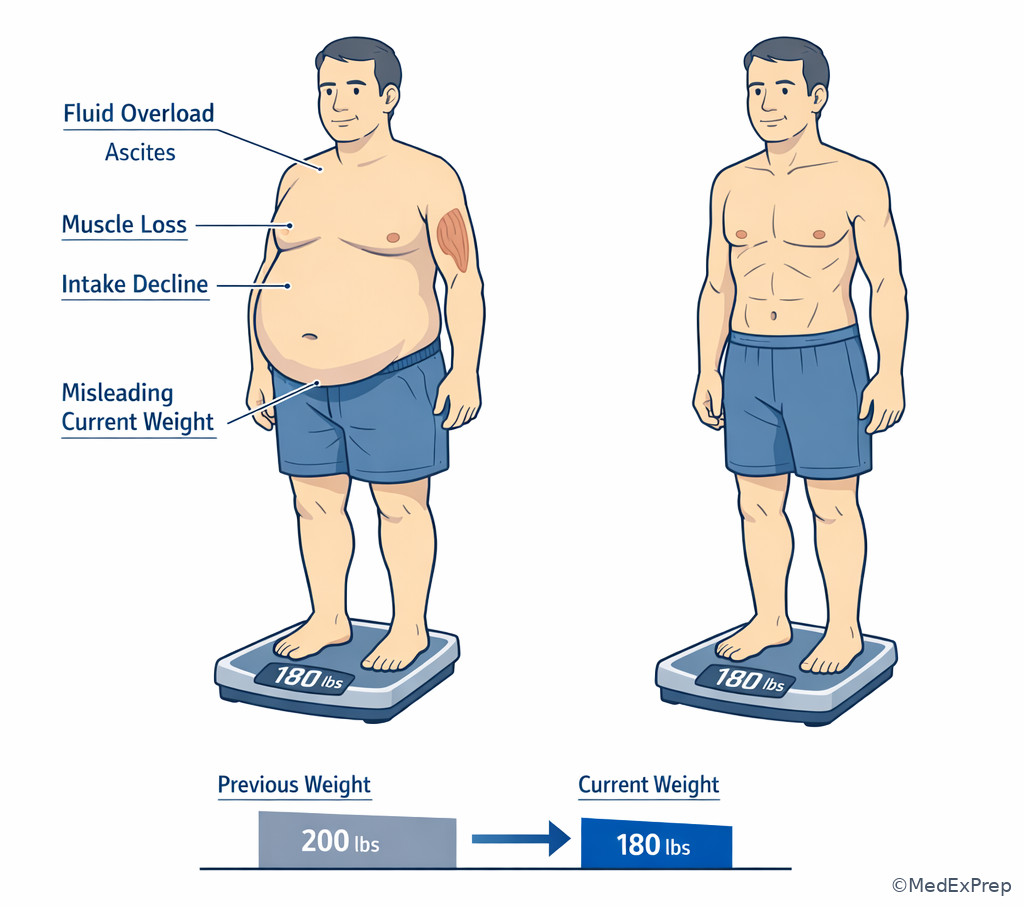
- Edema, ascites, and large fluid shifts can make current body weight misleading.
- Hospitalized older adults often screen positive more readily because age and disease burden worsen risk.
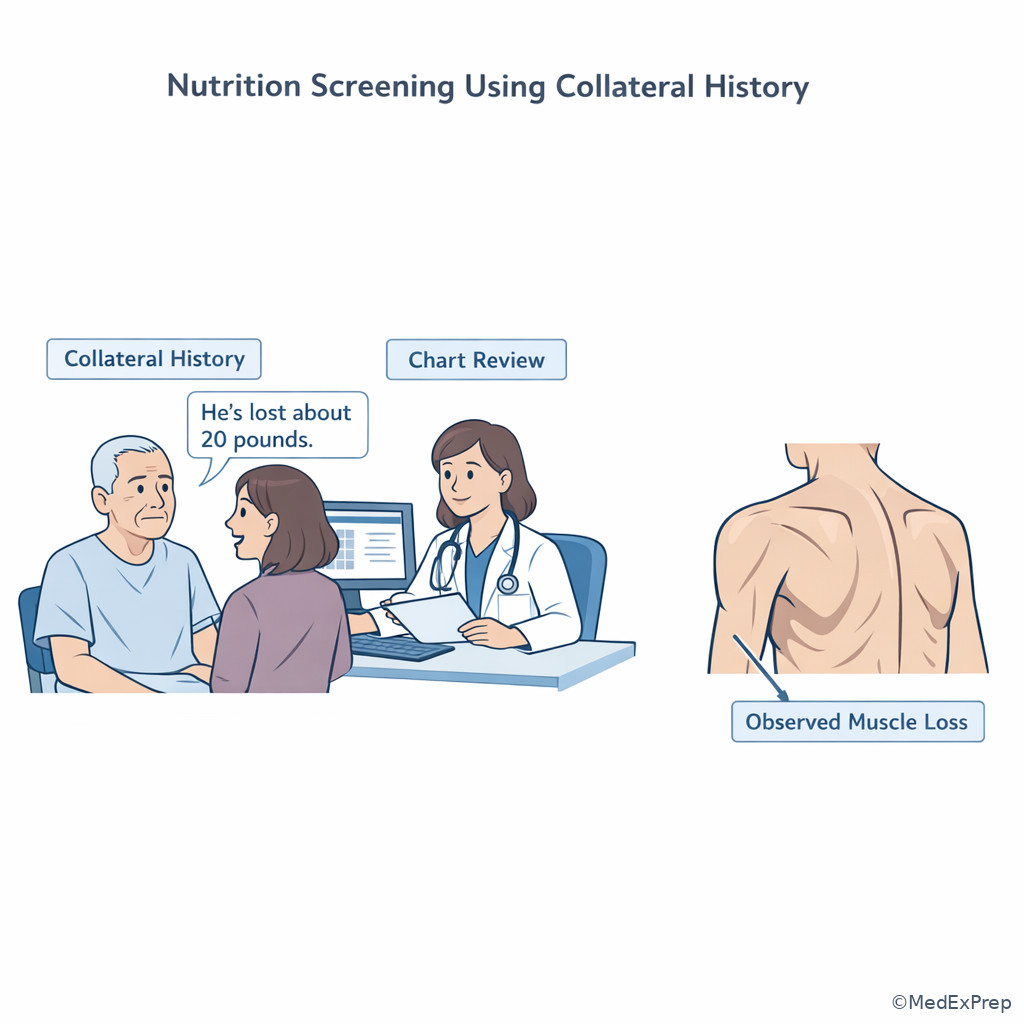
- If the patient cannot provide history, collateral history and chart review become critical.
- A positive screen should trigger timely nutrition assessment, not therapeutic overreaction without supporting data.
- Acute illness with little or no intake can increase urgency even before a formal diagnosis is established.
Exam takeaway: Use screening to decide who needs full assessment and how urgently the nutrition team should act.
flowchart TD
A[Patient encounter] --> B{Adequate intake history and weight data?}
B -->|Yes| C[Apply appropriate screening tool]
B -->|No| D[Use available chart and collateral data]
D --> C
C --> E{Positive screen?}
E -->|No| F[Routine rescreening by setting]
E -->|Yes| G[Prompt full nutrition assessment]
G --> H[Determine diagnosis, route readiness, and intervention urgency]
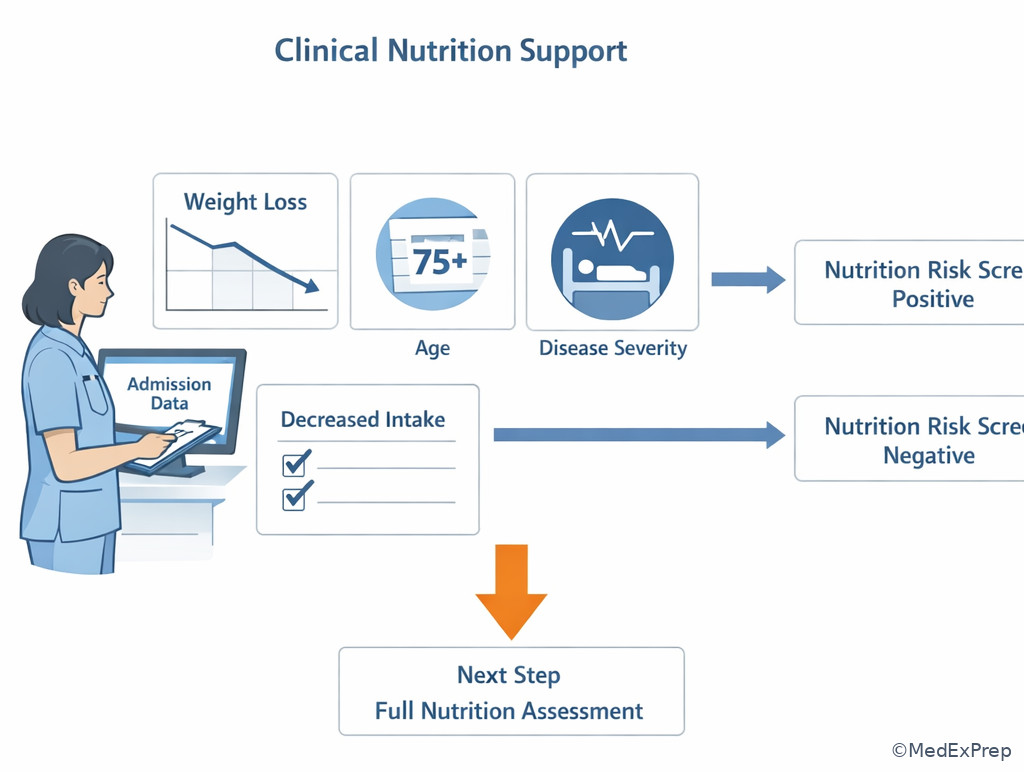
See Fig 1 for the core decision sequence the exam expects: screen first, assess next, intervene based on assessment and clinical urgency.
Exam takeaway: Match the tool to the care setting and the limited data available in the stem.
flowchart LR
A[MST] --> A1[Very rapid]
A --> A2[Weight loss + appetite]
B[NRS-2002] --> B1[Hospital setting]
B --> B2[Nutrition status + disease severity + age]
C[MUST] --> C1[Community and broad use]
C --> C2[BMI + weight loss + acute disease effect]
D[SGA] --> D1[Assessment method]
D --> D2[More detailed than screening]
See Fig 2 when stems ask which tool best fits a hospitalized patient versus a quick outpatient screen.
Exam takeaway: Visualize where intake history, weight trend, and disease burden enter the screening decision before assessment begins.
Exam takeaway: A normal or increased scale weight can hide nutrition risk when edema or ascites is present.
Core content
1.1.1.3 Foundational: What screening is designed to decide
A Explanation
The central decision conflict is simple: Does this patient need a full nutrition assessment now, or can screening wait or remain routine? Screening is a triage step. It is designed to choose between escalate and do not escalate yet. The single rule that resolves most exam questions is this: screening identifies risk; diagnosis requires deeper assessment. That distinction matters because many answer choices offer a diagnostic label when the only data provided are appetite loss, recent weight loss, and acute illness.
WHY THIS IS TESTED: the exam wants to know whether you can act safely with incomplete data. In practice, clinicians often see the patient before a formal nutrition exam is complete. The best recommendation may be to flag the patient for prompt assessment, document risk, and prepare for route/requirement decisions later.
Choose a screening tool when you need a rapid, structured method; reject the urge to overinterpret a single score as a full diagnosis. If a stem gives only a short history and current illness, the task is usually triage. If it gives detailed body composition, intake percentages, weight history, and physical findings, the task is moving toward assessment.
B Worked example
A 72-year-old man is admitted with community-acquired pneumonia. Home medications include furosemide 40 mg by mouth daily and metformin 1000 mg by mouth twice daily. He has COPD and type 2 diabetes. The admitting nurse documents that he has eaten “almost nothing” for 6 days because of dyspnea and fatigue. His wife reports his pants have become loose over 2 months, but the current admission weight is similar to a clinic weight from 3 weeks ago. He has bilateral leg edema. Albumin is low. The team asks for the most appropriate nutrition-related recommendation.
Identify task: This is a screening/triage question, not a formal malnutrition diagnosis question. Extract key facts: older adult, acute illness, poor intake for nearly a week, likely unintentional weight loss by history, misleading current weight because of edema. Apply rule: screening uses intake and weight-pattern risk signals; edema can hide weight loss. Eliminate distractors: a “no risk because BMI/weight is unchanged” answer fails because fluid status distorts weight. A “diagnose severe malnutrition immediately from albumin” answer fails because albumin is not a diagnostic shortcut here. Verify: the safest recommendation is that he screens at nutrition risk and needs prompt full nutrition assessment.
C Exam trap
D Checkpoint
Question: A hospitalized older adult has had poor oral intake for 5 days and probable unintentional weight loss by family report, but no formal nutrition assessment has yet been completed. What is the most appropriate interpretation?
- A. The patient can be diagnosed with malnutrition based on screening data alone.
Tempting because risk features are present; wrong because screening identifies risk and triggers assessment rather than serving as the complete diagnostic process. - B. The patient screens positive for nutrition risk and should receive prompt nutrition assessment.
Tempting because it may feel less decisive; right because it matches the purpose of screening and the next safe step. - C. The patient is low risk unless serum albumin is also decreased.
Tempting because laboratory values seem objective; wrong because albumin is not required for initial risk screening and is confounded by illness. - D. The patient is low risk because no BMI is provided.
Tempting because some tools use BMI; wrong because screening can still identify risk from poor intake and weight history.
1.1.1.4 Foundational: High-yield screening tools and when to prefer each
A Explanation
Board questions rarely expect memorization of every tool item, but they do expect you to know the logic of common screening tools. The decision conflict is: Which tool fits this care setting and this amount of available information? MST is attractive when speed matters and you have only brief patient-reported data; it centers on weight loss and appetite. NRS-2002 is more hospital-oriented and adds disease severity and age, making it useful when acute illness burden is part of the stem. MUST is broad and commonly framed around BMI, recent weight loss, and the acute disease effect of having little intake for several days.
The rule that resolves most choose-vs-reject questions is: pick the tool whose core variables are actually available in the stem. If the stem gives intake decline, reported weight loss, acute hospitalization, and age, NRS-2002 is often a strong fit. If it gives almost nothing except appetite and weight loss history, MST is more plausible. If the stem emphasizes community or outpatient screening with BMI and weight loss, MUST may be the better match. Reject SGA as the “quick screening” answer when the question clearly wants a rapid triage instrument; SGA is more detailed and functions as assessment.
WHY THIS IS TESTED: the exam rewards flexible reasoning, not brand-name memorization. You need to see what information the stem supplies and match that to the tool’s structure. See Fig 2.
B Worked example
A 58-year-old woman with metastatic ovarian cancer is admitted for small bowel obstruction management. She receives ondansetron 4 mg IV every 8 hours as needed and hydromorphone 0.5 mg IV every 4 hours as needed. She also has CKD stage 3 and hypertension. She reports a 10-pound unintentional weight loss over 1 month and poor intake due to nausea. The team wants a rapid admission nutrition risk screen. Her current BMI is not yet verified because standing weight is unavailable.
Identify task: select a rapid screening approach. Extract key facts: hospitalized adult, acute illness burden, documented poor intake and weight loss, BMI unavailable. Apply rule: prefer a tool workable with available admission data and suited to hospital screening. Eliminate distractors: MUST becomes less attractive if BMI is missing and the stem emphasizes hospital acuity; SGA is more assessment than quick screen. Verify: NRS-2002 is often the best fit in this hospital-style stem because it incorporates nutritional impairment plus disease severity.
C Exam trap
D Checkpoint
Question: Which tool is most consistent with a rapid adult screening approach centered on recent unintentional weight loss and decreased appetite?
- A. MST
Tempting because it directly uses those variables; right because that is its classic quick-screen logic. - B. SGA
Tempting because it is nutrition-focused and familiar; wrong because it is more detailed than a rapid initial screen. - C. A complete malnutrition diagnostic framework
Tempting because the outcome matters; wrong because the question asks for screening, not diagnosis. - D. A formula selection checklist
Tempting because nutrition support may follow; wrong because route/formula choice comes after screening and assessment.
- The most common high-yield screening signal is poor intake plus unintentional weight loss.
- True or False: A positive screening result alone confirms malnutrition. False.
- Name the 3 major clues that often drive screening decisions: intake decline, weight change, illness burden.
Exam takeaway: Pick the screening tool that matches both the setting and the variables supplied in the question stem.
flowchart TD
A[Need rapid screen] --> B{Hospital acute care?}
B -->|Yes| C{Disease severity emphasized?}
C -->|Yes| D[NRS-2002]
C -->|No| E{Only appetite and weight loss available?}
E -->|Yes| F[MST]
E -->|No| G[NRS-2002 or local validated hospital tool]
B -->|No| H{BMI and weight loss available?}
H -->|Yes| I[MUST]
H -->|No| J[MST or local validated tool]
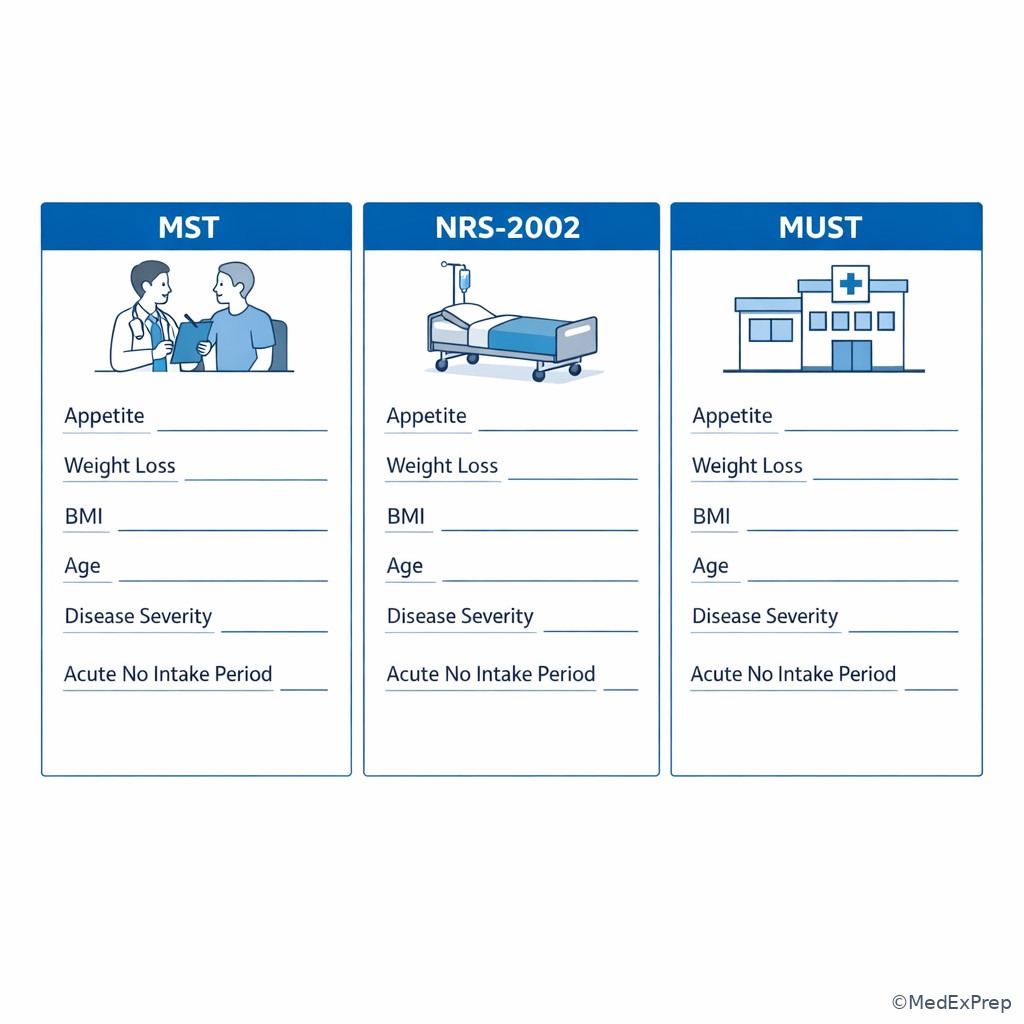
See Fig 3 for the exam-style match-the-tool framework.
Exam takeaway: Remember which patient data elements each screening tool prioritizes when stems provide incomplete information.
1.1.1.5 Application: Interpreting weight, intake, and misleading data
A Explanation
Once you know the tool purpose, the next decision conflict is: Should I trust the obvious number, or should I reinterpret it in clinical context? Most screening errors come from overtrusting current weight, BMI, or a single lab value. The single rule that resolves these conflicts is: trend beats snapshot, and clinical context beats isolated numbers. Unintentional weight loss matters more than a still-“normal” BMI. Reduced intake matters even if obesity is present. Fluid overload can hide lean tissue loss. A patient can screen positive despite having a high BMI, especially if the recent trajectory is poor.
WHY THIS IS TESTED: board stems are built with noise. They include tempting but misleading facts such as obesity, edema, low albumin, steroid use, or one surprisingly normal weight. You must choose the data that govern screening rather than the data that decorate the vignette.
Choose the history of change over the appearance of stability. Reject conclusions based purely on albumin or BMI. Monitor for hidden risk in patients with cancer, infection, chronic organ disease, GI symptoms, dysphagia, or prolonged NPO status. See Fig 1 and the weight-interpretation image above: they both reinforce that misleading weight data should push you toward fuller review rather than false reassurance.
B Worked example
A 46-year-old woman with Crohn disease and heart failure is admitted for abdominal pain and vomiting. She receives pantoprazole 40 mg IV daily and furosemide 20 mg IV twice daily. She reports eating less than one meal per day for the past week and says she has lost “about 15 pounds” over 2 months. Her BMI is 31 kg/m2. Admission weight is 2 kg higher than a month ago, and she has 3+ peripheral edema. C-reactive protein is elevated.
Identify task: interpret screening-related data despite conflicting numbers. Extract key facts: inflammatory disease, vomiting, very poor intake, probable unintentional weight loss, obesity, edema. Apply rule: obesity does not rule out risk; fluid retention may hide true tissue loss. Eliminate distractors: “low risk due to BMI 31” ignores trend and fluid shift; “diagnose malnutrition from CRP” confuses inflammation with diagnosis. Verify: she should still be considered at nutrition risk and prioritized for assessment.
C Exam trap
D Checkpoint
Question: Which finding most strongly supports nutrition risk in an adult whose BMI remains in the obese range?
- A. Elevated CRP with no intake history
Tempting because illness severity matters; wrong because it is not the strongest stand-alone screening clue without intake/weight context. - B. Unintentional recent weight loss and markedly reduced intake
Tempting because it seems too obvious; right because these are core screening drivers regardless of BMI. - C. Normal serum sodium and potassium
Tempting because normal labs feel reassuring; wrong because normal electrolytes do not exclude nutrition risk. - D. BMI greater than 30 kg/m2
Tempting because high BMI suggests reserve; wrong because BMI alone does not negate screening concern.
1.1.1.6 Application: What to do after a positive screen
A Explanation
After the patient screens positive, the exam shifts to action. The decision conflict is: Should you wait for more data, start intervention discussions, or jump straight to a diagnosis or route choice? The single rule is: positive screening triggers timely assessment, data completion, and nutrition support planning proportional to urgency. It does not automatically mean EN, PN, or a malnutrition severity label. But it does mean you should not ignore the signal.
WHY THIS IS TESTED: safe practice depends on sequencing. Clinicians must recognize when to recommend assessment, monitor intake, verify weight history, and alert the team that route selection may soon be needed. This is especially important when the patient may be heading toward prolonged inadequate intake, GI dysfunction, or later refeeding risk. The most defensible answer is often an interdisciplinary recommendation such as “prompt nutrition assessment and evaluate feasibility of oral, enteral, or parenteral support based on GI function and anticipated duration of inadequate intake.”
Choose escalation when the history suggests ongoing inability to meet needs. Reject passive rescreening if the patient already has a clear positive screen and worsening illness. Do not overstep scope by “placing a tube” or “inserting a central line”; your role is to recommend, clarify, and escalate appropriately. In the next topics, you will turn this positive screen into diagnostic and assessment reasoning.
B Worked example
A 67-year-old man with pancreatic cancer, recent chemotherapy, and atrial fibrillation is admitted for dehydration and persistent nausea. He receives apixaban 5 mg by mouth twice daily at home and ondansetron 8 mg IV every 8 hours inpatient. He has consumed only sips of fluid for 4 days. His daughter reports 8% unintentional weight loss over 2 months. A rapid screen is positive. The resident asks what the nutrition support clinician should recommend next.
Identify task: choose the next step after a positive screen. Extract key facts: persistent poor intake, active illness, meaningful recent weight loss, oncology context. Apply rule: positive screen leads to prompt full assessment and route-readiness evaluation, not immediate unsupported diagnosis. Eliminate distractors: “rescreen next week” is unsafe because risk is already established; “start PN immediately” is premature without full route and duration assessment. Verify: recommend prompt nutrition assessment and evaluation of appropriate nutrition support options based on GI function and expected duration of inadequate intake.
C Exam trap
D Checkpoint
Question: A patient screens positive for nutrition risk on admission. What is the most appropriate next recommendation?
- A. Diagnose severe malnutrition and select a formula immediately
Tempting because action feels efficient; wrong because diagnosis and regimen selection require fuller assessment. - B. Repeat screening in 7 days before taking any further action
Tempting because rescreening is part of routine workflow; wrong because a positive screen requires escalation now. - C. Recommend prompt nutrition assessment and determine route/readiness based on clinical context
Tempting because it seems less dramatic; right because it preserves sequencing and safety. - D. Use albumin alone to confirm the screen before consulting nutrition support
Tempting because it seems objective; wrong because albumin is not the required gatekeeper for assessment.
- True or False: A positive screen automatically means PN. False.
- Best next step after a positive screen: prompt full nutrition assessment.
- If the stem says “obese but eating almost nothing with recent weight loss,” think still at nutrition risk.
Exam takeaway: A positive screen leads to assessment and route-readiness planning rather than reflex treatment choices.
flowchart TD
A[Positive nutrition screen] --> B[Verify intake and weight history]
B --> C{Unable to meet needs now or soon?}
C -->|Yes| D[Prompt full nutrition assessment]
D --> E[Assess GI function and likely duration]
E --> F[Recommend oral optimization, EN, or PN as appropriate]
C -->|No| G[Rescreen per setting and monitor closely]
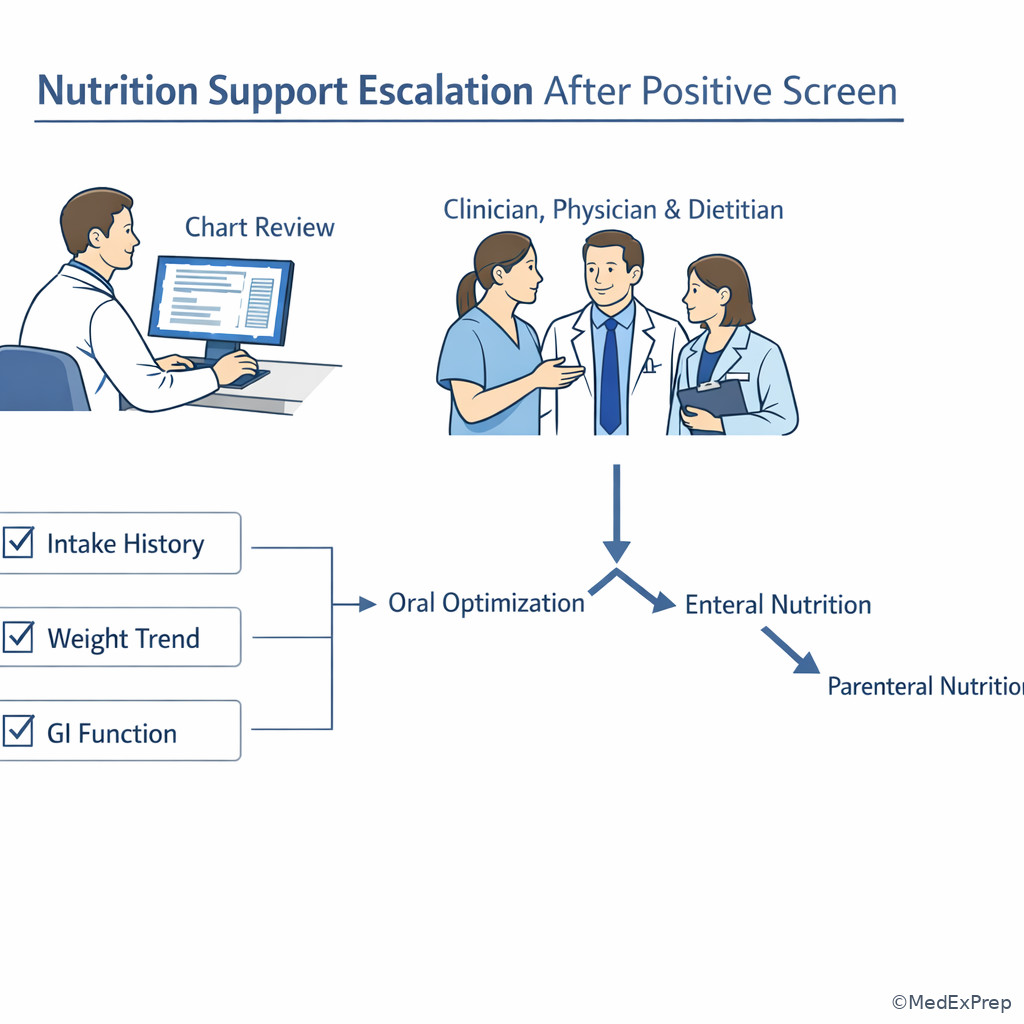
See Fig 4 for the safe action sequence after screening identifies risk.
Exam takeaway: After screening, the clinician should recommend assessment, data completion, and route planning within team-based scope.
1.1.1.7 Integration: Common differentials, boundary cases, and exam reasoning patterns
A Explanation
The last decision conflict is the most exam-like: which detail actually changes the screening conclusion? Boundary cases include obesity with intake decline, fluid-overloaded patients, older adults with vague weight history, cancer or GI disease patients who deny “weight loss” but report looser clothing, and post-op patients who are NPO but previously well nourished. The single rule is: screening is about present risk of nutrition compromise, not appearance, not one lab, and not future assumptions.
WHY THIS IS TESTED: the exam uses close-call stems where multiple choices sound reasonable. Your job is to locate the one clue that governs triage. For example, a brief post-op NPO period in an otherwise well-nourished patient is different from a prolonged intake decline with prior weight loss. A patient with high BMI and metastatic disease can be higher risk than a lean patient who is eating well and weight stable. A normal albumin does not rescue a high-risk history. If the history is incomplete, choose the answer that recommends clarification rather than false certainty.
This is also where role boundaries matter. The correct answer may be to recommend nutrition assessment, clarify missing weight history, or escalate to the treating team for route planning. Avoid options that imply independent procedural action outside scope.
B Worked example
A 61-year-old man with obesity, cirrhosis with ascites, and newly diagnosed esophageal cancer is admitted for dysphagia. He receives spironolactone 100 mg by mouth daily and lactulose 20 g by mouth three times daily. He reports taking only liquids for 10 days. He denies weight loss, but his spouse says he has become visibly thinner in the shoulders and face over 2 months. His admission weight is 4 kg above last month’s clinic weight. The intern says he is likely low nutrition risk because he is “still heavy.”
Identify task: determine whether screening concern is present despite misleading body size and fluid status. Extract key facts: dysphagia, prolonged poor intake, cancer, ascites, spouse-reported tissue loss. Apply rule: current high body weight with fluid retention does not rule out risk; intake decline is decisive. Eliminate distractors: “low risk due to obesity” fails; “cannot screen because self-reported weight loss is absent” fails because collateral history and clinical context count. Verify: he screens positive and needs prompt full assessment.
C Exam trap
D Checkpoint
Question: Which stem feature most strongly argues against postponing nutrition risk identification?
- A. Obesity with no edema and stable intake
Tempting because BMI is high; wrong because without decline in intake or weight this alone is not the strongest reason to escalate. - B. Brief overnight NPO status before an elective procedure
Tempting because any NPO order feels important; wrong because short procedural fasting alone does not create the same screening urgency. - C. Ten days of markedly reduced intake despite fluid-overloaded current weight
Tempting because weight appears reassuring; right because intake duration and fluid-confounded weight strongly support risk. - D. Normal prealbumin in a chronically ill patient
Tempting because a lab appears normal; wrong because it is less decisive than sustained intake decline.
Exam takeaway: High BMI does not protect against screening positivity when recent intake and weight trajectory are unfavorable.
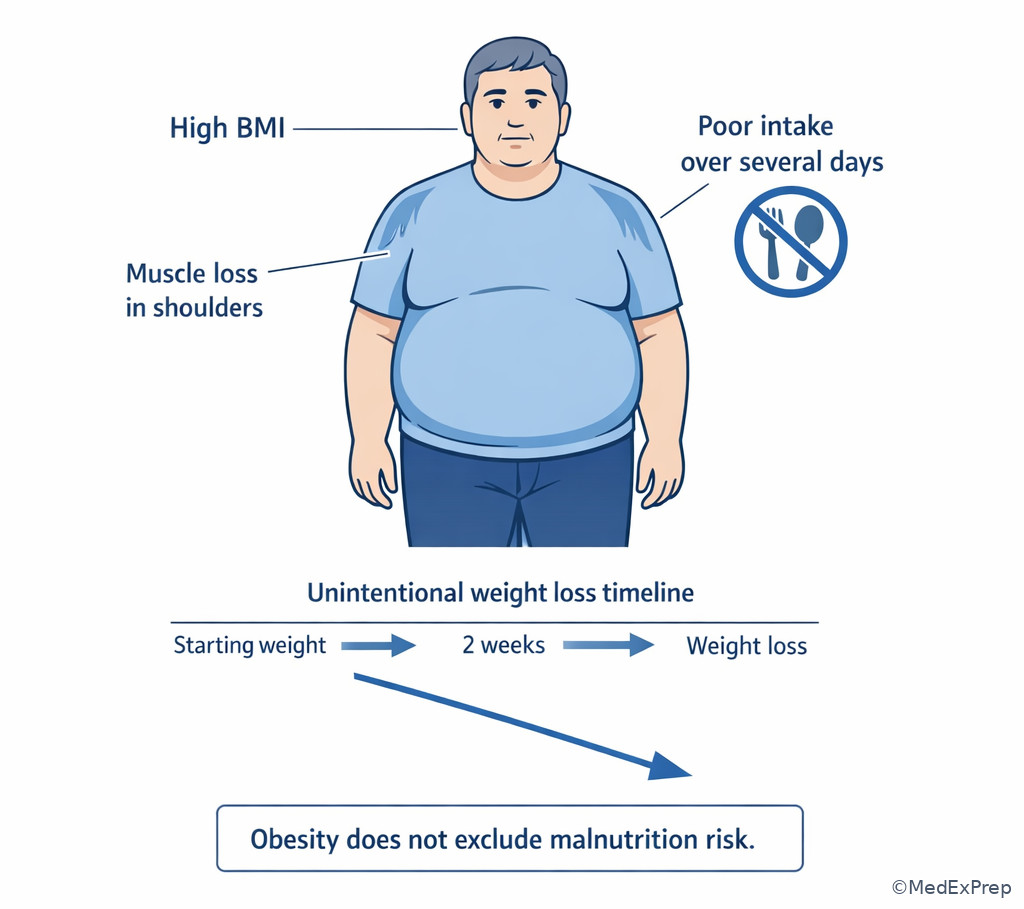
See Fig 5 for the classic board-style trap of obesity masking real risk.
Exam takeaway: Family report, chart review, and clinician observation can rescue an incomplete screening history.
Exam Traps & Differentiators
- Most common wrong answer: diagnosing malnutrition directly from a positive screen. Why: learners confuse triage with diagnosis.
- Looks similar but isn't: SGA versus MST/NRS/MUST. SGA is more assessment-oriented; the others are commonly used for rapid screening.
- Looks reassuring but isn't: obesity, normal BMI, or a stable single admission weight in the setting of edema or ascites.
- Looks objective but misleads: albumin, prealbumin, or CRP used as the primary screen determinant.
- Scope trap: answering with a procedural action rather than recommending assessment, clarification, or escalation.
| Pattern in the stem | Think | Do not jump to |
|---|---|---|
| Poor intake for several days + recent unintentional weight loss | Positive nutrition risk screen | Deferring action until a lab returns |
| Hospitalized older adult + acute illness burden | Hospital-focused screening logic | Assuming age alone diagnoses malnutrition |
| Obesity + reduced intake + loose clothing history | Risk can still be high | “Well nourished because BMI is high” |
| Edema or ascites + apparently stable weight | Weight may be misleading | Ruling out risk based on one scale value |
| Question asks for rapid screening tool | MST, MUST, NRS-style thinking | Choosing a full assessment framework |
| Positive screen with ongoing inability to eat | Prompt full assessment and route planning | Automatic PN without further assessment |
| Looks similar but isn't | Why it tempts | Single discriminator |
|---|---|---|
| Nutrition screening vs malnutrition diagnosis | Both discuss weight and intake | Screening triages risk; diagnosis requires fuller criteria |
| MST vs SGA | Both are nutrition-focused bedside tools | MST is rapid screening; SGA is more detailed assessment |
| Stable current weight vs stable nutritional status | The number feels objective | Fluid shifts can hide recent tissue loss |
| Low albumin vs nutrition risk | Low lab value feels diagnostic | Inflammation and illness confound albumin interpretation |
| Short NPO status vs sustained inadequate intake | Both involve not eating | Duration and preceding nutrition history determine urgency |
If the stem says “lost appetite and unplanned weight loss,” think screen positive.
If the stem says “BMI is high but intake has been poor and clothes are loose,” think risk may still be substantial.
If the stem says “edema, ascites, or fluid overload,” think current weight can mislead.
If the stem says “rapid tool on admission,” think structured screening, not full assessment.
If the stem says “positive screen,” think prompt nutrition assessment and route-readiness evaluation.
If the stem says “normal albumin,” think that does not erase a high-risk history.
Tables
| Tool / concept | Main inputs | Best use case | Exam note |
|---|---|---|---|
| MST | Weight loss, appetite | Very quick adult bedside screening | High-yield when only brief history is available |
| NRS-2002 | Nutrition status, disease severity, age | Hospitalized adults | Good fit when acute illness burden is emphasized |
| MUST | BMI, weight loss, acute disease effect | Broad screening, often community/outpatient style | Less helpful if BMI cannot be obtained reliably |
| SGA | History plus physical/functional assessment | Assessment rather than quick triage | Common distractor when the question asks for a rapid screen |
| Positive screen | Risk signal present | Trigger further evaluation | Leads to assessment; does not equal diagnosis |
| Comparison point | Screening | Assessment | Diagnosis |
|---|---|---|---|
| Primary goal | Find who is at risk | Understand nutrition status in detail | Assign clinical malnutrition conclusion |
| Speed | Rapid | More detailed | Depends on completed assessment |
| Typical inputs | Weight loss, intake, illness effect | History, anthropometrics, exam, function, intake pattern | Diagnostic characteristics interpreted in context |
| Most common exam action | Escalate or rescreen | Determine needs and route-readiness | Document and treat appropriately |
| Common mistake | Using it as a diagnosis | Skipping data verification | Overcalling severity from incomplete data |
| Differential / boundary case | Why it is confusing | Most likely screening interpretation |
|---|---|---|
| Obesity with recent poor intake | Body size suggests “reserve” | May still screen positive |
| Edema with stable admission weight | Weight appears unchanged | Risk may be masked; use trend and history |
| Low albumin during acute illness | Lab appears nutrition-specific | Do not use as the primary screening determinant |
| Overnight NPO for a planned procedure | No intake is documented | Usually less urgent if baseline history is otherwise reassuring |
| Cancer with subtle clothing-size changes | No exact weight amount available | Collateral evidence can still support risk |
| Normal BMI with rapidly worsening disease | Weight appears acceptable | Disease and intake decline can still justify positive screening |
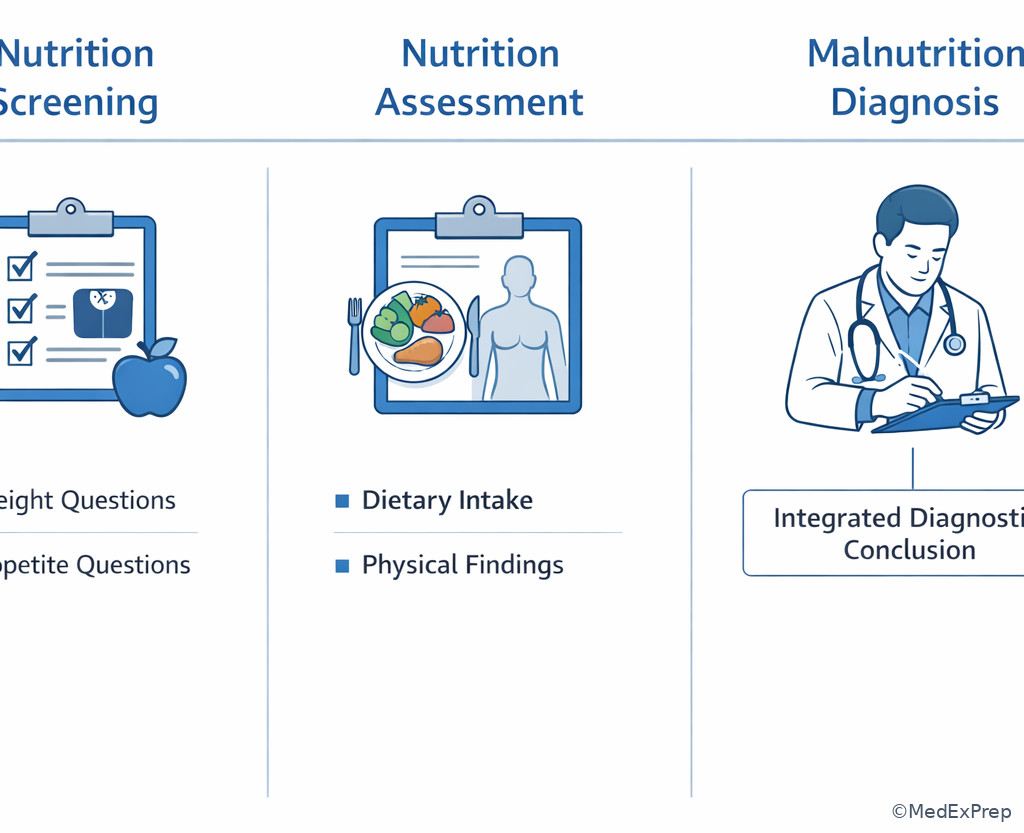
Exam takeaway: Distinguish rapid triage tasks from the broader data collection needed for diagnosis and nutrition support planning.
Algorithm / Approach
Exam takeaway: Start with available history, identify the governing risk clue, and escalate to full assessment when the screen is positive.
See Fig 6 for a compact approach you can apply to nearly every screening question in this chapter.
Rapid Review
- Positive screen → triggers assessment, not automatic diagnosis
- MST → best remembered for appetite loss plus weight loss
- NRS-2002 → strongest when hospital illness severity is emphasized
- MUST → depends on BMI, weight loss, acute disease effect
- SGA → assessment framework, not the classic rapid-screen answer
- Obesity → does not exclude high nutrition risk
- Edema/ascites → current weight may conceal true decline
- Albumin → poor discriminator for screening triage
- Trend over snapshot → recent trajectory beats one measurement
- Collateral history → valid when the patient cannot report weight change
- Short planned NPO → less urgent than sustained inadequate intake
- Acute disease burden → raises concern when paired with poor intake
- Best next step after positive screen → full assessment plus route/readiness planning
- Scope-safe answer → recommend, clarify, escalate; do not perform procedures
Self-check quiz
1. A 69-year-old woman admitted with pneumonia receives azithromycin 500 mg IV daily and lisinopril 10 mg by mouth daily. She reports poor appetite for 1 week and unintentional weight loss over the past month. Which interpretation is most appropriate?
- The patient requires immediate malnutrition diagnosis based on screening alone.
- The patient screens at nutrition risk and should receive prompt full assessment.
- The patient is low risk unless BMI is underweight.
- The patient is low risk unless albumin is decreased.
2. A clinician wants a rapid bedside adult screening approach centered on recent weight loss and appetite decline. Which option is the best match?
- MST
- SGA
- Comprehensive adult nutrition assessment
- Enteral formula tolerance checklist
3. A 56-year-old man with heart failure and cellulitis receives cefazolin 2 g IV every 8 hours and furosemide 40 mg IV twice daily. He has eaten less than 25% of meals for 6 days. His current weight is unchanged from last month, but he has 2+ edema. Which is the most appropriate nutrition screening conclusion?
- Low risk because body weight is unchanged
- Low risk because edema indicates fluid excess, not nutrition concern
- At risk because inadequate intake may be masked by fluid-related weight stability
- Cannot screen until dry weight is measured exactly
4. A 63-year-old woman with metastatic colon cancer, CKD stage 3, and nausea receives ondansetron 8 mg IV every 8 hours and pantoprazole 40 mg IV daily. The team asks for the most appropriate next step after a positive nutrition risk screen on admission. Which answer is best?
- Recommend prompt nutrition assessment and route-readiness evaluation
- Initiate PN immediately without further review
- Repeat the screen in 1 week before any escalation
- Use albumin to confirm the screen before involving nutrition support
5. A 74-year-old man with COPD and diabetes receives insulin glargine 20 units subcutaneously nightly and albuterol/ipratropium nebulizers every 6 hours. On admission he can report only poor appetite and recent loose-fitting clothes; BMI is not yet available. Which screening tool logic is most compatible with the data provided?
- MST-style logic because weight-loss history and appetite are available
- MUST-style logic because BMI is essential and already known
- SGA must be the only acceptable first step because clothing size changed
- No screening can occur until labs return
6. A 60-year-old woman with obesity, ovarian cancer, and ascites receives spironolactone 100 mg by mouth daily and oxycodone 5 mg by mouth every 6 hours as needed. She reports intake of only liquids for 8 days. Her current weight is 3 kg above last month, and albumin is low. Which is the most appropriate recommendation?
- Low risk because increased current weight argues against nutritional decline
- High nutrition risk; ascites may mask weight loss, so prompt assessment is needed
- Wait for a measured dry weight before making any screening conclusion
- Diagnose severe malnutrition immediately because albumin is low
7. A 48-year-old man with pancreatitis, hypertension, and alcohol use disorder receives lactated Ringer infusion and hydromorphone 0.5 mg IV every 4 hours as needed. He was well nourished before admission but has been NPO for 18 hours for a planned procedure. Which option best distinguishes this patient from one who should clearly screen positive?
- Short procedural NPO time without prior intake decline is less concerning than sustained poor intake with weight loss
- Any NPO order means the patient automatically screens positive
- Risk screening should be based only on serum proteins in pancreatitis
- Screening is inappropriate until the procedure is canceled
8. A 71-year-old man with esophageal cancer, CHF, and chronic kidney disease receives metoprolol succinate 50 mg by mouth daily and bumetanide 1 mg IV twice daily. He reports dysphagia and minimal intake for 9 days. His daughter describes visible shoulder wasting, but the chart shows stable weight because of edema. What is the most appropriate board-style conclusion?
- He is likely low risk because measured weight has not fallen
- He screens positive, and collateral history outweighs falsely reassuring weight data
- No screening conclusion can be made because the patient did not personally report weight loss
- Route selection should be finalized before any nutrition assessment occurs
Answer key
1. Correct answer: B
- A: Tempting because poor intake and weight loss suggest serious nutrition compromise. Incorrect for this scenario because screening data alone do not establish a complete malnutrition diagnosis; the single clue is that the question asks for interpretation of screening findings, not diagnostic criteria. Supported by standard nutrition care sequencing in hospital practice guidelines.
- B: Tempting because it feels less final than a diagnosis, but it is correct because poor appetite plus unintentional weight loss in an acutely ill older adult is classic positive-screen logic. The single clue is the combination of intake decline and recent weight loss. Supported by validated screening-tool principles in adult nutrition care literature.
- C: Tempting because BMI can be part of some tools. Incorrect because underweight is not required for nutrition risk; the single clue is the history of poor intake and weight loss.
- D: Tempting because albumin seems objective. Incorrect because albumin is not required to establish nutrition screening concern; the single clue is that screening is based on history and clinical context, not a confirmatory serum protein.
2. Correct answer: A
- A: Tempting because it sounds simple, and it is correct because MST is built around recent unintentional weight loss and decreased appetite in a rapid adult screen. The single clue is the stem’s emphasis on those two variables. Supported by adult screening-tool validation literature.
- B: Tempting because SGA is well known and clinically rich. Incorrect because SGA is more detailed assessment than rapid screening; the single clue is the phrase “rapid bedside adult screening approach.”
- C: Tempting because comprehensive assessment is valuable. Incorrect because the question asks specifically for a quick screen, not the full evaluation.
- D: Tempting because formula planning may follow later. Incorrect because tolerance checklists do not function as initial nutrition risk screens.
3. Correct answer: C
- A: Tempting because stable weight feels reassuring. Incorrect because edema can mask loss of tissue mass; the single clue is 2+ edema with 6 days of poor intake.
- B: Tempting because edema is indeed fluid excess. Incorrect because fluid excess does not erase nutrition risk; the single clue is sustained intake below needs.
- C: Tempting because it requires contextual reasoning, and it is correct because inadequate intake over nearly a week plus edema-confounded weight supports nutrition risk. The single clue is poor intake paired with unreliable weight interpretation.
- D: Tempting because precise data seem safer. Incorrect because screening should not be delayed when clinically meaningful concern is already present; the single clue is that the available history is sufficient to identify risk.
4. Correct answer: A
- A: Tempting because it sounds procedural rather than therapeutic, and it is correct because the proper next step after a positive screen is prompt full assessment plus route-readiness evaluation. The single clue is that the question asks for the next step after screening. Supported by standard nutrition care sequencing in guidelines and textbooks.
- B: Tempting because the patient is clearly ill and not eating well. Incorrect because PN selection requires broader assessment of GI function and anticipated duration; the single clue is lack of completed route-readiness information.
- C: Tempting because rescreening is common workflow. Incorrect because once positive, the patient should not simply wait another week; the single clue is “positive nutrition risk screen on admission.”
- D: Tempting because albumin may look like a confirmatory marker. Incorrect because albumin is not the gatekeeper for post-screen escalation; the single clue is that the screen is already positive.
5. Correct answer: A
- A: Tempting because it uses only the limited bedside history, and it is correct because appetite decline and recent weight-loss clues fit MST-style thinking well. The single clue is that BMI is not yet available, but appetite and loose-clothing history are.
- B: Tempting because MUST is a common tool. Incorrect because the stem specifically states BMI is not yet available, making MUST-style logic less directly supported by the provided data.
- C: Tempting because clothing-size change sounds qualitative and detailed. Incorrect because SGA is a broader assessment, not necessarily the best initial rapid screening approach in this scenario.
- D: Tempting because laboratory values seem necessary. Incorrect because screening can proceed from history without waiting for labs; the single clue is the already available intake and weight-change history.
6. Correct answer: B
- A: Tempting because the current weight is higher. Incorrect because ascites can conceal true loss; the single clue is 8 days of liquid-only intake with fluid accumulation.
- B: Tempting because it asks you to distrust the obvious scale number, and it is correct because ascites plus prolonged poor intake is classic hidden-risk screening logic. The single clue is fluid-overloaded weight masking decline.
- C: Tempting because dry weight sounds more exact. Incorrect because screening should not be postponed when adequate concern already exists; the single clue is prolonged poor intake in a high-burden cancer patient.
- D: Tempting because low albumin suggests severity. Incorrect because serum albumin alone does not justify immediate diagnostic labeling; the single clue is that the question remains at the screening/recommendation stage.
7. Correct answer: A
- A: Tempting because it differentiates based on duration and prior trajectory, and it is correct because short procedural NPO without preceding decline is not equivalent to sustained inadequate intake with weight loss. The single clue is the 18-hour planned procedural fast in an otherwise previously well-nourished patient.
- B: Tempting because NPO status feels automatically serious. Incorrect because context and duration matter; the single clue is the brief, procedure-related timeframe.
- C: Tempting because pancreatitis often involves lab monitoring. Incorrect because screening is not based only on serum proteins; the single clue is that the distinction requested is about clinical nutrition risk context.
- D: Tempting because procedural status complicates care. Incorrect because screening remains appropriate and does not depend on cancellation of the procedure.
8. Correct answer: B
- A: Tempting because stable charted weight looks objective. Incorrect because edema can invalidate that reassurance; the single clue is visible shoulder wasting plus minimal intake for 9 days.
- B: Tempting because it accepts collateral history over the scale number, and it is correct because dysphagia, minimal intake, cancer, and edema-confounded weight strongly support a positive screen. The single clue is the combination of prolonged inadequate intake and collateral evidence of wasting.
- C: Tempting because self-report seems preferable. Incorrect because collateral history is acceptable when the patient cannot provide complete weight-loss details; the single clue is the daughter’s consistent report of visible wasting.
- D: Tempting because route selection will matter soon. Incorrect because assessment follows screening before finalizing route; the single clue is that the case still asks for screening-level conclusion.
Keep going with the full CNSCP Prep Course (CNSCP)
You just studied the way members do, in the same lesson interface. Full access unlocks every lesson, the question bank and flashcards for a full year.
One payment · 1 year of access · No auto-renewal