1.1.1 - CMA Role Boundaries
Why it matters
- Many CMA questions are really safety questions disguised as workflow questions: the best answer is often the one that protects the patient and stays within role.
- Role-boundary errors can cause patient harm, legal exposure, documentation problems, and exam misses even when the clinical content seems familiar.
- In outpatient practice, medical assistants do many tasks independently in sequence, but not independently in judgment; that distinction is heavily tested.
- Knowing when to escalate is as important as knowing how to perform routine tasks. See Fig 1.
Key Terms & Must-Know Facts
1.1.1.1 Key terms
- Scope of practice/role: the tasks permitted by law, policy, training, and delegation.
- Delegation: assignment of a task by an authorized clinician according to law and policy.
- Supervision: oversight by the authorized clinician or practice structure.
- Outpatient workflow: routine office sequence for intake, rooming, assisting, documentation, and follow-up support.
- Independent judgment: making diagnostic, prescribing, or treatment decisions without clinician direction.
- Escalation: promptly notifying the supervising clinician or office lead when findings or requests exceed role.
- Standing order/protocol: preapproved office process that still must fit law, training, and authorization.
- Reinforcement of education: repeating approved instructions already given by the clinician.
- Informed consent discussion: clinician responsibility when the law or procedure requires clinician involvement.
- PHI: protected health information.
- Two-identifier verification: confirming patient identity before tasks, specimens, or medications.
- Abnormal finding: result, symptom, or observation requiring notification rather than independent management.
1.1.1.2 Must-know facts
- Medical assistants support care; they do not independently diagnose or prescribe.
- When a task is unclear, the safest next step is clarification before action.
- When findings are abnormal, worsening, or urgent, stop routine workflow and escalate.
- Documentation should record facts, actions taken, who was notified, and time when appropriate.
- A tempting wrong answer often asks the MA to interpret, decide, or authorize rather than obtain, prepare, reinforce, or report.
- Patient requests for medication changes, result interpretation, or treatment selection require clinician involvement.
- Local law and employer policy may vary; use the safest general principle and confirm local protocol.
- Delegation does not make a prohibited task suddenly allowed.
- The MA may carry out delegated routine tasks only when trained, authorized, and policy-permitted.
- Never falsify, backdate, or omit chart information to “help the office catch up.”
| High-yield boundary fact | Exam-safe interpretation |
|---|---|
| Patient asks, “What do my results mean?” | Do not interpret independently; route to clinician per protocol. |
| Provider is running late and asks for routine rooming | Within role if delegated, trained, and documented correctly. |
| Medication refill requested without clinician order | Do not authorize; forward according to office process. |
| Abnormal vital signs during intake | Repeat if appropriate, ensure patient safety, notify clinician. |
| Patient asks if a lesion is cancer | Do not diagnose; acknowledge concern and alert clinician. |
| Task allowed at one office but not another | Follow state law, employer policy, training, and supervision requirements. |
| Consent form signature needed | Witnessing may be allowed per policy, but the clinician handles the consent discussion when required. |
| Exposure incident or medication error | Do not hide it; follow protocol, report immediately, document facts. |
Core content
1.1.1.3 Foundational rule: role boundaries are defined by task type, authority, and judgment level
A Explanation
The exam repeatedly asks you to choose between doing a routine support task and crossing into licensed clinical judgment. The single rule that resolves the conflict is this: if the task requires independent diagnosis, prescribing, treatment planning, or definitive interpretation, it is outside the medical assistant role. If the task is a routine, delegated, trained, policy-approved support activity, it may be within role. That means the MA can obtain, prepare, assist, reinforce, document, label, route, and report; the MA cannot independently decide what a finding means or what treatment should happen next.
WHY THIS IS TESTED: exam stems often use familiar office tasks to tempt you into choosing the “helpful” action rather than the authorized action. The testable pattern is whether the MA is being asked to perform a delegated task or to decide something reserved to a clinician.
Use a fast internal screen: Task → Training → Authorization → Judgment. If the action is routine and delegated, proceed. If law/policy/training is uncertain, clarify. If the task requires judgment reserved to a licensed professional, stop and escalate. See Fig 1 and Fig 2.
Exam takeaway: Ask whether the task is delegated support work or independent clinical judgment before you act.
flowchart TD
A[Task appears in workflow] --> B{Routine delegated support task?}
B -->|Yes| C{Trained and policy permitted?}
C -->|Yes| D[Perform, verify, document]
C -->|No/Unsure| E[Clarify before acting]
B -->|No| F{Requires diagnosis, prescribing, treatment plan, or interpretation?}
F -->|Yes| G[Stop and escalate to clinician]
F -->|Unclear| E B Worked example
A 54-year-old man with hypertension and type 2 diabetes presents for a follow-up visit and says at check-in, “My home sugars are higher and I ran out of my metformin yesterday. Can you just send in a refill and tell me whether I should double the dose until my appointment?” He also mentions mild nasal congestion and asks whether it could be allergies. His last visit note is in the chart, and the clinician is running 25 minutes behind.
Reasoning chain: Identify the task: refill authorization and dose change. Extract key facts: the patient requests medication management, not simple scheduling; he is stable enough to wait, and the congestion comment is distracting noise. Apply rule: refill authorization and dose adjustment require clinician direction. Eliminate distractors: calling the pharmacy to approve the refill, advising him to double the dose, or interpreting symptoms as allergies all require judgment beyond role. Verify: route the request per office protocol, inform the patient you will notify the clinician, and document the request accurately.
C Exam trap
D Checkpoint
Question: A 37-year-old woman with asthma and seasonal allergies calls from the parking lot before her follow-up visit. She says she lost her inhaler, feels “a little tight,” and asks the medical assistant to tell her whether she should use her old steroid inhaler twice as often until she sees the provider. What is the most appropriate next step?
- Advise her to double the steroid inhaler because it was previously prescribed
- Ask her to come in, obtain intake information, and promptly notify the clinician of her medication question and symptoms
- Tell her the chest tightness is probably anxiety because she is speaking in full sentences
- Authorize the pharmacy to refill whichever inhaler she used last month
Answer: B
- A: Tempting because it seems like a temporary bridge using an existing medication; wrong because changing use frequency is a treatment decision. The stem clue is the request for dosing advice.
- B: Correct because the MA may support intake and escalate the symptom and medication question without independently managing either issue. The stem clue is outpatient workflow plus a question requiring clinician judgment.
- C: Tempting because speaking in full sentences may reduce concern for severe distress; wrong because the MA must not diagnose anxiety or dismiss respiratory symptoms.
- D: Tempting because refill history exists; wrong because refill authorization still requires clinician-approved process and cannot be independently chosen by the MA.
1.1.1.4 What is usually within role vs what requires clarification vs what is prohibited
A Explanation
The most practical boundary skill is not memorizing isolated tasks; it is classifying actions into three bins: within role now, clarify before acting, and do not do. Within role are routine delegated support tasks such as obtaining and documenting vitals, preparing rooms, stocking supplies, verifying identifiers, collecting and labeling specimens, performing authorized waived tests, reinforcing previously approved instructions, and assisting with routine procedures under supervision. Clarify-before-acting tasks are those that may be allowed in one setting but depend on state law, office policy, training, or explicit delegation. Do-not-do tasks are those involving diagnosis, interpretation for management, prescribing, changing orders, obtaining clinician-level consent, or disclosing PHI without proper authorization.
WHY THIS IS TESTED: the testable pattern is a near-miss choice where three options look helpful and only one respects the MA’s legal and organizational boundary. The stem often includes a busy office, a familiar patient, or a standing protocol to make overreach feel reasonable.
See Fig 2 for the side-by-side decision grid. The strongest exam move is to ask, “Am I being asked to support care or to decide care?”
Exam takeaway: Sort tasks into support, unclear authorization, or clinician-only judgment to avoid the best-looking distractor.
flowchart LR
A[Task in clinic] --> B{Support task?}
B -->|Yes| C[Within role now
examples: vitals, room prep, specimen labeling, approved education reinforcement]
B -->|Maybe| D[Clarify first
examples: law/policy varies, training unclear, standing order uncertain]
B -->|No| E[Prohibited for MA
examples: diagnose, prescribe, change dose, interpret for treatment, obtain clinician-level consent] Exam takeaway: Visualize three bins—do now, clarify first, and escalate—to answer workflow questions safely.
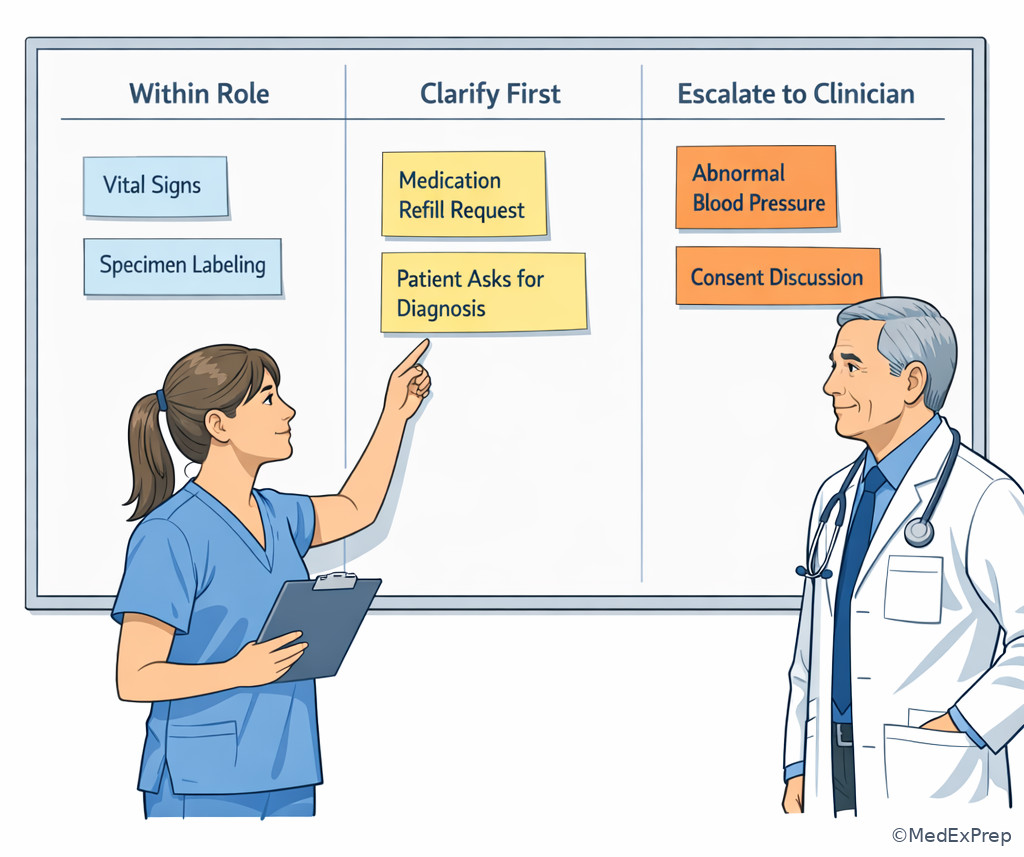
B Worked example
A 29-year-old woman with migraine and generalized anxiety disorder arrives for a same-day visit for severe headache. She asks the medical assistant, “The doctor usually gives me an injection. Can you go ahead and give it now so I can lie down?” Her chart shows previous ketorolac administrations. She also asks whether the office can fax work excuse papers now because she is late for a meeting.
Reasoning chain: Identify the task: medication administration before current clinician direction. Extract key facts: prior injections are documented, but there is no current order in the stem; work excuse paperwork is distracting administrative noise. Apply rule: prior history does not equal present authorization. Eliminate distractors: independently selecting and administering the prior medication, deciding the headache is “just her usual migraine,” or writing an excuse note all exceed role or authority. Verify: room the patient, obtain vitals as directed, flag symptoms promptly, and await clinician order per protocol.
C Exam trap
D Checkpoint
Question: Which task is most clearly within the role of an entry-level medical assistant in a routine ambulatory visit?
- Explaining to the patient that a new heart murmur likely indicates valvular disease
- Changing the dose on a refill request because the previous dose caused nausea
- Obtaining blood pressure, documenting the result, and notifying the clinician if it is markedly elevated
- Obtaining informed consent for a minor surgery on behalf of the physician
Answer: C
- A: Tempting because patients want understandable explanations; wrong because this interprets a finding and suggests diagnosis.
- B: Tempting because it seems practical and patient-specific; wrong because dose changes require clinician authority.
- C: Correct because obtaining and documenting vitals is routine support work, and escalation of an abnormal result stays within safe workflow.
- D: Tempting because paperwork often passes through the MA; wrong because clinician-level consent discussion cannot be replaced by the MA.
- The safest response to an unclear task is clarify before acting.
- True or False: A prior medication in the chart allows the MA to authorize a refill today. False.
- Name the 3 bins for task classification: within role, clarify first, prohibited/escalate.
| Action | Usually within role | Clarify first | Outside role / escalate |
|---|---|---|---|
| Obtain vital signs | Yes, if trained and delegated | If patient condition or protocol is unusual | No, unless asked to interpret or manage independently |
| Collect and label specimen | Yes | If collection method or legal chain requirement is unclear | No, if asked to interpret result |
| Reinforce clinician-approved aftercare instructions | Yes | If patient asks new medical questions beyond the approved script | No, if asked to change the plan |
| Medication administration | Only if delegated, trained, law- and policy-permitted, and ordered | If route, order, training, or authority is unclear | Outside role if no valid order or if selecting medication/dose |
| Explain lab result meaning | No | Not a “clarify then do” task unless the clinician provides a specific approved message | Yes, escalate to clinician |
| Authorize refill | No | Route per office process | Yes, clinician decision |
| Witness signature on forms | May be allowed by policy | Clarify exact form and policy | Outside role if substituting for clinician consent discussion |
1.1.1.5 Communication boundaries: what to say when patients ask for advice, diagnosis, or interpretation
A Explanation
Boundary questions are not only about physical tasks; they are also about words. The MA must often choose between being helpful conversationally and staying within approved communication limits. If a patient asks, “Do you think this is serious?” “What does my test mean?” or “Should I stop this medicine?” the correct move is not silence and not independent advice; it is a professional bridge statement plus escalation. Appropriate communication includes acknowledging concern, gathering relevant information, documenting the request, and routing it quickly to the supervising clinician according to protocol.
WHY THIS IS TESTED: exam stems often present a worried patient who directly asks the MA for reassurance or instruction. The tested pattern is whether the MA gives a medical opinion instead of using a safe communication script.
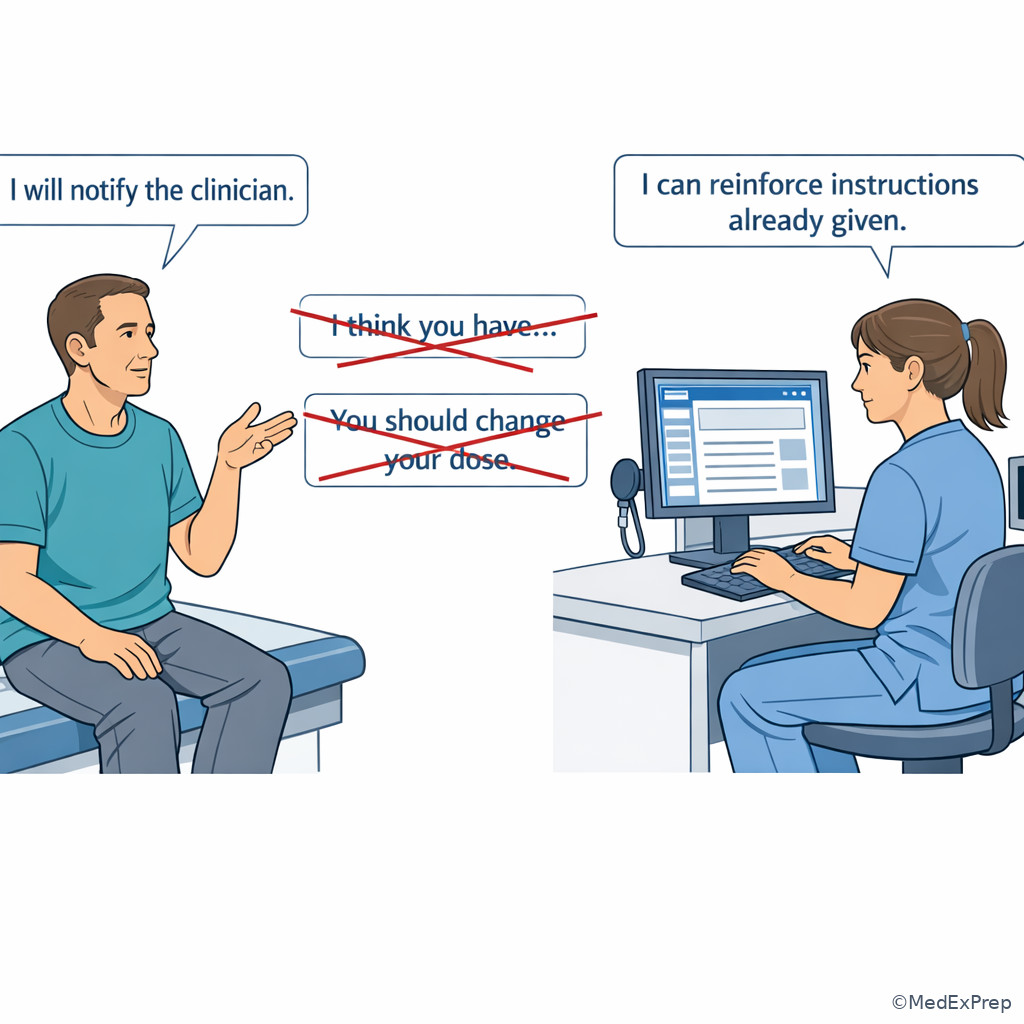
Choose communication that is factual and role-appropriate: “I’m going to document that concern and notify the clinician,” “I can reinforce the instructions the clinician gave you,” or “I’m not able to interpret the result, but I will route your question right away.” Reject statements that diagnose, predict outcomes, or instruct on starting, stopping, or adjusting medication without direction. See Fig 3.
Exam takeaway: Acknowledge, gather facts, route, and document instead of interpreting or advising.
flowchart TD
A[Patient asks for advice or interpretation] --> B[Acknowledge concern]
B --> C[Gather objective details per protocol]
C --> D{Within approved reinforcement?}
D -->|Yes| E[Repeat clinician-approved instructions]
D -->|No| F[Notify clinician / route message]
F --> G[Document facts and action taken] Exam takeaway: Use neutral, factual language when a patient asks for interpretation or treatment advice.
B Worked example
A 63-year-old woman with hypothyroidism, osteoarthritis, and a recent urgent care visit calls about a portal result she saw overnight. She says, “My urine says leukocyte esterase positive. That means I have a kidney infection, right? Should I start the leftover antibiotics from my husband?” She also mentions that she has a dental cleaning tomorrow and worries about rescheduling it.
Reasoning chain: Identify the task: interpret a result and advise on antibiotic use. Extract key facts: portal access, positive urine term, request for treatment advice, distracting dental appointment detail. Apply rule: interpreting the result and advising on medication are outside role. Eliminate distractors: telling her it means UTI, suggesting she begin antibiotics, or saying the result is “probably contamination” all require interpretation. Verify: gather current symptoms per office protocol, route promptly to the clinician, advise that the office will respond according to protocol, and document the communication.
C Exam trap
D Checkpoint
Question: A 45-year-old man with hyperlipidemia and GERD asks during rooming, “My blood pressure today is higher than usual. Does that mean I need another medication?” What is the most appropriate response by the medical assistant?
- “Yes, a second medication is usually needed when readings are this high.”
- “It may be due to stress, so let’s ignore it if you feel okay.”
- “I’ll document the reading and notify the clinician so your blood pressure can be addressed today.”
- “Stop your current medication until the clinician evaluates you.”
Answer: C
- A: Tempting because elevated pressure often leads to treatment changes; wrong because it advises therapy.
- B: Tempting because stress can elevate blood pressure; wrong because it independently interprets and dismisses the finding.
- C: Correct because it stays factual, supports workflow, and escalates without giving treatment advice.
- D: Tempting because some adverse effects or abnormal readings require medication review; wrong because stopping medication is a clinician decision.
1.1.1.6 Documentation boundaries: chart facts, not conclusions; record escalation, not independent decisions
A Explanation
Documentation is where many role errors become visible. The MA should chart what was obtained, observed, communicated, and done according to protocol. The MA should not chart unsupported diagnoses, guessed causes, or actions that suggest independent clinician decision-making. Safe charting language is objective: patient statement, measured values, appearance, time, who was notified, and what protocol step was taken. Unsafe charting language includes clinical conclusions, retrospective alterations, and undocumented exceptions.
WHY THIS IS TESTED: exam stems often ask for the “best documentation” after an abnormal finding, refusal, error, or request. The pattern is whether the note records verifiable facts and escalation instead of interpretation. The chart protects both patient safety and role integrity.
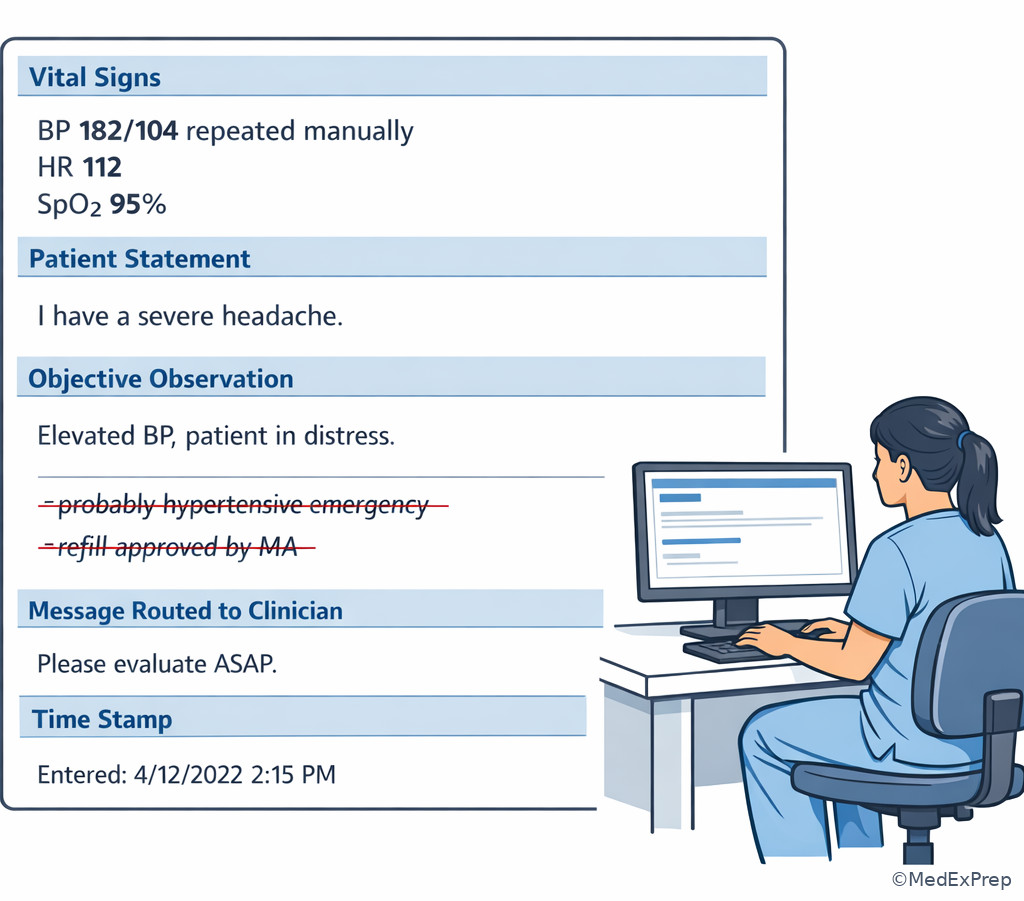
Examples: document “BP 182/104 repeated manually after 5 minutes; patient reports headache; supervising clinician notified at 10:12 AM” rather than “patient likely hypertensive urgency.” Document “patient requested refill for lisinopril; request routed to clinician” rather than “refill approved.” See Fig 4.
Exam takeaway: Record objective facts, your actions, and notifications rather than diagnoses or treatment decisions.
flowchart TD
A[Observation or request] --> B[Record objective facts]
B --> C[Document protocol action]
C --> D[Identify who was notified]
D --> E[Add time or sequence if relevant]
E --> F[Avoid conclusions, guesses, or backdating]
Exam takeaway: The safest note captures facts, time, and notification without independent interpretation.
B Worked example
A 71-year-old man with chronic kidney disease and coronary artery disease presents for blood pressure recheck. Initial automated BP is 188/100. He says he skipped breakfast because he came from the lab and jokingly mentions he hates “all these machines.” He denies chest pain but reports a mild headache. The clinician is with another patient.
Reasoning chain: Identify the task: document an abnormal vital sign and next steps. Extract key facts: markedly elevated BP, mild symptom, comorbidities, distracting joke about machines. Apply rule: obtain objective repeat measurement per protocol if appropriate, ensure safety, notify clinician, document facts and notification. Eliminate distractors: documenting “hypertensive crisis,” telling the patient to take an extra pill, or delaying documentation until the clinician signs off all exceed role or weaken record integrity. Verify: chart the values, symptoms reported, repeat action if done, and notification time.
C Exam trap
D Checkpoint
Question: Which chart entry is most appropriate after a patient requests an antibiotic refill and reports a new rash from the medication?
- “Antibiotic allergy confirmed; instructed patient to discontinue and added urgent refill request.”
- “Patient reports new rash after taking antibiotic; refill request and symptom message routed to supervising clinician per protocol.”
- “Likely drug eruption; patient reassured that rash should resolve.”
- “Refill denied because rash suggests medication intolerance.”
Answer: B
- A: Tempting because discontinuation may seem prudent; wrong because it labels the reaction and gives independent medication instruction.
- B: Correct because it records the patient report and the MA’s role-appropriate action without interpretation.
- C: Tempting because the rash may indeed be medication-related; wrong because it interprets and reassures independently.
- D: Tempting because refill should probably not proceed unchanged; wrong because denying treatment based on clinical judgment is not the MA’s decision.
- Fill in the blank: Objective documentation records facts, actions, and ________. notifications
- True or False: “Likely sinus infection” is acceptable MA charting after rooming. False.
- Name 3 objective note elements after an abnormal vital sign: measured value, patient statement/symptom, who was notified.
| Documentation situation | Safe wording | Unsafe wording |
|---|---|---|
| Abnormal BP | “BP 182/104, repeated manually; clinician notified” | “Hypertensive emergency” |
| Medication question | “Patient asks whether to increase dose; message routed” | “Dose should be increased” |
| Lab result inquiry | “Patient requests explanation of result; clinician message sent” | “Lab confirms infection” |
| Patient refusal | “Patient declined specimen collection after explanation; clinician informed” | “Noncompliant patient” |
| Adverse symptom reported | “Patient reports rash after medication start” | “Medication allergy established” |
| Error or near miss | “Wrong label identified before transport; specimen relabeled per protocol and event reported” | “No issue after fix” |
1.1.1.7 When uncertainty or abnormality changes the answer from “do” to “stop and escalate”
A Explanation
Foundational role boundaries become most important when something is not routine. A task that is usually within role can become unsafe when there is an abnormal finding, patient deterioration, missing authorization, conflicting identifiers, an error, or a request that adds clinician judgment. This is why the correct answer is often not merely “continue the workflow” but “stop, secure safety, and notify the supervising clinician.”
WHY THIS IS TESTED: board-style stems frequently start with a familiar task—rooming, injection prep, specimen collection, callback, refill routing—and then insert one clue that changes the safest action. The exam wants you to notice the pivot clue.
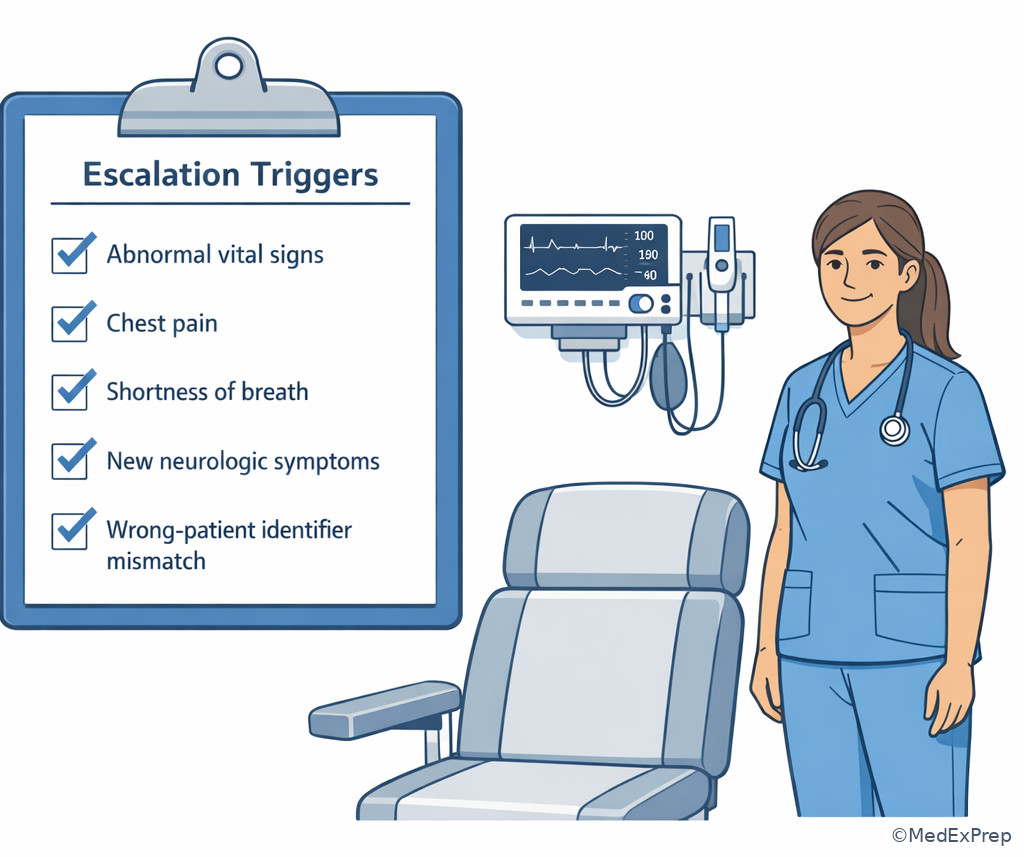
Key pivot clues include chest pain during intake, markedly abnormal vitals, new neurologic symptoms, uncertain patient identity, medication order mismatch, request to sign or explain clinician-level consent, or request to interpret findings. The MA’s strength is recognition plus escalation, not independent rescue decisions outside protocol. See Fig 5.
Exam takeaway: One abnormal or authorization-sensitive clue can convert a routine task into a stop-and-notify situation.
flowchart TD
A[Routine task starts] --> B{Any pivot clue?}
B -->|No| C[Proceed per protocol]
B -->|Yes| D{Urgent safety issue or abnormal finding?}
D -->|Yes| E[Stop routine flow, protect patient, notify clinician immediately]
D -->|No| F{Authorization/scope uncertainty?}
F -->|Yes| G[Pause and clarify before action]
F -->|No| C Exam takeaway: Recognize the single red-flag clue that changes a routine task into an escalation event.
B Worked example
A 42-year-old woman with obesity and hypothyroidism presents for a routine B12 injection and annual paperwork pickup. She appears pale and says she has had chest pressure since climbing the stairs but “still wants to get this over with quickly” because she has to pick up her child. The prefilled syringe is already prepared under the valid order from a prior visit, and the waiting room is busy.
Reasoning chain: Identify the task: routine injection administration. Extract key facts: chest pressure with exertion is the pivot clue; paperwork urgency and busy clinic are distracting noise. Apply rule: the task is no longer routine because a potentially urgent symptom is present. Eliminate distractors: administering the injection first because the order is valid, asking her to sit for a few minutes and then continuing without notifying anyone, or assuming anxiety due to life stress all miss the escalation trigger. Verify: keep the patient safe per office protocol, notify the clinician immediately, and document symptoms and notification.
C Exam trap
D Checkpoint
Question: A 61-year-old man with COPD and hyperlipidemia is being roomed for cough follow-up. During intake he develops new dizziness and says his left arm feels “heavy.” What is the most appropriate next step for the medical assistant?
- Complete the full intake to avoid missing history details before notifying the clinician
- Tell him these symptoms are likely from anxiety because follow-up visits can be stressful
- Stop routine rooming, maintain patient safety, and notify the supervising clinician immediately per office protocol
- Ask him to return to the waiting room until an exam room opens
Answer: C
- A: Tempting because complete data helps clinical decisions; wrong because the new neurologic symptom is an escalation trigger that overrides routine intake.
- B: Tempting because anxiety can cause dizziness; wrong because unilateral arm heaviness is the single clue against dismissing the event.
- C: Correct because patient safety and immediate escalation take priority when urgent symptoms appear during workflow.
- D: Tempting because space management matters in a busy clinic; wrong because returning him to routine flow delays care for a potentially urgent issue.
1.1.1.8 Integrating the exam approach: identify task, confirm role, choose action, verify and document
A Explanation
By exam day, you need one reliable decision framework for almost every role-boundary question. Start by naming the task precisely. Then ask whether it is within the MA role as a delegated support activity. Next, look for a pivot clue: abnormal finding, unclear authorization, patient request for advice, consent issue, refill request, or documentation risk. Then choose one of three actions: perform, clarify, or escalate. Finally, verify identifiers, safety, and documentation.
WHY THIS IS TESTED: the CMA exam rewards safe sequencing. Many wrong answers fail not because the task is impossible, but because the sequence is unsafe. For example, acting before clarification, reassuring before escalation, or documenting a conclusion rather than the fact pattern.
This final integration section turns scope facts into a repeatable exam algorithm. See Fig 6.
Exam takeaway: Use a repeatable framework—identify, classify, act, and document—to solve scope questions under time pressure.
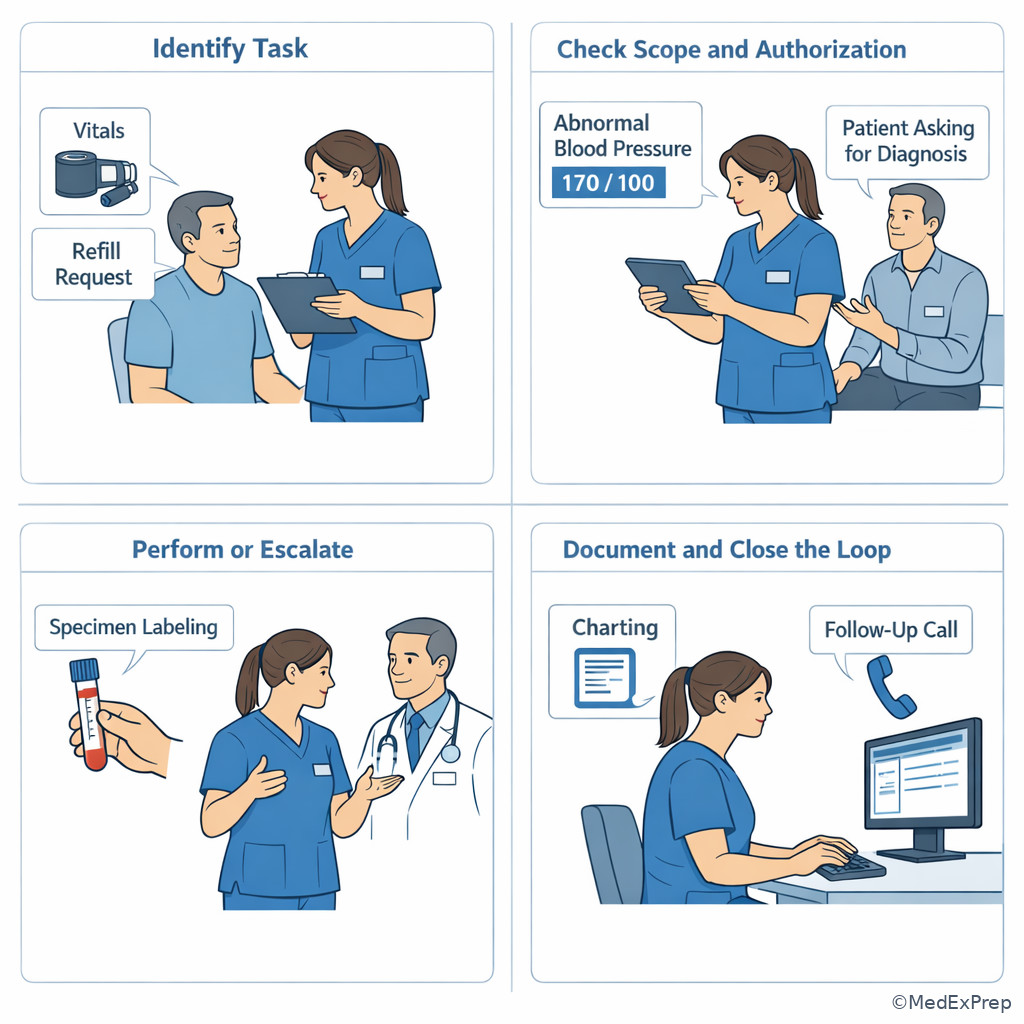
Exam takeaway: The correct response is usually the one that protects the patient while avoiding independent clinical judgment.
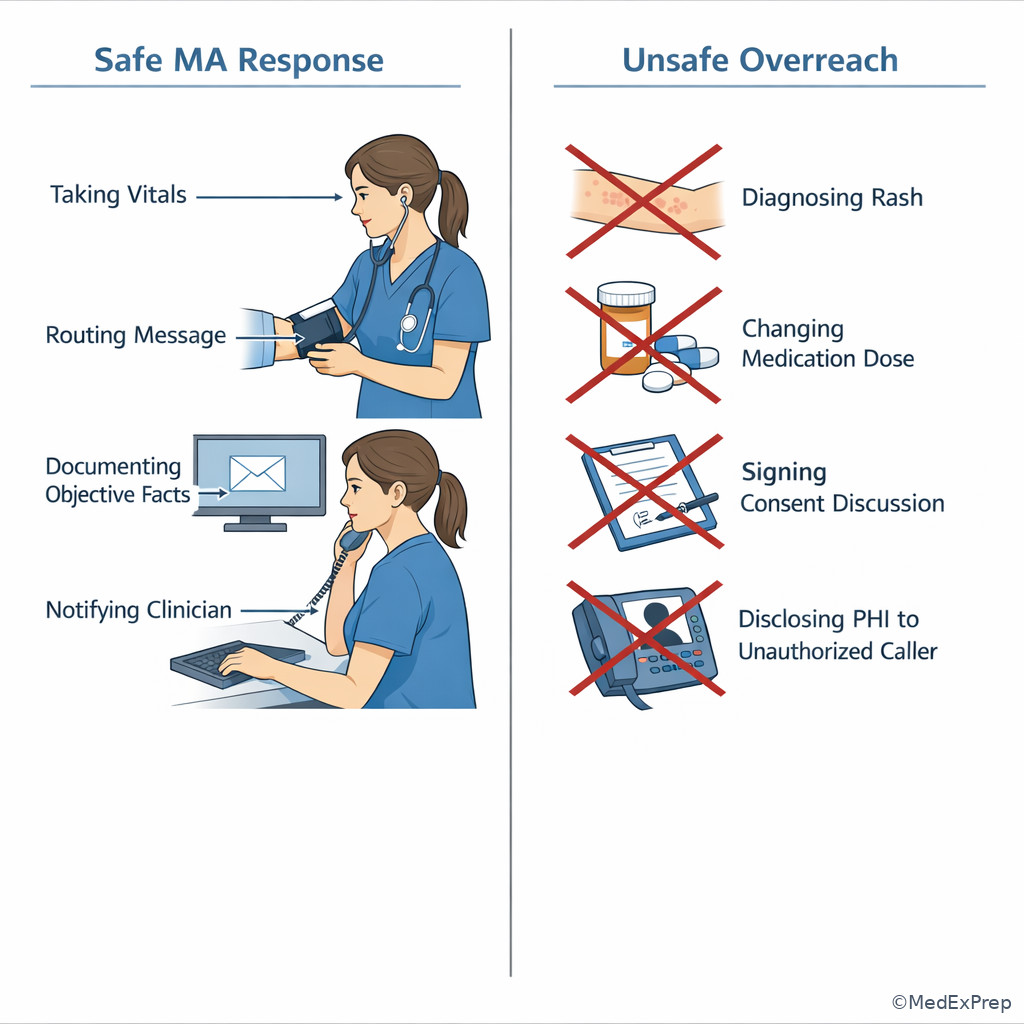
Exam takeaway: Solve boundary questions by matching the task to one of three actions—perform, clarify, or escalate.
B Worked example
A 36-year-old woman with lupus and chronic migraines presents for a urine specimen before a same-day visit. The label printed at the front desk shows the correct last name but the wrong date of birth. She also asks whether her new facial rash is likely an allergic reaction to hydroxychloroquine and requests a note excusing her from work today. The clinic is behind schedule, and the specimen courier arrives in 8 minutes.
Reasoning chain: Identify the tasks: specimen handling, interpretation of a rash, and work-note request. Extract key facts: identifier mismatch is the first pivot clue; rash interpretation is outside role; schedule pressure is noise. Apply rule: stop specimen processing until identifiers are corrected per protocol, do not interpret the rash, and route clinician-level requests appropriately. Eliminate distractors: relabeling from memory to save time, assuring the patient it is probably a drug reaction, or issuing a work note independently. Verify: re-identify the patient using approved identifiers, fix the label per protocol, document the issue if required, and notify the clinician about the rash concern.
C Exam trap
D Checkpoint
Question: A 50-year-old man with hypertension and chronic low back pain asks after rooming, “The provider always says my ECG is fine. Can you just tell me whether today’s tracing looks okay so I can get back to work?” What is the most appropriate next step?
- Tell him the tracing is probably normal if he has no chest pain today
- Compare today’s tracing with the prior one and reassure him if they look similar
- Inform him that you will ensure the clinician reviews the tracing and document the request
- Advise him to delay work only if the machine flags an abnormal rhythm
Answer: C
- A: Tempting because absence of chest pain lowers concern; wrong because this is still ECG interpretation.
- B: Tempting because comparison feels objective; wrong because independent ECG interpretation remains outside role even with prior tracings.
- C: Correct because it preserves role boundaries, closes the communication loop, and ensures review by the clinician.
- D: Tempting because machine flags are part of workflow; wrong because acting on the tracing’s significance is not the MA’s independent decision.
- If the stem asks the MA to decide what a finding means, think escalate.
- True or False: Time pressure can justify bypassing identity verification. False.
- What 4-step framework should you use? Identify, Classify, Act, Verify.
Exam Traps & Differentiators
- Most common wrong answer and why: choosing a medically reasonable action that still requires clinician judgment. It is tempting because it sounds efficient and patient-centered.
- Looks similar but isn't: reinforcing instructions already given by the clinician is not the same as creating new advice tailored to the patient’s new symptom or question.
- Looks similar but isn't: witnessing a signature per policy is not the same as obtaining clinician-level informed consent.
- Looks similar but isn't: obtaining an ECG or specimen is not the same as interpreting it for treatment decisions.
- Looks similar but isn't: routing a refill request is not the same as approving or changing it.
- Looks similar but isn't: documenting a patient report is not the same as diagnosing the cause of that report.
| If the stem says... | Think... | Reject... |
|---|---|---|
| “Can you tell me what this result means?” | Interpretation request → route to clinician | Any answer that translates the result into a diagnosis |
| “Can you just refill what I took last time?” | Prescribing workflow → forward per protocol | Any answer that authorizes or changes medication |
| “The doctor always gives me this injection” | Need current valid order and authorization | Any answer relying only on past treatment history |
| New chest pain, dyspnea, neuro change, or severe abnormal vital sign | Stop routine workflow and escalate | Any answer that finishes rooming first |
| Signature/consent form appears in the workflow | Check whether clinician discussion is required | Any answer where the MA substitutes for the clinician |
| Label mismatch or identifier discrepancy | Safety/identity pivot clue → pause and fix per protocol | Any answer prioritizing speed over verification |
| Confusable pair | Shared features | Single differentiator |
|---|---|---|
| Reinforce education vs give advice | Both involve patient communication | Reinforcement repeats approved instructions; advice creates new management guidance |
| Collect data vs interpret data | Both use clinical information | Collection/documentation is support work; meaning-making for treatment is clinician work |
| Carry out order vs choose order | Both involve treatment workflow | The MA may execute authorized tasks but may not select medication, dose, or plan |
| Witness signature vs obtain consent | Both appear around forms | Clinician explains risks/benefits and alternatives; MA does not replace that duty |
| Clarify uncertainty vs proceed anyway | Both happen in busy workflows | Unclear training/policy/law requires pause before action |
| Document facts vs chart conclusions | Both appear professional in the chart | Only objective, verifiable facts stay within MA documentation boundaries |
Related future traps: in Delegation And Supervision, the exam may test whether a task is delegated correctly even if it seems routine; in Abnormal Findings Escalation, the exam may test whether a symptom or vital sign overrides the original plan. Here, your job is to notice the boundary; there, you will learn the finer workflow after the boundary is crossed.
Algorithm / Approach
- Identify task: What exactly is the MA being asked to do?
- Check for clinician judgment: If the answer requires diagnosis, prescribing, independent interpretation, or consent responsibility, stop there.
- Check authorization: Is there a current valid order or approved protocol, and is the MA trained and policy-permitted?
- Check for pivot clues: abnormal symptoms, urgent vitals, ID mismatch, error, privacy issue, or new advice request.
- Choose the safest path: perform, clarify, or escalate.
- Document objectively: facts, actions taken, who was notified, and relevant timing.
Rapid Review
- Scope boundary → support tasks may be delegated; clinical judgment may not be assumed.
- Refill request → route to clinician; prior medication history does not authorize renewal.
- Abnormal vital sign → measure/document/escalate; do not convert it into a diagnosis.
- Patient asks what a result means → interpretation request, not education reinforcement.
- Existing order from a prior visit → not enough if current authorization or context is missing.
- Consent form in hand → paperwork presence does not transfer clinician consent duty.
- Waived test or specimen task → collection and processing may be within role; treatment decisions from results are not.
- Busy office pressure → never overrules identity verification or scope limits.
- Charting professionally → objective wording beats sophisticated interpretive wording.
- Patient reassurance → safe only if it repeats approved clinician instructions, not personal judgment.
- Standing protocol → still depends on law, training, employer policy, and current applicability.
- Urgent symptom during routine task → routine task stops; escalation becomes the new priority.
- ECG acquisition → obtaining the tracing differs from telling the patient it is normal.
- Boundary question strategy → ask whether the stem wants you to perform work or decide care.
Self-check quiz
1. A 26-year-old woman with allergic rhinitis and acne asks during intake whether her new facial redness “means eczema.” She is otherwise stable and only wants a quick answer before work. What is the most appropriate response by the medical assistant?
- State that eczema is the most likely diagnosis because the rash is itchy
- Tell her it is probably a medication reaction and advise stopping new products
- Document the concern and notify the clinician that she is requesting interpretation of a new finding
- Reassure her that facial redness is common and does not require review
2. A 48-year-old man with hypertension and GERD presents for follow-up. Which task is most appropriate for an entry-level medical assistant to perform independently within routine outpatient workflow when trained and authorized?
- Adjust his antihypertensive dose after today’s reading
- Explain the significance of a new cardiac murmur heard by the provider
- Obtain and document vital signs, then report a markedly abnormal result to the clinician
- Authorize a refill because the medication appears on the active medication list
3. A 59-year-old woman with diabetes and chronic kidney disease arrives for routine follow-up. During rooming, her automated blood pressure is 186/102, and she reports a mild headache but says she “just wants to get the visit done.” The clinic is running behind, and she also asks whether she can skip her fasting labs today. What is the most appropriate next step?
- Document “hypertensive urgency” and ask her to wait quietly until the clinician is free
- Repeat the blood pressure per protocol if appropriate, ensure safety, and notify the clinician promptly
- Advise her to take an extra dose of her blood pressure medication now
- Proceed with routine intake and mention the pressure to the clinician at the end of rooming
4. A 34-year-old man with asthma and obesity calls requesting a refill of his rescue inhaler and asks whether he should double his inhaled steroid until the weekend because he has more wheezing after yard work. He also mentions he lost his insurance card. What is the most appropriate action by the medical assistant?
- Authorize the refill and advise doubling the inhaled steroid because this is a common temporary adjustment
- Route the refill and medication question to the clinician per protocol and document the patient’s reported symptoms
- Tell him to wait until the weekend and call back if symptoms worsen
- Recommend using a family member’s inhaler if the pharmacy delays the refill
5. A 67-year-old woman with osteoarthritis and hypothyroidism presents for a routine injection that she has received many times before. While being seated, she says she developed new chest pressure walking from the parking lot but thinks it is probably indigestion. The syringe has already been prepared under a valid order. What is the most appropriate next step?
- Administer the injection first because the order is valid and then inform the clinician
- Ask her to rest for 10 minutes and complete the injection if the pressure improves
- Stop the routine task, maintain patient safety, and notify the clinician immediately per office protocol
- Document that the pain is likely noncardiac because it occurred after exertion and proceed
6. A 40-year-old woman with lupus, migraine, and recent prednisone use provides a urine specimen before a same-day visit. The printed label has her correct name but an incorrect date of birth. She is in a hurry because the courier is about to leave, and she asks whether her facial swelling means an allergic reaction. What is the most appropriate next step?
- Correct the date of birth on the label from memory, send the specimen, and reassure her that the swelling is probably medication-related
- Hold the specimen process until identifiers are corrected per protocol, avoid interpreting the swelling, and notify the clinician of her concern
- Send the specimen because the name matches, then message the clinician later about the facial swelling
- Discard the specimen immediately without verification and instruct her to collect another sample after the visit
7. A 72-year-old man with coronary artery disease, hyperlipidemia, and chronic back pain comes for an ECG ordered by the provider. After the tracing is obtained, he says, “The machine didn’t beep, so I’m fine, right?” He denies current chest pain but looks anxious and wants to leave before the clinician enters because his ride is waiting. What is the most appropriate response?
- Tell him the tracing is likely normal if the machine did not flag a critical rhythm
- Compare the tracing with the last ECG and reassure him if it looks similar
- Explain that the clinician will review the ECG, ensure the tracing is routed promptly, and document the patient’s request
- Advise him to go home and return only if he develops chest pain
8. A 52-year-old woman with hypertension, anxiety, and a recent urgent care visit arrives for follow-up and hands the medical assistant a consent form for an office procedure scheduled next week. She says the physician explained it too quickly and asks, “Can you tell me the risks again and whether I really need this?” She also requests a medication refill and reports dizziness this morning. What is the most appropriate next step?
- Review the major risks from memory, answer her questions, and route only the refill request to the physician
- Explain that you cannot substitute for the clinician’s consent discussion, document her questions and dizziness, and notify the clinician promptly
- Tell her to sign now so the office can keep the schedule moving and ask the clinician later if needed
- Advise her to postpone the procedure and stop her blood pressure medication until dizziness resolves
Answer key
1.1.1.9 Question 1
Correct answer: C
- A: Tempting because itch and redness can suggest eczema at a surface level. Incorrect for this scenario because naming the diagnosis is independent interpretation. Single stem clue: she asks what the new finding “means.” Source: American Association of Medical Assistants scope principles; CMA role expectations in outpatient workflow.
- B: Tempting because facial redness can reflect irritation or reaction. Incorrect because advising her to stop products is treatment guidance beyond approved reinforcement. Single stem clue: no clinician-approved instruction is given in the stem. Source: AAMA role boundaries; outpatient team-based care standards.
- C: Correct because the MA may document the concern and notify the clinician without diagnosing or advising. This follows the support-versus-judgment rule. Single stem clue: request for interpretation of a new problem. Source: Kinn’s The Medical Assistant; AAMA role and legal/ethical guidance.
- D: Tempting because reassurance feels patient-centered. Incorrect because it minimizes a new complaint and implies interpretation without clinician review. Single stem clue: new facial redness with a direct request for meaning. Source: AAMA role boundaries; ambulatory risk-management practice.
1.1.1.10 Question 2
Correct answer: C
- A: Tempting because the blood pressure reading may indeed affect management. Incorrect because dose adjustment is a treatment decision. Single stem clue: “adjust” signals changing care. Source: AAMA role guidance; Kinn’s The Medical Assistant.
- B: Tempting because patients often ask support staff to explain findings. Incorrect because explaining the significance of a murmur requires interpretation. Single stem clue: “significance” asks for meaning, not data collection. Source: AAMA professional scope principles.
- C: Correct because obtaining and documenting vitals is routine support work, and reporting a markedly abnormal value is the correct escalation step. Single stem clue: collect/document/report sequence. Source: CMA exam role expectations; ambulatory workflow standards.
- D: Tempting because the drug is already listed and follow-up patients commonly need refills. Incorrect because refill authorization remains a clinician-controlled process. Single stem clue: “authorize” signals prescribing workflow. Source: AAMA role boundaries and medication safety guidance.
1.1.1.11 Question 3
Correct answer: B
- A: Tempting because the blood pressure is very high and the label sounds medically sophisticated. Incorrect because the MA should not assign the diagnosis label in the chart; the proper step is objective reassessment and notification. Single stem clue: the item asks for the next step, not the diagnosis label. Source: AAMA scope guidance; objective documentation principles in Kinn’s.
- B: Correct because repeating the reading per protocol, ensuring safety, and promptly notifying the clinician fits role, documentation, and escalation rules. Single stem clue: markedly abnormal BP plus symptom of headache. Source: Ambulatory vital-sign workflow standards; AAMA role expectations.
- C: Tempting because severe BP elevations often prompt medication changes. Incorrect because advising an extra dose is prescribing/treatment direction. Single stem clue: the action changes medication use. Source: Medication safety and role-boundary standards.
- D: Tempting because complete intake helps efficiency. Incorrect because the severe abnormal result is the pivot clue that changes priority from routine rooming to prompt escalation. Single stem clue: 186/102 with symptom. Source: AAMA escalation principles; outpatient safety workflow.
1.1.1.12 Question 4
Correct answer: B
- A: Tempting because asthma plans sometimes include temporary adjustments, and refill requests are common. Incorrect because both refill authorization and dose escalation require clinician-directed workflow. Single stem clue: he asks whether he should double the inhaled steroid. Source: AAMA role boundaries; medication safety principles.
- B: Correct because routing the refill and medication question while documenting the reported wheezing stays within role and supports timely clinician action. Single stem clue: medication question plus symptoms. Source: CMA role expectations; outpatient message handling standards.
- C: Tempting because some mild exacerbations are monitored. Incorrect because telling him to wait delays clinician review of both symptoms and refill need. Single stem clue: active wheezing question in a patient without medication access. Source: Ambulatory escalation principles.
- D: Tempting because it tries to prevent undertreatment. Incorrect because recommending another person’s medication is unsafe and outside any acceptable role. Single stem clue: suggestion to use non-prescribed medication. Source: Medication safety and legal role standards.
1.1.1.13 Question 5
Correct answer: C
- A: Tempting because there is a valid order and the injection is routine for this patient. Incorrect because new chest pressure is the single pivot clue that makes the original workflow unsafe to continue. Single stem clue: exertional chest pressure. Source: AAMA escalation expectations; ambulatory urgent symptom workflow.
- B: Tempting because rest may reduce symptoms and the patient suggests indigestion. Incorrect because the MA must not independently observe-and-decide when a potentially urgent symptom appears. Single stem clue: new chest pressure before treatment. Source: Outpatient safety standards.
- C: Correct because stopping the routine task, maintaining safety, and notifying the clinician immediately is the most appropriate response to the new red flag. Single stem clue: routine task plus acute symptom. Source: CMA role and escalation principles.
- D: Tempting because patients often misattribute symptoms. Incorrect because labeling pain “noncardiac” is independent interpretation. Single stem clue: the patient asks for no interpretation, but the answer option creates one. Source: AAMA role boundaries.
1.1.1.14 Question 6
Correct answer: B
- A: Tempting because it seems efficient and addresses both problems quickly. Incorrect because correcting identifiers from memory bypasses verification, and reassuring about swelling is interpretation. Single stem clue: incorrect date of birth on the printed label. Source: Patient identification and specimen safety standards; AAMA scope principles.
- B: Correct because identifier mismatch requires stopping specimen processing until corrected per protocol, and the swelling question requires clinician notification rather than interpretation. Single stem clue: two separate boundary problems: ID mismatch and interpretation request. Source: Specimen labeling safety guidance; AAMA role boundaries.
- C: Tempting because the patient name matches and time pressure is real. Incorrect because one correct identifier is not enough when the printed date of birth is wrong; delaying the swelling concern also weakens safety. Single stem clue: wrong DOB on label. Source: Two-identifier verification standards.
- D: Tempting because discarding mismatched material feels cautious. Incorrect because the better step is to hold and resolve the mismatch per protocol rather than automatically discard without verification. Single stem clue: the specimen may still be usable once proper identity correction occurs. Source: Specimen integrity and labeling workflow guidance.
1.1.1.15 Question 7
Correct answer: C
- A: Tempting because machine alerts can suggest urgency level. Incorrect because absence of a machine alert does not authorize the MA to interpret the ECG. Single stem clue: patient asks whether the tracing is “fine.” Source: AAMA scope limits; ECG workflow basics.
- B: Tempting because comparison with prior tracings seems objective and practical. Incorrect because reading similarity still constitutes interpretation for patient advice. Single stem clue: reassurance based on tracing review. Source: Role boundary standards for diagnostic support tasks.
- C: Correct because the MA may ensure proper routing, communicate that the clinician will review the tracing, and document the patient’s question. Single stem clue: acquired test needing clinician review. Source: Diagnostic support workflow and AAMA role guidance.
- D: Tempting because return precautions are common in practice. Incorrect because telling him when to seek care is management advice not based on clinician instruction in the stem. Single stem clue: no clinician-approved discharge guidance exists here. Source: Scope and patient-education reinforcement rules.
1.1.1.16 Question 8
Correct answer: B
- A: Tempting because patients deserve clear explanations and the MA may know the common risks. Incorrect because repeating risks from memory as a substitute for the clinician’s consent discussion crosses the consent boundary; it also ignores the dizziness symptom. Single stem clue: she says the physician explained it too quickly and asks whether she really needs it. Source: Consent and authorization role standards; AAMA scope guidance.
- B: Correct because the MA should not replace the clinician’s consent discussion; documenting her questions and dizziness and notifying the clinician addresses both the legal and clinical issues safely. Single stem clue: consent clarification request plus symptom report. Source: AAMA professional/legal guidance; outpatient escalation standards.
- C: Tempting because schedule pressure often pushes paperwork forward. Incorrect because encouraging signature before adequate clinician discussion undermines valid consent and ignores the symptom concern. Single stem clue: patient explicitly states her questions were not answered. Source: Consent workflow principles.
- D: Tempting because dizziness may affect procedure timing and blood pressure medication can contribute to symptoms. Incorrect because postponing the procedure and stopping medication are both treatment decisions outside role. Single stem clue: the option changes clinical management. Source: Medication safety and role-boundary guidance.
Keep going with the full CMA (AAMA) Prep Course (CMA)
You just studied the way members do, in the same lesson interface. Full access unlocks every lesson, the question bank and flashcards for a full year.
One payment · 1 year of access · No auto-renewal