1.1.1 - BCEMP Blueprint Domains
BCEMP Blueprint Domains
- 1 BCEMP Blueprint Domains —
- 2 What you'll learn —
- 3 Blueprint mapping —
- 4 Why it matters —
- 5 Key Terms & Must-Know Facts —
- 6 Key terms —
- 7 Must-know facts —
- 8 Core content —
- 9 1.1.1.1 Foundational domain map: what the blueprint is really organizing —
- 10 1.1.1.2 Foundational weighting and study allocation: what deserves the most repetitions —
- 11 1.1.1.3 Application: translating broad blueprint wording into pharmacist subskills —
- 12 1.1.1.4 Application: domain-task thinking to classify stems quickly —
- 13 1.1.1.5 Integration: distinguishing patient care, practice management, and education/resea —
- 14 Exam Traps & Differentiators —
- 15 Looks similar but isn't —
Why it matters
- The exam tests broad emergency medicine pharmacy practice, not isolated drug facts; blueprint awareness tells you what the question is really asking you to do.
- Patient Care/Management dominates the exam, so efficient preparation starts with recognizing medication selection, dose, route, timing, monitoring, and safety tasks.
- Lower-emphasis domains still generate points; operational safety, education, and literature interpretation often appear as deceptively simple stems.
- Blueprint thinking reduces distractor pull: if the stem asks for the pharmacist’s best action, eliminate choices that require physician-only procedures or non-medication decisions.
Exam takeaway: Classify the stem by domain first, then choose the medication-related action within pharmacist scope.
flowchart TD
A[BCEMP stem] --> B{Which domain?}
B --> C[Patient Care / Management]
B --> D[Practice Management]
B --> E[Education / Research]
C --> C1[Recommend drug or dose]
C --> C2[Verify safety]
C --> C3[Monitor response]
C --> C4[Escalate urgent issue]
D --> D1[Medication safety]
D --> D2[Operations and policy]
D --> D3[Preparedness and shortages]
E --> E1[Interpret evidence]
E --> E2[Teach patient or team]
E --> E3[Apply guideline]
Use this as your first pass on every stem. See Fig 1.
Key Terms & Must-Know Facts
1.1.1.1 Key terms
- Blueprint domain: The broad tested category used to organize exam content.
- Patient Care/Management: Medication-related assessment, selection, optimization, verification, monitoring, and urgent support.
- Practice Management: Safety systems, policy, logistics, inventory, operations, quality, and workflow issues in emergency care.
- Education/Research: Guideline use, evidence appraisal, communication, and teaching.
- Subskill: A teachable pharmacist action extracted from broad blueprint wording.
- Stem classification: Rapid identification of what type of task the question is testing.
- Medication-related action: Recommend, verify, prepare, clarify, monitor, reconcile, or escalate.
- Out-of-role signal: Language that asks the pharmacist to do a non-pharmacist task.
- Distractor: A tempting but incorrect option that fits a different task or domain.
- Safety verification: Check of dose, route, contraindication, interaction, timing, access, or compatibility.
- Transitions of care: Medication continuity planning at ED arrival, admission, transfer, or discharge.
- Guideline application: Using authoritative recommendations to select the best medication-related action.
1.1.1.2 Must-know facts
- Patient Care/Management is the dominant exam weight.
- Broad blueprint phrases must be translated into specific pharmacist subskills.
- The best answer is usually the best medication-related action, not the full medical plan.
- Practice Management questions often test safety, logistics, policy, and preparedness.
- Education/Research is not filler; it commonly appears through guideline use, counseling, or evidence interpretation.
- A strong BCEMP test-taker first identifies the task, then the drug issue.
- Answer choices that require performing procedures or making diagnosis-only decisions are often wrong for pharmacist-scope stems.
- Board-style stems may include distracting vitals or labs even when the true task is operational or safety-based.
- When blueprint wording is broad, think: What would the ED pharmacist notice, say, monitor, or clarify?
| Blueprint term | What it usually means on the exam | Typical pharmacist action |
|---|---|---|
| Patient Care/Management | Urgent pharmacotherapy, safety checks, monitoring, disposition medication planning | Recommend/verify/monitor |
| Practice Management | Medication-use systems, policies, shortages, quality improvement, preparedness | Clarify/standardize/prevent error |
| Education/Research | Counseling, staff education, literature appraisal, guideline interpretation | Teach/appraise/apply evidence |
| Broad objective | High-level wording not tied to one specific disease state | Translate into subskills |
| Subskill | Concrete testable task under a broad objective | Classify the stem |
Core content
1.1.1.3 Foundational domain map: what the blueprint is really organizing
A Explanation
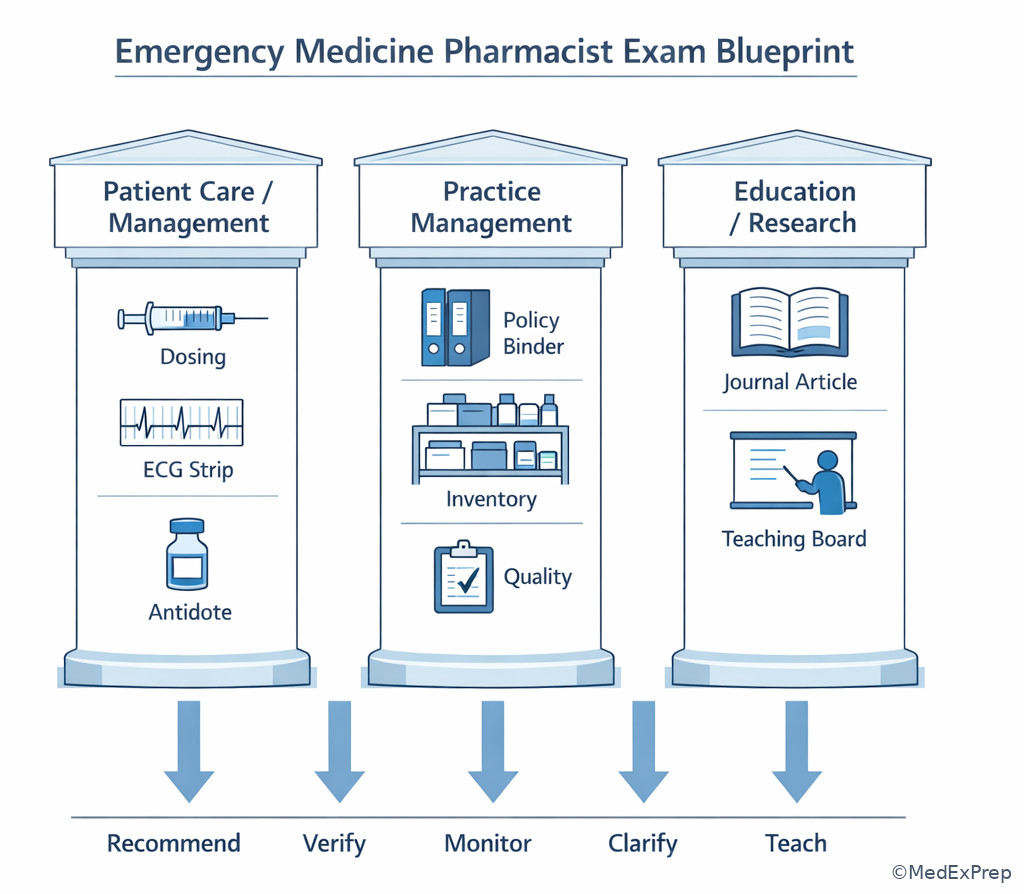
The first decision conflict on this topic is content bucket vs testable task. Many candidates memorize domain names but cannot use them under exam pressure. The rule that resolves the conflict is simple: a blueprint domain is only useful if you can convert it into a pharmacist action. Patient Care/Management means the stem is most likely asking what medication to choose, how to dose it, whether an order is safe, what to monitor, or when to escalate. Practice Management means the stem is about safe medication-use systems, policy, standardization, shortage planning, inventory, or quality. Education/Research means the question turns on evidence interpretation, guideline application, or teaching communication.
WHY THIS IS TESTED: the exam often hides a straightforward medication-use task inside broad wording. Candidates lose points when they overread the stem as a disease-diagnosis question rather than a pharmacist-scope decision. The choose-vs-reject rule is: choose the answer that best matches the blueprint domain and stays within the emergency pharmacist role; reject the option that sounds clinically decisive but requires non-pharmacist authority or ignores the medication-related task. See Fig 2.
Exam takeaway: Translate every blueprint label into a pharmacist action before evaluating answer choices.
Exam takeaway: A visual domain map helps you see how patient care, operations, and evidence questions differ in what action they demand.
B Worked example
A 67-year-old man with heart failure, stage 3 CKD, and atrial fibrillation presents with septic shock. The team asks the ED pharmacist to review an order set containing norepinephrine infusion, vancomycin loading dose, and stress-ulcer prophylaxis. A potassium of 3.2 mEq/L and a remote history of gout are also listed. The question asks which BCEMP domain is primarily being tested if the best answer focuses on recommending the safest initial vasoactive and anti-infective strategy.
Reasoning chain: Identify task: the stem is asking for the pharmacist’s medication recommendation in an acutely ill patient. Extract key facts: septic shock, urgent drug selection, dose/safety review, multiple comorbidities. Apply rule: urgent pharmacotherapy selection and verification fall under Patient Care/Management. Eliminate distractors: Practice Management would fit a drug shortage or standardization question; Education/Research would fit appraisal of sepsis data or staff teaching. Verify: the distracting potassium and gout history do not shift the domain. The governing feature is the medication-related bedside decision.
C Exam trap
D Checkpoint
Question: A stem asks the ED pharmacist for the most appropriate next step after identifying an unsafe alteplase dose in a patient with acute ischemic stroke, including immediate clarification with the team and dose correction. Which blueprint domain is most directly being tested?
- Patient Care/Management — Tempting because it includes bedside action; correct because this is a time-sensitive medication verification and safety intervention for an individual patient.
- Practice Management — Tempting because medication safety systems belong there; wrong here because the task is patient-specific urgent dose correction, not system redesign.
- Education/Research — Tempting because stroke protocols rely on guideline knowledge; wrong because the stem is not asking for evidence appraisal or teaching.
- Inventory/Preparedness only — Tempting if you focus on drug availability; wrong because the issue is a live dose-verification decision, not stock management.
1.1.1.4 Foundational weighting and study allocation: what deserves the most repetitions
A Explanation
The next decision conflict is study breadth vs study proportion. BCEMP candidates must cover all domains, but not equally. The rule that resolves this is: allocate the most repetitions to Patient Care/Management while preserving deliberate review time for Practice Management and Education/Research. “Dominant exam weight” does not mean “the only content that matters.” It means most stems will still ask you to make or verify medication decisions in emergency care, so your prep must repeatedly rehearse acute drug selection, route, timing, adverse effect monitoring, reversal logic, renal/hepatic adjustments, transitions of care, and safety checks.
Practice Management and Education/Research still deserve explicit review because these domains often generate points through overlooked material: high-risk order verification, shortage contingencies, policy-driven safety constraints, patient/team counseling, and literature application. Candidates often underperform here because they study only disease states. WHY THIS IS TESTED: the exam rewards balanced professionals, not narrow memorization. Choose a study plan that mirrors weighting; reject a plan that ignores low-frequency domains completely. See Fig 3.
Exam takeaway: Heavier domains deserve more repetitions, but lower-weight domains still require explicit review blocks.
Exam takeaway: Build your schedule around dominant patient care content without zeroing out practice management or evidence topics.
flowchart LR
A[Weekly study block] --> B[Patient Care / Management]
A --> C[Practice Management]
A --> D[Education / Research]
B --> B1[Acute pharmacotherapy]
B --> B2[Dosing and monitoring]
B --> B3[Toxicology and reversal]
C --> C1[Safety and policy]
C --> C2[Inventory and shortages]
C --> C3[Quality improvement]
D --> D1[Guidelines]
D --> D2[Evidence appraisal]
D --> D3[Patient and team teaching]
Use Fig 4 when building your review calendar.
B Worked example
A PGY2 resident is six weeks from the exam and has completed 400 flashcards on vasopressors, anticoagulant reversal, and status epilepticus but has not reviewed medication safety, drug shortage response, or literature interpretation. She asks how to rebalance. She also mentions a distracting concern that she “probably won’t be asked much” about practice standards because the ED is mostly clinical.
Reasoning chain: Identify task: this is blueprint-based study allocation. Extract key facts: strong Patient Care/Management preparation, neglected Practice Management and Education/Research. Apply rule: dominant weight means more emphasis, not exclusive emphasis. Eliminate extremes: do not advise equal time to every domain; do not advise ignoring smaller domains. Verify: the best recommendation is to preserve her patient care-heavy plan while adding explicit scheduled blocks for operations, quality, medication safety, counseling, and evidence/guideline interpretation.
C Exam trap
D Checkpoint
Question: Which study strategy best reflects the BCEMP blueprint for a foundational learner?
- Spend nearly all time on disease-state pharmacotherapy and ignore operations until the final week — Tempting because Patient Care/Management is dominant; wrong because it creates avoidable blind spots in explicitly tested domains.
- Divide time equally across all domains regardless of weight — Tempting because it seems fair; wrong because it underrepresents the dominant patient care workload.
- Emphasize Patient Care/Management while scheduling recurring review blocks for Practice Management and Education/Research — Tempting because it sounds balanced; correct because it mirrors weighting without neglecting lower-frequency topics.
- Study only calculations first because math appears everywhere — Tempting because calculations feel concrete; wrong because the blueprint is broader than calculations.
- The dominant BCEMP domain is Patient Care/Management.
- True or False: Lower-weight domains can be ignored safely. False.
- Name the three broad buckets: Patient Care/Management, Practice Management, Education/Research.
1.1.1.5 Application: translating broad blueprint wording into pharmacist subskills
A Explanation
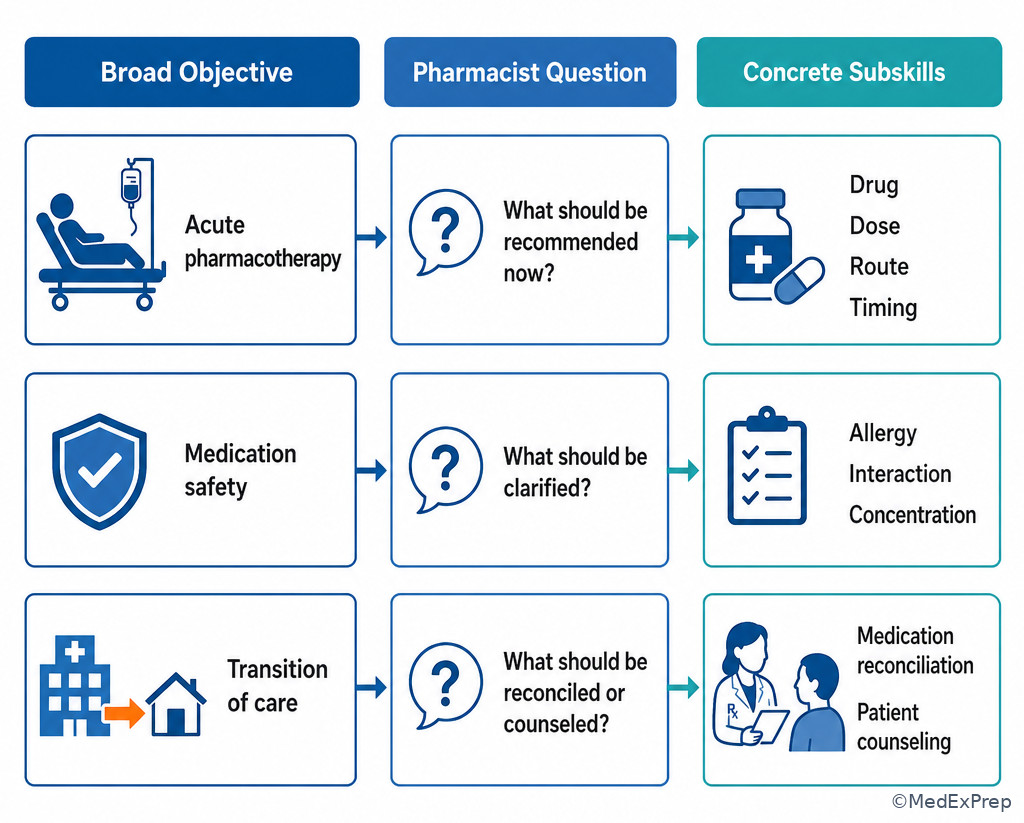
Now the decision conflict becomes general objective vs concrete action. Public blueprint language is often broad by design. On the exam, however, questions are answerable only when you convert the broad objective into one or more specific subskills. For example, a broad statement about caring for acutely ill patients can translate into subskills such as selecting the initial vasopressor, verifying a thrombolytic dose, identifying an antidote contraindication, recommending renal dose adjustment, detecting a harmful interaction, preparing a weight-based infusion, or planning monitoring after ED disposition. Practice Management wording can map to subskills such as standardizing concentrations, responding to shortages, reducing alert fatigue, or identifying look-alike/sound-alike risk. Education/Research can map to subskills such as choosing the guideline-concordant recommendation, counseling on naloxone use at discharge, or identifying the most practice-changing limitation in a study.
WHY THIS IS TESTED: stems rarely quote the blueprint. They operationalize it. The rule is: rewrite the broad objective as “What would the emergency pharmacist do next?” Choose answers that correspond to a real pharmacist behavior; reject answers that remain abstract or drift into physician-only territory. See Fig 5.
Exam takeaway: Convert abstract blueprint language into a specific pharmacist task before solving the stem.
Exam takeaway: A visual conversion from broad objective to pharmacist task reduces abstract blueprint wording to answerable actions.
B Worked example
A 32-year-old woman with epilepsy, obesity, and postpartum status presents after a generalized seizure. She is receiving levetiracetam 1500 mg IV, and the team asks the pharmacist to verify whether a fosphenytoin backup order is appropriate if seizures recur. The stem also includes a distracting mild AST elevation and notes that the patient forgot breakfast. The question asks which derived subskill is being tested under a broad patient care objective.
Reasoning chain: Identify task: this is not merely “neurologic emergency care”; it is verification of second-line antiseizure therapy appropriateness. Extract key facts: medication backup order, acute setting, patient-specific review, safety decision. Apply rule: convert broad objective to pharmacist subskill — recommend/verify medication choice and monitoring in a time-sensitive neurologic emergency. Eliminate distractors: counseling alone would fit discharge planning; literature appraisal is not asked; procedural seizure diagnosis is outside task. Verify: the distracting AST and missed meal do not change the core subskill.
C Exam trap
D Checkpoint
Question: A blueprint objective states “support care of acutely ill patients.” Which derived subskill is the best exam-ready translation for an ED pharmacist?
- Interpret all diagnostic imaging independently before recommending therapy — Tempting because it sounds comprehensive; wrong because it exceeds pharmacist scope.
- Select, dose, verify, and monitor emergency medications while escalating non-pharmacist decisions — Tempting because it is action-focused; correct because it translates the objective into real ED pharmacist tasks.
- Determine the final medical diagnosis and disposition without team input — Tempting because diagnosis guides therapy; wrong because the blueprint is pharmacist-centered.
- Memorize disease definitions without linking them to action — Tempting for foundational study; wrong because it does not produce testable pharmacist performance.
1.1.1.6 Application: domain-task thinking to classify stems quickly
A Explanation
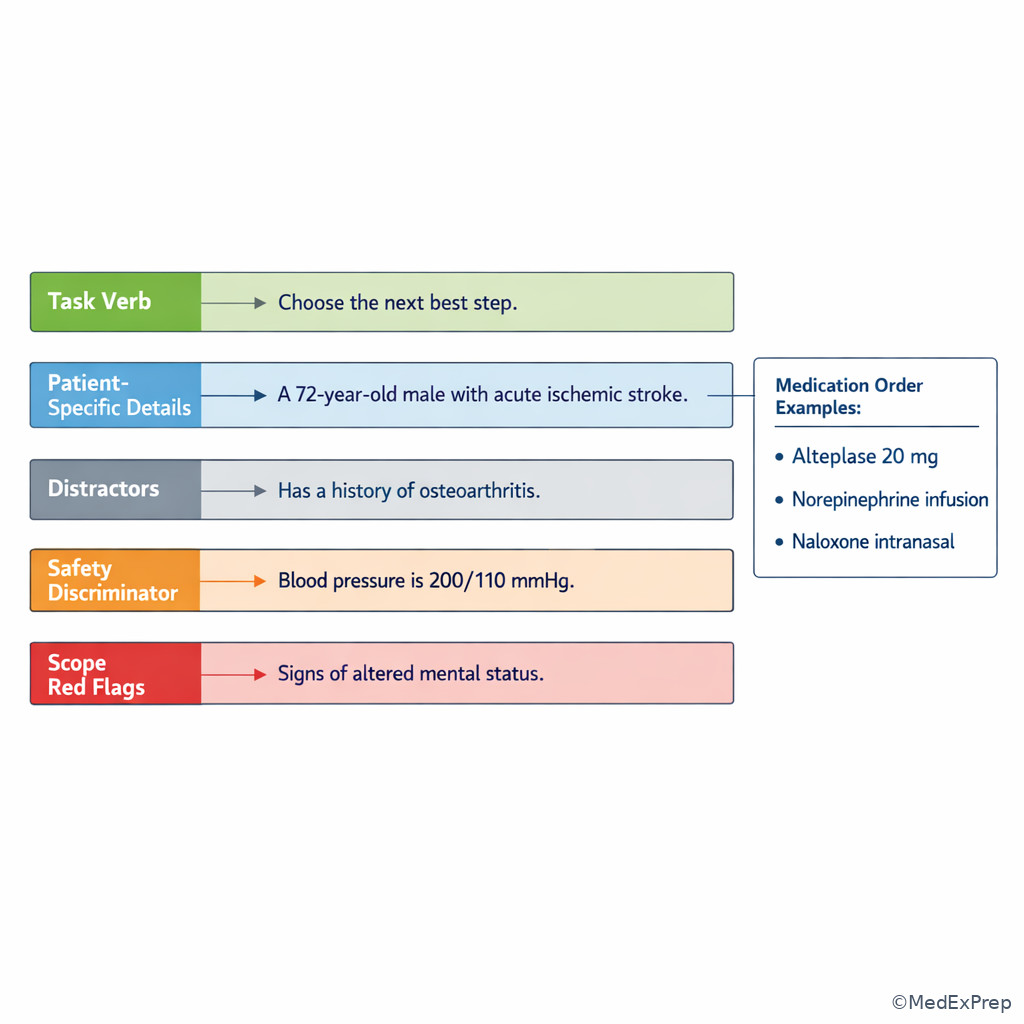
At exam speed, you do not have time for lengthy reflection. The decision conflict is read every detail first vs classify early. The resolving rule is: classify the stem by domain-task before you process all the noise. Ask three questions in order: (1) What is the pharmacist being asked to do? (2) Is the problem patient-specific, system-based, or evidence/communication-based? (3) What single safety or scope rule decides between the top two options? This approach prevents common BCEMP errors, especially in stems loaded with comorbidities, one abnormal lab, and a tempting clue that points to a different but related topic.
Board-style stems often include details that are true but secondary. A potassium level, remote allergy, or chronic home medication may matter later, but not before you know the task category. WHY THIS IS TESTED: the exam rewards prioritization under pressure. Choose early classification because it reduces cognitive load; reject detail-first reading when it causes you to answer the wrong question. See Fig 6.
Exam takeaway: Identify the pharmacist task first, then sort patient-specific, systems, or evidence details around that task.
Exam takeaway: Visual triage of task verb, domain, and single discriminator helps you avoid noise-driven errors.
B Worked example
A 74-year-old woman with COPD, hypertension, and chronic warfarin therapy presents after a fall with intracranial hemorrhage concern. The team is preparing imaging, and the pharmacist is asked to identify the most appropriate medication-related action immediately. Her INR is 3.4, serum sodium is 132 mEq/L, and she reports taking ibuprofen for arthritis. One option asks to recommend prothrombin complex concentrate and IV vitamin K; another asks to review the CT personally before advising reversal.
Reasoning chain: Identify task: immediate medication-related action. Extract key facts: warfarin-associated bleed concern, urgent reversal framing, pharmacist asked for medication support. Apply rule: classify as Patient Care/Management with a reversal/safety subskill. Eliminate distractors: reviewing CT personally is an out-of-scope signal; sodium and ibuprofen are distracting details. Verify: recommending evidence-based reversal and escalation to the treating team fits both domain and role.
C Exam trap
D Checkpoint
Question: Which first step best improves speed and accuracy on BCEMP stems?
- Memorize every lab value before deciding what the stem wants — Tempting because details feel protective; wrong because you may answer the wrong task.
- Find the pharmacist action verb and classify the domain-task before analyzing the noise — Tempting because it is efficient; correct because it aligns the question with the tested subskill.
- Choose the most aggressive intervention because emergency care is high acuity — Tempting in critical care contexts; wrong because scope and safety still control.
- Default to policy questions when order sets are mentioned — Tempting because order sets sound operational; wrong because many order-set stems are still patient-specific medication decisions.
- Fill in the blank: The first thing to identify in a stem is the task verb.
- True or False: Mention of an order set always means Practice Management. False.
- One-liner: If the answer requires primary imaging interpretation, think out of pharmacist scope.
1.1.1.7 Integration: distinguishing patient care, practice management, and education/research in close-call stems
A Explanation
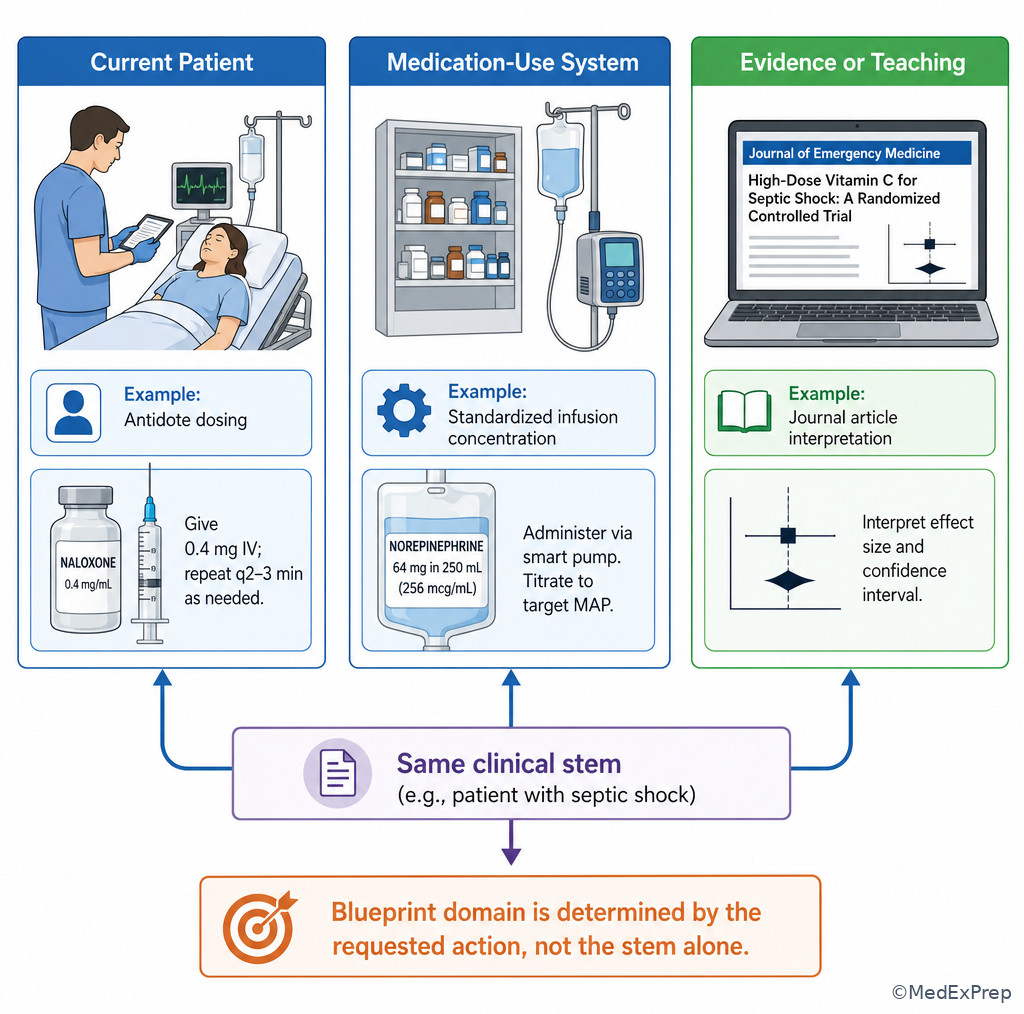
The final foundational integration skill is handling close-call stems that contain features from multiple domains. A single question may mention a patient, a protocol, and a guideline citation. The rule that resolves the conflict is: ask what the answer must change right now. If the answer changes this patient’s drug therapy or safety check now, it is Patient Care/Management. If it changes the system, stock, workflow, standardization, or error-prevention process more than the current patient, it is Practice Management. If it changes understanding, interpretation, counseling, or evidence-based recommendation framing, it is Education/Research.
This distinction matters because distractors are often domain-shifted. A good operational fix may be true in general but wrong if the question asks what to do for the patient in front of you. Likewise, a bedside recommendation may be clinically sound but wrong if the stem asks for the best quality-improvement response to repeated dosing errors across multiple shifts. WHY THIS IS TESTED: BCEMP practice is interdisciplinary and systems-aware, so the exam expects you to separate immediate patient action from process redesign and educational response.
Exam takeaway: Distinguish whether the answer changes the current patient, the department workflow, or the team's understanding.
B Worked example
An ED has had three recent delays in administering four-factor PCC for warfarin-associated bleeding. A current patient with suspected intracranial hemorrhage arrives, and the pharmacist is asked two separate questions during the same case: first, what immediate reversal regimen to recommend; second, what department-level intervention would most reduce future delays. The stem adds distracting details about a mildly elevated lactate and a pending type and screen.
Reasoning chain: Identify task: there are actually two different tasks. Extract key facts: immediate bedside reversal for the current patient; recurring operational delay across multiple cases. Apply rule: the first maps to Patient Care/Management, the second to Practice Management. Eliminate distractors: a literature journal club on reversal data would be Education/Research and may be useful, but it is not the strongest process fix. Verify: one case can touch multiple domains, but each question still has one primary tested task.
C Exam trap
D Checkpoint
Question: A stem asks which intervention would most reduce recurrent smart-pump programming errors with norepinephrine infusions across multiple ED shifts. Which blueprint domain is primary?
- Patient Care/Management — Tempting because norepinephrine is a bedside drug; wrong because the stem focuses on recurrent system-wide error prevention.
- Practice Management — Tempting because it emphasizes workflow, standardization, and medication safety; correct because the target is system redesign.
- Education/Research — Tempting because staff education may be part of the fix; wrong because the primary task is process improvement, not evidence interpretation.
- Transitions of care — Tempting if you think about handoffs; wrong because infusion programming errors are an operational safety issue here.
Exam Traps & Differentiators
- Most common wrong answer and why: picking a broadly true clinical statement instead of the specific pharmacist task. It is tempting because the statement is medically correct; it fails because it does not answer what the pharmacist should recommend, verify, prepare, monitor, or clarify.
- Domain shift trap: choosing Practice Management because the stem mentions an order set or protocol. The eliminating clue is whether the question is about the current patient’s medication decision.
- Scope trap: choosing an answer that asks the pharmacist to interpret imaging independently, perform a procedure, or make the final diagnosis. The eliminating clue is role language outside pharmacist scope.
- Weight trap: ignoring smaller domains during preparation. The eliminating clue is that BCEMP explicitly includes operations, quality, education, and evidence use.
- Noise trap: anchoring on a lab abnormality that is not the tested discriminator. The eliminating clue is the task verb, not the loudest detail.
1.1.1.8 Looks similar but isn't
| If the stem focuses on... | Think... | Not usually... | Discriminator |
|---|---|---|---|
| Immediate patient-specific drug choice, dose, route, or reversal | Patient Care/Management | Practice Management | Current patient action |
| Repeated medication errors across shifts or system redesign | Practice Management | Patient Care/Management | Workflow-level fix |
| Guideline interpretation, evidence quality, or staff/patient teaching | Education/Research | Pure bedside action | Understanding/communication |
| Medication reconciliation at ED discharge or transition | Patient Care/Management | Only operations | Patient-specific continuity |
| Drug shortage contingency planning | Practice Management | Education/Research | Operational readiness |
| New study changes use of thrombolytics or reversal agents | Education/Research | Only policy | Evidence application |
1.1.1.9 If the stem says ..., think ...
- “most appropriate medication-related action now” → think Patient Care/Management.
- “across multiple recent cases” → think Practice Management.
- “best way to educate/counsel/appraise” → think Education/Research.
- “clarify unsafe order before dispensing/preparing” → think patient-specific safety task under Patient Care/Management.
- “standardize concentrations / reduce recurring errors” → think Practice Management.
- “apply guideline findings to the current recommendation” → think Education/Research feeding back into practice.
| Common confusable pair | Why they blur together | Single clue that separates them |
|---|---|---|
| Bedside order verification vs medication-use policy | Both mention safety and orders | One patient now vs recurring system fix |
| Guideline-based recommendation vs research appraisal | Both involve literature | Apply guidance now vs critique evidence quality |
| Counseling at discharge vs staff education program | Both are teaching | Individual patient vs department-level education |
| Scope-appropriate escalation vs independent diagnosis | Both sound decisive | Pharmacist supports medication decisions, not final diagnosis |
Tables
| Domain | High-yield stem cues | Likely answer type | Close-call distractor |
|---|---|---|---|
| Patient Care/Management | acute, immediate, dose, route, reversal, verify, monitor, contraindication | Drug recommendation or safety intervention | System policy answer |
| Practice Management | recurrent errors, workflow, standardization, shortage, preparedness, policy | Process redesign or risk reduction strategy | Patient-specific bedside answer |
| Education/Research | guideline, evidence, counsel, educate, appraise, study design | Teaching point or evidence-based interpretation | Operational fix answer |
| Broad blueprint wording | Exam-ready pharmacist subskill | Example from EM practice |
|---|---|---|
| Manage acutely ill patients | Select and dose urgent therapy | Choose norepinephrine initial strategy in septic shock |
| Ensure medication safety | Detect contraindication or dose error | Clarify incorrect alteplase dose before administration |
| Support transitions of care | Reconcile and counsel high-risk discharge meds | Naloxone and opioid discharge planning |
| Contribute to operations | Standardize process to reduce error | Smart-pump library update for vasopressors |
| Apply evidence | Use guideline/study to support recommendation | Select recommended antidote strategy based on current guidance |
| Educate patients and team | Deliver focused medication teaching | ED discharge counseling on anticoagulant resumption questions |
| Observed stem feature | Correct interpretation | Why learners miss it |
|---|---|---|
| Order set is mentioned | May still be patient care if the action is patient-specific verification | Order sets sound operational |
| Guideline is mentioned in bedside case | Still may be patient care if used to support immediate therapy | Guidelines trigger “research” reflex |
| Several recent cases are cited | Likely practice management or quality improvement | Clinical details distract from system focus |
| Question asks what to say to patient/team | May be education if communication is the tested task | Learners overfocus on disease facts |
| One tempting option requires independent procedural authority | Likely wrong on pharmacist-scope grounds | It sounds decisive and high acuity |
Algorithm / Approach
Exam takeaway: The fastest reliable route is task verb → domain → subskill → scope check → best action.
flowchart TD
A[Read stem] --> B[Find task verb]
B --> C{Primary target?}
C --> D[Current patient]
C --> E[System or workflow]
C --> F[Evidence or teaching]
D --> G[Patient Care / Management]
E --> H[Practice Management]
F --> I[Education / Research]
G --> J[Translate to drug subskill]
H --> J
I --> J
J --> K{Within pharmacist scope?}
K -->|Yes| L[Choose best action]
K -->|No| M[Reject option]
Rapid Review
- Patient Care/Management → current-patient medication decision beats protocol language.
- Practice Management → repeated error across cases points to system redesign.
- Education/Research → communication or evidence interpretation is the discriminator.
- Order set mention → not enough alone to label Practice Management.
- Guideline mention → may still support a bedside patient-care answer.
- Out-of-scope option → often a strong distractor because it sounds decisive.
- Broad objective → rewrite as recommend/verify/prepare/monitor/clarify.
- Dominant weight → study more, not exclusively, from that domain.
- Close-call stems → ask what the answer changes: patient, system, or understanding.
- Noise detail → ignore until after task classification.
- Discharge counseling → usually patient care unless the stem asks about education program design.
- Quality-improvement language → think Practice Management even if drugs are named.
- Primary imaging/procedure language → reject as pharmacist answer unless the role is explicitly collaborative and medication-focused.
Self-check quiz
1. A 58-year-old man with septic shock, diabetes, and CKD has norepinephrine 8 mg in 250 mL ordered and broad-spectrum antibiotics pending. The team asks the ED pharmacist for the most appropriate medication-related action now. Which blueprint domain is primary?
- Patient Care/Management
- Practice Management
- Education/Research
- Inventory/Preparedness
2. An ED pharmacist reviews several cases with repeated delays in stocking intranasal naloxone kits for discharge after opioid overdose. A patient with COPD and OUD is being discharged on buprenorphine/naloxone, but the question asks which domain is tested by fixing the naloxone distribution workflow across shifts. Which is the best answer?
- Patient Care/Management
- Practice Management
- Education/Research
- Toxicology only
3. A 71-year-old woman with atrial fibrillation, hypertension, and prior stroke presents with suspected ischemic stroke. Alteplase 90 mg IV is ordered for a body weight of 72 kg. Serum glucose is 152 mg/dL, and she also takes sertraline. As the ED pharmacist, what is the most appropriate first action for this stem classification exercise?
- Classify it as Education/Research because alteplase use depends on guidelines
- Classify it as Practice Management because a dose-verification issue involves medication safety
- Classify it as Patient Care/Management because the immediate task is patient-specific dose clarification
- Classify it as operations because the product requires preparation workflow
4. A 45-year-old man with alcohol use disorder and cirrhosis presents after acetaminophen ingestion. NAC 150 mg/kg IV loading is started, and the toxicology fellow asks the pharmacist to summarize the guideline-supported role of acetaminophen nomogram timing for the team. The question asks which blueprint domain is most directly emphasized by that request. Which is the best answer?
- Patient Care/Management
- Practice Management
- Education/Research
- Inventory/Preparedness
5. A 29-year-old postpartum woman with migraine and asthma is in the ED observation unit after anaphylaxis. The pharmacist is asked to create a counseling plan for epinephrine auto-injector use at discharge while also reconciling newly prescribed medications. The stem asks specifically about the counseling task. Which blueprint domain is primary?
- Practice Management
- Education/Research
- Patient Care/Management
- Operations only
6. During a norepinephrine shortage, a 63-year-old patient with septic shock, obesity, and HFrEF is receiving vasopressor support. The pharmacist is asked in one question to recommend the best immediate vasoactive alternative for this patient, and in a separate question to develop the department’s shortage-response standardization plan. Which statement best distinguishes the primary domains being tested?
- Both questions are Practice Management because shortages are operational by definition
- The first is Patient Care/Management and the second is Practice Management
- The first is Education/Research and the second is Patient Care/Management
- Both questions are Patient Care/Management because both involve drugs used in shock
7. A 76-year-old man with warfarin therapy, CKD, and recent head trauma is in the CT scanner. The pharmacist is asked for the most appropriate immediate medication-related recommendation if intracranial hemorrhage is confirmed. One answer choice says to prepare PCC dosing guidance and vitamin K recommendations for the team; another says to personally interpret the scan first because reversal should wait for radiology details. Which principle most reliably eliminates the wrong option?
- Any imaging-related stem belongs to Education/Research
- Pharmacists should avoid all reversal recommendations until a final diagnosis is documented
- Scope matters: recommending medication reversal is within role, but primary imaging interpretation is not
- Warfarin reversal is primarily an inventory issue
8. A 34-year-old man with OUD, hepatitis C, and homelessness is treated for opioid overdose with naloxone 0.4 mg IV followed by 2 mg intranasal take-home supply. The pharmacist is asked which action best represents a derived subskill under a broad blueprint objective for transitions and emergency patient care. Which is the best answer?
- Provide patient-specific overdose education, verify naloxone dispensing, and reconcile discharge medications
- Independently decide final discharge diagnosis and social disposition
- Perform the respiratory assessment and administer all bedside doses personally
- Interpret toxicology mass spectrometry as the final diagnostic authority before counseling
Answer key
1.1.1.10 1. Answer: A — Patient Care/Management
A. Patient Care/Management: Tempting because bedside shock therapy, drug concentration, and antibiotic timing are classic acute care issues; correct because the PK/PD and clinical focus is immediate patient-specific medication recommendation and verification. The single stem clue is “most appropriate medication-related action now.” This aligns with guideline-driven bedside pharmacotherapy support in emergency care. Sources: ASHP emergency medicine pharmacy practice principles; DiPiro Pharmacotherapy.
B. Practice Management: Tempting because infusion preparation and safe use can involve systems. Incorrect here because no recurring workflow, standardization, or policy problem is being asked. The single eliminating fact is that the stem centers on the patient in front of you. Sources: ASHP; AHFS Drug Information.
C. Education/Research: Tempting because sepsis therapy uses guideline knowledge. Incorrect because the task is not evidence appraisal or teaching; it is action selection. The discriminating clue is bedside urgency. Sources: DiPiro; ACCP/critical care guidance.
D. Inventory/Preparedness: Tempting because vasopressors require stocking and preparation. Incorrect because no stock shortage or preparedness issue is described. The discriminating clue is direct patient care. Sources: ASHP; Clinical Pharmacology.
1.1.1.11 2. Answer: B — Practice Management
A. Patient Care/Management: Tempting because naloxone and discharge medications are patient-specific topics. Incorrect because the question explicitly asks about fixing the workflow across shifts, which is a system intervention. The single clue is “across shifts.” Sources: ASHP medication safety and transitions principles.
B. Practice Management: Tempting because it fits operational naloxone kit distribution; correct because the task targets medication-use process, stock flow, and implementation reliability rather than one patient’s regimen. The discriminating clue is recurrent distribution failure. Sources: ASHP; AHFS.
C. Education/Research: Tempting because naloxone discharge teaching matters. Incorrect because counseling an individual patient is not the requested task. The single clue is workflow redesign. Sources: ASHP naloxone counseling resources; FDA labeling.
D. Toxicology only: Tempting because overdose is the underlying clinical topic. Incorrect because “toxicology” is a content area, not the primary blueprint domain asked here. The single clue is systems-level distribution process. Sources: DiPiro; ASHP.
1.1.1.12 3. Answer: C — classify as Patient Care/Management
A. Education/Research: Tempting because alteplase use is guideline-bound. Incorrect because the primary pharmacological issue is dose verification for this specific patient, not appraisal of the guideline evidence. The key clue is an unsafe ordered dose relative to body weight. Sources: FDA labeling for alteplase; stroke guidelines.
B. Practice Management: Tempting because medication safety is often associated with systems. Incorrect because the PK/PD decision is patient-specific dose clarification in real time. The single fact that eliminates it is the live bedside order. Sources: FDA labeling; ASHP medication-use safety.
C. Patient Care/Management: Tempting because it is action-oriented; correct because the pharmacist must verify dose appropriateness and immediately communicate correction. The stem clue is the body-weight-linked alteplase order for a current patient. Sources: FDA labeling; stroke guideline documents.
D. Operations: Tempting because preparation workflow exists for alteplase. Incorrect because preparation is secondary to the dose-safety issue. The single clue is that the unsafe dose must be clarified before product workflow matters. Sources: FDA labeling; AHFS.
1.1.1.13 4. Answer: C — Education/Research
A. Patient Care/Management: Tempting because NAC dosing is an active bedside therapy. Incorrect for this specific question because the asked task is to summarize the guideline-supported role of nomogram timing for the team. The single clue is the request to explain evidence/guidance. Sources: FDA labeling; toxicology guidance; AHFS.
B. Practice Management: Tempting because team communication can involve workflow. Incorrect because no system redesign or policy intervention is requested. The discriminating clue is interpretation of guideline support, not process optimization. Sources: ASHP; Clinical Pharmacology.
C. Education/Research: Tempting because it explicitly involves guidance interpretation; correct because the pharmacist is teaching the team how evidence and nomogram timing should inform use. The key clue is “summarize the guideline-supported role.” Sources: toxicology guidelines; DiPiro.
D. Inventory/Preparedness: Tempting if you think about stocking NAC formulations. Incorrect because the stem is not about supply or preparedness. The clue is educational interpretation. Sources: AHFS; FDA labeling.
1.1.1.14 5. Answer: B — Education/Research
A. Practice Management: Tempting because discharge processes can be standardized. Incorrect because the stem specifically asks about the counseling task for the individual patient. The single clue is patient teaching. Sources: FDA epinephrine auto-injector labeling; ASHP patient education principles.
B. Education/Research: Tempting because it centers on counseling; correct because the primary tested action is medication education, even though reconciliation is also present in the case. The discriminating clue is that the question asks specifically about the counseling task. Sources: FDA labeling; AHFS.
C. Patient Care/Management: Tempting because reconciliation at discharge is patient care. Incorrect for this question because the stem narrows the asked task to counseling, which is the education-focused component. The single clue is “asks specifically about the counseling task.” Sources: ASHP transitions guidance.
D. Operations only: Tempting because discharge workflows are operational. Incorrect because there is no system-level redesign focus. The clue is individual communication. Sources: ASHP.
1.1.1.15 6. Answer: B — first Patient Care/Management, second Practice Management
A. Both Practice Management: Tempting because the shortage creates an operational backdrop. Incorrect because the first question still asks for the best immediate vasoactive choice for one patient, which is bedside pharmacotherapy. The single clue is “immediate ... for this patient.” Sources: ASHP shortage management; DiPiro vasopressor guidance.
B. First Patient Care/Management, second Practice Management: Tempting because it preserves both truths; correct because the first is a patient-specific drug recommendation and the second is a department-level shortage-response strategy. The discriminating clue is one current patient vs departmental standardization. Sources: ASHP; ACCP/critical care references.
C. First Education/Research, second Patient Care/Management: Tempting if you think alternative vasopressor selection is evidence-based. Incorrect because evidence informs the recommendation but does not change the primary domain, and the second clearly addresses system planning. The clue is operational standardization in the second question. Sources: DiPiro; ASHP.
D. Both Patient Care/Management: Tempting because both involve shock medications. Incorrect because the second asks for a systems response to shortage. The single eliminating clue is “department’s shortage-response standardization plan.” Sources: ASHP shortage guidance.
1.1.1.16 7. Answer: C — scope matters
A. Any imaging-related stem belongs to Education/Research: Tempting because imaging interpretation relies on knowledge. Incorrect because the presence of imaging in the case does not determine the blueprint domain. The single clue is that the pharmacist is asked for an immediate medication-related recommendation. Sources: ASHP emergency medicine practice statements.
B. Avoid all reversal recommendations until final diagnosis is documented: Tempting because it sounds conservative and safety-minded. Incorrect because pharmacists routinely support evidence-based reversal planning when clinically indicated and requested by the team. The discriminating clue is the prompt for medication-related recommendation contingent on hemorrhage confirmation. Sources: reversal guidance; AHFS; DiPiro.
C. Scope matters: recommending reversal is within role, but primary imaging interpretation is not: Tempting because it aligns the task and role; correct because the single clinical fact that eliminates the distractor is pharmacist scope, not radiology expertise. PK/PD reasoning supports PCC/vitamin K planning as a medication action. Sources: ASHP; reversal guidelines; FDA/label-based references.
D. Warfarin reversal is primarily an inventory issue: Tempting because PCC availability matters. Incorrect because the acute problem is patient care; inventory is secondary unless the stem asks about stock policy. The clue is the immediate bedside context. Sources: ASHP; DiPiro.
1.1.1.17 8. Answer: A — provide education, verify naloxone, and reconcile discharge meds
A. Provide patient-specific overdose education, verify naloxone dispensing, and reconcile discharge medications: Tempting because it bundles several pharmacist actions; correct because it translates a broad transitions/patient-care objective into concrete ED pharmacist subskills. The discriminating clue is that all actions remain medication-related and patient-specific. Sources: ASHP transitions-of-care principles; FDA naloxone labeling.
B. Independently decide final discharge diagnosis and social disposition: Tempting because discharge planning feels comprehensive. Incorrect because final diagnosis and disposition authority are not pharmacist-only tasks. The single eliminating fact is scope. Sources: ASHP practice statements.
C. Perform the respiratory assessment and administer all bedside doses personally: Tempting because overdose care is urgent. Incorrect because the task as written extends into bedside clinical execution outside routine pharmacist-scope framing for this exam. The clue is performing non-pharmacist care tasks rather than recommending/verifying. Sources: exam scope guardrails; ASHP.
D. Interpret toxicology mass spectrometry as the final diagnostic authority before counseling: Tempting because confirmatory data sounds definitive. Incorrect because counseling and medication planning do not require the pharmacist to act as final diagnostic authority. The discriminating clue is scope and task mismatch. Sources: ASHP; DiPiro.
Keep going with the full BCEMP Prep Course (BCEMP)
You just studied the way members do, in the same lesson interface. Full access unlocks every lesson, the question bank and flashcards for a full year.
One payment · 1 year of access · No auto-renewal