1.1.1 - Patient ID And Labeling
Patient ID and Labeling
What you'll learn
- LABORATORY OPERATIONS: Specimen management — Apply patient identification rules before collection, during labeling, and at accession.
- LABORATORY OPERATIONS: Preanalytical error recognition — Distinguish correct labeling from mislabeled, unlabeled, and partially labeled specimens.
- LABORATORY OPERATIONS: Documentation and reporting — Choose the most appropriate next laboratory step when an identification discrepancy is found.
- IMMUNOHEMATOLOGY: Transfusion safety foundations — Recognize why blood bank identification errors require immediate stop-and-escalate action.
- QUALITY SYSTEMS: Quality assurance basics — Connect identification failures to specimen rejection, recollection, and chain-of-custody integrity.
Blueprint mapping
- Laboratory Operations → Specimen handling principles → Patient identification, bedside/specimen labeling, accession integrity
- Laboratory Operations → Preanalytical error recognition → Label discrepancies, wrong patient/wrong specimen prevention
- Quality Systems → Documentation and error prevention → Corrective action, rejection, notification, and traceability
- Immunohematology → Transfusion safety → Strict specimen identification and discrepancy escalation
Why it matters
- Most catastrophic laboratory errors begin before analysis, and patient misidentification is among the highest-risk preanalytical failures.
- On the ASCP MLT exam, the correct answer is often the safest next laboratory step, not the fastest way to keep workflow moving.
- Correct labeling protects every downstream area: hematology, chemistry, microbiology, urinalysis, and especially blood bank.
- When identification is uncertain, an MLT must preserve specimen integrity, document the discrepancy, and follow policy rather than guess, relabel from memory, or release results.
Key Terms & Must-Know Facts
1.1.1.1 Key terms
- Positive patient identification — confirming the specimen belongs to the intended patient using required identifiers.
- Unique identifier — medical record number, accession number, or other institution-approved identifier.
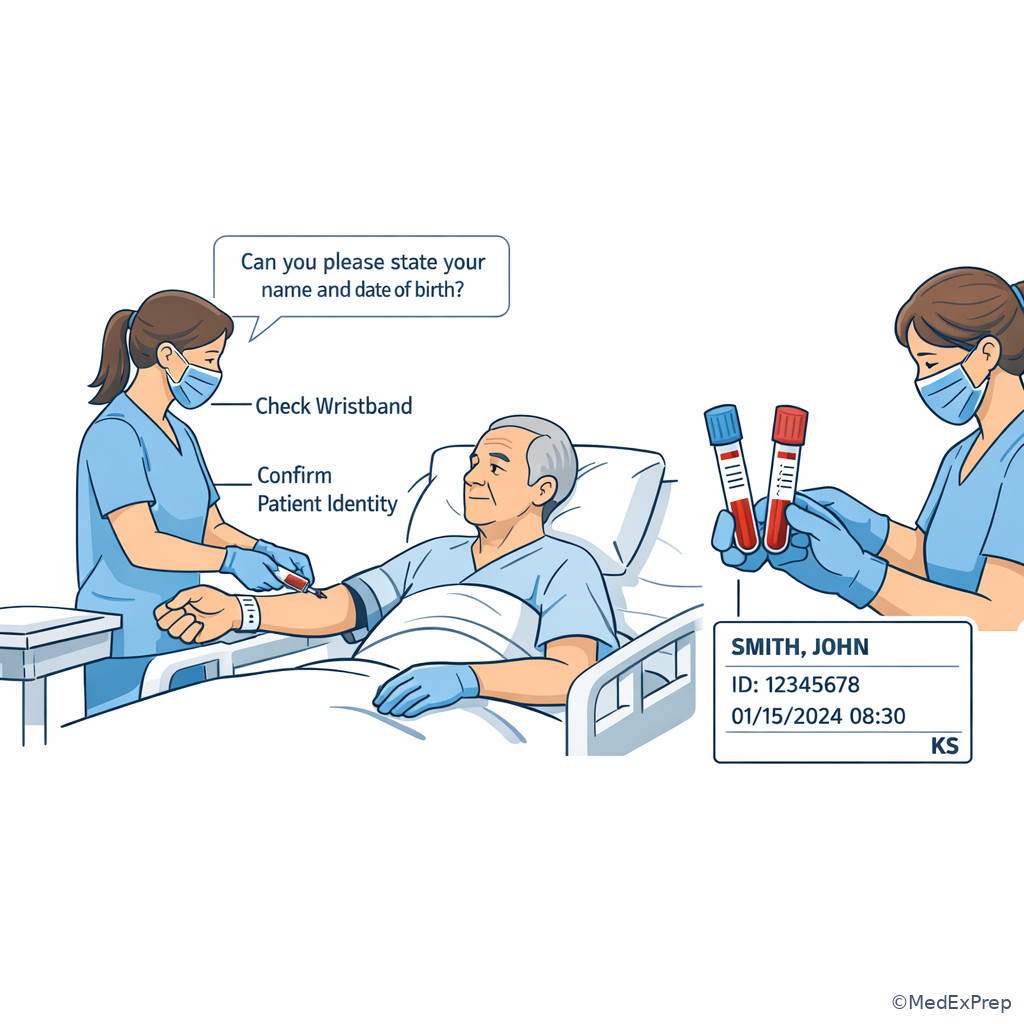
- Bedside labeling — labeling the specimen in the presence of the patient immediately after collection.
- Accessioning — receiving, verifying, and entering the specimen into the laboratory system.
- Unlabeled specimen — specimen container missing required patient identifiers.
- Mislabeled specimen — label present but identifiers are wrong, incomplete, conflicting, or attached to the wrong specimen.
- Partially labeled specimen — some required information present, but one or more required elements missing.
- Specimen rejection — formal refusal to test due to failure of acceptability criteria.
- Recollection — obtaining a new specimen because identity or integrity cannot be assured.
- Chain of custody — documented tracking of specimen identity and handling, especially for legal or forensic testing.
- Two-identifier rule — common requirement to use two independent patient identifiers; local policy may vary.
- WBIT — wrong blood in tube; specimen collected from the wrong patient but labeled as someone else.
- Aliquot label — secondary label applied to a portion of an already identified primary specimen.
- Delta check — comparison of current and previous results that may flag possible patient/sample mismatch.
1.1.1.2 Must-know facts
- Identity errors are preanalytical errors.
- An unlabeled specimen is generally not acceptable for routine testing; blood bank is especially strict.
- Do not relabel a specimen from memory, chart review alone, or verbal assurance after it leaves the patient.
- The key decision is not “Can this result be generated?” but “Can this result be trusted for this patient?”
- Patient room number is not a reliable unique identifier.
- Blood bank identification discrepancies usually require immediate stop, rejection, recollection, and escalation per policy.
- A specimen can be high quality analytically but still unusable if identity is uncertain.
- Corrective documentation is part of the laboratory action; silent fixes are unsafe.
- Local policy varies in exact identifiers and exception handling, but identity uncertainty never becomes acceptable just because recollection is inconvenient.
Exam takeaway: Most labeling questions test where identity must be confirmed before the lab proceeds.
flowchart LR
A[Order entered] --> B[Patient identified with required identifiers]
B --> C[Specimen collected]
C --> D[Specimen labeled at bedside]
D --> E[Transport to lab]
E --> F[Accession check]
F --> G{Identifiers complete and match?}
G -- Yes --> H[Testing proceeds]
G -- No --> I[Stop, document, reject or escalate per policy]
See Fig 1 for the highest-risk handoff points. The exam commonly asks where the process failed and what the MLT should do next.
Exam takeaway: Labeling immediately after collection in the patient's presence reduces wrong-patient errors.
Core content
1.1.1.3 Foundational rule: positive patient identification before the specimen exists
A Explanation
The central decision conflict is simple: Do you trust the identity link enough to let testing begin, or do you reject the specimen because the identity link failed? The single rule that resolves most questions is this: specimen identity must be established before collection and preserved at labeling without any later guesswork. If the identifiers are not verified at the patient and transferred correctly to the specimen, the lab no longer knows whose sample it has.
WHY THIS IS TESTED: exam stems hide identity failure behind otherwise normal workflow details. A tube may be properly filled, not hemolyzed, and sent quickly, but if the patient was identified using a room number only or the label was applied later at the desk, the specimen is unsafe. Choose acceptance only when the identity chain is intact; reject when the identity chain is broken.
For the MLT, the bench-centered action is to verify required identifiers on receipt and compare them with the requisition or electronic order. Common acceptable identifiers include patient full name and a unique number such as medical record number or date of birth, depending on local policy. A room number, diagnosis, or physician name is not enough. If identity elements are missing or conflicting, testing should not proceed just because recollection is inconvenient or because the specimen is difficult to obtain.
B Worked example
A 74-year-old inpatient with chronic kidney disease, diabetes, and mild confusion has morning CBC and BMP tubes delivered to the laboratory. The requisition lists full name and medical record number. One lavender tube and one green tube are labeled with the patient’s last name and room number only; both tubes are properly filled and arrive within 10 minutes. The transporter says, “The nurse knows they’re from Mr. Harris; he was the only patient drawn in that room.” The analyzer queue is heavy, and the potassium order is marked STAT.
Reasoning chain: Identify task → determine specimen acceptability based on identification, not urgency. Extract key facts → missing required unique identifier; room number is not sufficient; verbal reassurance is not documentation. Apply rule → a specimen missing required identifiers cannot be accepted based on someone’s memory after collection. Eliminate distractors → do not test and hold results, do not relabel from the requisition, do not accept because the tubes are otherwise good quality. Verify → safest next laboratory action is rejection/recollection and notification per policy.
The tempting clue is the STAT potassium, because urgent care pressures staff to keep moving. But the exam expects safety logic: an urgent result on the wrong patient is more dangerous than a delayed result on the right patient.
C Exam trap
D Checkpoint
Question: Which specimen is the most appropriate to accept for routine testing?
- A tube labeled with patient full name and room number only, matching the requisition name.
- A tube labeled with patient full name and medical record number, collected time missing, if local policy requires time for that specimen type.
- A tube labeled after transport arrival by a collector who remembers drawing the patient 15 minutes earlier.
- A tube with no label but accompanied by a printed requisition with complete identifiers.
Answer: B, if local policy allows the specific omission for that specimen type; otherwise reject per policy. This option is the closest acceptable because the core patient identifiers are present. A is tempting because one identifier matches, but room number is not a reliable second identifier. C is tempting because the collector “knows” the patient, but delayed relabeling breaks the identity chain. D is tempting because the paperwork is complete, but an unlabeled primary specimen cannot be trusted.
1.1.1.4 Required label elements and what makes a specimen unacceptable
A Explanation
The decision conflict here is complete enough to accept versus incomplete enough to reject. The single resolving rule: required patient identifiers on the specimen container must match the order exactly enough to establish unambiguous identity under policy. For exam purposes, the container matters more than the paperwork because testing is performed on the container’s contents.
Common required elements include patient full name, a second unique identifier, collection date/time, and collector identification or initials, but exact required elements may vary by specimen type and institution. The exam often tests partially labeled versus mislabeled. Partially labeled means one required element is missing; mislabeled means an identifier is wrong or conflicts with the order. Mislabeled specimens are usually higher risk than incompletely labeled specimens because they can represent wrong-patient collection rather than simple omission.
Another key distinction: primary container versus secondary paperwork. A perfect requisition does not rescue an unacceptable primary specimen. In contrast, an aliquot label can be generated from an acceptable primary specimen because the identity chain was already secured. See Fig 2 for the accept/reject comparison.
Exam takeaway: Use the label on the primary container, not verbal assurance or paperwork, to decide specimen acceptability.
flowchart TD
A[Primary specimen arrives] --> B{Required identifiers present?}
B -- No --> C[Reject or escalate per policy]
B -- Yes --> D{Identifiers match order?}
D -- No --> E[Mislabeled or conflicting specimen: stop]
D -- Yes --> F{Other required elements complete?}
F -- Yes --> G[Accept for testing]
F -- No --> H[Apply specimen-specific policy: reject, qualify, or resolve before testing] B Worked example
A 32-year-old emergency department patient with asthma and sickle cell trait has tubes for troponin and CBC sent to the laboratory. The order shows “Angela Morris,” DOB 04/17/1992, MRN 445812. The green tube label reads “Angela Morris, 445812.” The lavender tube reads “Angela Norris, 445812.” Both were collected at the same time by the same phlebotomist. The patient also has an elevated temperature documented in the chart, which is irrelevant to specimen identity but may distract the test taker.
Reasoning chain: Identify task → determine whether either specimen can be accepted. Extract key facts → green tube matches; lavender tube has discordant surname spelling with the same MRN. Apply rule → a mismatch on the primary specimen creates identity uncertainty for that tube. Eliminate distractors → do not assume a transcription typo and edit the tube; do not accept both because one tube is correct; do not reject the entire encounter automatically if policy allows one accurately labeled specimen to be processed. Verify → green tube may proceed if otherwise acceptable; lavender tube must be handled per discrepancy policy, commonly rejection and recollection.
C Exam trap
D Checkpoint
Question: Which finding most strongly supports classifying a specimen as mislabeled rather than merely partially labeled?
- Collection time is absent.
- Collector initials are absent.
- Medical record number on the tube does not match the requisition.
- Test code is absent from the requisition.
Answer: C. A nonmatching MRN indicates conflicting patient identity, which is a mislabeled specimen concern. A and B are tempting because they are required in many settings, but they are omissions rather than patient-identity conflicts. D is plausible because requisition completeness matters, but it does not directly change the patient identity on the primary specimen.
- The most important document for specimen identity is the primary container label.
- True or False: A complete requisition can rescue an unlabeled tube. False.
- Name the higher-risk problem: missing data or conflicting data. Conflicting data.
1.1.1.5 Bench response to unlabeled, mislabeled, and questionable specimens
A Explanation
Now the decision conflict shifts from definition to action: What should the MLT do next once a discrepancy is recognized? The single resolving rule is stop before testing or release if the specimen’s identity cannot be defended. This is not a diagnosis question; it is a workflow safety question. The correct answer usually includes some combination of hold, document, notify, reject, recollect, and escalate according to policy.
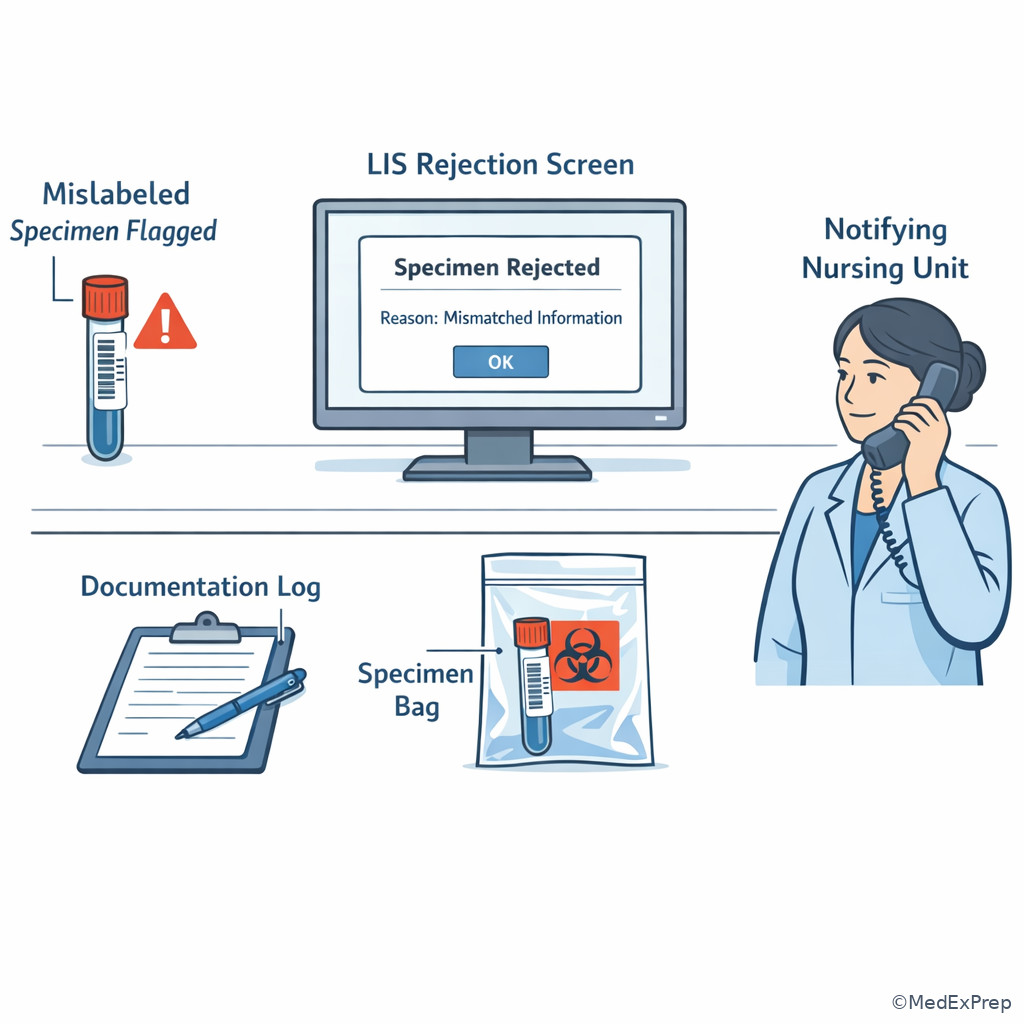
For routine laboratory areas, policies differ in exactly how omissions are handled, but there are broad entry-level rules: unlabeled specimens are generally rejected; mismatched specimens are treated as potential wrong-patient events; relabeling after arrival is not done from memory; and any exception process must be policy-driven and documented. If the stem offers a shortcut that bypasses chain-of-identity controls, it is usually wrong. See Fig 3 for the bench action algorithm.
Blood bank questions are even stricter. Because transfusion testing errors can be fatal, any unresolved patient/specimen discrepancy generally requires immediate stop and recollection. Even if the patient is difficult to draw or previously typed, the MLT does not override identification safeguards. In bench language: no verified identity, no testing and no release.
Exam takeaway: When identity is uncertain, the safest next laboratory action is to stop, document, and follow rejection or escalation policy.
flowchart TD
A[Specimen received] --> B{Label complete and matches order?}
B -- Yes --> C[Test specimen]
B -- No --> D{Unlabeled or conflicting identity?}
D -- Yes --> E[Do not test or release]
E --> F[Document discrepancy]
F --> G[Notify collector/unit/supervisor]
G --> H[Reject and recollect per policy]
D -- No --> I[Minor omission: follow specimen-specific policy before testing] Exam takeaway: The correct next step after an ID discrepancy includes documentation and notification, not silent correction.
B Worked example
A 58-year-old oncology patient with anemia and neutropenia has a type and screen specimen sent for pretransfusion testing before surgery. The specimen label contains full name and date of birth, but the wristband number written on the tube differs by one digit from the blood bank requisition. The unit calls and says the patient was “probably registered twice,” and they need blood available quickly. The tube is not hemolyzed and was collected 20 minutes ago.
Reasoning chain: Identify task → determine the most appropriate next laboratory step in transfusion safety. Extract key facts → blood bank specimen; conflicting unique identifier; urgency present but cannot override safety; explanatory verbal reassurance is not a fix. Apply rule → unresolved blood bank identification discrepancy means stop, do not perform compatibility testing on that specimen, request recollection per policy, and escalate/document. Eliminate distractors → do not proceed using historical type; do not correct the requisition; do not call the discrepancy “minor” because only one digit differs. Verify → one digit is enough to break trust in identity.
C Exam trap
D Checkpoint
Question: A routine chemistry specimen arrives unlabeled but with a bag label and requisition that appear complete. What is the most appropriate next laboratory step?
- Label the tube from the requisition and run testing because the specimen is otherwise acceptable.
- Hold the specimen, notify the collection area, and follow rejection/recollection policy.
- Run the tests but suppress release until the nurse confirms patient identity by phone.
- Compare with prior chemistry values and release if they are consistent.
Answer: B. A complete bag or requisition does not identify the unlabeled primary specimen. A is tempting because it seems efficient, but it creates an unsupported identity link. C is tempting because withholding release appears safer, but generating results from an unidentified specimen is still unsafe. D is tempting because prior values can seem reassuring, but a plausible delta does not prove identity.
1.1.1.6 Special high-risk context: blood bank, legal specimens, and chain of custody
A Explanation
The decision conflict becomes more severe in high-risk systems: Can a “close enough” identification process ever be accepted when downstream harm could be catastrophic? The answer is usually no. The single resolving rule is high-risk specimen types demand stricter identity control because downstream use depends completely on exact patient linkage.
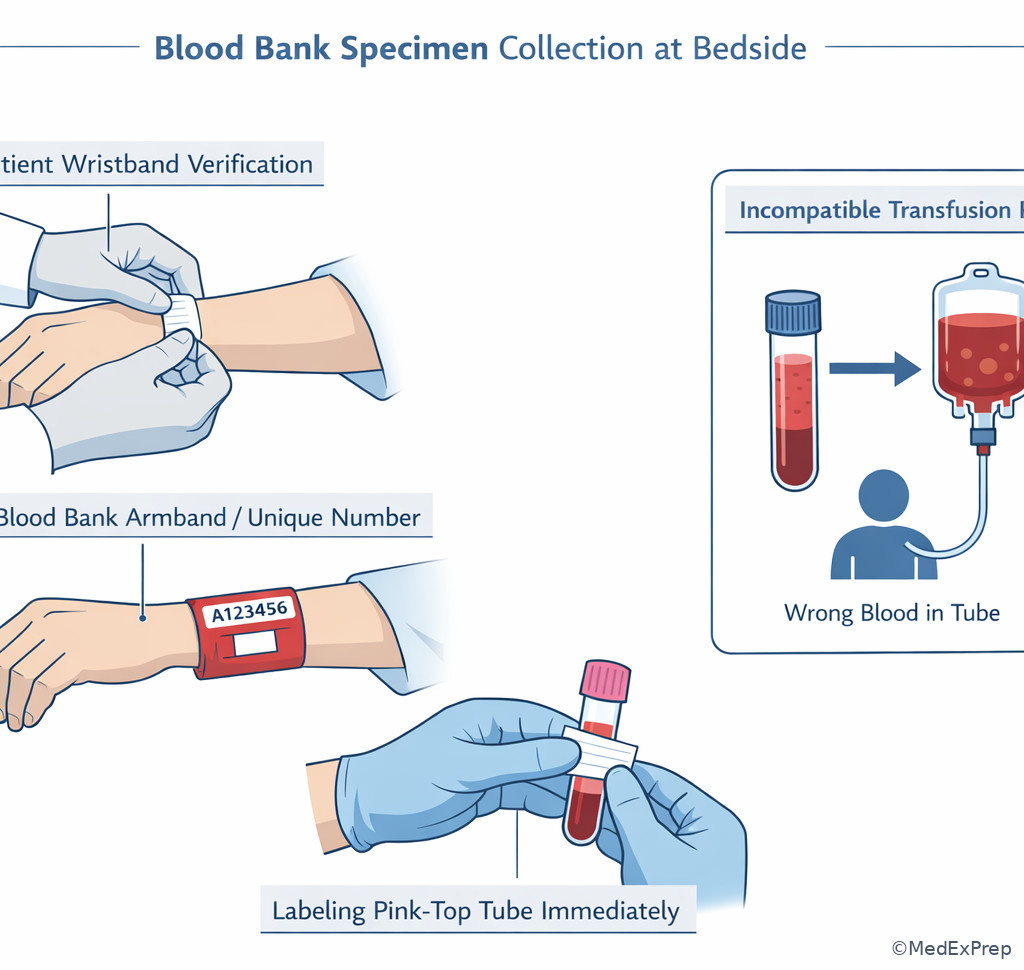
Blood bank is the most testable example. A WBIT event can produce ABO-incompatible transfusion if not caught. Therefore, blood bank specimens usually require especially strict bedside identification, labeling, and discrepancy handling. Similarly, chain-of-custody specimens in toxicology, forensic, or legal contexts can be invalidated if documentation or sealing is incomplete even when the analyte result itself would be accurate. In both settings, identity and traceability are part of the test result.
Exam writers like to contrast routine chemistry convenience with blood bank rigidity. In routine areas, local policy may allow limited exception handling for minor omissions. In blood bank and legal contexts, the safer exam answer is almost always to stop, recollect, and document. See Fig 4 for the comparison. Also note the forward connection: in the upcoming lesson on Collection Tubes and Additives, the right patient must still be paired with the right tube; both dimensions matter.
Exam takeaway: In transfusion testing, any unresolved labeling discrepancy requires immediate stop-and-escalate action.
B Worked example
A 27-year-old trauma patient with no prior type on file arrives for emergency surgery. A type and screen specimen and a urine drug screen specimen are sent together. The blood bank tube has full name and date of birth but no collector initials. The urine chain-of-custody seal is broken, though the label is complete. The surgeon’s team calls twice asking why results are delayed. A mild lipemia flag is present on a chemistry sample from the same patient, which is a distracting detail unrelated to specimen identity.
Reasoning chain: Identify task → determine disposition of two different high-risk specimens. Extract key facts → blood bank specimen with missing required traceability element; urine legal specimen with broken chain seal; urgency and unrelated lipemia do not repair identity/custody defects. Apply rule → both high-risk specimens require strict adherence to policy; unresolved defects mean stop and escalate. Eliminate distractors → do not process either “because some identifiers are present”; do not assume collector initials can be added later from staffing records; do not ignore broken chain seal because analyte testing itself is possible. Verify → patient safety and legal defensibility depend on traceable identity, not analytic capability alone.
C Exam trap
D Checkpoint
Question: Which scenario most clearly requires immediate escalation rather than routine correction?
- A serum tube for chemistry is missing collector initials, and local policy permits documented follow-up before testing.
- A microbiology swab label lacks collection time, but the patient identifiers match and the source is stated.
- A blood bank specimen has a unique identifier on the label that differs from the requisition by one digit.
- A urine container lacks the test mnemonic, but the order in the system is complete.
Answer: C. In blood bank, even a one-digit unique-identifier conflict is a major safety event until proven otherwise. A is tempting because missing collector initials can matter, but the stem explicitly says policy permits follow-up. B is plausible because microbiology timing affects acceptability, but this is not the same level of identity threat. D is tempting because order/specimen linkage matters, but lack of a test mnemonic is usually not equivalent to wrong-patient risk.
- True or False: Historical blood type can authenticate a currently discrepant specimen. False.
- The most feared blood bank preanalytical event tied to labeling is wrong blood in tube.
- Broken legal/forensic chain documentation affects specimen validity, not just paperwork quality.
1.1.1.7 Prevention systems: bedside workflow, accession checks, and plausibility review
A Explanation
The final integration question is how the laboratory catches identity errors before patient harm occurs. The single rule: prevention requires multiple checkpoints because no single person or step is fail-safe. Good systems include bedside verification, immediate labeling, accession comparison, barcode use, analyzer/worksheet review, and plausibility tools such as delta checks.
An MLT may not witness collection, but the bench still plays a key role. Accession review can catch mismatched identifiers. Result plausibility review can detect a possible wrong-patient event when current results are grossly inconsistent with previous patterns, especially if the specimen quality itself is fine. Delta checks do not prove misidentification, but they can prompt investigation. Similarly, multiple specimens from the same encounter should be consistent in identifiers and collection chronology.
Do not overreach: the MLT does not make the medical diagnosis from a delta check. The correct action is to investigate specimen identity, review collection information, consider recollection per policy, and escalate as needed. See Fig 5 for the layered prevention model and Fig 6 for a visual example of accession barcode verification.
Exam takeaway: ID safety depends on bedside verification, accession checks, and plausibility review working together.
flowchart LR
A[Bedside identifiers] --> B[Immediate tube labeling]
B --> C[Transport integrity]
C --> D[Accession compare label vs order]
D --> E[Testing and analyzer flags]
E --> F[Result plausibility and delta review]
F --> G{Concern persists?}
G -- Yes --> H[Investigate identity and escalate]
G -- No --> I[Release verified results] Exam takeaway: At accession, the MLT must compare the primary specimen label with the order before testing begins.
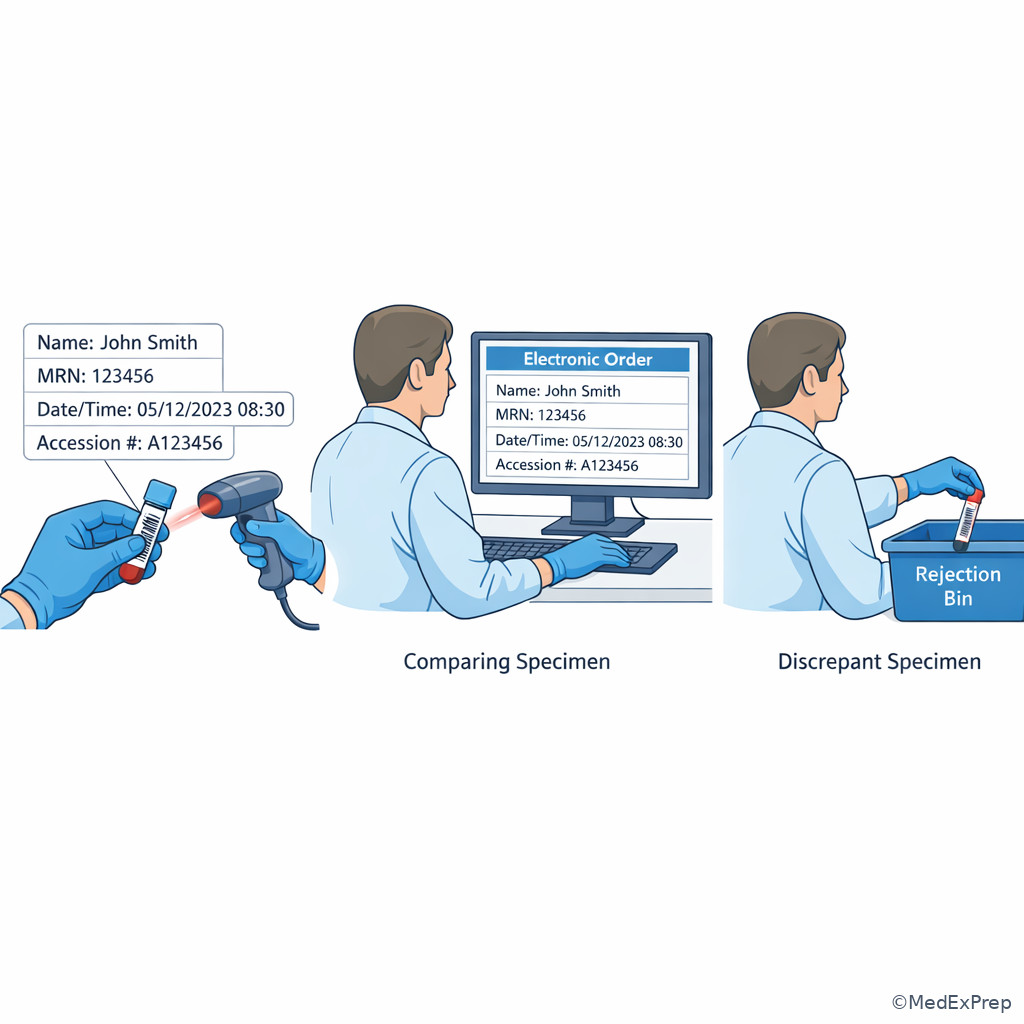
See Fig 5 for the idea that a safe laboratory does not depend on one perfect person. See Fig 6 for the bench-level checkpoint that belongs directly to the MLT.
B Worked example
A 66-year-old outpatient with stable chronic anemia, hypertension, and hyperlipidemia has a CBC collected at a clinic. Previous hemoglobin values for six months were 10.8–11.4 g/dL. Today’s sample is properly labeled and not clotted, but the analyzer reports hemoglobin 16.2 g/dL and hematocrit 49%, with no analyzer error flags. The patient’s lipid profile specimen from the same visit carries identical identifiers. A note in the chart mentions recent iron therapy, a distracting clue that could make the jump seem plausible.
Reasoning chain: Identify task → determine whether results can be released immediately. Extract key facts → specimen appears acceptable, but major delta from patient baseline suggests possible specimen mix-up or other preanalytical issue; iron therapy would not usually normalize severe chronic anemia overnight. Apply rule → plausibility review is part of identity safety. Eliminate distractors → do not release solely because the label is complete; do not diagnose a transfusion or treatment effect; do not repeat only instrument QC when the result pattern suggests possible patient mismatch. Verify → investigate specimen identity and follow policy before release.
C Exam trap
D Checkpoint
Question: Which tool is most useful for detecting a possible identification error after a properly labeled specimen has already reached testing?
- Delta check against prior results
- Color of the collection tube
- Presence of slight lipemia
- Whether the sample was transported by pneumatic tube
Answer: A. A delta check can flag major inconsistency suggestive of wrong-patient or wrong-specimen events. B is tempting because the wrong tube can invalidate results, but it does not primarily detect identity mismatch after labeling. C is plausible because interferences matter, but lipemia speaks to chemistry accuracy, not identity. D is tempting because transport can affect specimen integrity, but not specifically patient linkage.
Exam Traps & Differentiators
1.1.1.8 Most common wrong answer and why
Wrong answer: relabel the specimen from the requisition and proceed. Why it tempts: it looks efficient, keeps turnaround time low, and seems harmless when the paperwork is complete. Why it is wrong: the requisition identifies an order; it does not prove the unlabeled or discrepant specimen is the correct patient’s specimen.
1.1.1.9 Looks similar but isn't
| Issue | What it looks like | Why it matters | Typical laboratory action |
|---|---|---|---|
| Partially labeled specimen | One required noncore element missing | May be an omission rather than wrong patient | Follow specimen-specific policy; document, resolve, or reject |
| Mislabeled specimen | Identifier conflicts with requisition or another tube | Possible wrong-patient/wrong-specimen event | Stop, reject, recollect, escalate per policy |
| Unlabeled specimen | No patient identifiers on primary container | No defensible identity link | Reject and recollect |
| Wrong tube/additive | Correct patient, incorrect container | Identity may be fine, analytic validity is not | Usually reject for recollection |
| Plausibility concern | Label appears correct but results are wildly discordant | Possible hidden misidentification or specimen mix-up | Investigate before release |
1.1.1.10 If the stem says ..., think ...
- “The nurse confirms by phone” → think verbal assurance does not authenticate the tube.
- “STAT” or “urgent surgery” → think urgency does not override identity safeguards.
- “Only one digit is different” → think wrong unique identifier = wrong specimen until resolved.
- “Specimen otherwise acceptable” → think analytic quality cannot compensate for identity failure.
- “History matches prior results” → think plausibility supports review but does not prove identity.
- “Blood bank specimen” → think strict stop-and-escalate logic.
| Confusable pair | Single discriminator | Safer exam answer |
|---|---|---|
| Unlabeled tube vs complete requisition | Primary container is unidentified | Reject/recollect |
| Correct label vs implausible major delta | Plausibility review suggests hidden mismatch | Investigate before release |
| Missing collection time vs wrong MRN | Wrong MRN threatens patient identity directly | Treat as mislabeled/high risk |
| Routine chemistry omission vs blood bank discrepancy | Transfusion safety raises risk level | Immediate escalation in blood bank |
Related future trap: in Collection Tubes and Additives, a candidate may focus on tube color and forget that the first question is still whether the specimen belongs to the correct patient. Related future trap in Specimen Acceptability Criteria: a nonhemolyzed, well-filled specimen may still require rejection if labeling fails.
Tables
| Required label/reference element | Why it matters | Exam note |
|---|---|---|
| Patient full name | Primary human-readable identifier | Misspelling/conflict can invalidate the tube |
| Unique identifier (MRN, DOB, accession per policy) | Distinguishes same/similar names | Room number is not equivalent |
| Collection date/time | Supports specimen age and chronology | Importance varies by specimen type and policy |
| Collector initials/ID | Traceability for follow-up and QA | Especially important in blood bank and discrepancy review |
| Specimen source if needed | Critical for microbiology/body fluids | Wrong source can misdirect interpretation |
| Barcode/accession linkage | Supports LIS traceability | Barcode does not replace checking visible identifiers |
| Specimen status | Identity confidence | Can testing proceed? | Typical next step |
|---|---|---|---|
| Fully labeled and matched | High | Yes, if otherwise acceptable | Accession and test |
| Partially labeled | Variable | Depends on missing element and policy | Review policy; resolve or reject |
| Mislabeled/conflicting | Low | No | Reject/recollect/escalate |
| Unlabeled | None | No | Reject/recollect |
| Properly labeled but implausible result pattern | Questioned after testing | Hold release pending review | Investigate identity/plausibility |
| Differential problem | Primary concern | Most likely tested principle | Next laboratory action |
|---|---|---|---|
| Wrong patient in tube | Identity | Preanalytical safety failure | Stop, document, escalate, recollect |
| Wrong additive tube | Analytic validity | Collection tube selection/order of draw | Reject and recollect in correct tube |
| Hemolyzed sample | Interference/specimen quality | Acceptability and qualified reporting | Follow analyte-specific policy |
| Clotted EDTA CBC | Specimen integrity | Anticoagulated specimen acceptability | Reject/recollect |
| Extreme unexpected delta | Plausibility/possible ID error | Postcollection verification | Investigate before release |
Exam takeaway: Visual comparison helps distinguish omission errors from wrong-patient conflicts.
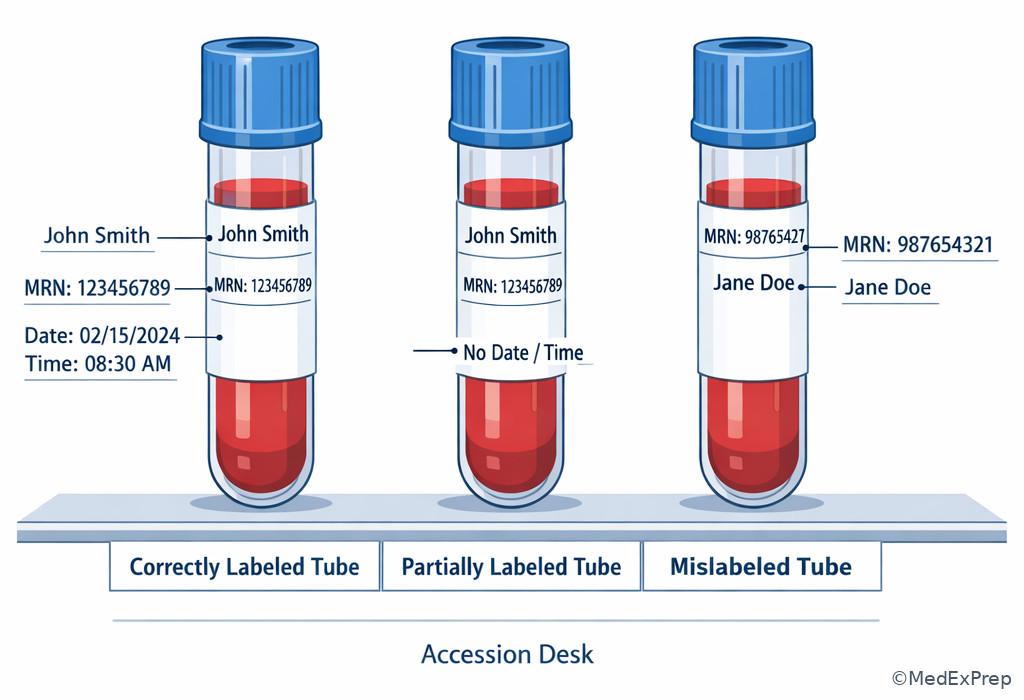
Exam takeaway: Classifying the problem first prevents the common mistake of using the wrong corrective action.
flowchart TD
A[Label problem] --> B{No identifiers?}
B -- Yes --> C[Unlabeled]
B -- No --> D{Wrong/conflicting identifier?}
D -- Yes --> E[Mislabeled]
D -- No --> F{Required element missing?}
F -- Yes --> G[Partially labeled]
F -- No --> H[Label acceptable; assess other specimen criteria] Algorithm / Approach
Rapid Review
- Unlabeled primary tube → reject; requisition cannot rescue it.
- Mislabeled specimen → treat as wrong-patient risk, not minor clerical cleanup.
- Room number → location cue, not reliable patient identifier.
- STAT request → does not override ID safeguards.
- Blood bank discrepancy → immediate stop-and-escalate logic.
- Partial omission vs wrong identifier → wrong identifier is higher risk.
- Primary container label → outranks bag label for identity decisions.
- Relabeling from memory → unsafe shortcut and common distractor.
- Historical results → support review, do not authenticate current tube.
- Delta check → trigger for investigation when result pattern is implausible.
- Collector initials/date-time → traceability tools; exact requirements vary by policy/specimen.
- Chain of custody → identity plus documented handling, not analyte result alone.
Self-check quiz
1.1.1.11 1. Which specimen is most appropriate to reject immediately for an identification problem?
A morning BMP tube arrives with no label on the primary container. The requisition in the transport bag contains the patient’s full name, MRN, and collection time. The specimen is not hemolyzed and the unit states the draw was difficult.
- Reject the specimen and request recollection.
- Label the specimen from the requisition and proceed.
- Run testing and hold results until the nurse confirms identity.
- Compare previous BMP results and release if they are consistent.
1.1.1.12 2. Which item is the best second patient identifier for routine specimen labeling?
An outpatient phlebotomy area is reviewing bedside identification practice. Several patient descriptors are available at collection.
- Room number
- Medical record number
- Ordering physician name
- Patient diagnosis
1.1.1.13 3. A CBC specimen has correct patient name and MRN, but collector initials are missing. Local policy states collector initials are required on hematology specimens and missing initials require recollection. What is the most appropriate next laboratory step?
A 49-year-old inpatient with COPD and heart failure has a lavender tube that is properly filled, not clotted, and arrives within 5 minutes. The unit asks that the test be run quickly because discharge planning is pending.
- Run the CBC because patient identifiers are present and add initials later.
- Reject the specimen and request recollection per policy.
- Run the CBC but append a comment about missing initials.
- Call the nurse and verbally document the collector name, then proceed.
1.1.1.14 4. A chemistry tube and CBC tube from the same patient arrive together. The chemistry tube matches the order; the CBC tube has the correct name but a different MRN. What is the best laboratory action?
A 63-year-old patient with diabetes and chronic kidney disease has tubes collected in the ED after syncope. Both tubes were reportedly drawn at the same time. Potassium is ordered STAT.
- Process both because one tube confirms the patient encounter.
- Process the chemistry tube if acceptable and reject the discrepant CBC tube per policy.
- Reject both tubes automatically because they were collected together.
- Correct the CBC tube MRN from the requisition and proceed.
1.1.1.15 5. Which finding most strongly suggests a possible hidden patient/specimen mismatch despite complete labeling?
A 71-year-old outpatient with stable chronic anemia, hypertension, and osteoarthritis has a correctly labeled CBC. The specimen is not clotted and analyzer QC is in range. Today’s hemoglobin is 16.0 g/dL after six months of values near 10.5 g/dL. The chart notes oral iron use started last week.
- Slight lipemia in a chemistry sample collected at the same visit
- A major unexpected delta from prior hemoglobin values
- Normal platelet count with no analyzer flags
- Short transport time from clinic to lab
1.1.1.16 6. A pretransfusion specimen arrives with full name and date of birth, but the unique blood bank identifier differs from the requisition by one digit. What is the most appropriate next laboratory step?
A 56-year-old surgical patient with coronary artery disease and iron-deficiency anemia may need transfusion. The nurse states the patient was “registered twice” and asks the blood bank to proceed using the patient’s historical ABO/Rh because surgery starts in 30 minutes.
- Proceed with ABO/Rh and antibody screen using the current specimen because most identifiers match.
- Use historical blood type to validate the current specimen and continue testing.
- Stop testing on the discrepant specimen, document the discrepancy, and request recollection per policy.
- Perform ABO/Rh only and defer antibody testing until clarification is received.
1.1.1.17 7. A legal urine drug screen specimen has complete patient identifiers, but the custody seal is broken on receipt. What is the best laboratory action?
A 34-year-old employee with hypertension and seasonal allergies presents for employer-mandated testing after a workplace incident. The specimen volume is adequate and temperature is appropriate. The collection site calls and says the seal probably loosened in transport.
- Test the specimen because the analytical conditions are acceptable.
- Replace the seal in the laboratory and document the correction.
- Hold the specimen, document the chain-of-custody defect, and follow rejection/escalation policy.
- Report the result with a comment that the seal was broken on arrival.
1.1.1.18 8. Which action is most appropriate when an unlabeled CSF tube arrives from a lumbar puncture that was reportedly difficult and traumatic?
A 6-year-old child with fever and seizures has CSF sent for urgent cell count and chemistry. The collection note states only a small volume was obtained. The transport bag label and electronic order are complete, and the provider calls emphasizing that recollection may be challenging.
- Label the primary tube from the bag label and proceed because recollection is difficult.
- Run the chemistry only because cell count can be more affected by preanalytical issues.
- Hold the specimen, notify the appropriate provider/area, and follow policy for unlabeled high-risk specimens.
- Accept the specimen if the provider signs a note confirming patient identity.
Answer key
1.1.1.19 1. Correct answer: A
A. Tempting because it delays care, but it is correct because the primary specimen has no identifiers and therefore no defensible patient link. Single clue: unlabeled primary container.
B. Tempting because the requisition is complete and the draw was difficult, but it is incorrect because paperwork cannot authenticate the unlabeled tube. Single clue: identity must be on the primary specimen.
C. Tempting because withholding release sounds cautious, but it is incorrect because running tests on an unidentified specimen is still unsafe. Single clue: testing should stop before results are generated.
D. Tempting because prior values can reassure, but it is incorrect because plausibility does not prove tube identity. Single clue: unlabeled specimen status overrides historical consistency.
Authority: CLSI specimen labeling and patient identification standards; McPherson and Pincus; Harmening.
1.1.1.20 2. Correct answer: B
A. Tempting because staff often use location informally, but it is incorrect because room number is not a stable unique patient identifier. Single clue: location can change and may be shared or misrecorded.
B. Tempting because it is routine and system-based, and it is correct because MRN is a true unique identifier in most institutions. Single clue: unique patient-specific number.
C. Tempting because it appears official, but it is incorrect because the ordering provider identifies the order, not the patient. Single clue: multiple patients can share the same provider.
D. Tempting because diagnoses are memorable, but it is incorrect because diagnoses are not identifiers and may be similar across patients. Single clue: diagnosis does not uniquely link specimen to patient.
Authority: CLSI GP33 and institutional patient identification standards; McCall and Tankersley.
1.1.1.21 3. Correct answer: B
A. Tempting because the core patient identifiers are present, but it is incorrect for this scenario because the stem explicitly states local policy requires collector initials and mandates recollection when they are missing. Single clue: policy requirement is specified in the stem.
B. Tempting because it follows written procedure despite workflow pressure, and it is correct because MLT action must follow stated specimen policy. Single clue: missing initials require recollection per policy.
C. Tempting because a comment seems transparent, but it is incorrect because documentation does not replace a failed required specimen element when policy requires recollection. Single clue: append-comment option bypasses explicit policy.
D. Tempting because verbal clarification feels practical, but it is incorrect because post hoc verbal verification does not replace required label traceability. Single clue: collector initials were required on the specimen itself.
Authority: CLSI specimen labeling standards; quality systems principles in Henry’s Clinical Diagnosis and Management by Laboratory Methods.
1.1.1.22 4. Correct answer: B
A. Tempting because both tubes came from the same encounter, but it is incorrect because one acceptable specimen does not authenticate a second discrepant tube. Single clue: CBC tube MRN does not match.
B. Tempting because it separates specimens by their own labeling status, and it is correct because each primary container stands on its own identity evidence. Single clue: chemistry tube matches, CBC tube conflicts.
C. Tempting because both may have been collected together, but it is incorrect because the stem gives one specimen with complete agreement; automatic rejection of both overreaches unless policy specifies otherwise. Single clue: only one tube is discrepant.
D. Tempting because the requisition seems authoritative, but it is incorrect because relabeling from paperwork repairs nothing once identity conflict exists on the primary specimen. Single clue: conflicting identifier on the CBC tube.
Authority: CLSI specimen acceptability guidance; McCall and Tankersley; ASCP-style preanalytical reasoning.
1.1.1.23 5. Correct answer: B
A. Tempting because interferences can affect results, but it is incorrect because slight lipemia in a chemistry sample does not explain a large CBC identity concern. Single clue: the question asks about hidden mismatch, not chemistry interference.
B. Tempting because it directly points to a verification problem, and it is correct because a major unexpected delta is a classic trigger for identity review. Single clue: six months of stable anemia followed by abrupt normal-high hemoglobin.
C. Tempting because normal supporting results can reassure, but it is incorrect because plausible internal CBC values do not exclude wrong-patient events. Single clue: internal consistency is not the same as patient consistency over time.
D. Tempting because transport affects quality, but it is incorrect because short transport time does not identify patient mismatch. Single clue: transport detail is workflow noise.
Authority: Henry’s Clinical Diagnosis and Management by Laboratory Methods; quality assurance texts on delta checks and result plausibility review.
1.1.1.24 6. Correct answer: C
A. Tempting because most identifiers match and surgery is soon, but it is incorrect because a single unique-identifier mismatch in blood bank makes the specimen unsafe. Single clue: blood bank identifier differs by one digit.
B. Tempting because historical type seems objective, but it is incorrect because prior records cannot validate the current discrepant specimen. Single clue: current specimen identity remains unresolved.
C. Tempting because it follows strict transfusion safety logic, and it is correct because blood bank discrepancies require stop, document, and recollect per policy. Single clue: pretransfusion specimen plus identifier conflict.
D. Tempting because partial testing appears safer than full testing, but it is incorrect because no blood bank testing should proceed on a specimen with unresolved identity discrepancy. Single clue: identity problem affects the entire specimen, not just one assay.
Authority: Harmening, Modern Blood Banking and Transfusion Practices; AABB transfusion safety principles; CLSI transfusion-related specimen ID standards.
1.1.1.25 7. Correct answer: C
A. Tempting because volume and temperature are acceptable, but it is incorrect because legal validity depends on intact custody documentation as well as specimen quality. Single clue: broken custody seal.
B. Tempting because it preserves workflow, but it is incorrect because the laboratory cannot recreate original custody conditions after receipt. Single clue: seal integrity must be preserved continuously, not re-created.
C. Tempting because it seems strict, and it is correct because chain-of-custody defects require documented hold/rejection/escalation per policy. Single clue: legal specimen with broken seal.
D. Tempting because commenting seems transparent, but it is incorrect because a legally compromised specimen may not be reportable as a valid custody specimen. Single clue: defect invalidates custody status, not just report wording.
Authority: Chain-of-custody laboratory practice standards; CLSI specimen handling principles; quality assurance texts.
1.1.1.26 8. Correct answer: C
A. Tempting because recollection may be difficult and the bag is labeled, but it is incorrect because the primary CSF tube remains unlabeled and cannot be authenticated after the fact. Single clue: unlabeled primary specimen.
B. Tempting because limited testing may seem like a compromise, but it is incorrect because identity failure affects all testing on that tube, not just selected assays. Single clue: patient linkage is absent for the specimen as a whole.
C. Tempting because it balances urgency with safety, and it is correct because high-risk unlabeled specimens require hold, notification, and policy-driven disposition. Single clue: difficult recollection does not restore specimen identity.
D. Tempting because provider confirmation sounds authoritative, but it is incorrect because a provider note cannot re-establish chain-of-identity once the unlabeled specimen is detached from the patient. Single clue: confirmation is retrospective, not specimen-based.
Authority: CLSI specimen identification standards; laboratory operations texts addressing unlabeled irreplaceable specimens and policy-based exception handling.
Keep going with the full ASCP MLT Prep Course (MLT)
You just studied the way members do, in the same lesson interface. Full access unlocks every lesson, the question bank and flashcards for a full year.
One payment · 1 year of access · No auto-renewal