1.1.1 - Patient Identification & Labeling
Why it matters
- A perfectly performed test on the wrong patient is still a dangerous laboratory error.
- Patient identification mistakes are high-yield on MLS exams because they test safety, quality systems, scope limits, and specimen acceptability at the same time.
- Many stems hinge on one discriminating clue: Can the specimen still be confidently linked to one patient? If not, the safest answer is usually to reject or hold pending policy-based resolution.
- Transfusion-service specimens use stricter rules because a labeling error can lead directly to incompatible blood issue.
Key rule: The laboratory does not repair uncertain patient identity by guessing, cross-checking old results, or rewriting labels after collection unless a defined policy explicitly allows a narrowly controlled correction process. If identity is uncertain, stop the workflow.
Key Terms & Must-Know Facts
1.1.1.1 Key terms
- Patient identifier: Unique data element used to match a specimen to one patient, such as full name, medical record number, date of birth, or accession-linked unique number per policy.
- At bedside/in presence labeling: Label applied immediately after collection while still with the patient or specimen source.
- Mislabeled specimen: Tube label contains identifiers, but they belong to another patient or do not match accompanying documentation.
- Unlabeled specimen: Tube has no patient identification.
- Partially labeled specimen: Tube has some but not all required identifiers.
- Specimen rejection: Laboratory refusal to process a specimen that fails acceptability criteria.
- Specimen hold: Temporary stop in testing or reporting while verification is performed.
- Positive patient identification: Active confirmation using identifiers from the patient or authorized source before collection.
- Recollection: New specimen obtained because original identity or integrity cannot be assured.
- LIS mismatch: Disagreement between specimen label and electronic order record.
- Chain of identity: Continuous traceable link from patient to specimen to result.
- Wrong blood in tube (WBIT): Blood specimen labeled as one patient but actually collected from another; critical in transfusion service.
1.1.1.2 Must-know facts
- Two independent patient identifiers are commonly required; local policy defines acceptable combinations.
- Room number and bed number are poor identifiers and are often not acceptable as primary identifiers.
- Time and collector initials may be required labeling elements even when they are not the core patient identifiers.
- An unlabeled blood specimen is generally not safe to relabel after it leaves the bedside.
- A specimen with conflicting identifiers is higher risk than one with a missing optional field.
- Pretransfusion specimens have the strictest acceptance rules in most laboratories.
- The MLS role is to enforce specimen acceptance policy, document the nonconformance, and escalate when needed.
- Previous matching results do not prove current specimen identity.
- Critical test urgency does not eliminate identification rules; emergency exceptions must follow policy, not improvisation.
| Element | Usually required? | Why it matters | Exam cue |
|---|---|---|---|
| Full patient name | Yes | Primary link to patient identity | If missing, think acceptability problem |
| Medical record or unique ID number | Yes | Distinguishes same/similar names | Best discriminator when names are similar |
| Date of birth | Often | Second independent check | Useful when MRN unavailable on stem |
| Collection date/time | Often | Supports specimen validity and traceability | Missing date/time may delay but not always equal wrong patient |
| Collector initials/ID | Often | Traceability and accountability | Documentation error, not always identity failure |
| Room number | No as sole identifier | Location can change; not unique | Tempting distractor |
Exam takeaway: Trace the specimen from patient to report and stop at the first broken identity link.
flowchart LR
A[Patient present] --> B[Positive identification]
B --> C[Collection]
C --> D[Immediate tube labeling]
D --> E[Order-label match]
E --> F[Lab receipt verification]
F --> G[Testing and release]
X[Broken link] --> Y[Hold or reject specimen]
Exam takeaway: The safest timing is verify patient first, collect second, label immediately in the patient's presence.
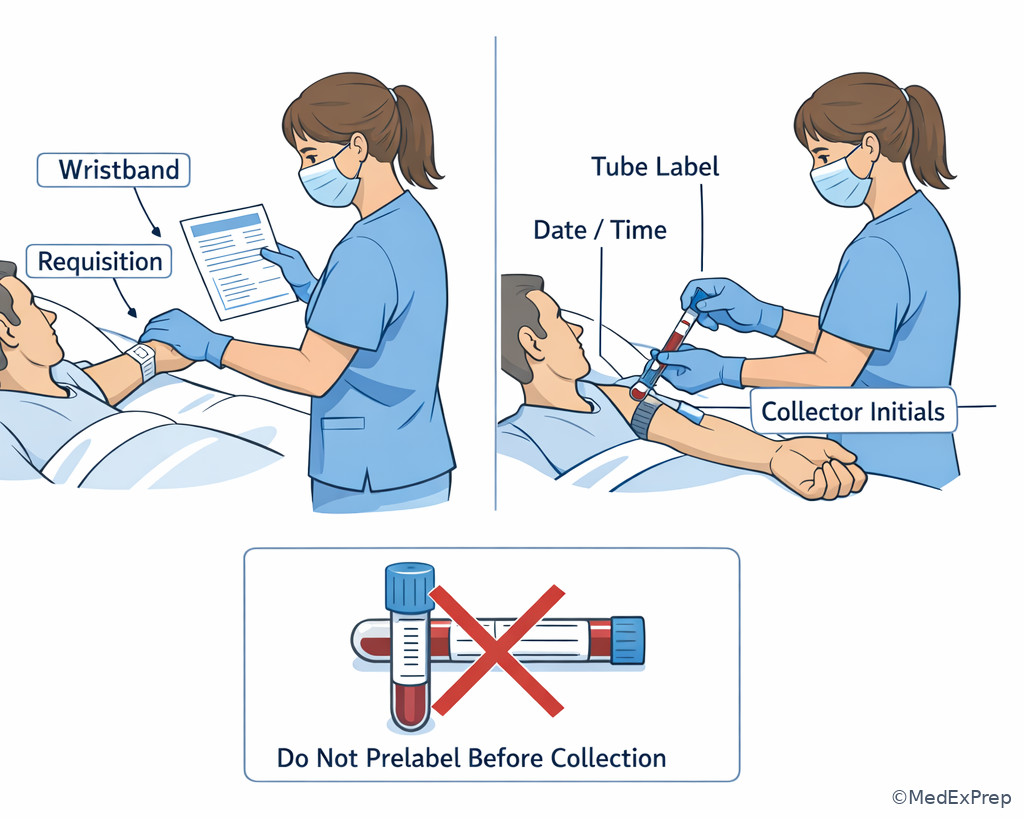
Core content
1.1.1.3 Foundational rule: what makes a specimen identifiable enough to test?
A Explanation
The main decision conflict is simple: Do you have enough trustworthy identity information to proceed, or must you stop? On exam stems, the resolving rule is whether the specimen container itself carries the required patient identifiers and whether those identifiers match the order and available source documents. A specimen is not acceptable just because the requisition is complete, the collector sounds confident, or prior results match. The tube must be linked to one patient without ambiguity.
WHY THIS IS TESTED: Examiners use labeling questions to test whether you prioritize patient safety over convenience. The correct MLS action is usually determined by one rule: identity must be established on the specimen, not reconstructed after the fact.
Choose testing when the tube label contains the required identifiers and matches the LIS/order. Reject or hold when the tube is unlabeled, bears another patient's identifiers, contains insufficient identifiers per policy, or conflicts with the electronic order. When a stem includes a missing date/time or collector initials, decide whether the defect threatens patient identity or mainly affects traceability/documentation. Identity failures are high-risk hard stops. Documentation gaps may be policy-dependent and sometimes correctable before release.
For ASCP-style questions, the highest-yield distinction is this: missing patient identity data on the tube is worse than missing ancillary collection information. If the patient link is broken, recollection is usually required.
B Worked example
A 68-year-old inpatient with diabetes, chronic kidney disease, and anemia has a lavender-top EDTA tube sent for a CBC. The requisition lists full name, medical record number, and date of birth. The tube label contains the patient's full name and room number, but no medical record number. Collection time is present. The floor calls and says, “It is definitely the right patient; this is his usual morning draw.” A previous day's CBC is consistent with the current clinical picture.
Reasoning chain: Identify task - specimen acceptability based on labeling. Extract key facts - tube lacks one required independent patient identifier, requisition is complete, and prior similar results are a distracting clue. Apply rule - specimen identity must be sufficient on the tube itself; room number is not a reliable substitute for a unique identifier. Eliminate distractors - do not accept based on verbal assurance, do not complete the label in the lab, do not use prior matching results to infer identity. Verify - safest next step is reject or hold for recollection per policy because the patient-specimen link is incomplete.
C Exam trap
Common wrong answer: Accept the specimen because the requisition is complete and the floor confirms the identity.
Why it is tempting: The stem gives reassuring noise: stable patient, expected result trend, confident nursing call, and only one missing item.
Single clue that eliminates it: The missing item is a required patient identifier on the tube, not merely an ancillary documentation field.
D Checkpoint
Question: Which specimen is most appropriate to accept for testing under standard identity logic, assuming local policy requires two patient identifiers on the tube?
- Tube labeled with patient full name and room number; requisition has full demographics.
- Tube labeled with full name and medical record number; requisition has matching identifiers but collector initials are missing.
- Tube unlabeled; requisition attached with full name, medical record number, and collection time.
- Tube labeled with full name and medical record number that differ from the electronic order by one digit.
Answer: B
- A: Tempting because there are two pieces of information, but room number is not a reliable patient identifier.
- B: Correct because the tube carries two matching patient identifiers; missing collector initials is a traceability issue, not a broken patient link.
- C: Tempting because the requisition is complete, but an unlabeled tube cannot be safely linked to the patient.
- D: Tempting because the discrepancy is small, but even a one-digit mismatch breaks exact identity matching.
Practitioner Action: ASSESS the tube before the paperwork. INTERVENE by holding or rejecting when required patient identifiers are missing or discrepant. REFER unresolved identity discrepancies to the supervisor or collection area per policy. DOCUMENT the exact labeling defect and disposition in the LIS/nonconformance record.
1.1.1.4 Foundational rule: bedside labeling timing and why prelabeling fails
A Explanation
The decision conflict here is whether a specimen can still be trusted if the collector did not label it immediately in the patient's presence. The single rule that resolves the conflict is that the safest time to label is immediately after collection, before leaving the patient or source. Prelabeling empty tubes or delaying labeling until later creates an interval in which specimen identity can be swapped, forgotten, or mixed with another patient's tubes.
WHY THIS IS TESTED: Board questions often present “almost correct” workflows. The collector verified the wristband, drew the blood correctly, and planned to label the tubes at the desk. The exam asks whether that delay is acceptable. It is not the venipuncture skill being tested; it is the integrity of the identity chain.
Choose the workflow that verifies identity using approved identifiers, collects the specimen, then labels the tube immediately while still with the patient. Reject workflows that rely on memory, preprinted labels placed on the counter before collection, or later relabeling after transport. The risk is not theoretical. Multiple correctly drawn tubes become unsafe once their patient assignment depends on recollection rather than direct labeling.
This is also where upcoming topics connect. Collection Tubes & Additives will teach you which tube to draw; this lesson teaches that even the right tube is still wrong if labeled at the wrong time. See Fig 2 for the visual sequence that exam stems expect you to recognize.
Memory anchor: VCLL = Verify, Collect, Label, then Leave. If the collector leaves before labeling, the chain is no longer secure.
B Worked example
A 27-year-old postpartum patient with hypertension and iron deficiency anemia is drawn for CBC and CMP. The phlebotomist verifies the wristband correctly but collects tubes for two roommates during a busy round, planning to label both sets at the nursing station because the patient was sleeping. On receipt, both sets appear properly labeled, but a nursing note documents the delayed labeling process. The potassium on one specimen is unexpectedly high, which is a distracting clue that may make the issue seem analytic rather than identity-related.
Reasoning chain: Identify task - determine whether the specimen identity chain remained valid. Extract key facts - delayed labeling occurred after collecting from more than one patient. Apply rule - labeling later at the station breaks direct bedside association and creates risk of wrong-patient assignment. Eliminate distractors - do not focus first on the potassium value, and do not accept because labels are now present. Verify - the primary problem is preanalytic identity integrity; specimens may require rejection and recollection according to policy.
C Exam trap
Common wrong answer: Proceed because the tubes are now labeled and the phlebotomist documented the process honestly.
Why it is tempting: The stem reassures you that the labels are complete and the collector did verify the patients initially.
Single clue that eliminates it: The specimens from more than one patient were left unlabeled until after the collector left the bedside.
D Checkpoint
Question: Which collection workflow best preserves specimen identity?
- Print labels for all morning draws, place them on the tray, collect all tubes, and label at the end of the round.
- Verify two patient identifiers, collect one patient's tubes, label immediately in the patient's presence, then proceed to the next patient.
- Collect the specimen, carry it to the nursing station, and label it while the encounter is still fresh in memory.
- Prelabel tubes before entering the room if the patient has a wristband and electronic order.
Answer: B
- A: Tempting because it seems efficient, but batching unlabeled tubes creates a classic wrong-patient risk.
- B: Correct because identity is verified and preserved without any unlabeled interval after collection.
- C: Tempting because the delay is short, but memory-based labeling is not a secure identity process.
- D: Tempting because labels match the order, but prelabeling empty tubes allows tubes to be attached to the wrong collected specimen.
Practitioner Action: ASSESS whether labeling occurred immediately after collection. INTERVENE by holding specimens collected under delayed-label conditions. REFER high-risk process deviations to supervisory review and collection leadership. DOCUMENT the timing failure, affected specimens, and recollection actions.
- The safest time to label a tube is immediately after collection and before leaving the patient.
- True or False: A complete requisition can rescue an unlabeled specimen. False.
- Name the 3 key identity links: patient verification, specimen labeling, order-result matching.
Exam takeaway: Distinguish identity failures from documentation defects because only the latter may be correctable by policy.
flowchart TD
A[Specimen received] --> B{Tube has required patient identifiers?}
B -- No --> C[Reject or recollect]
B -- Yes --> D{Identifiers match order/LIS?}
D -- No --> E[Hold and investigate mismatch]
D -- Yes --> F{Missing time/collector info only?}
F -- Yes --> G[Policy-based correction or delayed release]
F -- No --> H[Accept for testing] Exam takeaway: Missing optional fields and broken patient identity are not equivalent risk categories.
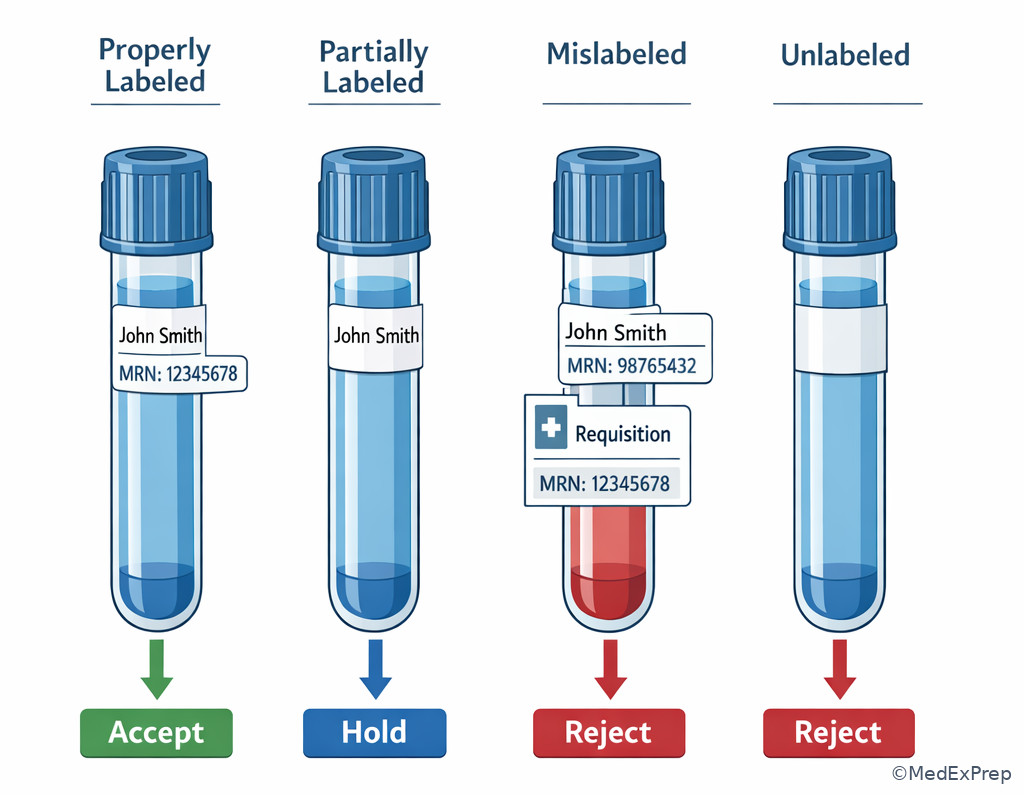
1.1.1.5 Application: accept, hold, reject, or recollect?
A Explanation
Now the decision becomes operational: Which defects permit temporary hold and clarification, and which demand immediate rejection/recollection? The single finding that resolves most stems is whether the original specimen can still be safely tied to one patient without post hoc guesswork. If yes, you may hold and clarify. If no, reject.
WHY THIS IS TESTED: MLS candidates must make safe next-step decisions, not just memorize definitions. Questions often give several plausible actions: call the nurse, relabel the tube, run the test and append a comment, or reject. The best answer depends on whether patient identity itself is intact.
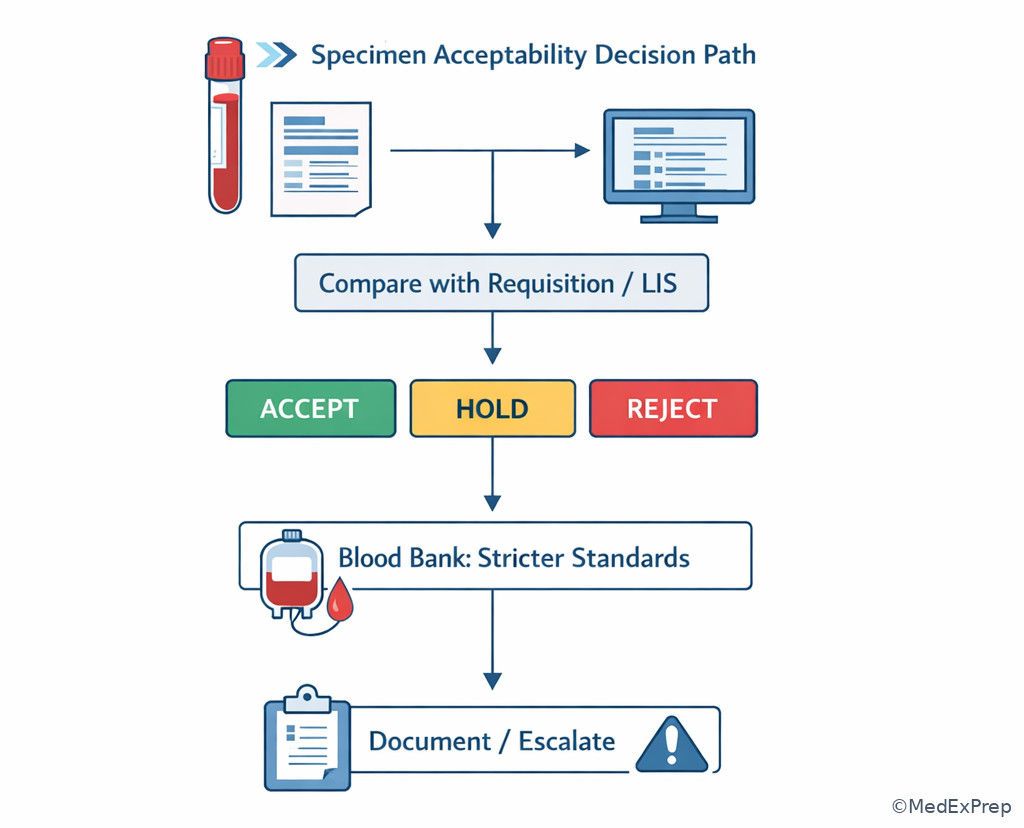
Accept when required identifiers are present and fully match. Hold when there is a discrepancy that may represent an order-entry or accession issue but the original label still clearly identifies one patient; for example, a correct bedside-labeled tube with a LIS transposition error discovered at receipt. Reject when the specimen is unlabeled, labeled with another patient's identity, partially labeled below policy minimum, or collected in a way that broke the identity chain. Recollect when the original identity cannot be restored confidently from the specimen itself.
Do not confuse “urgent test” with “acceptable specimen.” A stat troponin, blood gas, type and screen, or coagulation specimen still requires valid identification. Urgency changes communication priority, not safety rules. See Fig 3 for the accept/hold/reject sorting logic.
Recall: This is the first topic in the course, so there is no prior specimen-integrity lesson to build from. Keep this framework in mind because the next topics on Collection Tubes & Additives and Transport, Storage & Processing will add tube-selection and timing errors on top of the same accept-or-reject logic.
B Worked example
A 73-year-old man with sepsis, atrial fibrillation, and chronic liver disease has a blue-top citrate tube sent for PT/INR. The tube is labeled with full name and medical record number. The electronic order shows the same full name, but the medical record number differs by one transposed digit. Collection date/time and phlebotomist initials are present. The patient is on warfarin, and the unit calls repeatedly because the result is needed quickly before an invasive procedure.
Reasoning chain: Identify task - determine immediate laboratory disposition. Extract key facts - the tube itself identifies one specific patient, but the LIS/order mismatch suggests possible accession or order-entry error. Apply rule - because the tube is labeled and not anonymous, identity may still be resolvable through investigation; do not test-and-release automatically, but also do not relabel casually. Eliminate distractors - urgency does not justify proceeding without verification; recollection may be needed if discrepancy cannot be resolved. Verify - the safest next step is hold the specimen and investigate the mismatch according to policy, escalating if unresolved.
C Exam trap
Common wrong answer: Reject immediately any specimen with a one-digit discrepancy.
Why it is tempting: Strict identity language makes candidates over-apply rejection logic to every mismatch.
Single clue that eliminates it: The specimen is not unlabeled or ambiguously labeled; it still clearly carries a patient identity and may represent an order or accession mismatch that requires a hold-and-investigate step first.
D Checkpoint
Question: A serum tube has full name and MRN that match each other on the tube, but the electronic order contains the same name with a different MRN. What is the most appropriate immediate laboratory action?
- Run the test and report because the patient name matches.
- Rewrite the tube label to match the order.
- Hold the specimen and investigate the discrepancy according to policy before testing/release.
- Discard the specimen without documentation because patient harm could occur.
Answer: C
- A: Tempting because partial agreement exists, but exact matching is required before release.
- B: Tempting because it seems efficient, but the laboratory must not relabel a specimen to force agreement without authorized resolution.
- C: Correct because the specimen identifies a patient, yet a mismatch exists that must be resolved before proceeding.
- D: Tempting because safety matters, but undocumented disposal skips required investigation and traceability.
Practitioner Action: ASSESS whether the defect is identity loss or a mismatch with intact labeling. INTERVENE by holding the specimen when the mismatch may be resolvable and rejecting when identity is broken. REFER unresolved discrepancies for supervisory review. DOCUMENT all communications, mismatch details, and final disposition.
Exam takeaway: A labeled specimen with an order mismatch is usually a hold-and-investigate problem, not an automatic relabel-and-run problem.
flowchart TD
A[Tube and order disagree] --> B{Tube identifies one patient clearly?}
B -- No --> C[Reject and recollect]
B -- Yes --> D[Hold specimen]
D --> E[Review accession entry and source documents]
E --> F{Resolved per policy?}
F -- Yes --> G[Proceed with traceable correction]
F -- No --> H[Recollect and escalate] Exam takeaway: The accession step compares tube, order, and LIS because identity errors are often detected before analysis begins.
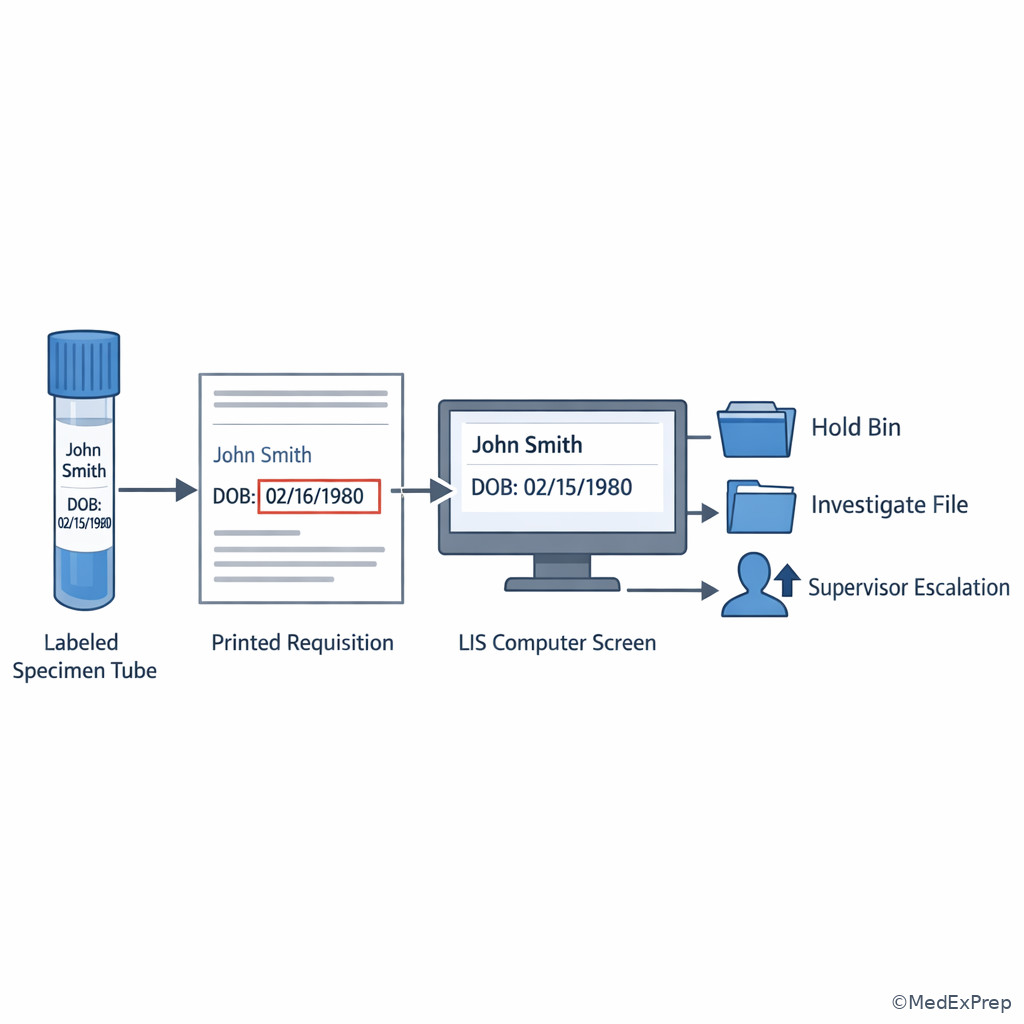
1.1.1.6 Application: special risk situations and transfusion-service strictness
A Explanation
The decision conflict here is whether all specimens are treated equally when labeling is imperfect. They are not. The single rule that resolves these stems is that the higher the downstream patient risk, the lower the tolerance for any identity defect. Pretransfusion testing, blood bank specimens, and some irreplaceable specimens often have stricter institutional rules, but blood bank labeling is the classic exam focus.
WHY THIS IS TESTED: MLS exams emphasize safe scope. In transfusion medicine, a mislabeled or uncertain specimen can lead to incompatible blood issue. Therefore, answers that might seem “reasonable” for routine chemistry become clearly unsafe in blood bank contexts.
For a type and screen, type and crossmatch, or pretransfusion specimen, missing identifiers, conflicting identifiers, or absent required collection details typically trigger rejection and recollection. Do not “correct” the label from the requisition, and do not accept based on prior ABO/Rh history alone. Previous blood type is a useful comparison, not proof of current specimen identity. In many systems, even a near-perfect specimen with one missing required field is unacceptable for transfusion testing because the consequence of error is so severe.
Board stems may also test irreplaceable non-blood specimens, such as CSF or tissue, where policy may differ and escalation is necessary rather than routine discard. The key is still scope: you do not invent exceptions. You follow policy, document, and escalate.
High-Yield Connection: This concept is tested alongside Immunohematology/Transfusion Medicine, especially ABO discrepancy basics and compatibility logic. Know both specimen identity rules and blood bank safety consequences for exam day — they are frequently paired in stems.
Memory anchor: Blood bank = zero guesswork. If a pretransfusion specimen makes you want to “probably accept,” the exam-safe answer is usually to reject and recollect unless policy explicitly states otherwise.
B Worked example
A 59-year-old trauma patient with prior transfusions, coronary artery disease, and chronic anemia has a stat type and screen ordered before surgery. The pink-top specimen label shows full name and MRN, but the date of birth is absent even though local blood bank policy requires full name, MRN, DOB, collection date/time, and collector ID on pretransfusion specimens. The nurse states that the patient is unstable and that the historic blood type in the LIS matches the wristband. A normal platelet count on the CBC is included as a distracting detail.
Reasoning chain: Identify task - pretransfusion specimen acceptability. Extract key facts - missing required blood bank identifier, urgent situation, prior blood type available, local strict policy given. Apply rule - in transfusion-service testing, required labeling elements are enforced strictly because consequences are severe. Eliminate distractors - do not accept using historical blood type; do not add DOB in the lab; do not make an emergency release decision outside role. Verify - reject the specimen for recollection and follow policy-based communication/escalation.
C Exam trap
Common wrong answer: Accept because the historic ABO/Rh matches and surgery is urgent.
Why it is tempting: The stem uses urgency and reassuring history to pressure a convenience decision.
Single clue that eliminates it: The question explicitly states the blood bank policy requires the missing identifier on the pretransfusion specimen.
D Checkpoint
Question: Which statement best reflects MLS handling of a mislabeled pretransfusion specimen?
- Accept if the patient's prior ABO/Rh type matches the current label.
- Rewrite the missing identifier from the wristband if the nurse is present.
- Reject and request recollection according to blood bank policy.
- Issue uncrossmatched blood independently because the specimen defect creates urgency.
Answer: C
- A: Tempting because history can support correlation, but it cannot prove current specimen identity.
- B: Tempting because bedside sources exist, but post-collection lab relabeling is not a safe substitute for proper collection labeling.
- C: Correct because pretransfusion specimens require strict compliance with identity policy.
- D: Tempting because emergency release is a real process, but authorizing it independently is outside entry-level MLS scope unless explicit protocol assigns that step.
Practitioner Action: ASSESS whether the specimen is for routine or pretransfusion use. INTERVENE with rejection/recollection for any required blood bank labeling defect. REFER urgent clinical needs to blood bank supervisory or medical staff per protocol rather than making unsupported exceptions. DOCUMENT the defect, notification, and disposition precisely.
- The most dangerous labeling context tested is pretransfusion testing.
- True or False: Historical ABO/Rh can replace current specimen identification. False.
- Name the deciding question in mismatch stems: Can this original specimen still be confidently linked to one patient?
Exam takeaway: Pretransfusion specimens are handled with the strictest identity standards because wrong-patient labeling can lead to incompatible blood issue.
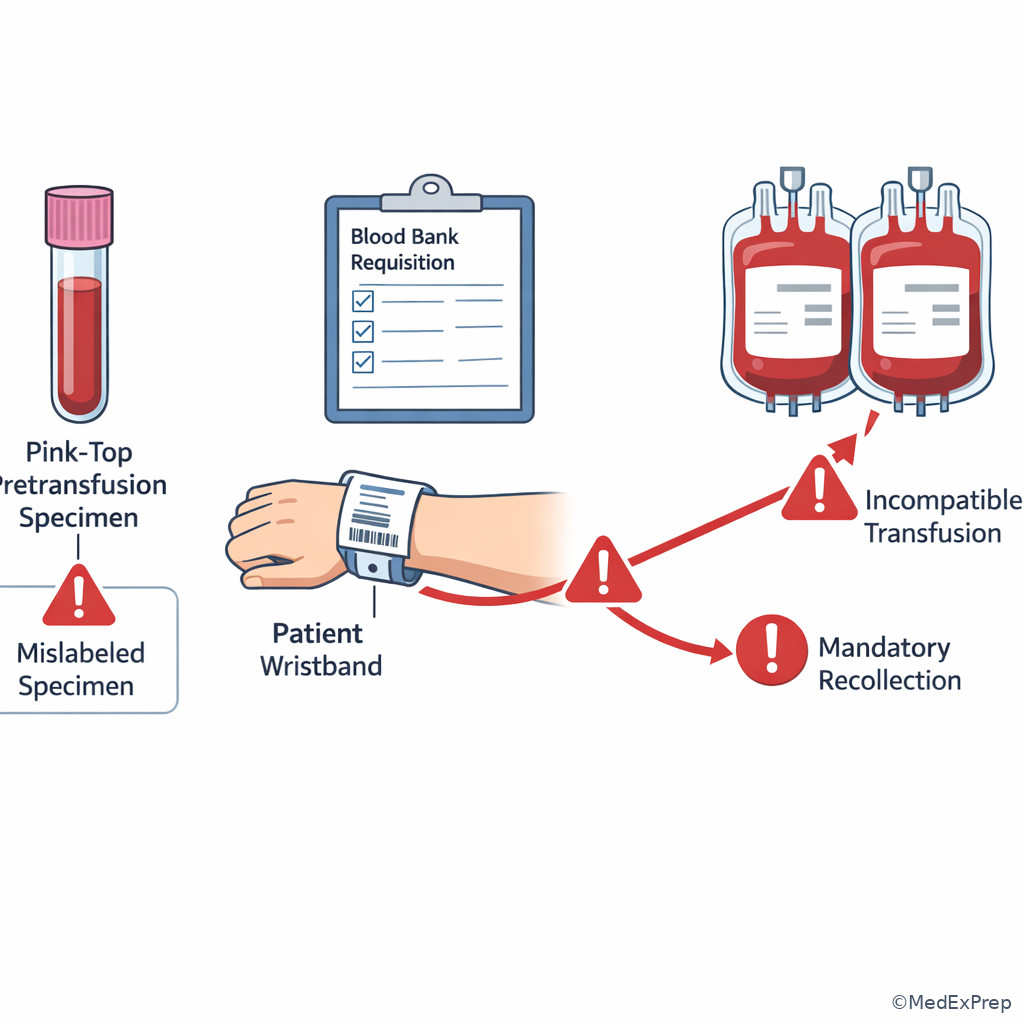
1.1.1.7 Integration: documentation, communication, and scope-safe escalation
A Explanation
The final decision conflict is not whether there is an error, but what the MLS should do next within scope once the error is recognized. The single rule is this: identify the defect, prevent unsafe testing/reporting, document the nonconformance, and escalate according to policy. Do not create your own workaround.
WHY THIS IS TESTED: MLS questions often include plausible but overreaching actions such as changing labels, authorizing clinical exceptions, or releasing with a comment. The exam wants the safest laboratory action that preserves traceability and stays within entry-level role boundaries.
The scope-safe sequence is: hold or reject the specimen, notify the appropriate source area, document the exact problem, and escalate unresolved or high-risk issues. Documentation should include what was wrong, who was notified, when, and what disposition occurred. This matters for patient safety, quality indicators, and regulatory traceability. In some institutions, there may be a specific policy pathway for exceptions involving irreplaceable specimens or witnessed relabeling by the collector. On the exam, if policy is not explicitly given, do not assume a permissive exception exists.
Do not release results from an unacceptable specimen simply because the values “look right.” Analytic accuracy cannot compensate for identity uncertainty. See Fig 1 again: once the identity chain breaks, downstream quality no longer rescues the result. Also see Fig 4 for the mismatch investigation pathway.
High-Yield Connection: This concept is also tested alongside future topics in Critical Values & Delta Checks and Corrective Action Logic. Know when to stop reporting because of identity failure versus when to troubleshoot an analytic problem after identity is secure.
B Worked example
A 44-year-old emergency department patient with asthma, obesity, and dehydration has a green-top plasma specimen for chemistry testing. The accessioner notices the tube label is complete, but the accompanying paper requisition lists a different date of birth. The nurse says the paper form was likely printed for the wrong patient and asks the lab to “just use the tube label since the CMP is needed quickly.” The glucose is critically elevated on repeat instrument check, a distracting clue that may tempt immediate release.
Reasoning chain: Identify task - determine appropriate MLS action within scope. Extract key facts - labeled specimen, conflicting documentation, urgent request, critical-appearing value. Apply rule - do not release from a specimen with unresolved identity discrepancy; hold and investigate because a wrong form or wrong tube remains possible. Eliminate distractors - do not diagnose hyperglycemia, do not release with a note, and do not rewrite the requisition yourself. Verify - safest action is to hold the result, investigate/document the discrepancy, and escalate if unresolved.
C Exam trap
Common wrong answer: Report the verified critical glucose immediately because patient care urgency overrides paperwork concerns.
Why it is tempting: Critical-value culture teaches fast communication, and the result may be analytically reproducible.
Single clue that eliminates it: Critical reporting applies only after the specimen is confirmed acceptable for that patient.
D Checkpoint
Question: After identifying an unacceptable unlabeled specimen, what is the most appropriate MLS action?
- Label it using the requisition because the specimen source is obvious.
- Hold the specimen, notify the collection area, document the nonconformance, and request recollection per policy.
- Run the test and suppress the result until the clinician calls.
- Discard it immediately without entering anything into the LIS to avoid confusion.
Answer: B
- A: Tempting because it seems to solve the problem quickly, but it creates an unsafe laboratory relabeling event.
- B: Correct because it protects patient safety, preserves traceability, and stays within MLS scope.
- C: Tempting because analysis could save time, but testing an unacceptable specimen wastes resources and may create reporting risk.
- D: Tempting because the specimen is unusable, but failing to document the nonconformance breaks quality tracking and communication.
Practitioner Action: ASSESS whether results should be held from release. INTERVENE by stopping unsafe processing and initiating recollection or investigation. REFER high-risk or policy-exception cases to supervisory personnel. DOCUMENT the defect, communication, and final outcome in the LIS/quality system.
Exam takeaway: The laboratory response to a labeling error includes traceable documentation and notification, not just specimen disposal.
Exam Traps & Differentiators
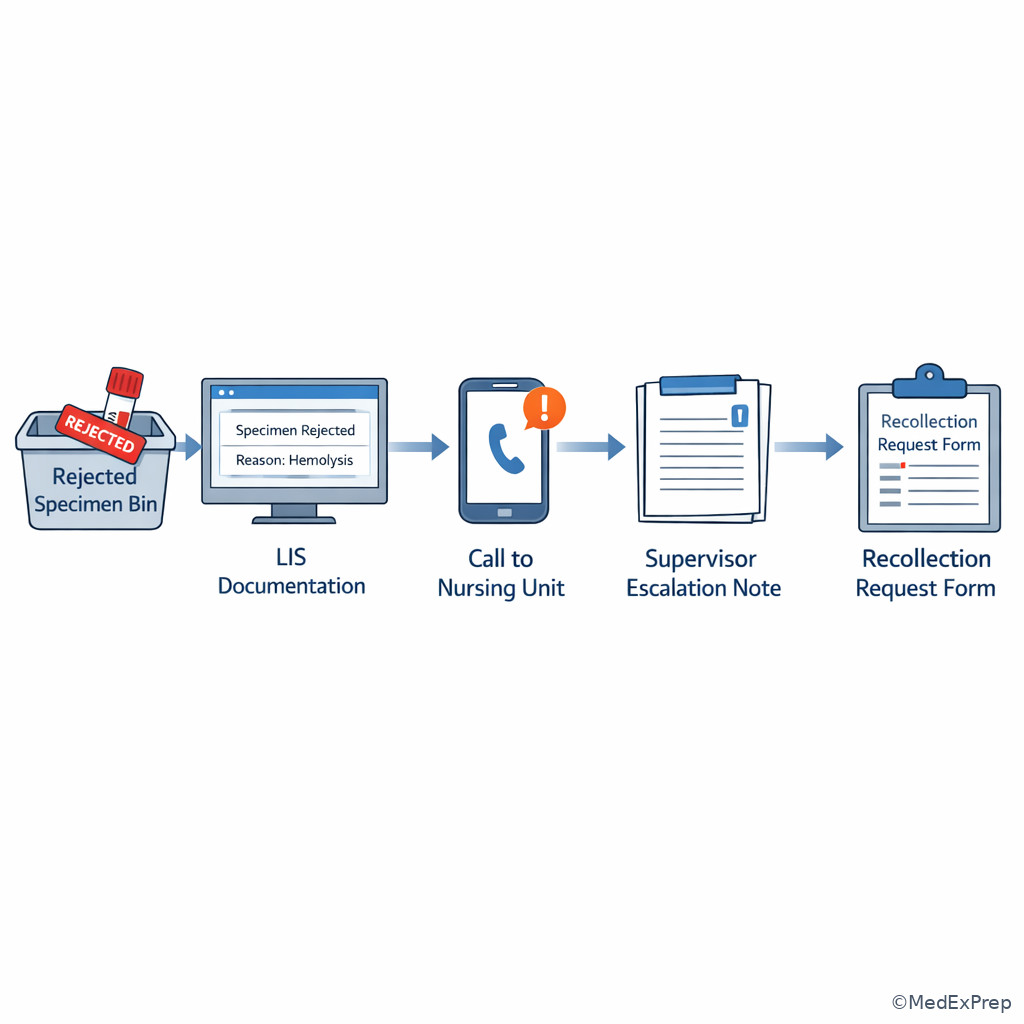
Common traps & distractors: The exam often pairs the right laboratory safety action with a tempting convenience action. Eliminate answers that rely on memory, verbal reassurance, prior results, or relabeling after collection.
- Most common wrong answer and why: “Accept because the requisition is complete.” Tempting because the paperwork looks correct. Wrong because the specimen container itself must securely identify the patient.
- Looks similar but isn't: Missing collector initials versus missing MRN. Both are incomplete labels, but one threatens traceability while the other may break patient identity.
- If the stem says the tube is unlabeled, think reject/recollect, not add a label from the order.
- If the stem says identifiers on the tube and LIS differ, think hold and investigate before testing or release.
- If the stem says the specimen is for blood bank/pretransfusion use, think strictest identity enforcement.
- If the stem says the patient is a stat or critical case, think urgency changes communication priority, not identity rules.
- If the stem says the collector wants to label after leaving the bedside, think broken chain of identity.
- If the stem says historical results match, think reassuring noise, not proof.
| Scenario | Looks like | Actually is | Best MLS action |
|---|---|---|---|
| Tube unlabeled, requisition complete | Simple paperwork mismatch | Identity lost | Reject and recollect |
| Tube has name + MRN, collector initials missing | Major labeling failure | Traceability/documentation defect | Policy-based correction or hold |
| Tube name matches, MRN differs from order | Minor typo to ignore | Mismatch needing investigation | Hold and investigate |
| Pretransfusion specimen missing required DOB | Same as routine chemistry omission | High-risk blood bank rejection scenario | Reject and recollect per policy |
| Collector labels tubes later at station | Workflow efficiency issue only | Identity-chain failure | Do not accept as routine if policy deems invalid |
| Defect type | Key discriminator | Typical disposition | Why exam tests it |
|---|---|---|---|
| Unlabeled specimen | No patient link on tube | Reject/recollect | Tests zero-tolerance identity loss |
| Partially labeled specimen | May or may not meet minimum ID policy | Depends on missing element | Tests identity vs documentation distinction |
| Mislabeled specimen | Tube identifiers conflict with source/order | Hold or reject | Tests investigation versus recollection logic |
| Delayed labeling | Label applied after leaving patient/source | Often reject/recollect per policy | Tests chain-of-identity concept |
| Blood bank label defect | Higher-risk downstream use | Strict rejection/recollection | Tests transfusion-safety priority |
Related future trap: in Collection Tubes & Additives, the specimen may be correctly identified but analytically invalid because the wrong tube was used. In this lesson, the identity problem comes first; a correctly selected tube still cannot be tested if the patient link is unsafe.
Related future trap: in Transport, Storage & Processing, the specimen may be properly labeled but rejected for delay, temperature, or light exposure. Learn to separate who the specimen belongs to from whether the specimen remained stable.
Algorithm / Approach
Exam takeaway: The tube label, not the reassuring clinical context, determines whether identity is secure enough to proceed.
Rapid Review
- Unlabeled tube -> identity lost, not merely incomplete paperwork
- Room number -> location clue, not reliable patient identifier
- Matching requisition with unlabeled tube -> still reject/recollect
- Missing collector initials -> traceability issue, not automatic wrong-patient proof
- One-digit MRN mismatch -> exact match failure, investigate before release
- Delayed labeling after leaving bedside -> broken chain of identity
- Historical matching result -> reassurance only, never identity proof
- Urgent test request -> speeds communication, not specimen acceptance rules
- Blood bank specimen -> strictest labeling enforcement
- MLS scope -> hold/reject/document/escalate, not invent exceptions
- Tube first -> specimen label determines initial acceptability
- Mismatch with intact tube labeling -> hold-and-investigate, not automatic relabel
- Correct tube type but wrong identity -> still unusable
- Critical value from uncertain specimen -> do not report until identity is resolved
Memory anchor: Tube, Match, Risk, Record — check the Tube, confirm Match, consider specimen Risk, and Record the disposition.
Self-check quiz
1. A lavender-top CBC tube arrives with the patient's full name and medical record number on the tube. The requisition matches exactly, but collector initials are missing. What is the best interpretation of this labeling issue?
- The specimen is unlabeled and must be discarded.
- The patient identity is intact, but traceability documentation is incomplete.
- The tube is mislabeled because two identifiers are not enough without initials.
- The specimen must be accepted without any further review because name and MRN are present.
2. Which item is the least appropriate to use as one of the primary patient identifiers on a specimen tube?
- Date of birth
- Medical record number
- Room number
- Full patient name
3. A 62-year-old inpatient with CHF and chronic kidney disease has a green-top tube for electrolytes. The tube is unlabeled, but the requisition includes full name, DOB, and MRN. The nurse says she drew only one patient during that round and can label it now. What is the most appropriate next laboratory step?
- Accept the specimen because the nurse can verify the patient identity verbally.
- Label the tube from the requisition and proceed because the order is complete.
- Reject the specimen and request recollection according to policy.
- Run the test first, then decide whether the result pattern fits the patient.
4. A 71-year-old patient with cirrhosis and atrial fibrillation has a blue-top PT/INR specimen. The tube label has full name and MRN, but the electronic order has the same name with an MRN differing by one digit. The unit calls to request rapid release before a procedure. What is the best laboratory action?
- Release the result because the patient name matches and the test is urgent.
- Hold the specimen and investigate the discrepancy before testing or release.
- Rewrite the order MRN to match the tube label because the difference is small.
- Discard the specimen immediately without documenting the event.
5. A phlebotomist verifies two identifiers correctly, draws specimens from two adjacent patients, and labels both sets later at the nursing station. Both labels appear complete. Which interpretation best fits the scenario?
- The workflow is acceptable because identity was verified before each draw.
- The workflow is acceptable if the results are consistent with prior values.
- The delayed labeling creates a chain-of-identity failure that may require rejection per policy.
- The problem is analytic, not preanalytic, because labeling is ultimately complete.
6. A 56-year-old trauma patient with prior transfusions, CAD, and chronic anemia has a stat type and screen ordered. The pink-top tube has full name and MRN but lacks DOB; local blood bank policy requires full name, MRN, DOB, collection date/time, and collector ID. The historic blood type in the LIS matches the wristband. What is the most appropriate MLS action?
- Accept the specimen because historical ABO/Rh agreement lowers the risk.
- Reject the specimen and request recollection according to blood bank policy.
- Add the DOB from the wristband because the patient is in the ED and transfusion may be needed.
- Issue uncrossmatched blood independently because the specimen defect makes the situation emergent.
7. A 44-year-old ED patient with obesity, asthma, and dehydration has a chemistry specimen with a complete tube label. The paper requisition lists a different DOB than the tube, and the CMP shows a critically high glucose on repeat analysis. The nurse says the paper requisition is probably wrong and asks the lab to report immediately. What is the best next step?
- Report the critical glucose at once because repeat analysis confirmed the value.
- Hold the result, investigate the identity discrepancy, document the event, and escalate per policy if unresolved.
- Correct the requisition to match the tube because the specimen label is probably right.
- Cancel the order and discard the specimen without calling because identity questions make all results unusable.
8. A serum tube for a 35-year-old outpatient with lupus and iron deficiency arrives with full name and DOB on the tube. Local policy requires two patient identifiers, one of which must be a unique numeric identifier. The requisition includes a matching MRN, and the draw site states they can fax a corrected copy of the order immediately. What is the most appropriate interpretation?
- The specimen is acceptable because there are two identifiers on the tube, even though one is not numeric.
- The specimen is acceptable because the requisition supplies the missing numeric identifier.
- The specimen does not meet policy because the tube lacks the required unique numeric identifier.
- The specimen should be accepted if the chemistry results match previous values in the LIS.
Answer key
1. Answer: B
- A: Tempting because missing label elements can feel severe, but the tube is not unlabeled; the patient link is present. The discriminating clue is that full name and MRN are already on the tube.
- B: Correct because the required patient identity is intact while collector initials affect traceability/accountability. The discriminating clue is that the missing element is not the patient identifier itself.
- C: Tempting because some labs require additional fields, but two valid patient identifiers usually satisfy identity linkage. The discriminating clue is that initials are not the same as patient identifiers.
- D: Tempting because the main identity requirement is met, but “without further review” is too broad; policy may still require documentation correction. The discriminating clue is the phrase “best interpretation,” not immediate final disposition.
Rationale: This question separates patient identity from specimen traceability. MLS practice standards require secure patient identification on the specimen itself before testing. Missing collector initials may still be a defect, but it is not equivalent to an unlabeled or wrong-patient specimen. Authoritative laboratory quality guidance emphasizes traceable labeling and documentation while prioritizing patient identity as the first safety checkpoint.
2. Answer: C
- A: Tempting because DOB can occasionally be missing in some settings, but it is widely used as a valid patient identifier. The discriminating clue is that DOB identifies the patient, not the location.
- B: Tempting because numbers can be transposed, but MRN is a standard unique identifier when accurate. The discriminating clue is uniqueness.
- C: Correct because room number is not reliably unique and can change. The discriminating clue is that location is not patient identity.
- D: Tempting because names can duplicate, but full name remains a standard identifier when paired with another unique one. The discriminating clue is that the question asks for the least appropriate item.
Rationale: The exam commonly tests the difference between true patient identifiers and contextual information. Room or bed number may help locate a patient but should not serve as a primary identifier because patients move and rooms are reused. Laboratory and patient-safety guidance consistently support use of stable, patient-specific identifiers rather than location-based markers.
3. Answer: C
- A: Tempting because the nurse appears confident and only one patient was drawn, but verbal reassurance after collection does not restore an unlabeled tube's identity. The discriminating clue is that the tube is completely unlabeled.
- B: Tempting because the requisition is complete, but labeling from paperwork after the fact is unsafe. The discriminating clue is that identity must be on the original specimen container, not added retrospectively by lab staff.
- C: Correct because an unlabeled specimen cannot be safely linked to the patient and requires recollection under standard policy. The discriminating clue is the absent tube label.
- D: Tempting because analyzers could generate useful numbers, but result plausibility cannot prove patient identity. The discriminating clue is that preanalytic identity failure must be resolved before testing.
Rationale: Unlabeled specimens are among the highest-risk preanalytic events. The MLS must protect patient safety by rejecting the specimen and requesting recollection, not by reconstructing identity from recollection or documentation. Laboratory operations standards and accreditation expectations support rejection/documentation pathways for unlabeled samples to preserve traceability and prevent wrong-patient reporting.
4. Answer: B
- A: Tempting because urgency and partial agreement feel reassuring, but exact matching is required before release. The discriminating clue is the one-digit MRN discrepancy.
- B: Correct because the tube still identifies one patient, yet an order mismatch exists that requires investigation before testing/release. The discriminating clue is that the specimen is labeled, not anonymous.
- C: Tempting because the discrepancy seems minor, but rewriting identifiers without traceable resolution is unsafe. The discriminating clue is that the laboratory must investigate, not force agreement.
- D: Tempting because safety matters, but immediate undocumented discard bypasses required nonconformance handling. The discriminating clue is that a labeled specimen with a discrepancy may still be investigable.
Rationale: This question tests the middle category between accept and reject. A clearly labeled specimen with an order/LIS mismatch is usually a hold-and-investigate problem because the mismatch may stem from accession or order entry. Safe MLS practice requires preventing release until exact identity is verified, with documentation and escalation as needed. Quality-system standards emphasize controlled discrepancy resolution rather than ad hoc relabeling.
5. Answer: C
- A: Tempting because the collector did verify identifiers correctly at first, but verification alone is not enough if labeling is delayed after collection. The discriminating clue is that the tubes were labeled later at the station.
- B: Tempting because prior consistency can feel validating, but matching results do not prove specimen identity. The discriminating clue is the post-collection unlabeled interval involving more than one patient.
- C: Correct because delayed labeling after collection, especially across multiple patients, breaks the secure identity chain and may require rejection under policy. The discriminating clue is batching unlabeled specimens.
- D: Tempting because final labels are present, but the problem occurred before analysis and is therefore preanalytic. The discriminating clue is workflow timing, not assay performance.
Rationale: Bedside labeling timing is a classic specimen-integrity concept. Even when initial patient identification is correct, delayed labeling creates an interval where collected tubes can be mixed or mislabeled. Phlebotomy and accreditation guidance emphasize immediate in-presence labeling to preserve chain of identity. The laboratory response is policy-based hold or rejection, not reliance on memory or result plausibility.
6. Answer: B
- A: Tempting because historical ABO/Rh agreement sounds reassuring in an urgent context, but prior typing does not prove current specimen identity. The discriminating clue is that blood bank policy explicitly requires the missing DOB.
- B: Correct because pretransfusion specimens are handled under strict labeling rules, and a missing required identifier mandates rejection/recollection per policy. The discriminating clue is the stated local blood bank requirement.
- C: Tempting because the missing information is available, but adding identifiers after collection in the lab does not replace proper specimen labeling. The discriminating clue is that the defect is on the original pretransfusion specimen.
- D: Tempting because emergency transfusion processes exist, but independently issuing uncrossmatched blood is outside entry-level MLS scope unless explicit protocol authorizes that action. The discriminating clue is the role boundary.
Rationale: Blood bank specimens are tested with heightened caution because misidentification can directly cause incompatible transfusion. Standard transfusion-service practice requires strict specimen labeling and recollection when required elements are absent. The laboratory professional's responsibility is to enforce policy, communicate urgency through proper channels, and escalate rather than create unauthorized exceptions. AABB-oriented transfusion safety principles strongly support strict identity control.
7. Answer: B
- A: Tempting because the result is critical and analytically confirmed, but critical reporting applies only after specimen identity is established. The discriminating clue is the unresolved DOB discrepancy between requisition and tube.
- B: Correct because the safest action is to hold release, investigate the identity conflict, document it, and escalate if necessary. The discriminating clue is that the specimen has a documentation mismatch affecting identity confidence.
- C: Tempting because the tube may indeed be correct, but the MLS should not independently alter source documentation to force agreement. The discriminating clue is the need for controlled investigation, not assumption.
- D: Tempting because safety could justify cancellation, but immediate discard without communication or investigation is not the best process response when a labeled specimen may be resolvable. The discriminating clue is that the tube itself is labeled, so investigation comes before disposal.
Rationale: This question integrates identity, critical result handling, and scope. A reproducible critical result does not override specimen acceptability requirements. The MLS must pause reporting until the patient-specimen-order link is secure, document the nonconformance, and escalate per policy. Quality-system standards support traceable discrepancy resolution and prohibit unsafe release based solely on analytic repeatability.
8. Answer: C
- A: Tempting because two data points are present, but the question gives a policy requiring one identifier to be a unique numeric ID. The discriminating clue is the explicit local policy requirement.
- B: Tempting because the requisition contains the needed MRN, but the specimen tube itself lacks the required numeric identifier. The discriminating clue is that requisitions do not substitute for missing required tube identifiers.
- C: Correct because the specimen does not meet stated policy even though two identifiers appear on the tube. The discriminating clue is that not all identifier combinations satisfy every policy.
- D: Tempting because prior values may correlate, but result consistency never substitutes for compliance with specimen-label policy. The discriminating clue is that historical agreement is only supportive noise.
Rationale: This stem tests an important nuance: some institutions specify not just the number of identifiers but the type of identifier required. When the policy states that one identifier must be a unique numeric ID, full name plus DOB is insufficient even though both identify the patient. Entry-level MLS practice requires applying the policy given in the stem, not generalizing from looser rules elsewhere. Accreditation-minded quality systems rely on exact policy adherence for specimen acceptability.
Keep going with the full ASCP MLS Prep Course (MLS)
You just studied the way members do, in the same lesson interface. Full access unlocks every lesson, the question bank and flashcards for a full year.
One payment · 1 year of access · No auto-renewal