1.1.1 - HT Scope Of Practice
HT Scope Of Practice
What you’ll learn
- COMPETENCY: Professional Practice -> HT scope boundaries — distinguish routine bench responsibilities from pathologist-, supervisor-, and director-level decisions.
- COMPETENCY: Specimen Workflow -> within-scope actions — identify what an HT should verify, perform, document, and escalate during the specimen-to-slide process.
- COMPETENCY: Quality Systems -> corrective action limits — choose appropriate troubleshooting steps allowed by SOP and reject unauthorized process changes.
- COMPETENCY: Safety -> risk recognition and response — apply HT-first safety actions for chemical, sharps, and biohazard hazards.
- COMPETENCY: Exam Strategy -> scope-aware answer selection — identify when the best exam answer is to stop, document, and escalate rather than continue processing.
- Domain: Professional practice and workflow reasoning → HT bench responsibilities and escalation boundaries
- Domain: Specimen identification and accession workflow → accept/reject/escalate decisions
- Domain: Quality control and quality assurance → corrective action within procedure
- Domain: Laboratory safety and regulatory practice → hazard recognition, containment, and documentation
Why it matters
- Many HT questions are not testing diagnosis; they are testing whether you protect specimen integrity, patient identification, and slide quality.
- The most tempting wrong answers often sound proactive but are outside HT authority, such as independently changing policy, accepting identifier discrepancies, or making interpretive decisions.
- Scope-of-practice reasoning anchors the entire course: fixation, processing, microtomy, staining, QC, and safety all depend on knowing what you may correct yourself versus what must be escalated.
- On the exam, the safest and highest-yield answer is often the one that preserves chain of identification and follows SOP, even if another option sounds faster.
Key rule: Think like an entry-level histotechnician at the bench: verify, perform approved routine steps, document, and escalate when the problem exceeds SOP, scope, or specimen safety.
Key Terms & Must-Know Facts
1.1.1.1 Key terms
- Scope of practice: the boundaries of tasks an HT may perform under established procedure.
- SOP: standard operating procedure governing approved workflow steps.
- Escalation: referral of a discrepancy, unsafe condition, or unresolved technical failure to authorized personnel.
- Chain of identification: continuous specimen-label linkage from receipt through slide release.
- Corrective action: documented response to QC or workflow failure within approved limits.
- Specimen discrepancy: any mismatch, omission, ambiguity, or irreconcilable identifier problem.
- QC: operational checks that confirm a process is performing acceptably.
- QA: broader system oversight intended to reduce recurring defects.
- Artifact: non-diagnostic change introduced by handling, processing, sectioning, or staining.
- Bench-level troubleshooting: routine correction allowed by procedure, such as reagent replacement or repeating a stain run when permitted.
- Out-of-scope action: a task reserved for a pathologist, supervisor, director, or authorized designee.
- Specimen integrity: preservation of tissue identity and morphology.
- Documentation: required written or electronic recording of actions, QC, and discrepancies.
1.1.1.2 Must-know facts
- HT exam answers should stay rooted in routine histotechnology bench practice, not diagnosis or patient management.
- An HT does not accept mislabeled or irreconcilable specimens just to keep turnaround moving.
- Failed QC is never ignored; the process is held, corrective action is taken per SOP, and findings are documented.
- If a problem can be corrected by approved procedure, do it and document it; if not, escalate.
- Changing validated methods, reagent criteria, or acceptance thresholds without authorization is outside HT scope.
- Safety events involving formaldehyde, xylene, blades, or biohazards require immediate control of risk before workflow continuation.
- The pathologist interprets tissue; the HT ensures the slide is correctly prepared, labeled, and suitable for review.
- Local procedures vary, but the exam tests stable principles: preserve identity, preserve morphology, follow SOP, and escalate appropriately.
Exam takeaway: Use this framework to separate perform-now tasks from stop-and-escalate situations.
flowchart TD
A[Question stem] --> B{Is the task routine bench work under SOP?}
B -->|Yes| C{Any identifier, safety, or failed QC issue?}
B -->|No| D[Escalate to authorized personnel]
C -->|No| E[Perform and document]
C -->|Yes| F{Correctable by approved procedure?}
F -->|Yes| G[Correct, verify, document]
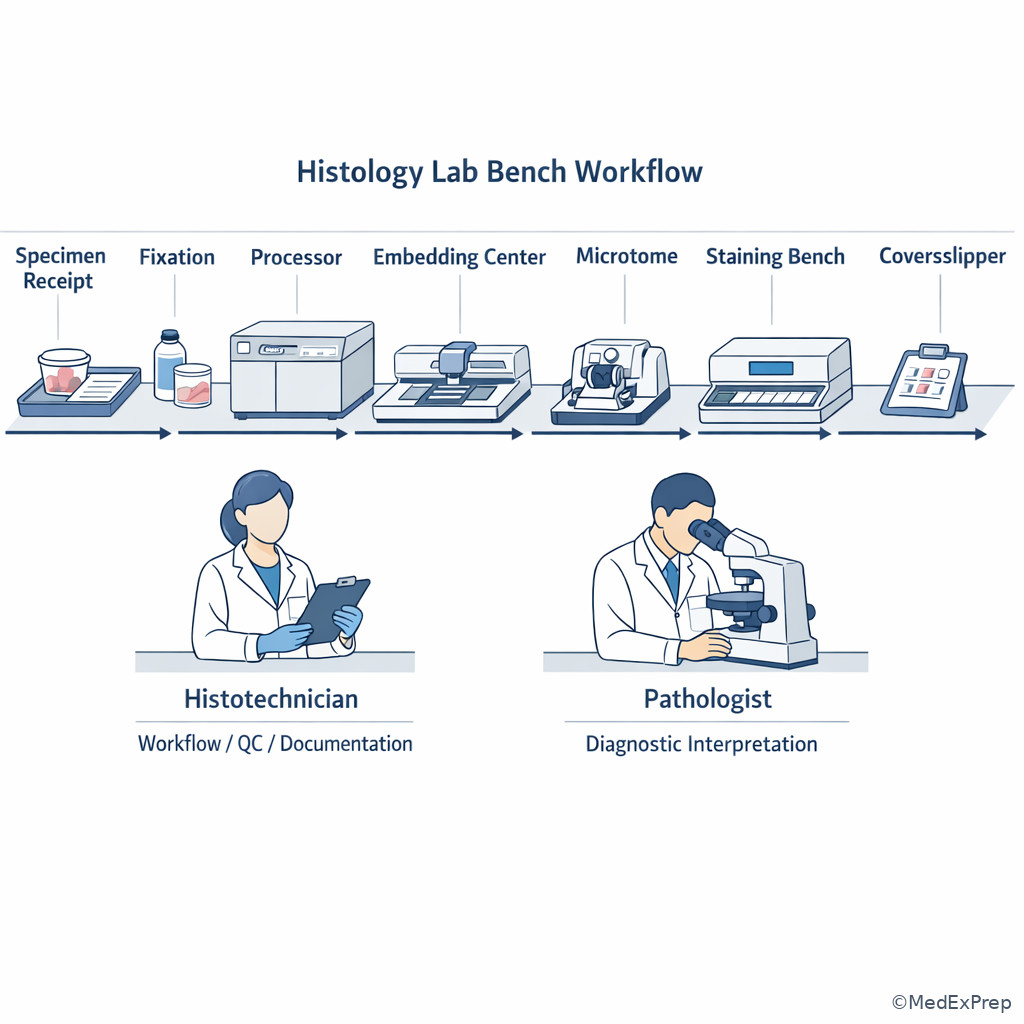
F -->|No| D Exam takeaway: Visual role separation helps you reject answers that drift into diagnosis or unauthorized method changes.
Core content
1.1.1.3 Foundational boundary: what the HT does vs what the HT must not do
A Explanation
The decision conflict here is simple but heavily tested: do you act independently, or do you stay within routine bench authority? The resolving rule is whether the task is part of the approved specimen-to-slide workflow under SOP. An HT may verify identifiers, process tissue, embed, cut, stain, perform routine QC, recognize artifacts, document findings, and escalate unresolved issues. An HT does not diagnose tissue, sign out results, determine patient treatment, validate new methods independently, or override identification policy. See Fig 1.
WHY THIS IS TESTED: exam writers build distractors that reward action-oriented learners who want to “fix everything.” The correct answer often depends on rejecting an answer that sounds decisive but crosses into pathologist, supervisor, or director authority. In histotechnology, good practice is not maximal independence; it is controlled, documented, SOP-based action.
Choose the answer that protects the specimen and the patient even if it delays workflow. Reject answers that include phrases such as “interpret the biopsy,” “release the result,” “change the protocol,” or “accept the mismatch and proceed.” For this exam, the HT role is procedural and quality-focused.
Memory anchor: PVED = Perform routine steps, Verify identifiers/QC, Escalate what exceeds SOP, Document everything. If an answer does not fit PVED, be suspicious.
Recall: This is the first lesson, so there is no prior topic to build from. In the next lesson on ASCP HT Exam Emphasis, we will narrow this broad scope rule into the exact bench-heavy question patterns you should expect.
B Worked example
A 58-year-old patient’s colon biopsy arrives for routine histology. The cassette label matches the requisition accession number, but the container has a handwritten suffix that is not present in the LIS. The tissue appears adequately fixed. A new resident standing nearby says the sample is probably fine and asks you to proceed so the pathologist can review it sooner. The stem asks for the most appropriate next step.
Reasoning chain: Identify the task → specimen acceptance and workflow control. Extract key facts → identifier discrepancy exists; fixation adequacy is irrelevant noise; resident reassurance is a tempting-but-wrong clue because residents do not override policy. Apply the rule → an HT must not accept an irreconcilable or ambiguous identifier mismatch. Eliminate distractors → proceeding with processing, annotating the suffix yourself, or asking the pathologist to diagnose from the tissue all bypass chain-of-identification rules. Verify → the correct action is to hold the specimen, follow discrepancy policy, document the issue, and escalate to authorized personnel for resolution.
C Exam trap
Common wrong answer: Proceed because the tissue is present and appears well fixed.
Why it is tempting: learners overvalue morphology and turnaround time, assuming technical quality can compensate for paperwork inconsistency.
Single clue that eliminates it: the identifier mismatch. Identity control outranks convenience and even apparent tissue adequacy.
D Checkpoint
Question: Which task is most clearly within routine HT scope?
- Interpret the frozen section to determine whether the lesion is malignant.
- Modify the laboratory’s validated H&E differentiation time because slides look a little dark today.
- Document weak control staining, replace an exhausted reagent if allowed by SOP, and repeat the run.
- Release the final pathology report once the slide quality appears acceptable.
Answer: C
- A: Tempting because HTs see the tissue first, but interpretation for diagnosis belongs to the pathologist.
- B: Tempting because it sounds like troubleshooting, but changing a validated parameter on your own exceeds routine authority.
- C: Correct because it is bench-level corrective action tied to QC, SOP, and documentation.
- D: Tempting because slide preparation is complete, but report release is outside HT scope.
Practitioner Action: ASSESS whether the task is routine bench work under SOP. INTERVENE only with approved technical actions. REFER interpretive, policy, or unresolved issues to the supervisor, pathologist, or authorized designee. DOCUMENT the discrepancy, action taken, and handoff.
1.1.1.4 Foundational boundary: specimen identification, acceptance, and chain of control
A Explanation
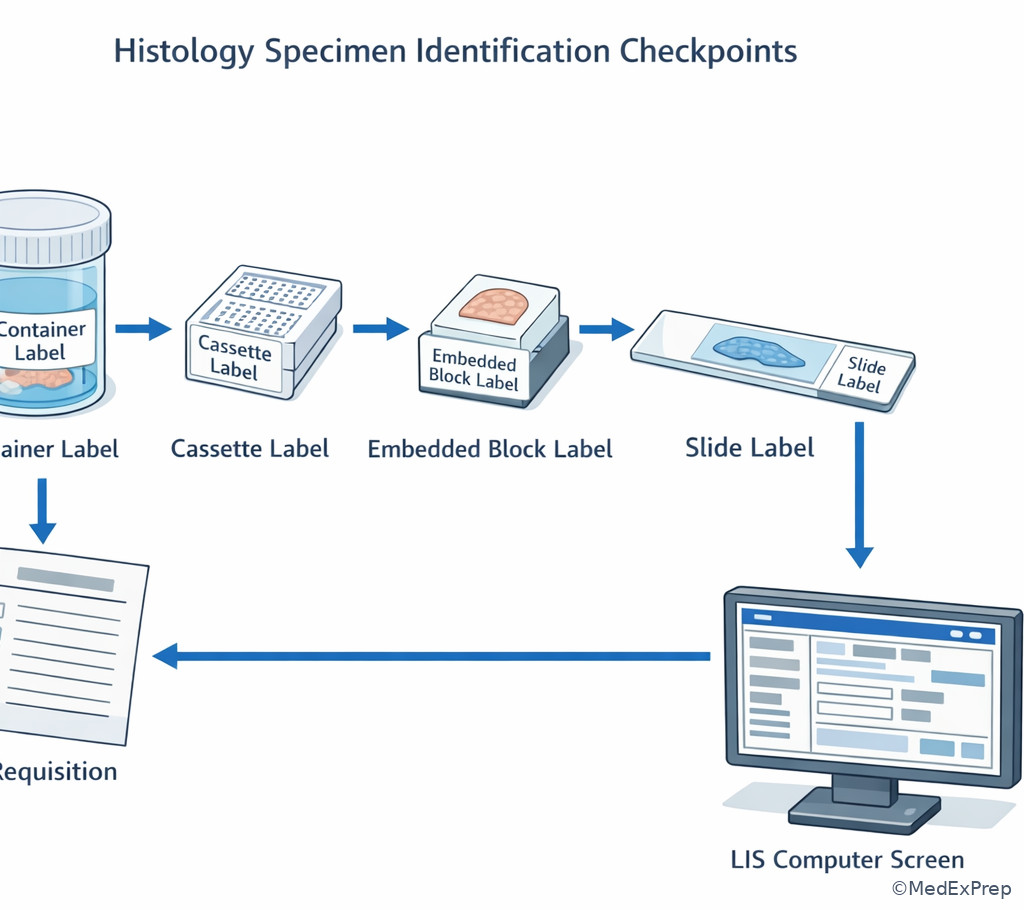
The decision conflict is continue the workflow vs stop the workflow. The single resolving rule is whether patient and specimen identity remain reliable at every handoff. If identifiers are complete and concordant, the HT proceeds. If labels are missing, conflicting, ambiguous, or otherwise irreconcilable, the HT holds the specimen and follows discrepancy policy. See Fig 2.
WHY THIS IS TESTED: chain-of-identification errors cause the most consequential laboratory failures. Board-style questions often distract you with clinically interesting tissue type, urgency, or apparent fixation quality. Those details do not rescue a compromised identifier chain. The exam wants you to recognize that an HT protects identity before morphology.
Within scope, an HT may compare the container, cassette, slide, requisition, and LIS; ensure required identifiers are present per institutional policy; and document discrepancies. Outside scope is unilateral acceptance of a mismatch, relabeling without authorization, or inventing an identifier based on context clues. When in doubt, hold and escalate.
High-Yield Connection: This concept is tested alongside Specimen-To-Slide Workflow. Know both the order of technical steps and the rule that any unresolved identity problem stops the sequence before fixation, embedding, cutting, or staining continue.
B Worked example
A 72-year-old patient with diabetes and chronic kidney disease has two skin punch biopsies submitted at the same time. The requisition lists “left forearm” and “right forearm,” but one cassette is labeled only with the accession number and no site designation. The tissue fragments appear similar in size, and another technologist suggests guessing based on the order listed on the requisition. A mild delay in gross room delivery is also mentioned. What is the most appropriate action?
Reasoning chain: Identify the task → specimen site identification and workflow continuation. Extract key facts → paired specimens require correct site linkage; missing site label creates ambiguity; delivery delay is irrelevant noise. Apply the rule → never guess specimen identity from order or appearance. Eliminate distractors → processing both and adding a note later, assigning the likely site, or asking the pathologist to infer the site from histology all violate identity control. Verify → hold the case, document the discrepancy, and escalate per policy.
C Exam trap
Common wrong answer: Use the requisition order to infer which cassette belongs to which site.
Why it is tempting: in daily workflow, sequence often matches paperwork, so the inference feels practical.
Single clue that eliminates it: there are multiple specimens from the same patient, making site assignment inseparable from labeling accuracy.
D Checkpoint
Question: Which finding most strongly requires holding a specimen rather than continuing routine processing?
- The tissue is small and may be difficult to orient.
- The fixative volume seems lower than ideal, but identifiers are complete and tissue is already received.
- The cassette accession number does not match the specimen container accession number.
- The clinician requests rapid turnaround for same-day review.
Answer: C
- A: Tempting because orientation matters, but it is a technical challenge, not an identity stop signal.
- B: Tempting because fixation affects quality, but mismatched identifiers carry higher immediate risk than a process variable to document and address.
- C: Correct because a direct accession mismatch breaks chain of identification and requires discrepancy resolution.
- D: Tempting because urgency pressures workflow, but urgency never overrides identifier policy.
- The highest-priority preanalytic rule in histotechnology is preserve specimen identity.
- True or False: If tissue appears adequate, a minor label discrepancy can be corrected later. False.
- Name the three actions for an irreconcilable discrepancy: hold, document, escalate.
Practitioner Action: ASSESS all identifiers at each handoff. INTERVENE by stopping the process when identity is uncertain. REFER discrepancies to authorized personnel under policy. DOCUMENT the mismatch, time discovered, specimen status, and notification pathway.
Exam takeaway: Any unresolved identifier mismatch beats urgency, tissue appearance, and turnaround pressure.
flowchart TD
A[Specimen received] --> B{Container, cassette, requisition, LIS all match?}
B -->|Yes| C[Proceed to routine workflow]
B -->|No| D{Discrepancy resolvable by policy and authorized verification?}
D -->|Yes| E[Resolve, document, continue if permitted]
D -->|No| F[Hold specimen and escalate]
F --> G[Do not relabel by guesswork] Exam takeaway: Mentally tracing identifiers at every handoff helps prevent the common exam error of fixing a technical issue while missing a labeling failure.
1.1.1.5 Application: bench troubleshooting, QC, and the limit of independent corrective action
A Explanation
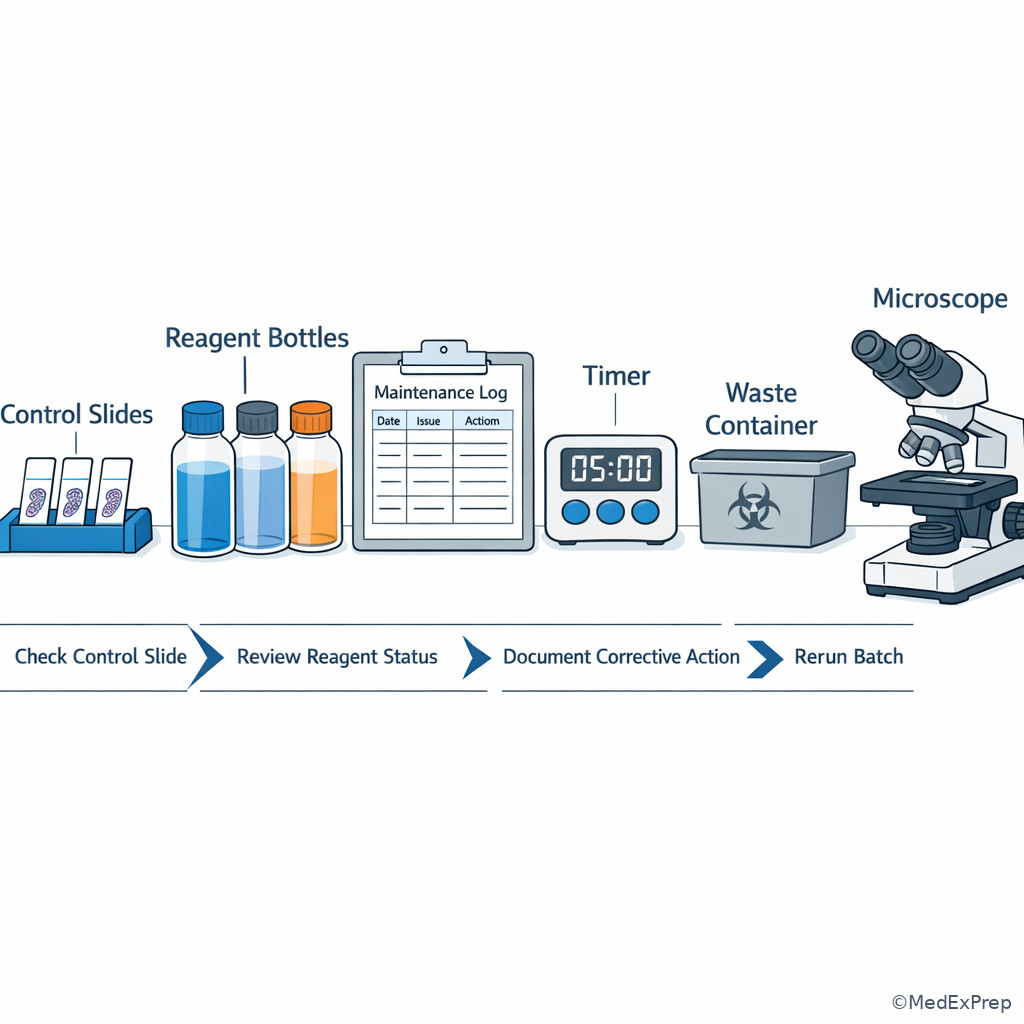
The decision conflict is correct the problem yourself vs stop and escalate. The single resolving rule is whether the corrective action is already authorized in SOP and whether the result can be verified by routine QC. HTs are expected to troubleshoot many daily issues: replacing a known exhausted reagent, rerunning a stain after allowed corrective action, checking water bath temperature, cleaning carryover per procedure, or documenting a failed control and repeating the run. See Fig 3.
WHY THIS IS TESTED: exam stems often include an obvious technical failure and then tempt you with an unauthorized “creative fix.” The right answer is not the most technically sophisticated option; it is the most controlled option that stays inside validated process limits. Bench troubleshooting is appropriate. Independent method redesign is not.
Choose an answer that references control slides, reagent status, maintenance checks, repeat performance, documentation, and supervisor notification when the issue persists. Reject options that suggest changing accepted cutoff criteria, using substitute reagents not in procedure, recalibrating a process without authorization, or reporting results despite failed QC.
Memory anchor: QCV = Question the failure, Correct only per SOP, Verify before release. If you cannot verify, you cannot continue.
High-Yield Connection: This concept is tested alongside ASCP HT Exam Emphasis and later with Stain Quality Control. Know both the technical cause of weak or uneven staining and the scope rule that failed controls require action before slides go forward.
B Worked example
A 44-year-old patient’s gastric biopsy is included in a morning H&E batch. The positive control slide shows weak nuclear staining, and several patient slides appear pale. The reagent log suggests the hematoxylin may be near end of use life. A coworker recommends increasing differentiation time on the next run because the eosin looks balanced. The case also includes a note that the patient has anemia, which is irrelevant to the bench question. What is the most appropriate corrective action?
Reasoning chain: Identify the task → batch QC failure response. Extract key facts → weak control nuclei, likely reagent exhaustion, multiple slides affected; patient anemia is noise; changing differentiation time targets the wrong step. Apply the rule → hold the run, replace or refresh reagent if allowed by SOP, repeat the stain, verify acceptable control performance, and document. Eliminate distractors → sending pale slides to the pathologist, changing a different stain parameter, or altering acceptance criteria all fail the QC-first rule. Verify → acceptable control recovery is required before routine release.
C Exam trap
Common wrong answer: Adjust a nearby process variable that seems related, such as differentiation or bluing, without first addressing the failed control.
Why it is tempting: learners recognize an H&E issue and want to manipulate the stain sequence quickly.
Single clue that eliminates it: the control slide is weak in the same direction as the patient slides, pointing to batch failure that requires QC-based correction, not guesswork.
D Checkpoint
Question: Which action best stays within HT scope after a routine stain control fails?
- Release the slides because the tissue architecture is still visible.
- Substitute a nonapproved reagent from another bench because it should work similarly.
- Perform the SOP-approved corrective action, rerun the stain, verify the control, and document.
- Change the laboratory’s acceptance threshold for control intensity for the rest of the shift.
Answer: C
- A: Tempting because some morphology remains visible, but failed QC means the process is not yet acceptable.
- B: Tempting because it sounds practical, but an unapproved substitute exceeds routine authority.
- C: Correct because it matches bench troubleshooting within validated procedure.
- D: Tempting because it seems like problem-solving, but only authorized personnel can change criteria.
Practitioner Action: ASSESS whether the failure affects controls, patient slides, or instruments. INTERVENE with approved corrective steps only. REFER persistent failure or nonprocedural fixes to supervisory authority. DOCUMENT the QC failure, corrective action, repeat results, and disposition of affected slides.
Exam takeaway: Fix only what SOP allows, then verify with controls before the batch moves forward.
flowchart LR
A[QC failure found] --> B[Hold affected run]
B --> C{Approved corrective action exists?}
C -->|Yes| D[Replace/check/clean/repeat per SOP]
C -->|No| E[Escalate]
D --> F{Control acceptable on repeat?}
F -->|Yes| G[Document and release]
F -->|No| E Exam takeaway: Visualizing controls, logs, and reagent checkpoints helps you choose verification-based answers over improvised fixes.
1.1.1.6 Application: safety, exposure response, and when workflow must stop
A Explanation
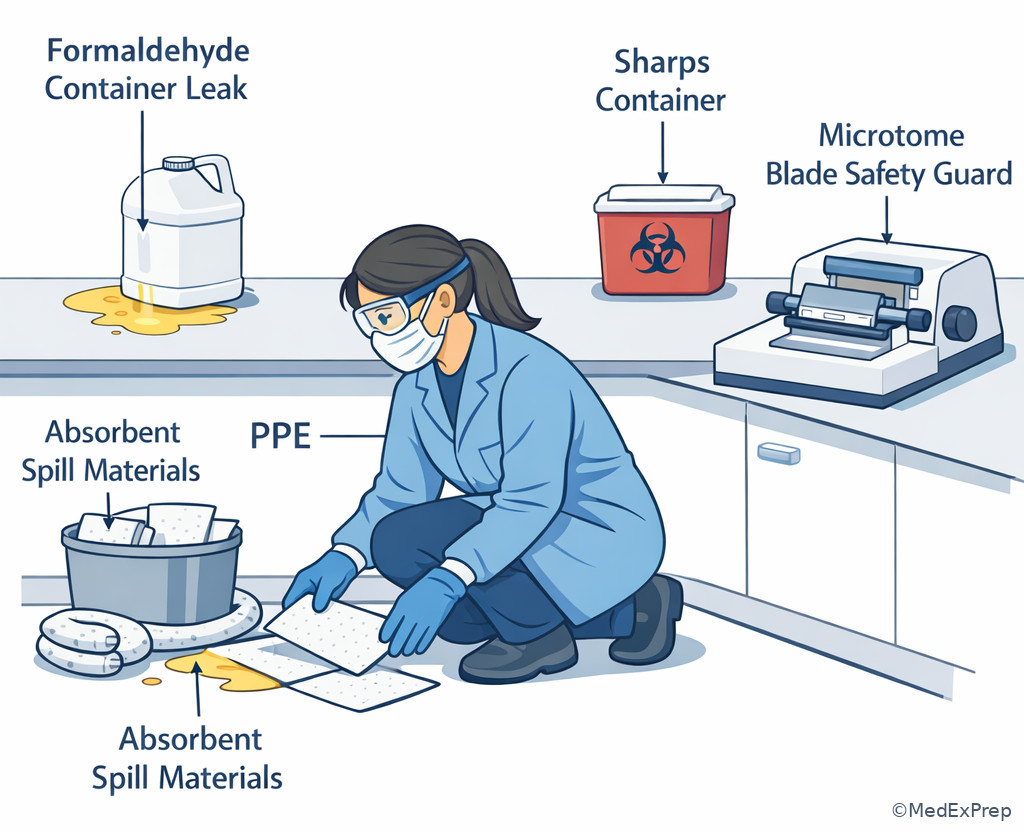
The decision conflict is keep the bench moving vs control the hazard first. The single resolving rule is that safety threats take immediate priority over turnaround. HTs routinely work with formaldehyde, xylene or substitutes, sharp blades, hot paraffin, infectious material, and cryostat contamination risks. Within scope, the HT uses PPE, follows chemical hygiene and sharps procedures, contains minor spills per policy if trained and equipped, disposes of waste correctly, and documents incidents. See Fig 4.
WHY THIS IS TESTED: safety questions often use urgency as a distractor. An exam stem may say the pathologist is waiting or that the tissue is time-sensitive. The correct answer still starts with exposure control, decontamination steps per policy, securing sharp hazards, or stopping use of unsafe equipment. The exam rewards safe sequencing, not speed.
Reject answers that minimize an exposure, continue working with damaged PPE, recap a blade manually, ignore a formaldehyde odor, or bypass incident reporting. Choose the answer that controls risk, protects staff, and then resumes workflow through established procedure. Local spill kit steps vary, but the exam principle is stable: contain, protect, report, document.
Key rule: In HT exam logic, safety outranks speed. If an answer continues processing through a chemical, sharps, or contamination hazard, it is usually wrong.
B Worked example
During paraffin embedding of a small breast biopsy from a 67-year-old patient with hypertension and COPD, a technologist notices a strong formaldehyde odor near a leaking container on the gross bench. The pathologist is waiting for slides from a separate urgent case, and a coworker suggests finishing embedding first because the leak looks minor. The stem asks for the best immediate action.
Reasoning chain: Identify the task → hazard response, not embedding technique. Extract key facts → active chemical exposure risk; urgency of another case is noise; the leak is visible and odor confirms concern. Apply the rule → stop unsafe activity, follow spill/exposure policy, use appropriate PPE and containment steps if trained and indicated, notify appropriate personnel, and document. Eliminate distractors → finishing the block first, moving the container barehanded, or masking the odor with increased room airflow without reporting all fail the control-first principle. Verify → work resumes only after the hazard is addressed according to policy.
C Exam trap
Common wrong answer: Finish the immediate technical task before dealing with the spill or exposure source.
Why it is tempting: histology workflow often feels time-pressured, and the leak may appear small.
Single clue that eliminates it: the active odor and leaking chemical indicate current exposure risk, which must be controlled before routine bench work continues.
D Checkpoint
Question: Which response best fits HT scope when a used microtome blade is found unsecured on the bench?
- Leave it in place until the case is complete to avoid interrupting ribboning.
- Securely remove and dispose of it in the approved sharps container, then document per policy if an incident occurred.
- Recap it manually and place it back in the blade dispenser slot.
- Ask the pathologist whether the blade needs to be discarded.
Answer: B
- A: Tempting because it preserves workflow momentum, but it leaves an active sharps hazard in place.
- B: Correct because securing sharps is a routine safety action clearly within HT practice.
- C: Tempting because it sounds protective, but manual recapping creates avoidable injury risk.
- D: Tempting because it seeks authority, but sharps disposal is not a pathologist decision point.
- The first priority in a spill or sharps hazard is control the hazard.
- True or False: Urgent turnaround justifies finishing a quick task before addressing a leak. False.
- Name four safety response words: contain, protect, notify, document.
Practitioner Action: ASSESS for exposure source, sharps risk, and contamination spread. INTERVENE with PPE and immediate hazard-control steps allowed by policy. REFER significant spills, exposures, or equipment hazards to supervisory and safety channels. DOCUMENT the event, actions taken, and any specimen impact.
Exam takeaway: Safety questions are solved by controlling exposure first, not by preserving turnaround.
1.1.1.7 Integration: documentation, escalation, and choosing the best exam answer when multiple actions seem reasonable
A Explanation
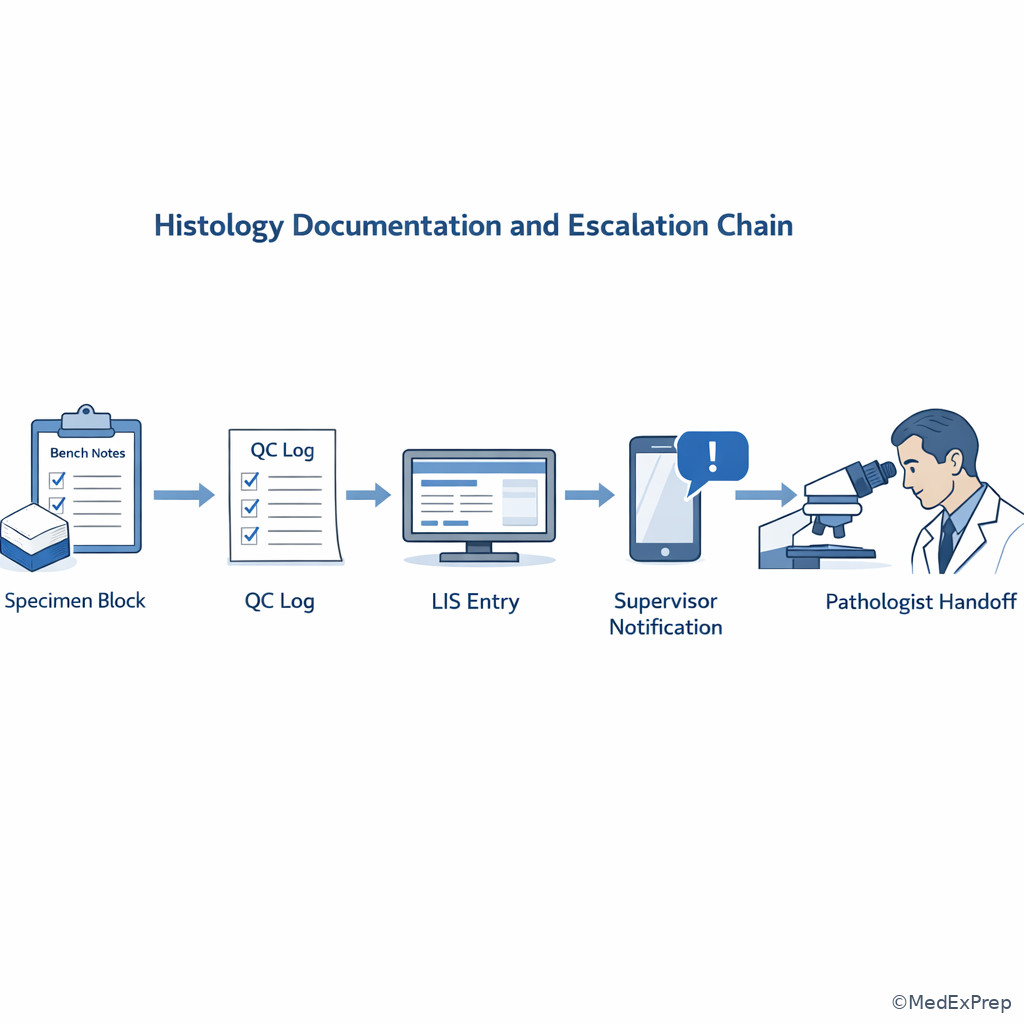
The decision conflict is which good action comes first? Many board items present multiple reasonable steps, and the best answer depends on sequence. The resolving rule is: preserve identity and safety, then perform authorized correction, then document, then escalate when required by unresolved discrepancy or scope limit. Documentation is not clerical busywork; it is part of correct practice because it preserves traceability and supports QA review. See Fig 5.
WHY THIS IS TESTED: exam writers love close-call options. Two answers may both be technically good, but one skips documentation, one bypasses policy, or one escalates too late. Your job is to choose the answer with the right order and authority. Document what happened, what you observed, what corrective action was taken, the outcome, and whom you notified.
Escalation is not a sign of failure; it is the correct endpoint when the issue is outside routine authority or remains unresolved after permitted troubleshooting. In HT exam language, the best answer often includes some combination of hold, verify, document, notify.
Memory anchor: HVEN = Hold unsafe/invalid flow, Verify the issue, Execute approved action or escalate, Note it in documentation.
Recall: In the upcoming topic Specimen-To-Slide Workflow, we build on this by placing scope decisions inside the exact order of fixation, processing, embedding, microtomy, staining, and finishing. Here, the emphasis is not the mechanics of each step but whether you are allowed to proceed at all.
B Worked example
A 63-year-old patient with rheumatoid arthritis and obesity has a skin excision submitted for routine processing. During coverslipping, you notice one slide label is smeared and barely legible after mounting. The tissue section itself looks technically excellent, and the pathologist has requested expedited review. A colleague suggests sending it now because the block number can probably be inferred from the case stack. What is the most appropriate next step?
Reasoning chain: Identify the task → final slide identification control. Extract key facts → label legibility is compromised; tissue quality and pathologist urgency are noise; inference from case order is not acceptable. Apply the rule → do not send a slide with uncertain identification. Hold the slide, follow relabel/reprint procedure if authorized, verify against the block and LIS, document the event, and escalate if identity cannot be re-established per policy. Eliminate distractors → forwarding the slide, handwriting a best guess, or asking the pathologist to infer identity all fail chain-of-control rules. Verify → the slide can move only when the identification chain is restored.
C Exam trap
Common wrong answer: Send the slide because the section quality is excellent and the correct block is probably obvious.
Why it is tempting: learners confuse technical adequacy with acceptability for release.
Single clue that eliminates it: the label is barely legible, so the slide cannot be reliably linked to the specimen without formal verification.
D Checkpoint
Question: A routine issue cannot be resolved with the corrective actions listed in SOP. What is the best next step?
- Continue processing and explain the uncertainty in a note to the pathologist.
- Escalate to the authorized supervisor or designee, document the issue, and hold affected material as required.
- Develop a temporary workaround and implement it for the rest of the batch.
- Discard the affected slide or block so the workflow can move on.
Answer: B
- A: Tempting because it keeps turnaround moving, but unresolved process uncertainty should not be passed downstream without control.
- B: Correct because escalation is the proper endpoint once the issue exceeds routine HT authority.
- C: Tempting because it shows initiative, but unapproved workarounds can create unvalidated process changes.
- D: Tempting because it removes the problem, but discarding patient material is never a casual bench decision.
Practitioner Action: ASSESS whether the issue is resolved, verified, and documented. INTERVENE only through approved steps. REFER any unresolved, out-of-scope, or high-risk issue to the proper authority. DOCUMENT the sequence, communication, and specimen disposition.
Exam takeaway: When more than one answer seems good, choose the one that preserves control, records the event, and notifies the right person.
flowchart TD
A[Problem detected] --> B[Hold unsafe or invalid step]
B --> C[Verify facts and scope]
C --> D{Correctable within SOP?}
D -->|Yes| E[Perform correction]
D -->|No| F[Notify supervisor or authorized designee]
E --> G[Verify result]
G --> H[Document event and outcome]
F --> H Exam takeaway: Good exam answers preserve traceability by pairing every problem with verification, notification, and written record.
1.1.1.8 Integration: recognizing out-of-role distractors on the HT exam
A Explanation
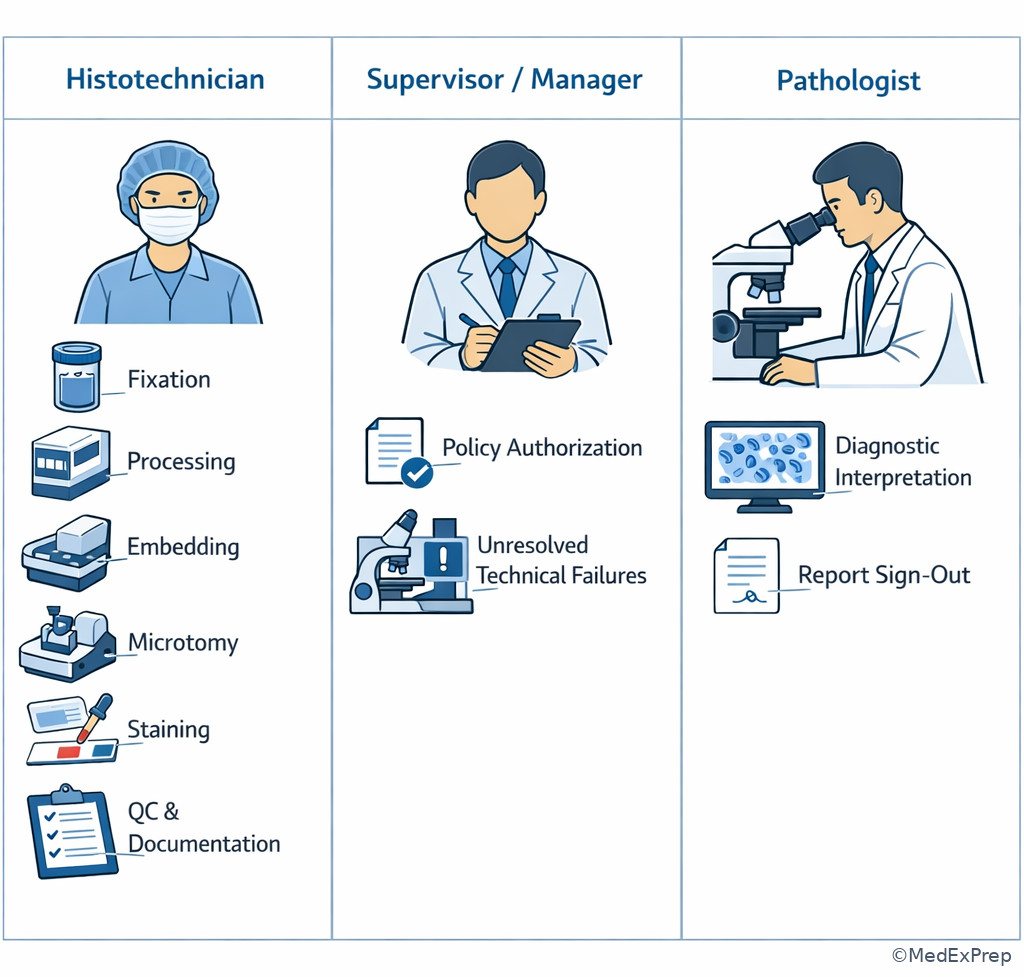
The decision conflict is choose the technically smartest answer vs choose the role-correct answer. The single resolving rule is to reject options that belong to another professional role even if they sound medically sophisticated. Classic out-of-role distractors include diagnosing the lesion, selecting patient treatment, validating a new assay independently, overriding specimen identification policy, or designing a nonapproved research-style protocol. See Fig 6.
WHY THIS IS TESTED: ASCP HT questions often hide the real testable point inside polished medical language. If an option asks you to act “as the pathologist,” determine staging, authorize a new method, or report the biopsy result, the stem is testing scope recognition rather than advanced science. HT success depends on disciplined role boundaries.
A useful exam habit is to scan options for authority words: diagnose, release report, validate, authorize, override, prescribe, determine management. Those verbs are red flags. In contrast, safe HT verbs are verify, process, stain, troubleshoot, repeat, label, document, escalate.
B Worked example
A 51-year-old patient with cirrhosis and atrial fibrillation has a liver biopsy processed and stained. The section is wrinkled, but nuclei and architecture are still visible. One answer option says to notify the pathologist that the biopsy likely shows severe disease and ask whether to cut deeper levels. Another says to recut the block using standard technique if allowed by SOP, document the artifact, and submit acceptable slides. A third says to rewrite the microtomy procedure to reduce future wrinkles. A fourth says to release the slide because the pathologist can still make the diagnosis. Which is the most appropriate HT response?
Reasoning chain: Identify the task → technical artifact correction. Extract key facts → wrinkle is a bench issue; disease severity is a tempting but irrelevant interpretive clue; rewriting procedure exceeds authority. Apply the rule → select the role-correct technical action: recut if allowed, verify quality, document. Eliminate distractors → diagnostic language, policy rewriting, and releasing suboptimal material without correction all drift away from HT scope. Verify → the acceptable response improves slide quality while staying within bench authority.
C Exam trap
Common wrong answer: Choose the option with the most advanced medical wording.
Why it is tempting: sophisticated language can feel more authoritative and therefore more correct.
Single clue that eliminates it: the option asks for interpretation, policy creation, or another nonbench authority rather than a routine histotechnology action.
D Checkpoint
Question: Which answer choice most likely represents an out-of-scope distractor for an HT exam stem?
- Repeat sectioning using approved parameters and document the artifact trend.
- Confirm the specimen accession and relabel only through authorized discrepancy procedure.
- Determine that the tissue is malignant and notify the surgeon immediately.
- Replace the depleted reagent according to SOP and verify acceptable control staining.
Answer: C
- A: Tempting because it is a real technical action, and it remains within routine HT practice.
- B: Tempting because relabeling can be risky, but the wording keeps it within authorized discrepancy procedure.
- C: Correct because diagnosis and immediate clinical communication of malignancy are not HT responsibilities.
- D: Tempting because it sounds simple, but it is exactly the kind of SOP-based bench correction an HT may perform.
- Which verbs usually fit HT scope? verify, process, stain, troubleshoot, document, escalate.
- True or False: “Determine the diagnosis” is an HT verb. False.
- The best answer often sounds less dramatic because it stays within SOP and role limits.
Practitioner Action: ASSESS the verb and authority level in each option. INTERVENE with the routine bench action only. REFER interpretation, policy override, or method authorization to the proper role. DOCUMENT the technical issue and your within-scope response.
Exam takeaway: On close-call options, the key discriminator is often the action verb rather than the technical detail.
flowchart TD
A[Answer option] --> B{Verb used}
B -->|Verify / process / stain / document / escalate| C[Likely within HT scope]
B -->|Diagnose / release report / authorize / override / validate| D[Likely out of scope]
C --> E[Check SOP and safety]
D --> F[Reject unless stem explicitly asks about escalation] Exam takeaway: Seeing HT, supervisor, and pathologist tasks side by side makes it easier to reject authority-level distractors.
Exam Traps & Differentiators
The most common wrong answer in this topic is the overconfident fix: an option that seems efficient or medically sophisticated but bypasses scope, policy, identity control, or QC verification.
| Looks reasonable | Why it tempts | Why it is wrong | Single clue that flips the answer |
|---|---|---|---|
| Proceed because tissue appears adequate | Morphology looks usable | Identity failure outranks tissue appearance | Any unresolved identifier mismatch |
| Adjust a process variable on your own | Shows initiative and technical knowledge | Changes validated procedure without authorization | No SOP-approved correction stated |
| Send imperfect slides because the pathologist can still interpret them | Preserves turnaround | Failed QC or label uncertainty makes release inappropriate | Control failure or illegible identification |
| Finish the urgent task before dealing with the spill or blade hazard | Urgency feels clinically important | Safety takes priority over speed | Active chemical odor, spill, contamination, or unsecured sharp |
| Choose the most advanced medical answer | Sounds authoritative | May ask the HT to diagnose, authorize, or report | Out-of-role verbs |
| If the stem says... | Think... |
|---|---|
| “Container and cassette do not match” | Hold specimen; discrepancy policy; do not guess |
| “Control slide failed” | Stop release; corrective action per SOP; verify with repeat QC |
| “Pathologist is waiting urgently” | Urgency does not override identity, QC, or safety |
| “The tissue likely shows...” | Interpretive wording is probably a distractor |
| “No procedure exists for this workaround” | Escalate rather than invent a new method |
| “The label is smeared/partially missing” | Restore verified identification before forwarding |
| Commonly confused pair | Key differentiator | Correct HT move |
|---|---|---|
| Technical artifact vs diagnostic interpretation | Artifact asks how to improve slide quality; diagnosis asks what the tissue means | Correct the technical issue; do not interpret disease |
| Routine troubleshooting vs unauthorized process change | Routine action is already in SOP and verifiable | Perform approved correction only |
| Resolvable discrepancy vs irreconcilable mismatch | Resolvable issues have authorized verification path | Resolve per policy if allowed; otherwise hold and escalate |
| Urgent workflow vs unsafe workflow | Urgent still waits if there is an active hazard | Control exposure or sharp risk first |
| Documentation note vs acceptable release | A note does not fix a failed process | Fix/verify first, then document |
Common traps & distractors: The exam frequently pairs this lesson with later topics on workflow and QC. A mislabeled specimen and a poorly fixed specimen are not handled the same way; identity failure usually stops the process immediately, whereas a process-quality issue may permit documented corrective action depending on SOP.
Tables
| Task area | Usually within HT scope | Usually outside HT scope |
|---|---|---|
| Specimen handling | Verify identifiers, label controls, hold discrepancies, document | Override irreconcilable mismatch policy |
| Fixation/processing/embedding | Perform routine workflow per SOP | Redesign validated protocol independently |
| Microtomy/staining | Cut, stain, troubleshoot routine artifacts, repeat approved runs | Adopt nonapproved workaround without authorization |
| QC | Review controls, replace approved reagents, document corrective action | Change acceptance criteria independently |
| Interpretation | Recognize technical adequacy or artifact | Diagnose disease or sign out results |
| Safety | Use PPE, control hazards, follow spill/sharps procedures | Ignore exposure risk to preserve turnaround |
| Escalation | Notify supervisor/pathologist/authorized designee when indicated | Make final authority decisions beyond assigned role |
| Problem type | Primary risk | First HT priority | Typical next move |
|---|---|---|---|
| Identifier mismatch | Wrong-patient/wrong-specimen error | Stop chain progression | Document and escalate |
| Failed stain control | Invalid slide quality | Hold affected batch | Correct per SOP and verify |
| Active chemical leak | Staff exposure | Control hazard | Contain/notify/document |
| Microtomy artifact with clear cause | Suboptimal section quality | Technical correction | Recut or adjust per SOP |
| Unapproved workaround needed | Unvalidated process change | Do not improvise | Escalate for authorization |
| Smeared slide label | Lost chain of identification | Hold release | Relabel only via verified procedure |
| Out-of-role signal in answer choice | Why it matters | Safer HT-framed alternative |
|---|---|---|
| “Make the diagnosis” | Interpretive authority belongs to pathologist | Prepare technically acceptable slide and hand off |
| “Release the case/report” | Reporting is not bench-level HT function | Verify slide quality and documentation status |
| “Authorize a new method” | Validation/authorization exceeds entry-level HT role | Escalate unresolved technical issue |
| “Override policy” | Bypassing identity or QC safeguards is unsafe | Follow discrepancy or corrective-action policy |
| “Determine treatment/staging” | Clinical management is outside histotechnology scope | Maintain specimen integrity for pathologist review |
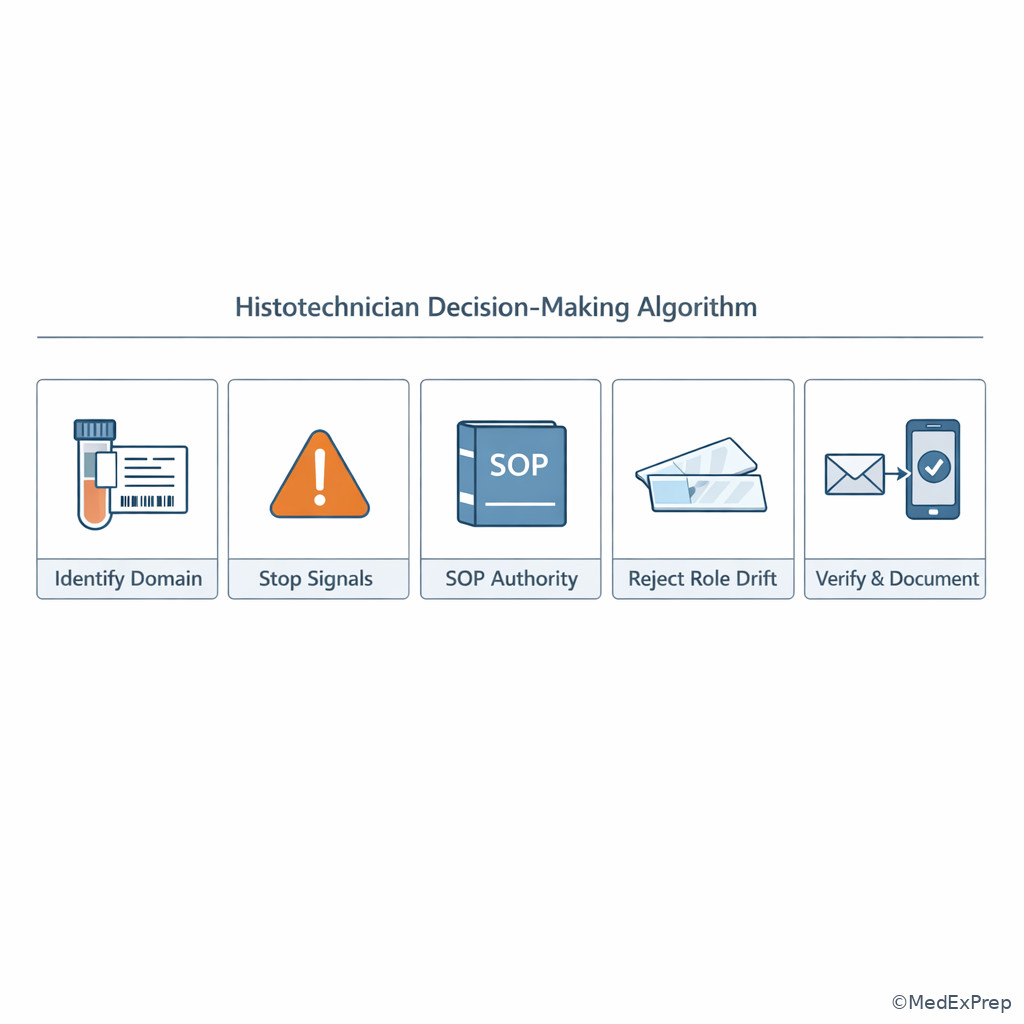
Algorithm / Approach
Exam takeaway: The correct answer usually follows the order identify problem, stop if unsafe/invalid, correct if authorized, verify, document, escalate if needed.
Rapid Review
- Identifier mismatch → hold before any downstream processing
- Good morphology with bad labeling → still unacceptable
- Failed control slide → no routine release until verified correction
- Urgency request → never overrides identity, safety, or QC
- Artifact recognition → technical quality judgment, not diagnosis
- Allowed troubleshooting → already described in SOP and verifiable
- Unapproved workaround → escalate, do not improvise
- Active chemical odor or leak → control hazard first
- Unsecured blade → immediate sharps action, not delayed cleanup
- Illegible slide label → restore verified identity before handoff
- “Determine malignancy” option → out-of-scope distractor
- “Change the protocol today” option → authority-level distractor
- Best HT verbs → verify, process, troubleshoot, document, escalate
- Best close-call sequence → hold/verify/correct-or-escalate/document
Memory anchor: HVDE = Hold when unsafe or uncertain, Verify facts, Do approved action, Escalate if not resolved. Fast enough for test day, broad enough for most scope questions.
Self-check quiz
1. A routine H&E run shows weak staining on the control slide. The reagent log shows the hematoxylin is due for replacement. Which action is the most appropriate for an HT?
- Interpret the tissue based on residual morphology and release the case.
- Replace the reagent per SOP, repeat the run, verify control performance, and document.
- Change the laboratory’s control acceptance criteria for that batch.
- Report the control failure directly as a diagnostic limitation in the final pathology report.
2. During specimen receipt, a container accession number does not match the cassette accession number. The tissue is small but appears adequately fixed. Which is the best next step?
- Proceed with processing because the tissue quality appears acceptable.
- Assign the accession based on the requisition order and document the assumption.
- Hold the specimen, follow discrepancy procedure, and escalate for identifier resolution.
- Ask the pathologist to determine which accession is most likely correct from the tissue appearance.
3. A 66-year-old patient with diabetes and peripheral vascular disease has two skin biopsies submitted from different sites. One slide label becomes smeared after coverslipping, while the section itself is excellent. The pathologist requests rapid review. Which action is most appropriate?
- Send the slide because the block can likely be inferred from the worklist order.
- Recreate the slide identity from memory and handwrite the likely label.
- Hold the slide, verify identity through authorized procedure, relabel only if confirmed, and document the event.
- Release the slide with a note that the pathologist should interpret it cautiously.
4. A 54-year-old patient with chronic hepatitis and hypertension has a liver biopsy in a staining batch with weak control nuclei. A coworker suggests increasing eosin time because the sections look pale overall. The SOP lists reagent replacement and rerun steps for weak hematoxylin control. What is the best action?
- Increase eosin time because both colors contribute to visual contrast.
- Replace the appropriate reagent per SOP, rerun the batch, verify the control, and document.
- Release the current slides because architecture is still visible.
- Revise the H&E procedure for future runs before repeating the batch.
5. A 47-year-old patient with asthma and obesity has a biopsy being embedded when a strong xylene-like odor is noticed near a leaking waste container. Another technologist says the leak is minor and the urgent blocks should be finished first. Which is the most appropriate immediate action?
- Finish embedding the urgent blocks, then address the leak.
- Stop the unsafe activity, follow spill/exposure policy, contain or report as required, and document.
- Move the container quickly without PPE so the odor dissipates faster.
- Ignore the odor unless someone develops symptoms.
6. A 59-year-old patient with rheumatoid arthritis and chronic kidney disease has a gastric biopsy processed overnight. The H&E control fails, but the patient slide looks only mildly pale. One option is to send it because the pathologist can still review architecture; another is to repeat the run after SOP-approved correction; a third is to lower acceptance standards for this small biopsy; a fourth is to call the clinician about a likely serious lesion. Which choice is most appropriate?
- Send the slide because mild pallor will not prevent interpretation.
- Repeat the run after approved corrective action, verify control recovery, and document before release.
- Lower the control threshold because the specimen is limited.
- Call the clinician because an inadequately stained gastric biopsy may still suggest important disease.
7. A 73-year-old patient with COPD and atrial fibrillation has a skin excision accessioned correctly. During microtomy, the section shows repetitive chatter. The supervisor is unavailable for 10 minutes. Which action is the best next step for an HT if the SOP includes routine blade and block checks for chatter but does not permit parameter redesign?
- Diagnose the tissue on the current section because chatter usually does not obscure malignancy.
- Perform the listed routine checks and corrective steps for chatter, recut, and document the action.
- Rewrite the sectioning protocol to a new thickness range for the rest of the day.
- Discard the block and request a new specimen.
8. A 62-year-old patient with coronary artery disease and diabetes has three GI biopsies in one case. After staining, one slide label is fully legible, one is partially blurred but matches the worklist, and one slide appears unlabeled after coverslipping. The sections are otherwise excellent, and the pathologist is waiting. Which action requires immediate clarification before any slide handoff?
- The fully legible slide because the biopsy sites are clinically important.
- The partially blurred slide only, because some identifier remains visible.
- The apparently unlabeled slide, because chain of identification cannot be confirmed.
- None; all may be sent together if the case packet is intact.
Answer key
1. Correct answer: B
- A: Tempting because residual morphology may still be visible. Incorrect because failed control means the batch has not met QC requirements for release; the discriminating clue is the weak control slide. Authoritative practice emphasizes control-based verification and documentation in histotechnology workflow (Carson and Hladik; Bancroft and Gamble).
- B: Tempting because it seems slower, but it is correct because it stays within routine HT troubleshooting: replace reagent if allowed, repeat, verify the control, and document. The key clue is that the reagent is due for replacement and the control has failed. This matches standard bench corrective action principles (Carson and Hladik).
- C: Tempting because small temporary threshold changes can sound practical. Incorrect because an entry-level HT does not independently change validation or acceptance criteria. The single clue is that this would alter a laboratory standard rather than follow existing SOP (Bancroft and Gamble).
- D: Tempting because it acknowledges the problem. Incorrect because final diagnostic reporting is outside HT scope, and the immediate issue is technical correction, not report wording. The key clue is “final pathology report,” which signals another role (ASCP BOC content expectations; Carson and Hladik).
2. Correct answer: C
- A: Tempting because tissue adequacy feels central to histology. Incorrect because identity failure outranks morphology; the discriminating clue is the accession mismatch, not fixation quality (Carson and Hladik).
- B: Tempting because requisition order often matches specimen order. Incorrect because guessing identity breaks chain-of-control principles. The key clue is that the mismatch has not been formally resolved (Bancroft and Gamble).
- C: Correct because the proper HT response is to stop routine progression, follow discrepancy procedure, and escalate. The decisive clue is nonmatching accession numbers between container and cassette. This preserves specimen integrity and aligns with standard laboratory identification practice (Carson and Hladik).
- D: Tempting because the pathologist has authority in the case. Incorrect because tissue appearance cannot safely resolve identifier conflict, and the pathologist does not replace discrepancy policy. The key clue is that this is an identification problem, not a diagnostic problem (ASCP BOC exam scope guidance).
3. Correct answer: C
- A: Tempting because worklist order may appear to support inference. Incorrect because inferred identity is not verified identity; the discriminating clue is the smeared label after coverslipping (Carson and Hladik).
- B: Tempting because handwriting seems like a quick rescue. Incorrect because memory-based relabeling is unsafe unless identity is formally confirmed through authorized procedure. The key clue is uncertainty, not absence of effort (Bancroft and Gamble).
- C: Correct because it restores the chain of identification through policy-based verification before handoff. The decisive clue is that the section quality is irrelevant if slide identity is not secure. This is the HT-first response within scope (Carson and Hladik).
- D: Tempting because it warns the pathologist. Incorrect because a note does not cure identifier uncertainty. The single clue is that release would still occur without verified identity (ASCP BOC content scope).
4. Correct answer: B
- A: Tempting because pale slides may make eosin seem relevant. Incorrect because the stem specifically identifies weak hematoxylin control and provides an SOP response. The discriminating clue is the failed control nuclei, not general pallor (Carson and Hladik).
- B: Correct because it uses the exact approved corrective path: replace the implicated reagent, rerun, verify controls, document. The key clue is that SOP already lists the response, making it clearly within scope (Bancroft and Gamble).
- C: Tempting because some architecture remains visible. Incorrect because acceptable release depends on validated QC, not partial usefulness. The clue that eliminates it is the failed control (Carson and Hladik).
- D: Tempting because recurring issues can suggest protocol review. Incorrect for this scenario because an HT should not revise procedure independently, and immediate batch correction is the tested priority. The single clue is that the question asks for the best current action, not policy development (ASCP BOC scope).
5. Correct answer: B
- A: Tempting because the blocks are urgent and nearly complete. Incorrect because active chemical exposure risk takes priority over throughput. The discriminating clue is the strong odor from a leaking waste container (OSHA chemical hygiene principles; Carson and Hladik).
- B: Correct because it follows standard hazard response: stop unsafe activity, follow spill/exposure policy, contain or report appropriately, and document. The key clue is the active leak with odor, indicating a current hazard rather than a theoretical risk (OSHA; Bancroft and Gamble).
- C: Tempting because rapid removal may seem efficient. Incorrect because handling a leaking solvent container without PPE increases exposure risk. The discriminating clue is the need for policy-based protective response (OSHA).
- D: Tempting because symptoms have not yet appeared. Incorrect because safety control is based on hazard recognition, not waiting for harm to occur. The key clue is the detectable leak/odor itself (OSHA laboratory safety guidance).
6. Correct answer: B
- A: Tempting because the slide defect seems mild and architecture remains visible. Incorrect because the failed control invalidates routine release regardless of how salvageable one patient slide appears. The discriminating clue is the control failure, not the degree of pallor (Carson and Hladik).
- B: Correct because QC failure demands approved correction, repeat verification, and documentation before any release. The key clue is that one option explicitly preserves validated process control (Bancroft and Gamble).
- C: Tempting because tiny biopsies sometimes appear harder to stain perfectly. Incorrect because lowering acceptance thresholds for one case is an unauthorized criteria change. The discriminating clue is that the option changes standards rather than follows them (ASCP BOC scope expectations).
- D: Tempting because it sounds clinically urgent and patient-centered. Incorrect because clinician notification about probable disease is outside HT role, and the immediate issue is technical QC. The clue is the interpretive and management-facing nature of the option (Carson and Hladik).
7. Correct answer: B
- A: Tempting because chatter may not fully obscure pathology. Incorrect because diagnosis is not the HT task, and the present problem is a correctable artifact. The discriminating clue is that the issue arises during microtomy and the SOP provides routine chatter checks (Carson and Hladik).
- B: Correct because the HT should use the routine, authorized corrective steps already built into SOP, then recut and document. The key clue is that the SOP specifically includes blade and block checks, making this an in-scope technical response (Bancroft and Gamble).
- C: Tempting because a new thickness range might reduce chatter. Incorrect because redesigning sectioning parameters for the day exceeds routine authority when not permitted by SOP. The discriminating clue is the explicit statement that parameter redesign is not allowed (ASCP BOC scope).
- D: Tempting because severe artifact can make a block feel unusable. Incorrect because discarding a block and requesting new tissue is far beyond routine bench authority and not justified before standard correction attempts. The clue is that the artifact is potentially correctable and the specimen is irreplaceable patient material (Carson and Hladik).
8. Correct answer: C
- A: Tempting because site-specific GI biopsies are clinically important. Incorrect because the fully legible slide does not itself create an identification barrier. The discriminating clue is that the label is intact (Carson and Hladik).
- B: Tempting because partial blur does raise concern. Incorrect as the best answer because the unlabeled slide creates the more immediate and absolute chain-of-identification failure. The single clue is that one slide appears completely unlabeled (Bancroft and Gamble).
- C: Correct because a slide that cannot be linked to the case by verified labeling requires immediate clarification before any handoff. The key clue is total inability to confirm identity at the slide level (Carson and Hladik).
- D: Tempting because the case packet and excellent sections may feel reassuring. Incorrect because packet integrity does not replace slide-level identification control. The discriminating clue is the unlabeled slide after coverslipping (ASCP BOC scope expectations).
Keep going with the full ASCP HT/HTL Prep Course (HT)
You just studied the way members do, in the same lesson interface. Full access unlocks every lesson, the question bank and flashcards for a full year.
One payment · 1 year of access · No auto-renewal