1.1.1 - Chemical Safety And PPE
Why it matters
- Chemistry benches combine patient specimens, concentrated reagents, solvents, acids, bases, and instrument waste streams; the exam often asks for the most appropriate next laboratory action when risk is recognized.
- Many wrong answers sound technically useful but are unsafe because they ignore hazard class, exposure route, or laboratory policy.
- Safety questions are frequently disguised as workflow questions: specimen processing, reagent preparation, analyzer maintenance, and spill cleanup all require PPE and scope-aware judgment.
- Safe actions protect both staff and result integrity; contamination, improper storage, or undocumented exposure can create both personnel harm and analytical error.
Key Terms & Must-Know Facts
1.1.1.1 Key terms
- PPE — personal protective equipment used to reduce exposure.
- SDS — Safety Data Sheet; primary reference for hazards, handling, storage, and first aid.
- Corrosive — chemical that causes tissue destruction or material damage.
- Flammable — substance that ignites easily; often requires ignition-source control and approved storage.
- Oxidizer — chemical that intensifies combustion.
- Volatile — readily vaporizes; inhalation risk increases.
- Fume hood — engineering control for hazardous vapors, not a storage shelf.
- Eyewash — emergency flushing device for ocular exposure.
- Safety shower — emergency decontamination for larger body exposure.
- Incompatible chemicals — substances that react dangerously if mixed or stored together.
- Secondary container label — label on transferred chemical identifying contents and hazards per policy.
- Exposure route — skin, eye, inhalation, ingestion, injection.
- Universal precautions — treat specimens as potentially infectious.
- Engineering control — hazard control built into the environment, such as shields or ventilation.
- Administrative control — SOPs, training, restrictions, and documentation practices.
1.1.1.2 Must-know facts
- Use the SDS and local SOP before handling unfamiliar chemicals.
- Engineering controls beat PPE alone; PPE does not replace proper ventilation or splash barriers.
- Routine gloves do not mean all gloves are chemically appropriate for every reagent.
- After a splash to the eye or skin, immediate flushing comes before paperwork.
- Do not clean a spill unless it is within your training, spill class, and laboratory policy.
- Acids, bases, solvents, oxidizers, and toxics may require different storage and cleanup rules.
- Food, drink, and mouth pipetting are never acceptable in the chemistry laboratory.
- Unlabeled or improperly labeled chemicals are a safety and compliance failure.
- Closed-toe shoes, lab coat, and eye protection are common baseline bench expectations, but local policy may add task-specific requirements.
- When the safest action is uncertain, stop work, secure the area, and escalate.
| Hazard cue | Primary concern | First lab mindset | Common exam error |
|---|---|---|---|
| Acid/base splash risk | Eye/skin injury | Barrier PPE + immediate access to eyewash/shower | Delaying flushing to find supervisor first |
| Volatile solvent | Inhalation + fire risk | Ventilation/fume hood + ignition control | Assuming standard bench ventilation is enough |
| Oxidizer | Combustion enhancement | Separate from combustibles/reducing agents | Storing with flammables for convenience |
| Unknown/unlabeled liquid | Unpredictable exposure | Do not use; isolate and escalate | Testing it informally by smell or appearance |
| Small bench spill | Surface contamination | Assess class, quantity, training, spill kit, policy | Cleaning immediately without identifying hazard |
| Large or inhalation-risk spill | Personnel danger | Evacuate/secure/notify per SOP | Trying to be helpful beyond training |
Core content
1.1.1.3 Foundational hazard recognition: what risk are you actually choosing between?
A Explanation
The first exam decision is rarely “What chemical is this exactly?” It is usually “What hazard category controls my next action?” In chemistry safety questions, you must choose between reacting to the visible task and reacting to the governing hazard. A colorless liquid on the bench could be harmless saline, but if it is in the reagent area near concentrated acid bottles, the safe decision is not to guess. The resolving rule is simple: unknown or incompletely identified chemical risk is treated as a hazard until verified by label, SDS, and policy.
WHY THIS IS TESTED: stems often include distracting workflow urgency such as a pending critical troponin, analyzer downtime, or a busy morning run. The tested pattern is whether you will prioritize hazard recognition over productivity pressure.
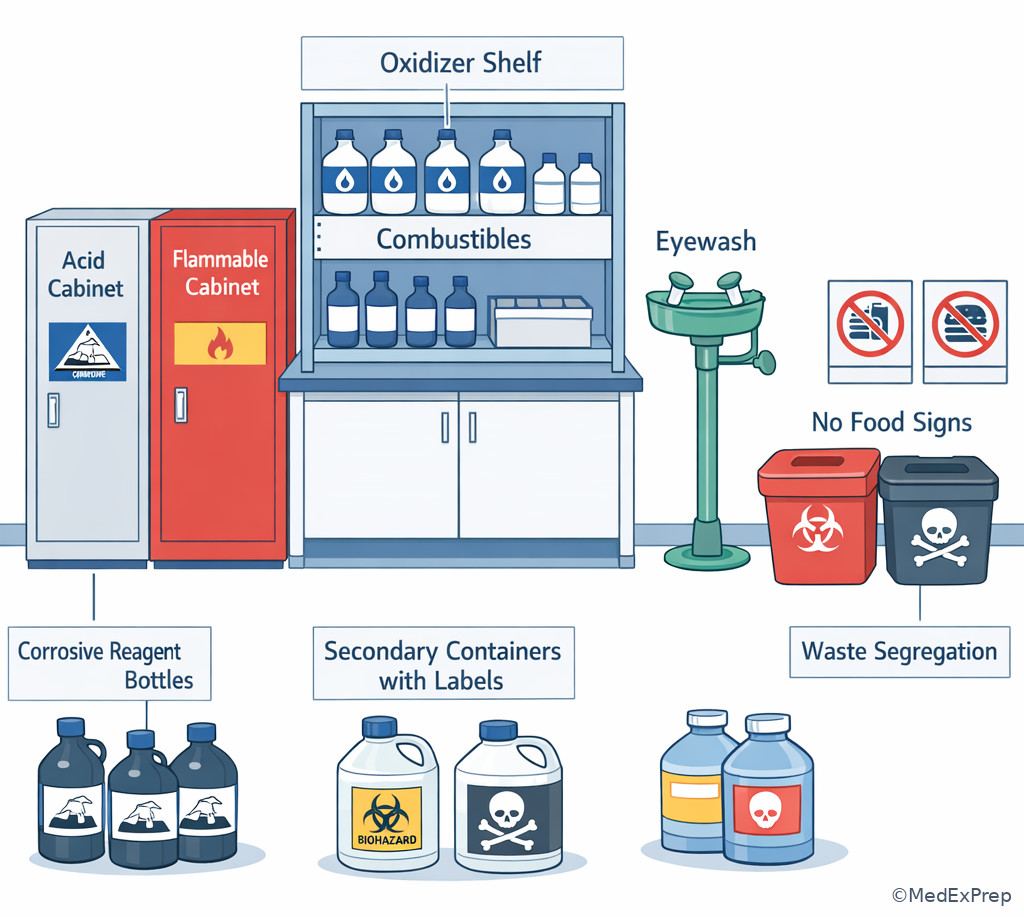
For bench-level chemistry personnel, hazard recognition starts with labels, pictograms, storage location, odor/volatility clues, and task context. Corrosives threaten tissue on contact. Flammables add ignition and vapor concerns. Oxidizers make ordinary combustibles more dangerous. Toxics shift attention to exposure route and containment. Reactives and incompatibles make “just wipe it up” the wrong instinct. See Fig 1.
Key rule: If the hazard class is unclear, do not improvise handling. Verify with the label/SDS or stop and escalate according to the SOP.
Recall: In the upcoming topic CLIA And Accreditation Basics, you will build on this same principle: do not operate outside validated procedure. Safety and compliance use the same decision habit — follow the approved method, not personal guesswork.
Exam takeaway: Choose the hazard category first because it determines PPE, engineering controls, and whether you can proceed at all.
flowchart TD
A[Chemical task or spill noticed] --> B{Known identity and label?}
B -- No --> C[Stop use or cleanup and isolate area]
C --> D[Check SDS or escalate per SOP]
B -- Yes --> E{Main hazard?}
E -- Corrosive --> F[Eye and skin splash protection]
E -- Flammable --> G[Control ignition and vapors]
E -- Toxic or volatile --> H[Use ventilation and exposure limits]
E -- Oxidizer or reactive --> I[Separate incompatibles and avoid mixing]
F --> J[Proceed only within training and policy]
G --> J
H --> J
I --> J Exam takeaway: Visual placement of acids, flammables, oxidizers, and waste containers helps you spot unsafe proximity before handling begins.
B Worked example
A 29-year-old night-shift chemistry technologist is preparing to refill analyzer reagent reservoirs. The section is busy with morning electrolyte specimens. A clear bottle containing liquid is found on the reagent prep counter with a partial handwritten label reading “clean…” and no date. Nearby are sodium hydroxide cleaner, deionized water, and an alcohol-based disinfectant. The technologist has mild asthma and is wearing gloves and a lab coat; a coworker suggests opening the bottle and smelling it to decide where it belongs. A potassium QC run is pending and the analyzer is already in standby.
Reasoning chain: identify task → determine whether the issue is workflow or hazard. Extract key facts: incomplete label, unknown contents, volatile possibilities, busy section pressure, tempting shortcut by smell. Apply rule: unknown/incompletely labeled chemical is treated as hazardous until identified; do not use sensory testing. Eliminate distractors: using it as cleaner is unsafe, pouring it into waste is unsafe, opening to smell adds inhalation exposure. Verify: the correct laboratory action is to stop use, isolate the container, and follow policy for unidentified chemical handling and notification.
C Exam trap
Common wrong answer: “Open the bottle in the hood to identify it by odor.”
Why it is tempting: it sounds cautious because the hood seems safer than the open bench.
Single clue that eliminates it: the contents are unknown; identification by smell is not an acceptable laboratory safety method.
D Checkpoint
Question: A chemistry bench worker finds an unlabeled secondary container in the reagent area during a busy shift. Which is the most appropriate next laboratory action?
- A. Transfer the liquid to hazardous waste because unidentified chemicals should always be discarded immediately.
- B. Continue the run and ask the next shift whether they recognize the container.
- C. Stop using the container, isolate it, and follow the laboratory SOP for unidentified chemicals and notification.
- D. Open the container briefly near the hood to determine whether it is acid, base, or alcohol by smell.
Answer: C
- A is tempting because disposal sounds safer than use, but wrong because disposal itself may be unsafe if the chemical class is unknown.
- B is tempting because workflow pressure is real, but wrong because unidentified chemicals should not remain in use areas awaiting informal recognition.
- C is correct because unknown chemical identity requires isolation and policy-based handling, not improvisation.
- D is tempting because it appears to gather data, but wrong because smelling unknown chemicals creates avoidable inhalation exposure.
Practitioner Action: ASSESS label completeness, storage location, and likely hazard class; INTERVENE by stopping use and isolating the material; REFER to the supervisor or safety procedure when identity is uncertain; DOCUMENT the finding and any containment steps according to policy.
1.1.1.4 PPE selection: choose barrier level based on splash, vapor, and task
A Explanation
PPE questions test whether you choose equipment based on the actual exposure route, not just the presence of chemicals. Gloves protect hands, but they do not solve splash-to-eye risk or inhalation risk. A lab coat reduces contamination of clothing and skin, but it is not a substitute for a chemical-resistant apron when larger-volume splash risk exists. The deciding rule is: match PPE to the highest realistic exposure route in the task.
WHY THIS IS TESTED: exams like to place a routine-seeming task next to one extra clue — concentrated acid aliquoting, volatile solvent transfer, analyzer waste replacement, or splash-prone cleaning. That single clue upgrades PPE needs.
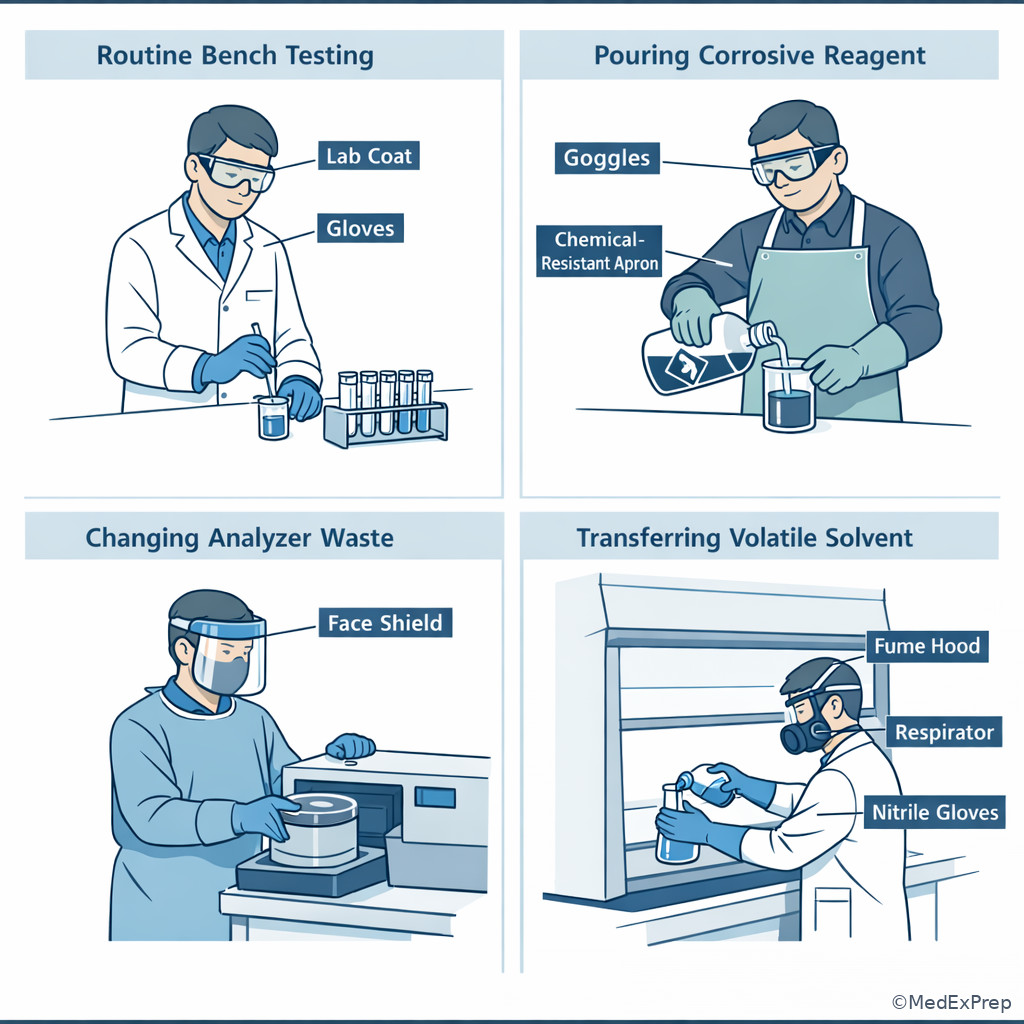
Baseline chemistry PPE often includes lab coat, gloves, and eye protection, with closed-toe shoes and no exposed legs. Escalation depends on task. Splash risk increases the need for goggles or face protection. Volatile or noxious fumes shift priority toward engineering control such as a hood, because PPE alone cannot fully manage inhalation exposure. Glove choice can also be task-dependent; “wear gloves” is not enough if the glove material is incompatible with the chemical. See Fig 2.
Common pitfall: Choosing more PPE without choosing the correct type of PPE. A second pair of gloves does not replace eye protection during splash-prone pouring.
Memory anchor: “HEV-S” for task screening — Hands, Eyes, Vapors, Skin/clothing. If any category is at risk, address it before starting.
High-Yield Connection: This concept is tested alongside Hemolysis Lipemia Icterus Effects and Unacceptable Specimen Decisions. Exam stems may combine specimen handling with splash risk; know both the safety action and the specimen-integrity consequence.
Exam takeaway: The correct PPE answer comes from the highest-risk exposure route in the task, not from a generic routine-bench checklist.
flowchart LR
A[Task begins] --> B{Main exposure route?}
B -- Hand contact --> C[Appropriate gloves]
B -- Splash to eyes or face --> D[Goggles or face protection]
B -- Clothing or skin splash --> E[Lab coat and consider apron]
B -- Vapors or volatile chemicals --> F[Use hood or ventilation control]
C --> G[Confirm chemical compatibility]
D --> G
E --> G
F --> G
G --> H[Proceed only if PPE and controls fit the task] Exam takeaway: Match routine bench work, corrosive pouring, analyzer waste handling, and volatile reagent transfer to different protection levels.
B Worked example
A 46-year-old chemistry technologist with eczema and seasonal allergies is assigned analyzer maintenance. The task includes replacing alkaline wash solution, emptying waste, and priming a cleaning line that occasionally splashes. The distractor detail is that the reagent volume is small, and a coworker says standard gloves are enough because the system is mostly closed. A stack of outpatient metabolic panels is delayed, and the technologist wants to finish quickly.
Reasoning chain: identify task → maintenance with splash-prone alkaline cleaner and waste handling. Extract key facts: caustic solution, splash history, waste exposure, closed system but not fully splash-proof. Apply rule: choose PPE to the highest realistic exposure route, not the average one. Eliminate distractors: gloves alone do not protect eyes or clothing; routine eyeglasses are not equivalent to splash eye protection unless approved; speed pressure does not downgrade PPE. Verify: appropriate action is enhanced splash protection per SOP, including eye protection and any additional barrier such as apron/face protection if specified locally.
C Exam trap
Common wrong answer: “Standard gloves are enough because the instrument is closed.”
Why it is tempting: many analyzer steps are enclosed, so routine bench PPE often feels sufficient.
Single clue that eliminates it: the stem states the line occasionally splashes; that upgrades eye and clothing protection needs.
D Checkpoint
Question: Which task most clearly requires upgrading from routine glove-and-coat protection because of exposure route?
- A. Loading capped serum tubes onto the chemistry analyzer rack
- B. Reviewing patient reports at the workstation near the analyzer
- C. Pouring concentrated acid cleaning solution into a secondary container with known splash risk
- D. Performing barcode reconciliation for specimens after centrifugation
Answer: C
- A is tempting because specimen contact still requires PPE, but wrong because the exposure route is lower than a chemical splash task.
- B is tempting because the analyzer area contains hazards, but wrong because documentation review itself does not create the same splash risk.
- C is correct because concentrated corrosive pouring with splash risk directly threatens eyes and skin/clothing.
- D is tempting because post-centrifugation specimens still need careful handling, but wrong because the key discriminator is corrosive splash exposure.
Practitioner Action: ASSESS the task for hands, eyes, vapors, and clothing exposure; INTERVENE by selecting task-specific PPE and engineering controls; REFER if the required PPE or hood access is unavailable; DOCUMENT any equipment shortages or safety barriers according to policy.
- True or False: Gloves alone are adequate for a known splash-prone corrosive transfer. False.
- The most important driver of PPE choice is the highest realistic exposure route.
- Name the 3 core decision inputs before a task: hazard class, exposure route, and engineering controls.
1.1.1.5 SDS, labeling, and storage: the safest answer is often the documentation answer
A Explanation
Board-style laboratory safety questions often hinge on whether you use the official information source instead of memory or habit. The SDS tells you hazard identification, handling, storage, incompatibilities, required precautions, and first-aid measures. Secondary containers must be labeled according to policy so the next person does not inherit an unidentified hazard. The key conflict is choosing between speed and traceability. The resolving rule: if the label or storage status is incomplete, the chemical is not workflow-ready.
WHY THIS IS TESTED: chemistry labs frequently transfer reagents, prepare cleaning solutions, and store multiple concentrated agents. The testable pattern is whether you recognize that labeling and storage are not clerical details; they are the control system that prevents exposure and mix-ups.
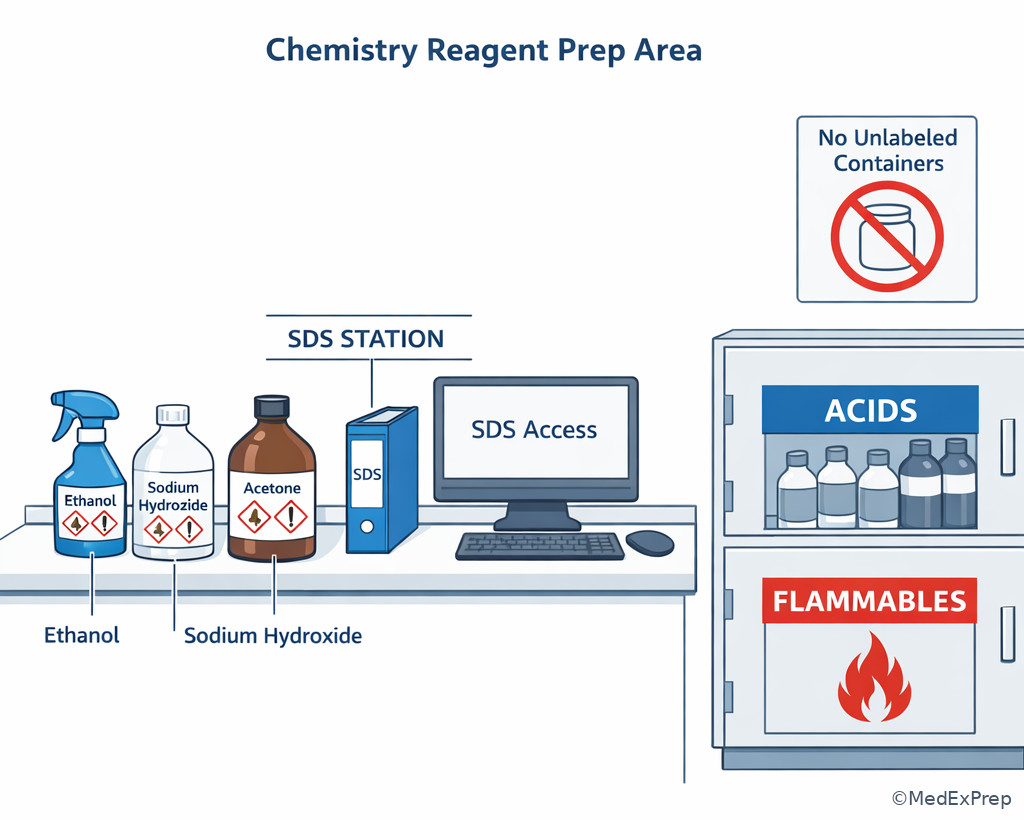
Exams commonly contrast acceptable storage with convenience storage. Flammables belong in approved locations away from ignition sources. Oxidizers are segregated from combustibles or reducing agents. Corrosives are not stored based only on bottle size or shelf space. A fume hood is for active control of hazardous vapors, not long-term storage that disrupts airflow and access. See Fig 4.
Key rule: Missing label, missing date/preparer information where required, or incompatible storage transforms an ordinary bench item into a safety problem that must be corrected before use.
Forward link: In Result Confidentiality And Documentation, you will apply the same traceability mindset to patient results, corrective action, and notification. Safety documentation and result documentation are both about defendable laboratory actions.
Exam takeaway: Missing labels and incompatible storage are exam-level red flags that require correction before routine work continues.
flowchart TD
A[Chemical in use or storage] --> B{Label complete?}
B -- No --> C[Do not use]
C --> D[Relabel per policy or isolate and notify]
B -- Yes --> E{Storage compatible?}
E -- No --> F[Move per approved storage rules]
E -- Yes --> G{Need more hazard detail?}
G -- Yes --> H[Consult SDS]
G -- No --> I[Proceed with task-specific controls]
H --> I Exam takeaway: A visible SDS access point and complete secondary labeling reduce both exposure risk and exam-style traceability errors.
B Worked example
A 57-year-old senior technologist returns from lunch and notices a bottle of diluted acid descaler stored inside a fume hood next to a bottle of solvent-based cleaner. The descaler label lists the chemical name but no preparation date or initials. A newer employee explains that the hood was used “as extra cabinet space” because the acid cabinet was full. The section is also preparing for a CAP inspection simulation, and another staff member wants to leave the setup alone until after the run finishes.
Reasoning chain: identify task → this is not a patient-result decision; it is a storage/labeling compliance and safety issue. Extract key facts: incomplete secondary label, improper hood storage, incompatible convenience placement. Apply rule: incomplete label or improper storage means the item is not acceptable as left. Eliminate distractors: leaving it until later preserves convenience but not safety; using the hood as storage is not acceptable airflow practice; adding only a date without verifying storage is incomplete correction. Verify: correct laboratory action is to correct per SOP, relocate appropriately, and document or notify as required.
C Exam trap
Common wrong answer: “Leave the bottle in the hood because the hood is the safest place for chemicals.”
Why it is tempting: hoods are associated with hazardous chemicals, so they feel like secure storage spaces.
Single clue that eliminates it: a fume hood is an engineering control for active work, not routine storage that obstructs proper function.
D Checkpoint
Question: Which finding most directly requires correction before the chemical can be considered acceptable for routine shared use?
- A. The original manufacturer bottle is discolored from age but remains legible and properly stored.
- B. A secondary container has the correct chemical name but lacks required additional labeling elements under local policy.
- C. The SDS is available electronically rather than in a paper binder.
- D. The reagent is stored on a low shelf instead of eye level.
Answer: B
- A is tempting because appearance can raise concern, but wrong if the bottle remains intact, legible, and policy-compliant.
- B is correct because a secondary container missing required labeling is not fully traceable or safe for shared use.
- C is tempting because learners may overvalue paper access, but wrong because electronic SDS access is commonly acceptable if available per policy.
- D is tempting because storage height matters ergonomically, but wrong because the stem asks for the most direct readiness failure.
Practitioner Action: ASSESS label completeness, SDS availability, and storage compatibility; INTERVENE by correcting or removing noncompliant items from use; REFER unresolved storage/capacity issues to the supervisor or safety lead; DOCUMENT corrective action and any restricted-use decision per SOP.
1.1.1.6 Spill and exposure response: when to clean, when to flush, when to escalate
A Explanation
This is the highest-yield application section because the exam loves “most appropriate next laboratory action” after a splash or spill. The conflict is between acting fast and acting correctly. The single rule that resolves many questions is: for personnel exposure, immediate decontamination comes before cleanup; for spills, hazard class and spill size determine whether you clean or escalate.
WHY THIS IS TESTED: stems include emotional urgency — a splash during analyzer maintenance, a dropped reagent bottle, vapors, or a coworker insisting the spill is small. The exam wants to know whether you distinguish person exposure priority from environment cleanup priority.
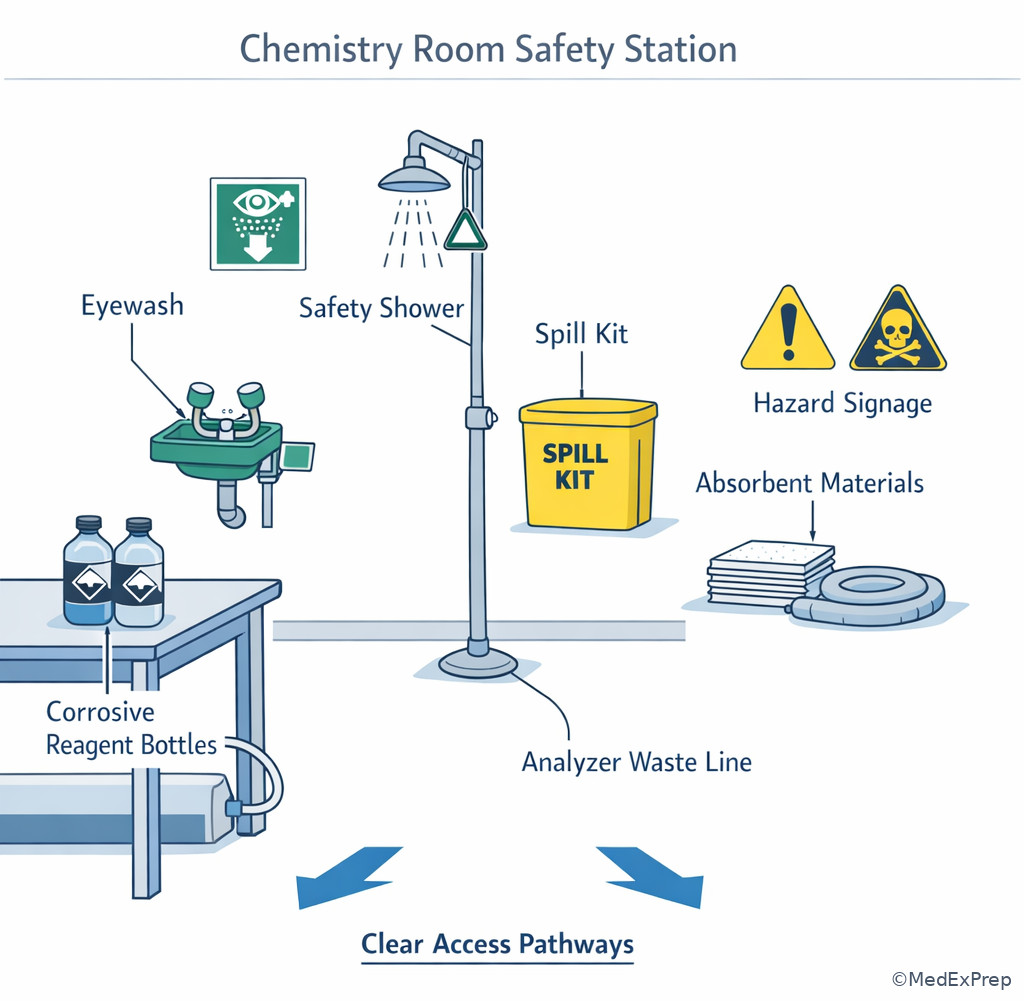
Eye exposure requires prompt eyewash use. Significant skin/clothing contamination may require shower or immediate flushing and contaminated clothing removal according to policy. If no one is exposed, then assess spill type, quantity, fumes, and training. A small spill of a known chemical that your SOP allows you to manage with the correct kit is very different from a large, volatile, unknown, or inhalation-risk spill. See Fig 5.
Key rule: Never delay flushing an exposed eye or skin surface in order to finish a run, preserve turnaround time, or collect paperwork first.
Memory anchor: “Flush first, facts second” for personal exposure. Once decontamination starts, then notify, document, and follow the SDS/SOP.
High-Yield Connection: This concept overlaps with Result Verification Workflow. Just as unsafe results are held for review, unsafe spills are held for policy-based response. In both cases, urgency does not justify bypassing the control process.
Exam takeaway: First decide whether a person is exposed; that single branch determines whether decontamination or area control comes first.
flowchart TD
A[Spill or splash occurs] --> B{Person exposed?}
B -- Yes --> C[Use eyewash or flush skin immediately]
C --> D[Remove contaminated clothing per SOP]
D --> E[Notify and document after decontamination begins]
B -- No --> F{Known, small, within training and kit?}
F -- Yes --> G[Use approved spill procedure]
F -- No --> H[Secure area and escalate]
G --> I[Document corrective action]
H --> I Exam takeaway: Recognizing immediate decontamination equipment in the chemistry laboratory supports the correct “flush first” response on exam stems.
B Worked example
A 34-year-old technologist with contact lenses and no prior chemical injury history is disconnecting analyzer cleaner tubing. She has hypertension and migraine history, which are irrelevant distractors. A small spray of alkaline cleaner contacts her cheek and left eye area. Another technologist says the spill on the floor is minor and should be wiped immediately before anyone slips. A QC lockout is active, and the line is due back in service within 10 minutes.
Reasoning chain: identify task → determine whether this is a person exposure or only an environmental spill. Extract key facts: eye-area exposure, chemical splash, coworker pressure to prioritize floor cleanup, workflow delay. Apply rule: person exposure takes precedence; immediate flushing is the correct next action. Eliminate distractors: cleaning the floor first delays decontamination; documenting first delays care; continuing maintenance is unsafe. Verify: start eyewash/flush according to SOP, then notify and manage the environmental spill under policy.
C Exam trap
Common wrong answer: “Clean the floor spill first to prevent secondary injury.”
Why it is tempting: preventing slips sounds broadly safety-oriented.
Single clue that eliminates it: the worker had eye-area chemical exposure; personal decontamination takes priority.
D Checkpoint
Question: A known corrosive reagent spills on the bench and floor. One worker has chemical splash to the forearm but no obvious burn yet. What is the most appropriate next laboratory action?
- A. Begin spill cleanup immediately because the floor hazard threatens the whole section.
- B. Flush the exposed skin promptly and follow exposure procedures before continuing spill management.
- C. Photograph the scene and save the reagent bottle for documentation before any response.
- D. Wait for the supervisor so the exposure duration can be documented accurately.
Answer: B
- A is tempting because area safety matters, but wrong because active personnel exposure comes first.
- B is correct because decontamination of exposed tissue is the priority action.
- C is tempting because documentation is required, but wrong because it cannot delay immediate safety response.
- D is tempting because supervision is important, but wrong because waiting prolongs exposure.
Practitioner Action: ASSESS whether any person is exposed and whether the spill is known, small, and within SOP; INTERVENE with immediate flushing or approved spill containment; REFER larger, volatile, unknown, or out-of-scope events to the supervisor/emergency response pathway; DOCUMENT exposure details, corrective action, and notifications after immediate safety steps are underway.
- The first branch in a spill question is: Was any person exposed?
- True or False: Documentation should begin before eyewash use in a splash to the eye. False.
- The single clue that upgrades a spill question to immediate decontamination is eye/skin contamination.
1.1.1.7 Integration at the bench: safe work habits, scope boundaries, and what not to improvise
A Explanation
Foundational safety knowledge becomes exam-ready only when you integrate it with real chemistry workflow. Many stems ask about analyzer cleaning, waste disposal, reagent transfer, specimen receipt, or bench organization. The tested conflict is often between “keeping the lab moving” and “staying inside policy.” The resolving rule is: if the action requires a safety judgment you cannot support with SOP, SDS, training, and authorized equipment, you stop and escalate.
WHY THIS IS TESTED: ASCP-style chemistry questions reward bench judgment. Candidates are expected to know when to repeat, hold, label, isolate, notify, or document — not to invent a workaround. Safety answers often mirror QC answers: the correct action is to avoid releasing or continuing work under uncontrolled conditions.
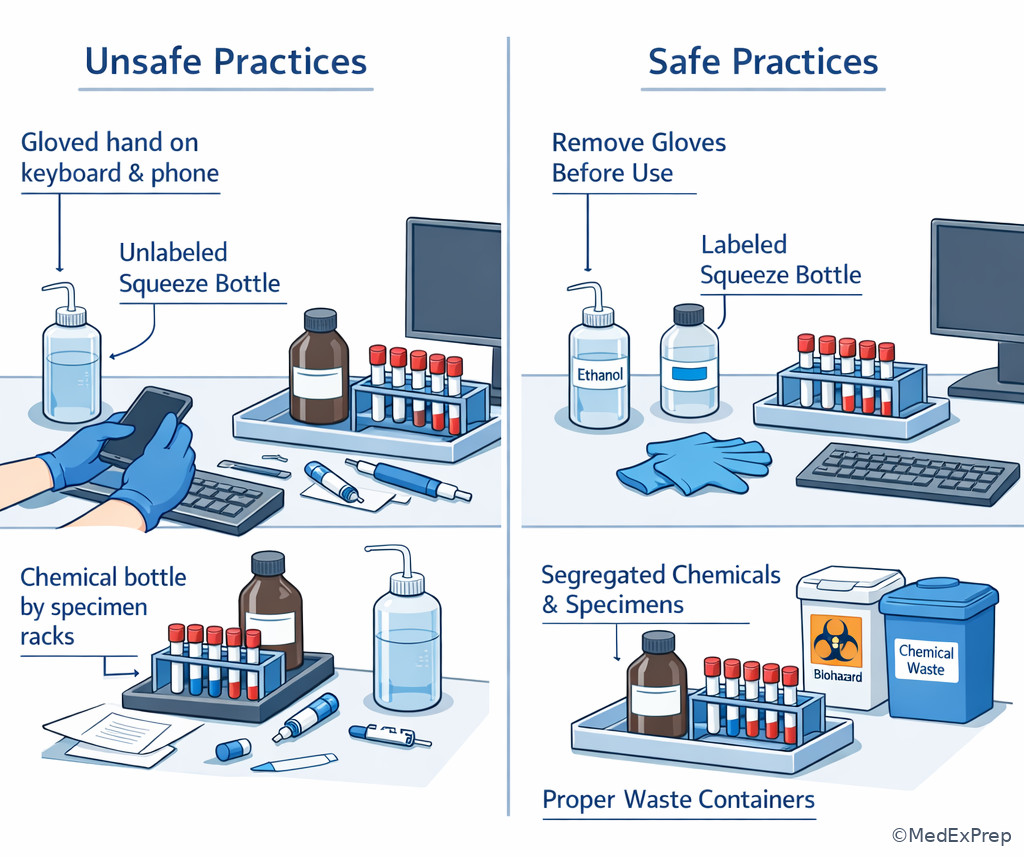
Examples of non-improvisable situations include: neutralizing an unknown spill without policy support; mixing wastes to “save containers”; reusing food containers for chemical storage; using household cleaning methods on laboratory chemicals; or deciding from memory that two agents are compatible. Likewise, PPE removal and hand hygiene matter after glove use; contaminated gloves touching keyboards, phones, and door handles create downstream exposure and contamination problems. See Fig 6.
High-Yield Connection: This section overlaps with QC Failure Troubleshooting and Autoverification And Manual Review. The cross-topic theme is control failure: when a process is no longer controlled, you hold the workflow and escalate rather than guessing.
Memory anchor: “STOP” — Stop the task, Trace the hazard source, Obey the SOP/SDS, Page or notify the appropriate person if outside scope.
Exam takeaway: The exam often tests ordinary workflow habits such as glove contamination, unlabeled transfers, and shortcut cleanup rather than dramatic accidents.
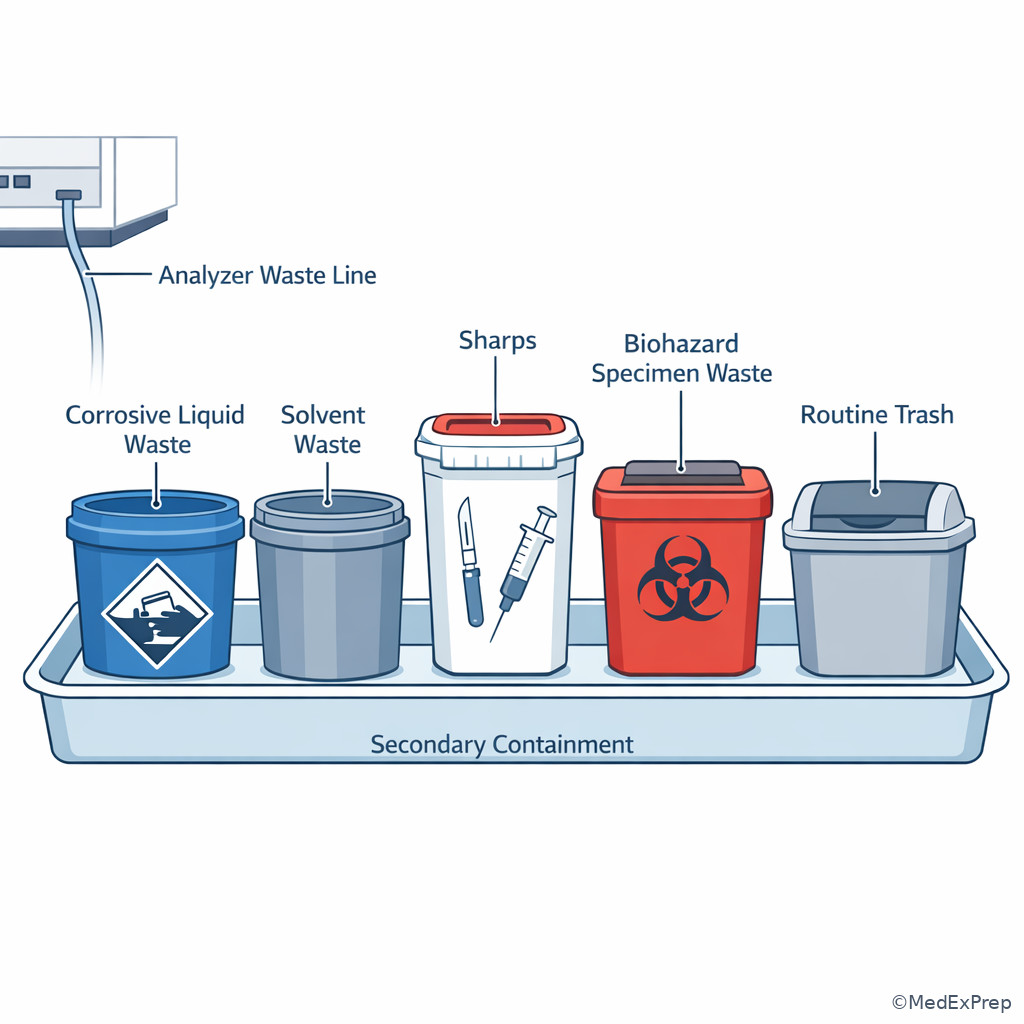
Exam takeaway: Waste handling is a safety-control step, so exam questions may test whether you avoid mixing or relabeling waste outside SOP.
B Worked example
A 41-year-old chemistry bench technologist is asked to help during a high-volume morning run. He has diabetes and mild hearing loss, which do not affect the decision. An analyzer waste bottle is nearly full, and a coworker suggests pouring some of it into another partially filled waste container “because both came from chemistry anyway.” Another distractor is that both containers appear clear and similar in color. The section also has a stat ammonia specimen waiting, increasing time pressure.
Reasoning chain: identify task → waste handling and possible mixing. Extract key facts: two different waste containers, assumption of equivalence, pressure to keep analyzer running, no policy confirmation. Apply rule: do not mix wastes or improvise disposal outside SOP because compatibility cannot be assumed from location or appearance. Eliminate distractors: “same department” does not mean chemically compatible; temporary bench storage does not fix the issue; relabeling after mixing is not a control. Verify: correct action is to follow the approved waste procedure and escalate if capacity or replacement container availability is a problem.
C Exam trap
Common wrong answer: “Combine the two waste containers because they came from the same analyzer section.”
Why it is tempting: the wastes seem operationally related and the action appears efficient.
Single clue that eliminates it: compatibility is not verified by origin or appearance; waste handling must follow approved segregation rules.
D Checkpoint
Question: Which laboratory action most clearly falls outside acceptable bench-level safety judgment and should be rejected unless specifically authorized by SOP?
- A. Stopping a task because the required chemical label is incomplete
- B. Consulting the SDS before using an unfamiliar cleaner
- C. Mixing two partially filled chemical waste containers to free space for analyzer operation
- D. Upgrading eye protection for a splash-prone maintenance step
Answer: C
- A is tempting as an overly cautious choice, but wrong because stopping for incomplete labeling is appropriate.
- B is tempting as time-consuming, but wrong because SDS consultation is a correct control step.
- C is correct because mixing waste without explicit policy authorization is unsafe improvisation.
- D is tempting because some may think it is excessive, but wrong because splash risk justifies upgraded protection.
Practitioner Action: ASSESS whether the unsafe condition is controlled by an existing SOP; INTERVENE only within training and approved procedure; REFER unresolved chemical, waste, or exposure issues to the supervisor/safety chain; DOCUMENT the hazard, actions taken, and handoff clearly for traceability.
Exam Traps & Differentiators
Common traps & distractors: Safety questions often tempt you with answers that sound efficient, experienced, or practical. Reject any option that depends on guessing chemical identity, delaying decontamination, or using convenience storage/disposal instead of approved procedure.
Most common wrong answer and why: “Handle it quickly and document later.” This is tempting because chemistry workflow is time-sensitive. It is wrong when the stem includes an exposure, unlabeled chemical, incompatible storage, missing PPE, or unsupported waste handling decision. The single exam clue is usually one red-flag word: unknown, splash, volatile, unlabeled, or mixed waste.
| Looks similar | But the correct interpretation is | Single discriminator |
|---|---|---|
| Small spill vs exposure event | Exposure event takes priority | Any eye/skin contamination means flush first |
| Routine bench PPE vs upgraded PPE | Upgrade for splash/vapor risk | Task includes pouring, waste change, or splash-prone maintenance |
| Known cleaner vs unknown transferred liquid | Unknown must be isolated | Incomplete or missing label |
| Safe hood use vs hood misuse | Hood is for active hazardous handling, not storage | Item is left in hood as “extra space” |
| Same-section waste vs compatible waste | Compatibility cannot be assumed | No SOP authorization to mix |
| Electronic SDS vs paper SDS | Either may be acceptable if accessible per policy | The issue is access and use, not binder format |
| If the stem says... | Think... |
|---|---|
| “partial handwritten label” | Unverified identity; do not use |
| “splash to eye” or “face” | Immediate eyewash/decontamination |
| “volatile odor” or “fumes” | Inhalation risk; ventilation and escalation may be primary |
| “stored in hood for convenience” | Improper storage practice |
| “both wastes are from chemistry” | Do not assume compatibility |
| “busy run” or “QC delay” | Noise; safety still governs the next action |
Related confusable pair from neighboring topics: In CLIA And Accreditation Basics, future questions may ask whether you can use a nonvalidated workaround to keep testing going. The trap is the same as here: convenience is never the deciding principle. In Result Confidentiality And Documentation, you will see a related trap where staff document informally rather than using approved traceable systems.
Algorithm / Approach
| Situation | Most appropriate first laboratory action | Avoid |
|---|---|---|
| Unknown liquid in reagent area | Isolate and identify through label/SDS/policy | Smelling or testing it informally |
| Eye splash from corrosive reagent | Immediate eyewash/decontamination | Documenting before flushing |
| Volatile solvent transfer | Use ventilation/hood plus correct PPE | Relying on gloves alone |
| Secondary container missing required label elements | Correct or remove from use | Leaving it for later because staff “know what it is” |
| Waste container nearly full | Use approved replacement/disposal pathway | Mixing with other waste containers |
| Spill exceeds training or SOP | Secure area and escalate | Improvised cleanup |
Rapid Review
- Unknown chemical → isolate first, identify before any handling
- Eye or skin exposure → decontamination outranks cleanup and paperwork
- Routine gloves → not enough for splash-prone corrosive transfer
- Volatile reagent task → engineering control beats PPE-only thinking
- Secondary container → must meet local labeling requirements before shared use
- Fume hood → active hazard control, not convenience storage
- Same-area wastes → not proof of compatibility
- Busy workflow → noise, not a reason to bypass safety steps
- Electronic SDS access → acceptable if available and usable per policy
- Unlabeled bottle with familiar appearance → still treated as unidentified
- Analyzer maintenance → often higher splash risk than routine specimen loading
- Gloved hands on keyboard/phone → contamination spread, not harmless efficiency
- Stop-and-escalate decision → correct when hazard exceeds SOP or training
- Corrosive vs flammable clue → determines whether splash control or ignition/vapor control leads
Self-check quiz
1. During morning chemistry setup, a technologist finds a squeeze bottle containing clear liquid with no label in the reagent prep area. A coworker states it is probably deionized water because that bottle shape is usually used for rinsing. What is the most appropriate next laboratory action?
- A. Use the liquid for rinsing because the bottle type suggests its contents
- B. Smell the liquid briefly to determine whether it is alcohol or acid
- C. Isolate the bottle and follow the SOP for unidentified chemicals
- D. Pour it into the sink with running water to remove the hazard
2. Which task most clearly requires eye protection beyond routine hand protection because of the highest likely exposure route?
- A. Scanning barcodes on capped chemistry tubes
- B. Pouring a concentrated alkaline cleaner into a secondary container
- C. Verifying patient demographics in the LIS
- D. Reviewing QC comments at the workstation
3. A 38-year-old chemistry technologist is replacing analyzer wash solution. He has asthma and eczema. While disconnecting tubing, a small amount of cleaner splashes onto his cheek and near one eye. A second technologist points out a puddle forming on the floor and says it should be wiped immediately to prevent slips. What is the most appropriate next laboratory action?
- A. Flush the exposed area immediately and then proceed through the exposure procedure
- B. Clean the floor spill first because it endangers more personnel
- C. Photograph the spill and exposure scene before beginning response
- D. Wait for the supervisor so the exact exposure time can be documented
4. A 52-year-old technologist preparing diluted acid descaler notices that the only available storage location is inside a fume hood beside solvent cleaner bottles. The secondary container has the chemical name but no preparation date or initials, although the analyzer is due back online in 15 minutes. Which action is most appropriate?
- A. Leave the container in the hood because hazardous chemicals are safest there
- B. Use the descaler now and correct the label at the end of shift
- C. Correct the labeling and storage issue before routine shared use continues
- D. Move the descaler next to any other clear cleaning solution to save space
5. A 27-year-old night-shift technologist finds two partially filled waste containers near the chemistry analyzer. One is from a solvent-containing method, and the other is from routine alkaline wash waste. Both are nearly clear in appearance. A coworker suggests combining them to avoid interrupting a stat run for a patient with renal failure and heart failure. What is the most appropriate next laboratory action?
- A. Combine them because both originated in the chemistry section
- B. Relabel both as mixed hazardous waste after combining
- C. Use the approved disposal/replacement pathway rather than mixing wastes
- D. Add water to one container to make room temporarily
6. A 44-year-old technologist wearing gloves and a lab coat is asked to transfer a volatile solvent reagent used in a specialty chemistry method. She also wears regular prescription glasses. The amount is small, and the transfer is expected to take less than a minute. The reagent bottle and SDS indicate inhalation and flammability concerns. Which is the most appropriate laboratory approach?
- A. Perform the transfer quickly at the open bench because the volume is small
- B. Use glove protection alone because eye and vapor exposure are unlikely in a short transfer
- C. Use the appropriate ventilation/hood and task-matched PPE before transfer
- D. Delay the transfer until patient testing is completed, then perform it with standard bench precautions
7. A 31-year-old new chemistry employee finds a bottle labeled “acid cleaner” on a low shelf in the reagent room. The manufacturer label is intact, but the bottle is stored beside oxidizer solution because the acid cabinet is full. The supervisor is in a meeting, and morning maintenance is behind schedule. Which action best reflects appropriate laboratory safety judgment?
- A. Leave the bottle in place until the supervisor returns because the label is complete
- B. Use the cleaner immediately since identity is known and storage can be corrected later
- C. Correct or escalate the incompatible storage issue before routine use proceeds
- D. Transfer some oxidizer to another shelf so the chemicals are no longer touching
8. A 36-year-old technologist with contact lenses is cleaning a chemistry bench after a small known spill of a caustic reagent that local SOP says trained staff may clean with the designated spill kit. During cleanup, she notices her contaminated gloves have touched the keyboard and barcode scanner. A stat ammonia sample and critical potassium repeat are waiting. What is the most appropriate next laboratory action?
- A. Continue testing because the contamination is limited to equipment surfaces, not patient specimens
- B. Remove contaminated gloves, perform hand hygiene as required, and decontaminate affected surfaces per policy
- C. Put a second pair of gloves over the first pair and finish the pending stat work
- D. Ignore the surface contamination because the original spill was already controlled
Answer key
1. Correct answer: C
- A: Tempting because bottle type and routine use patterns can feel familiar. Incorrect for this scenario because container appearance is not chemical identification. The single stem clue is no label.
- B: Tempting because it appears to gather quick information. Incorrect because smell is not an acceptable identification method for unknown chemicals. The discriminating clue is unidentified liquid in reagent prep area.
- C: Correct because an unlabeled container must be isolated and handled by policy for unidentified chemicals, not used or guessed about. The key clue is unlabeled.
- D: Tempting because disposal sounds protective. Incorrect because disposal route depends on identity and hazard class, which are not known. The clue is contents are unknown.
Source: Clinical and Laboratory Standards Institute safety guidance; OSHA Hazard Communication requirements.
2. Correct answer: B
- A: Tempting because specimen handling still involves biohazard awareness. Incorrect because the question asks for the task with the clearest need to upgrade due to exposure route; capped tube scanning does not create the same splash hazard. The clue is capped.
- B: Correct because concentrated alkaline pouring is a splash-prone corrosive transfer, making eye protection essential. The clue is pouring concentrated cleaner.
- C: Tempting because it occurs in the lab area. Incorrect because LIS review does not itself create direct chemical splash exposure. The clue is verification task.
- D: Tempting because it occurs near active instruments. Incorrect because workstation review is not the highest-risk exposure route among the options. The clue is workstation review.
Source: McPherson and Pincus, Henry's Clinical Diagnosis and Management by Laboratory Methods; OSHA laboratory safety principles.
3. Correct answer: A
- A: Correct because chemical exposure to the face/near eye requires immediate flushing and exposure response before floor cleanup. The single discriminating clue is splashes onto his cheek and near one eye.
- B: Tempting because secondary injuries from slips matter. Incorrect here because personnel decontamination takes priority over environmental cleanup. The clue is active exposure.
- C: Tempting because documentation may be needed for incident review. Incorrect because photography cannot delay immediate safety action. The clue is most appropriate next action after exposure.
- D: Tempting because supervisor notification is part of policy. Incorrect because waiting extends exposure time. The clue is chemical contact already occurred.
Source: OSHA emergency eyewash/shower principles; CLSI laboratory safety standards.
4. Correct answer: C
- A: Tempting because hoods are associated with hazardous chemicals. Incorrect because a fume hood is not routine convenience storage. The clue is only available storage location is inside a fume hood.
- B: Tempting because the analyzer schedule creates time pressure. Incorrect because incomplete labeling means the secondary container is not ready for routine shared use. The clue is no preparation date or initials under local requirements.
- C: Correct because both the labeling deficiency and the storage issue require correction before normal use continues. The discriminator is combined labeling plus improper storage concerns.
- D: Tempting because it appears organized. Incorrect because storage must be based on compatibility, not appearance. The clue is clear cleaning solution is not a hazard class.
Source: OSHA Hazard Communication Standard; laboratory chemical hygiene and storage guidance.
5. Correct answer: C
- A: Tempting because both wastes came from chemistry operations. Incorrect because shared origin does not prove chemical compatibility. The clue is solvent-containing method versus alkaline wash waste.
- B: Tempting because relabeling sounds like control. Incorrect because relabeling after unauthorized mixing does not reverse the unsafe act. The clue is suggests combining them first.
- C: Correct because approved waste replacement/disposal pathways must be used instead of improvised mixing. The discriminator is no policy confirmation of compatibility.
- D: Tempting because dilution seems to lower danger. Incorrect because adding water changes composition and may be inappropriate or hazardous. The clue is temporary room-making is not SOP disposal.
Source: Standard laboratory hazardous waste handling guidance; institutional chemical waste segregation policies based on hazard compatibility.
6. Correct answer: C
- A: Tempting because the quantity is small and the task is brief. Incorrect because inhalation and flammability risks are determined by hazard properties, not only duration. The clue is SDS indicates inhalation and flammability concerns.
- B: Tempting because gloves are often the most visible PPE item. Incorrect because gloves alone do not control vapor exposure or necessarily protect eyes adequately. The clue is volatile solvent reagent.
- C: Correct because hazardous vapor and fire risk call for proper ventilation/hood plus task-matched PPE before transfer. The key discriminator is inhalation and flammability concerns on the SDS.
- D: Tempting because delaying the task may seem safer operationally. Incorrect because postponement without changing controls does not solve the hazard. The clue is standard bench precautions remain insufficient.
Source: OSHA laboratory safety principles; chemical hygiene plan standards for volatile hazardous reagents.
7. Correct answer: C
- A: Tempting because the manufacturer label is complete and the supervisor is unavailable. Incorrect because incompatible storage is itself a safety problem that should not simply wait through routine operations. The clue is stored beside oxidizer solution.
- B: Tempting because identity is known and maintenance is behind. Incorrect because known identity does not excuse incompatible storage conditions. The clue is acid cabinet is full leading to convenience placement.
- C: Correct because incompatible storage must be corrected or escalated before routine use proceeds. The key discriminator is acid cleaner stored beside oxidizer.
- D: Tempting because it appears to create separation quickly. Incorrect because ad hoc relocation of chemicals without approved storage planning may create a new hazard. The clue is no validated storage solution is described.
Source: Chemical compatibility storage guidance in laboratory safety standards; OSHA hazard communication and chemical hygiene principles.
8. Correct answer: B
- A: Tempting because the pending stat samples create urgency and the contamination is on equipment, not specimens. Incorrect because contaminated gloves and touched surfaces can spread hazardous residue and violate safe workflow. The clue is contaminated gloves have touched the keyboard and barcode scanner.
- B: Correct because glove removal, hand hygiene, and decontamination of contacted surfaces are required to stop contamination spread. The discriminator is surface contamination from contaminated gloves.
- C: Tempting because double-gloving sounds more protective. Incorrect because covering contaminated gloves does not correct contaminated surfaces or proper glove removal practice. The clue is existing contamination has already spread.
- D: Tempting because the initial spill itself is under control. Incorrect because secondary contamination of shared equipment remains an active safety issue. The clue is keyboard and scanner contact.
Source: CLSI laboratory safety practice guidance; standard infection prevention and chemical contamination control principles for laboratory work areas.
Keep going with the full ASCP Chemistry Prep Course (C/SC)
You just studied the way members do, in the same lesson interface. Full access unlocks every lesson, the question bank and flashcards for a full year.
One payment · 1 year of access · No auto-renewal